Get Premium
Dark mode theme is available exclusively for premium users. Learn more about the benefits of subscribing.
No fees, cancel anytime.

 Dark Mode Ad-Free Browsing Unlimited Content
 Ad-Free Browsing Unlimited Content Dark Mode
Join 1.2 million Panda readers who get the best art, memes, and fun stories every week!

The argument always seems to start over something small: a tone of voice, an unwashed dish, a comment that lands wrong.
Ten minutes later, you are saying things you do not mean to the people you love most. Conflict between family members is unavoidable, but the damage it leaves behind is not. The difference comes down to how you handle the heated moment.
Ignoring problems has never fixed anything, and the same goes for interpersonal conflicts. While unresolved conflicts can cost businesses in the US about $359 billion every year, according to HRSpotlight, these conflicts cost families something even harder to quantify.
If you try to avoid conflict rather than learn effective methods of resolving it, the trust, stability, and sense of home that bind your family are at risk.
The whole point of conflict resolution strategies is to face the problem head-on in a way that helps the family grow and communicate better.
Instead of building resentment by bottling up feelings or distancing from each other, that moment of disagreement becomes an opportunity to learn.
To move from fighting to understanding, you have to shift from trying to win the argument to managing difficult conversations in a way that ensures all parties feel heard and respected.
The more everyone feels validated when emotions are high, the easier it is to settle amicably.
Image credits: skynesher / Getty Images
Conflict is essentially a clash of perspectives between the involved parties, but how they choose to manage and respond to it determines the outcome.
The most important factor in determining whether a conflict ends as a productive conversation or a dispute is the language used to communicate.
Healthy conflict keeps attention fixed on the problem at hand rather than on the people involved.
Arguing healthily means sharing your thoughts, feelings, evidence, and differing opinions without destructive criticism or personal insults.
In healthy conflict, the conversation is aimed at managing and resolving things, so the result is ultimately productive.
Stays focused on the problem
Uses thoughts, feelings, and evidence
Aims to find a solution together
Everyone gets heard, no interruptions
Ends in resolution and stronger trust
Attacks the person
Uses insults, blame, and “you always” statements
Aims to win and make the other person lose
Mockery, dismissals, talking over
Ends in escalation and festering resentment
When family members disagree in a healthy way on core topics, they can still recognize and respect that each differing perspective contributes to the issue.
Instead of viewing every contrary opinion as an attack, try to understand where the other person is coming from, so you see it as a different point of view that can help you better understand the situation.
In healthy conflict management, skip the personal jabs or mockery, even when challenging perspectives that seem ridiculous to you.
The atmosphere of the discussion should stay safe for everyone, so they have the chance to speak and be heard without interruptions or dismissals.
As a dispute resolution professor at the University of Utah College of Law explains, a productive conflict begins with both parties letting go of their fear of “losing” in the disagreement.
Understand that it’s an avenue to work with your family member to find a solution, not a win-or-lose situation.
Image credits: katemangostar / Magnific
If you’re trying so hard to defeat the other person, you shift the target of conflict resolution to attacking them so you can win, and that’s a slippery slope to ending up with a destructive conflict.
Soon, there’s intense tension; the dispute escalates over even the simplest things. You ruin any chance of solving the problem, and you could even damage your relationship.
Statements like “You never wash your dishes after eating” or “You are being very selfish” are examples of the wrong approach to managing and resolving conflict.
These sorts of statements point fingers at the other person rather than addressing the problem.
They’re absolute and accusatory, and they don’t leave any room for them to explain. The other person is likely to get defensive, and it intensifies feelings very quickly from disagreement to anger and hostility. If you don’t resolve the conflict, their hurt feelings will last even longer.
To highlight the importance of effective conflict resolution in the family, a 2019 paper published in the American Psychological Association Journal discusses the ripple effects of destructive conflict on the children.
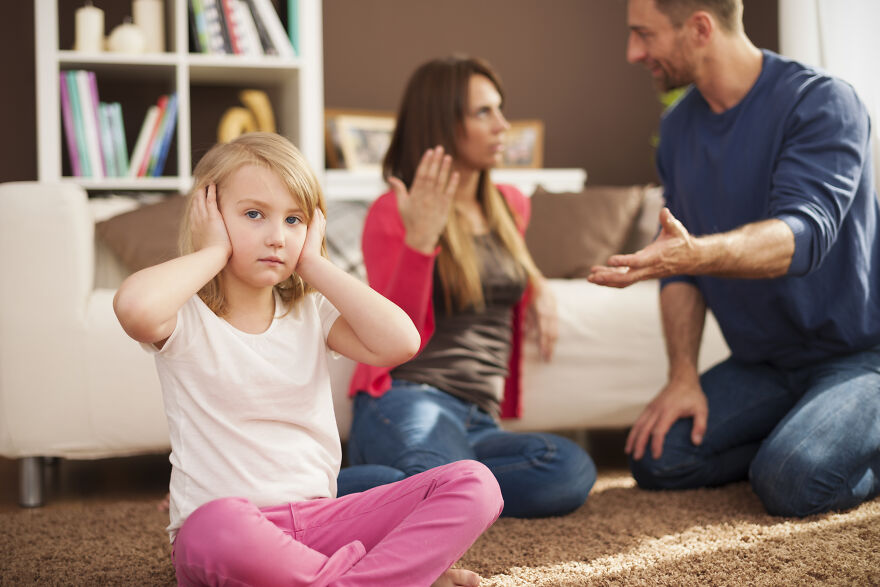
The way parents respond to conflict is more strongly linked to children’s psychological outcomes than whether they disagree at all.
Disagreeing in private and presenting a united front gives children a safe emotional space and a working model of healthy conflict resolution at home.
Image credits: gpointstudio / Magnific
The key to steering a disagreement away from a toxic discussion to healthy de-escalation is communication and emotional awareness. Your body language, choice of words, and manner of speaking are all important factors in your approach to conflict.
And in the end, the same conflict resolution skills that help you de-escalate disagreements will come in handy during workplace conflicts, where unresolved disputes can affect productivity and teamwork.
An effective way to let things cool off in a disagreement is to take a break from the conversation as soon as it starts to get heated.
Family conflicts involve strong emotions, so once there’s yelling, crying, or any physical threats, forget about getting through to the other person and take a step back.
If you don’t, what follows may be a series of insults and hurtful words, making conflict resolution more difficult.
Crying, shouting, and shaking are some of the brain’s natural responses to intense distress, and according to an article by psychosocial rehabilitation specialist Kendra Cherry via Verywell Mind, these responses reduce your chances of making good decisions at the time.
This is because the prefrontal cortex, the part of the brain responsible for rational thinking, becomes less active as a person becomes more distressed, making you more prone to giving emotional responses instead.
A simple “I want to resolve this, but I’m too upset right now. Can we talk in 30 minutes?” immediately slams the brakes on intensifying conflict.
Make sure to state your willingness to return to the conversation after the time-out; otherwise, you might come across as avoidant and trigger another wave of reactions.
In disagreements, it helps when one or both parties use words that label exactly how they feel about the problem at hand.
This communication technique, called “I-statements”, helps you avoid accusing or criticizing the other person.
When you’re focused on communicating your feelings with emotional intelligence, the conversation is free of blame and threats, and the conflict stays constructive.
Avoid making direct statements like “You make me so mad when you don’t listen to me.” This sounds accusatory and can make the other party feel cornered.
To reduce tension, use statements that describe your emotional state rather than their behavior. In this example, “I feel ignored when you don’t pay attention to me” might work better.
In an article with The Counseling Hub, professional counselor Dr. Tara Vossenkemper explains that to effectively use I-statements, you should conclude them with a statement of something positive that you want from the other party.
Saying “I’d appreciate it if you didn’t use your phone while we’re talking” specifically informs the person of what change in behavior you would prefer from them.
That way, you can eliminate the need for the other person’s defense and reduce any tension previously surrounding the conflict.
Any intentional effort to listen to and understand what the other person is saying is a constructive way to manage conflict.
Active listening involves concentrating, understanding, recalling, and responding appropriately to the person’s statements. When people feel heard, hot heads cool down, and the intensity of the conversation decreases, allowing for rationality.
Besides listening, it also helps to occasionally repeat or summarize what is said to confirm that they are well understood.
This communication skill shows empathy even when there is disagreement, respects the other person’s opinions, and is simply polite in discussions.
Ultimately, this leads to a productive conflict and sometimes, even a negotiated agreement between the parties involved.
Constantly keep in mind that the conflict is about the situation, not the person involved. Resist the urge to make any statements that criticize their character, even when things get heated, to avoid hurtful exchanges.
Keeping the problem separate from the people helps the family work against the situation rather than against each other.
Finally, in a healthy family unit, conflict is resolved only when a solution that satisfies both parties is reached. When one person has to compromise and submit to the other to maintain peace in the home, that is not a win-win.
When people enter a disagreement with the mindset of not letting it go until someone “loses” and they “win”, the conflict festers and becomes toxic.
Resolving conflicts this way also sets a template for any future disagreements to be resolved amicably.
For long-term success, it also helps the relationship grow constructively over time as people learn to accommodate one another, whether the tension is between partners or rooted in ongoing sibling rivalry.
You don’t live with the same people every day for your entire life without having a few disagreements with them.
Regardless of blood relationship, every individual in the family has a unique personality, making conflict a regular occurrence.
Conflict is a normal part of family life and is caused by a number of factors in homes around the world.
According to the Cambridge Family Enterprise Group, all of these factors can be traced to a common root: disrespect between the two parties.
Image credits: Drazen Zigic / Magnific
Most family conflict traces back to a handful of recurring triggers:
The suppressed tensions can easily spark disagreements at home and, if left unaddressed, will continue to worsen.
According to research by the Gottman Institute, CNBC states that roughly 69% of relationship conflicts never fully go away.
If not resolved or de-escalated immediately, family conflict may fester for years and deepen mistrust among family members.
The way a family handles conflict does not stay in childhood. Kids who grow up watching disagreements turn into yelling, stonewalling, or contempt tend to carry that blueprint into adulthood, and it quietly shapes how they handle stress, trust, and closeness for years.
Some become conflict-avoidant, going silent or agreeing to anything just to keep the peace, because raised voices once meant danger.
Others swing the opposite way and escalate fast, reading neutral comments as attacks because that is what disagreement always looked like at home.
Many describe a low-level hypervigilance, a habit of scanning the room for tension that never fully switches off.
These patterns carry over into people’s relationships and parenting.
Adults who never saw conflict actually repaired often do not know how to apologize, sit with discomfort, or return to a hard conversation once tempers have cooled, so the same ruptures recur in the next generation.
The encouraging part is that none of this is permanent. Recognizing the pattern you inherited is the first step to choosing a different one, and the de-escalation skills above can be learned at any age.
Every strategy above assumes both people actually want a resolution. With a narcissistic parent or sibling, that assumption breaks down because the goal is control, not compromise.
I-statements get twisted, time-outs get treated as punishment, and every conversation loops back to their version of events.
In these families, one person is often cast as the scapegoat who absorbs the blame while another becomes the favored golden child, and recognizing that pattern matters far more than perfecting your phrasing.
When you are dealing with this, the aim shifts from winning the argument to protecting your own peace.
Conflict resolution depends on both parties being willing to listen to each other, reflect, and adjust accordingly.
While people can learn how to resolve conflicts, sometimes, it gets to a point where logical de-escalation doesn’t suffice.
Especially when the environment is hostile, or the other party refuses to be calm, disagreements cannot be hashed out by simply talking them out.
In a conflict that involves emotional or physical abuse, you need to move from resolution to protecting personal safety and well-being.
Manipulation and hostility are signs of chronic toxicity in the family. Patterns like persistent gaslighting are not disagreements you can talk your way out of, and continuing to engage when the alarm bells are ringing only exposes you to further harm.
In a situation like this, you need a neutral third party to mediate. This could be any skilled person you respect, but preferably get a professional counselor or therapist who can create a safe environment, facilitate productive conversations, and skilfully guide you to a solution.
This is not the same as getting an arbitrator to simply hear both parties and issue a final “judgment.”
A mediator will help you both grow and use your free will to settle matters.
It is easy to assume these situations only happen to other families until you see how often one unresolved moment snowballs. In one widely shared account, a single insult at a family photo shoot, where an in-law called the children “the misfits,” hardened into a decade-long estrangement because no one was willing to address it and move on.
It is a textbook example of the festering this article warns about: the original argument was small, but the refusal to repair it was not.
Other readers have shared the everyday triggers that build up over time, from money and messy rooms to old grudges that resurface at every holiday.
A collection of real family drama gathered dozens of these stories, and the through-line matches the experts’ advice: communicate before assumptions take over, and address the issue while it is still small.
These stories are not here to scare anyone away from their own family. They are a reminder that the difference between a passing argument and a permanent rift is almost always whether someone chose to repair it.
Resolving a single argument is not the same as healing the relationship underneath it. After the heat dies down, repair is what actually rebuilds trust, and according to the Greater Good Science Center at UC Berkeley, it is the repair after conflict, not the absence of conflict, that keeps a family close.
The goal is not a household that never fights. It is one that knows how to come back together afterward.
Repair usually starts with a genuine acknowledgment. Naming your part in what happened, without a “but” attached, signals that the relationship matters more to you than being right.
From there, small, consistent actions rebuild safety faster than a single grand apology: following through on what you promised, staying calm the next time the topic comes up, and showing the other person that raising an issue will not blow up in their face.
For deeper or long-standing rifts, patience matters more than speed.
As HelpGuide notes in its guidance on difficult family relationships, mending a serious rift takes self-reflection and a willingness from both sides to engage without blame, which usually means understanding the root of the conflict instead of relitigating who was right.
When the same fights keep returning, no matter how carefully you handle them, a family therapist can provide everyone with a neutral space to be heard and practical tools for communicating. Reaching out for that help is a sign of commitment to the relationship, not a failure.
Healthy, productive conflict is more of an advantage in the family than a chance to prove how well you can win a debate.
It is a chance to better understand your family’s opinions and learn to cohabit more peacefully.
So whenever you disagree, remember that conflict itself is not a failure of the love you share; you just need to handle it with respect and reach an agreement.
Ultimately, healthy conflict resolution helps to build better communication, trust, and love in the family.

By entering your email and clicking Subscribe, you're agreeing to let us send you customized marketing messages about us and our advertising partners. You are also agreeing to our Privacy Policy.
Thank you! You've successfully subscribed to newsletters!

































 No fees, cancel anytime









23
0