Get Premium
Dark mode theme is available exclusively for premium users. Learn more about the benefits of subscribing.
No fees, cancel anytime.

 Dark Mode Ad-Free Browsing Unlimited Content
 Ad-Free Browsing Unlimited Content Dark Mode
Join 1.2 million Panda readers who get the best art, memes, and fun stories every week!
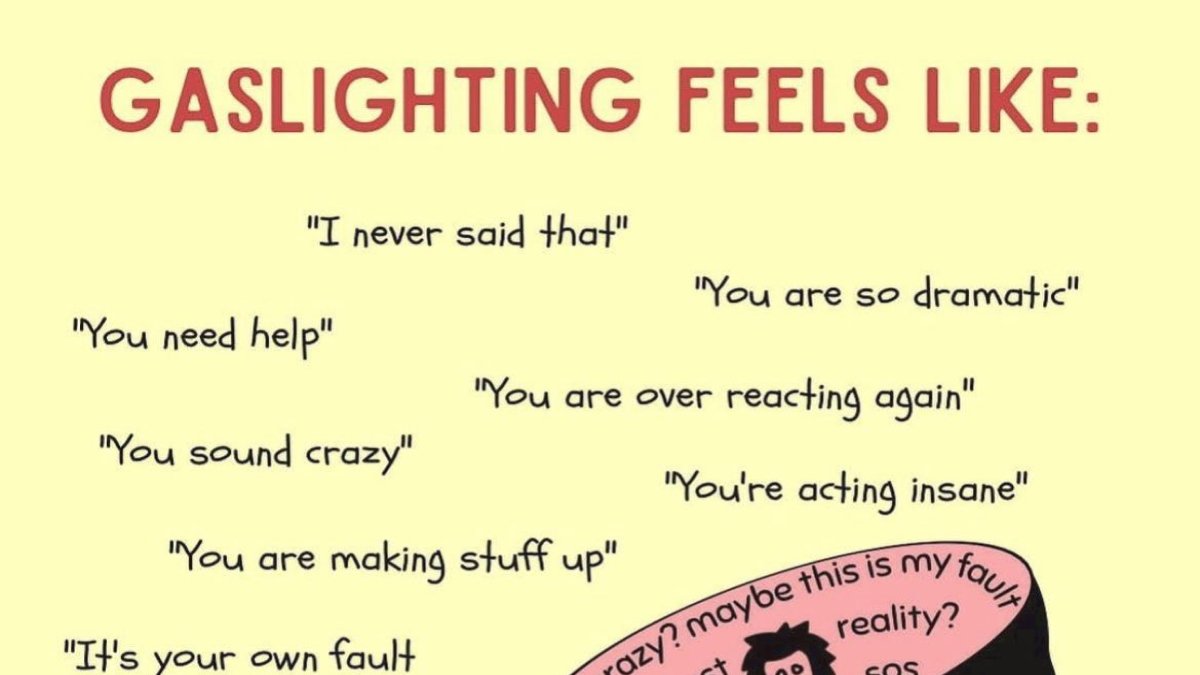
It’s a word we hear all the time online, but gaslighting is a very real and very devastating form of manipulation that affects many people’s lives.
Here, we’ll deep-dive into what it is, warning signs and behaviors to watch out for, and how to protect your peace and self-esteem.
Gaslighting is a form of emotional abuse in which one person deliberately causes another to doubt their own perceptions, question their sanity, and lose their sense of identity.
Over time, the victim’s memory of events becomes distorted, and they may end up relying on the perpetrator’s account. Often, this is what the perpetrator wants.
Per Psychology Today, manipulative individuals gaslight others to gain control of them, and they do it by initially building trust, then slowly chipping away at their self-worth and happiness until they become wholly dependent on the gaslighter.
While gaslighting can occur in the workplace, in friendships, and in romantic relationships, the most painful and destabilizing form often happens within families.
Image credits: trauma.mentalhealth.report / Instagram
From childhood, we’re conditioned to trust our parents, siblings, and other close relatives as reliable sources of truth and empathy.
When those same people begin manipulating our memories and perceptions via gaslighting tactics and reframing events to gain power in the relationship, the psychological impact can be profound. You’re left questioning if you should trust your own memory or the people who raised you.
Many people who experience gaslighting describe a slow erosion of confidence in their own thoughts and feelings. It rarely begins with blatant manipulation because that makes it harder to hoodwink the victim.
Instead, it starts subtly: small dismissals, minor contradictions, casual remarks designed to make you feel confused. The manipulator may declare things where there is plenty of evidence to the contrary, minimize your feelings, or imply that you’re overreacting.
Eventually, the person being gaslit may begin to question reality and cling to the gaslighter’s version, all while feeling anxious and emotionally exhausted during interactions.
They might replay conversations in their head, wondering if they did say things they’re sure they never said, or if they completely misunderstood a situation.
Per ASA research on domestic abuse and gaslighting, they feel “crazy”, which leaves them vulnerable to further manipulation and domestic or familial abuse.
Image credits: r/classicfilms
Gaslighting is not a simple disagreement or conflict; it’s the key to imbalancing intimate relationships. It is the mechanism that keeps assigned family roles locked in place. The moment a child tries to step out of the role, their perception is denied.
Healthy relationships leave space for open dialogue, differing opinions, and respectful debate, whereas gaslighting systematically undermines one partner’s position until their version of reality becomes the submissive one.
Understanding what gaslighting is and recognizing when it is happening to you are the first big steps toward protecting yourself from its damaging effects.
Gaslighting follows recognizable patterns that crop up in toxic relationships. While every situation is unique, the behavior often involves specific tactics designed to destabilize your sense of reality and shift control of the narrative.
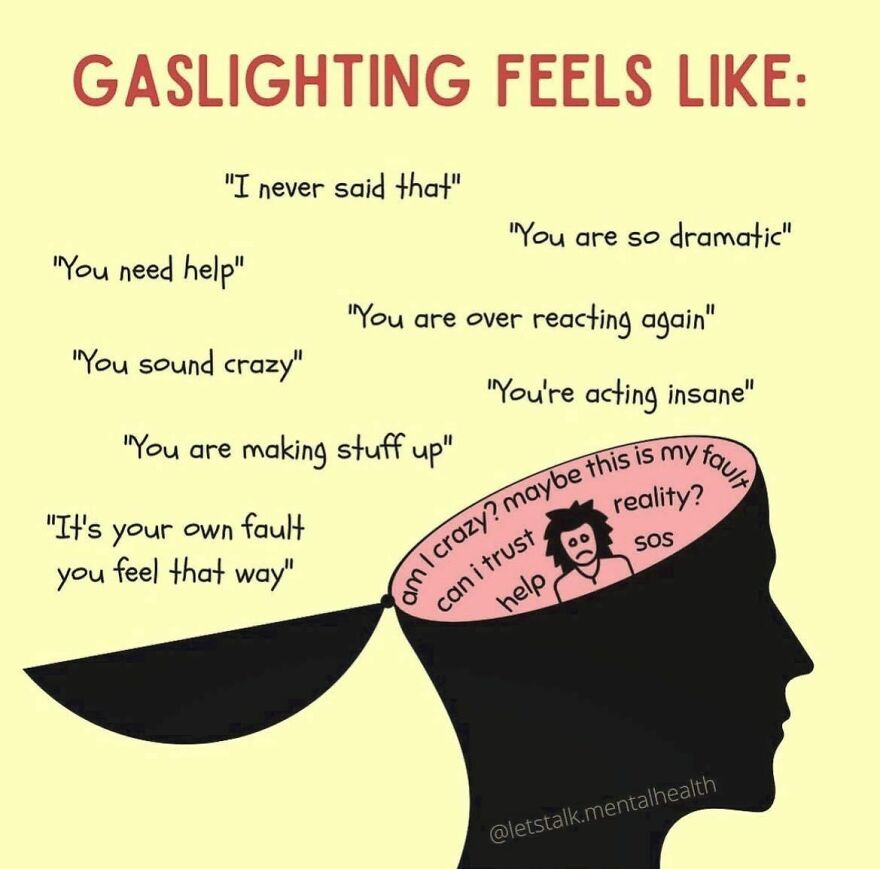
The most common signs include:
These behaviors are rarely isolated incidents. Gaslighting becomes harmful when these tactics are repeated over time because the repetition slowly weakens your trust in your own memory and judgment.
According to the National Domestic Violence Hotline, you may find yourself withholding information, lying to avoid being put down, struggling with decisions, or apologizing when you’re not in the wrong.
Image credits: r/Manipulation
One of the most telling red flags that this is happening is how you feel after interacting with the gaslighter. People who are being gaslit often report feeling confused, second-guessing themselves, or mentally drained after conversations.
You may leave an interaction feeling like the discussion turned against you and made you out to be the crazy one, even if you raised a legitimate concern.
Another warning sign is the constant need to defend your version of events. Instead of discussing the actual issue, you find yourself trying to prove that something happened at all.
When reality itself becomes the subject of debate, it is often a sign of manipulation. If other people become involved and the gaslighter also gets them on their side, the situation has spiraled beyond your control.
Recognizing these signs of gaslighting is the first step towards freedom. Once you see the tactics clearly, you stop seeing the gaslighter as someone who cares about you or someone you’ve wronged, and you see them for what they truly are: a manipulative individual.
Breaking free of this psychological manipulation technique makes it harder for them to continue dominating your perception and that of others, too.
Gaslighting within families carries unique psychological weight because it occurs within relationships that are supposed to provide safety, support, and belonging.
When manipulation comes from family members, it often feels less like a disagreement and more like an attack on your identity.
Two dynamics are especially common for gaslighters in family environments.
Image credits: loudquietly / Reddit
Families often create a collective narrative about their past. Stories about childhood, family struggles, or significant events become part of a shared identity. Gaslighting can occur when someone deliberately rewrites these narratives to control how events are remembered.
People who engage in gaslighting might say things like:
“You were always a difficult child.”
“You’re remembering that wrong.”
“That’s not how it happened.”
Because multiple family members may repeat the same version of events, the pressure to conform to that narrative can be overwhelming.
The individual who remembers things differently may begin to question whether their memory is flawed, especially if family members team up against them and treat them like the black sheep for insisting on the truth.
In some cases, the rewritten narrative serves to protect someone’s reputation or avoid accountability.
According to Psychology Today’s breakdown of family gaslighting types, this is a common form of gaslighting carried out to preserve the “picture-perfect” family image, and it places people in the “double-bind” of questioning whether they’re loved or rejected by the unit.
Gaslighting victims experience long-term psychological damage, especially if the “shared reality” manipulation continues into adulthood.
For example, if a parent behaved unfairly years ago but continues to refuse to take responsibility for decades, the child has no opportunity for proper closure and may always assume they’re remembering it wrong. The tension between your memory and the collective story can be deeply unsettling.
Image credits: NoEfficiency9 / Reddit
Another powerful form of family gaslighting relies on guilt and obligation. Family relationships often come with strong expectations of loyalty, and when these expectations are weaponized, they silence legitimate concerns. The manipulator may frame any disagreement as a betrayal.
Examples of this type of gaslighting include:
“After everything we’ve done for you…”
“Families should stick together.”
“You’re tearing this family apart.”
This tactic pressures you to accept their version of events to preserve harmony, making you feel that questioning them is selfish or disloyal.
For many people, this creates an impossible choice: maintain your own reality or question your sanity for the sake of family peace. Most choose the latter because the fear of being rejected by family can be very powerful.
The result is that they may remain silent about manipulation for years and find it impossible to learn to trust anybody else.
They may convince themselves that confronting the behavior isn’t worth the conflict, even as the emotional cost continues to build. Understanding how damaging this dynamic is explains why family gaslighting is so difficult to challenge.
Knowing how to tell if someone is gaslighting you is important, but the next challenge is deciding how to respond. When someone repeatedly manipulates reality, traditional approaches like logical debate or emotional appeals rarely work.
Gaslighting is not about resolving disagreements; it’s about maintaining control.
Instead of trying to win the argument, the goal becomes protecting your mental clarity and emotional boundaries.
One of the most exhausting effects of gaslighting is trying to prove your version of events. You may find yourself repeating details, pointing out inconsistencies, or trying to make the other person understand your perspective.
Unfortunately, this rarely works because the gaslighter will not allow it and may keep changing the subject.
While closure is good, it can be just as effective to free yourself from the cycle without the gaslighter’s approval. You don’t have to convince somebody who is committed to misunderstanding you.
Sometimes the healthiest response is simply to refuse to participate in the argument anymore.
The primary impact of gaslighting is a scrambled memory, so you must hold onto your own perception of reality.
Choosing to keep a record doesn’t mean obsessively cataloging every conversation; it means writing down important dates, interactions, and incidents that you know may be denied or distorted later on.
A simple journal entry may include:
Over time, this record can become a valuable anchor when self-doubt begins to creep in, giving you a tangible timeline to follow to prove you’re not losing your mind.
Documentation also helps shift the focus from emotional confusion to factual observation. Instead of asking yourself, “Am I overreacting?”, you can look at a series of events and evaluate them more objectively.
Gaslighting is a psychological manipulation tactic, and the longer the abuser has access to you, the more vulnerable you are to long-term mental health consequences.
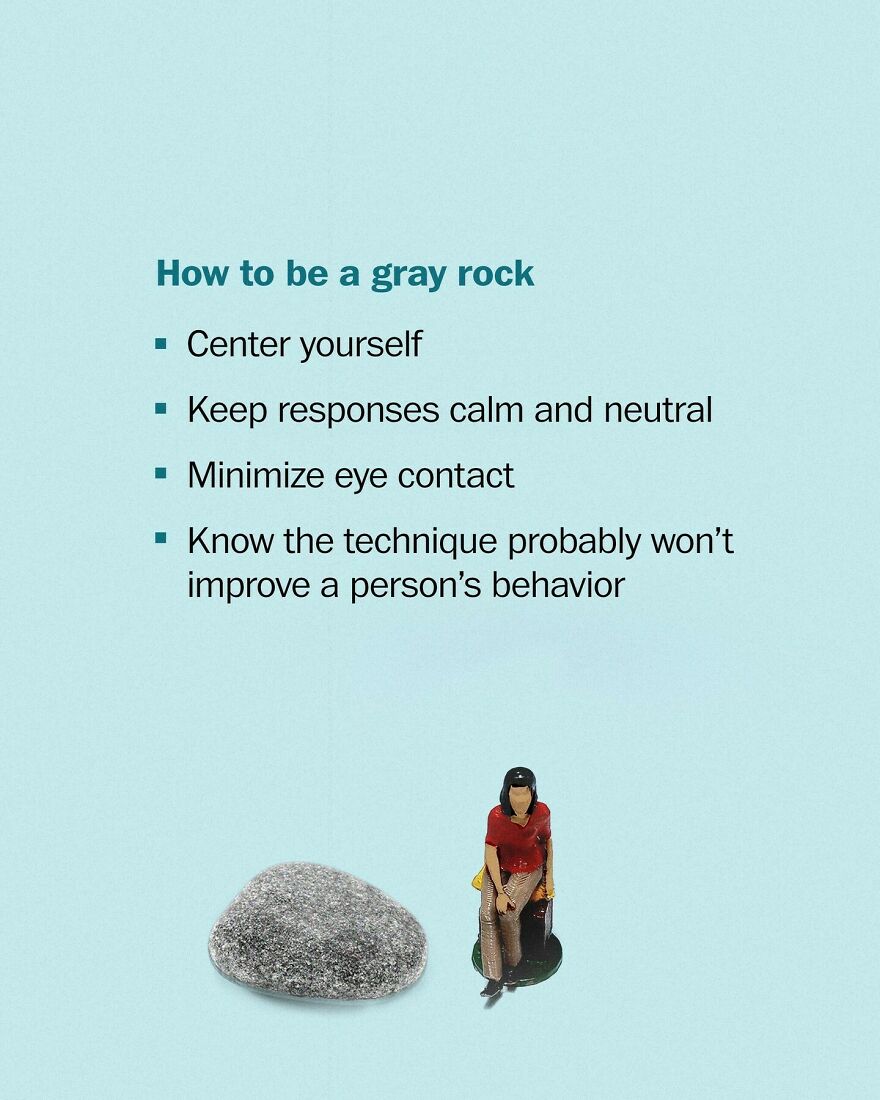
The “grey rock” method is one way to encourage the gaslighter to lose interest in you, and, per Psych Central’s guide to the grey rock method, the key is refusing to give them a reaction. If there is no longer a “thrill” for the gaslighter, they may start to leave you alone.
Image credits: washingtonpost / Instagram
Gaslighters feed off of emotional displays because they reinforce their sense of control over the interaction.
By responding minimally and neutrally, you remove the emotional fuel that keeps that dynamic going.
Typical grey rock responses might include:
“I see.”
“That’s interesting.”
“Okay.”
“If you say so.”
These responses neither argue nor agree. They simply acknowledge the statement without providing the emotional engagement the gaslighter is seeking.
Over time, some manipulators lose interest when their tactics seemingly become ineffective.
Perhaps the most important strategy after grey rocking is recognizing that you don’t have to remain in a conversation that is abusive, cruel, or manipulative.
Many people feel obligated to continue arguing until the issue is solved, especially with spouses, friends, or family, but gaslighting conversations rarely reach a satisfying conclusion.
Instead, it can be helpful to set a boundary and disengage, such as by saying:
“I see we remember this differently, so I’m going to end this conversation now.”
This response does several important things. It acknowledges the disagreement without accepting the gaslighter’s version of events, and it establishes your right to step away from a discussion.
Walking away from manipulation is not avoidance; it’s self-protection and survival.
Image credits: spiritmedicinewithnicole / Instagram
Gaslighting is powerful because it attacks something fundamental: your trust in your own perception of reality.
When someone repeatedly denies your experiences, minimizes your emotions, or rewrites your history, it can make you feel as though your thoughts and memories are unreliable.
But recognizing the pattern changes the dynamic.
When you understand what gaslighting looks like, the confusion begins to lift. The contradictions that once felt mysterious start to make sense, and the conversations that left you feeling disoriented are exposed as careful articulations of manipulation.
You are not crazy. You are not “too sensitive”. Your feelings and memories deserve respect, even if others refuse to acknowledge them.
Trusting your own reality is one of the most powerful acts of resistance against gaslighting. It allows you to set boundaries, disengage from harmful conversations, and protect your sense of self.
And, sometimes, that quiet act of self-trust is the beginning of reclaiming your voice for good.
For more guidance on navigating complex family dynamics, explore the Bored Panda Family Hub.
Gaslighting behavior is usually intentional, but sometimes a person may engage in “unconscious gaslighting”, which often stems from their own insecurities, trauma, or inability to accept responsibility.
They may not realize they are being manipulative, though the behavior is still harmful.
Even when you realize a loved one is gaslighting you, you may still love them.
However, gaslighting in a relationship is impossible to manage without giving into the whims of the manipulator, which is why it’s so common in abusive relationships. Unless the gaslighter accepts and changes their behavior, you cannot have a healthy, equal relationship with them.
A common example is when a partner denies saying something hurtful, insisting, “I never said that,” even when you clearly remember it.
Over time, repeated denial of your experiences can make you question your own memory and judgment, which is the core intent of gaslighting.

By entering your email and clicking Subscribe, you're agreeing to let us send you customized marketing messages about us and our advertising partners. You are also agreeing to our Privacy Policy.
Thank you! You've successfully subscribed to newsletters!

The one aspect I think this post refers to in passing, but misses giving firm examples for, is the “wilful misinterpretation” approach. You say something casually, offer a mild opinion, next thing you know, you’re in the middle of a vicious verbal destruction of your entire character over the “horrible, vile, disgusting, thing” you “just said”. No amount of “No, I didn’t say that, mean that, nor have I ever thought it” works. The other person is absolutely insistent their interpretation is accurate, continuously talks over your attempts to set the record straight - giving “examples” of how they’re right, and repeatedly states you’re desperately trying to weasel out of being called out on what you said. Note that part of the tactic is to slyly change the description of the verbal exchange from “what you meant”, to “what you said” during the diatribe. It was one of my exe’s favourite approaches and one of my siblings is currently on a communication timeout for using the same tactic.
The one aspect I think this post refers to in passing, but misses giving firm examples for, is the “wilful misinterpretation” approach. You say something casually, offer a mild opinion, next thing you know, you’re in the middle of a vicious verbal destruction of your entire character over the “horrible, vile, disgusting, thing” you “just said”. No amount of “No, I didn’t say that, mean that, nor have I ever thought it” works. The other person is absolutely insistent their interpretation is accurate, continuously talks over your attempts to set the record straight - giving “examples” of how they’re right, and repeatedly states you’re desperately trying to weasel out of being called out on what you said. Note that part of the tactic is to slyly change the description of the verbal exchange from “what you meant”, to “what you said” during the diatribe. It was one of my exe’s favourite approaches and one of my siblings is currently on a communication timeout for using the same tactic.




































 No fees, cancel anytime










30
4