Get Premium
Dark mode theme is available exclusively for premium users. Learn more about the benefits of subscribing.
No fees, cancel anytime.

 Dark Mode Ad-Free Browsing Unlimited Content
 Ad-Free Browsing Unlimited Content Dark Mode
Join 1.2 million Panda readers who get the best art, memes, and fun stories every week!
It’s a tearful but joyous moment when your baby birds (your children) finally fly out of the nest, move out of the family home, and start making it on their own. Or rather, it would be a tearful but joyous moment if it actually happened.
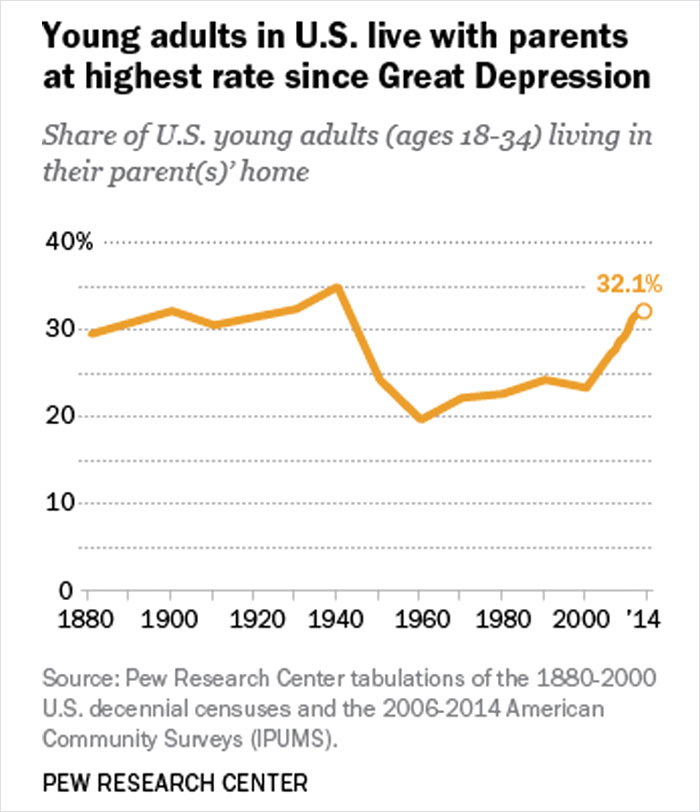
The reality is, however, that history appears to be repeating itself. In the West — Europe, the United States, Australia, etc. — more and more youngsters choose to live with their parents and move out of their family homes far later than usual. Just like in the days of yore. Bored Panda reached out to Andrea Breen, an Associate Professor at the Department of Family Relations and Applied Nutrition at the University of Guelph, about the phenomenon, so scroll down to read the full interview.
According to Breen from the University of Guelph, “economic necessity is a key reason” why kids live with their parents for longer. “More and more families need to combine incomes in order to afford basic necessitates, including housing, food, healthcare, and access to education. Economic necessity is driving young adults to stay in (or return to) their parents’ homes and it is also an important factor in many older adults moving in with their adult children (also an important related trend).”
Image credits: DGLimages
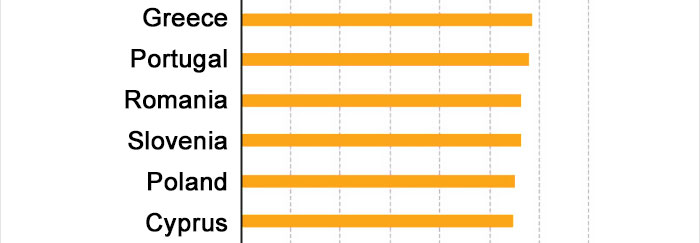
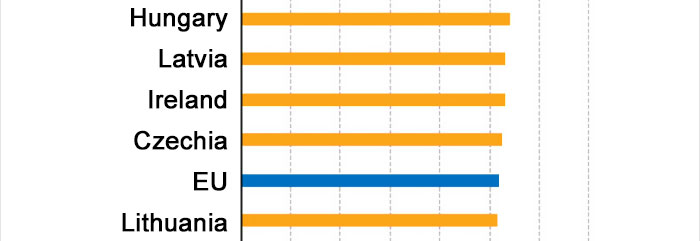
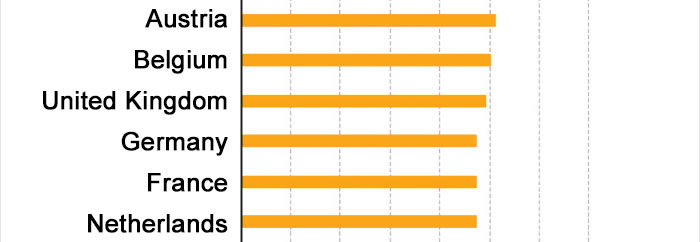
Image credits: Eurostat
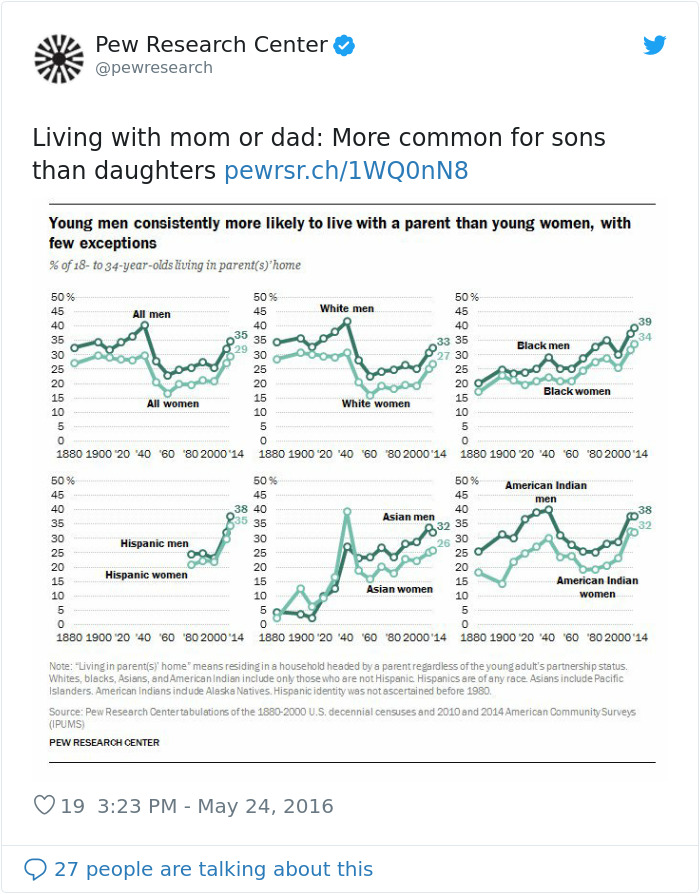
According to Eurostat’s 2018 data, the average age across the European Union when young people leave their parents’ homes is more than 25 years old. In 2017, Eurostat showed that 35.3 percent of 25 to 34-year-old men were still living at home, compared to 21.7 percent of women of the same age group. The smallest percentage of young people living with their parents was found in Denmark (3.2 percent), Finland (4.7 percent), and Sweden (6 percent). While the highest was in Croatia (59.7 percent), Slovakia (57 percent), and Greece (56.3 percent).
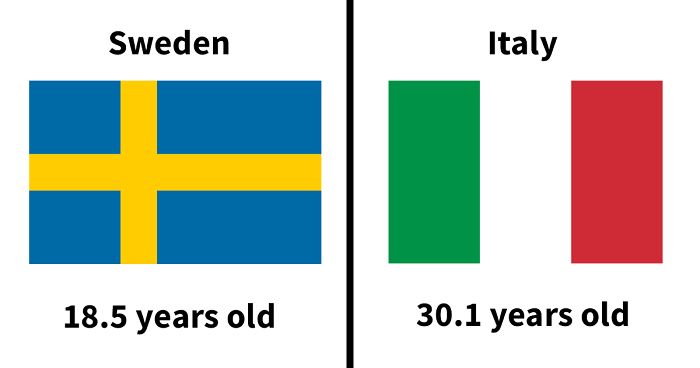
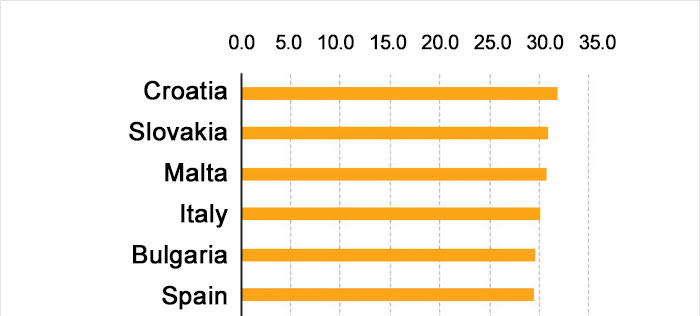
Meanwhile, Statista’s 2018 data shows that the average age when ‘youngsters’ from Montenegro left their family homes was 32.8. Croatians are in second place with an average age of 31.8; Slovakians are third with 30.9; Italians come right after that with 30.1.
“Another key reason is family caregiving needs,” Breen explained why young people live with their parents for longer. “Young people in Canada, Australia, the US, Britain (and in other parts of the world) are actively engaged in providing daily care for family members (including siblings, parents, grandparents, and other family members).”
“Family members are struggling to fill the gaps in healthcare and social welfare systems that do not provide adequate care and support for people with chronic illness, disabilities, mental health struggles, and substance abuse disorders. This is particularly important as populations age. Much of the care for grandparents is now provided by grandchildren, whose contributions to family life may be financial and may also involve caregiving and other forms of household labor.”
“And a third reason is culture. Individualistic notions of people growing up and “going out on their own” are not the norm in many cultures, which emphasize that elders should be looked after by family members and that family well-being is a collective responsibility. This is challenging individualistic notions that the ultimate aim of adult life is to be independent and able to “go it alone”. Immigration trends and movements to recognize and value Indigenous cultures (in Canada, the US, and Australia) are also pieces of this puzzle.”
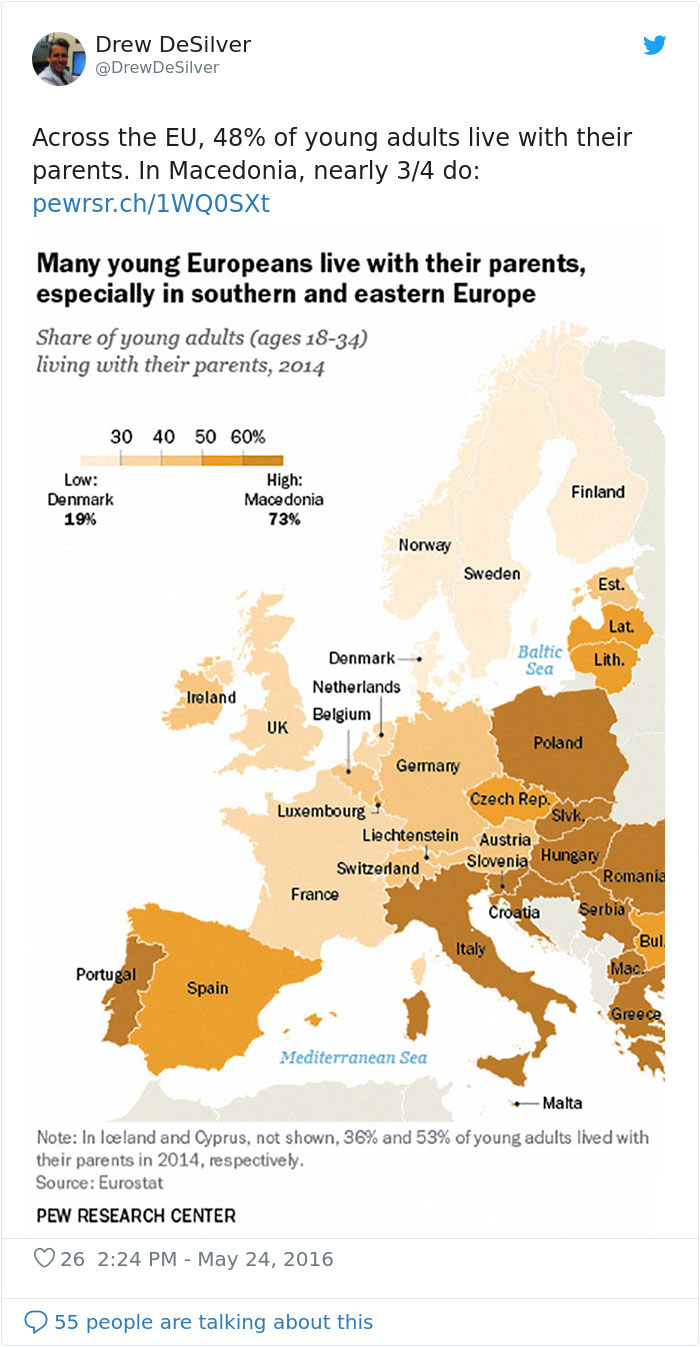
Image credits: DrewDeSilver
Image credits: eyeonhousing
Breen went on to analyze whether living at one’s parents’ home has positive or negative effects: “It really depends on the family.”
“Recently I did some interviews with CBC Canada after news that an upstate NY couple won a lawsuit to kick their 30-year-old son out of the house. Obviously, that seems like an extreme example of family conflict related to an (adult) child living with his parents too long. While the headline is an attention-grabber, the reality is that we do not know what that family may have been struggling with behind the scenes (e.g. mental health issues? addiction?).”
“It is important to highlight that the trend of extended families living together is in part a symptom of the terrible financial struggles that many families face. Many people have no choice but to live with their parents (or their adult children) in order to make ends meet. On the other hand, for some families, these changes might also create opportunities for stronger connections to family and culture and benefits to mental health and well-being.”
Nobody’s judging the people still living with their parents, but by the age that they do move out, those individuals are less like baby birds and more like the gigantic harpy eagles that live in rainforests.
The Guardian writes that the thinktank Civitas found that the number of young people who opt to live with their parents has grown incredibly over the last 20+ years. In 1997, 19.48 percent of young Brits (20 to 34 years old) lived with their parents; by 2017, the number was 25.91 percent.
Image credits: Pew Research Center/NPR
Image credits: pewresearch
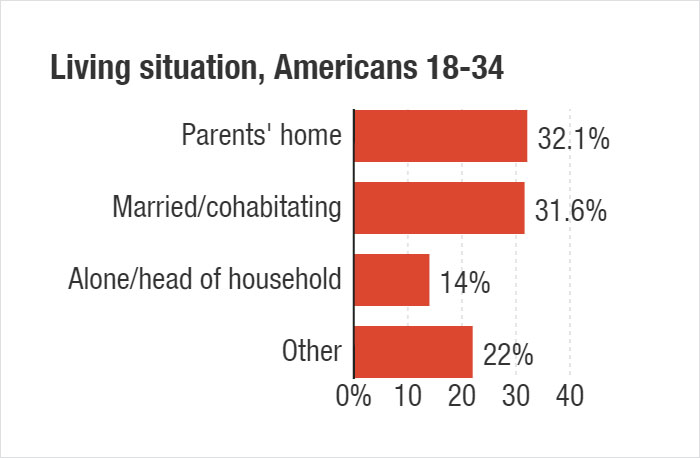
The same is true ‘across the pond,’ in the United States. For example, NBC reports that according to the data that Census collected 1 in 4 Californians between 25 and 33 years of age are still living with their mother and father. Things are no different in Australia, where 43 percent of 20 to 24-year olds haven’t moved out yet, compared to 36 percent back in 1981.
There are serious reasons for this phenomenon, and it’s not just the ‘youngsters’ who have to shoulder the blame. The fact is, financial stability and property affordability both have a lot to do with the decision whether to stay with mom and dad or to fly out of the nest.
Image credits: Pew Research Center
According to The Economist, Brits have it bad: house prices have doubled over the last two decades, and a 27-year-old today is thus half as likely to become a home-owner than 15 years ago. The fact of the matter is, buying a house was far cheaper a generation ago. And even cheaper the further back you go.
Curbed writes that in the United States, in 1959, a teacher would make 5,200 dollars a year, while an average house in California cost 12,788 dollars. That’s an income of 44,493 dollars and a house price of 109,419 dollars when adjusted for today’s dollars. Nowadays, teachers living in San Francisco earn a median salary of 72,340 dollars, but buying a home in the city costs 1.61 million dollars.
There are other reasons why young people are moving out later in life, such as getting into serious relationships later and later in life, which means they’re likely to move out later as well. Focusing on careers and being able to postpone starting a family may have something to do with that. However, another possible explanation could be a change in values, resulting in young people caring more about their families than before.

There's definitely a cultural component too, i'm from south Italy and in the process to leave home at the age of 28, both my parents and grandparents are confused by my choice because usually we leave home only when we marry and if the parents house is big enough not even then.

Brazil is almost the same (we're practically Italians in São Paulo!), but the main reason is to end education first, THEN move out. But the economy, OH THE ECONOMY! - I've left with 23.
Load More Replies...
I know a few people that still live with their parents and it isn't by choice. Unfortunately under our current financial climate, lack of affordable rentals, high unemployment rates and difficult housing market doesn't make it a choice for most people staying at home longer. I moved out at 18 but had to move back in with my parents at 21 with my partner and young daughter for about a year because of issues finding an affordable rental after the landlords wouldn't renew the lease because they had family that they wanted to move in. In many countries it is completely normal for families to live under the same roof as each other all their lives. Whatever works for some families obviously don't work for others.

The whole "get out from your parents home" started as a real estate campaign in the 60's. Before that, several generation living under the same roof and helping each other out was the norm (mind you it didn't mean you were an unmaried, unemployed manchild who played video games 24/7). Well, now we have a lot of old people complaining that their kids aren't there to help them.
Load More Replies...
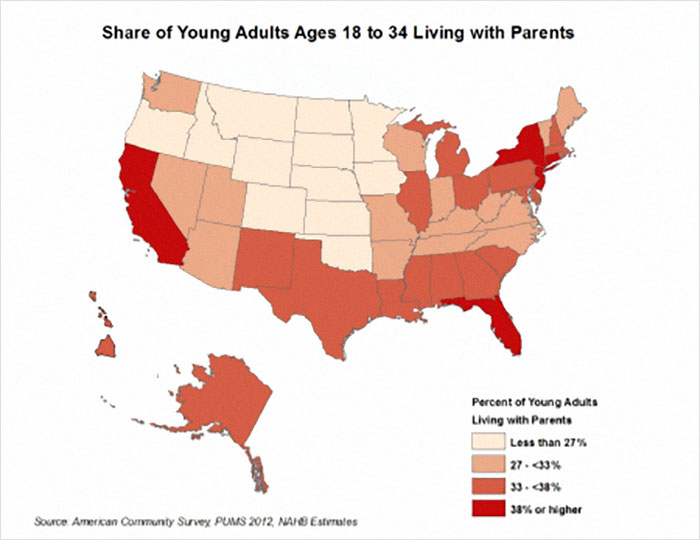
Just by a quick look on the map of the US I'd say it's pretty obvious - young people stay the longest with their parents in the most expensive states that with the biggest population density (California, around NYC and Washington, Florida...) while the less populated states where its much cheaper to live are clearly easier for young people to leave a nest. It's the same where I live (Prague, Czech Republic). It's not an easy task, learning to stand on your own feet. I'd say it says more about the countries and their political/social systems than the young people.
If you guys saw the rent costs in Jersey... I think I'll be 40 by the time I move out...
Load More Replies... There's definitely a cultural component too, i'm from south Italy and in the process to leave home at the age of 28, both my parents and grandparents are confused by my choice because usually we leave home only when we marry and if the parents house is big enough not even then.
Brazil is almost the same (we're practically Italians in São Paulo!), but the main reason is to end education first, THEN move out. But the economy, OH THE ECONOMY! - I've left with 23.
Load More Replies... I know a few people that still live with their parents and it isn't by choice. Unfortunately under our current financial climate, lack of affordable rentals, high unemployment rates and difficult housing market doesn't make it a choice for most people staying at home longer. I moved out at 18 but had to move back in with my parents at 21 with my partner and young daughter for about a year because of issues finding an affordable rental after the landlords wouldn't renew the lease because they had family that they wanted to move in. In many countries it is completely normal for families to live under the same roof as each other all their lives. Whatever works for some families obviously don't work for others.
The whole "get out from your parents home" started as a real estate campaign in the 60's. Before that, several generation living under the same roof and helping each other out was the norm (mind you it didn't mean you were an unmaried, unemployed manchild who played video games 24/7). Well, now we have a lot of old people complaining that their kids aren't there to help them.
Load More Replies... Just by a quick look on the map of the US I'd say it's pretty obvious - young people stay the longest with their parents in the most expensive states that with the biggest population density (California, around NYC and Washington, Florida...) while the less populated states where its much cheaper to live are clearly easier for young people to leave a nest. It's the same where I live (Prague, Czech Republic). It's not an easy task, learning to stand on your own feet. I'd say it says more about the countries and their political/social systems than the young people.
If you guys saw the rent costs in Jersey... I think I'll be 40 by the time I move out...
Load More Replies...

































 No fees, cancel anytime






















175
115