Get Premium
Dark mode theme is available exclusively for premium users. Learn more about the benefits of subscribing.
No fees, cancel anytime.

 Dark Mode Ad-Free Browsing Unlimited Content
 Ad-Free Browsing Unlimited Content Dark Mode
Join 1.2 million Panda readers who get the best art, memes, and fun stories every week!
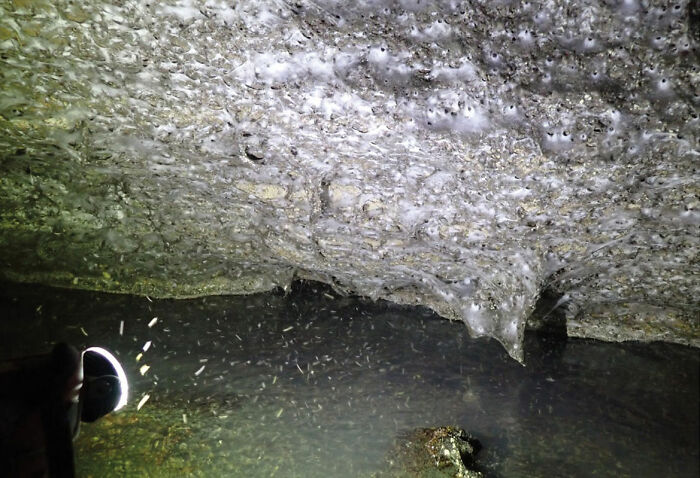
Deep inside a pitch-black chamber on the Albanian–Greek border, scientists have stumbled upon something straight out of a nightmare: the world’s biggest spider web.
The discovery, published in Subterranean Biology, revealed a tangled colony of more than 110,000 spiders coexisting within a single web stretching 1,140 square feet, roughly the size of a semi-detached house in the UK.
“This is one of the first examples of two spider species creating a colony,” researchers said, stunned that the normally solitary and cannibalistic animals were thriving together.
Image credits: Subterranean Biology
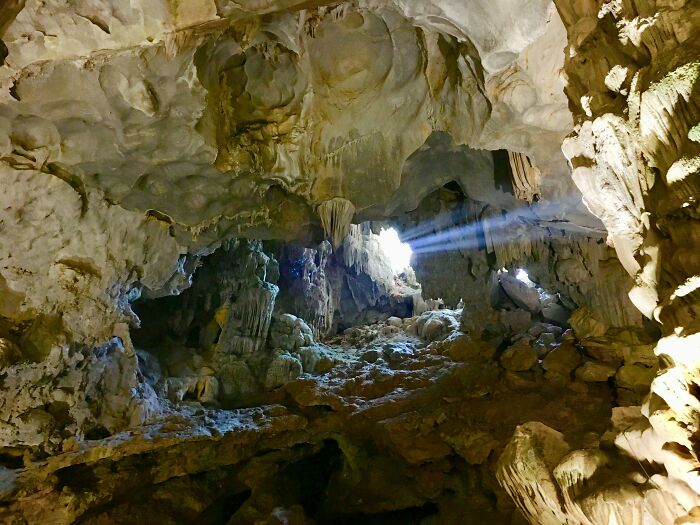
The discovery was made inside a location known as the Sulfur Cave, a natural chamber carved by sulfuric acid and known for its toxic atmosphere and yellow-stained walls.
According to visitors, the air inside reeks of rotten eggs, which is the result of hydrogen sulfide gas rising from underground water and reacting with oxygen to form sulfuric acid.
Over time, that acid slowly ate away at the surrounding rock, hollowing out the chamber that has now become home to an unprecedented community of arachnids.
Image credits: Subterranean Biology
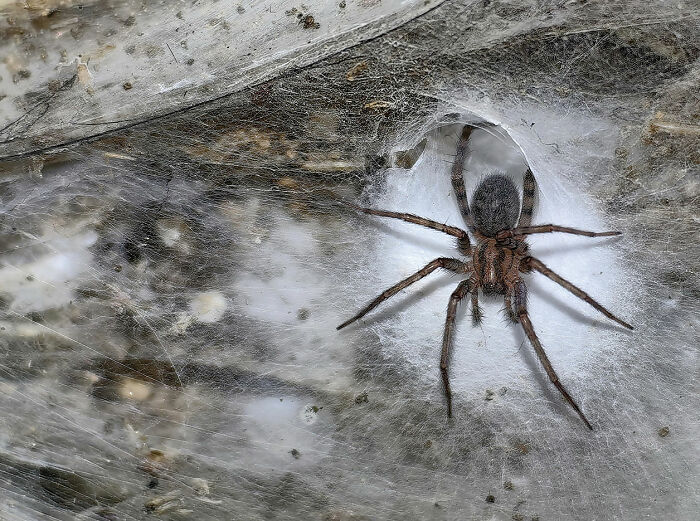
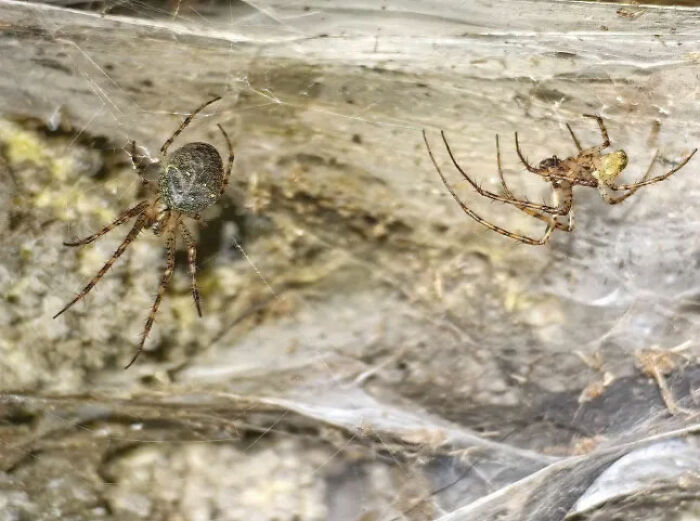
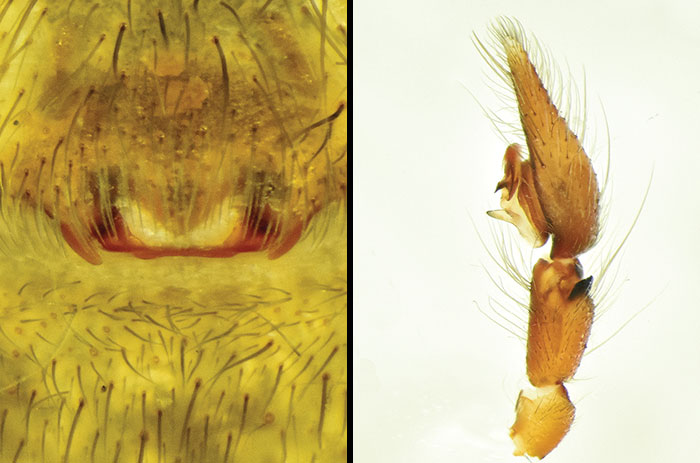
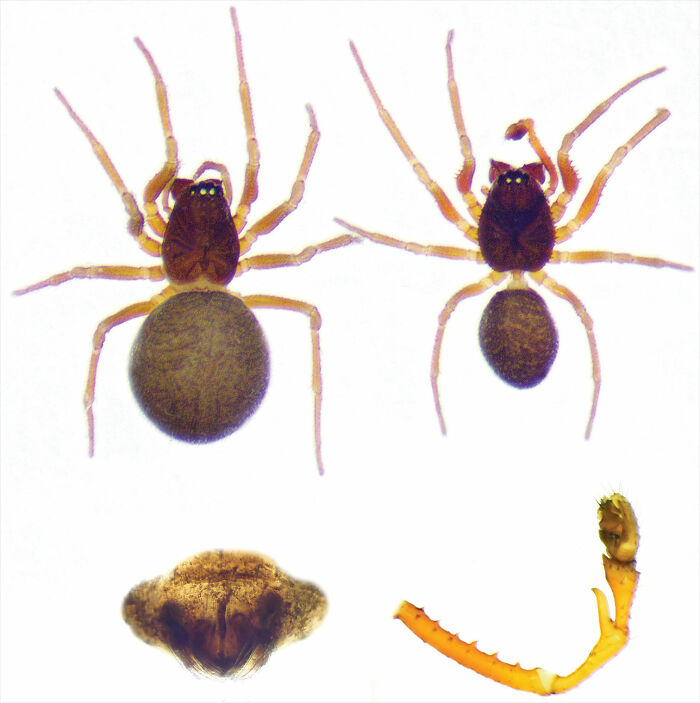
The two species responsible for the web are the larger Tegenaria domestica, known as the domestic house spider, and the much smaller Prinerigone vagans, a type of sheet weaver.
Beyond the size of the web, the fact that these two species collaborated is what caught researchers’ attention.
“What’s fascinating here is, firstly, that there is a group of communally living spiders in a cave,” said Jason Dunlop, curator of arachnids at the Berlin Natural History Museum.
Image credits: Subterranean Biology
“Most spiders are solitary, but a few species are known to live in groups, although these usually build large communal webs outdoors covering a whole tree or bush.
“What’s really unexpected,” he continued, “is that two rather different species of spider from two different families are involved: a kind of house spider like the one that sometimes appears in the bath, and a smaller money spider.
“That’s unique as far as I’m aware.”
Image credits: www.facebook.com
Image credits: t-online
The first to spot the web were cavers from the Czech Speleological Society back in 2022.
When researchers from the Sapientia Hungarian University of Transylvania revisited the site two years later, they counted an estimated 69,000 house spiders and 42,000 sheet weavers living side by side.
Image credits: Subterranean Biology
What stunned scientists most was the fact that, under normal conditions, the larger species would devour the other.
“Spiders are usually pretty cannibalistic and bigger ones would usually cheerfully eat little ones,” said Dunlop.
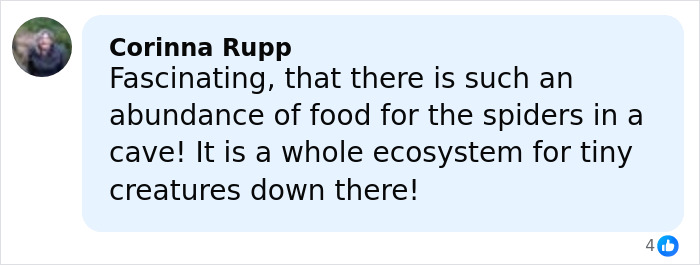
“This very unusual arrangement is only possible because there is an abundance of small ‘flies’ in the cave, which means there is enough food for everyone, even when living at impressive densities of tens of thousands of individuals.”
Image credits: www.facebook.com
Image credits: Subterranean Biology
The researchers discovered that both spider species fed on tiny non-biting midges, which are small gnat-like insects that thrive in damp environments.
These midges feed on microbial slime produced by sulfur-eating bacteria, forming the base of this strange and unique underground food chain.
Image credits: Subterranean Biology
Dunlop emphasized that the spiders weren’t living under any kind of hierarchy. This was only possible due to the amount of resources in the cave.
“It’s not like a bee’s nest or an ant or wasp colony,” he explained.
“There is no one ‘queen’ spider coordinating all this. It’s more like a flat share where lots and lots of spiders have converged together and share a particular space close to a remarkably rich food source.”
Image credits: Tofael Hossain / unsplash (not the actual photo)
Online, people were already thinking about how to put the discovery to use.
“Where is this so I know where to take my husband on vacation? A permanent vacation,” a reader wrote.
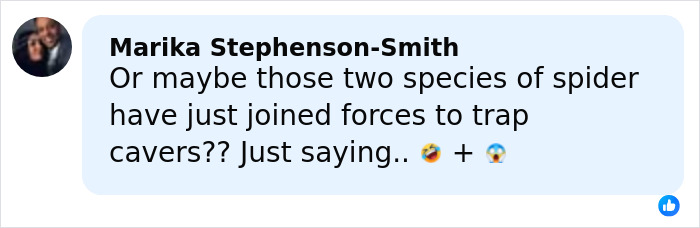
“Networking spiders showing their first website,” another added.
Image credits: www.facebook.com
Others, rightfully so, questioned how exactly the researchers came up with the number of spiders living in the cave.
In cave ecology studies, scientists measure a defined section of the web. They count every spider visible in the sample area, and repeat that process in multiple spots to get an average of the number of specimens per square meter.
The result is then multiplied by the total estimated surface area in the web network.
Image credits: www.facebook.com
Image credits: www.facebook.com
Image credits: www.facebook.com
Image credits: www.facebook.com
Image credits: www.facebook.com
Image credits: www.facebook.com
Image credits: www.facebook.com
Image credits: www.facebook.com
Image credits: www.facebook.com
Image credits: www.facebook.com
Image credits: www.facebook.com
Image credits: www.facebook.com
Image credits: www.facebook.com
Image credits: www.facebook.com
Image credits: www.facebook.com

By entering your email and clicking Subscribe, you're agreeing to let us send you customized marketing messages about us and our advertising partners. You are also agreeing to our Privacy Policy.
Thank you! You've successfully subscribed to newsletters!







































 No fees, cancel anytime




























41
9