Get Premium
Dark mode theme is available exclusively for premium users. Learn more about the benefits of subscribing.
No fees, cancel anytime.

 Dark Mode Ad-Free Browsing Unlimited Content
 Ad-Free Browsing Unlimited Content Dark Mode
Join 1.2 million Panda readers who get the best art, memes, and fun stories every week!
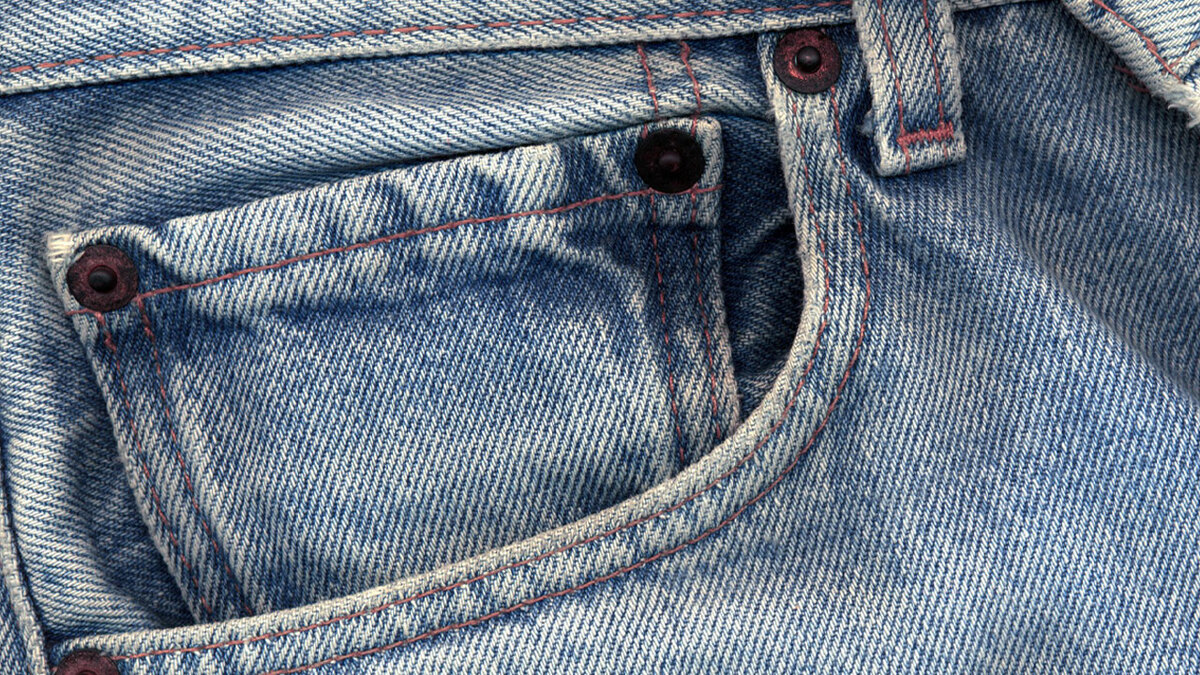
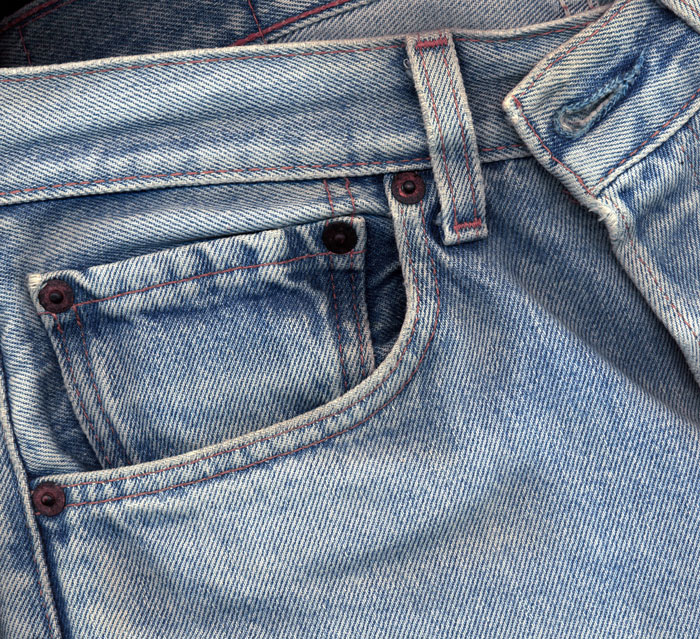
Every jean-wearer must have noticed at some point that there was a tiny pocket sewn into their pants that could hardly fit anything larger than a few coins. This mystery of why such a small pouch even exists has baffled some people for decades.
That’s why we’re finally going to expose the reason behind why this miniature pocket was created and what its purpose even is. You might be surprised to learn it has a lot to do with the needs of cowboys and miners, even though it’s now mostly used as a fashion statement or a comfortable piece of clothing.

By entering your email and clicking Subscribe, you're agreeing to let us send you customized marketing messages about us and our advertising partners. You are also agreeing to our Privacy Policy.
Thank you! You've successfully subscribed to newsletters!
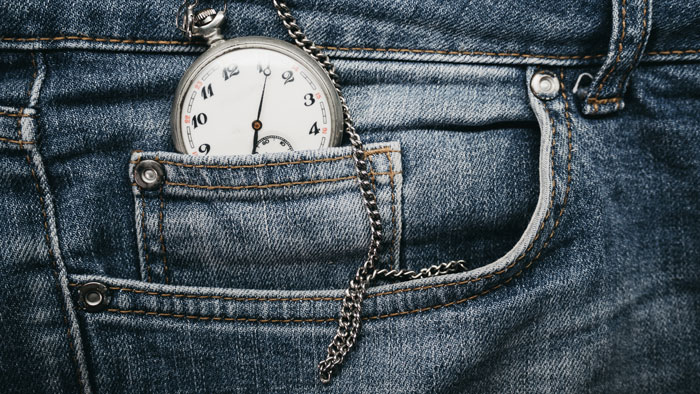
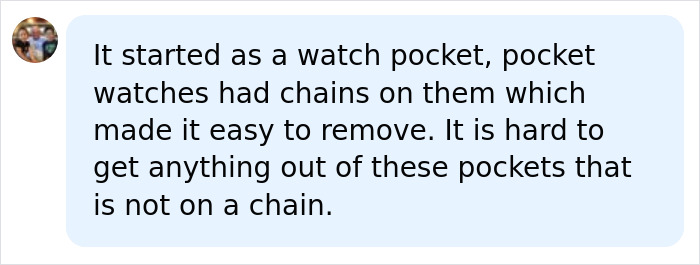
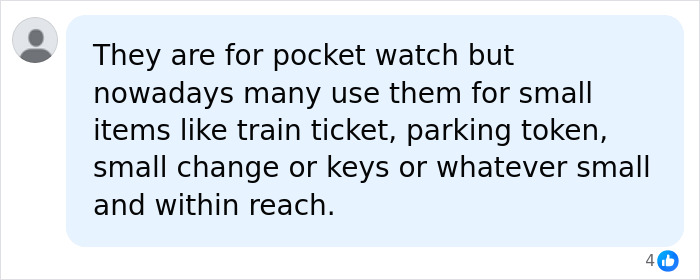
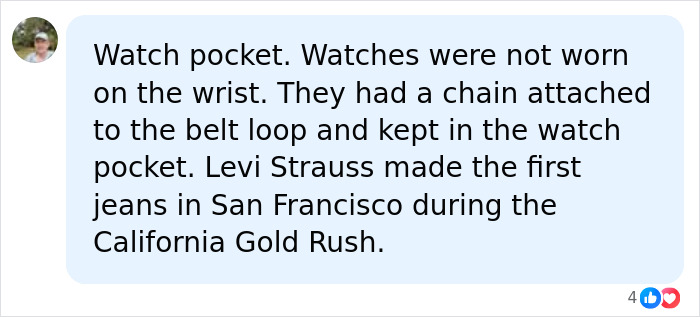
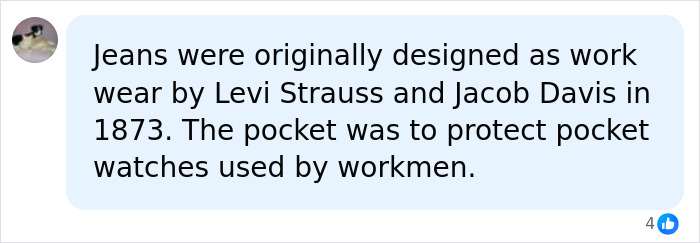
This invention dates back to 1873, after Levi Strauss had created workwear denim for miners and cowboys in the American West. The little pouch was added in collaboration with Jacob Davis to hold pocket watches, which were commonly attached to waistcoat chains and could be easily damaged, so they needed extra protection.
Levi’s ingenious idea was to create this tiny pouch and make it tight enough so that the watch couldn’t fall out and get cracked. He also patented the idea of adding rivets at either end of its openings to reinforce the stress points and prevent the pocket from tearing. This design was mass-produced after 1890 and led many farmers, cowboys, miners, and railroad workers to wear denim pants and enjoy the tiny pockets.
Over time, people have started wearing wristwatches or using their mobile phones to tell the time, so the need for a mini pouch on denim pants is no longer there. Despite that, manufacturers advise people to use the pocket to store other things like coins, lip balm, earpods, and other little items.
Companies keep adding these tiny pouches, and they have even reduced their size from 3.5 inches to just 3 inches, which means only coins might fit. In the 1950s, rebellious teens used the pocket to carry lighters, store guitar picks, or keep movie stubs. Interestingly, even centuries later, this design feature hasn’t changed much.
According to Hawthorn, weavers in Nîmes, France, accidentally made the first modern denim in the 17th century while trying to replicate a hard cotton fabric called ‘jeane.’ This material used a twill weave, which made it sturdy, and the indigo dye on its threads added a unique white-bluish color. Over time, English and French people used this fabric and began calling it denim.
What’s interesting to note is that the indigo dye, which is one of the oldest to be used in textile manufacturing, comes from India. Because it is a natural color extracted from plant leaves, the process is also economical and, over time, has become synonymous with what jeans should look like.
In 1853, Levi Strauss, a Bavarian native, came to San Francisco to open a dry goods business with his brothers. Over the next two decades, he built the business into a very successful operation. One of his customers, a tailor named Jacob Davis, was tasked with making pants for a laborer that wouldn’t fall apart easily.
He had the idea to add metal rivets where trousers strain, and he quickly filed a patent for his creation. Once his invention took off, he needed a business partner to keep the momentum going, and so he approached Levi Strauss, who had sold him the cloth to make his riveted pants. This led them to collaborate and secure their patent in 1873, which helped create the different types of jeans you see today.
Jeans are worn by young and old, but in the 19th century, they were mainly considered rugged workwear. According to Byrdie, miners, cowboys, and other laborers commonly wore denim in the American West, but after Hollywood adopted the trend, regular folks began wearing it much more.
What’s interesting about jeans is that they weren’t just restricted to workers, students, or fashionistas; they were also seen at one point as a sign of rebellion. Theren Moodley reveals that by the 1970s, denim clothing played an unexpected role in the civil rights movement as blue clothing represented solidarity with the working class. That’s why some photos show Martin Luther King Jr. and Ralph Abernathy marching in Birmingham protests wearing jeans.
As the decades passed, punks and young people took over denim pants and wore them to music festivals. The SANVT Journal notes that one of the most interesting trends to come from this was the popularity of skinny jeans, which folks could wear to work, parties, and just to enhance their style.
Since the beginning, denim pants have been a staple in people’s wardrobes and have adapted to fit different styles and trends. Even if folks don’t know the colorful history behind the jeans they are wearing, at least they now know what the tiny pockets on their pants were created for.
Why did you think the tiny denim pouches existed, and what will you be putting in them? We’d love to hear your thoughts.

1. Duh, I thought everybody knew that. 2.Gousset is not the French word for pocket. It's quite literally gusset, and like the English word can be used in various contexts, so I can see how it _could_ be used for this, but I don't think I've ever heard it used in conversation (or in writing, come to that), Apparently it's also used in English to refer to a piece of Medieval armour.

Upvoted especially #1. We must be old or something.🤷
Load More Replies...

It's for you to wonder what the hell is making that noise in the washing machine.
1. Duh, I thought everybody knew that. 2.Gousset is not the French word for pocket. It's quite literally gusset, and like the English word can be used in various contexts, so I can see how it _could_ be used for this, but I don't think I've ever heard it used in conversation (or in writing, come to that), Apparently it's also used in English to refer to a piece of Medieval armour.
Upvoted especially #1. We must be old or something.🤷
Load More Replies... It's for you to wonder what the hell is making that noise in the washing machine.





























 No fees, cancel anytime






























32
20