Get Premium
Dark mode theme is available exclusively for premium users. Learn more about the benefits of subscribing.
No fees, cancel anytime.

 Dark Mode Ad-Free Browsing Unlimited Content
 Ad-Free Browsing Unlimited Content Dark Mode
Join 1.2 million Panda readers who get the best art, memes, and fun stories every week!

Bridgerton recently returned with its fourth season, and viewers are eager to understand the meaning of one word, which, in the show’s glittering Regency-era world, can shatter a woman’s future.
Part 1 of the fourth installment introduces Yerin Ha’s Sophie Baek, who is described as a “ward.” The label hints at a scandalous forbidden romance, hiding secrets that will have major implications for the second half of season 4.
In the London-set romantic drama, social status is everything, and Sophie’s is tied to this one word. Its real meaning is revealed through her backstory and directly impacts her potential romance with Benedict Bridgerton.
Here is what “ward” stands for in Bridgerton and why it is important to Sophie’s story.
Spoilers ahead!
Image credits: Netflix
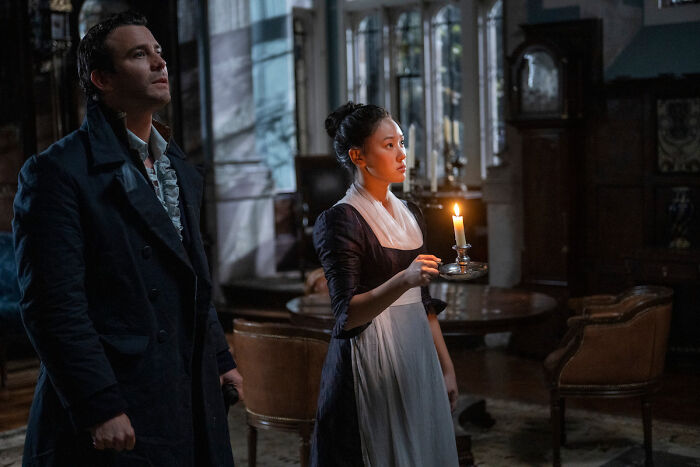
Sophie Baek is initially introduced as the mysterious Lady in Silver at the masquerade ball in episode 1. She is actually a maid working at Penwood House, and flashbacks in episode 2 reveal that she was the ward of Lord Penwood.
During the Regency era, the phrase “ward” was typically used to describe a minor, especially an orphan with property or a high-ranking connection, placed under the legal protection of a guardian.
When Penwood’s new wife, Lady Araminta, arrives at his residence, he introduces Sophie as his ward, implying she is not a commoner like his other housemaids. However, after his passing, Sophie is reduced to serving as a maid.
Image credits: Netflix
As a ward, Sophie enjoyed a fairly normal childhood, receiving most of the perks of aristocracy. It is later revealed that Sophie’s status as Lord Penwood’s ward was meant to hide her true parentage.
As Lady Araminta explains in the funeral scene, she is the illegitimate daughter of Lord Pendwood. Her mother, an unnamed maid, became the aristocrat’s mistress, leading to Sophie’s birth.
After Penwood’s demise, Sophie learns that she was not included in her father’s will, and Lady Araminta offers her a position as a housemaid, which she accepts for financial security. Since her father left her no inheritance, Sophie is not a ward in the truest sense of the word.
Image credits: Netflix
Her background as the illegitimate child of a Lord landed Sophie in a strange place within the rigid hierarchy of the Regency era. Despite having aristocratic ties, she is forced into the labor class because of her stepmother’s machinations.
Her status directly impacts her budding romance with Benedict Bridgerton, the second son of the noble and powerful titular family. In episode 4, Benedict and Sophie finally act on their feelings for each other.
Given the social constraints stemming from Sophie’s social status, Benedict offers to make her his mistress. The first half of season 4 ends without Sophie accepting or rejecting the offer.
Image credits: Netflix
In a chat with Tudum, showrunner Jess Brownell provided some insight into Sophie’s feelings about the offer.
“For Sophie, the idea of being a mistress is the worst possible thing she could be asked,” she said.
She added that Sophie’s past makes her apprehensive of accepting such an offer, and she hoped Benedict “could see beyond” the social restrictions.
Hence, the class system will likely be a major hurdle that the lovers must overcome to unite when the romantic drama returns with Part 2 of season 4 on February 26, 2026.
Bridgerton Season 4, Part 1 is currently streaming on Netflix.

By entering your email and clicking Subscribe, you're agreeing to let us send you customized marketing messages about us and our advertising partners. You are also agreeing to our Privacy Policy.
Thank you! You've successfully subscribed to newsletters!





































 No fees, cancel anytime







8
0