Bored Panda works better on our iPhone app
Continue in app Continue in browser

The Bored Panda iOS app is live! Fight boredom with iPhones and iPads here.

30 UK Grammar Questions That Sound Easy – Until You Actually Try Them
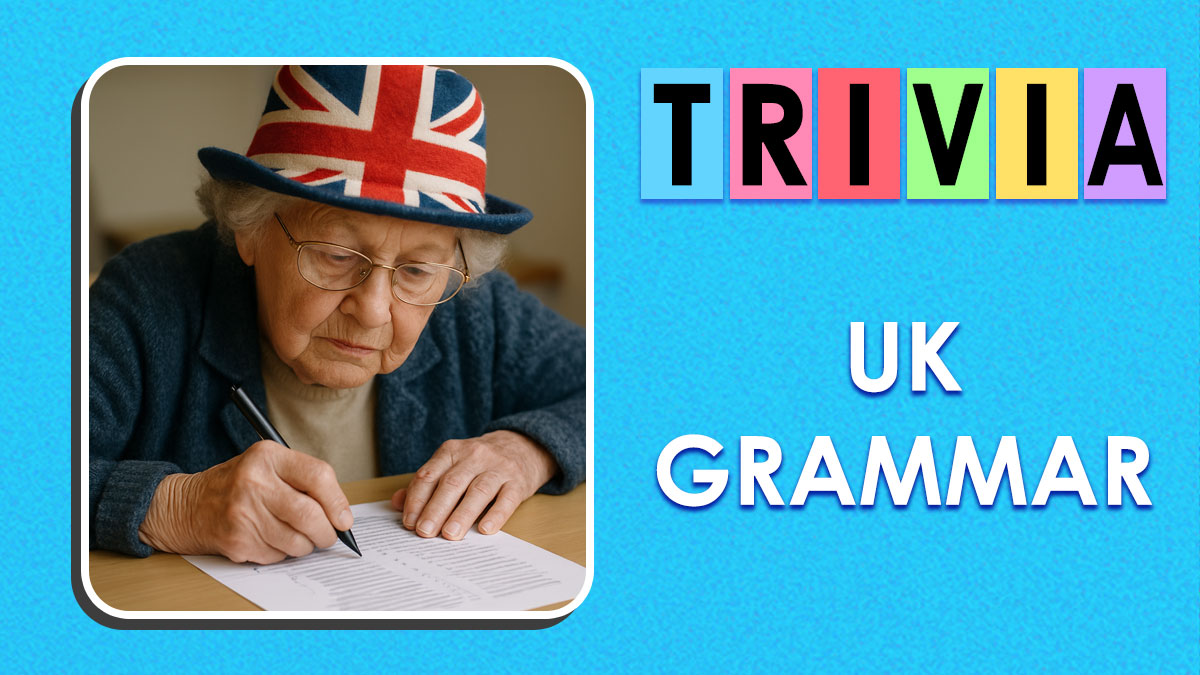
Elderly woman wearing a UK flag hat focused on writing answers for UK grammar trivia questions on paper.
Quizzes

30 UK Grammar Questions That Sound Easy – Until You Actually Try Them

33

ADVERTISEMENT

From commas and apostrophes to verb tenses and clauses, this 30-question UK English-inspired quiz puts your everyday language knowledge to the test.

Some questions are straightforward, others are designed to trip you up if you’re not paying close attention – just like real English does.

Let’s see how well you really know your grammar. Begin!

🚀 💡 Want more or looking for something else? Head over to the Bored Panda Quizzes and explore our full collection of quizzes and trivia designed to test your knowledge, reveal hidden insights, and spark your curiosity.💡 🚀


RELATED:

    Progress:

    Give it another try!
    I give up!

    Not Quite Done Yet!

    Continue the Quiz

    Thanks! Check out the results:

    REWARD
    REWARD
    Quiz icon

    View alternative results:

    Quiz icon

    Your general stats:

    TOTAL POINTS
    TRIVIAS SOLVED
    PERFECT SCORES
    QUIZZES COMPLETED
    Your result:
    SCORE
    REWARD

    How did you score compared to others?

    Discover Your Competitive Edge

    Subscribe Premium to Compare Your Stats with Others

    More Premium features:

    Unlimited content
    Ad-free browsing
    Dark mode

    How did you score compared to others?

    You scored better than % of people
    Trivia Takers
    Score

    Your general stats:

    TOTAL POINTS
    TRIVIAS SOLVED
    PERFECT SCORES
    QUIZZES COMPLETED
    User Result
    Reward
    User avatar
    User avatar
    / 30
    User avatar
    User avatar
    / 30
    Trivia Top Performers
    Quiz leaderboards
    Quiz panda avatar
    You
    Share on Facebook
    Ikhona Makaluza

    Ikhona Makaluza

    Writer, Trivia Content Writer

    Read more »

    Artist + Writer

    Read less »
    Ikhona Makaluza

    Ikhona Makaluza

    Writer, Trivia Content Writer

    Artist + Writer

    Erika Saikovskytė

    Erika Saikovskytė

    Author, Photo Editor

    Read more »

    This lazy panda forgot to write something about itself.

    Read less »

    Erika Saikovskytė

    Erika Saikovskytė

    Author, Photo Editor

    This lazy panda forgot to write something about itself.

    What do you think ?
    LakotaWolf (she/her)
    Community Member
    1 hour ago Created by potrace 1.15, written by Peter Selinger 2001-2017

    How is this specifically "UK grammar" and not just "normal English language grammar regardless of what side of the pond you're on"?

    Ace
    Community Member
    Premium
    1 hour ago Created by potrace 1.15, written by Peter Selinger 2001-2017

    #26 Grammatically, all of the available options are equally valid. I could wear a helmet, I might wear a helmet tomorrow, I would wear a helmet if I were teaching children to ski. "Should" is just an opinion.

    ADVERTISEMENT
    Ace
    Community Member
    Premium
    1 hour ago Created by potrace 1.15, written by Peter Selinger 2001-2017

    #8 with the comma - no, you do not need a comma, As for their explanation "Commas are used after fronted adverbials." W*F? Do they seriously expect anyone to remember such contorted rules like that?

    LakotaWolf (she/her)
    Community Member
    1 hour ago Created by potrace 1.15, written by Peter Selinger 2001-2017

    A fronted adverbial is very specific, though, to be fair. It's when the adverb is moved to the beginning of the sentence instead of immediately following the verb ("The door opened slowly" is a sentence in regular form; "Slowly, the door opened" is the same sentence in fronted adverbial form.) It's not a sin to NOT put a comma after the fronted adverb, but it IS generally accepted as proper grammatical/technical form. I was an English major and got my degree in English/Creative Writing, so maybe I remember this stuff more clearly than others, but it's something we were taught. For clarity and technicality's sake, one should put a comma after a fronted adverbial. Otherwise, the sentence can look like a run-on sentence - "Before dawn Kohl jumped on Lakota's kidneys to wake her up" vs. "Before dawn, Kohl jumped on Lakota's kidneys to wake her up." It's a fiddly thing, but it's legitimate and is actually grammatically/technically correct to have a comma after a fronted adverb.

    Load More Replies...

    LakotaWolf (she/her)
    Community Member
    1 hour ago Created by potrace 1.15, written by Peter Selinger 2001-2017

    How is this specifically "UK grammar" and not just "normal English language grammar regardless of what side of the pond you're on"?

    Ace
    Community Member
    Premium
    1 hour ago Created by potrace 1.15, written by Peter Selinger 2001-2017

    #26 Grammatically, all of the available options are equally valid. I could wear a helmet, I might wear a helmet tomorrow, I would wear a helmet if I were teaching children to ski. "Should" is just an opinion.

    ADVERTISEMENT
    Ace
    Community Member
    Premium
    1 hour ago Created by potrace 1.15, written by Peter Selinger 2001-2017

    #8 with the comma - no, you do not need a comma, As for their explanation "Commas are used after fronted adverbials." W*F? Do they seriously expect anyone to remember such contorted rules like that?

    LakotaWolf (she/her)
    Community Member
    1 hour ago Created by potrace 1.15, written by Peter Selinger 2001-2017

    A fronted adverbial is very specific, though, to be fair. It's when the adverb is moved to the beginning of the sentence instead of immediately following the verb ("The door opened slowly" is a sentence in regular form; "Slowly, the door opened" is the same sentence in fronted adverbial form.) It's not a sin to NOT put a comma after the fronted adverb, but it IS generally accepted as proper grammatical/technical form. I was an English major and got my degree in English/Creative Writing, so maybe I remember this stuff more clearly than others, but it's something we were taught. For clarity and technicality's sake, one should put a comma after a fronted adverbial. Otherwise, the sentence can look like a run-on sentence - "Before dawn Kohl jumped on Lakota's kidneys to wake her up" vs. "Before dawn, Kohl jumped on Lakota's kidneys to wake her up." It's a fiddly thing, but it's legitimate and is actually grammatically/technically correct to have a comma after a fronted adverb.

    Load More Replies...

    You May Like
    Related on Bored Panda
    Popular on Bored Panda
    Trending on Bored Panda
    Also on Bored Panda
    ADVERTISEMENT