Get Premium
Dark mode theme is available exclusively for premium users. Learn more about the benefits of subscribing.
No fees, cancel anytime.

 Dark Mode Ad-Free Browsing Unlimited Content
 Ad-Free Browsing Unlimited Content Dark Mode
Join 1.2 million Panda readers who get the best art, memes, and fun stories every week!
Scientists at the University of Santiago de Compostela in Spain have identified a new area for male pleasure.
The discovery, published in the scientific journal Andrology, challenged the previously held belief that the glans, the head of the male organ, or the prostate are the most sensitive zones.
The scientists reached this conclusion after mapping sensory nerves in 30 fetuses and 14 cadaveric male organs from donors aged between 46 and 96.
The study raises concerns for circumcision procedures, which can sometimes come close to this sensitive spot.
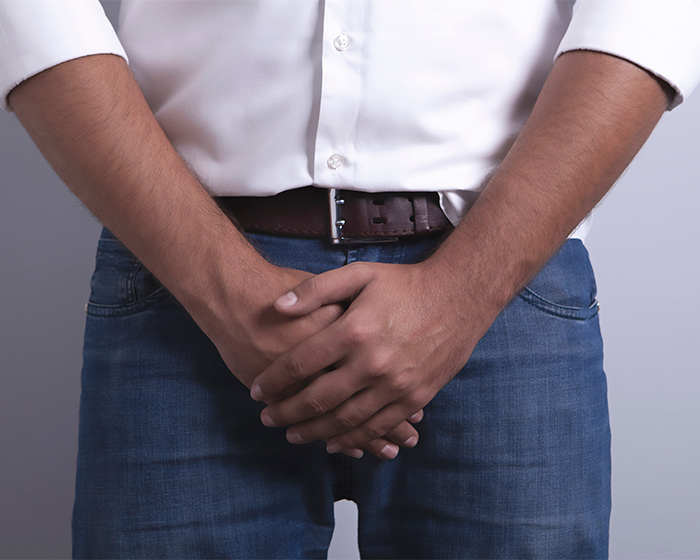
Image credits: be free/Adobe Stock (Not the actual photo)
The discovery was detailed in a study titled The Sensory Penis: A Comprehensive Immunohistological and Ontogenetic Exploration of Human Penile Innervation, published in the journal Andrology in September 2025.
To get the results, the researchers sliced the donated cadaver organs into fine sections and added dyes that bound to the nerves.
The sections were then examined under a microscope.
Image credits: AntonioDiaz/Adobe Stock (Not the actual photo)
According to Alfonso Cepeda-Emiliani, María Otero-Alén, Juan Suárez Quintanilla, Marina Gándara-Cortés, Tomás García-Caballero, Rosalía Gallego, and Lucía García-Caballero, a triangular region where the shaft meets the head of the male organ — known as the frenular delta — is the most responsive.
The area contains a higher density of nerve endings — up to 17 concentrated in a small area in some cases — making it more sensitive to stimulation.
Image credits: SZ Photos/Adobe Stock (Not the actual photo)
In the study, Cepeda-Emiliani noted that while their findings “may seem self-evident to anyone attuned to the sensations of their p**is during s**ual activity, our work scientifically validates the existence of a ventral penile anatomical region that serves as a center of s**ual sensation.”
Eric Chung, a urologist at the University of Queensland in Australia and the president-elect of the International Society for Sexual Medicine, agreed with the study, calling the discovered region “one of the most pleasurable spots” for men.
The frenular delta was named by Ken McGrath, a faculty member in the Department of Health at Auckland University of Technology in New Zealand, in 2001.
Cepeda-Emiliani addressed the issue that the frenular delta has historically received little scientific attention, saying that this “underscores persistent blind spots in s**ual medicine and urology.”
Image credits: poko42/Adobe Stock (Not the actual photo)
According to New Scientist, a leading science and technology magazine, some circumcision techniques make incisions across the frenular delta area.
This may affect its complex nerve networks and reduce sensation if the incisions are deep and the whole zone is removed.
Image credits: BGStock72/Adobe Stock (Not the actual photo)
Kelsey Pedler, a urologist at Port Macquarie Base Hospital in Australia, said she wasn’t taught about the frenular delta and its specialized nerves during surgical training.
“The region is not mentioned in the most well-regarded urological surgical anatomy textbooks, even in the most up-to-date editions,” she said.
Image credits: fizkes/Adobe Stock (Not the actual photo)
Pedler only performs circumcisions when they are medically necessary, such as when the prepuce, most commonly known as the fo**skin is too tight, but says that “now that we know about this area of nerves, it’s even more important to only do these operations when they’re absolutely indicated.”
Moreover, a 2013 study titled Male Circumcision Decreases Penile Sensitivity as Measured in a Large Cohort, claimed that uncircumcised men reported more pleasure from stimulation of their frenular delta than circumcised men.
On the other hand, Anatomic Maps of Erogenous Sensation and Pleasure in the P**is: Are There Differences Between Circumcised and Uncircumcised Men?, a study published in 2023, claimed that circumcised male organs may have ways of compensating for any nerve disruptions in the frenular delta area.
Image credits: vladorlov/Adobe Stock (Not the actual photo)
Gräfenberg’s study on a female pleasure spot dates back to the first half of the 20th century, when women’s intimate health was widely disregarded as a scientific subject.
In the 1940s, Ernst Gräfenberg conducted research on female reproductive physiology, with particular attention to the urethra.
Gräfenberg observed that stimulation of the region along the front wall of the female genital area produced heightened pleasure in some women.
Image credits: Jacob Lund/Adobe Stock (Not the actual photo)
He suggested that this area contained a concentration of sensitive tissue and nerve endings, making it distinct from surrounding regions.
In 1950, he published a paper, The Role of the Urethra in Female O**asm, in which he described this zone and its responsiveness to stimulation.
Although he did not originally call it the “G-s**t,” his work laid the foundation for what later became known as the Gräfenberg spot, named in his honor.
Cepeda-Emiliani and his colleagues are now conducting a similar in-depth study on female cadavers.
Image credits: MenForFairness
Image credits: Softmedic
Image credits: BlindSpot350
Image credits: Jossyluv04
Image credits: awextruck
Image credits: Jossyluv04
Image credits: RobbieS93808733

By entering your email and clicking Subscribe, you're agreeing to let us send you customized marketing messages about us and our advertising partners. You are also agreeing to our Privacy Policy.
Thank you! You've successfully subscribed to newsletters!






































 No fees, cancel anytime




































25
2