Get Premium
Dark mode theme is available exclusively for premium users. Learn more about the benefits of subscribing.
No fees, cancel anytime.

 Dark Mode Ad-Free Browsing Unlimited Content
 Ad-Free Browsing Unlimited Content Dark Mode
Join 1.2 million Panda readers who get the best art, memes, and fun stories every week!

An extremely popular mobile game for women, titled Love and Deepspace, has ignited a fierce debate online after including a new and controversial feature—a period tracker.
The option, dubbed as “creepy” by some players, allows users to enter their personal, biological information, allowing the in-game romanceable hunks to take into account those dates and issue personalized reminders to buy supplies and prepare for that special time of the month.
“There’s a period tracker?! That’s…really offputting. Of course they’re stealing that data,” one user said.
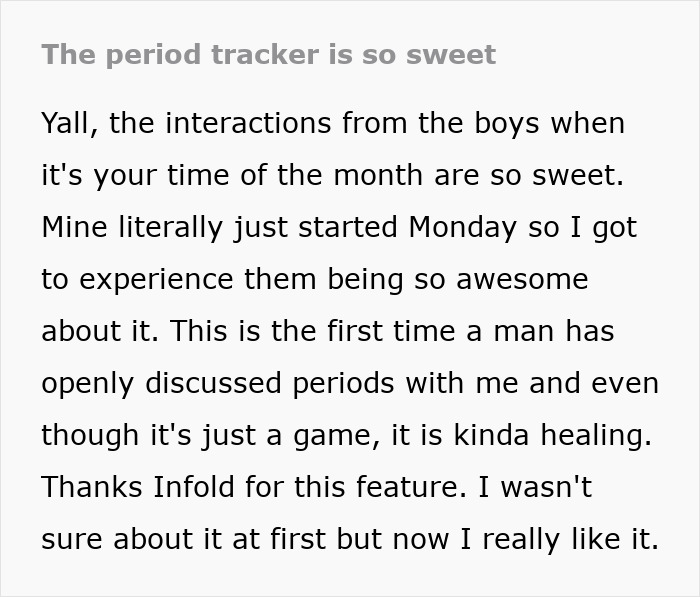
“This is so sweet! This is how a studio should cater to women!” replied another.
On the other hand, the feature has been panned by experts, who warn against the commercialization of personal health data in a game with gambling elements and underage users.
Image credits: Love and Deep Space
Known as a “maiden’s” game—“otome” in Japanese—the app is part of a genre of video games specifically targeted at women, featuring a female protagonist who is lusted and sought after by a host of interesting and attractive male characters.
Love and Deepspace has been nothing short of a massive success: since it was released in January 2024, the game has captivated a staggering 50 million users and generated approximately $710 million in revenue.
However, the addition of a period tracker—marketed as a “Remind Me” feature—has split its female audience into passionate advocates and wary critics, who believe the information required crossed privacy boundaries.
Image credits: Getty Images / Unsplash
According to critics, the feature is problematic not only due to the intimate nature of the requested information, but also for the co-dependency it allegedly aims to generate between the user and the app.
“Games like these rely on building an emotional connection to the player,” explained Dr. Andrija Bernik, PhD in Computer and Information Sciences of the University of Zagreb.
“These players are [likely to be] in their twenties, lonely or with very few friends, and are emotionally vulnerable,” he said.
Image credits: Tonberith
Love and Deepspace is a free-to-play game, but like most apps of that nature, it makes most of its revenue through consistent spending on the part of users.
The game puts players in the shoes of “Pip,” a fully customizable female character that embarks on an adventure in humanity’s far future.
The game has players battling with monsters, leveling up and customizing their avatar, while experiencing an original story.
Along the way, Pip joins forces with a host of romanceable characters, tailor-made to satisfy different romantic fantasies.
These characters are essential to defeat the game’s challenges and progress in the story, and the items needed to make them stronger lie behind what’s known as a “gacha” system.
Image credits: EchosError
Gacha is a term employed to describe gambling mechanics in video games that distinguish themselves from normal gambling by disclosing their percentage odds to the player, requiring the user to buy tokens to effectively “roll the dice” and get the power-up their favorite character needs.
“People who have less self-control when gambling suffer from depression or social anxiety and are also more inclined to higher spending when making gacha game draws,” Dr. Bernik said.
Chat I dont need you anymore pic.twitter.com/aqDRWaFRJL
— Amaya Whisper 🧪🗡️ (@Amaya_Whisper) January 30, 2025
For Dr. Bernik, the problem gets even more concerning when one takes into account the availability of the game.
“This is not helped by the fact that gacha games are available to all ages, and there is no limit, warning, or supervision,” he added.
Love and Deepspace, despite its sexual content, mild drug use and references, and gambling mechanics is rated for ages 12 and up on Apple’s App Store.
“These games use the emotional state of the player, the player’s good luck, bad luck, satisfaction, insecurity, financial stability, and dopamine when the player gets lucky in order to create addiction and the habit of repeating and continuing the game,” the scholar stated.
Image credits: Jonathan Borba / Unsplash
“Almost all applications we use collect our personal information for commercial purposes,” analytics consultant Nicolás Vásquez explained to Bored Panda. “The information is then used, and sold, to facilitate commercialization of products and services that better align with the consumer’s needs.”
“However, the harvesting of such data is a delicate matter when children are involved, especially something as intimate as periods,” he said, explaining that the information could be used to target users when they’re at their most vulnerable.
Image credits: Getty Images / Unsplash
On the flip side, the feature was a big hit for a sizable portion of the game’s playerbase, who appreciate what they see as a thoughtful integration of a tool that demystifies and normalizes menstruation.
For many fans, the period tracker isn’t just another calendar function—it’s a sign that the developers are genuinely attentive to women’s day-to-day realities.
“It’s refreshing to see a game that not only entertains but also offers practical support,” Luisa Grigori, a player from Italy, stated. “This is exactly how a studio should cater to women.”
this love and deepspace period tracker is truly the best thing that happened to me cuz why am i excited to enter it…. pic.twitter.com/yfVzZwtUXt
— nanami’s overtime (@sasukesmom) February 1, 2025
Belen Quinteros, a player from Chile, explained to Bored Panda that the feature is reflective of the way the romanceable characters are written.
“For some, it functions as wish fulfillment because a lot of real-life men tend to be uncomfortable or weird about periods,” she said. “Fantasizing about having a guy who pays attention and takes care of you can be fun.”
“I’m just very curious if they’ll do something during ovulation,” another user said, wondering if volunteering the information would lead to special interactions with their favorite characters. “I don’t see it as a big deal.”
Image credits: Love and Deep Space
“Our goal is to first and foremost deliver an immersive, romantic experience for our players,” a representative of Infold, the game’s developer company, said in an interview.
“We’ve put a lot of thought into our development process, we’re constantly exploring techniques to let characters interact with the players naturally. We hope everyone can feel true companionship with our male leads.”
Love and Deepspace’s inclusion of a period tracker presents a multifaceted issue. On one hand, it symbolizes an embrace of natural bodily functions and weaves them into an interactive narrative in a way that resonated with many players.
Image credits: fyoszczur
On the other, it raises concerns about data collection and privacy, especially when taking into account the portion of the audience who are minors and are sharing their private health information for commercial use.
“Companies create user profiles, and then use that information to more accurately market to them,” analyst Nicolas Vásquez said.
“A feature like this would allow a company to know which of their users are experiencing periods, when, and if they are regular or not, then they can sell that information to third parties and market to the user when it’s most convenient.”
“Personally, I think it’s a horrible idea.”
Image credits: kamikorinona
Image credits: ArialYuriko
Image credits: TheDuelLogs
Image credits: YTstreamermemer
Image credits: GuroTenshi
Image credits: GiantExplosion3
Image credits: Goose_VT
Image credits: dividiastorm
Image credits: avgsiaoo97244
Image credits: Noroi_sama
Image credits: Brezals
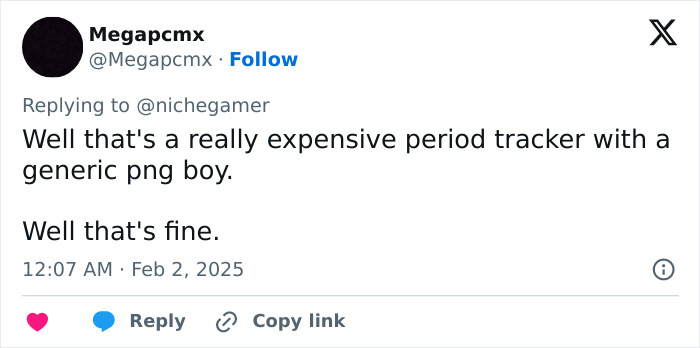
Image credits: Megapcmx
Image credits: Proskillzs81621
Image credits: Shaddonius
Image credits: LuArt64
Image credits: GlAVENCHY

By entering your email and clicking Subscribe, you're agreeing to let us send you customized marketing messages about us and our advertising partners. You are also agreeing to our Privacy Policy.
Thank you! You've successfully subscribed to newsletters!


Next up in Modern Dystopia: US government uses the data to track possible pregnancies.

They already want their health care to take a more biblical approach
Load More Replies...
Next up in Modern Dystopia: US government uses the data to track possible pregnancies.
They already want their health care to take a more biblical approach
Load More Replies... 
































 No fees, cancel anytime

























3
15