Get Premium
Dark mode theme is available exclusively for premium users. Learn more about the benefits of subscribing.
No fees, cancel anytime.

 Dark Mode Ad-Free Browsing Unlimited Content
 Ad-Free Browsing Unlimited Content Dark Mode
Join 1.2 million Panda readers who get the best art, memes, and fun stories every week!

Sometimes, being brutally honest isn’t the best life strategy. You might think you’re simply telling the truth, but society has a way of twisting it into something else. However, for people with autism or other social-communication difficulties, honesty isn’t a choice, it’s how they naturally express themselves.
Case in point today’s Original Poster (OP) whose daughter’s brain interprets communication literally, and who had to recently discover that honesty really isn’t always the best policy. As for the OP, she was left wondering if she would be unreasonable if she would be wrong to call it out.
More info: Mumsnet
Image credits: cookie_studio / Freepik (not the actual photo)
Image credits: ThisFairShark
Image credits: EyeEm / Freepik (not the actual photo)
Image credits: ThisFairShark
Image credits: stockking / Freepik (not the actual photo)
Image credits: ThisFairShark
The OP noted that her daughter has long struggled to interpret social cues due to autism and is explicitly stated in her support plan. However, during a recent science class, her daughter wasn’t entirely focused on the lesson. Sensing her inattention, the teacher asked if she was bored to which responded honestly that she was.
Her classmates burst into laughter, and for that, her daughter was handed a lunchtime detention scheduled for the following week. The OP knew that her daughter had no intention of being rude, and that simply lacked the instinctive social awareness to read subtle cues that neurotypical students often pick up on automatically.
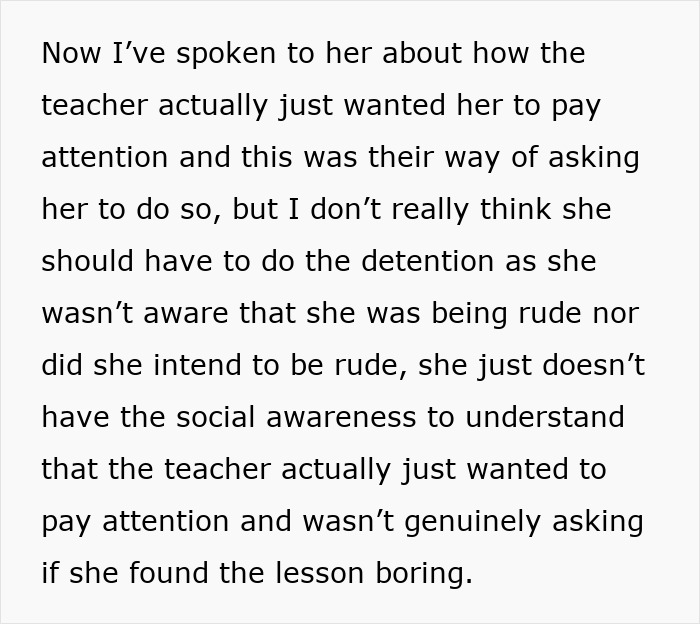
She explained to her daughter afterwards that the teacher’s question was really just a way of saying “pay attention”. Yet, the detention remained on the books, and that felt a bit unfair after all, her daughter’s behavior wasn’t intentional, malicious, or defiant.
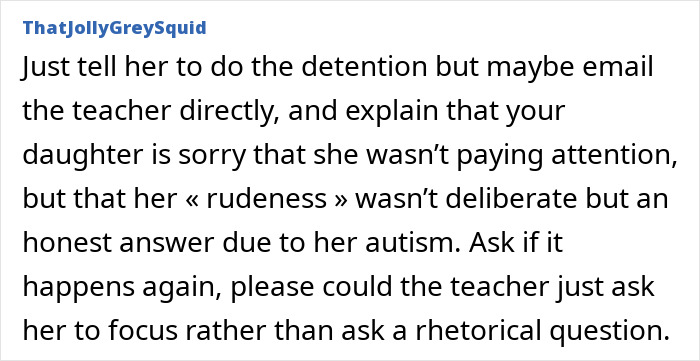
This left her wondering if she would be unreasonable to contact the school, loop in the Special Educational Needs and Disabilities (SEND) team, and ask the staff to give clearer, more literal instructions in the future.
Image credits: garetsvisual / Freepik (not the actual photo)
Autistic children or those with social-communication difficulties often experience challenges in interpreting social cues, including tone, facial expressions, or implied meaning. As Simply Psychology notes, responses that may seem rude can actually reflect differences in social awareness rather than intentional defiance. Therefore, honest responses can easily be misinterpreted by neurotypical peers or adults.
However, this is where the role of a school’s support system becomes crucial. Teachwire explains that Special Educational Needs Coordinators (SENCOs) oversee a school’s approach to supporting pupils with special educational needs or disabilities (SEND). They coordinate tailored support plans, ensure interventions meet individual requirements, and act as a bridge between teachers, parents, and external specialists.
Effective communication strategies are equally important in preventing misunderstandings. According to Autism Speaks, instructions for autistic students should use clear, concise language and short sentences, avoiding vague or abstract terms. In fact, they recommend positive phrasing to help students understand expectations more clearly.
For example, in the OP’s daughter’s case, a teacher explicitly asking her to “pay attention” instead of phrasing it indirectly as a rhetorical question could have avoided the confusion that led to the lunchtime detention.
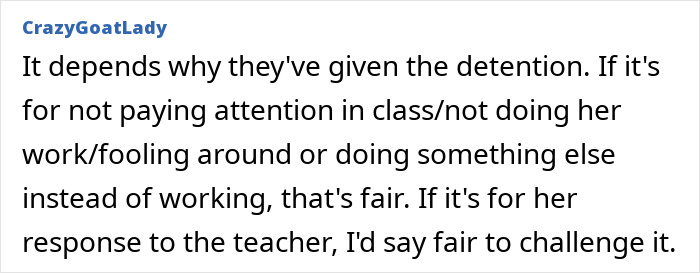
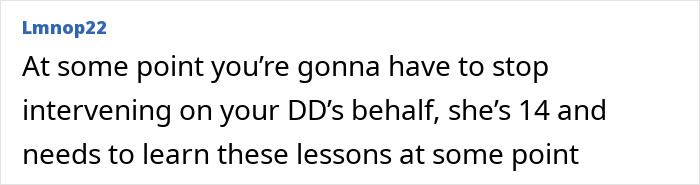
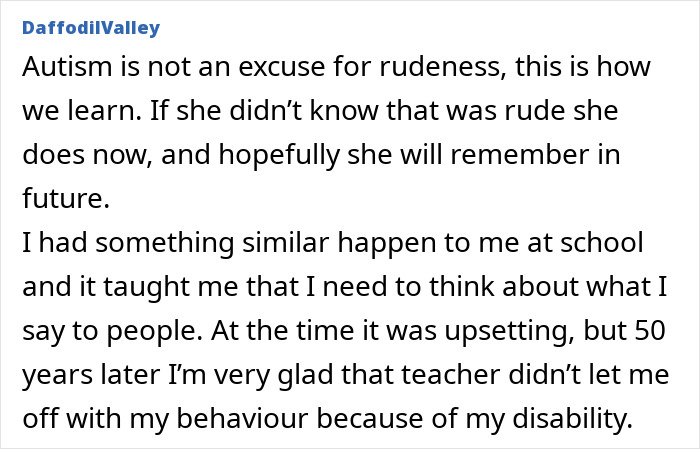
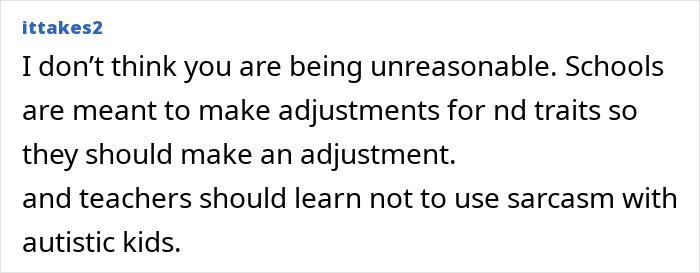
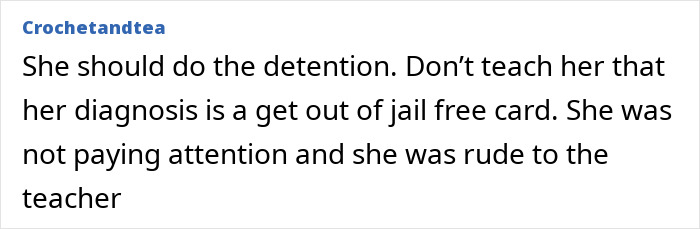
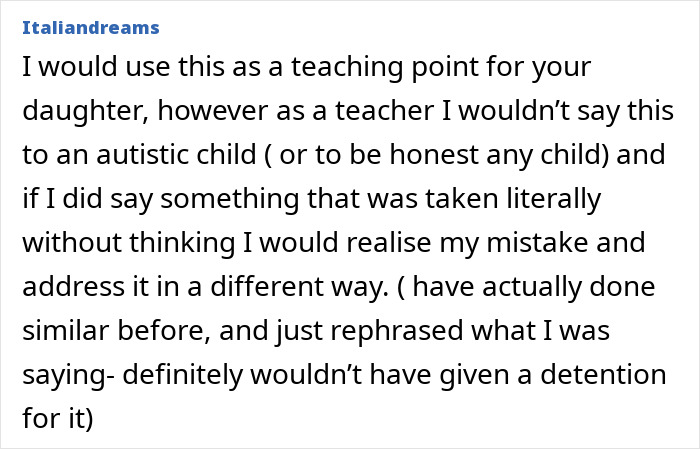
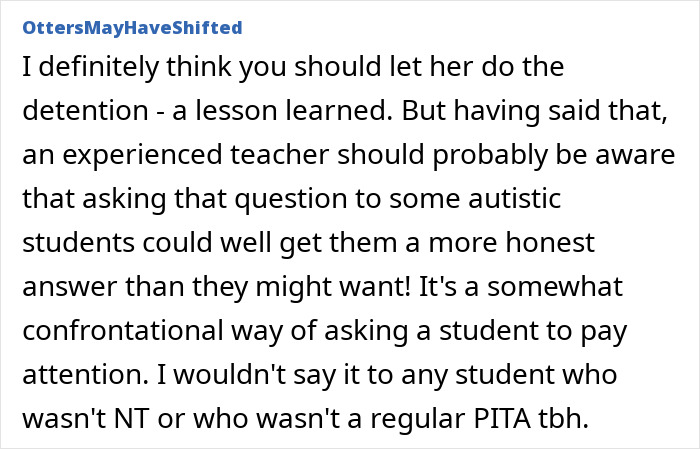
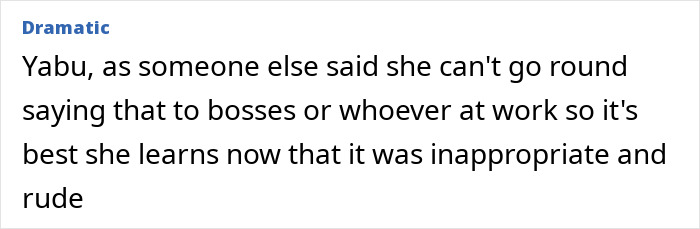
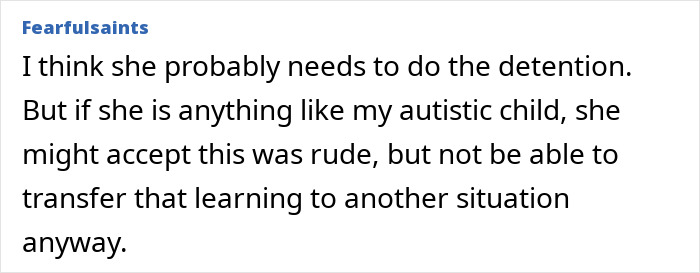
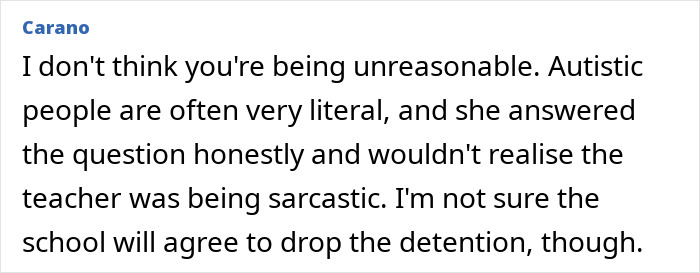
Netizens felt strongly that the detention was appropriate, emphasizing that the OP’s daughter’s honesty doesn’t excuse rudeness. They noted that learning social boundaries early is important, especially before entering the workplace. They also suggested handling the situation with some nuance, acknowledging her autism while still addressing the behavior.
What do you think about this situation? Do you think the detention was fair, or should intent matter more than the outcome? We would love to know your thoughts!

By entering your email and clicking Subscribe, you're agreeing to let us send you customized marketing messages about us and our advertising partners. You are also agreeing to our Privacy Policy.
Thank you! You've successfully subscribed to newsletters!


Sounds like a lot of the comments are from people who have little or no understanding of Autism. I'm no expert either, but at least I know that those saying "now she knows" and "lesson learned" are completely clueless. If an autistic child could just 'learn their lesson" and suddenly understand sarcasm then they would not be autistic.

Yeah, for a lot of autistic people, they may learn that you shouldn't admit that someone is boring you, and then they will never admit that again, even when honesty is called for. But for a lot they won't be able apply learning that to other similar social interactions. Do we give them detention very day?
Load More Replies...
I'm autistic and even after nearly 40 years of living with it I still blurt things I subsequently realise I shouldn't have said. It's almost like a compulsion. And if I were that teacher I'd have just laughed and maybe issued a mild scolding. Detention is taking it way too far.

I'd genuinely like to ask that teacher what she expected the student to say. You ask a smartass question - chances are you'll get a smartass (or in this case, unintentionally sassy) answer.
Load More Replies...
Back in the day when I was 15 (1969) and 6ft tall. I had a little bully of a teacher who one day picked on me for no other reason than he wanted to make some sort of example of me. He said are you bored in my class? I replied, well yes our previous History teacher made the subject interesting. He picked up a cane he had on his desk (yes it was still a thing) and walked towards me. I said you touch me with that and I will punch your lights out and my father will probably come down here and do worse. He told me to sit down and then literally never spoke to me again. F##k you Mr Thomas you tiny Tw@t.

Good on you (I don't mean this sarcastically; I know it can be hard to tell at times). Serves him right.
Load More Replies...
These neurotypicals *really* have a problem with communication. If you want to a child to pay attention in class, then tell them to pay attention. Don't ask stupid questions like, "Am I boring you?" and then take the huff when an honest answer is given.
"Neurotypical" is irrelevant, unless you could show that non-neurotypical people would be any less prone to this.
Load More Replies...
As a teacher, I would feel responsible of relieving any student of their boredom. There are pleasant ways of doing this, and then there are the ways that always work. It may be that my students were rarely bored because there was always the question "What is that random lunatic going to say or do next?" to perk up the interest level.

She wasn't rude, she wasn't mean. Any educator who would ask an autistic kid if they are ebored deserves whatever answer they give. I would argue saying "a little" was her softening th answer and being kind. If you can't keep your class paying attention, that's on the educators not the student.
Right? If your students are all bored, that's a *you* problem. I mean, there's always going to be the odd kid that is bored (especially if it's a compulsory subject), but if most/all the kids are bored, that's definitely on the teacher and good teachers do not have that problem. I have had both (as I'm sure many of us have), and with teachers the awesome ones stick in your head just as much as the trash ones do. I remember the maths teacher that made my life hell in years 7-10 at high school because he was shit as much as I remember my teacher in grade 6 (I was in a grade 3, 4, 5, 6 class. Tell me how many teachers could pull that off, let alone pull it off well) being amazing. It was only until years later I found out my awesome teacher is actually an extremely distant relative. 😆 She's now got a doctorate in teaching and is lecturing -- my friend had her as a lecturer and loved her. I'm so proud of her. ❤️
Load More Replies... So she's being punished for something she didn't understand was wrong? Maybe... explain why it was wrong instead of punishing her? It's sort of like the people who push their dogs' noses into their poop when they do it in the wrong spot. The dog doesn't (generally) know what they've done wrong, the only thing they get from the interaction is that their owner is cruel/abusive. Man, this makes me feel for the OP's daughter. (Edit: POOP AND ABUSIVE, BP. POOP AND ABUSIVE.)

Sometimes... sometimes... teachers really ask for it. In the middle of an argument about something (it's been decades, I don't remember what), a teacher yelled "Do I look stupid to you?". The answer he got was not the one he was expecting. The only thing that saved me from a lifetime of detention was that it was a special needs school so, yeah, don't ask a question if you don't want a brutally honest answer. ;)



Well she didn't knew that her answer would be perceived as rude, now she knows so if that happens again in the future then detention is fine, but right now it was an honest mistake and I don't think she should be punished for not knowing a social cue nobody taught her existed. It's like sipping your drink loudly, if you don't know that it's rude to do in some countries then why should you be punished for doing it unknowingly ?

Nowhere in the article is it acknowledged that the teacher was being rude! Targeting a student with sarcasm is just nasty. I taught in the NYC school system for 10 years , and if I saw a student who seemed uninterested (but was not being disruptive), I'd try to engage them in some way. Making snarky remarks is not a good model for how we want students to behave towards teachers and each other.

I'd also like to add - the child isn't going to learn anything from detention. All this experience will teach her is to be hesitant to answer questions. So, the next time an adult acts her a question and she's not sure - that adult may not get an honest answer, if they get one at all.
I'm almost 40 and am still baffled by rhetorical questions. Last time was over the holidays - I'd arrived sick and on medication and spent four nights in my brother's spare room. His wife asked me to take the bedding down to the laundry room. When my brother caught me he said "C'mon do you really think they need to be washed?" I started to answer that I was sick and had asked his wife - and he told me he didn't want to argue and walked away. AH! How else was the student supposed to answer that question? If she said "No, I'm not bored," the teacher might've called her out again. If she didn't answer - the teacher would've said "Well, answer me." As an Audhd adult I would've recognized the tone (on a good day, hopefully) and apologized. But a 14 year old? Understanding that it's a rhetorical question and the teacher isn't looking for an answer? The teacher was intentionally being sassy, and it backfired on her because the student didn't recognize a rhetorical question. A simple "(student's name) please pay attention" would've sufficed.
The teacher was displaying inability to communicate appropriately with persons with autism. A wise teacher would realize that they had a responsibility to make instruction more engaging. Students are able to understand that some classmates with autism cannot ethically be held to all the same standards as they themselves must be. A teacher who doesn't know that needs more training.


Teacher was being a smart-a*s jerk. "Am I boring you?" F F S, don't ask leading questions, or questions you don't want answers to. The child was not "rude". Rude would have been "Yes, you dreary old wind-bag, you were holding forth at length on nothing and I am not learning anything at all." She told the honest truth, and to the teacher, that should have been a clue that their teaching content/style is not universally engaging.


No. Detention is warranted, both because she wasn't paying attention and her response. She'll be more likely to remember next time if there's consequences this time.
How is her response a punishable thing is she didn't knew it was a rude thing to say ? And detention for not paying attention in class is a bit harsh, we've all had our moments.
Load More Replies... She should do the detention. The goal for her is to be able to integrate well with other people throughout her life, right? So, this extraordinarily minor consequence (a single detention) is an easy thing to experience to let her know that there are consequences for rudeness even when she didn't intend it.
And exactly what lesson do you think was learned here? Most likely "never admit to being bored". So most likely she will never admit to being bored even when that question is asked genuinely. Also, why is it only us ND's that has to adapt our behavior to the rest and not meeting somewhere in between?
Load More Replies...
Interesting range of opinions. Seemingly, rudeness isn't rude if: a) you're not aware of it, and b) you're "just being honest". I'm looking forward to trying this out at work next week.
Nobody likes a wanker. You (should, at least) know that whilst it doesn't allow people to get away with murder, autism changes the way people see things and interpret things. There is a huge difference between someone genuinely being unaware due to autism (a protected disability, at least in Australia, by the way) and someone just being deliberately obnoxious/obtuse (eg: your post).
Load More Replies...
Lee, she was not rude. Her teacher asked a question. She answered it honestly. The teacher was in the wrong to use sarcasm on an autistic child. It's the job of the teacher to know better. - - - I'm so sick of schools traumatising autistic children.
Load More Replies... Sounds like a lot of the comments are from people who have little or no understanding of Autism. I'm no expert either, but at least I know that those saying "now she knows" and "lesson learned" are completely clueless. If an autistic child could just 'learn their lesson" and suddenly understand sarcasm then they would not be autistic.
Yeah, for a lot of autistic people, they may learn that you shouldn't admit that someone is boring you, and then they will never admit that again, even when honesty is called for. But for a lot they won't be able apply learning that to other similar social interactions. Do we give them detention very day?
Load More Replies... I'm autistic and even after nearly 40 years of living with it I still blurt things I subsequently realise I shouldn't have said. It's almost like a compulsion. And if I were that teacher I'd have just laughed and maybe issued a mild scolding. Detention is taking it way too far.
I'd genuinely like to ask that teacher what she expected the student to say. You ask a smartass question - chances are you'll get a smartass (or in this case, unintentionally sassy) answer.
Load More Replies... Back in the day when I was 15 (1969) and 6ft tall. I had a little bully of a teacher who one day picked on me for no other reason than he wanted to make some sort of example of me. He said are you bored in my class? I replied, well yes our previous History teacher made the subject interesting. He picked up a cane he had on his desk (yes it was still a thing) and walked towards me. I said you touch me with that and I will punch your lights out and my father will probably come down here and do worse. He told me to sit down and then literally never spoke to me again. F##k you Mr Thomas you tiny Tw@t.
Good on you (I don't mean this sarcastically; I know it can be hard to tell at times). Serves him right.
Load More Replies... These neurotypicals *really* have a problem with communication. If you want to a child to pay attention in class, then tell them to pay attention. Don't ask stupid questions like, "Am I boring you?" and then take the huff when an honest answer is given.
"Neurotypical" is irrelevant, unless you could show that non-neurotypical people would be any less prone to this.
Load More Replies... As a teacher, I would feel responsible of relieving any student of their boredom. There are pleasant ways of doing this, and then there are the ways that always work. It may be that my students were rarely bored because there was always the question "What is that random lunatic going to say or do next?" to perk up the interest level.
She wasn't rude, she wasn't mean. Any educator who would ask an autistic kid if they are ebored deserves whatever answer they give. I would argue saying "a little" was her softening th answer and being kind. If you can't keep your class paying attention, that's on the educators not the student.
Right? If your students are all bored, that's a *you* problem. I mean, there's always going to be the odd kid that is bored (especially if it's a compulsory subject), but if most/all the kids are bored, that's definitely on the teacher and good teachers do not have that problem. I have had both (as I'm sure many of us have), and with teachers the awesome ones stick in your head just as much as the trash ones do. I remember the maths teacher that made my life hell in years 7-10 at high school because he was shit as much as I remember my teacher in grade 6 (I was in a grade 3, 4, 5, 6 class. Tell me how many teachers could pull that off, let alone pull it off well) being amazing. It was only until years later I found out my awesome teacher is actually an extremely distant relative. 😆 She's now got a doctorate in teaching and is lecturing -- my friend had her as a lecturer and loved her. I'm so proud of her. ❤️
Load More Replies... So she's being punished for something she didn't understand was wrong? Maybe... explain why it was wrong instead of punishing her? It's sort of like the people who push their dogs' noses into their poop when they do it in the wrong spot. The dog doesn't (generally) know what they've done wrong, the only thing they get from the interaction is that their owner is cruel/abusive. Man, this makes me feel for the OP's daughter. (Edit: POOP AND ABUSIVE, BP. POOP AND ABUSIVE.)
Sometimes... sometimes... teachers really ask for it. In the middle of an argument about something (it's been decades, I don't remember what), a teacher yelled "Do I look stupid to you?". The answer he got was not the one he was expecting. The only thing that saved me from a lifetime of detention was that it was a special needs school so, yeah, don't ask a question if you don't want a brutally honest answer. ;)
Well she didn't knew that her answer would be perceived as rude, now she knows so if that happens again in the future then detention is fine, but right now it was an honest mistake and I don't think she should be punished for not knowing a social cue nobody taught her existed. It's like sipping your drink loudly, if you don't know that it's rude to do in some countries then why should you be punished for doing it unknowingly ?
Nowhere in the article is it acknowledged that the teacher was being rude! Targeting a student with sarcasm is just nasty. I taught in the NYC school system for 10 years , and if I saw a student who seemed uninterested (but was not being disruptive), I'd try to engage them in some way. Making snarky remarks is not a good model for how we want students to behave towards teachers and each other.
I'd also like to add - the child isn't going to learn anything from detention. All this experience will teach her is to be hesitant to answer questions. So, the next time an adult acts her a question and she's not sure - that adult may not get an honest answer, if they get one at all.
I'm almost 40 and am still baffled by rhetorical questions. Last time was over the holidays - I'd arrived sick and on medication and spent four nights in my brother's spare room. His wife asked me to take the bedding down to the laundry room. When my brother caught me he said "C'mon do you really think they need to be washed?" I started to answer that I was sick and had asked his wife - and he told me he didn't want to argue and walked away. AH! How else was the student supposed to answer that question? If she said "No, I'm not bored," the teacher might've called her out again. If she didn't answer - the teacher would've said "Well, answer me." As an Audhd adult I would've recognized the tone (on a good day, hopefully) and apologized. But a 14 year old? Understanding that it's a rhetorical question and the teacher isn't looking for an answer? The teacher was intentionally being sassy, and it backfired on her because the student didn't recognize a rhetorical question. A simple "(student's name) please pay attention" would've sufficed.
The teacher was displaying inability to communicate appropriately with persons with autism. A wise teacher would realize that they had a responsibility to make instruction more engaging. Students are able to understand that some classmates with autism cannot ethically be held to all the same standards as they themselves must be. A teacher who doesn't know that needs more training.
Teacher was being a smart-a*s jerk. "Am I boring you?" F F S, don't ask leading questions, or questions you don't want answers to. The child was not "rude". Rude would have been "Yes, you dreary old wind-bag, you were holding forth at length on nothing and I am not learning anything at all." She told the honest truth, and to the teacher, that should have been a clue that their teaching content/style is not universally engaging.
No. Detention is warranted, both because she wasn't paying attention and her response. She'll be more likely to remember next time if there's consequences this time.
How is her response a punishable thing is she didn't knew it was a rude thing to say ? And detention for not paying attention in class is a bit harsh, we've all had our moments.
Load More Replies... She should do the detention. The goal for her is to be able to integrate well with other people throughout her life, right? So, this extraordinarily minor consequence (a single detention) is an easy thing to experience to let her know that there are consequences for rudeness even when she didn't intend it.
And exactly what lesson do you think was learned here? Most likely "never admit to being bored". So most likely she will never admit to being bored even when that question is asked genuinely. Also, why is it only us ND's that has to adapt our behavior to the rest and not meeting somewhere in between?
Load More Replies... Interesting range of opinions. Seemingly, rudeness isn't rude if: a) you're not aware of it, and b) you're "just being honest". I'm looking forward to trying this out at work next week.
Nobody likes a wanker. You (should, at least) know that whilst it doesn't allow people to get away with murder, autism changes the way people see things and interpret things. There is a huge difference between someone genuinely being unaware due to autism (a protected disability, at least in Australia, by the way) and someone just being deliberately obnoxious/obtuse (eg: your post).
Load More Replies... Lee, she was not rude. Her teacher asked a question. She answered it honestly. The teacher was in the wrong to use sarcasm on an autistic child. It's the job of the teacher to know better. - - - I'm so sick of schools traumatising autistic children.
Load More Replies...
























 No fees, cancel anytime
 then open in external browser


 and click "Open in External Browser"














34
42