Get Premium
Dark mode theme is available exclusively for premium users. Learn more about the benefits of subscribing.
No fees, cancel anytime.

 Dark Mode Ad-Free Browsing Unlimited Content
 Ad-Free Browsing Unlimited Content Dark Mode
Join 1.2 million Panda readers who get the best art, memes, and fun stories every week!

Sometimes, being brutally honest isn’t the best life strategy. You might think you’re simply telling the truth, but society has a way of twisting it into something else. However, for people with autism or other social-communication difficulties, honesty isn’t a choice, it’s how they naturally express themselves.
Case in point today’s Original Poster (OP) whose daughter’s brain interprets communication literally, and who had to recently discover that honesty really isn’t always the best policy. As for the OP, she was left wondering if she would be unreasonable if she would be wrong to call it out.
More info: Mumsnet
Image credits: cookie_studio / Freepik (not the actual photo)
Image credits: ThisFairShark
Image credits: EyeEm / Freepik (not the actual photo)
Image credits: ThisFairShark
Image credits: stockking / Freepik (not the actual photo)
Image credits: ThisFairShark
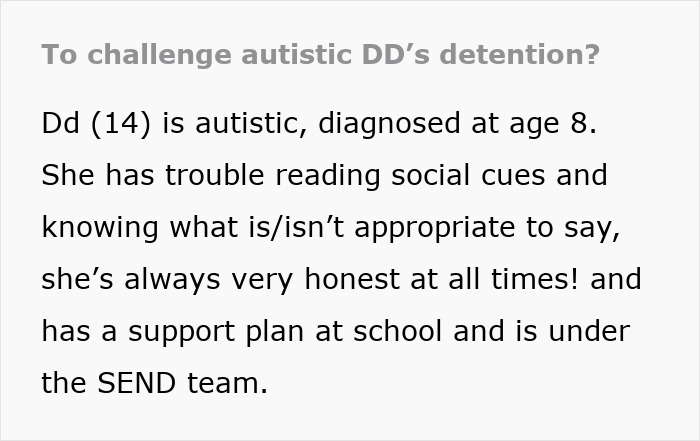
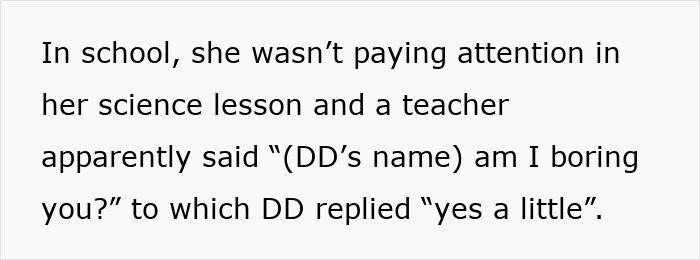
The OP noted that her daughter has long struggled to interpret social cues due to autism and is explicitly stated in her support plan. However, during a recent science class, her daughter wasn’t entirely focused on the lesson. Sensing her inattention, the teacher asked if she was bored to which responded honestly that she was.
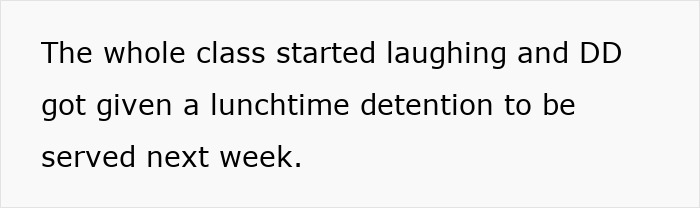
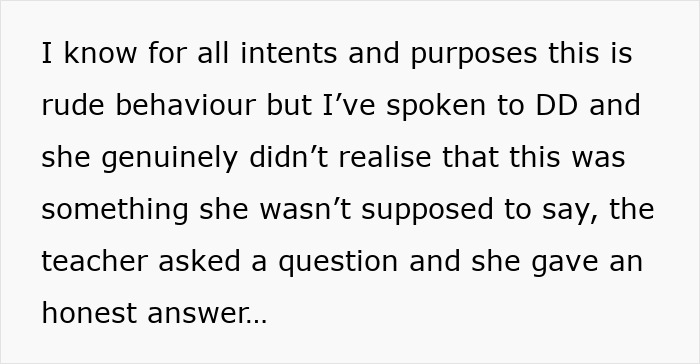
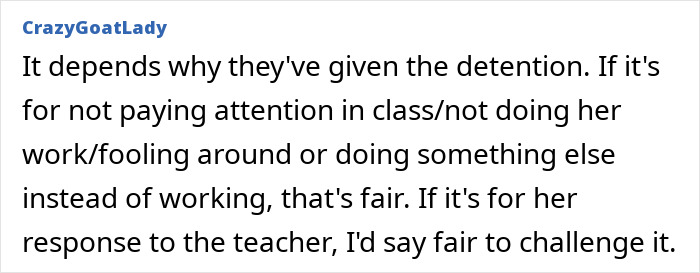
Her classmates burst into laughter, and for that, her daughter was handed a lunchtime detention scheduled for the following week. The OP knew that her daughter had no intention of being rude, and that simply lacked the instinctive social awareness to read subtle cues that neurotypical students often pick up on automatically.
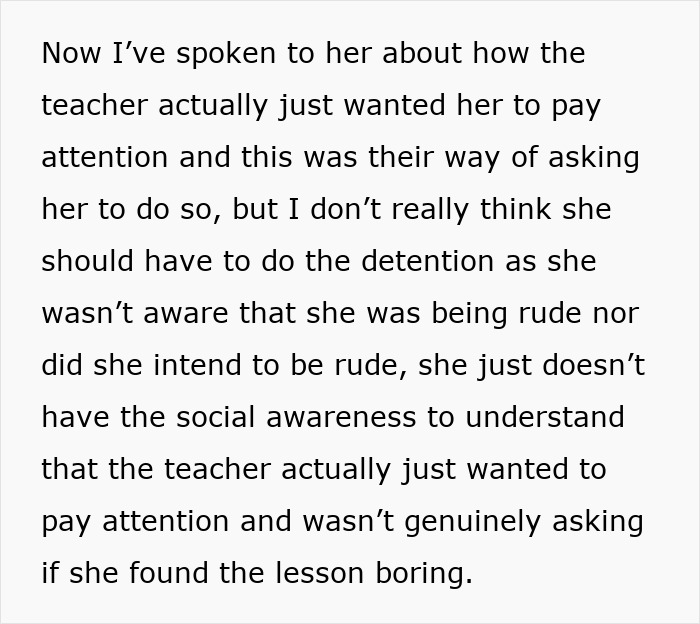
She explained to her daughter afterwards that the teacher’s question was really just a way of saying “pay attention”. Yet, the detention remained on the books, and that felt a bit unfair after all, her daughter’s behavior wasn’t intentional, malicious, or defiant.
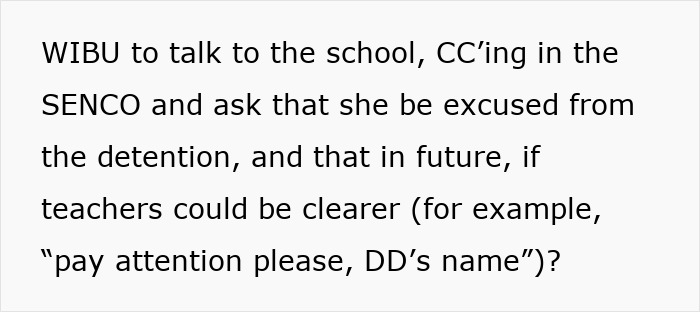
This left her wondering if she would be unreasonable to contact the school, loop in the Special Educational Needs and Disabilities (SEND) team, and ask the staff to give clearer, more literal instructions in the future.
Image credits: garetsvisual / Freepik (not the actual photo)
Autistic children or those with social-communication difficulties often experience challenges in interpreting social cues, including tone, facial expressions, or implied meaning. As Simply Psychology notes, responses that may seem rude can actually reflect differences in social awareness rather than intentional defiance. Therefore, honest responses can easily be misinterpreted by neurotypical peers or adults.
However, this is where the role of a school’s support system becomes crucial. Teachwire explains that Special Educational Needs Coordinators (SENCOs) oversee a school’s approach to supporting pupils with special educational needs or disabilities (SEND). They coordinate tailored support plans, ensure interventions meet individual requirements, and act as a bridge between teachers, parents, and external specialists.
Effective communication strategies are equally important in preventing misunderstandings. According to Autism Speaks, instructions for autistic students should use clear, concise language and short sentences, avoiding vague or abstract terms. In fact, they recommend positive phrasing to help students understand expectations more clearly.
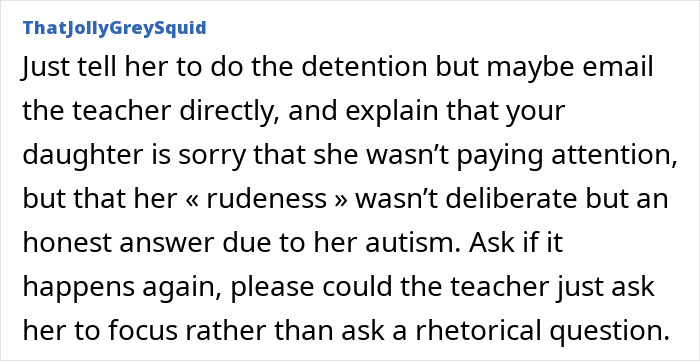
For example, in the OP’s daughter’s case, a teacher explicitly asking her to “pay attention” instead of phrasing it indirectly as a rhetorical question could have avoided the confusion that led to the lunchtime detention.
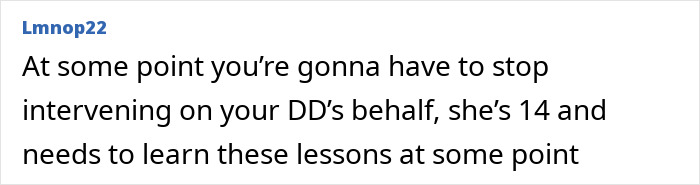
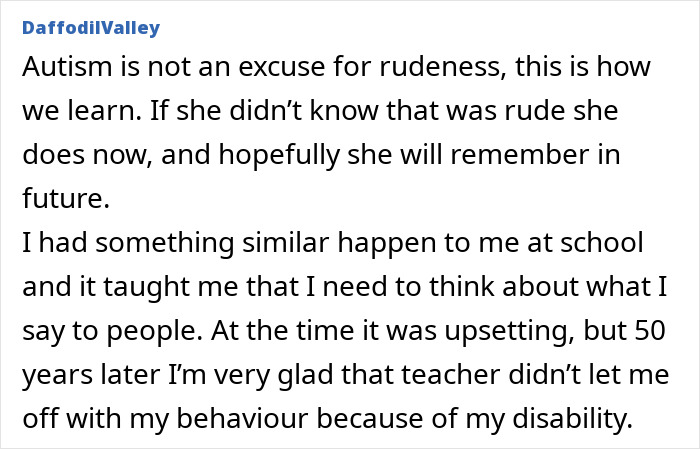
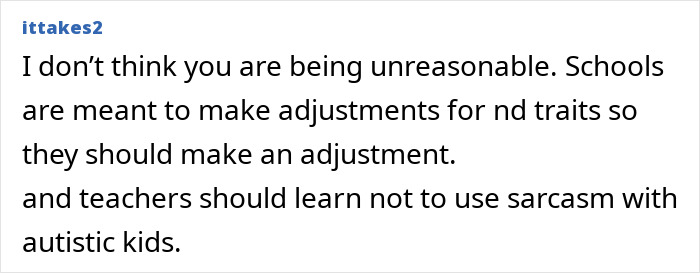
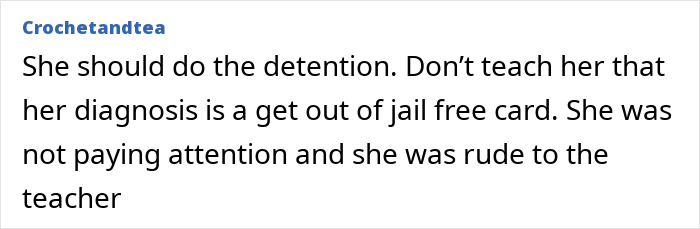
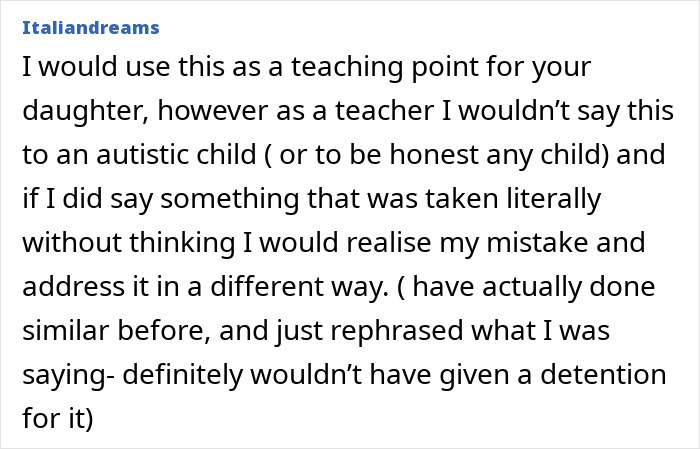
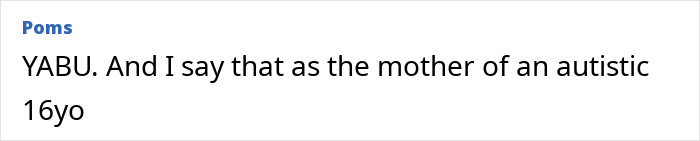
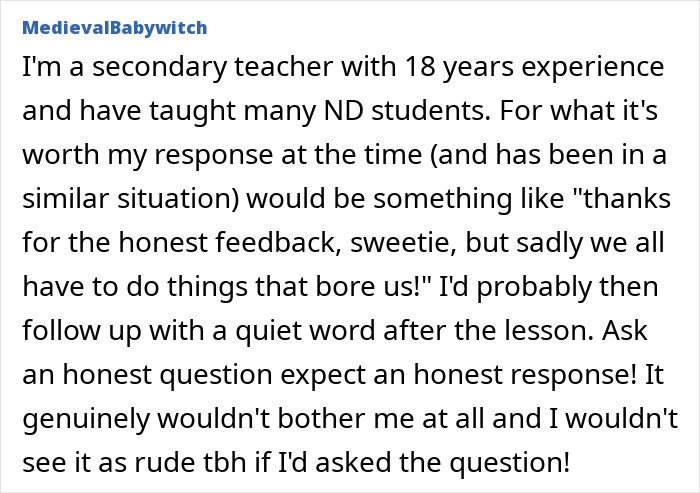
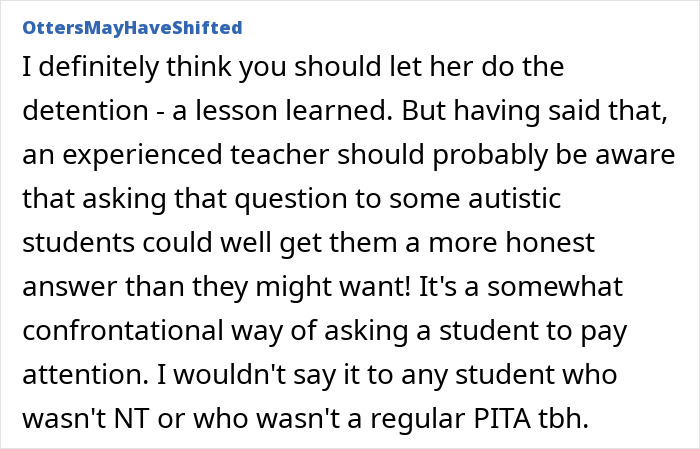
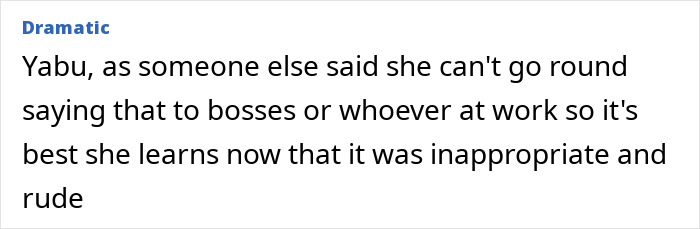
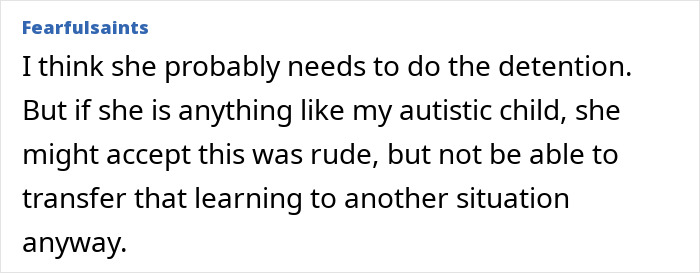
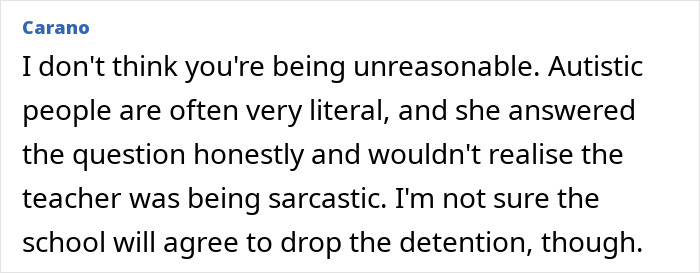
Netizens felt strongly that the detention was appropriate, emphasizing that the OP’s daughter’s honesty doesn’t excuse rudeness. They noted that learning social boundaries early is important, especially before entering the workplace. They also suggested handling the situation with some nuance, acknowledging her autism while still addressing the behavior.
What do you think about this situation? Do you think the detention was fair, or should intent matter more than the outcome? We would love to know your thoughts!

By entering your email and clicking Subscribe, you're agreeing to let us send you customized marketing messages about us and our advertising partners. You are also agreeing to our Privacy Policy.
Thank you! You've successfully subscribed to newsletters!


Sounds like a lot of the comments are from people who have little or no understanding of Autism. I'm no expert either, but at least I know that those saying "now she knows" and "lesson learned" are completely clueless. If an autistic child could just 'learn their lesson" and suddenly understand sarcasm then they would not be autistic.

Yeah, for a lot of autistic people, they may learn that you shouldn't admit that someone is boring you, and then they will never admit that again, even when honesty is called for. But for a lot they won't be able apply learning that to other similar social interactions. Do we give them detention very day?
Load More Replies...
I'm autistic and even after nearly 40 years of living with it I still blurt things I subsequently realise I shouldn't have said. It's almost like a compulsion. And if I were that teacher I'd have just laughed and maybe issued a mild scolding. Detention is taking it way too far.

I'd genuinely like to ask that teacher what she expected the student to say. You ask a smartass question - chances are you'll get a smartass (or in this case, unintentionally sassy) answer.
Load More Replies...
Back in the day when I was 15 (1969) and 6ft tall. I had a little bully of a teacher who one day picked on me for no other reason than he wanted to make some sort of example of me. He said are you bored in my class? I replied, well yes our previous History teacher made the subject interesting. He picked up a cane he had on his desk (yes it was still a thing) and walked towards me. I said you touch me with that and I will punch your lights out and my father will probably come down here and do worse. He told me to sit down and then literally never spoke to me again. F##k you Mr Thomas you tiny Tw@t.

Good on you (I don't mean this sarcastically; I know it can be hard to tell at times). Serves him right.
Load More Replies... Sounds like a lot of the comments are from people who have little or no understanding of Autism. I'm no expert either, but at least I know that those saying "now she knows" and "lesson learned" are completely clueless. If an autistic child could just 'learn their lesson" and suddenly understand sarcasm then they would not be autistic.
Yeah, for a lot of autistic people, they may learn that you shouldn't admit that someone is boring you, and then they will never admit that again, even when honesty is called for. But for a lot they won't be able apply learning that to other similar social interactions. Do we give them detention very day?
Load More Replies... I'm autistic and even after nearly 40 years of living with it I still blurt things I subsequently realise I shouldn't have said. It's almost like a compulsion. And if I were that teacher I'd have just laughed and maybe issued a mild scolding. Detention is taking it way too far.
I'd genuinely like to ask that teacher what she expected the student to say. You ask a smartass question - chances are you'll get a smartass (or in this case, unintentionally sassy) answer.
Load More Replies... Back in the day when I was 15 (1969) and 6ft tall. I had a little bully of a teacher who one day picked on me for no other reason than he wanted to make some sort of example of me. He said are you bored in my class? I replied, well yes our previous History teacher made the subject interesting. He picked up a cane he had on his desk (yes it was still a thing) and walked towards me. I said you touch me with that and I will punch your lights out and my father will probably come down here and do worse. He told me to sit down and then literally never spoke to me again. F##k you Mr Thomas you tiny Tw@t.
Good on you (I don't mean this sarcastically; I know it can be hard to tell at times). Serves him right.
Load More Replies...
























 No fees, cancel anytime











35
45