Get Premium
Dark mode theme is available exclusively for premium users. Learn more about the benefits of subscribing.
No fees, cancel anytime.

 Dark Mode Ad-Free Browsing Unlimited Content
 Ad-Free Browsing Unlimited Content Dark Mode
Join 1.2 million Panda readers who get the best art, memes, and fun stories every week!
While Hollywood heavyweights like Leonardo DiCaprio and Michael B. Jordan drive the hype for high-budget blockbusters, there’s an unsung hero actually gluing you to your seat: the environment.
From the glimmering, sprawling sets of Wicked: For Good to the haunting, claustrophobic atmosphere of Sinners, production and sound design do more heavy lifting than the average moviegoer realizes.
This is the core that turns a run-of-the-mill production into a record-breaking box office hit. An army of artists works behind the scenes so you don’t just watch a film – you feel it.
With the 98th Academy Awards right around the corner, we’re looking back at the stellar sets and thunderous sound effects that rocked the movie-watching experience for 2025’s biggest hits.
View this post on Instagram
If you really think about it, production design is the force that anchors an actor into a character by embedding them into a meticulously imagined world.
From minuscule details to cleverly tucked-away Easter eggs, the attention to detail required to make a premise authentic is an art in itself.
Often, production designers look past the aesthetic brief to find inspiration in elements that hold symbolic value. Sinners’ production designer, Hannah Beachler, shared with Variety that the film was more than just a vampire movie; it was a blend of folklore, spirituality, history, and culture that the team had to weave into the very fabric of the sets.
In 2025’s standout hits like Sinners and Frankenstein, world-building isn’t just about big, extravagant sets; it’s about creating physical textures. For the juke joint in Sinners, where a significant chunk of the action takes place, Beachler wanted to achieve a very specific rusty look.
Rather than opting for digital shortcuts, the team took eight weeks to build the set by applying multiple coats of paint and boric acid to chemically rust the metal sheets’ exteriors. The carpenters and scenic artists on set also transformed surrounding trees to look weathered and worn by torching, sanding, staining, painting, and chemically distressing the wood.
Collaborating with set decorator Monique Champagne, Beachler brought the 1930s setting to life by obsessing over the era’s craftsmanship and design language, from the vibrant colors to the wood’s unique patina. As she told Architectural Digest, “With the architecture and the set decoration, there is so much texture and detail that is part of the Southern tradition.”
This focus wasn’t just for show. She used these textures to underscore the social hardships faced by residents in the Jim Crow era, creating stark contrasts between the different sides of town.
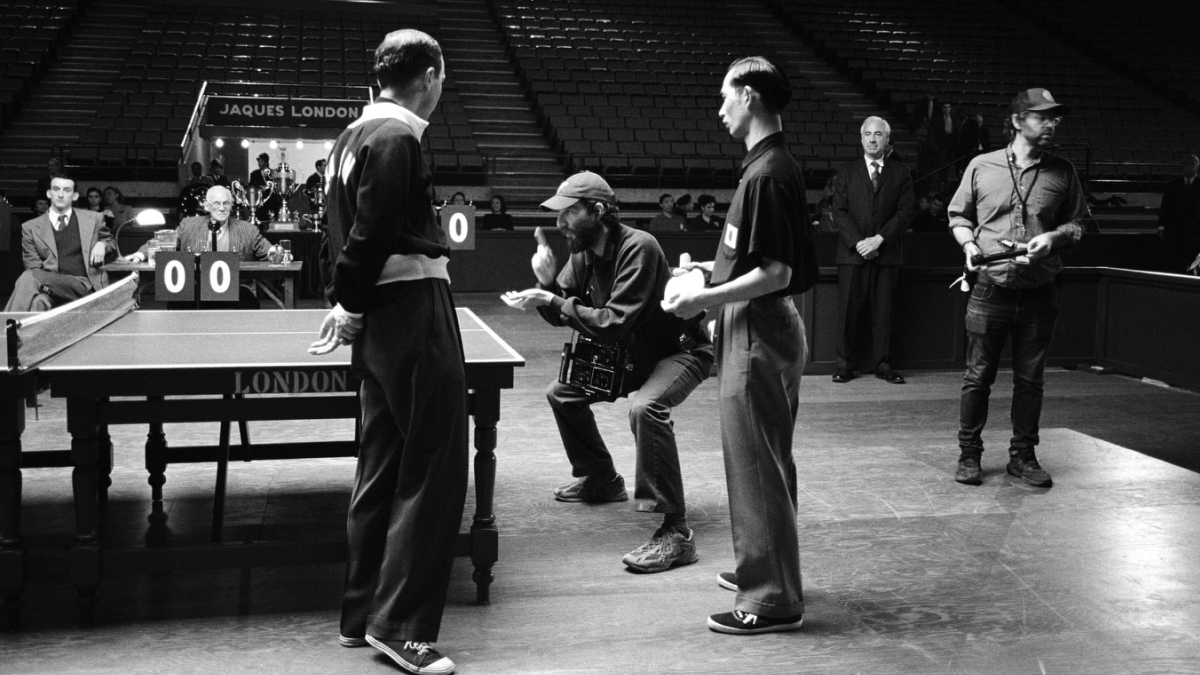
Subtlety is what truly anchors a film’s credibility, and no one does it better than Oscar-nominated production designer Jack Fisk. Drawing on his legendary work on films like There Will Be Blood, The Revenant, and Killers of the Flower Moon, Fisk brought meticulous realism to the set of Marty Supreme.
To recreate the 1950s New York of ping-pong legend Marty Reisman, Fisk tracked down the original architectural plans to replicate Lawrence’s Table Tennis Club, a historic speakeasy in Midtown Manhattan. His dedication to the era extended to the downtown storefronts, where he even drew inspiration from his childhood to recreate the retro equipment and signage.
From locating the original plans to replicate the Lawrence’s Table Tennis Club – a black-owned, Prohibition-era speakeasy located in Midtown Manhattan — frequented by Marty Reisman, to taking inspiration for retro equipment from his own childhood to re-create downtown stores of 1950s New York.
Fisk didn’t leave any stone unturned, proving that even the most minute details can make a world from seventy years ago feel entirely real (via Architectural Digest).
If you want to test the power of sound in film, try watching a gruesome horror on mute. There’s nothing that kills the tension faster than a horror movie stripped of its eerie sound effects, or an action sequence missing the punch of crisp fighting tracks.
In the hands of a maestro, sound effects do more than just accompany the image. They evoke emotions and act as a catalyst for the entire screenplay.
View this post on Instagram
Foley artists create custom audio during post-production that adds an essential layer of oomph to the visuals.
For the sci-fi epic Mickey 17, director Bong Joon Ho reunited with the South Korea-based veteran Ralph Tae-Young Choi to create the unique vocalizations of Mama Creeper and Baby Creeper.
Choi meticulously organized a library of animal recordings to design these otherworldly sounds, which proved vital to the film’s immersive success. The duo brought a seasoned prowess to the project, having previously collaborated on Parasite, Okja, and Snowpiercer.
The sound of the human printer crafted by sound designer Eilam Hoffman was a mechanical nightmare built from processed recordings of EMF signals, piston pumps, and the rhythmic hum of a 3D printer (via A Sound Effect).
Taking the notion of invisibility quite literally, sound designers often use infrasound, waves below 20 Hz, to instill subconscious sensations in the viewers. Because soundwaves at such a low frequency can’t be consciously heard, the body instead feels them as a physical vibration.
Director Joseph Kosinski leveraged this psychological trick to make his Oscar-nominated film, F1, as immersive as possible. He wanted viewers to feel trapped inside the cockpit.
To achieve this, the sound team recreated everything from the turbocharger’s distinct whistle to the chaotic, dirty air turbulence that occurs when following another car.
The challenge was to ensureaudiences felt a physical sense of danger without letting the engine roar drown out the human emotional core of the story.
Interestingly, they also mastered the opposite of noise by using sudden silences during high-impact crash scenes to evoke a shocked response from the viewer (via Awards Focus).
We live in an era where bad VFX becomes a viral meme, but truly perfect VFX remains entirely invisible.
Whether it is a visual-heavy fantasy like Avatar: Fire and Ash or the more surgical effects found in Sinners and The Lost Bus, well-executed visual effects do more than just create spectacle.
In fact, they anchor the story in a reality we never think to question.
When it comes to modern filmmaking, the most effective VFX are often the ones you don’t even realize are there.
In Joseph Kosinski’s F,1, the production utilized a hybrid approach, in which live-action footage was digitally altered to enhance the raw reality of the track.
Rather than creating racing from scratch, the makers intercut authentic broadcast footage with principal photography to make the high-speed sequences feel more believable. VFX studio Framestore contributed a staggering 1,200 shots to the film, including tasks ranging from reskinning entire scenes to meticulous crowd replication and set extensions.
According to the VFX Supervisor, it was rare to have a shot that simply involved “adding crowd.” Instead, the team had to simultaneously perfect the cars’ visuals and precisely capture the motion blur of the wheels and the environment to ensure every frame felt like it was moving at 200 mph (via VFXV).
We only complain about bad CGI when it breaks the laws of physics or feels uncanny. However, the most successful visual effects of 2025 were those the audience never even realized were digital in the first place.
The best example would be the 1,013 VFX shots in Ryan Coogler’s Sinners. While the film is a supernatural thriller, a massive portion of the digital workload was dedicated to invisible augmentation.
From the expansive cotton fields and CG vultures to the seamless twinning effect that allowed Michael B. Jordan to pass a cigarette to himself as a twin, the goal was to integrate the footage seamlessly. VFX Supervisor Michael Ralla and Cinematographer Autumn Durald Arkapaw adopted an approach of not taking shortcuts.
They went so far as to ensure that glowing vampire eyes mimicked the exact lens aberrations, grain, and diffraction spikes of the 65mm and IMAX film formats they were shooting on (via VFXV).
There’s a lot more to these movie secrets than meets the eye. Beyond the sweeping visuals, there are subtle layers that you may have missed while engrossed in the theatrical experience.
We’ve already established that Sinners is a film deeply rooted in culture, race, and history, but the level of detail goes far beyond standard props. Costume designer Ruth E. Carter treated the project as an “immersive experience,” drawing from paintings and photography from the 1920s and 1930s to capture the authentic style of the Deep South.
Some of the most meticulous detail was reserved for the sharecroppers’ workwear to keep the look authentic and raw. Carter instructed the wardrobe team to avoid professional alterations. As she shared with Harper’s Bazaar, “If something was big, it had to stay big. If something was long, you had to turn the cuff up because that’s what they did.”
Beyond the fit, the team leaned into the gritty texture of the script, ensuring every extra on set looked perpetually sweaty to match the story’s humid atmosphere.
One element that likely escaped the average viewer, but thrilled film purists, was the specific format used to capture Leonardo DiCaprio’s latest performance in One Battle After Another. Director Paul Thomas Anderson took a risk by shooting the critically acclaimed film on the classic VistaVision, a horizontal 35mm film format pioneered in the 1950s.
Because this format runs film through the camera horizontally, it creates a much larger negative area than standard 35mm. Production designer Florencia Martin told The Film Stage this wide-angle format required her to build expansive, 360-degree sets, creating “a playground” for the actors.
The epic landscapes and nerve-wracking car chases benefited from the higher resolution and sharper depth of field provided by the format, resulting in indelible, ultra-crispimages in the unique 1.50:1 frame. To handle the massive scale, Cinematographer Michael Bauman even commissioned custom-built lenses from Panavision designed specifically to cover the oversized film frame (via Kodak).
Ultimately, we’ve established that the most rewarding aspects of a movie are often not just the story, but the singular intent, passion, and exhaustive research that goes into creating a believable end product. These layers of craftsmanship are what allow a project to stay true to the filmmaker’s original vision.
These details aren’t always something a casual viewer will capture during the first viewing in plain sight, but rather the little discoveries that reward those who return for a third or fourth watch.
In an era where films and TV shows are often treated as background noise, the specific frequency of a monster’s growl or the unique vintage apparatus used to film an action sequence are the hidden movie secrets that truly turn a production into a masterpiece.


























 No fees, cancel anytime






26
0