Get Premium
Dark mode theme is available exclusively for premium users. Learn more about the benefits of subscribing.
No fees, cancel anytime.

 Dark Mode Ad-Free Browsing Unlimited Content
 Ad-Free Browsing Unlimited Content Dark Mode
Join 1.2 million Panda readers who get the best art, memes, and fun stories every week!
What started as a cryptocurrency launchpad has now evolved into something critics are calling one of the internet's most dystopian experiments yet.
Pump.fun GO, a newly launched bounty marketplace from crypto platform Pump.fun, allows users to pay strangers to complete virtually any task imaginable in exchange for cash rewards.
The system operates through a simple formula: one user creates a challenge, deposits money into escrow, and another user completes the task and submits proof for approval.
While some bounties involve harmless promotional work or social media engagement, others have quickly veered into far more controversial territory, with users offering thousands of dollars for extreme public stunts, permanent body modifications, and increasingly bizarre acts designed to generate attention online.
The platform was created as an expansion of Pump.fun, a Solana-based meme coin launchpad founded in 2024 by British entrepreneurs Noah Tweedale, Alon Cohen, and Dylan Kerler.
Their original goal was to simplify cryptocurrency creation and eliminate some of the scams that plagued the memecoin market.
Introducing pump fun GO: Pay ANYONE to do ANYTHING
Create & complete bounties for ANY task and leverage the power of humans & money across the globe
The world is at your fingertips. It’s time to GO 👇 pic.twitter.com/TvmIeAoTOB
However, critics argue that the company's latest venture transforms internet attention into a marketplace where almost any action can be bought, sold, and monetized.
Because Pump.fun GO embraces a "pay anyone to do anything" philosophy, it has already sparked concerns about exploitation, public safety, and harassment.
Critics warn that financially vulnerable individuals may feel pressured to complete humiliating, risky, or potentially harmful tasks for relatively small payouts.
Others fear the platform could encourage increasingly extreme behavior as users compete for larger rewards and viral fame.
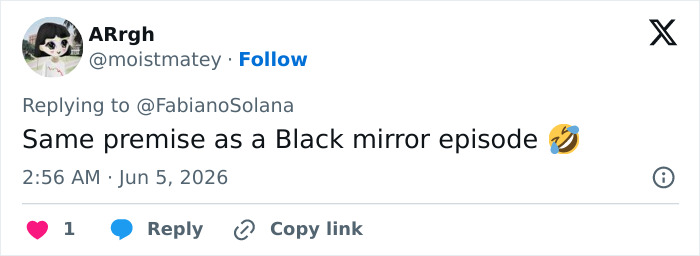
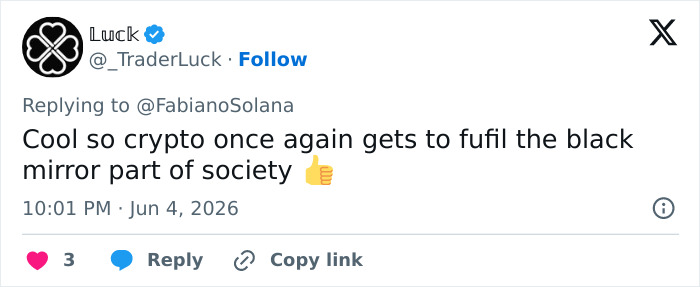
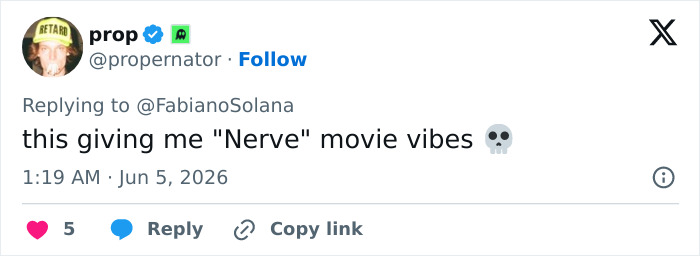
The controversy has led many internet users to compare the platform to Netflix's dystopian anthology series Black Mirror, which frequently explores how technology and financial incentives can erode morality and human empathy.
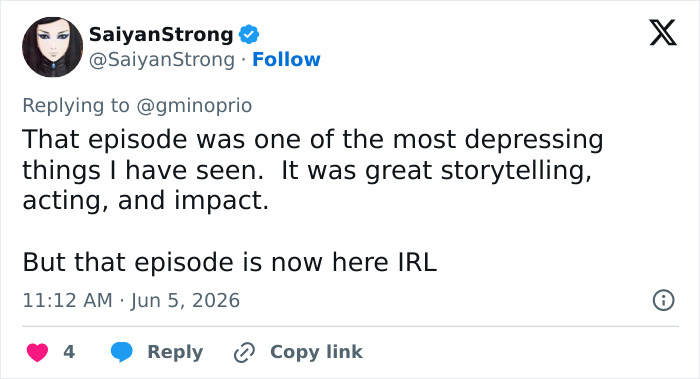
Some observers specifically pointed to the Season 7 premiere episode, Common People, which follows a financially struggling man who performs increasingly extreme acts for money, while others noted similarities to Season 3’s Shut Up and Dance, in which anonymous figures manipulate strangers into carrying out bizarre real-world tasks.

Image credits: Netflix
Social media users wasted no time drawing parallels. "They literally just made the Black Mirror episode," one commenter wrote.
Another added, "People always praise Black Mirror but they weren't exactly ever super unrealistic."
A third warned, "I'm sure nothing will go wrong when strangers are getting paid to do crazy stuff in public during a time when unemployment is rising, so people might be desperate enough to do some truly dangerous or despicable things."
Others echoed the sentiment, with one user joking, "Maybe the writers were time travelers explaining us the future," while another wrote, "Black Mirror was a peek into future timeline."
"The Black-Mirror-crazy-premise to reality pipeline is getting shorter and shorter."
Here are some of the most disturbing and controversial bounties that have appeared on the platform so far.
This post may include affiliate links.
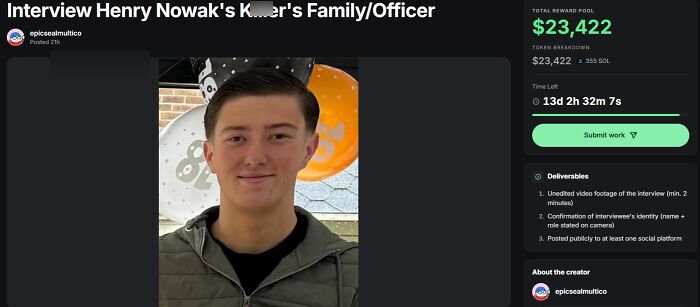
This open bounty offers a $23,255 crypto payout to anyone willing to track down and film an interview with family members of the man convicted in the Henry Nowak case, a high-profile British tragedy that sparked nationwide debate over policing and bias.
The task requires participants to obtain at least two minutes of unedited footage, confirm the interviewee's identity on camera, and publish the footage on a public social media platform.
What makes the bounty particularly troubling is that it targets relatives who were not accused or convicted of any wrongdoing themselves.
Critics have pointed out that the task effectively places a financial reward on locating and confronting private citizens, including elderly family members who have already faced intense public scrutiny and ostracization following the case.
Eighteen-year-old finance student Henry lost his life following a violent altercation with his now-convicted attacker, Vickrum Digwa, in Southampton, UK, in December 2025.
Following the attack, Digwa falsely claimed to the police that he had been the victim of a racist attack.
When authorities arrived at the scene, they completely believed Digwa's "wicked lie" and instead handcuffed Henry while ignoring his pleas that he had been brutally st*bbed and "couldn't breathe."
In police bodycam footage capturing Nowak's final moments, an officer infamously replied, "I don't think you have, mate."
Nowak lost consciousness in handcuffs and lost his life shortly afterward due to his life-threatening injuries.
Vickrum was found guilty of homicide and sentenced to life imprisonment with a minimum term of 21 years. His mother, Kiran Kaur, was also convicted for helping hide the weapon used in the attack.
The release of the police bodycam footage sparked massive riots and protests across the Southampton region, with critics alleging that anti-racism training caused officers to automatically favor the minority attacker over the d*ing victim.
Critics have compared this bounty to Black Mirror's Season 3 episode, Hated in the Nation, in which an anonymous online mob uses social media algorithms and a hashtag (#D*athTo) to collectively select targets, resulting in the real-world ex*cution of people who have drawn public ire or controversy.
One user responding to the bounty wrote, "How is this even remotely legal? Paying people to commit crimes?"

Trying to get an interview with the kìllèrs family under these circumstances may be questionable at the very least, but, it's not illegal. Regular journalists do this all the time.
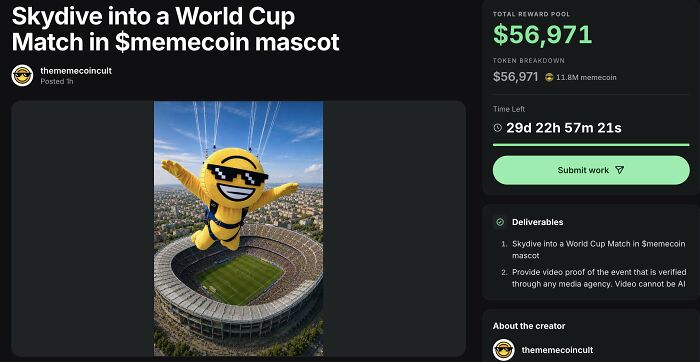
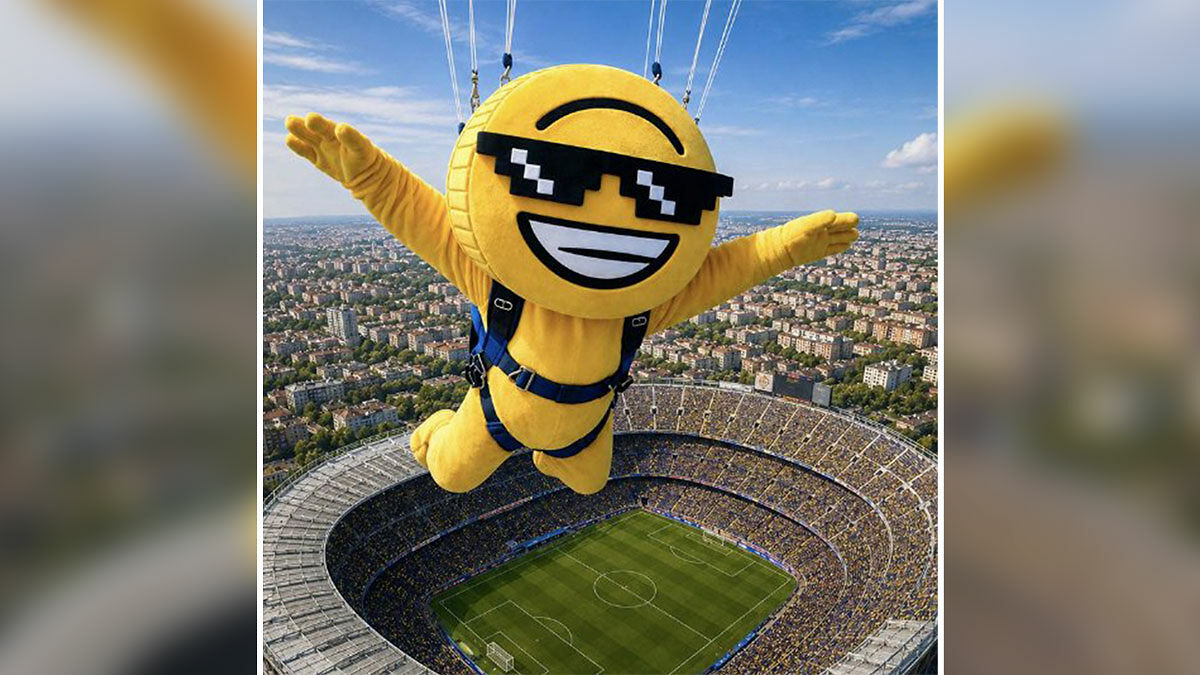
One of the most alarming bounties offered a staggering $56,000 reward for a stunt that sounds more like the plot of a dystopian TV show than a real-world challenge.
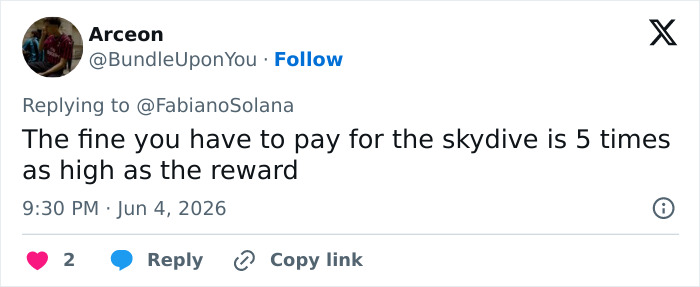
The task required a participant to skydive directly into an active match during the 2026 FIFA World Cup while wearing a full-body mascot costume representing their chosen memecoin project.
What makes the challenge particularly disturbing is that it effectively put a price tag on disrupting one of the world's largest sporting events.
A successful attempt would likely involve breaching strict security measures, endangering spectators and players, and creating chaos during a globally televised match, all for the sake of internet attention and crypto promotion.
While the bounty has since been deleted, it remains one of the platform's highest-paying tasks.
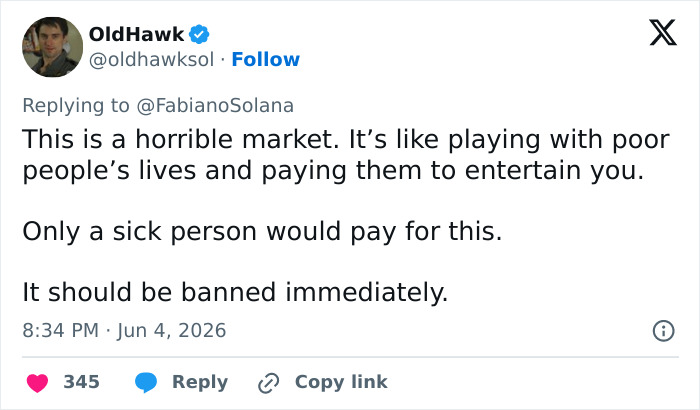
One critic reacted online, “This is a horrible market. It’s like playing with poor people’s lives and paying them to entertain you. Only a sick person would pay for this. It should be banned immediately.”
Another user agreed, replying, “Yep reminds me of Squid Game.”
A third netizen added, “This is basically a black mirror episode from the newest season… it gives off a really bad feeling.”
“No stadium is gonna allow a plane in the airspace over a World Cup match, let alone in the US lmao.”
Would you really try doing this in a country where you can be shòt and kìllèd for......well, anything?
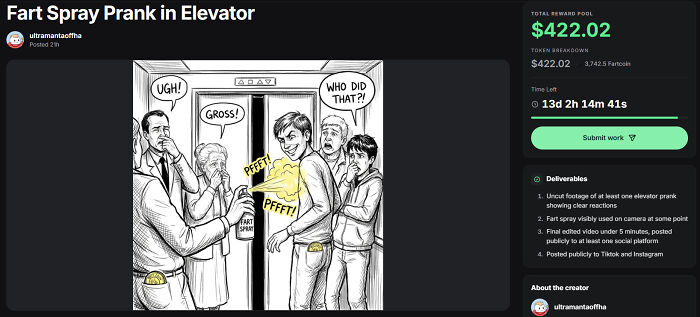
This bounty offered a relatively small payout of $428.26 to anyone willing to pull a stink spray prank inside a crowded elevator and film the results.
Participants were required to capture uncut footage of at least one prank, visibly use the spray on camera, and upload an edited video to social media platforms such as TikTok and Instagram.
The bounty description explicitly encouraged creators to seek out the funniest and most chaotic reactions possible, even recommending multiple elevator runs.
Unlike a prank carried out in a park or other open area, an elevator traps unsuspecting strangers inside a small enclosed environment, forcing them to endure the situation until the doors open.
The risks extend beyond embarrassment or discomfort.
Novelty stink sprays are specifically designed to mimic extremely foul odors, and in an enclosed space, they can trigger panic, claustrophobia, nausea, breathing difficulties, or other adverse reactions in vulnerable individuals.
Elderly passengers, young children, pregnant women, and people with respiratory conditions could be particularly affected.
For less than $500, participants were encouraged to deliberately provoke strangers, disrupt public spaces, and risk confrontations or intervention by property management or law enforcement.
One social media user commented, “This is going to get real spicy. What guarantees they will pay if you do it?”
Others expressed, “This is literally just real-life side quests for degenerates… the beginning of the end.”
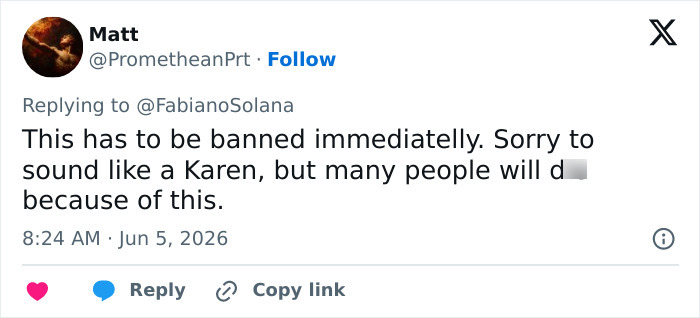
“This has to be banned immediately. Sorry to sound like a Karen, but many people will d*e because of this.”
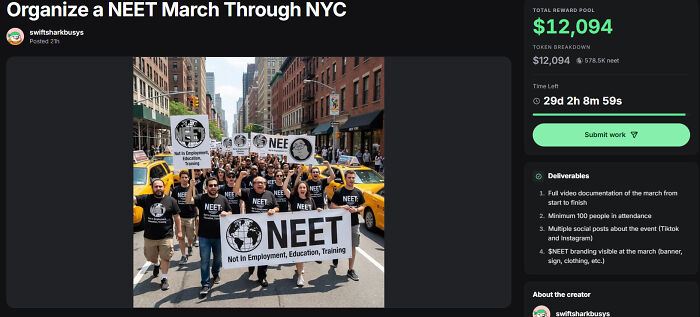
This unusual bounty offered a $12,945 crypto payout to anyone who could organize a public "NEET March" through the streets of New York City.
To claim the reward, participants had to gather at least 100 attendees, document the entire event on video, generate multiple TikTok and Instagram posts, and ensure that $NEET branding was prominently displayed throughout the march.
NEET stands for "Not in Education, Employment, or Training," a term originally used by governments and researchers to describe young people who are not studying, working, or participating in vocational programs.
In recent years, however, the label has evolved into an internet subculture, with some online communities embracing it as a lifestyle centered around rejecting traditional career paths and social expectations.
Critics found the bounty disturbing because it seemed to recast a demographic often associated with economic hardship, social isolation, and unemployment as a marketing tool for a meme coin project.
Rather than drawing attention to the struggles many NEETs face, the bounty effectively turned an economically vulnerable demographic into a marketing vehicle for a meme coin project.
Critics argued that it monetized social isolation and unemployment, encouraging organizers to leverage participants' circumstances for online engagement and publicity.
One comment online read, “Incentive systems always surface the strangest behaviors. This is what happens when money meets crowd creativity.”
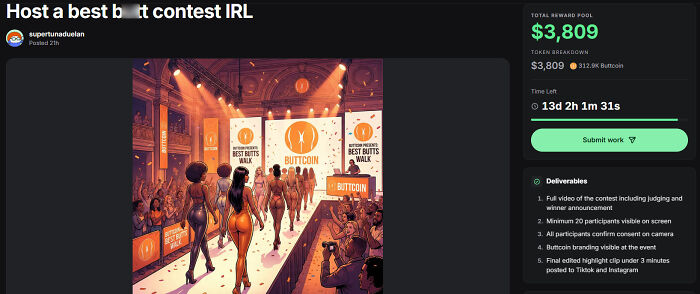
This bounty offered a $3,832 crypto payout to anyone willing to organize and film a real-life "Best B*tt Contest" in a crowded location.
To claim the reward, organizers had to recruit at least 20 participants, obtain on-camera consent from everyone involved, display B*ttcoin branding throughout the event, and publish a polished highlight reel on TikTok and Instagram.
Contestants were to be judged either by audience applause or a voting panel, with the bounty description encouraging creators to make the event as entertaining as possible.
On the surface, the challenge may sound like a harmless internet prank or impromptu beauty pageant.
However, critics argued that the bounty effectively outsourced the logistical, legal, and safety responsibilities of hosting a public contest to random internet users chasing a payday.
Traditional promotional events typically require permits, crowd management plans, age verification procedures, and liability waivers to protect both organizers and participants.
The most troubling aspect, critics said, was how little compensation was being offered relative to the potential risks.
For less than $4,000, organizers were expected to coordinate a public event involving dozens of strangers, film and distribute their images online, and assume responsibility for any disputes, complaints, or legal issues that might arise.
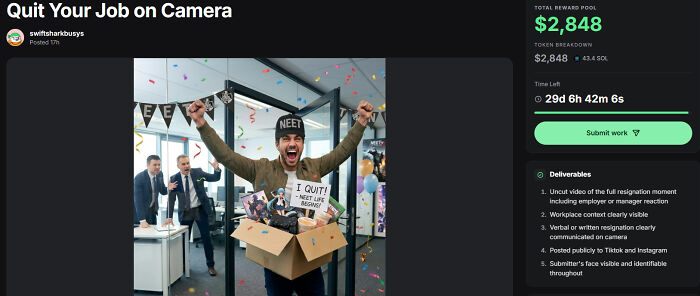
This bounty offered a $2,861 crypto payout to anyone willing to record themselves quitting their job on camera.
To claim the reward, participants had to submit an uncut video of the resignation, clearly show their workplace, capture their employer's or manager's reaction, publicly post the footage on TikTok and Instagram, and keep their face visible throughout the process.
What makes this challenge particularly disturbing is the enormous imbalance between the reward and the potential consequences.
For less than $3,000, participants are effectively being asked to walk away from a steady income, workplace benefits, professional references, and future career opportunities.
Unlike a private resignation handled professionally, the bounty encourages users to turn a major life decision into public entertainment for social media engagement.
Critics have also pointed out that broadcasting a resignation online could follow participants for years.
Future employers routinely review applicants' online presence, and a viral video of someone dramatically quitting their job may not leave the best impression.
Moreover, under Pump.fun GO's rules, the platform has final authority over whether a submission meets its standards.
That means a participant could quit their job, publicly upload the footage, and still have their submission rejected if moderators decide it was not entertaining, creative, or high-quality enough.
In that scenario, the individual would be left unemployed and uncompensated, having taken all the risk while the platform bears virtually none.
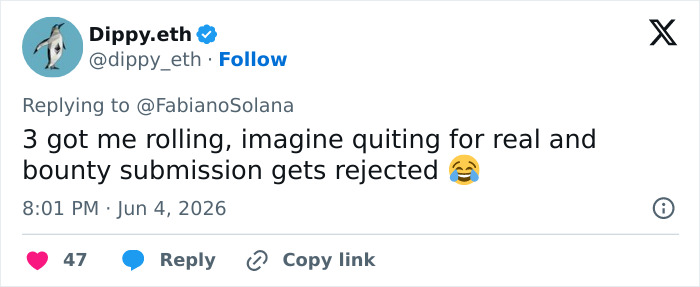
This concern was echoed online, with one user on X writing, “Imagine quiting for real and bounty submission gets rejected.”
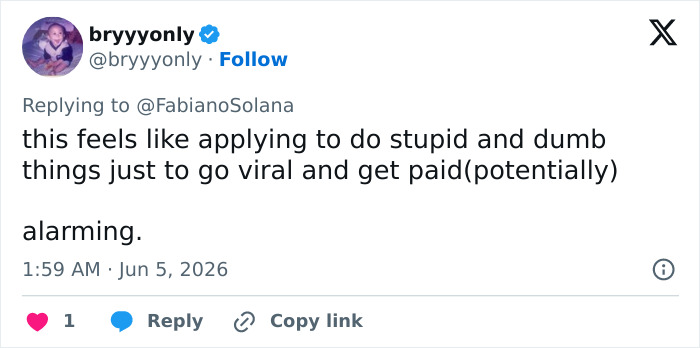
Another user commented, “This feels like applying to do stupid and dumb things just to go viral and get paid(potentially) alarming.
“Who thought this would be a good feature… crazy times ahead.”

I suppose if you hated your job and were planning to quit anyway...why not?
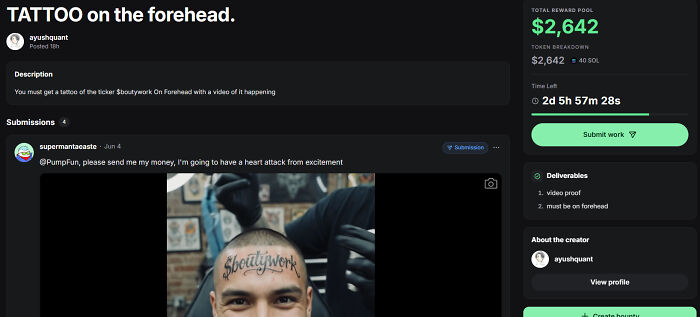
This bounty offered a $2,608 crypto reward pool to users willing to get the ticker "$bountywork" tattooed on their forehead and document the entire process on video.
To qualify, participants had to permanently ink the cryptocurrency's name onto their forehead and upload footage proving the tattoo was completed.
Unlike many of the platform's other stunts, this challenge requires a permanent physical alteration that cannot simply be undone once the payout is collected.
Critics argue that it effectively asks people to turn themselves into walking advertisements for a speculative digital asset in exchange for a few thousand dollars.
A temporary prank or embarrassing video can eventually be forgotten, but a forehead tattoo can affect future job prospects, personal relationships, and social interactions for years to come.
Meanwhile, the promoted cryptocurrency could lose relevance or disappear entirely, leaving participants with a permanent reminder of a project that may no longer exist.
The platform's submission board reportedly includes videos from users who have already completed the challenge, with some expressing immediate regret after going through with it.
One person wrote, “D*mn, i really did it, already rgeretting it haha. but that's the price i have to pay haha.”
For critics, the bounty is one of the clearest examples of how financial incentives and viral internet culture can encourage people to make life-altering decisions for relatively small rewards while shouldering all the long-term consequences themselves.
One person commented, “Bruh quitting job and tattooing forehead bounty difference makes no sense. I want to quit anyway, I sure don’t want to have some tattoo on my forehead.”
“Just gonna be a bunch of morons doing stupid sh*t all for some money…”
Looks like the tattooist missed the “n” in “bounty.” If you’re going to humiliate yourself with a forehead tattoo, at least spell it right.
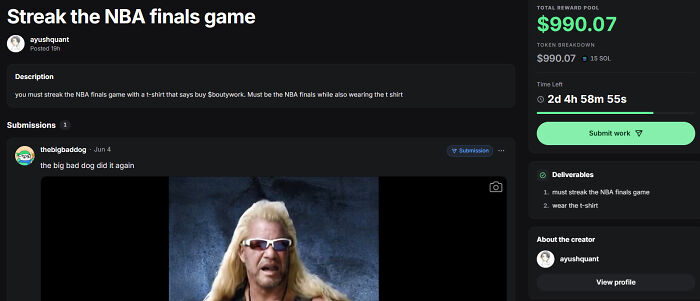
This bounty offers a $965.26 crypto reward pool to users willing to streak an NBA Finals game while wearing a t-shirt displaying the ticker "$bountywork."
To qualify, participants must record and submit clear video evidence of themselves invading the court during an active NBA Finals game while prominently featuring the specified sponsor’s branding.
Unlike minor social media stunts, this challenge necessitates the commission of a serious criminal act in a highly secured, high-stakes environment.
It encourages individuals to engage in reckless behavior that invites severe legal and physical consequences in exchange for a relatively small financial payout.
Invaders face immediate arrest for criminal trespassing and disorderly conduct, which results in a permanent criminal record.
The NBA enforces a strict zero-tolerance policy, leading to immediate lifetime bans from all league arenas for those who interfere with play.
Furthermore, security personnel are trained to treat court invaders as active threats, which frequently results in aggressive physical takedowns and potential injury during the apprehension.
Reflecting on the trend, one critic commented, "I would say pathetic behaviour but they are a parasitic company so it is understandable."
Another added, "This is why the new pump.fun feature is not the best idea. People will go to the lowest of lows and cause havoc."
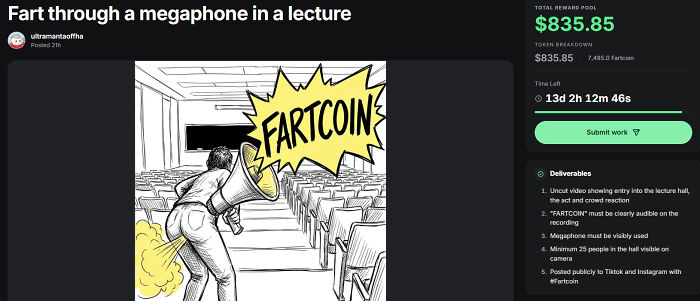
This bounty offered an $850.58 crypto payout to anyone willing to disrupt a university lecture for the sake of a meme coin promotion.
According to the challenge description, participants had to enter a lecture hall with a megaphone, pass gas through it, shout "FARTCOIN" loudly, and capture the entire crowd's reaction on camera.
To qualify for payment, the recording had to show at least 25 people in attendance, visibly feature the megaphone, and be posted publicly on TikTok and Instagram.
At first glance, the stunt may sound like little more than an immature prank.
However, the bounty turns educational spaces into content-generating stages where students and faculty become unwilling participants in viral marketing campaigns.
The challenge explicitly rewards disruption, encouraging users to interrupt classes attended by people who paid to be there and instructors who are simply trying to do their jobs.
The payout has also raised eyebrows because of the potential consequences involved.
For less than $1,000, participants risk disciplinary action, fines, or even criminal charges related to trespassing and disorderly conduct.
Students who attempt the stunt at their own universities could face suspension or other academic penalties that far outweigh the reward's value.
In fact, one participant who uploaded footage of the challenge appeared to acknowledge those risks.
In a caption accompanying the video, the user wrote, "I made this video with help of 2 friends. We might get suspended for few days or get fined."
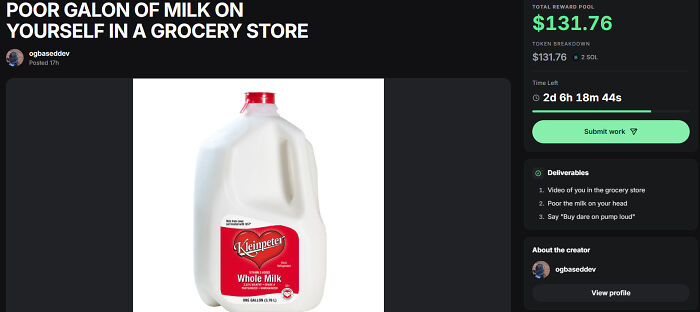
This bounty offers a $129.66 crypto reward to anyone who records themselves pouring a gallon of milk over their head inside a grocery store while saying, "Buy dare on pump loud."
Participating in this stunt leads to immediate and serious legal consequences.
Entering a private business to destroy merchandise is a crime, and law enforcement frequently arrests individuals on the spot for such public disruptions.
Specific charges often include criminal mischief and property damage for destroying store products and rendering aisles unusable.
Authorities may also file charges for disorderly conduct due to the hazardous and disruptive condition created for other shoppers.
Beyond the legal fallout, this stunt creates a significant burden for store employees.
The mess is sticky and rapidly spoils, often requiring professional bio-cleaning services if the liquid seeps into refrigeration vents or beneath shelving.
This can lead to thousands of dollars in property damage for which the individual may be held civilly liable.
The risk to the participant far outweighs the minimal financial payout.
A permanent criminal record for theft or vandalism can negatively impact future employment opportunities and personal reputation.
Comments such as “Hunger Games turning into reality,” “Free money. But at what cost?” and “This is going to end really, really badly,” flooded social media.

This is a research psychologist dream laboratory. Ultimately proving how dangerous unregulated capitalism is.

Life experience has sadly shown me that proving how dangerous unregulated capitalism is doesn’t change anything on its own.
Load More Replies...
I’ve been saying for decades now that social platforms should be held legally accountable for the shıt they host. They make $billions in profit while holding their hands up saying, “We aren’t responsible for what our users post. We can’t be ‘neutral’ and censor content.” Meanwhile, actively censoring content they don’t agree with. Misinformation is bad enough but for supporting the encouragement of illegal acts, they *should* be punished as accessories to the crime, along with the person who incited the crime and the person who committed it.
This is a research psychologist dream laboratory. Ultimately proving how dangerous unregulated capitalism is.
Life experience has sadly shown me that proving how dangerous unregulated capitalism is doesn’t change anything on its own.
Load More Replies... I’ve been saying for decades now that social platforms should be held legally accountable for the shıt they host. They make $billions in profit while holding their hands up saying, “We aren’t responsible for what our users post. We can’t be ‘neutral’ and censor content.” Meanwhile, actively censoring content they don’t agree with. Misinformation is bad enough but for supporting the encouragement of illegal acts, they *should* be punished as accessories to the crime, along with the person who incited the crime and the person who committed it.














 No fees, cancel anytime