Get Premium
Dark mode theme is available exclusively for premium users. Learn more about the benefits of subscribing.
No fees, cancel anytime.

 Dark Mode Ad-Free Browsing Unlimited Content
 Ad-Free Browsing Unlimited Content Dark Mode
Join 1.2 million Panda readers who get the best art, memes, and fun stories every week!
The winners of the 2025 Mangrove Photography Awards have just been announced and the images are nothing short of breathtaking. From mangroves glowing beneath the Milky Way to powerful portraits of communities affected by environmental loss, this year’s entries highlight both the extraordinary beauty and delicate fragility of these vital ecosystems.
Organized by the Mangrove Action Project, the competition saw a record-breaking 3,303 submissions from 78 countries, all celebrating the ecological importance of mangrove forests around the world.
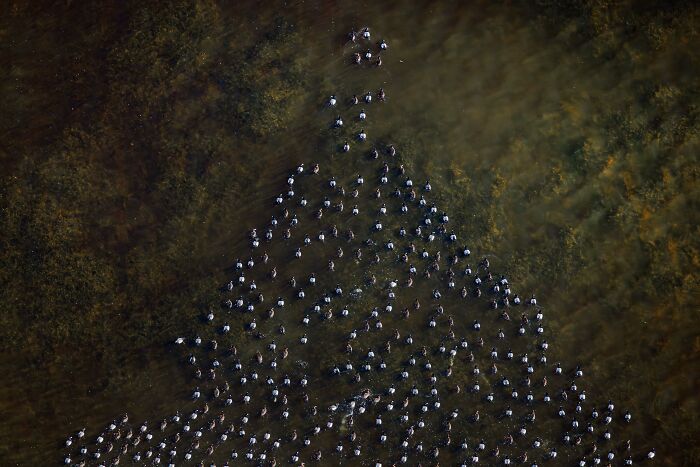
The title of Mangrove Photographer of the Year went to Mark Ian Cook for his stunning aerial image, Birds’ Eye View of the Hunt – a poignant shot that captures one of the Everglades’ iconic birds, whose fate is deeply tied to the health of its rapidly vanishing habitat.
Scroll down to explore 76 winning and shortlisted photos from the 11th edition of the awards, and discover why mangroves matter more than ever.
More info: mangroveactionproject.org | Instagram | x.com | Facebook | youtube.com
This post may include affiliate links.
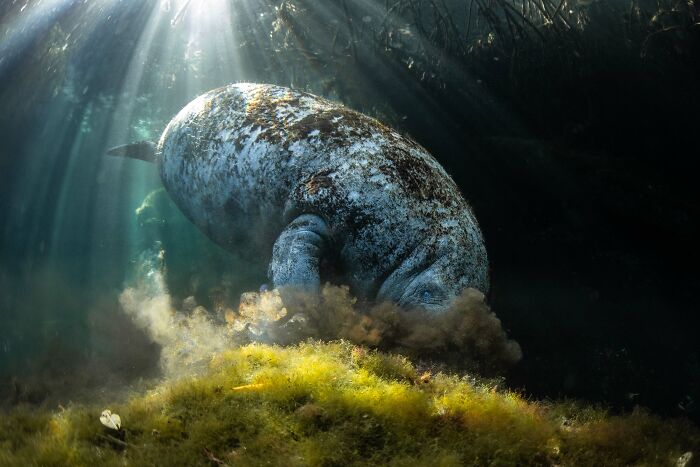
A gentle manatee grazes peacefully underwater, nestled beneath the tangled roots of a mangrove forest.
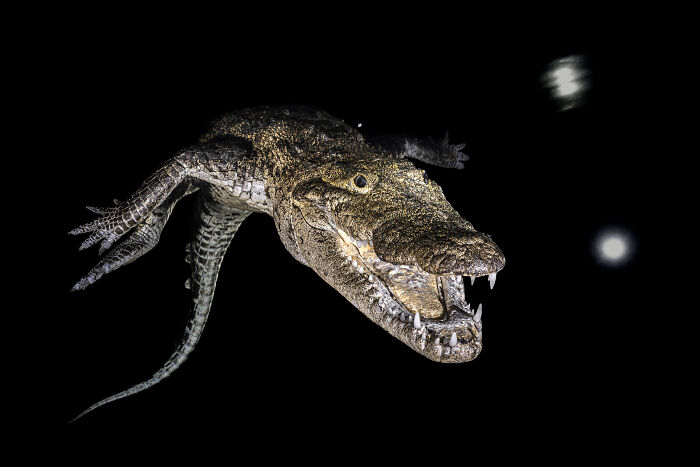
In Mayan culture, the crocodile is a sacred creature. It links earth, air and water. It is linked not only to nature, but also to the underworld, the place where souls wander. For the Mayans of Yucatan, cenotes are doorways to the underworld. And in mythology, the crocodile floated on the edge between the world of the living and that of the dead. This image of the crocodile, floating on the surface of this cenote, perfectly illustrates this sacred legend.
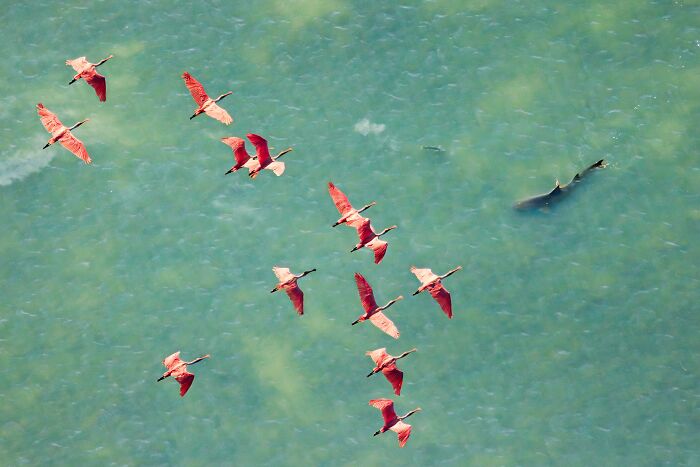
A flock of Roseate Spoonbills glide over a lemon shark hunting mullet in the shallow, mangrove-lined waters of Florida Bay.
“Historically, Florida Bay was the primary nestling region of the Roseate Spoonbill in the US, but this species is becoming increasingly rare there as sea level rise negatively impacts their important mangrove foraging habitat. This species feeds on small, estuarine fish, which it captures with its odd, spoon-shaped bill. Spoonbills are tactile foragers, meaning they feed by touch. As they forage, they sweep their bill from side to side in the water, holding it slightly open so it creates a negative pressure that effectively sucks any small fish it encounters into the bill. However, for this foraging method to be successful, the birds need relatively shallow water with very high densities of fish. This becomes particularly critical during the energetic bottleneck of the nesting season when the birds need to feed not only themselves but also 2 or 3 rapidly growing nestlings. High densities of fish are produced in the dry season when water levels decline, the area coverage of water in the mangroves shrinks, and fish become concentrated in increasingly smaller and shallower pools. Once a threshold depth of about 13 cm is reached, the spoonbills can feed effectively and start nesting. However, with climate-change induced sea-level rise, these critical lower water depths in the mangroves are increasingly failing to be met, fish densities are insufficient for effective foraging, and fewer birds are able to breed.”
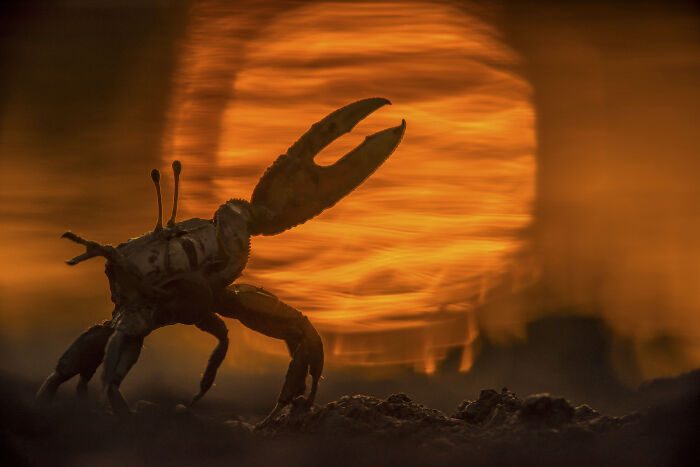
A male Fiddler Crab (Uca sp.) performing a signal dance in the mud at sunset.
“A male Fiddler Crab (Uca sp.) performing a signal dance in the mud at sunset. During courtship, males wave their enlarged claw and produce sounds to attract females. This behavior is more intense at night and can involve synchronous waving with other males.”
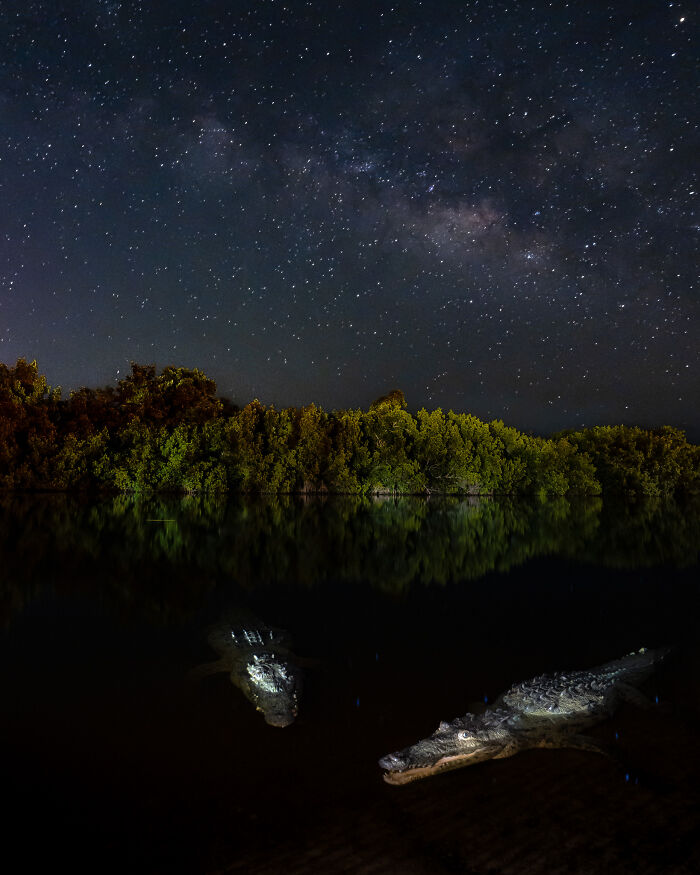
A pair of American Crocodiles sit before the Milky Way Galaxy in a mangrove forest in the Florida Everglades. “This image is one I’ve hoped to capture for the past 4 years living in Florida. Never whilst visiting this site did I get the chance before. But this day the stars literally aligned. At 2 AM, the Milky Way rose behind not one, but two crocodiles conducting some courting behavior. Seeing my opportunity I set up my tripod to utilize a long exposure to capture the Milky Way in my image. I then used a flash to freeze the crocodile’s subtle movement. After perfecting my settings, I shot a few images as the female appeared to circle the male and below. This one turned out to be my favorite.”
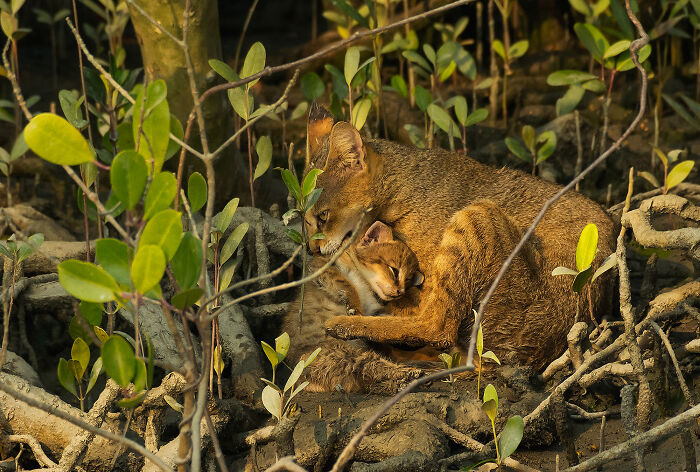
Mother" is a word that needs no separate definition. The word "mother" is formed with the pronunciation "m", which is present in all languages, like Maa/Amma, etc. Even in the sound of various animals calling their mother, the influence of "M" can be seen. Nature's own part is this "Mother" race. So perhaps such is the similarity of these words. In this picture, two mothers are holding their hands and protecting their child. Mother Nature and the jungle cat mother. “One evening in the winter of Indian Sundarban I was in the safari and I had information of jungle cat and her cubs. I was waiting for 3 hours at a distance. After some time, I saw the mother jungle cat sleeping, and her little cub was also sleeping in her lap. At sundown, she started licking her cub, took it up, and moved to the jungle. The whole moment was breathtaking to me. As I saw the lifetime moment, also the protective nature of mother.”
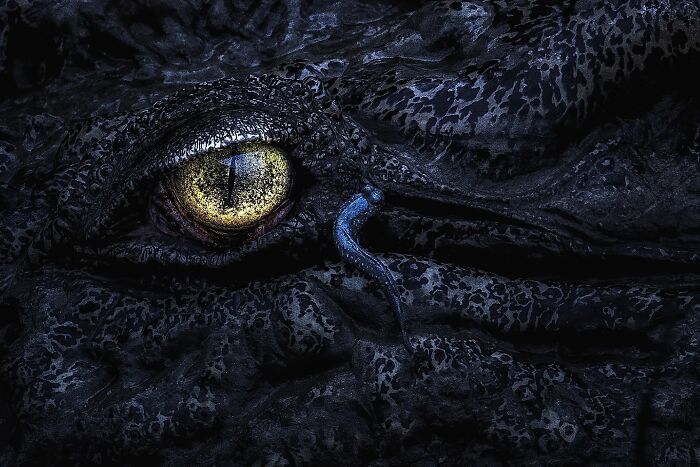
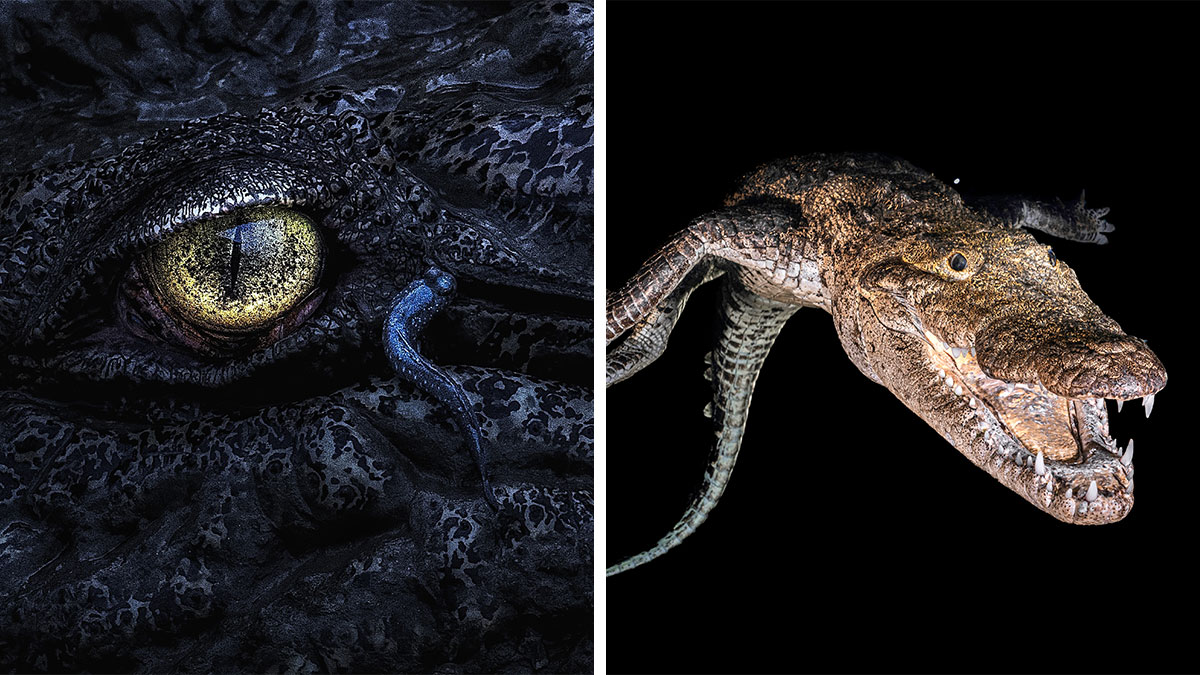
When giants and minnows coexist.
“In the Sundarbans, a massive crocodile rests near a tiny mudskipper. Despite the size difference, the fish shows no fear. Their contrasting colors create a rare, captivating moment in the wild.”
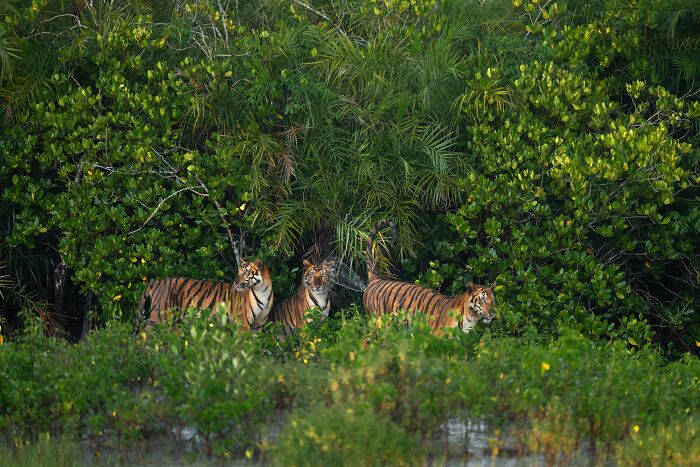
Sundarbans is a challenging place because Tiger territories keep submerging into water every six hours according to the moon cycle. While there is a myth among people that Tigers do not do scent/territory markings here because they lose the mark in water very quickly, I was lucky to photograph this rare behavior in mangroves. Only funny part was, the entire urine went on the subadult Tiger’s face.
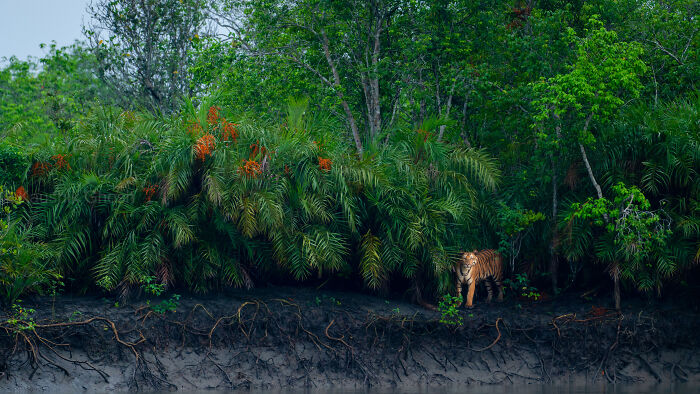
After hours of tracking through the mangroves, the elusive tiger finally revealed itself in the afternoon — emerging beneath the Hental tree, like a blossom unfolding in the wild. A perfect harmony of predator and habitat. “We had been moving through the dense mangroves since morning, every sound and broken twig fueling our anticipation. Hours passed, the forest holding tight to its secrets — until, in the quiet stillness of the afternoon, it happened. From behind a curtain of roots and shadows, the tiger appeared. She stepped into the light beneath a Hental tree, her presence sudden yet graceful, like a blossom blooming in the wild. In that moment, predator and habitat merged into a single, breathtaking scene — nature, perfectly in balance.”
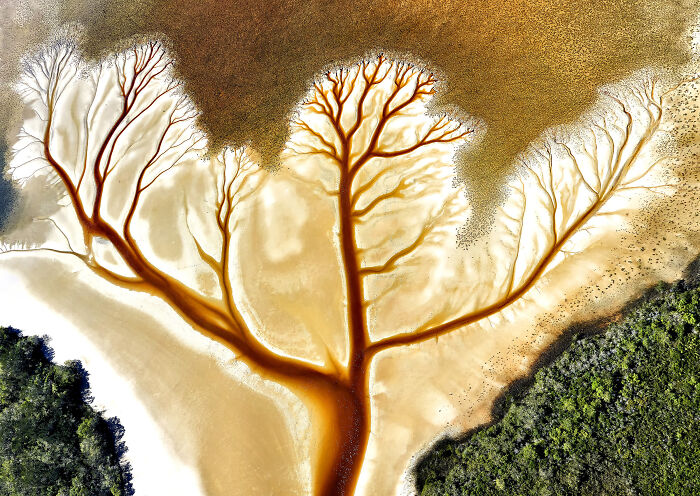
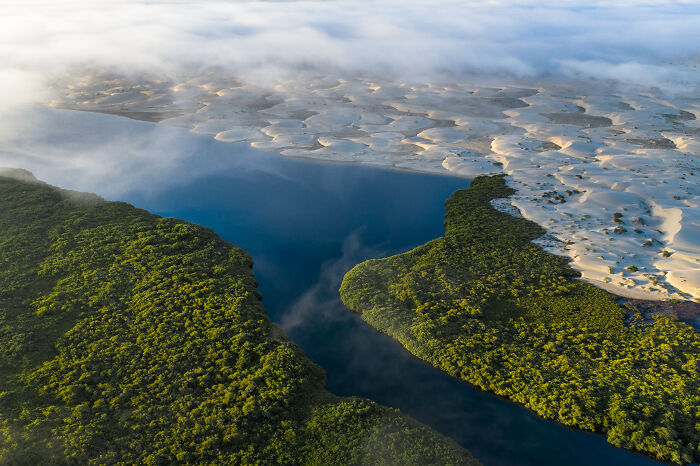
Aerial image taken from a helicopter of a tannin stained tidal creek and mixed mangrove community, NSW north coast.
“Part of a series of aerial images recording the coastal ecosystems of northern NSW.”
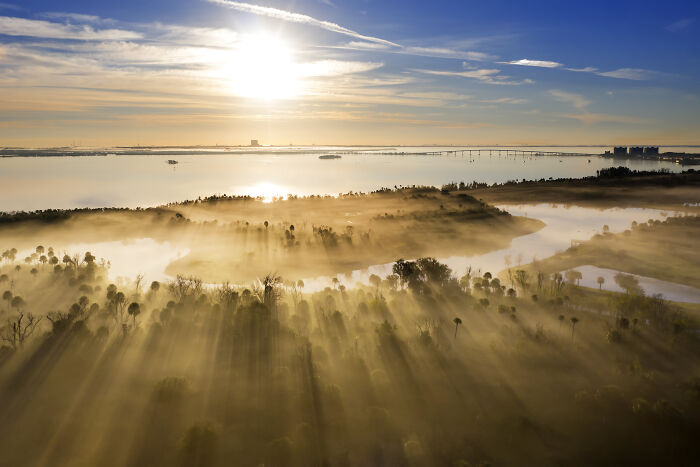
Mangroves in the mist.
“As Dawn breaks over Florida's east coast, golden rays pierce the early morning mist, revealing the intricate beauty of the Indian River Lagoon below. Captured by drone, this aerial view showcases a delicate estuarine ecosystem protected by winding shorelines of resilient mangrove trees-nature's guardians that shelter a vast diversity of wildlife, In the distance, the Kennedy Space Center reminds us that just beyond this peaceful refuge, humanity reaches for the stars. This image celebrates the harmony between natural wonder and scientific ambition, both grounded in the same fragile world.”
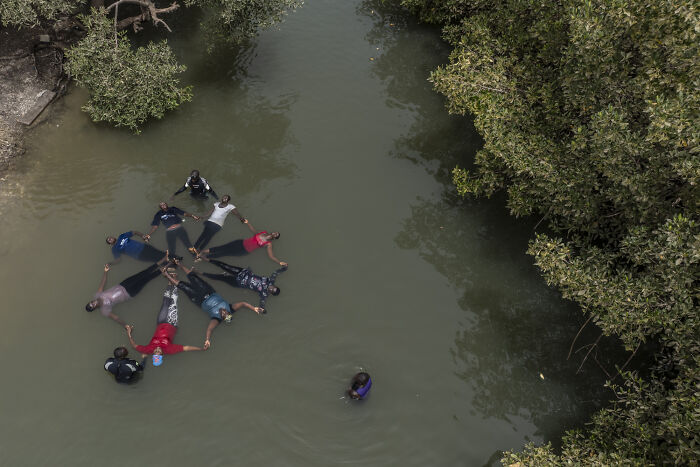
As part of FAO’s FISH4ACP program, the Gambian Navy teaches oyster harvesters to swim—giving women lifesaving skills and reducing drowning risks in the mangroves. Most had never learned to swim. These women play a vital role in protecting mangroves from illegal deforestation, safeguarding ecosystems that store up to 10 times more carbon than terrestrial forests and are crucial in fighting climate change.
“Gambian Navy swim trainers conducting a session with oyster harvesters. One of the techniques they focus on is just having the women learn how to relax and float in the water. As part of FAO's FISH4ACP program, the Gambian Navy is teaching oyster women how to swim—empowering them with lifesaving skills and enhancing their safety while harvesting oysters from the mangroves. Most of the women had never learned to swim, and tragically, a number have drowned while working on the river. The oyster women play a vital role in conserving mangroves by preventing illegal deforestation, particularly the cutting of trees by local villagers for firewood. Mangroves are crucial in the fight against climate change, as they can store up to 10 times more carbon than terrestrial forests.”
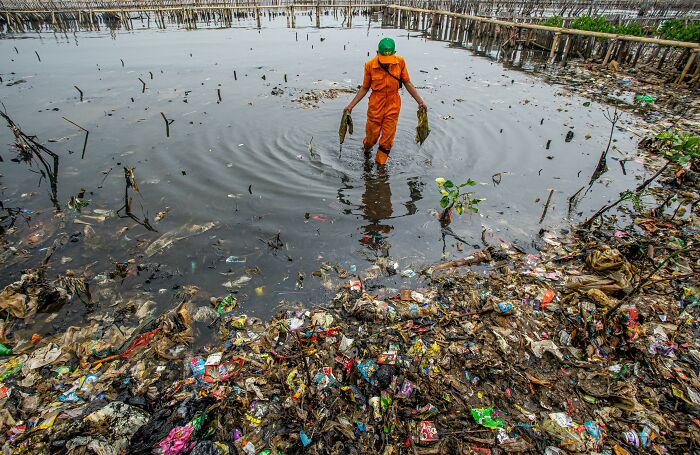
In Jakarta, Indonesia, a huge amount of rubbish, particularly plastic waste, is ending up in mangrove areas.
“A worker is cleaning the never ending rubbish in a mangrove restoration plot.”
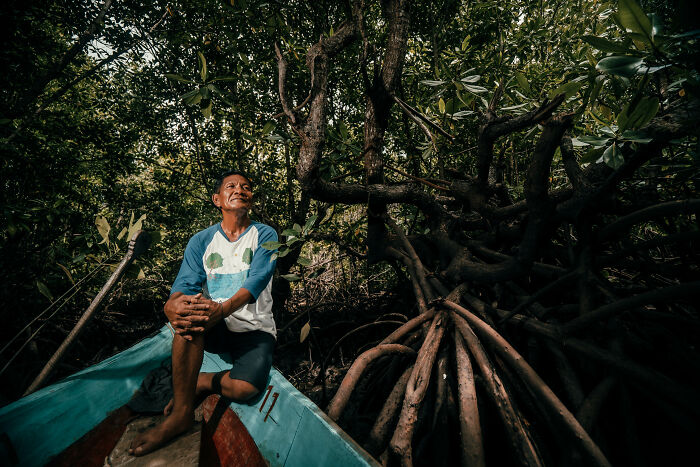
Pak Umar in the mangroves that protect his home.
“I had the privilege to meet Pak Umar a few months ago. A proud Bajau man who understands the importance of the mangroves for his home and fights for their preservation. The mangroves themselves are an extension of his personality and rich heritage.”
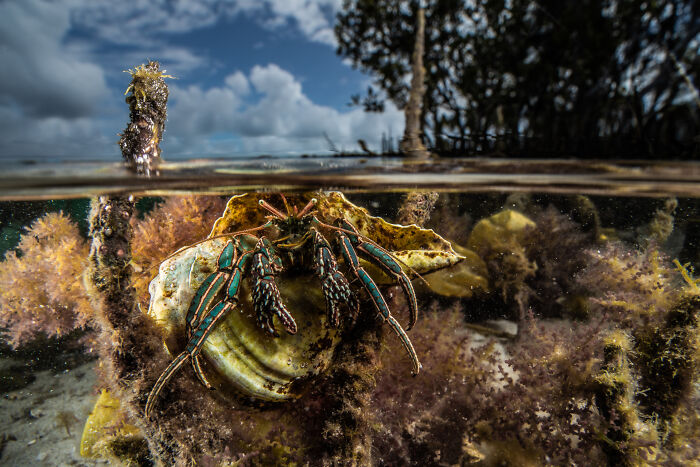
While Clibanarius taeniatus is one of Australia's more common hermit crab species, very little is known about it and I'm not sure it even has a common name.
“A study from 2003 found that its presence in large numbers generally indicates an environment that experiences higher freshwater flow than other marine intertidal regions. This is certainly true of the mangrove island I found at the entrance of Lake Macquarie which was absolutely teeming with these creatures. I visited this island at both low and high tides, and at low tide there were literally thousands of C.taeniatus feeding within the matrix of mangrove roots.”
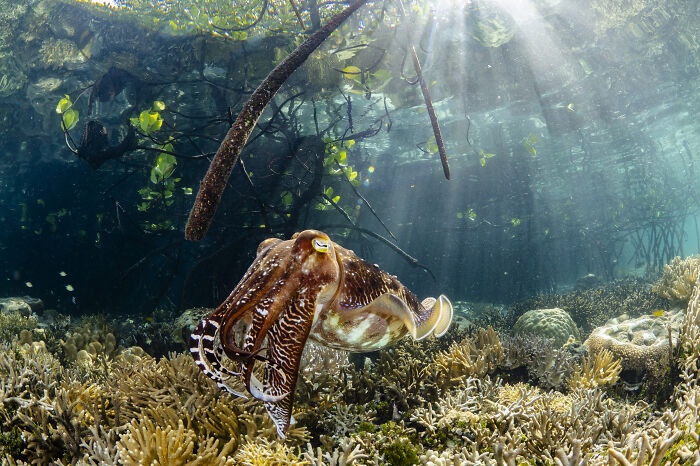
A large female cuttlefish pauses momentarily before continuing to lay eggs in the shallow reef beneath the mangroves.
“I've spent a considerable amount of time snorkeling and diving in the mangroves of Raja Ampat, and one thing I've come to learn is that cuttlefish routinely come up to the shallow reefs beneath the mangroves to lay their eggs, quite often in the same piece of coral. This large female had been laying eggs for hours, if not days, and would pause for about five minutes after laying each egg carefully in the corals.”
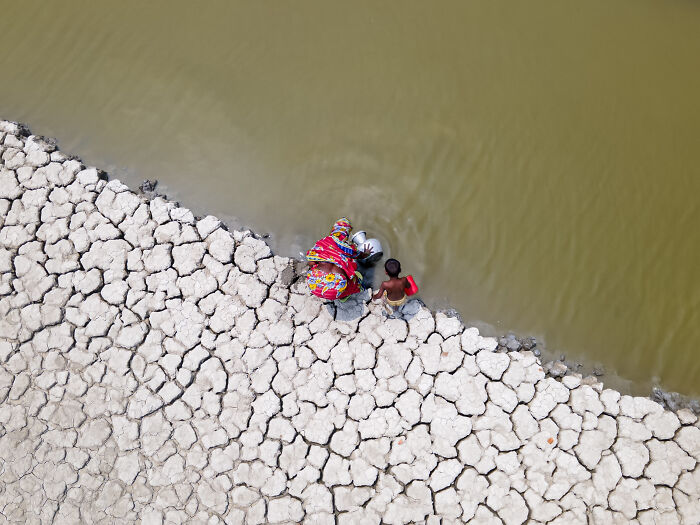
A determined woman and her grandson collect water from the last remnants of a drought-stricken landscape in Shyamnagar, Khulna. Despite living near a river, they walk 2–3 km daily to find drinkable water due to salinity intrusion, a result of rising sea levels and reduced rainfall affecting the coastal mangrove community.
“On May 15, 2023, in Shyamnagar, Khulna district, this image portrays the harsh reality of water scarcity in Bangladesh’s low-lying coastal belt. A resilient elderly woman and her young grandson are seen collecting precious water from a nearly dried-up source in a landscape ravaged by drought. Although they reside near a river, the water is undrinkable due to severe salinization—an escalating problem caused by rising sea levels and tidal intrusion linked to climate change. Every day, families like theirs are forced to walk 2 to 3 kilometers to access freshwater. The situation worsens in winter months when rainfall is scarce, and even the shallow sources begin to vanish. This scene captures not only their daily struggle but also the broader environmental crisis facing the Sundarbans’ mangrove communities—where once-abundant rivers now carry salt, not life. The photograph stands as a stark reminder of the mounting impact of climate change on vulnerable populations. It reveals a generational fight for survival—where the elderly, the young, and the in-between are bound together by resilience, courage, and necessity. While the mangroves are known for protecting lives from storms and erosion, the people living around them now fight to protect their own lives—one drop at a time.”
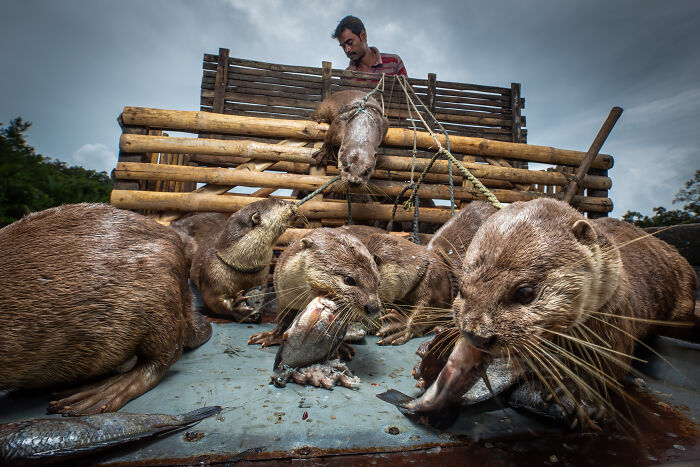
The otters get their reward for a busy morning of fishing.
“There are only a handful of otter fisherman left and their unusual method of fishing has been handed down from father to son for centuries. The trainer adult otters are tethered and the younger otters swim free. The otters chase fish from the muddy banks into the awaiting nets and after each fishing session get their share of the catch.”
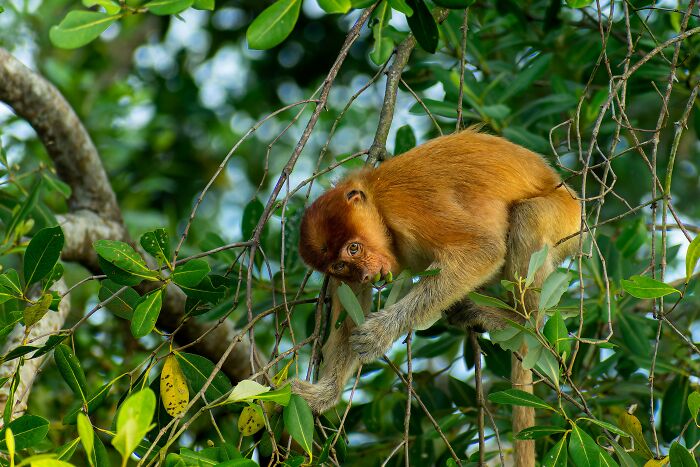
A young proboscis monkey enjoys an avicennia fruit amidst the dense mangrove forest. “This juvenile proboscis monkey is seen savoring an Avicennia fruit it found. The avicennia fruit is one of the primary food sources for proboscis monkeys. This image highlights the vital role of mangrove ecosystems in supporting the survival of this endangered species.”
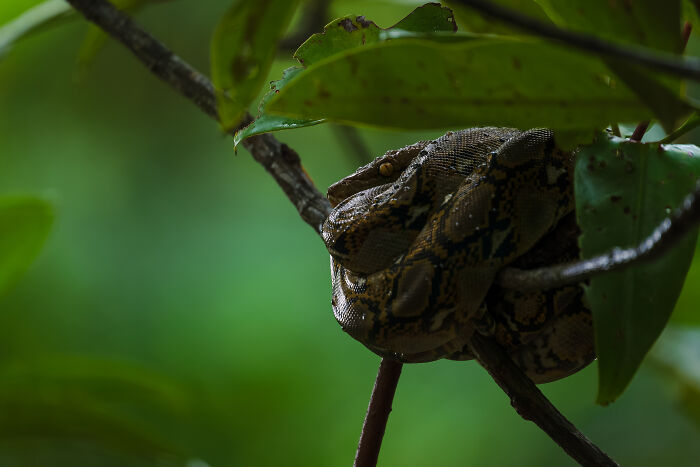
In the stillness of the Malaysian mangroves, a reticulated python lies motionless in the crook of a tree branch. Hidden in plain sight beneath glossy green leaves, it waits out the heat of the day, conserving energy for the cover of night—when the forest awakens and the hunt begins.
“I was exploring a mangrove forest in Malaysia, scanning the tangled branches and muddy banks for signs of movement, when I spotted this reticulated python coiled on a branch above a narrow stream. It was so well camouflaged against the dappled foliage that I nearly missed it - only the subtle curve of its body gave it away. To avoid disturbing the snake, I kept my distance and carefully set up my tripod on the opposite bank. Using a telephoto lens, I framed the shot to show the python tucked into the crook of the branch, sheltered by the broad leaves above. The dim, filtered light under the canopy made it challenging to expose the scene properly, but it also helped capture the mood of the moment - quiet, still, and almost hidden from view. During the day, mangrove forests can feel eerily calm. Most wildlife lies low, conserving energy in the heat, and this python was no exception. It remained completely motionless the entire time I observed it. Like many reptiles in these ecosystems, it’s likely nocturnal—waiting until dusk to begin its slow, silent hunt.”
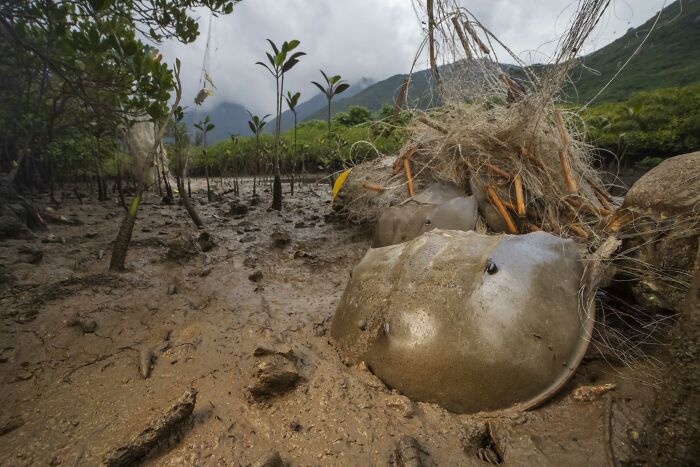
A poignant reminder of the dangers lurking in our coastal ecosystems: multiple horseshoe crabs find themselves ensnared in a ghost net that became stuck within the mangroves, highlighting the urgent need for action against marine debris, both in the ocean and on our coastlines.
“A poignant reminder of the dangers lurking in our coastal ecosystems: multiple horseshoe crabs find themselves ensnared in a ghost net that became stuck within the mangroves - a very common situation in Hong Kong and throughout Asia. Abandoned fishing nets washed ashore become trapped along the high tide line and in mangrove forests, entangling many creatures, including horseshoe crabs. This can lead to the injury and death of coastal wildlife. This highlights the urgent need for action against marine debris, both in the ocean and on our coastlines.”
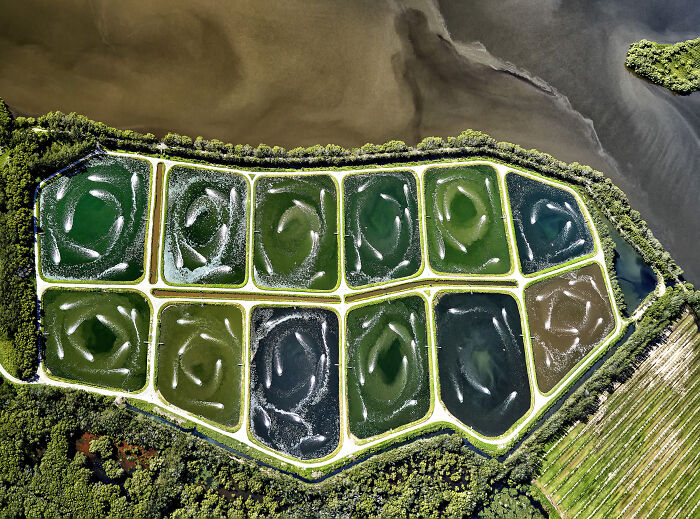
As in other parts of the world, mangrove ecosystems in Australia are sometimes converted to aquaculture production.
“Part of a series of aerial images taken from a helicopter of coastal ecosystems and impacts in northern NSW.”
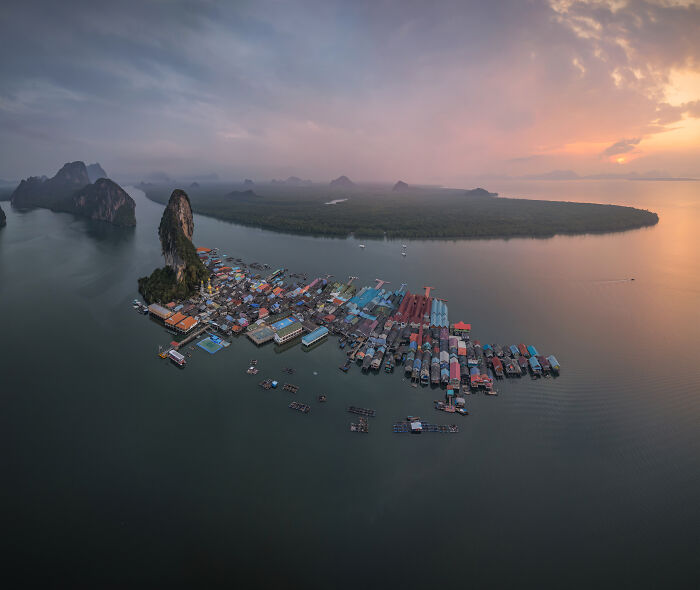
Aerial image of a Thai floating village in between mangrove landscapes.
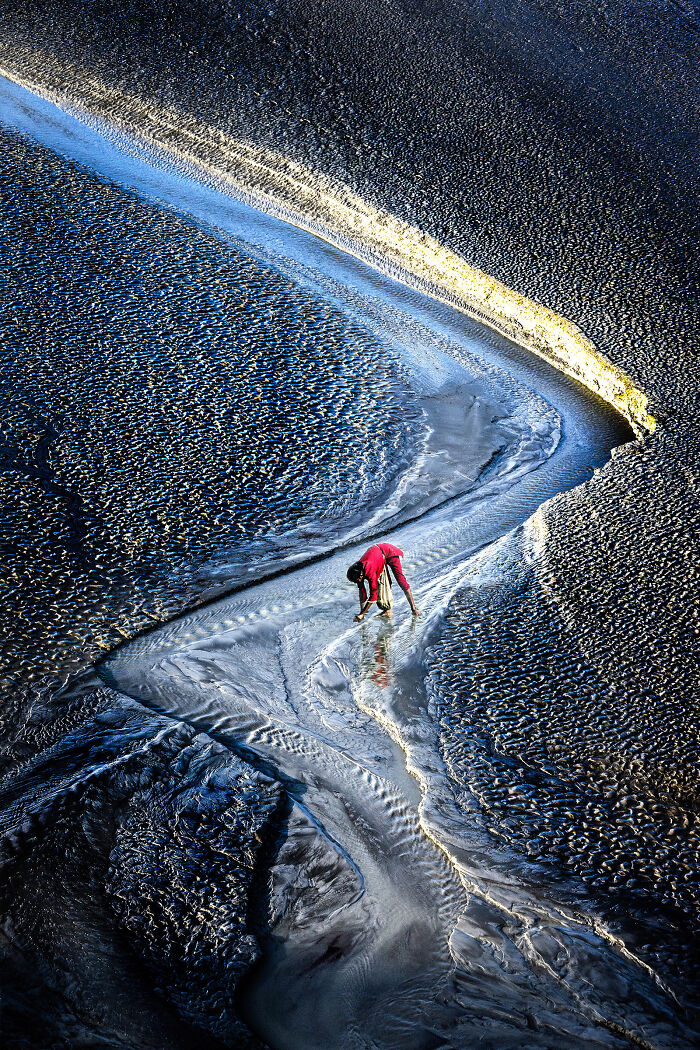
At low tide along the winding banks of the Matla River in Canning, a village girl bends gracefully over the exposed mudflats, carefully picking oyster shells. Dressed in red, she stands out against the cool, textured earth, her reflection mirrored in the riverbed. The curving riverbed guides her steps like a natural path, each shell a small offering from the receding tide. In this quiet labor, her presence becomes part of the landscape’s raw, rhythmic beauty.
“As the tide ebbs from the serpentine curves of the Matla River in Canning, the riverbed unveils its textured secrets—wet, glistening mudflats etched with ripples, trails, and the soft shimmer of late afternoon sunlight. In the midst of this raw, expansive landscape, a village girl in a red dress bends low to pick oyster shells. With quiet focus, she sifts through the soft mud, fingers expertly picking shells nestled in the ridges left by retreating water. Her presence is both purposeful and poetic—each shell she collects holds value, whether for sustenance, sale, or the rhythm of a daily routine that binds her to the tides. The land around her is alive yet silent, echoing only the distant cry of a heron or the faint rustle of wind in the mangroves beyond. The Matla, with its unpredictable swells and brackish waters, is both friend and threat—a provider of life and a reminder of nature’s unforgiving edge. During low tide, it offers this narrow window of opportunity, when its receding waters allow access to the hidden world beneath. For the girl, this moment is not just about shells but survival, tradition, and a deep, inherited knowledge of the land and river. The curve of the river acts like a natural frame around her, a reminder of how human life here is woven into the pattern of water and mud. All the oyster shells will be sold to make food for the nearby poultry farm. Her feet leave fleeting prints in the silt, washed away with the next tide, yet echoing the countless footsteps of those who came before her. The shell-picking is a ritual of resilience in a landscape shaped by impermanence. This scene, humble in scale, captures the enduring relationship between people and place in the Sundarbans delta. It speaks of dignity in simplicity, of childhood shaped by tides, and of a community’s ability to find life and meaning in the most fluid and challenging of environments.”
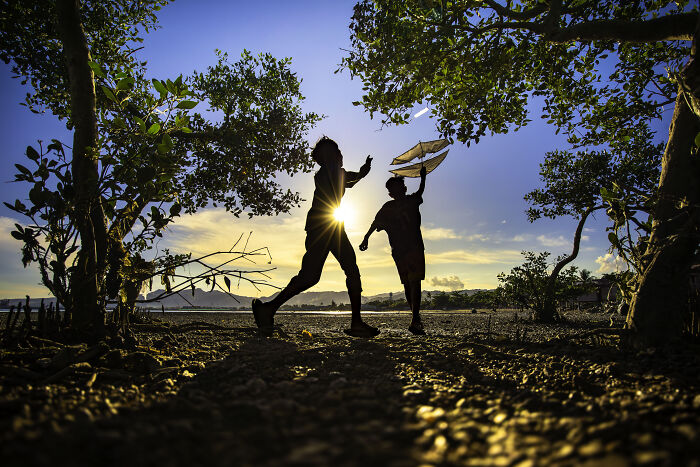
Mangroves don’t just protect coastlines—they protect childhoods.
“These resilient trees act as natural barriers against storms and erosion, quietly shielding the communities behind them. For many children in coastal areas, like those in this photo, mangroves create safe spaces to play, dream, and grow. Every tree standing is a silent guardian of memories being made—proof that protecting the environment is also protecting a way of life.”
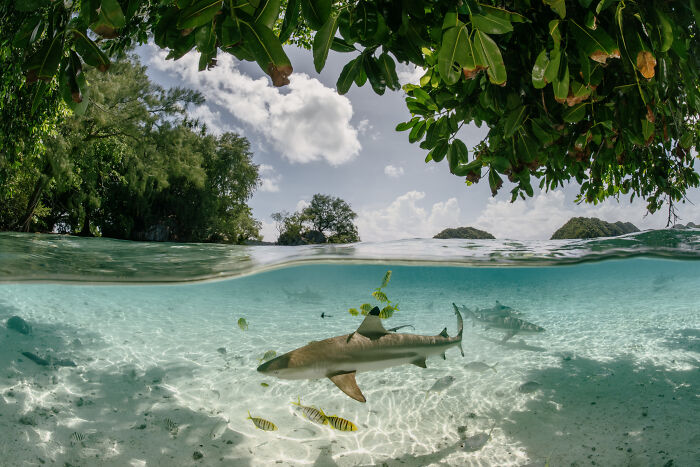
A juvenile blacktip reef shark swims in its mangrove lagoon nursery in Palau.
“Juvenile blacktip reef sharks cruise in the shallows under the mangroves in a portion of Palau's Rock Islands Southern Lagoon, a UNESCO world heritage site. At this site known as shark city, tour operators will throw their leftover lunches for the sharks to eat, bringing them close for tourists to enjoy. Sharks are protected in Palau- it was the first nation to declare itself a shark sanctuary.”
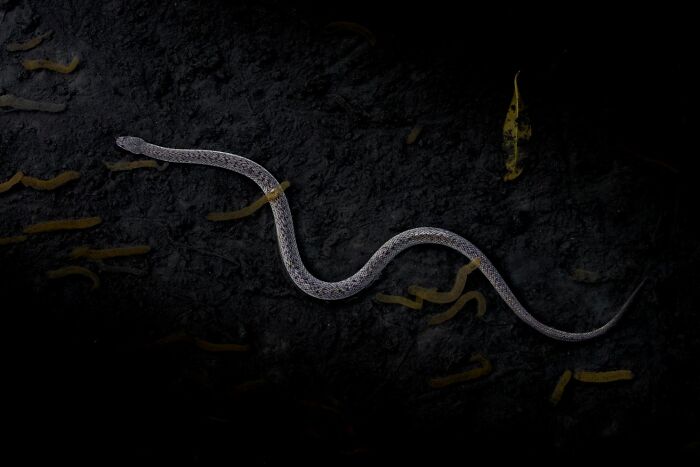
Dog-faced watersnake (Cerberus schneiderii) finding prey when the tide gets low.
“Dog-faced water snakes are a common species of water snake found in the mangroves of Thailand. They're venomous but harmless to humans. Their venom is used for hunting small animals.”
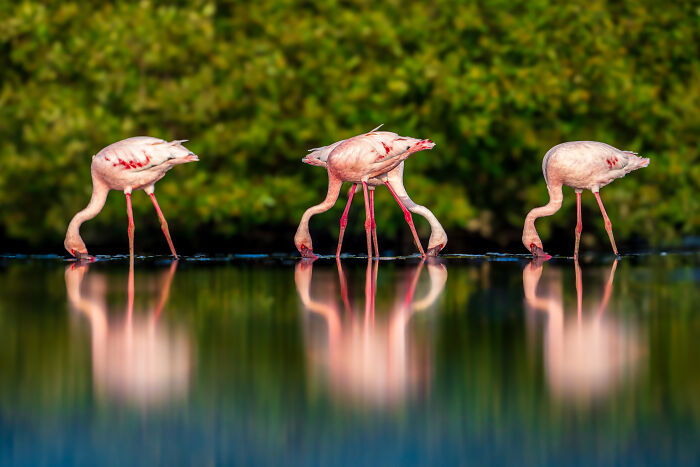
In the Jazan region, mangrove trees are vital coastal habitats that provide a rich food environment for migratory flamingos. These birds feed on algae and small invertebrates like crustaceans and plankton in the shallow waters. The mangroves offer a safe refuge, shielding them from disturbances and predators—making them an ideal rest stop during migration and a key contributor to biodiversity along Saudi Arabia’s coastlines.
“Mangrove trees in the Jazan region form a crucial habitat supporting migratory birds traveling from Europe to Africa, especially flamingos. This coastal ecosystem is rich in algae, crustaceans, and microscopic plankton—providing ideal nutrition for flamingos, which feed by filtering tiny organisms from the shallow water. Beyond nourishment, the mangrove environment offers a safe refuge from predators and environmental disturbances, making it a strategic stopover during the long migration. The dense roots and calm waters of the mangroves help minimize risks and allow the birds to recover their energy. Jazan is one of the most important stopover sites along the global migration route, attracting a variety of waterbirds in addition to flamingos, such as herons, terns, and spoonbills. Preserving this habitat is essential for supporting biodiversity and maintaining migratory pathways.”
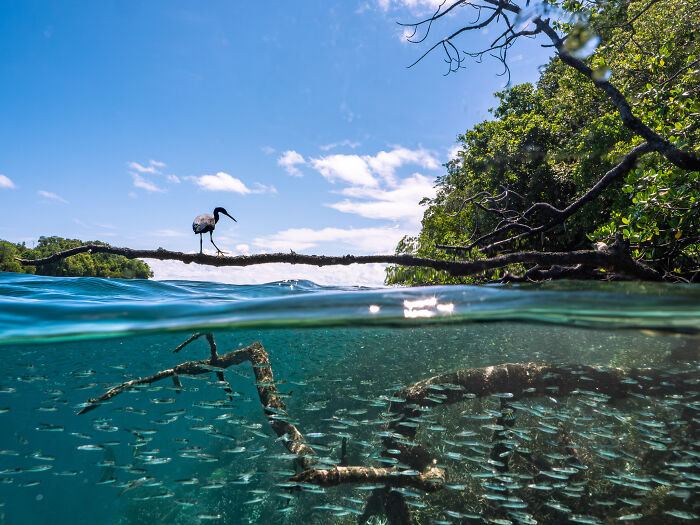
A Pacific Reef Heron hunts a school of fish from a mangrove branch in Raja Ampat, Indonesia. “This branch was a favorite hunting site of the local reef herons. I observed this individual’s behavior and wanted a shot of both the fish beneath the surface and the bird above. It was challenging to compose with the moving water surface, and the school of fish were quite dynamic. After patience on my part for the fish and bird to line up, and on the part of the bird as it hunted patiently, I managed to capture the image with the school of fish near the front, and the bird in a dynamic moment. I like this image because it so clearly demonstrates the existence of mangroves as the threshold between water and land. Here, the mangrove branch provides a perch for the bird, and protection for the fish.”
Part of a massive flock of diving ducks (primarily Lesser Scaup) apexing momentarily into an odd pyramidal shape in one of the mangrove-lined coastal lakes of Everglades National Park. “The coastal lakes of the Everglades are set within a dense matrix of mangroves adjacent to the Florida Bay estuary. Historically, prior to the drainage of the southern Everglades in the 1940s, these lakes were slightly brackish, crystal clear, and supported dense beds of aquatic vegetation, which in turn supported an abundance of animal life, including hundreds of thousands of migrating and wintering waterfowl. As the flows of the water from the north were curtailed by human activities, the salinity of the lakes increased considerably, the aquatic vegetation largely died off, and increased sedimentation and nutrients reduced the clarity of the water and the ability of the vegetation to recover. With the loss of the vegetation and the rich diversity of prey animals it supported, the waterfowl vanished from this part of the world. But with much increased volumes of freshwater flowing south last year because of the El Niño conditions, as well as recent restoration activities that allow more water to flow to this part of the Everglades, the coastal lakes have been recovering and, for the first time in 80 years, have attracted tens of thousands of waterfowl. There’s much still to do to get the water right for the Everglades, but this is yet another very encouraging sign that we’re heading in the right direction.”
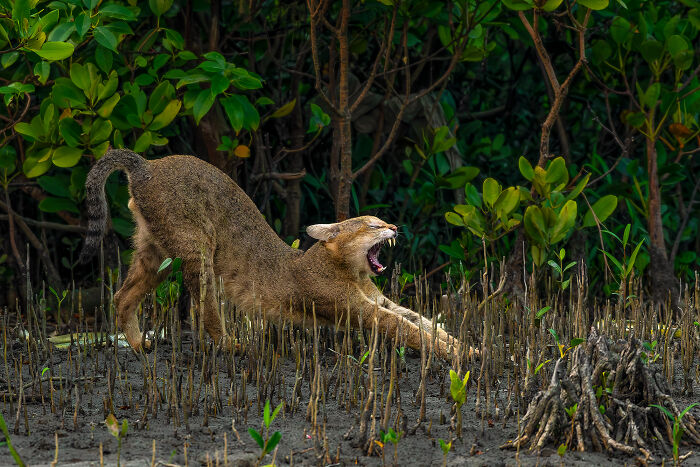
In the heart of the Sundarbans, the elusive Jungle Cat awakens with a powerful yawn — revealing nature’s sharp edge amid the tangled roots and tidal waters of the mangrove wilderness.
“In 2021, during a boat safari in the Sundarban Biosphere Reserve, our quest for the elusive swamp tiger went unanswered. As we turned back, a sleeping Jungle Cat emerged from the mangrove shadows. I captured its slow awakening — a deep stretch and a powerful yawn exposing sharp teeth — before it vanished into the dense tidal forest. This fleeting moment perfectly reflects the Sundarbans’ mysterious spirit and the wild rewards of patient observation.”
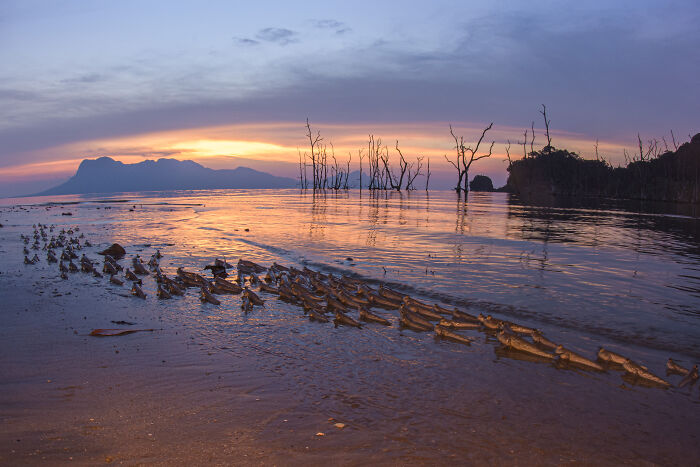
Mudskippers (Periophthalmus chrysospilos) march and feed together along the shore, following the tide. Kubah National Park, Borneo Island, Sarawak, Malaysia. “To shoot this image along the shore surrounded by mangrove forest in the Bako National Park, I stood still in the mud, along the shoreline, for almost two hours. The sun was setting, and I hoped the mudskippers would eventually get less shy and march in front of my lens. They were marching and feeding all together, and it was something amazing, but if you tried to approach them just by walking, they fled into the water and regrouped elsewhere, far away. So I tried to "become a fallen tree," and it finally worked out.”
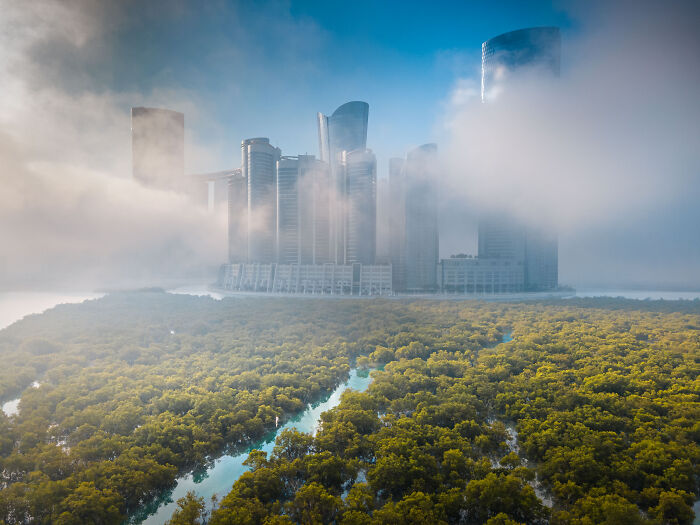
The harmonious blend of mangrove nature with the modernity of the city — a captivating contrast where urban innovation meets the timeless rhythm of the wild.
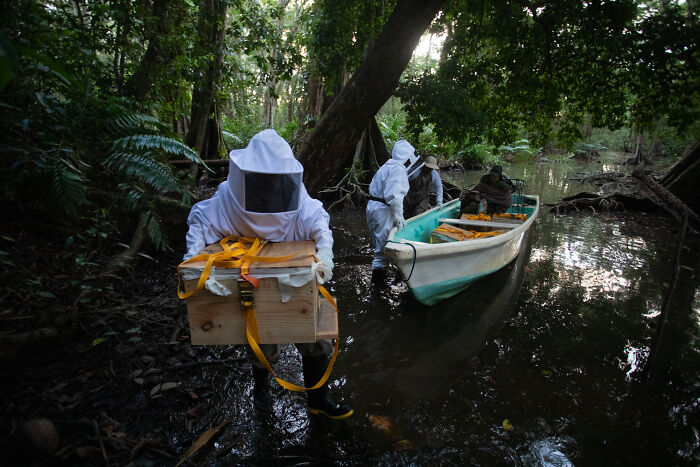
After a winding route through many narrow canals, fisherman Manuel carries a heavy bee hive off a boat to its new home within the buffer zone of the Terraba-Sierpe mangrove forest, the start of a new mangrove honey project for the community.
“After a winding route through many narrow canals, fisherman Manuel carries a heavy bee hive off a boat to its new home within the buffer zone of the Terraba-Sierpe mangrove forest, the start of a new mangrove honey project for the community. Manuel and the others are local fisherman who live within the the Terraba-Sierpe National Wetland, the largest mangrove forest in Costa Rica. For the local communities that live in this wetland, one of the poorest regions in Costa Rica, their primary source of income comes from fishing. Sadly fish and clam populations are declining from overfishing, loss of habitat, and climate change putting economic pressure on the communities. In order to build resilience for the community, Osa Conservation is working alongside the community to kick start a mangrove honey project, training fishermen like Manuel in beekeeping and business development. Flash to the moment this photo was taken. After months of training it was time to bring the bees to their new home within the buffer zone of the protected wetland. The only access is by boat and very difficult work transporting the heavy hives on unsteady vessels, particularly under the oppressive humid heat of tropical wetlands. Fast forward 6 months and the first batches of honey have been harvested, totaling close to 30kg. Excitement and pride is palpable in the mangrove beekeepers. The community members are working with a Costa Rican branding agency to develop their Mangrove Honey brand. Eventually the honey will be available commercially, first in the local lodges and shops of the Osa Peninsula and then further around Costa Rica. The honey is delicious and unique, with a distinct salty sweet flavor. Ideally in the future, this project has ripple effects, creating even more opportunities for a community with limited options, opportunities that are dependent on a prospering mangrove ecosystem rather than an over-harvested one. A resilient people and a resilient ecosystem. ”
Bakhawan Eco-Park in Kalibo, Aklan is a powerful story of nature’s revival and community resilience. Once a polluted shoreline, it has transformed into a thriving 220-hectare mangrove forest—protecting against climate threats and sustaining local livelihoods. This award-winning eco-park now stands as a symbol of hope, where families like the father and son in this photo enjoy the bounty of restored ecosystems.
“Bakhawan Eco-Park: Where Nature Heals and Communities Thrive" Once a barren, muddy coastline scarred by pollution, Bakhawan Eco-Park in New Buswang, Kalibo, Aklan now breathes life as a 220-hectare man-made mangrove forest—an inspiring symbol of restoration and resilience. Launched in 1990 through the vision of local government and NGOs, this reforestation initiative was born out of necessity—to shield the town from floods, storm surges, and the looming threat of climate change. Today, it’s more than a forest. It’s a living sanctuary teeming with mangrove species, fish, crabs, and migratory birds—an ecosystem reborn. But its impact stretches beyond the environment. For the local community, Bakhawan has sparked new hope: sustainable crab and fish harvests have revived livelihoods and strengthened food security. In this photo, a father and son share a joyful moment over a basket brimming with freshly caught crabs—a powerful image of nature’s generosity and the legacy we pass on. Celebrated globally, including accolades from the UNFAO and the Golden Eagle Award, Bakhawan Eco-Park is not just a success story—it’s a beacon of what’s possible when people and the planet grow together.”
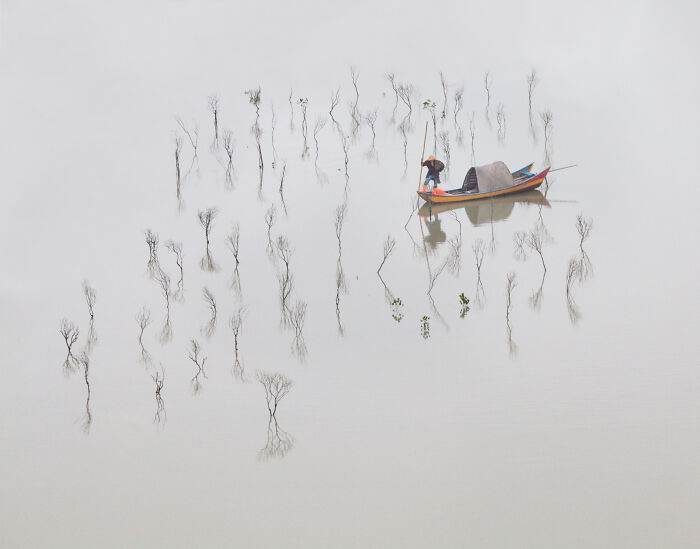
A fisherman meandering through the baby mangroves that resemble musical notes when viewed from afar.
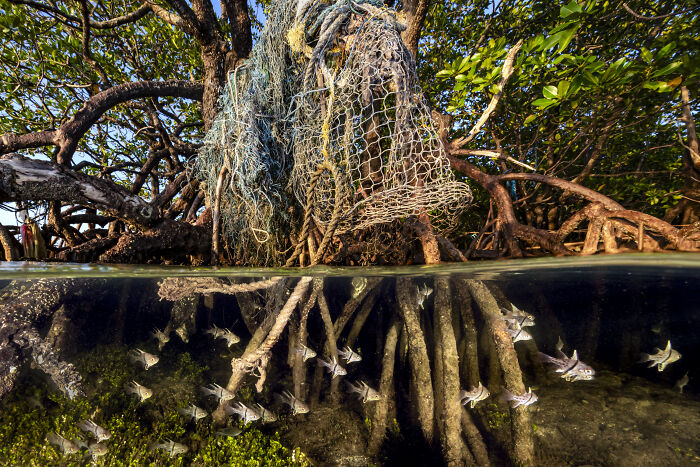
Half and half scene of mangroves, cardinalfish, and ghost net.
“This half and half image was shot in the shallow mangroves around Bangka Island in North Sulawesi, Indonesia. While exploring the shallow area near the roots, I stopped to take a picture of this discarded fishing net that had washed up into the tree roots and then noticed a few shy cardinalfish peeking out from the roots behind. I waited patiently for more of these cardinalfish to come out from the roots and then was able to capture this scene. Ocean debris such as this ghost net pose a threat to wildlife, including fish and birds which live amongst the mangrove forest.”
A leisurely escape through the tranquil mangrove channels of Abu Dhabi — where calm waters, winding paths, and the gentle rustle of leaves create a perfect harmony between adventure and nature.
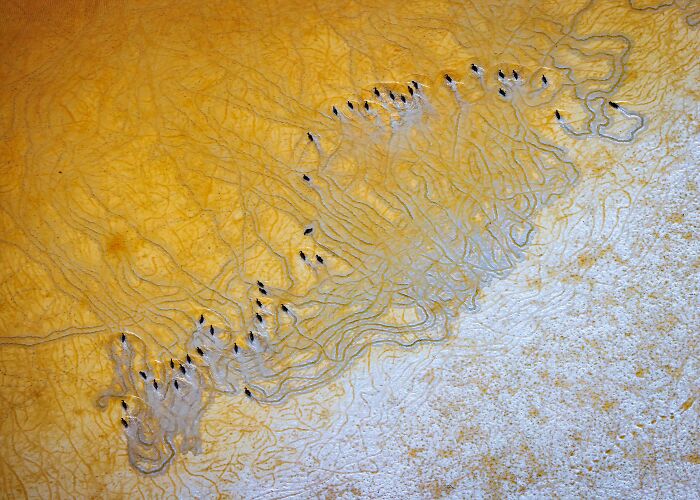
Blue-winged Teal create ephemeral artwork as they dabble for food in the chai-coloured shallows of Florida Bay, Florida.
“This image was taken last autumn after the summer rains had sent much-needed freshwater flows into the Florida Bay estuary. The odd yellow colour is entirely natural and is a consequence of the mangroves lining the bay; the first flush of freshwater from the Everglades gains this rich whiskey hue as it passes through the swamp and extracts the tannins leached from decaying mangrove leaves. The migrating teal are feeding just downstream of the mangroves, dabbling and filtering high densities of algae and other microorganisms from the shallow edge of the bay. It can be a challenge to produce creative aerial images of the topographically flat Everglades, so it’s often necessary to find subjects that are willing to interact with their habits in strange and wonderful ways, like these artistic teal. Here, my aim was to capture something of the ecology or essence of the ducks while also attempting to fit that into a visually appealing composition that incorporates, to the extent possible, the patterns, textures, and colours of the environment. It’s this combination of animal behavior and a captivating habitat that I believe makes for the most compelling images.”
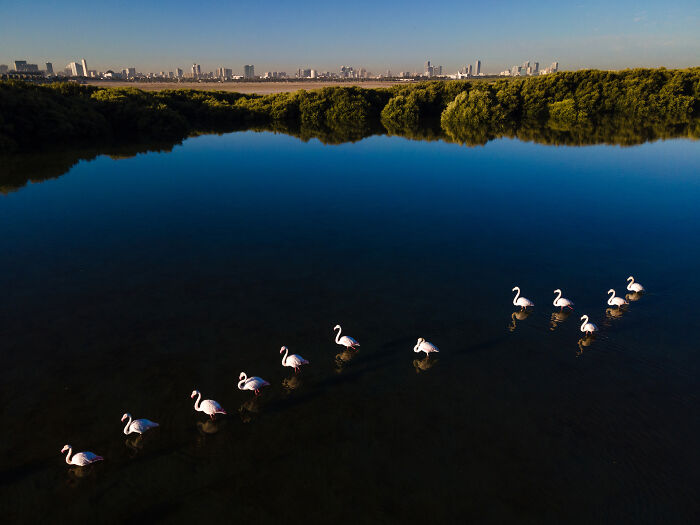
Captured at dawn in the serene wetlands of Al Zorah Mangrove Reserve, UAE, this aerial photograph showcases a graceful formation of flamingos wading through still, shallow waters.
“The tranquil blue reflections of the mangroves and skyline create a striking visual contrast, highlighting the harmony between urban development and fragile natural ecosystems. This image celebrates the unique biodiversity of the Al Zorah Mangroves—a sanctuary where wildlife thrives amidst rapid urban growth. The photograph was taken as part of a commitment to document and protect the UAE’s critical mangrove habitats through the lens of wildlife photography.”
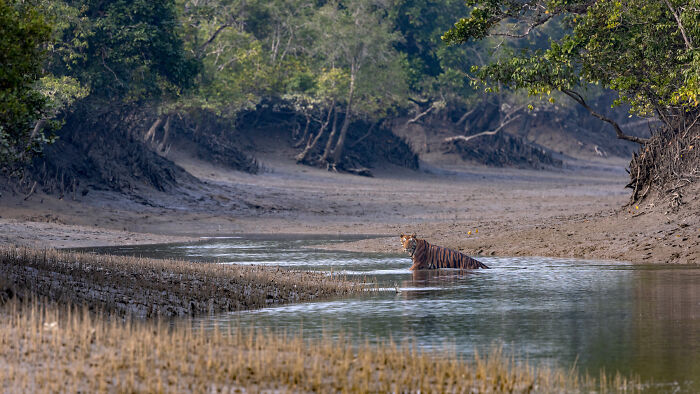
A Bengal tiger crossing a canal in the mangrove forest of Sundarbans “A Bengal tiger looking straight at me while patrolling its territory in the mysterious mangrove forest of Sundarbans in India. Sundarbans, the world's largest mangrove forest, is a uniquely dangerous place on earth. This place is home to many rare and globally threatened wildlife species, including the fabled Bengal Tiger. A Tiger here is unique because of its adaptability to the hostile mangrove habitat that renders it perpetually under stress. They eat fish and crabs, can swim very fast in big rivers, and drink salty water.”
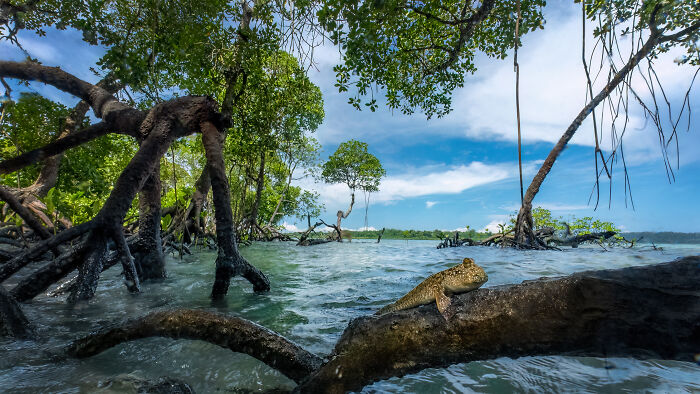
Amid the tangle of mangrove roots on Havelock Island in the Andaman archipelago, India, a mudskipper (Periophthalmus sp.) rests between the arching roots of a Rhizophora mangrove tree. Perfectly adapted to an amphibious life, mudskippers use their pectoral fins to “walk” on land, while their protruding eyes scan both sky and water for predators. Thriving at the edge of two worlds, these remarkable fish are synonymous with the mangrove ecosystem. “As the tide receded along the mangrove edges of Havelock Island in the Andamans, I found myself immersed in a quiet, unfolding ritual. A group of mudskippers (Periophthalmus sp.) clung to the textured bark of a mangrove root—startled, as always, by the retreating water. They looked stunned and frantic as they scurried back toward their vanishing home, as if the tide might not return. It became essential to capture the movement of the water—not as chaos, but as softness. A long exposure helped me translate that rhythm: the water melting into gentle motion, framing the stillness of the mangrove roots and the anxious little fish. I wanted that softness to contrast the other elements in focus, to reveal the quiet tension in this everyday event. After nearly four hours of sitting perfectly still—no adjustments, no shifts, barely a breath—the mudskippers slowly accepted my presence. While they remained wary, they no longer scattered at every twitch. And that trust, however tentative, allowed me a rare opportunity: to use my 16–35mm wide-angle lens to attempt a close-focus wide-angle shot—an intimate frame in a vast and shifting world. This image is a tribute to patience, to stillness, and to the strange beauty of creatures who live between land and sea, reacting to every tide as if it were the first.”
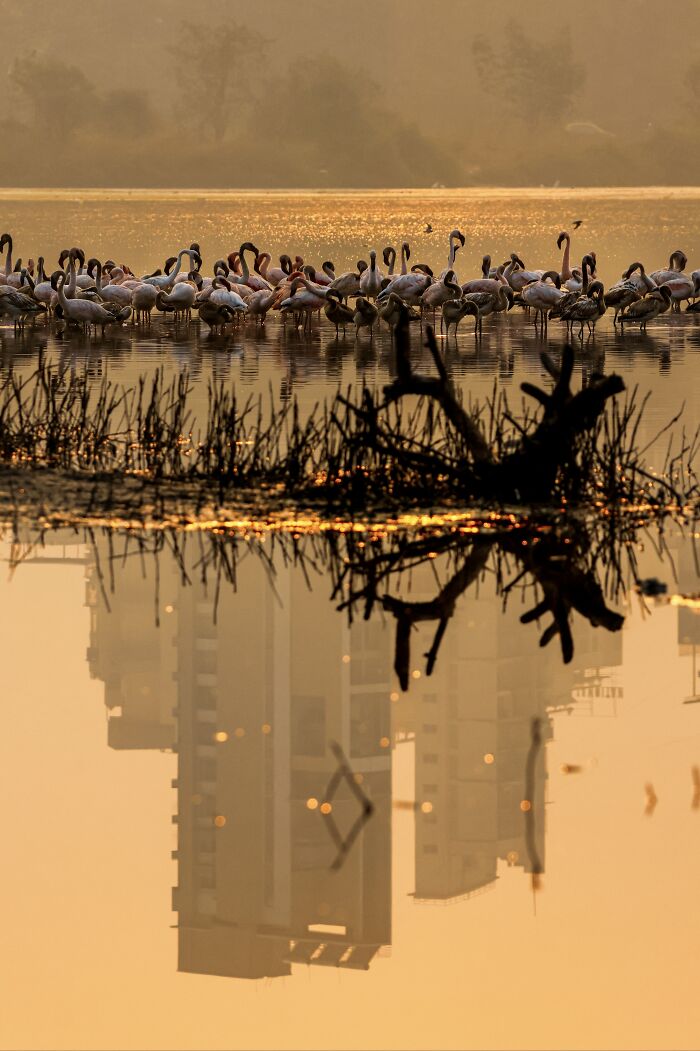
Lesser flamingos during sunrise in a Navi Mumbai wetland lake with cut mangrove trees and a building's reflection in the water. “During winter, thousands of lesser and greater Flamingos visit Mumbai and Navi Mumbai and stay on till the monsoon starts. In one of the wetland lakes in Navi Mumbai, mangroves were cut, and this was brought to public attention at large. Here, a group of Flamingos can be seen near a mangrove that has been cut, with the reflection of an adjoining high-rise that looms large. Is it growth or proliferation?”
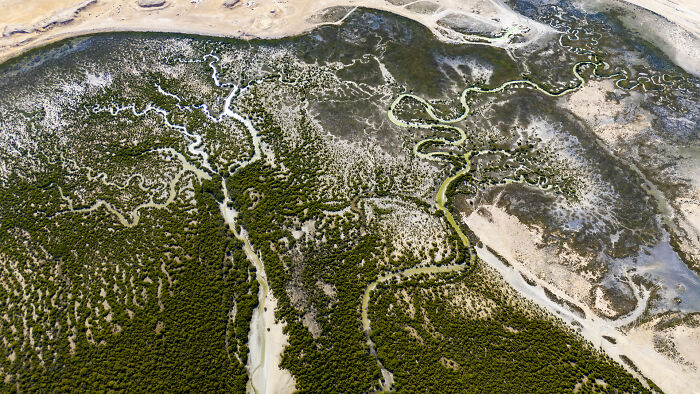
From above, the mangroves of Magdalena Bay resemble green lifelines threading through the desert—an ecosystem defying expectations.
“Hovering over Magdalena Bay reveals a stark truth: life finds a way. The winding channels of mangroves appear like veins across the arid coastal desert, drawing water and life into a seemingly inhospitable landscape. This bird’s-eye view reminds us how interconnected Earth's systems are—where moisture meets heat, where the sea bleeds into land. Mangroves here offer refuge to fish, birds, and mammals while withstanding rising tides and human pressure. The beauty and resilience of this ecosystem, etched into the landscape like brushstrokes of life, call for stewardship. This is not just scenery—it’s survival, painted in sand and chlorophyll.”
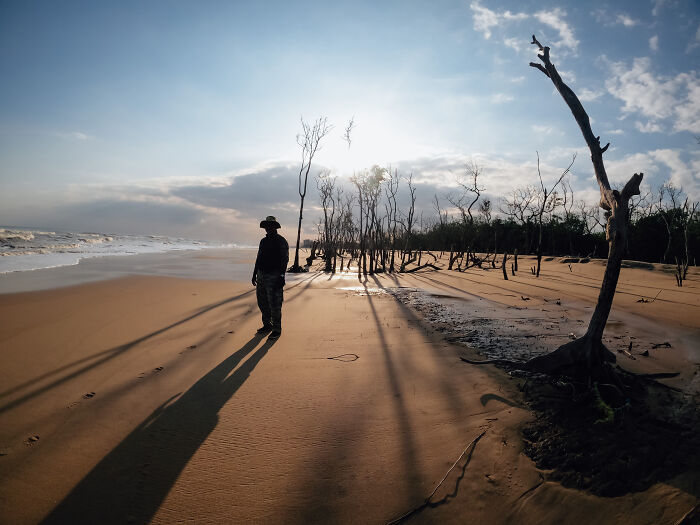
Few lucky mangroves in India have been notified as protected areas. With the ever expanding human activities these parks will eventually be the last refuge for wildlife. Safeguarding these parks is a crucial responsibility. And this job is best done by the ground guards. In the image is a forest guard patrolling the coastline of Bhitarkanika Wildlife Sanctuary.
“Bhitarkanika Wildlife Sanctuary in Odisha is a rich mangrove teaming with some of the best wildlife in India. This interesting mangrove is along the Bay of Bengal. It is manned by the hard working forest guards. They patrol the park by boat and on foot. Patrolling on foot is extremely tough but the foot guards don't shy away from it. I spent a day with them at Bhitarkanika to observe their work recently. The sheer will to save forest and wildlife drives them to work each day. Our trail ended on a beautiful beach along the Bay of Bengal. That is where this image was clicked. It is indicative of them with the guard standing in between the mangrove and the beach.”
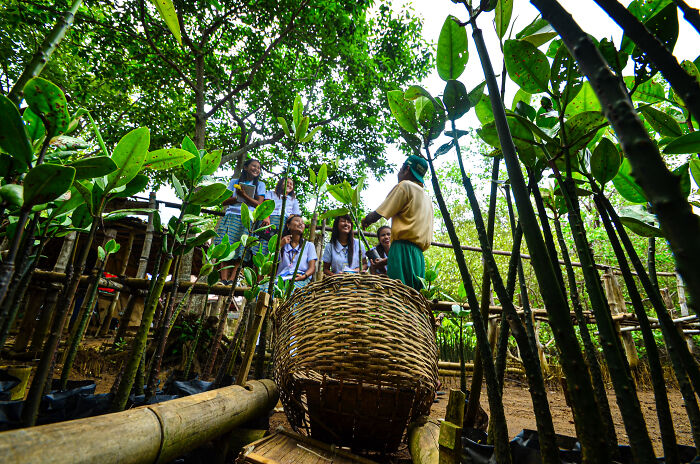
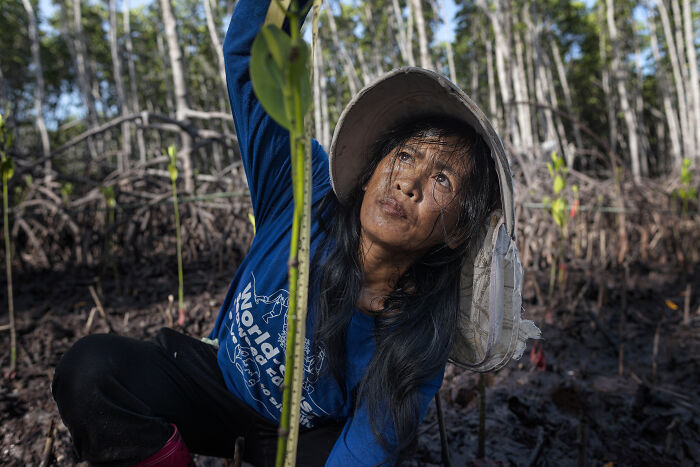
A Green Guardian educating the young students towards their journey into mangrove conservation, from seed propagation to replanting.
“The photo shows a forester educating young students about the life cycle of a mangrove.”
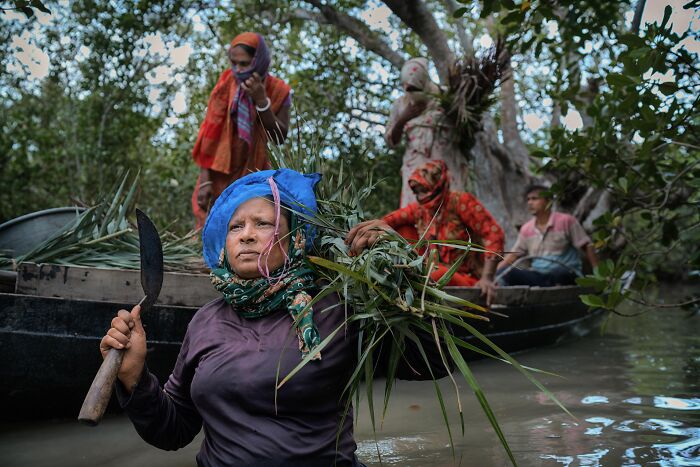
The Sundarbans, the world's largest mangrove forest, spans around 140,000 hectares across the Ganges, Brahmaputra, and Meghna deltas, primarily in Bangladesh. This UNESCO World Heritage site is home to diverse wildlife, including the Royal Bengal Tiger. However, climate change poses severe threats, with rising sea levels, salinity, and cyclones damaging the forest and displacing communities. Women face health challenges due to salinity and poor resources, while frequent natural disasters disrupt lives and livelihoods. Sustainable efforts are crucial to preserve this ecological treasure and support its resilient inhabitants.
“Shorbanu Khatun, a 45-year-old widow whose husband was killed by a Royal Bengal Tiger during honey hunting, never dares to enter the Sundarbans Forest to collect honey for her survival. Shorbanu, along with three other women who are also tiger widows, collectively hunts for honey in the deepest parts of the Sundarbans Forest. This perilous area is frequented by Royal Bengal Tigers, known for attacking and killing people, as well as pirates who kidnap honey collectors known as Mawalis. Karuna Rani, one of the few women in the Sundarbans who ventures into the forest to collect honey since her childhood, leads the way through the dense mangroves with Shorbanu. Aware of the ever-present threat of tigers, she prepares for the arduous task ahead. Alongside her fellow tiger widows, Karuna exhibits remarkable resilience and bravery, confronting both the dangers of wildlife and the challenging environmental conditions of their homeland. Karuna Rani holds a bowl ready to catch the honeycomb as her companion climbs a tree to cut the hive. Using a torch made from Gol leaves to smoke out the bees, these tiger widows bravely collect honey deep in the Sundarbans, facing numerous dangers from wildlife and environmental challenges. Shorbanu climbed up a tree in the Sundarbans Mangrove Forest to cut a beehive. She and her fellow women collaborators borrow money from the village Mahajan, who lends money to the Mawalis at high interest rates. Using smoke to ward off the bees, she carefully cuts the hive, her face shielded by a protective mesh. This dangerous task is a testament to her courage and determination as she works to support her family despite the ever-present threats of wildlife and environmental challenges. A fresh honeycomb rests in a bowl as Shorbanu and her fellow honey collectors take a moment to rest in the Sundarbans Mangrove Forest. This precious honeycomb, carefully cut from a tree, represents not only a vital source of income but also the immense risks these women undertake.”
Rooted in Care tells the story of a family living in harmony with Wanha’, the River of the Quails. Through fishing, planting, and reforesting red mangroves, they honor an ancient bond with nature - reminding us that the river gives, and we must give back.
“Once upon a time, there was a mangrove forest that migrated inland until it was embraced by a river. Over time, it learned to coexist with the surrounding jungles and flourished until the golden age of the Mayan civilization. That ancient people, guided by a profound worldview, achieved a remarkable balance between human development and the natural world. Such was their connection to life that they named this river Wanha’—the River of the Quails. However, that ancestral vision has faded over time. Modern humanity, disconnected from its roots, has largely forgotten how to live in harmony with the Earth. For decades, livestock grazing, agriculture, wildfires, and a lack of opportunities have caused severe degradation of mangrove ecosystems. Many of the river's inhabitants have been driven into a vicious cycle where harming the environment ultimately brings harm back to themselves. This photographic series portrays the daily life of a family that has found not only sustenance in the river and the red mangrove, but also a deep spiritual connection and a commitment to conservation. Through their hands, an ancestral relationship with water is revealed—fishing, harvesting, and navigating channels surrounded by living green roots. But what makes this story truly unique is its other half: planting. Each mangrove tree they plant is an act of gratitude, a promise made to the land. The images speak without words, delivering a simple yet powerful lesson: the river gives to us, and we must give back. This family teaches us that balance is not achieved through extraction, but through reciprocity. Reforestation becomes both an inheritance and lesson for future generations. Rooted in Care is a visual testament that conservation is not an isolated act, but a way of life. In Wanha’, nature and community beat together—like one shared heart.”
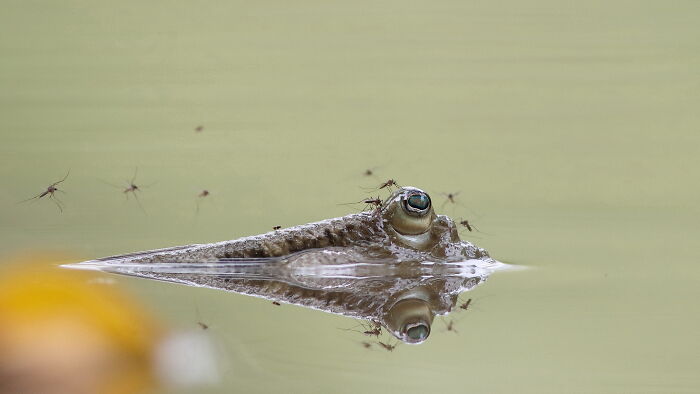
"Mosquito are dangerous than a tiger" is a Thai proverb. This saying seems to hold true, especially in mangrove forests where mosquitoes are abundant. Almost every creature appears to fall victim to them, even mudskippers and me.
This photo was taken at the mangrove along the coastline of Samut Prakarn, Thailand.
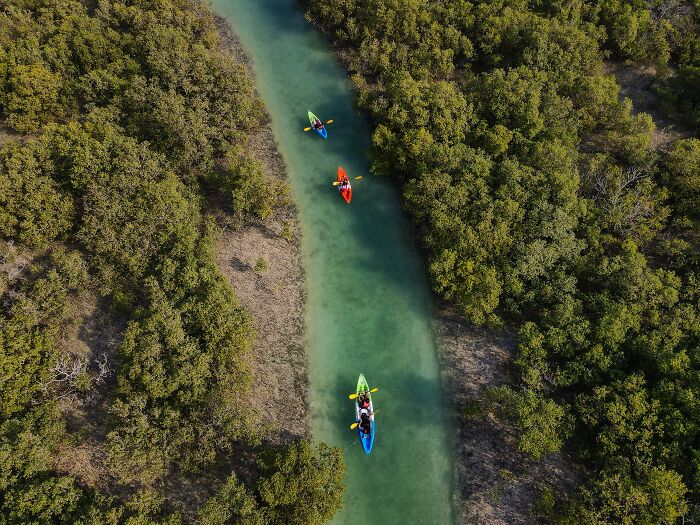
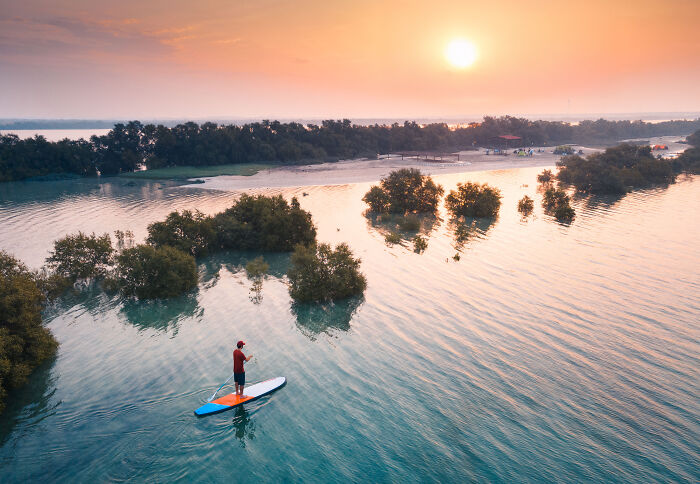
A serene morning kayak journey through the lush mangroves on one of Abu Dhabi’s tranquil islands — where nature whispers in stillness, and sunlight dances gently on the water’s surface, creating a scene of pure harmony.
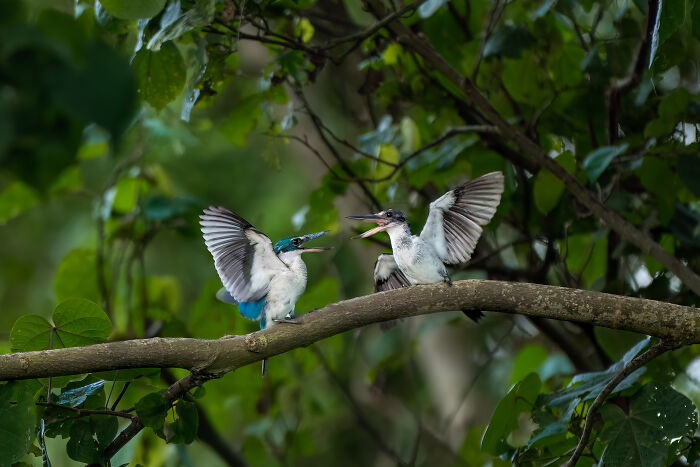
A moment of two Collared Kingfishers fighting near a mangrove forest fringe. “Two Collared Kingfishers were spotted perched next to each other on a mangrove tree, and suddenly started to quarrel and fight, until one of them flew away from there.”
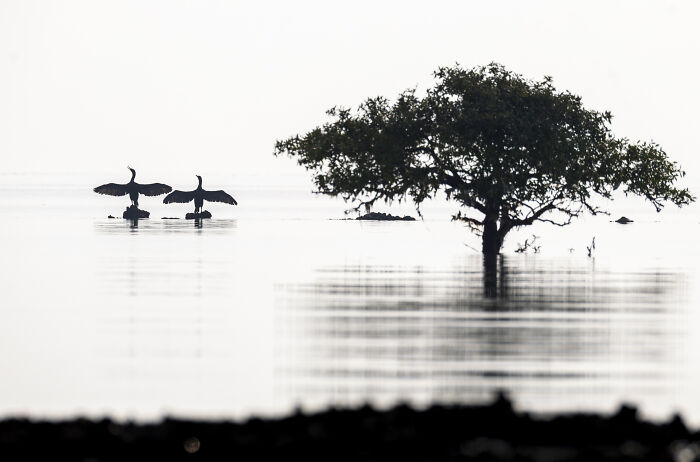
On a quiet morning, the cormorants welcome the sunrise as they rest among the branches of the mangrove trees. These skilled seabirds find in the shade of the mangroves a safe haven away from the waves and wind, where they can regain their energy after bathing in the sea. With the first golden rays of the sun, calm and tranquility fill the place, and the birds seem to join nature in greeting the start of a new day full of hope and life. “This photo was taken on the shores of Qatar, where cormorants were resting after a long day of hard work and searching for food. As the sun rose, the birds stayed under the mangrove trees to rest and dry their wings from the water. The weather was very humid during the summer, which made photographing challenging, and my lens was malfunctioning at times. However, thankfully, we succeeded in capturing these beautiful and peaceful moments that reflect the natural balance of wildlife in the coastal mangrove environment.”
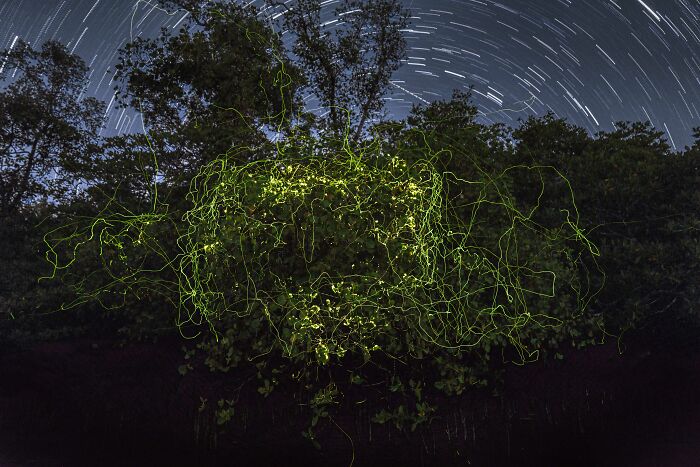
The dance of a colony of fireflies painting trails of light across a mangrove apple tree in the dark, as captured by a long exposure. The trails gathering around this particular tree show the fireflies’ affinity for the particular tree, with only a few individuals venturing away briefly before turning back. “The first time I visited the location was several years ago. Having never seen fireflies before I was amazed at the brilliant strobes of light they emitted, but I was also equally frustrated about not bringing a tripod. This time arriving at low tide and with a tripod in hand I intended to capture an image that could convey the size of the colony and how they move around. I quickly discovered a challenge to capturing their movement: they only emit light in short pulses and they move slowly across the frame -- even when using a shutter speed of 30s. As such I ended up taking 20 exposures of 30 seconds each and stacking them to form the final image, that captures the trail of both fast and slow moving individuals. Interestingly, the stroke of each line can be seen as an indicator of how fast the individual was moving. For instance, the fireflies that move quickly have trails where the individual strobes of light can be seen, whereas the strobes blend into a solid line for the individuals that move slowly.”
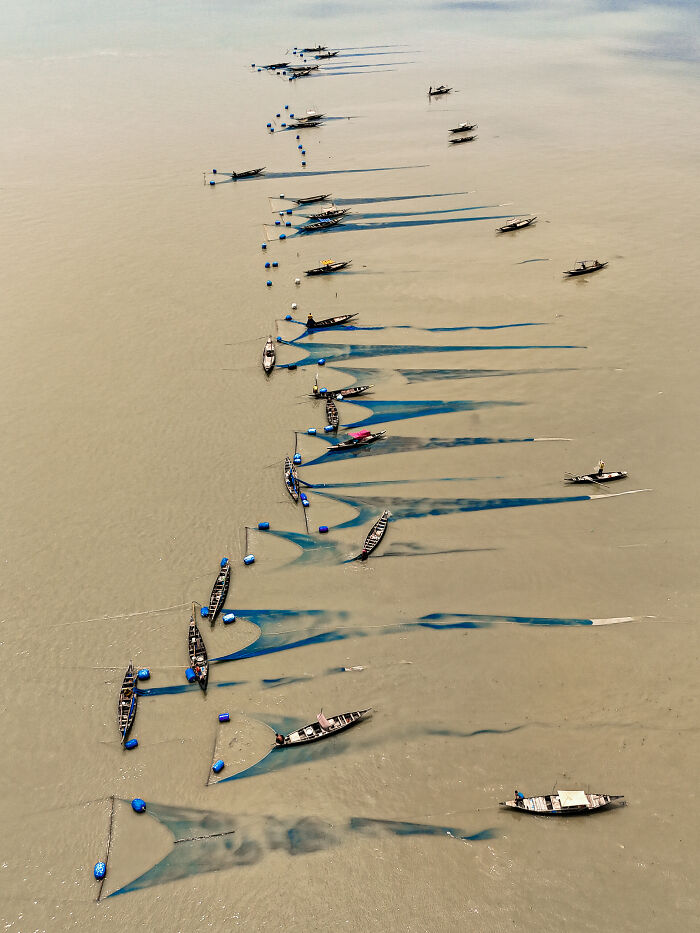
In the restricted waters of the Shibsha River in Khulna, Bangladesh, fishers defy seasonal bans, casting illegal nets in the Sundarbans buffer zone. This striking aerial view reveals the tension between survival and conservation in a climate-vulnerable region, underscoring the need for sustainable, community-driven solutions.
“This striking aerial image captures a line of fishing boats casting blue nets along the Shibsha River in Khulna, Bangladesh — a vital waterway flowing through the heart of the Sundarbans mangrove forest. Though fishing in this area is officially restricted during certain periods to protect biodiversity and restore fish stocks, many local fishers continue to operate in secret, driven by economic desperation. The nets seen here are among those banned by the government due to their destructive impact on juvenile fish and river ecology. Despite regular naval patrols, enforcement remains a challenge in this remote region. This image highlights the delicate balance between human livelihood and environmental conservation — and the urgent need for sustainable, community-led solutions in climate-vulnerable coastal zones.”
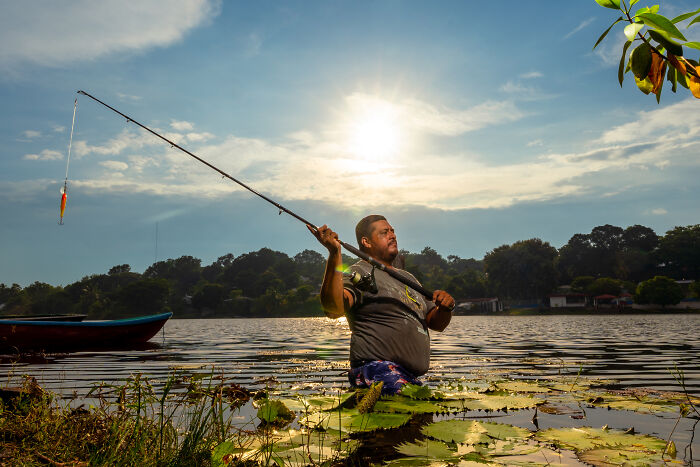
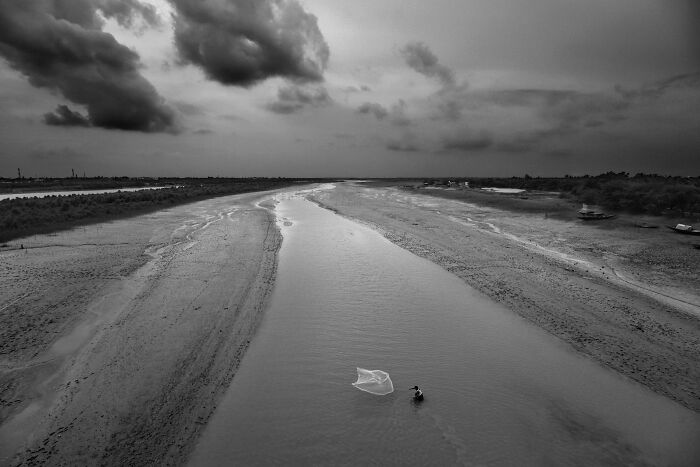
A fisherman is fishing in the river Matla during the low tide.
“A fisherman is fishing in the river Matla during the low tide in Canning, a town in West Bengal. Canning is considered as the gateway of the mangrove forest of Sunderban in India.”
Local residents join forces to plant mangrove trees, vital guardians of the coast and symbols of community resilience.
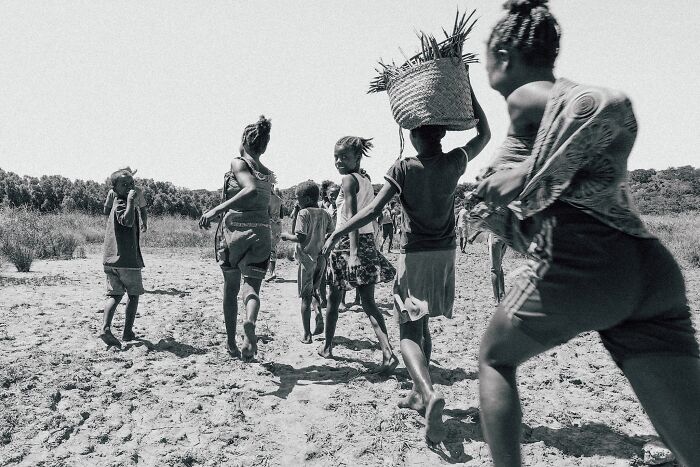
“With the support of the Planete Urgence association, residents of Amtsatrama, in the Analalava district of northwestern Madagascar, during the planting of mangrove trees, amphibious trees capable of thriving along marine shores and allowing the formation of mangroves.”
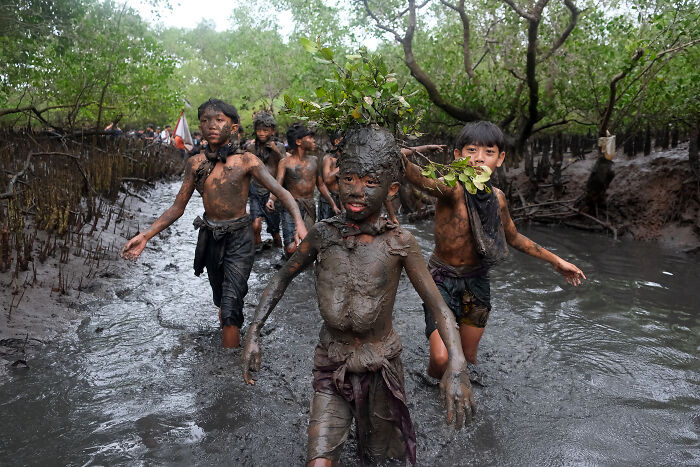
The Mebuug-buugan tradition aims as a form of self-purification and respect for nature, especially mangrove forests, which is held once a year, exactly one day after the Nyepi celebration in Kedonganan Village, Badung District, Bali Province, Indonesia, Sunday, March 30, 2025.
“The Mebuug-buugan tradition aims as a form of self-purification and respect for nature, especially mangrove forests, which is held once a year, exactly one day after the Nyepi celebration in Kedonganan Village, Badung District, Bali Province, Indonesia, Sunday, March 30, 2025. This tradition also functions as a means to maintain environmental cleanliness and remind the community about the importance of maintaining the mangrove ecosystem.”
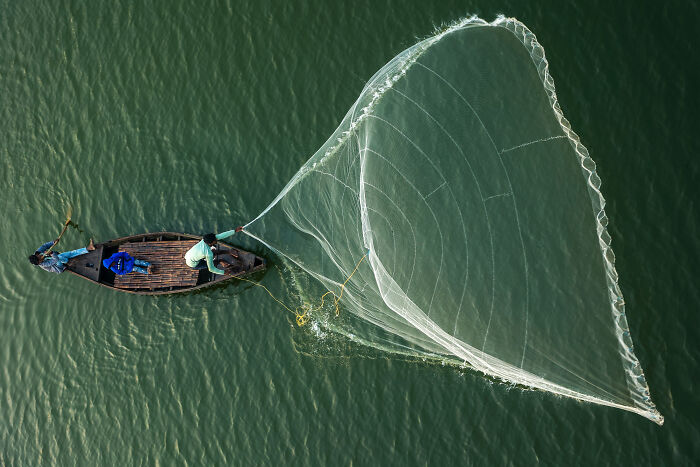
In the morning to catch fish
“A fisherman has a daily routine where he comes to the river in the morning to catch fish and gets neatly caught in the net which looks like a drone image.”
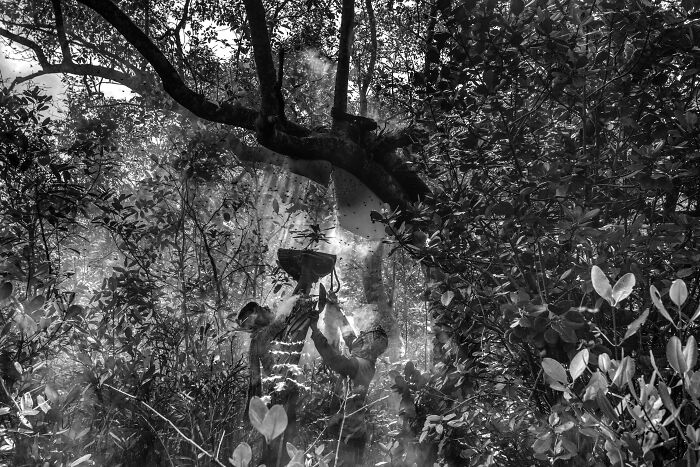
In the heart of the Sundarbans mangrove forest, honey hunters—locally known as Mawlai—risk their lives to harvest wild honey. This perilous pursuit ranks among the world's most dangerous professions, as hunters face deadly encounters with Royal Bengal Tigers, crocodiles, venomous snakes, and other wild beasts. Each season, the forest claims lives, yet the Mawlai return, driven by tradition, survival, and the lure of nature’s golden bounty.
“Deep within the labyrinth of the Sundarbans—the world’s largest tidal mangrove forest—moves a band of fearless men known as Mawlai, or honey hunters. For generations, these men have braved the dense wilderness to harvest wild honey, a sacred tradition and a seasonal livelihood passed down through time. Armed with little more than handmade tools, smoke pots, and ancestral knowledge, they navigate treacherous terrain where each step could trigger an ambush by nature’s deadliest predators. Towering Royal Bengal Tigers, stealthy crocodiles lurking in muddy waters, venomous snakes coiled in the undergrowth, and hostile weather are constant threats. The danger is so real that the Sundarbans honey hunt is considered one of the most hazardous professions on Earth. Yet, despite the risks, the Mawlai return to the forest every season, often traveling in small groups, chanting prayers and offering rituals to forest deities for protection. The honey they collect—golden, raw, and rich with the taste of wildflowers—is not just a product, but a symbol of endurance, cultural identity, and survival.”
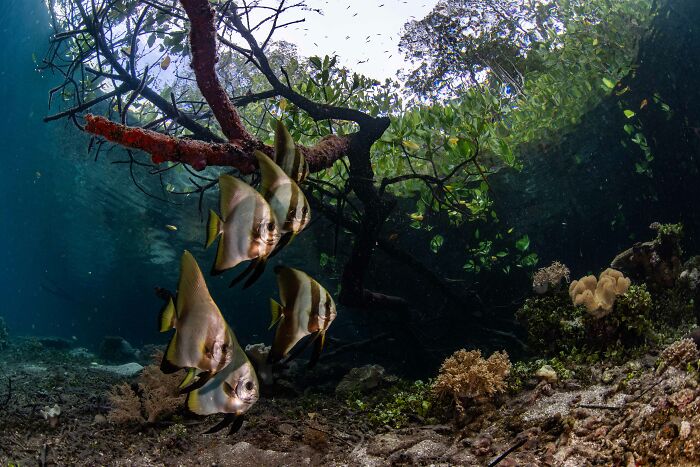
Longfin batfish find protection beneath a mangrove tree.
“Lush greenery meets soft corals, and fish find shade under a tree. A marriage between two worlds.”
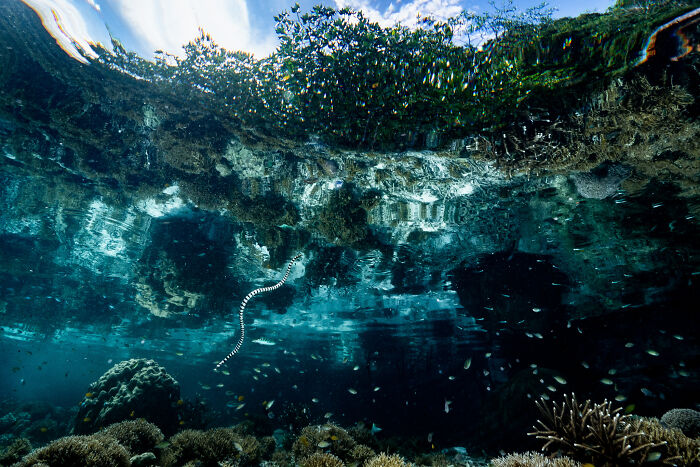
A Banded Sea Krait Rises to the surface for a breath at a pristine fringing mangrove reef. Like the mangroves, the sea krait represents the threshold between land and sea, as they too are reliant on the world above and below the surface.
“I believe the sea krait and mangroves are alike in many ways. Like mangroves, sea kraits live partially in the water and on land. They rest and lay their eggs on land, but forage out at sea. Both must breathe air. The sea krait relies on the mangrove for habitat and protection. On this day as I was searching the shallow waters in Raja Ampat, Indonesia, I was most excited to see this banded sea krait hunting along the fringing reef below the mangroves. I watched and photographed it for well over an hour as it hunted in the reef searching for prey, then about every 5 minutes it would swim back to shallow water, close to the mangroves for protection, and take a breath. Then it would repeat this cycle. I learned its rhythm and relied on my breath-holding capabilities to time my shallow dives with the snake’s ascent. I predicted the snakes’ path to position myself in a strategic location that would compose the snake with the reef, mangroves, and dreamy reflection. Each ascent was quite rapid, as the small snake is vulnerable at the surface to large predators from below, and feathered predators from above. I had mere moments to compose and capture my image with each ascent. Perfecting my lighting with my strobes added another challenge which I overcame with practice. I only got one chance per breath, after which I’d need to wait several minutes as the snake foraged below, before I would get another chance to capture this shot. After many attempts, I captured this image.”
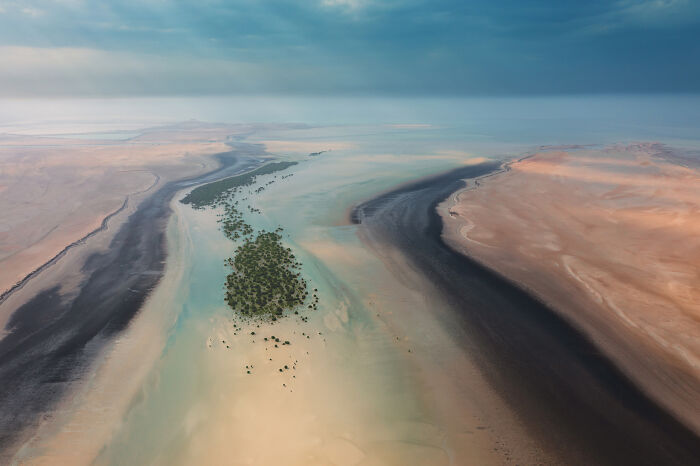
In the heart of a vast desert expanse, a ribbon of mangroves winds defiantly through salt flats and tidal plains — a living reminder of nature’s resilience. This aerial perspective captures the delicate balance between land and sea, where mangrove forests thrive as a vital ecological shield, protecting coastlines, preserving biodiversity, and capturing carbon in one of the harshest environments on Earth. A testament to how life endures — and heals — if given the space.
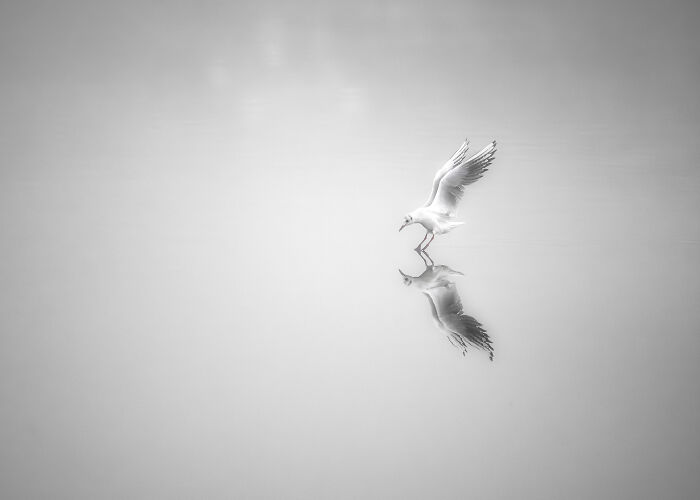
Feels Like Heaven
“This minimalistic photo of a seagull was taken in the mangroves along Khaleej Al Arabi Street in Abu Dhabi during a heavy fog. The bird was captured in the act of catching its food, while the dense mist transformed the moment into a scene that felt almost otherworldly. The stillness of the water below mirrors the seagull with perfect clarity, enhancing the sense of calm and transforming the moment into a quiet study in simplicity and grace.”
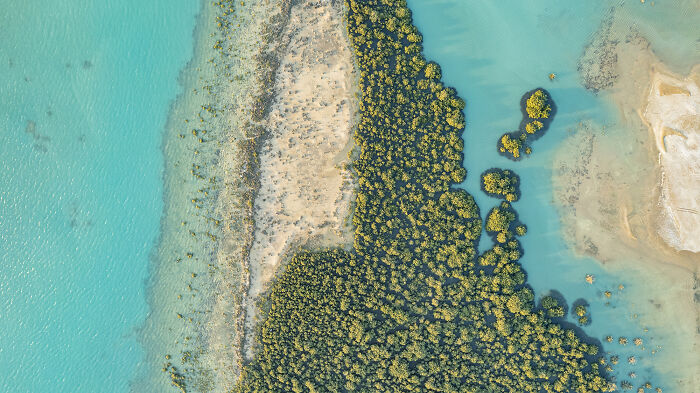
Aerial view of mangrove trees on the Red Sea coast, northwest of Saudi Arabia.
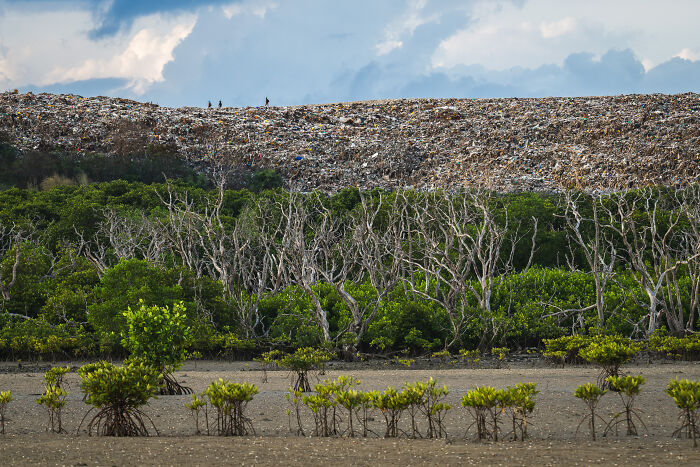
Not far from Bali’s airport and tourist beaches, I came across this mountain of waste towering behind one of the island’s struggling mangrove forests. Young shoots rise while dead trunks mark where others failed. The scene is a quiet warning—of resilience under threat and of what lies just out of frame in paradise. I took this photo to show the uneasy edge where mass tourism, urban waste, and vital ecosystems collide. “I took this photo near Pesanggaran in southern Bali while on a birding tour looking for shorebirds at low tide. As we walked along the sand beside a chain of mangrove forests, I stumbled upon this towering pile of trash. It was a jarring sight, rising above the canopy of one of the island’s struggling mangrove ecosystems, in plain view but somehow hidden in plain sight. This appears to be a long-standing trash site, possibly once formal but clearly unmanaged. In the past, a major fire burned through the rubbish here, and to this day, the landfill continues to grow, pressing against the edge of this delicate mangrove system. I was struck not only by the scale of the waste, but by the number of birds congregating around it, seemingly feeding from it, and the unexpected presence of people walking along the crest of the trash mound. Their small figures in the distance gave the scene a bizarre scale. Closer to my feet, among the sand and the crabs, were tyres, cans, and plastic debris. I noticed dead mangrove trees tangled in the middle layer of the forest, with young shoots planted in the foreground, likely part of a reforestation effort to combat the damage. The image felt layered in more than just its composition, the sky, the looming waste, the collapsing and regenerating trees, and the fragile shoots clinging to the tide line. I wanted the photo to serve as a wake-up call: an example of how mass tourism, consumerism, and poor waste infrastructure can collide in places that sell the idea of paradise. Shot on a Nikon Z8 with a 180–600mm lens to compress the layers I saw. This wasn’t what I intended to shoot, but it’s what I took away from this scene.”
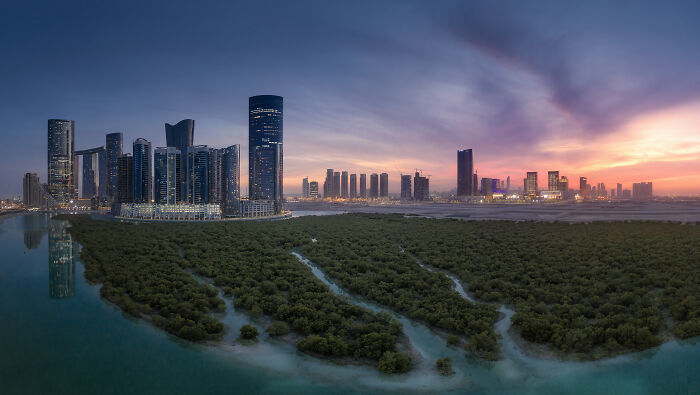
An aerial view from Reem Island where mangrove roots nourish the land, and skyscrapers rise—reflecting a city that breathes with nature.
“From high above Reem Island, this panoramic view captures a rare harmony where Abu Dhabi’s coastal mangroves meet the rising skyline. The tidal channels weave through the green forest like lifelines, feeding the city with breath and calm, while the sunset ignites the sky behind the towers. This is more than a visual spectacle—it’s a message: true progress respects its roots. The mangroves here don’t just shield the shores, they preserve the spirit of balance that every thriving city needs.”
The Philippines, an archipelago of over 7,000 islands, is one of the most disaster-prone countries in the world. Located in the Pacific typhoon belt, it experiences an average of 20 typhoons a year. Rising sea levels, intensifying storms and coastal erosion are having a profound impact on the environment and the people who depend on the sea for their livelihoods, food and cultural identity. In response to these growing challenges, mangrove restoration has emerged as a beacon of hope for vulnerable coastal communities. Through grassroots efforts and collaborative initiatives with local governments, NGOs and community-based organisations, mangrove restoration projects have gained momentum across the Philippines. These efforts are empowering people and building environmental resilience, reducing vulnerability to climate impacts while enhancing biodiversity and supporting the livelihoods of millions of Filipinos who rely on fishing as their main source of income.
“01 - Portrait of Rosalie Inso and her son Raymark in the coastal village of Buluan. Rosalie is the president of the BBFO, a 45-member community organization that has been working for 20 years to protect the area's coastal and marine resources. BBFO members have reforested 167 hectares of mangrove forest in the area with financial support from the local government unit, which paid them for each mangrove seed they planted in designated areas. With this extra income from fishing, Rosalie was able to pay for Raymark's studies, now a teacher. He says, "I owe a lot to my mother and her efforts to provide for my studies. I used to plant mangrove seeds with her when I was a child, and now I have the opportunity to teach my students the importance of contributing to the restoration of the environment in which we live". 02 - Most coastal communities in the Philippines depend on fishing for their livelihood. Families start involving their children from a very young age in what is their main business, teaching them how to catch and sell fish. Today, thanks to the educational campaigns of organizations like COMFAS, fisherfolk know more about environmental restoration and how it goes hand in hand with sustainable management of their waters. This gives them the opportunity to pass on to the new generation a useful knowledge needed to build their future resilience in both sustainably managing their fish resources while replanting mangroves forests. 03 - On November 8, 2013, Super Typhoon Yolanda (Haiyan) tore through Eastern Samar, becoming one of the strongest typhoons ever recorded. With winds reaching catastrophic speeds, the storm claimed at least 6,000 lives and left millions without homes, livelihoods, and basic infrastructure. Among the the hardest hit communities was Guiuan, where the storm made landfall and entire villages were wiped out by its fierce winds and surging waves. The haunting image of a lone house frame, now stranded in the mangroves, is a stark reminder of the storm's wrath. A symbol of the fragile boundary between human life and nature's most devastating forces, forever altered by the growing intensity of climate change. 04 - Handayan Island women monitor the growth of transplanted mangroves. The province of Bohol was the hardest hit in Central Visayas when Super Typhoon Odette (Rai) hit the coast in 2011. Many residents lost their homes and other family members, and those who survived said Odette was the strongest storm they had ever experienced in their lives. Since 2021, with support from ZSL, coastal communities have been engaged in mangrove restoration to rebuild the natural barrier that protects them during these violent storms. Indeed, mangrove forests provide critical protection for communities vulnerable to sea level rise and severe weather events caused by climate change. The deep network of tree roots holds the landscape together, acting as a shield that can potentially save lives. 05 - Maria measures the height of a newly planted mangrove on Mahanay Island and tracks its growth as part of the Rehabilitating Mangrove Greenbelts for Coastal Protection project. This initiative focuses on restoring mangrove forests that were degraded or devastated by typhoons in Getafe and Talibon. By actively involving local communities, especially women, these projects rebuild vital coastal ecosystems while increasing resilience to future storms. In the process, they provide sustainable income for villagers and empower them to participate in conservation efforts that directly impact their livelihoods. The role of women in these projects highlights a powerful truth: gender equality is not just a social issue, it is a critical element of climate action. When women are given equal opportunities to contribute to environmental solutions, entire communities become more resilient and the fight against climate change grows stronger. 06 - In Barangay Conception, the small-scale fisherfolk of KGMC have spent nearly four decades restoring their local marine ecosystem, turning the tide against the destructive fishing practices that once ravaged these waters. Since 1986, the community has replanted more than 50 hectares of mangroves and transformed abandoned, polluted fishponds into thriving coastal forests. This grassroots-led rewilding effort has revived biodiversity and brought back wild groupers, crabs, clams and shrimp, while improving livelihoods and reinforcing the interdependence between people and a healthy ocean. As climate threats escalate across the Philippines, Kabasalan stands as a model of resilience and ecological stewardship, proving that local action can protect both community and environment.”
Mangrove trees in many coastal areas are rapidly deteriorating due to climate change and rising temperatures that disrupt the balance of the marine environment. Marine pollution caused by human activities such as oil spills, industrial waste, and untreated sewage worsens the situation, gradually robbing mangroves of their healthy habitat. These pressures lead to the death of many mangrove trees, turning lush green forests into barren lands resembling deserts, with a loss of biodiversity.
“I captured this photo with great difficulty due to challenging weather conditions. My drone was small, which made it very hard to fly at high altitudes to get a full aerial landscape shot of the mangrove trees. Despite this, I managed to take a photo that clearly shows the contrast between the damaged areas where mangroves are collapsing and the healthy, vital zones. This image carries a powerful message highlighting the threat mangrove trees face from climate change and human activities that negatively impact this vital ecosystem.”
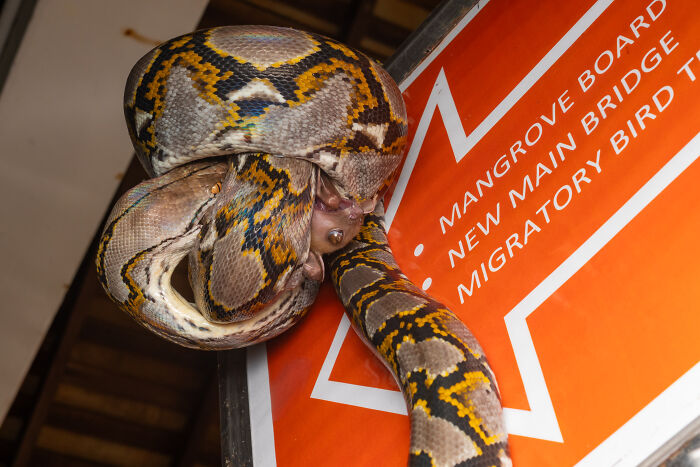
A Reticulated Python ensnares a Fruit Bat in its jaws, constricting it as it shrieks in pain. “A morning stroll at Singapore's Sungei Buloh Wetland Reserve (2022) yielded an unexpected encounter. As I arrived, I noticed a Reticulated Python (Malayopython reticulatus) hunting for Lesser Dog-faced Fruit Bats (Cynopterus brachyotis) in the rafters. Out of nowhere, it made a daring lunge for a mother bat and her child, flinging itself off the rafters and onto a signboard below where I was observing them. I watched in astonishment as the python constricted the bats, which were emitting loud squeaks. However, this encounter was brief. Seemingly stunned from the harsh fall, the python released its grip on the two and swiftly departed shortly after. The baby bat tragically died, while its mother lived to see another day. The outcome was a photo of the longest snake in the world suffocating its helpless prey, which donned a chilling expression.”
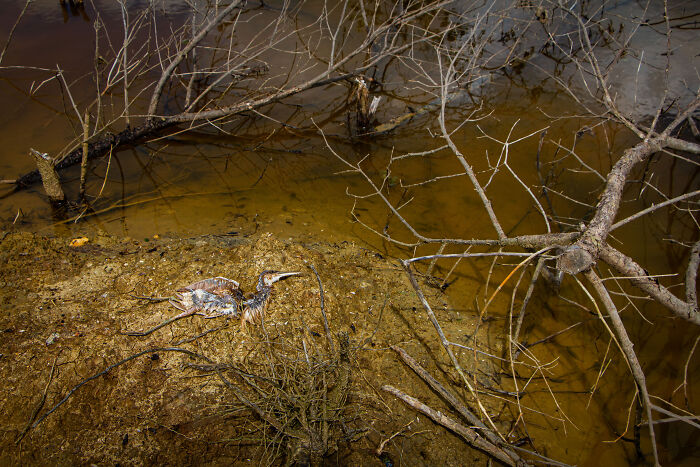
Its feathers dulled and its purpose erased, the Rufous Night Heron has found its end not from nature, but from neglect. Surrounded by the brittle remnants of dying mangroves, this image bears witness to the unraveling thread between species and shelter. The wild cannot wait for protection that comes too late.
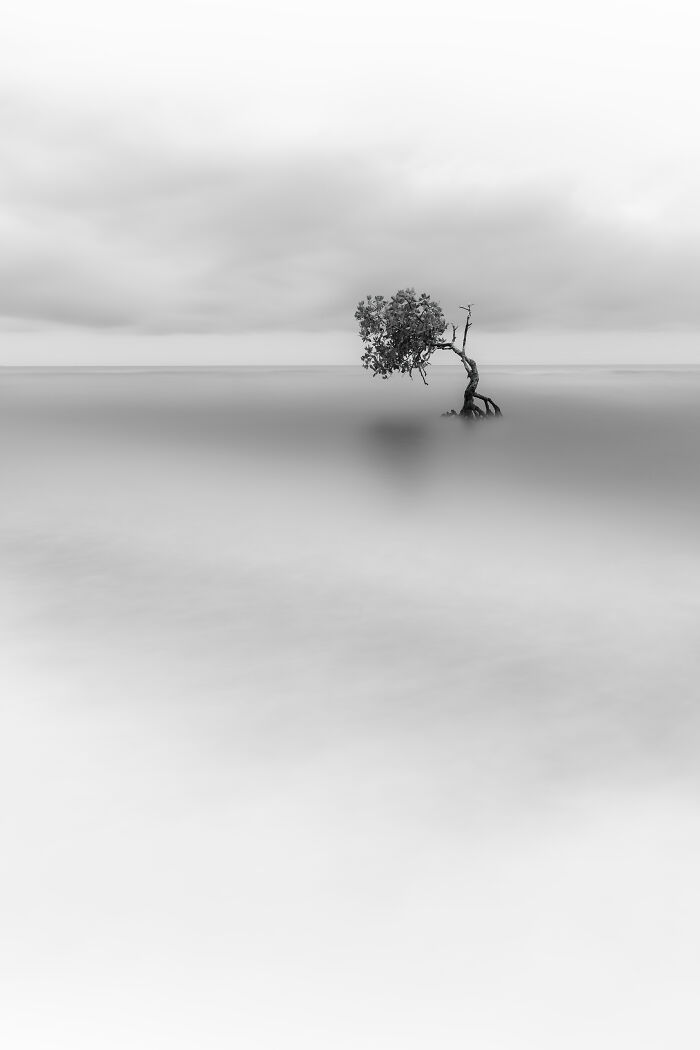
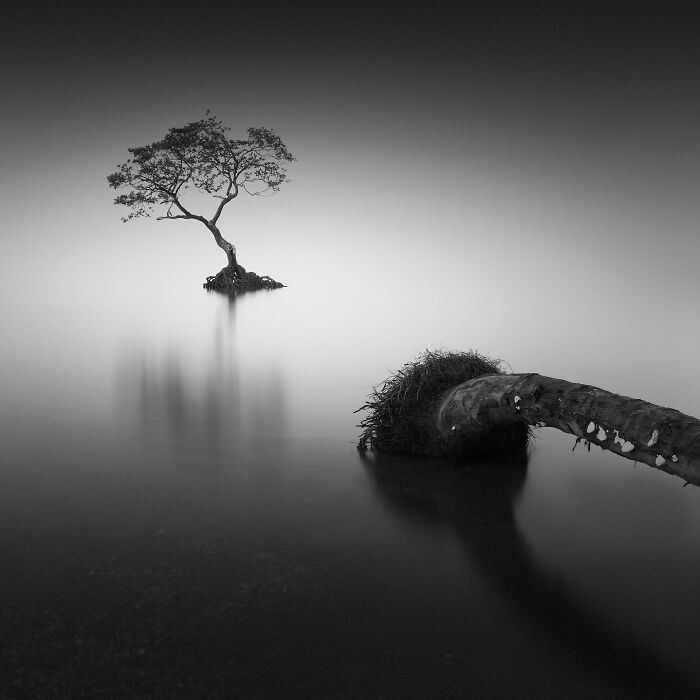
A solitary mangrove tree curves gracefully above a smooth, glass-like sea—captured in long exposure, evoking a final, quiet gesture of endurance.
“This image steps into the realm of fine art photography. Using a long exposure, I transformed the moving sea into a motionless, reflective surface—like an ice skating rink. Against this backdrop stands a single, bent mangrove tree, its shape uncannily resembling a person taking a bow after a performance. It’s the only tree on this stretch of coast, and I found myself wondering what happened to the others. In that context, the bowed form became symbolic: a final act, a solitary performer acknowledging the end.”
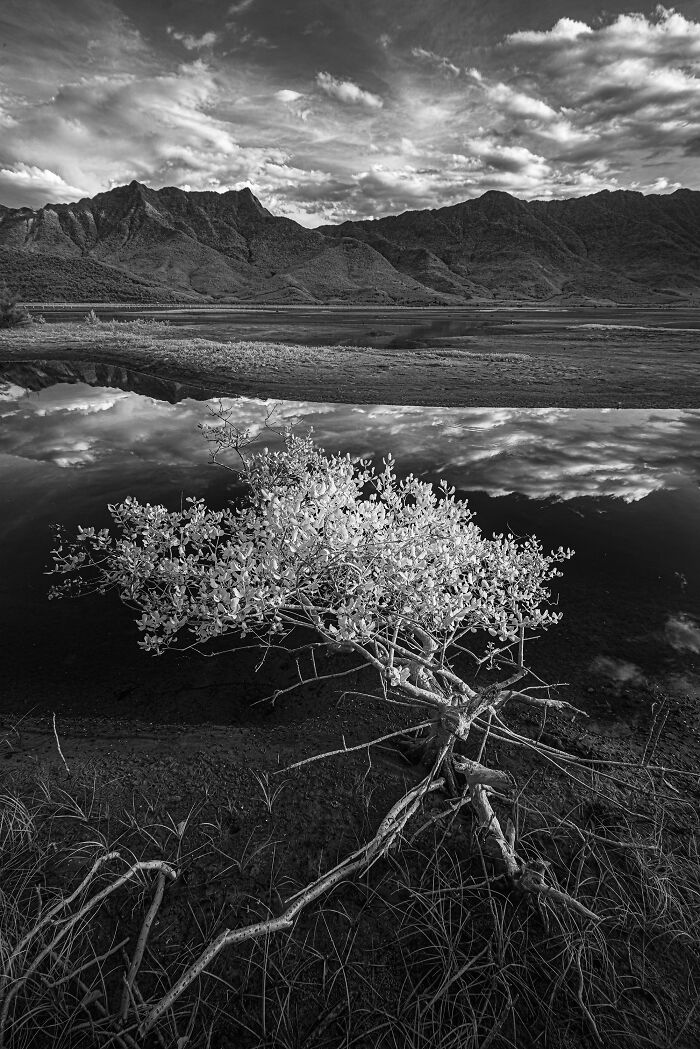
Vitality of a mangrove tree at the TamGiang lagoon- Hue city-Central Vietnam.
“Using infrared camera with filter 590nm to make this shot. Final images to be changed to black and white.”
Amidst chaos, stands tall, a silent sentinel against the tide of time. In monochrome elegance, it whispers tales of resilience, a beacon of hope amidst nature’s turmoil.
“In the stark contrast of black and white, this mangrove tells a story of resilience amidst chaos. Captured in Sipalay City, Philippines, the lone mangrove tree stands as a symbol of strength and endurance. In the foreground, a fallen coconut tree lies submerged in the water, a casualty of the destructive force of Super Typhoon Rai (Odette) last December 2021. Despite the devastation surrounding it, the mangrove remains steadfast, its roots firmly anchored in the earth. The juxtaposition of the upright mangrove and the fallen coconut tree serves as a poignant reminder of nature's ability to withstand adversity. In the face of climate change and increasing threats from extreme weather events, the mangrove stands as a beacon of hope. It is a testament to the resilience of life itself, urging us to stand firm in the face of challenges and to protect the precious ecosystems that sustain us all.”
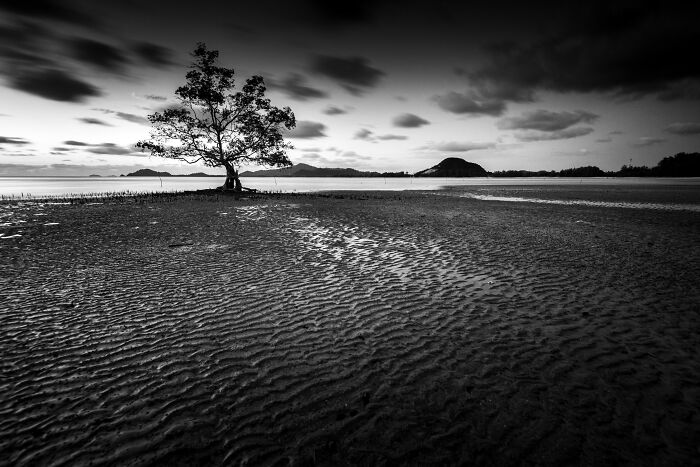
A lone mangrove stands resilient on the textured tidal flats, silhouetted against a dramatic sky.
“This black and white photograph captures the quiet power of nature through the stark silhouette of a solitary mangrove tree, rooted firmly in the rippled mudflats at low tide. The expansive foreground of textured earth contrasts with the calm sea and softly blurred clouds, evoking a sense of isolation and endurance. With distant hills lining the horizon, the image speaks to the resilience of life in coastal environments and the stark beauty found in simplicity and solitude.”
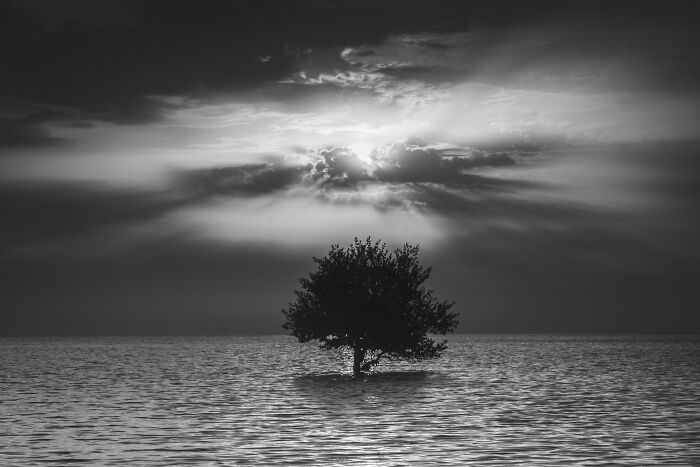
This photo was taken of a lone mangrove tree located away from the shore in the Al Khor area of Qatar.
“A lone mangrove tree stands firmly in shallow, calm waters, far from the shoreline, which appears faint and misty in the background. The mangrove tree symbolizes resilience, solitude, and the quiet beauty of nature thriving despite being isolated. Its distance from the land reflects its independence and perhaps a sense of abandonment, making it a powerful metaphor for strength in seclusion. The photo is rendered in black and white to evoke a dramatic and emotional tone, enhancing the sense of solitude and isolation.”
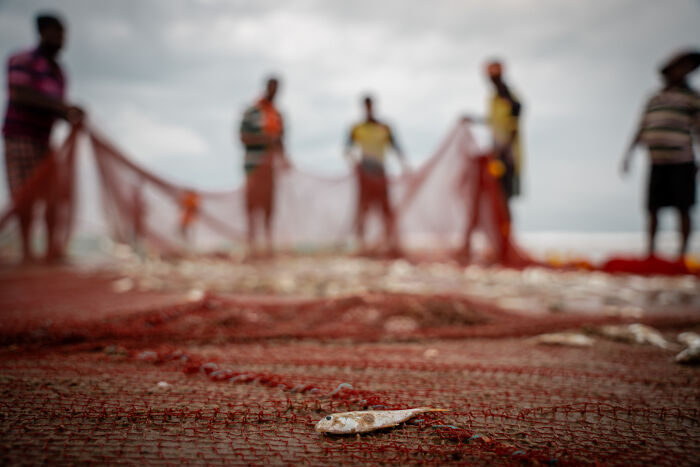
Picture of a fish with fishermen in the background.
“The fishermen and the fish”































 No fees, cancel anytime