Get Premium
Dark mode theme is available exclusively for premium users. Learn more about the benefits of subscribing.
No fees, cancel anytime.

 Dark Mode Ad-Free Browsing Unlimited Content
 Ad-Free Browsing Unlimited Content Dark Mode
Join 1.2 million Panda readers who get the best art, memes, and fun stories every week!
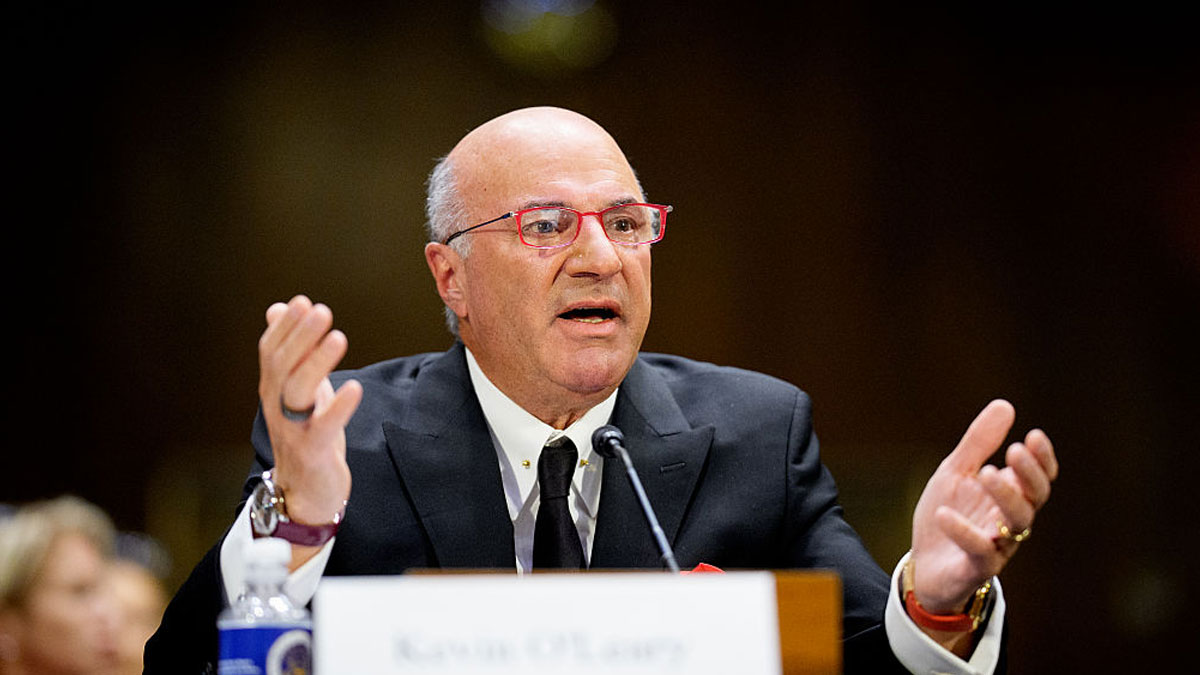
Millions of Shark Tank viewers know Kevin O’Leary as “Mr. Wonderful,” the straight-talking investor who never sugarcoats a deal. Decades on television and an even longer run in business have made him a household name on both sides of the border and a go-to voice on all things money.
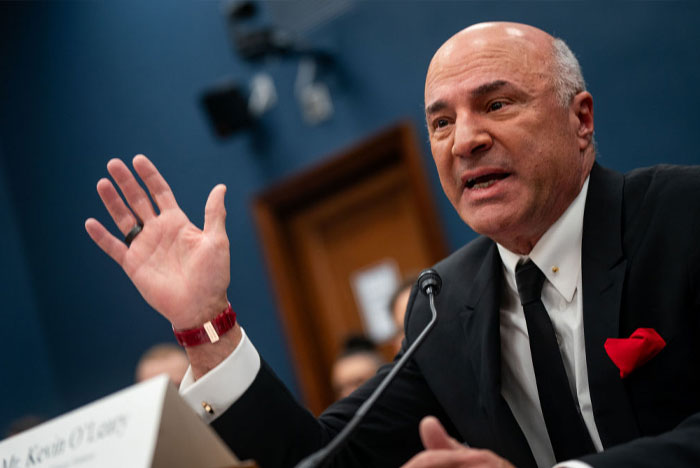 Image credits: Kent Nishimura/Getty Images
O’Leary’s credentials match the confidence: he sold his educational-software firm SoftKey International for billions, turning boardroom bravado into bankable results. With that kind of pedigree, it’s no wonder fans want the exact figure behind his fortune.
This article unpacks O’Leary’s income streams, tracks how each venture adds to his bottom line, and shows how his wealth stacks up against the other Shark Tank sharks.
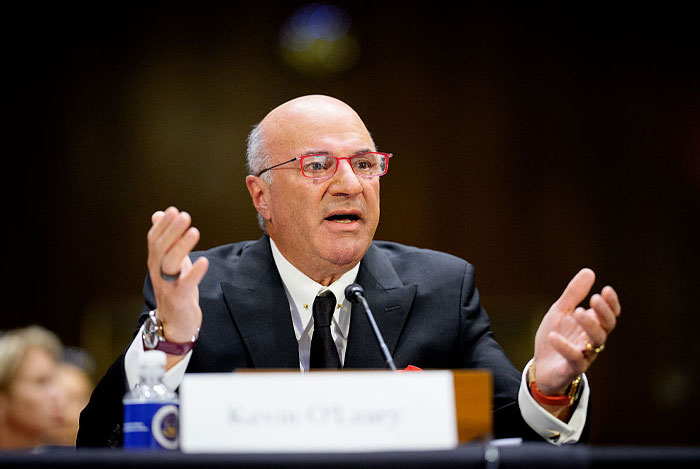 Image credits: Andrew Harnik/Getty Images
According to Celebrity Net Worth, Kevin O’Leary is worth $400 million.
His Maclean’s profile reveals that he learned to build wealth from humble beginnings. His economist stepfather persuaded him to pursue tertiary education up to his MBA. His mother, who ran the family’s clothing business, was also an avid investor who taught him the famous rule of saving at least one-third of his income.
O’Leary started as an intern at Nabisco Biscuit Company and rose to assistant manager at the cat food branch. According to his Ivey Advisory Board page, he co-founded his first company, Special Event Television (SET), after learning marketing at Nabisco.
He sold his share of SET for $25,000 and spent the small fortune, alongside a $10,000 investment loan from his mother, on a house and computer. He used that computer from his basement to develop an educational software startup, The Learning Company (formerly known as Softkey International).
According to Nuvo, O’Leary’s massive boost in net worth came after Mattel acquired The Learning Company for $4.2 billion in 1999.
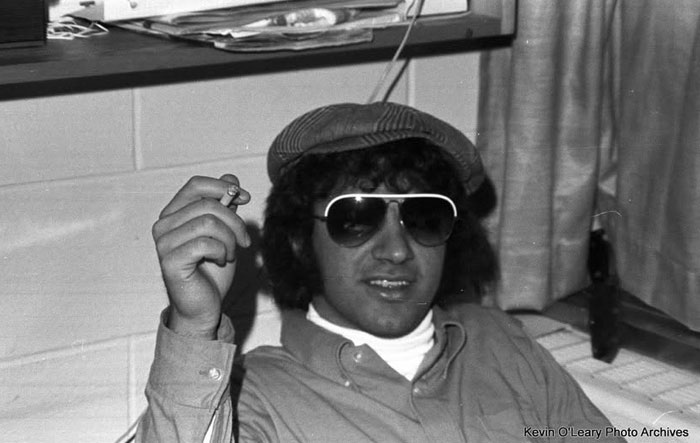 Image credits: Kevin O’Leary
In 2003, he invested in a climate-controlled storage company, StorageNow. According to The Globe And Mail, StorageNow was hugely successful, establishing 10 facilities across Canada to become the largest storage service in the country by 2006.
However, they were outpaced by InStorage Real Estate Investment Trust (REIT), and InStorage bought them out in 2007, leaving O’Leary with a net $4.5 million profit on his $500,000 investment.
After his multimillion-dollar investing wins, O’Leary leveraged his finance expertise and on-screen charisma to become a continentally renowned TV personality and investment mogul. He has built an empire on top of the SoftKey windfall by investing in media, technology, wine, mortgages, and venture capital.
💼 Kevin O’Leary
| Main income sources: | Business ventures, television appearances, investments |
| Major business ventures: | Co-founder of SoftKey (sold to Mattel for $4.2 billion), founder of O’Leary Funds and O’Leary Ventures |
| Television appearances: | Regular investor on “Shark Tank” and other business-related TV programs |
| Investments: | Diverse portfolio including technology startups, consumer products, and financial services |
| Real estate: | Properties in Canada and the United States |
| Philanthropy: | Supports various charitable organizations and educational initiatives |
| Social media following: | Instagram: over 500K; Twitter: over 800K |
In 2006, Kevin O’Leary joined the cast of Dragon’s Den, a reality TV show where entrepreneurs pitch their business ideas for investments from multimillionaires. Three years later, he joined Shark Tank, the American version of the show.
According to Failory, he has invested in 127 businesses on the show. O’Leary has made tens of millions of investments in sixteen seasons on Shark Tank.
According to CNBC, a Sharkalytics report showed that he invested $8.5 million in the first 13 seasons. The size of his investments has ranged from a $35,000 pittance for 50% of PaperBox Pilots to a $2.5 million fortune for 10% of Zipz Wine.
It’s difficult to estimate precisely how much O’Leary has made from Shark Tank, but he admitted that the sharks have “had catastrophic losers…[and] euphoric monster hits” when speaking with CNBC.
According to Yahoo!, Zipz has become dormant after failing to launch and pivot. O’Leary also once lost $500,000 on a bad judgment call with a Shark Tank investor.
But they haven’t all been grim stories, as he says he’s had “more hits than losers”. Eighteen months after his $75,000 investment in Groovebook, Forbes reported that Shutterfly bought the company for $14.5 million, making O’Leary a $5.8 million profit.
Another mega investment, Wicked Good Cupcakes, grew by 600% in one year after his royalty-based partnership and raised their annual sales from $150,000 to $10 million in three years.
O’Leary also revealed to CNBC’s Make It that he made a 1,346% return on his investment in Plated when the company was bought by Albertsons three years later.
According to Business Insider, his gamble on BasePaws also paid off with 20x to 90x returns from its acquisition by Zoetis.
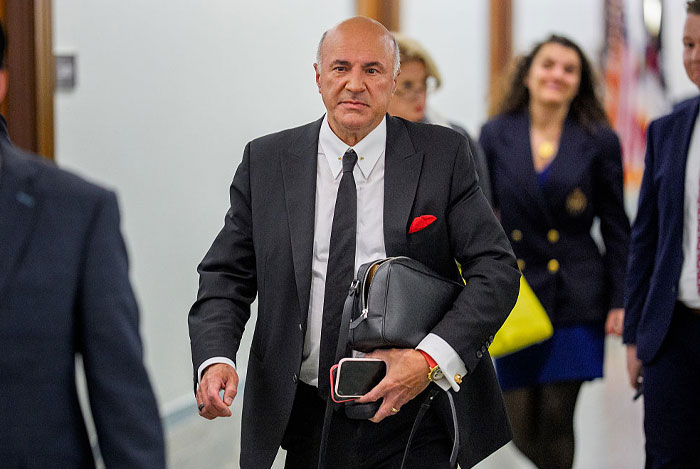 Image credits: Andrew Harnik/Getty Images
Since 2000, Kevin O’Leary has invested in small and medium-scale entrepreneurs off-TV through his venture capital platform, O’Leary Ventures.
In 2016, he partnered with Connor O’Brien to establish O’Leary Funds Management LP, a portfolio management and investment advisory service. According to The Globe And Mail, the firm’s assets under management grew by almost $1 billion in less than two years.
However, in February 2016, Morningstar Canada reported that after a “mostly poor relative performance” from O’Leary Funds, Canoe Financial had acquired the firm, merged the mutual funds, and discarded the O’Leary name.
He still chairs O’Shares Investments, a former division of O’Leary Funds that provides investment strategies and indexes for US-listed Exchange Traded Funds (ETFs).
In 2019, Kevin O’Leary dismissed Bitcoin as “a worthless digital game,” telling CNBC he wanted nothing to do with cryptocurrencies. Two years later, he conceded that his view had evolved on the Pomp Podcast, though he still deemed the space “inherently volatile.”
He backed that change of heart with capital, leading an investment in DeFi Ventures, which promptly rebranded to WonderFi in a nod to his “Mr. Wonderful” persona.
O’Leary also signed a $15 million endorsement deal to serve as a spokesperson for the crypto exchange FTX. When FTX collapsed in 2022, he told CNBC he lost $9.7 million in crypto payments and roughly $1 million in equity.
Aggrieved investors later named him in a class-action lawsuit over the exchange’s implosion, during which he argued that Binance founder Changpeng Zhao had engineered FTX’s downfall.
View this post on Instagram
Beyond his work on Shark Tank, O’Leary gives keynote talks on financial strategy. AAE Speakers lists his fee at up to $200,000 for an in-person appearance and $50,000 for a virtual one.
Variety reported in 2016 that ABC paid him about $50,000 per episode of Shark Tank. He also sells personalized Cameo videos starting at $1,500 apiece and told CNBC he records “a ton” of them, mostly for entrepreneurs looking to boost engagement on their business pages.
Over a decade of investing in the glare of millions of viewers has made Kevin O’Leary a finance celebrity. He has an audience of 4.67 million followers across Instagram, Twitter, Facebook, and YouTube, where he shares advice on personal finance and investing. He also uses his platform to endorse businesses from Shark Tank.
Outside the show, he partnered with the founders of Surprise Ride with a public endorsement on Beyond the Tank (per Business Insider).
In 2021, he translated his long-term passion for fine wines to a partnership with Vintage Wine Estates. According to Wine Spectator, Kevin O’Leary created Shop Mr. Wonderful, a lineup of wines he curated from the Vintage Wine Estates portfolio.
He also became a strategic partner with Wonder Trust, a company specializing in filing for Employee Retention Credit claims.
His latest business venture is WonderAds, a service that offers small television advertising packages with performance tracking to small and medium enterprises. He launched the business in 2024 with Shazam founder Philip Inghelbrecht.
In January 2025, he shared with Fox Business that he was teaming up with Project Liberty to buy TikTok’s US assets, modify the application to meet the Protecting Americans from Foreign Adversary Controlled Applications Act, and prevent its banning.
According to IMDB News, his public $20 billion offer was never considered because the company refused to give up the app’s key technology.
TV Insider reports that Kevin O’Leary and Barbara Corcoran share the record as the show’s longest-tenured sharks, yet O’Leary leads the pack with 317 episodes. A Harvard Business School case study says his “meteoric rise” on the series made his name synonymous with delivering the “cold hard truth.”
O’Leary built his investing chops from the ground up, but Shark Tank transformed that know-how into a public brand. The same study notes that the show has strengthened his image as a formidable deal-maker and unlocked new avenues — active investments, keynote stages, book contracts, and even a dip into politics.
Kevin O’Leary puts a firm price on “financial freedom”: $5 million in ready cash. As he told the Financial Post, “If you want personal freedom, and you want to not have to answer the phone and do whatever you wish with your time, you’re going to need $5 million in the bank. Not $5 million in housing, and not $5 million in stocks; $5 million liquid.”
He concedes that the most challenging hurdle is the first million. “The absolute hardest is to get the first one… then everything gets a lot easier,” he says. As Bezinga explains, that initial $1 million gives investors room to diversify and 8 percent annual return let’s compounding do the heavy lifting.
For entrepreneurs still climbing toward that figure, O’Leary urges them to turn “a passion into a problem-solving exercise” rather than chase money purely out of greed.
View this post on Instagram
He lays out these principles in five books, four under the Cold Hard Truth series, where he mixes family, small-business, and investing advice.
His record isn’t spotless. In 2017, the Financial Post revealed that O’Leary Funds had been “grinding capital,” using fund principal to cover payouts, which was legal but at odds with the frugality he preaches.
Wellington Financial CEO Mark McQueen criticized the move and accused O’Leary of sending mixed signals to his audience.
See how Kevin O’Leary’s fortune measures up against other entrepreneurs and stars in our net worth hub.
O’Leary is a big fan of luxury watches. He has an extensive collection that he has proudly shown off on Wrist Enthusiast. The timepieces include:
The entire collection is said to be worth $3 million.
According to Soap Central, Kevin O’Leary owns real estate in Geneva, Boston, and Ontario. His primary residence in Ontario is a 3000-square-foot lake house called the ‘Shark House.’ In a tour with CNBC, he confirmed that the property is worth $23 million.
View this post on Instagram
At roughly $400 million, Kevin O’Leary’s fortune pales beside some of his fellow sharks. Mark Cuban tops the tank with an estimated $5.7 billion in wealth, which he built after Yahoo! bought Broadcast.com.
Cuban, 66, has already announced that Season 16 will be his last; once he exits in May 2025, KIND Snacks founder Daniel Lubetzky, worth about $2.3 billion, will inherit the title of richest regular.
Tech-security mogul Robert Herjavec follows at around $600 million, while fashion icon Daymond John sits near $350 million. The show’s resident “Queen of QVC,” Lori Greiner, is reported at about $150 million, and real-estate trailblazer Barbara Corcoran rounds out the original lineup with roughly $100 million.
Occasional guest sharks can eclipse even O’Leary: Virgin Group titan Sir Richard Branson, for example, brings an estimated $2.8 billion to the tank when he stops by.


















 No fees, cancel anytime




7
0