Get Premium
Dark mode theme is available exclusively for premium users. Learn more about the benefits of subscribing.
No fees, cancel anytime.

 Dark Mode Ad-Free Browsing Unlimited Content
 Ad-Free Browsing Unlimited Content Dark Mode
Join 1.2 million Panda readers who get the best art, memes, and fun stories every week!

I honestly can’t remember how many times I’ve argued with my neighbors throughout my life. I’ve lived in several different cities, and in every single one of them, I seem to have encountered people who were simply difficult to live alongside. From noisy neighbors to downright rude ones, I’ve seen pretty much every type.
But never neighbors quite like those of this Original Poster (OP), who took neighborhood conflicts a step further by trespassing onto his property. And sure, there may be a few steps between having a difficult neighbor and occupying someone else’s land, but what the narrator described in this case is still a situation that makes you stop and think.
More info: Reddit
Image credits: dusanpetkovic / Magnific (not the actual photo)
Image credits: RDNE Stock project / Pexels (not the actual photo)
Image credits: korrawinj / Magnific (not the actual photo)
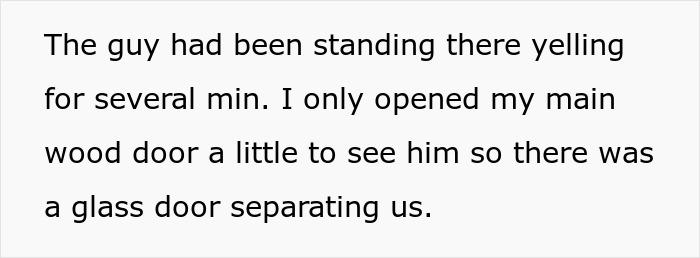
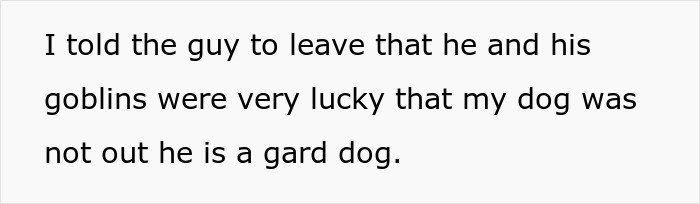
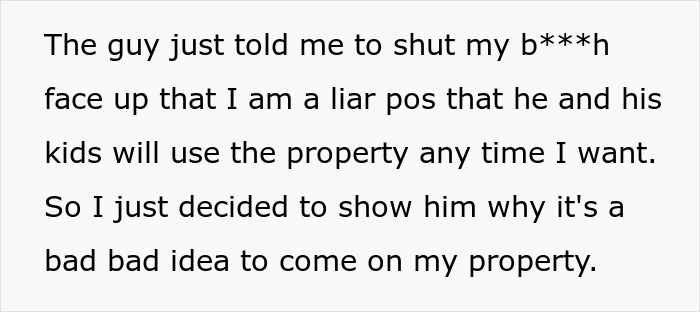
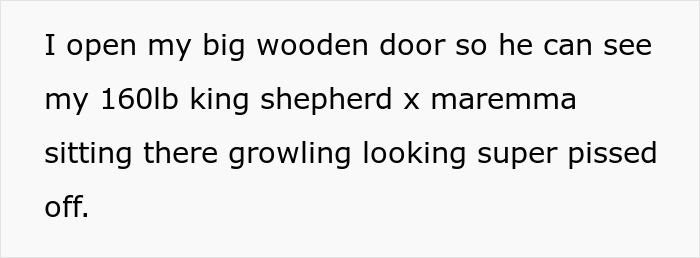
Image credits: zinkevych / Magnific (not the actual photo)
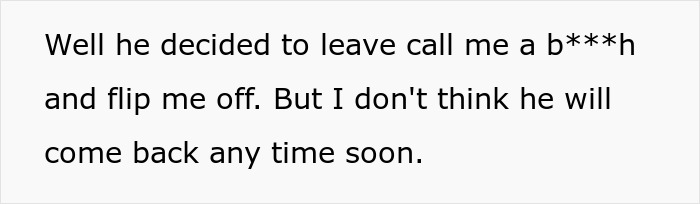
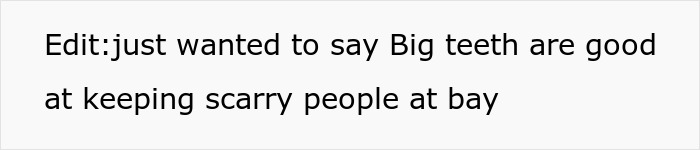
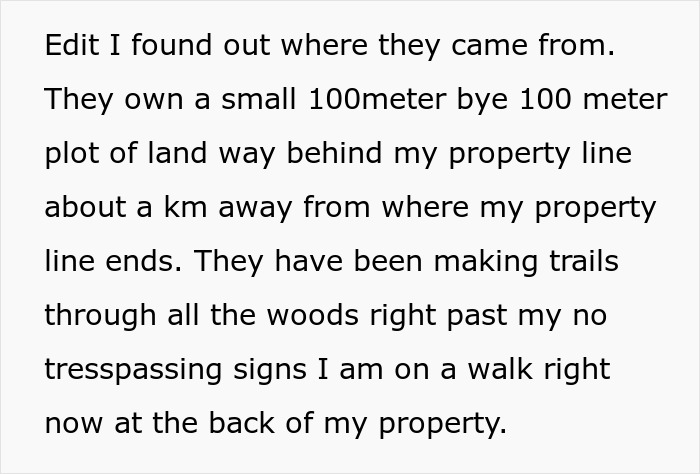
Image credits: anonymous
The OP in this story explained that he owns a large rural property bordered by fences, a forest, several “No Trespassing” signs, and even an entrance with a gate. He uses parts of the land for gardening, maple syrup production, setting rabbit traps, a whole outdoors dreamlife. So he was surprised, and who wouldn’t, to hear shouting coming from his backyard one day.
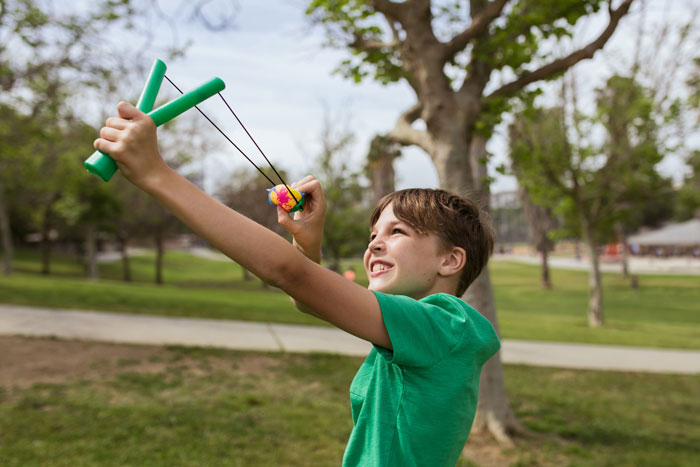
When he investigated, he found three children using slingshots to shoot at cans propped up near his shed and garden. The narrator told them to leave, explaining that the land was private property, and that they could even damage his home or his belongings. The kids scattered, but their father later showed up, outraged, insisting that the land was public because his children could access it.
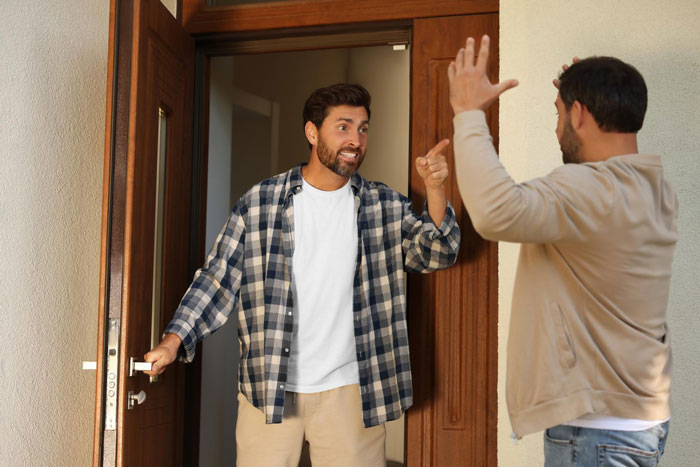
To add to the conflict, the man had apparently jumped the fence instead of using the intercom at the gate, trespassing into the author’s property, and continued yelling at the homeowner, claiming that he and his kids would use the property whenever they wanted. The narrator warned him to leave and mentioned that he was lucky the family’s 160-pound guard dog was not outside.
When the man continued insulting him, the narrator opened a wooden door and let the trespasser see the enormous King Shepherd-Maremma mix growling behind a glass door. The visitor quickly left, but the OP later discovered that the family owned a small plot not far away and had been making trails through the forest, continuing to ignore his property lines and multiple “No Trespassing” signs.
Image credits: Dmytro Glazunov / Unsplash (not the actual photo)
Some people seem to believe that being able to access something automatically means they have the right to use it. Experts in psychology explain that this kind of expectation can overlap with a sense of entitlement: the belief that you deserve special treatment. The underlying logic can look similar to demanding access to someone else’s property: wanting leads to the thought of being allowed to.
Entitlement can lead to being unable to understand the difference between access and permission. The trespassing father seemed to treat the homeowner’s fences and warnings as obstacles rather than boundaries, insisting that he and his children could use the land simply because they wanted to. The situation escalated in a way that may have more to do with being told a simple “no.”
According to this article, there is also a psychological reason why some people can react so strongly when someone tells them what to do. This is known as “psychological reactance”: when people feel that their freedom or choices are being restricted, they may feel motivated to resist the restriction. In some cases, that can even mean doing the opposite of what they were asked to do.
Reactance is indeed even more complex. Experts explain that this feeling can arise when “our freedom is threatened,” but resisting every boundary is not the same as defending autonomy. Sometimes a fence is just a fence, and a “No Trespassing” sign means exactly that. Being able to ignore a boundary does not mean having the right to do so, something that the trespasser dad has to learn.
What do you think? Do you have any neighbors who seem to suffer from a little psychological reactance whenever someone tells them “no”? Let us know in the comments!






By entering your email and clicking Subscribe, you're agreeing to let us send you customized marketing messages about us and our advertising partners. You are also agreeing to our Privacy Policy.
Thank you! You've successfully subscribed to newsletters!

"BEWARE OF DOG - OWNER IS NOT RESPONSBILE FOR INJURY OR D***H PAST THIS POINT"

"This sign will be marked evidence #1 in any legal questioning"
Load More Replies...
With the way this guy writes (and spells), the "No Trespassing" signs might have been illegible.

Really? THAT is what you take issue with in this story? I am going to take a chance and assume that his signs (of which he apparently has many) were store bought, therefore would be very unlikely to be spelled ( is it "spelled" or "spelt" which is correct? I am never totally sure) incorrectly. Even if they WERE home made AND badly spelled, surely even trespassing, foul mouthed, idiot kids and dad would understand what the property owner meant, even if they are rather stupid and entitled.
Load More Replies... "BEWARE OF DOG - OWNER IS NOT RESPONSBILE FOR INJURY OR D***H PAST THIS POINT"
"This sign will be marked evidence #1 in any legal questioning"
Load More Replies... With the way this guy writes (and spells), the "No Trespassing" signs might have been illegible.
Really? THAT is what you take issue with in this story? I am going to take a chance and assume that his signs (of which he apparently has many) were store bought, therefore would be very unlikely to be spelled ( is it "spelled" or "spelt" which is correct? I am never totally sure) incorrectly. Even if they WERE home made AND badly spelled, surely even trespassing, foul mouthed, idiot kids and dad would understand what the property owner meant, even if they are rather stupid and entitled.
Load More Replies...
















 No fees, cancel anytime













41
15