Get Premium
Dark mode theme is available exclusively for premium users. Learn more about the benefits of subscribing.
No fees, cancel anytime.

 Dark Mode Ad-Free Browsing Unlimited Content
 Ad-Free Browsing Unlimited Content Dark Mode
Join 1.2 million Panda readers who get the best art, memes, and fun stories every week!

Nepotism may be frowned upon in theory, but in reality, it’s still one of the most common ways to get a job. If your parents know somebody who’s hiring, why wouldn’t you want to take the job? As long as you’re actually qualified for it, of course.
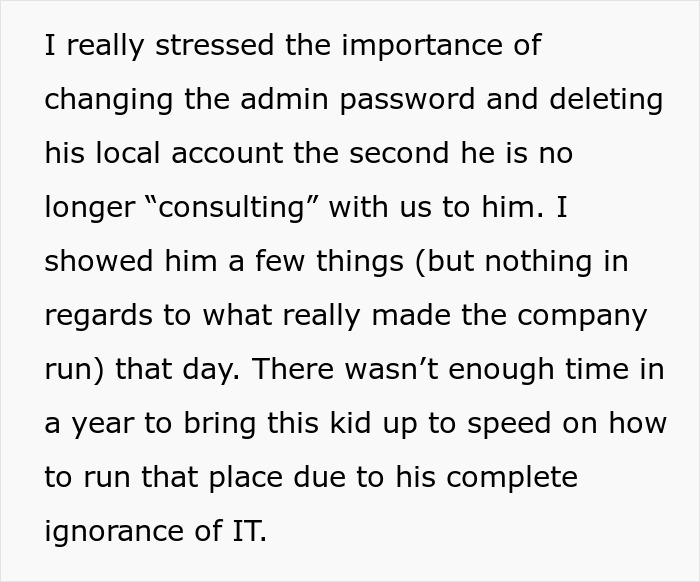
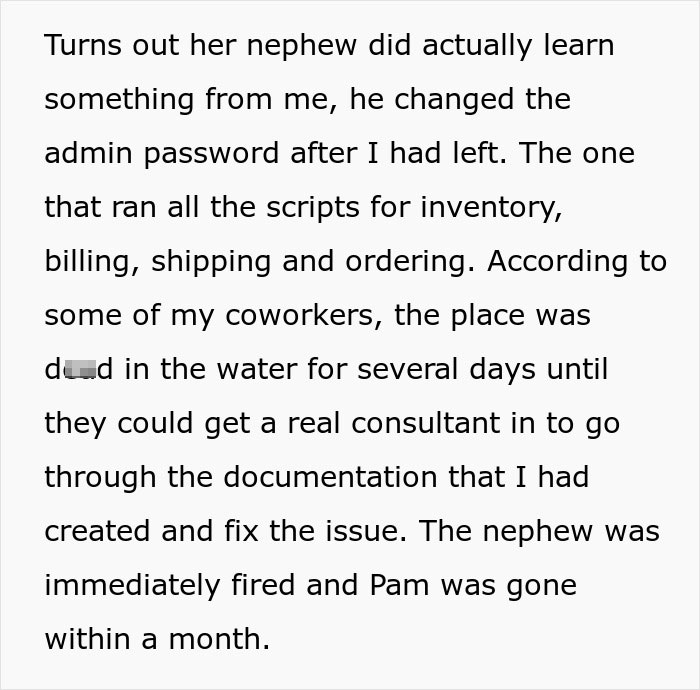
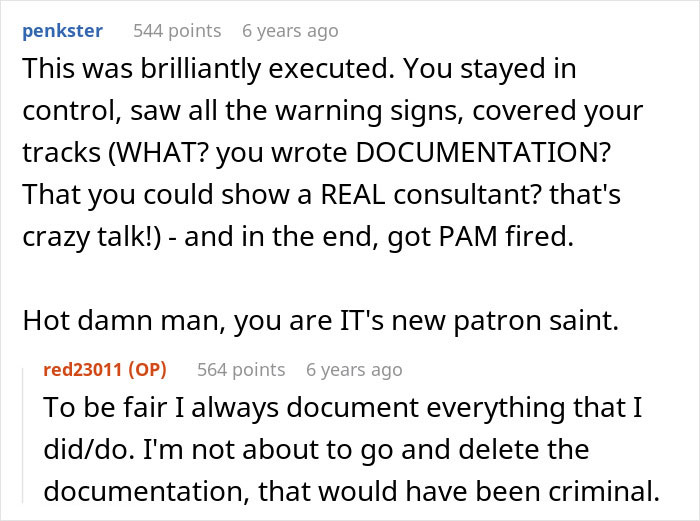
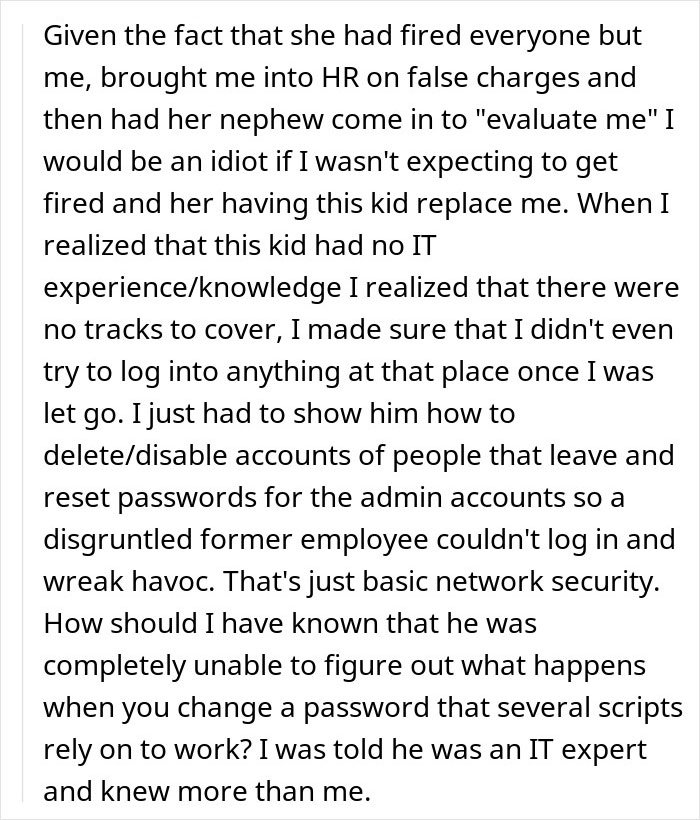
When one man lost his job to be replaced by his boss’ nephew, he was furious about the blatant nepotism. But before leaving the company for good, he made sure to get a taste of sweet revenge on his way out. Below, you’ll find the full story, as well as a conversation between Bored Panda and Professor of Leadership and Organizational Psychology at Claremont McKenna College in Claremont, California, Ronald Riggio, PhD.
Image credits: sedrik2007 / envanto (not the actual photo)
Image credits: Scott Graham / unsplash (not the actual photo)
Image credits: Karolina Grabowska / pexels (not the actual photo)
Image source: red23011
While people’s views on nepotism—individuals in a position of power showing preferential treatment to those of their kin, especially by providing them with employment opportunities—differ, at its core it is a type of favoritism, which rarely benefits a workplace.
“In many family-owned businesses, employees may feel that the hiring of relatives, and perhaps disparate treatment of them, is ‘normal’; in those instances, there may be less discontent,” Dr. Ronald Riggio told Bored Panda in a recent interview. “But there are also instances where non-relative employees in a family-owned business realize that only family members are going to get advanced to top-level positions in the company, leading to the loss of otherwise valuable employees.”
According to Prof. Riggio, the main disadvantage of nepotism is perceptions of favoritism and unfairness. However, he believes organizations can exist with nepotism, if they adhere to policies of fairness: if only the most qualified candidates, regardless of whether they are related or not, are hired; if promotions and raises or perks also need to be fairly administered; if it is clear that employed relatives are obviously competent. Dr. Riggio believes that would help reduce much of the sense of unfairness and favoritism associated with nepotism.
The expert told Bored Panda that nepotism is usually the most common in family-owned businesses, but hiring of relatives or spouses can be encouraged elsewhere, too. “The upside is what we have called ‘fast trust’—there is usually a bond among family members and they are likely to be seen as more trustworthy, more dedicated, and loyal.
“Of course, family life conflict can spill over into work conflict, and vice versa,” Prof. Riggio added, pointing out that in some companies, hiring those of your kin is explicitly banned, or strongly discouraged.
Image credits: Proxyclick Visitor Management System / unsplash (not the actual photo)
In a piece for Forbes, the CEO of Ascension Group International, Duane Tursi, emphasized that preferential treatment at a workplace affects more than just the superior and their favored employee. According to the expert, the ripple effect such a dynamic creates can disrupt team harmony, as well as lower employee morale and productivity.
“Leaders who allow favoritism to dictate decisions instead of merit and performance may unintentionally seed an organizational culture of division and skepticism,” Tursi wrote. “Over time, such a culture not only pushes talent away but also erodes the foundational values and vision that an organization stands for.”
Research on workplace favoritism and workforce sustainability seconded the idea that playing favorites can have numerous detrimental effects. It found that the perception of the presence of both favoritism and nepotism can result in employees lacking a sense of belongingness or identification with the organization. That leads to a negative workplace environment, which can hamper employee morale and satisfaction and defeat the sustainability goals of said workplace.
Image credits: Mizuno K / pexels (not the actual photo)
Matthew Staiger, a scientist at Opportunity Insights, Harvard’s economic mobility research and policy institute, found that nepotism has a rather significant impact on the job market. After researching the link between the two, he learned that nearly one-third of Americans will work at the same firm as a parent before reaching the age of 30. In those jobs, such workers tend to earn almost 20% more than they would otherwise.
According to Staiger, people are 200 times more likely to work at their parent’s place of employment compared to similar companies in the same geographic area, Harvard Magazine reports. Such a tendency is believed to be linked to the use of social connections.
Staiger is far from the only one who believes that nepotism is a somewhat well-rooted phenomenon, though; quite a large part of the general population seemingly does, too. A poll by YouGov found that out of 10 fields of work, politics seems to be the best environment for nepotism to thrive, as more than half of respondents believe that it’s a very common phenomenon in the field. Politics is followed by the fields of business, acting, media, music, and finance, respectively. Judging by the OP’s story, the IT sector doesn’t seem to be immune to it, either.

By entering your email and clicking Subscribe, you're agreeing to let us send you customized marketing messages about us and our advertising partners. You are also agreeing to our Privacy Policy.
Thank you! You've successfully subscribed to newsletters!


A few year after a left a company my friends still worked at, one of the VPs was promoted to CEO. Very smart, top of her field, very qualified, etc etc etc. Except she made one stupid change. That company is a consulting firm, so maximizing billable hours and minimizing overhead hours was crucial. And because those hours got bill, the staff had to enter the tasks they were doing for those hours. Everyone had to... except support and admin staff, like IT, Accounting, etc. Which makes sense since they're non-billable hours. Except she decided so support staff "would know what it was like for billable staff " so she made everyone, including non-billable hours, enter timecard tasks. W*F is IT supposed to enter, as they're not always busy but need to be present in case the s**t hits the fan? Or accounting when it's the down part of the cycle? A bunch of support left after that because how do you "justify" you job when your job is just to be there, whether it's busy or not?


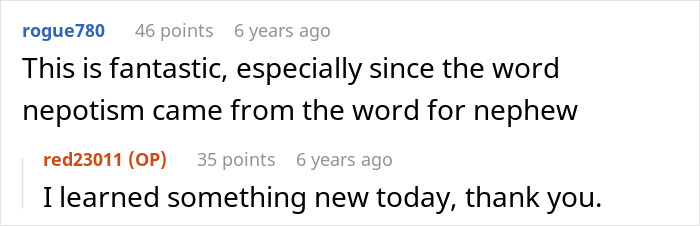
I was curious after seeing your post, so I did a little research. According to the Britannica website you are mistaken, at least partially. "The term nepotismo was created in the 14th or 15th century to describe the corrupt practice by popes of appointing male relatives to cardinalates and other important positions. It derives from the Latin root word nepos, meaning “nephew” or “grandson,” and the Italian word nipote, which may refer to any number of relatives."
Load More Replies... A few year after a left a company my friends still worked at, one of the VPs was promoted to CEO. Very smart, top of her field, very qualified, etc etc etc. Except she made one stupid change. That company is a consulting firm, so maximizing billable hours and minimizing overhead hours was crucial. And because those hours got bill, the staff had to enter the tasks they were doing for those hours. Everyone had to... except support and admin staff, like IT, Accounting, etc. Which makes sense since they're non-billable hours. Except she decided so support staff "would know what it was like for billable staff " so she made everyone, including non-billable hours, enter timecard tasks. W*F is IT supposed to enter, as they're not always busy but need to be present in case the s**t hits the fan? Or accounting when it's the down part of the cycle? A bunch of support left after that because how do you "justify" you job when your job is just to be there, whether it's busy or not?
I was curious after seeing your post, so I did a little research. According to the Britannica website you are mistaken, at least partially. "The term nepotismo was created in the 14th or 15th century to describe the corrupt practice by popes of appointing male relatives to cardinalates and other important positions. It derives from the Latin root word nepos, meaning “nephew” or “grandson,” and the Italian word nipote, which may refer to any number of relatives."
Load More Replies...







































 No fees, cancel anytime



























5
5