Get Premium
Dark mode theme is available exclusively for premium users. Learn more about the benefits of subscribing.
No fees, cancel anytime.

 Dark Mode Ad-Free Browsing Unlimited Content
 Ad-Free Browsing Unlimited Content Dark Mode
Join 1.2 million Panda readers who get the best art, memes, and fun stories every week!
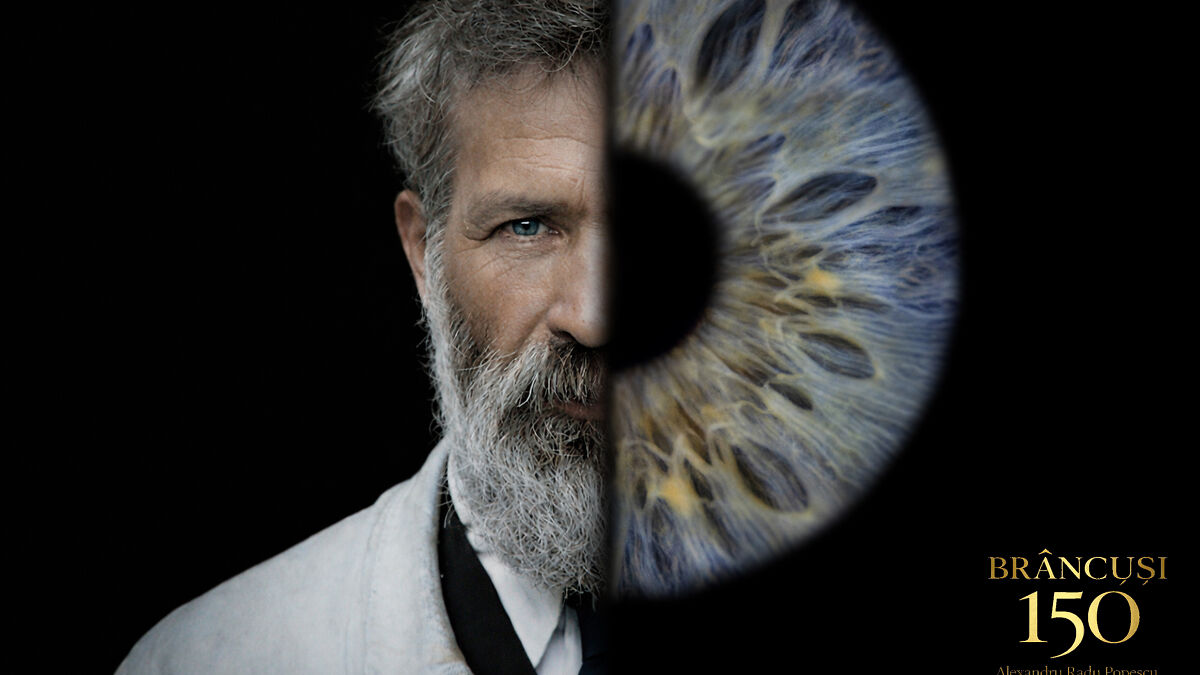
This project began with a simple question: What did Constantin Brâncuși see when he looked at the world?
As an artist deeply interested in identity and perception, I have spent years photographing the human iris through my ongoing project, UNiC, building an archive of over 300 iris portraits captured with a dedicated macro technique. The iris, to me, is not just a biological detail; it is a landscape of memory, emotion, and individuality.
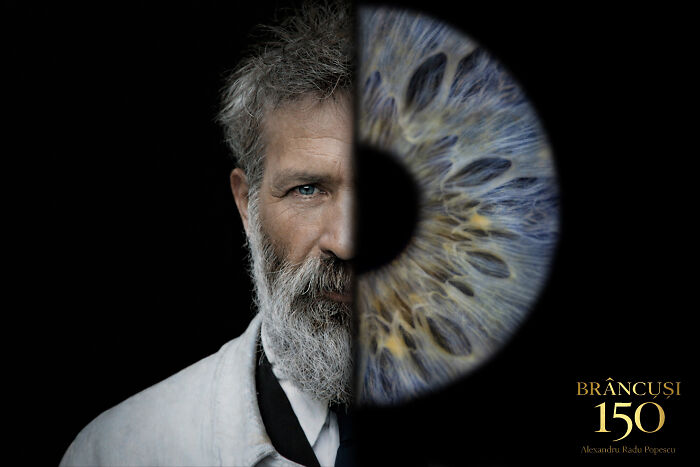
When I decided to create a visual tribute for the 150th anniversary of Brâncuși’s birth, I knew I wanted to go beyond a traditional portrait. I wanted to explore the idea of seeing through his eyes, not literally, but symbolically.
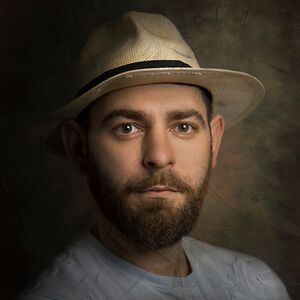
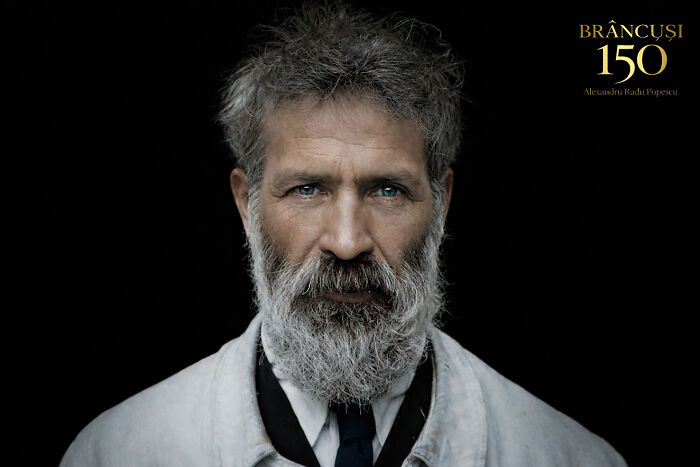
The starting point was a historical photograph of Brâncuși. To avoid copyright issues and to create an interpretive rather than documentary image, I used artificial intelligence as a creative tool to reimagine the portrait, preserving his presence while allowing the image to exist as a contemporary artistic reconstruction.
Next came the research phase.
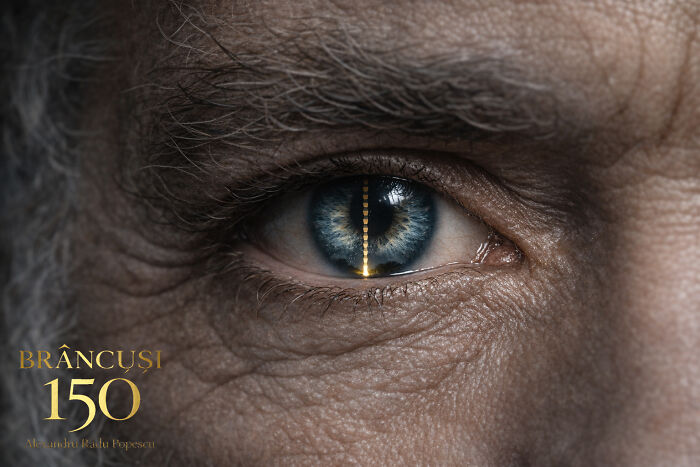
I studied historical descriptions and visual references to understand the colour of Brâncuși’s eyes, which were often described as blue-grey. With this in mind, I returned to my archive of irises, carefully reviewing more than 300 images to find one that resonated not only chromatically but conceptually.
I did not choose the iris simply because of its colour.
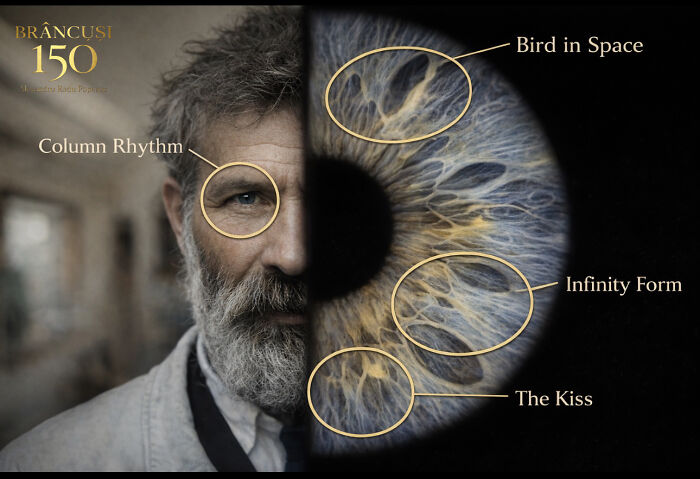
While studying its textures, I began to notice something unexpected: within the intricate fibres and organic patterns, forms appeared that seemed to echo the language of Brâncuși’s sculptures.
Certain elongated shapes suggested the upward movement of Bird in Space. Flowing lines hinted at a sense of infinity, reminiscent of the rhythmic continuity found in his columns. Subtle organic contours evoked the intimacy of The Kiss.
It felt as if the sculptural vocabulary of Brâncuși's purity of form, reduction, and spiritual ascent was naturally reflected within the micro-architecture of the human eye.
This discovery transformed the project.
The final image became a dialogue between portrait and perception: one half presenting a contemporary vision of Brâncuși, the other revealing an iris where viewers can intuitively discover echoes of his artistic universe.
For me, this work is not about recreating Brâncuși, but about exploring how his way of seeing continues to exist — in nature, in form, and perhaps even within us.
The project invites viewers to look closer, to slow down, and to reflect on the idea that art is not only something we observe, but something that shapes how we see the world.
In a way, this portrait asks a quiet question: Is the essence of an artist visible in the act of seeing itself?
Why The Iris Matters
The iris is unique to every person, like a fingerprint of perception.
By placing it at the centre of this tribute, I wanted to suggest that the act of seeing itself is deeply personal and that artistic vision transcends time.
Brâncuși believed in reducing forms to their essence. In a way, the iris complex yet fundamental mirrors that philosophy.
Discovering Brâncuși Inside The Iris
While examining the intricate texture of this iris, I began to notice shapes that felt strangely familiar.
Elongated forms suggested the upward movement of Bird in Space. Flowing structures evoked the endless rhythm found in his columns. Organic patterns hinted at the quiet intimacy of The Kiss.
It felt as if fragments of his sculptural philosophy simplicity, spiritual ascent, and purity of form were naturally echoed in the microscopic landscape of the human eye.
This moment transformed the project from a portrait into a dialogue.
This question stayed with me as I began working on a visual tribute to Constantin Brâncuși for the 150th anniversary of his birth. As a photographer exploring identity and perception through my ongoing UNiC iris project, I’ve always believed that the eye is more than a physical feature; it’s a map of individuality and a reflection of how we experience the world.
I wanted to create something that didn’t just represent Brâncuși but explored his way of seeing.
Reimagining The Portrait.
The process started with a historical photograph of Brâncuși. Rather than reproducing it directly, I used artificial intelligence as a creative tool to reinterpret the portrait, allowing me to build an image inspired by the original while avoiding copyright limitations and creating a contemporary artistic presence.
This approach transformed the portrait into something symbolic rather than documentary.


















 No fees, cancel anytime





10
0