Get Premium
Dark mode theme is available exclusively for premium users. Learn more about the benefits of subscribing.
No fees, cancel anytime.

 Dark Mode Ad-Free Browsing Unlimited Content
 Ad-Free Browsing Unlimited Content Dark Mode
Join 1.2 million Panda readers who get the best art, memes, and fun stories every week!
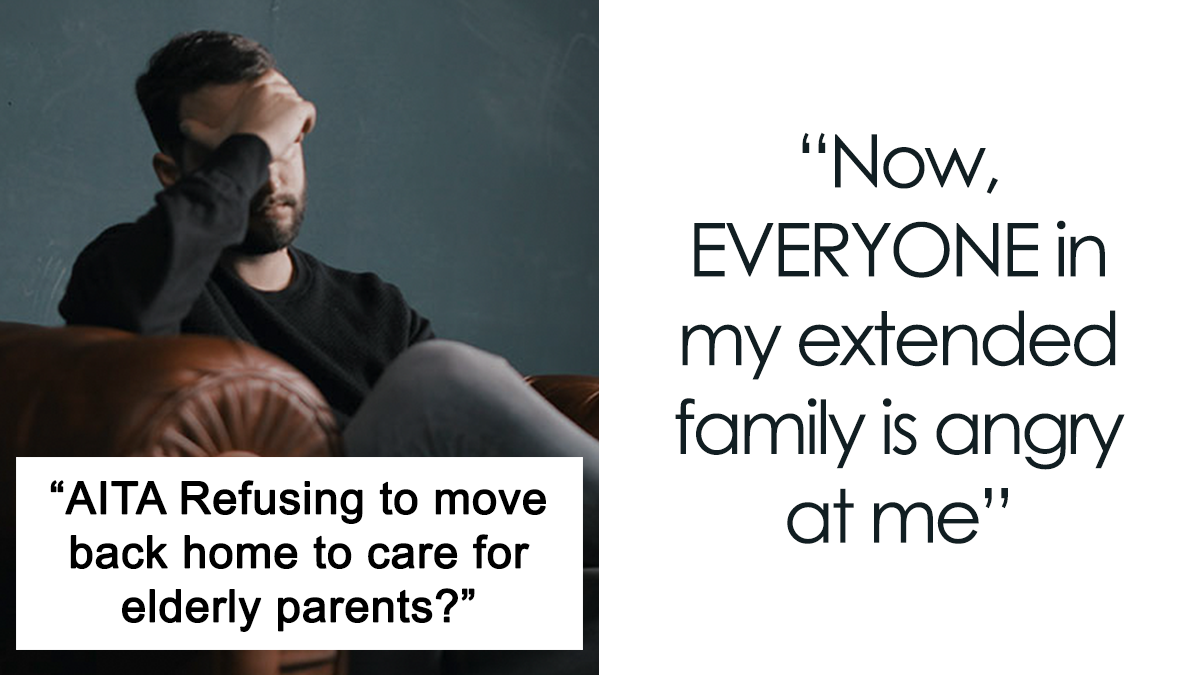
Among the topmost nerve-wracking events in life, according to the universal stress scale, is a change in your family member’s health — something that most of us go through, sooner or later, when our dear and aging parents can’t take care of themselves. Here they were, taking care of you, taking you to school and picking you up when you’re down. Now, the roles have switched and it’s your time to support your folks, sometimes requiring you to uproot your own personal life and move back in with them.
While this may be an opportunity to spend some quality time with your elders, reminisce about the good ol’ days in a town that formed you as a person — these things are a bit more complicated for people from LGBTQ communities.
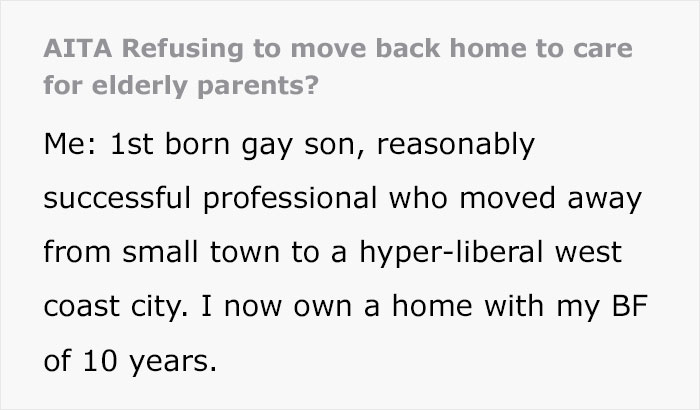
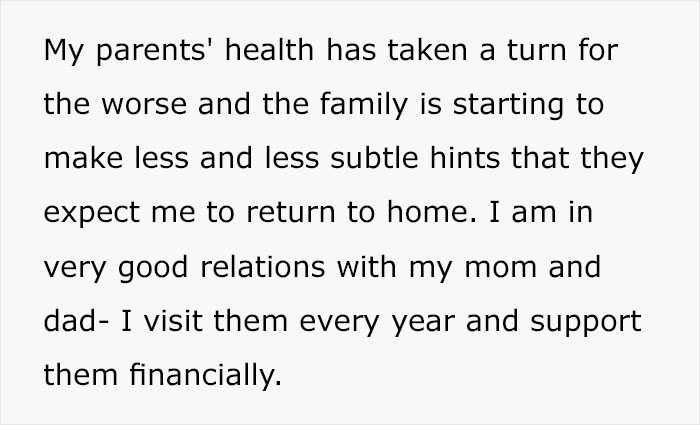
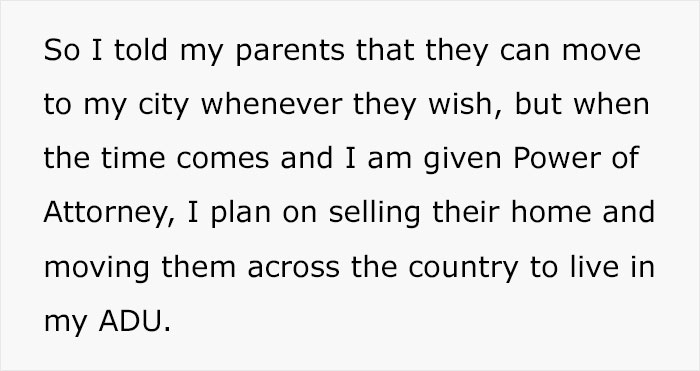
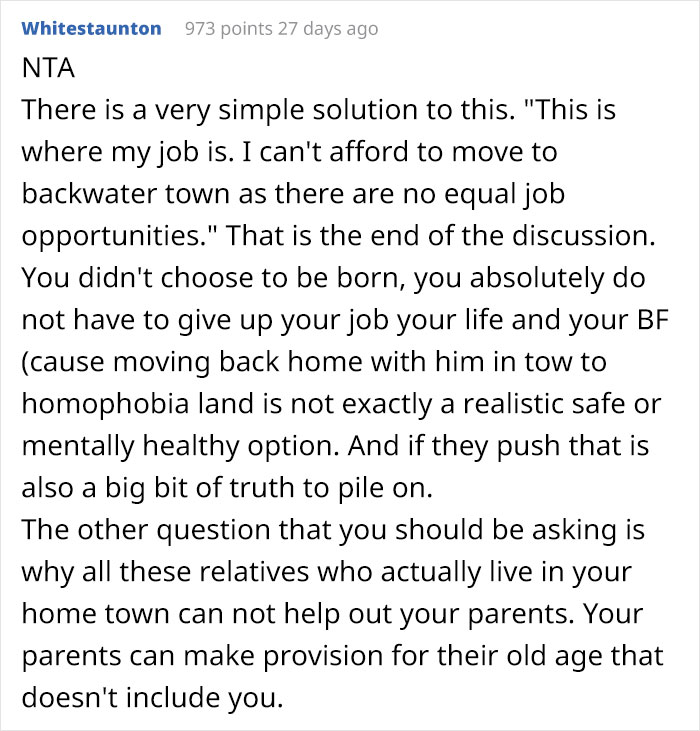
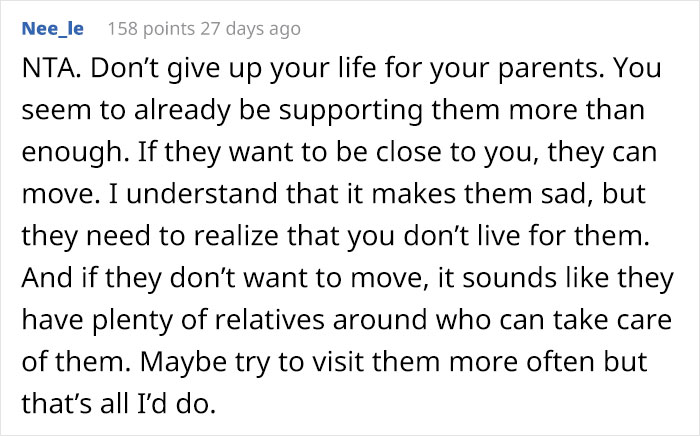
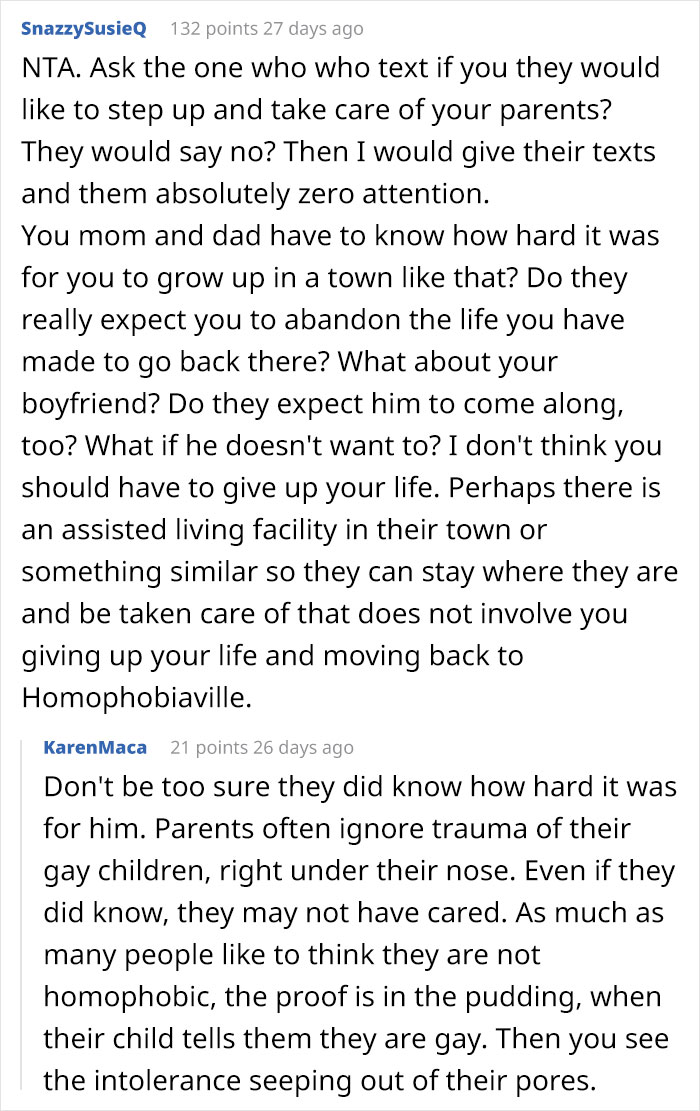
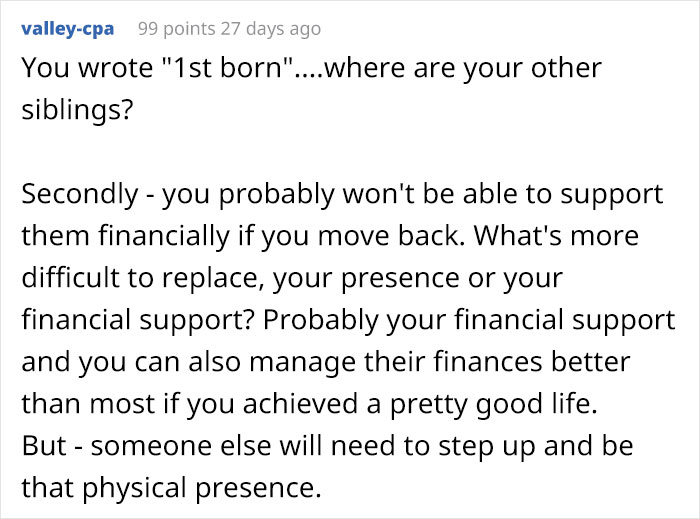
As this Redditor explains in his ‘Am I The [Jerk]‘ story, moving back in with his aging folks simply wasn’t an option because his conservative, Christian hometown wasn’t a place for a gay man. It wasn’t then and it isn’t now. Naturally, telling parents that you have no intention to make such a sacrifice for them stirred up negative reception from the whole family.
Unsure whether he did the right thing, this man turned to the trusted ‘Am I The [Jerk]’ community to get some much-needed perspective.
Image credits: Simon Godfrey (not an actual photo)
The age-old question many of us are forced to tackle each day: should I move closer to my aging folks, be there for them, or drop them at the assisted living center with a heavy heart (an idea that almost 90% of elders don’t even want to entertain, according to a widely cited study)?
There are many complicated aspects one must take into consideration before choosing one over the other — finances, time and health being the three big ones. But no matter what you decide, seeing the people that raised you decline before your eyes is never easy. “If I had a dollar for every tear I shed in guilt, I could have hired 15 caregivers,” Sara Tapscott described her traumatic decision to Forbes.
Image credits: Nik Shuliahin (not an actual photo)
Amanda Lambert, the owner of Lambert Care Management company and the author of ‘Aging with Care: Your Guide to Hiring and Managing Caregivers at Home’, is very well aware of the emotional toll that aging folks and their deteriorating health can create. After all, she’s been a professional guardian for almost 25 years now.
“My first experience working with older adults was coordinating a program called ‘Elderhostel’ which is now called ‘Road Scholar’,” Lambert told Bored Panda. Amanda says her fascination with eldercare began by chance — when she just entered her 30s and her students were off for the summer.
“At the time, I worked at a small college in New Hampshire coordinating student activities in the winter. The college decided to add the Elderhostel program for the summer when the students were off-campus. All of my preconceived notions and stereotypes about older adults were blown out of the water,” Lambert remembers. “The groups were dynamic, energetic, and diverse. I thought they were much more interesting than the students. I was hooked!”
“I promised my parents I’d never put them in a nursing home,” is a pretty popular sentiment that’s tricky to deliver. Yet, considering that the average duration of caregiving is a whopping 4.5 years, according to recent research (pre-Covid), many simply overestimate their abilities before making such promises.
“Mostly everyone feels a responsibility and obligation to care for aging parents. But you have to think about your career and other relationships, too,” Lambert pointed out. “Leaving the workforce to care for aging parents has consequences. You have to factor in the loss of income during caregiving and the impact on your social security.” That explains why about only 17% of adult children choose to dedicate their lives to their declining elders. The good news: the likelihood of doing so rises with age, a recent study shows.
When his father started showing early signs of Alzheimer’s disease and his mom was diagnosed with leukemia, Rick Lauber, the author of two guidebooks for caregivers, experienced the gut-wrenching reality of caregiving firsthand. “One of the hardest decisions was to move Dad into a secured, long-term care facility. At that time, his Alzheimer’s disease had seriously progressed and he could not continue to live on his own. I remember moving Dad into this facility and crying as I knew this would be his final home,” Lauber, 60, told Bored Panda.
At the time of this difficult chapter, Rick was working as a creative copywriter. But dedicating yourself to long-distance caregiving means you have to make some sacrifices. “Working part-time was somewhat of a difficult sacrifice as doing this greatly affected my income,” he explained. “But I knew that less income was only a temporary setback and that caregiving for my parents was my top priority.”
There’s no one-size-fits-all solution when it comes to caregiving, although assisted living facilities still seem like the most popular strategy. And while most will be tempted to keep their promises and not send their elderly parents to retirement homes, Amanda thinks most homes are not apt to fully provide the same accessibility features professional facilities can. “Caring for an aging parent at your own place is possible but challenging,” Lambert reasoned, explaining that most homes lack safety and privacy features otherwise available at assisted living facilities. “There are many advantages to assisted living and some communities will provide round-the-clock end-of-life care.”
Speaking as a former long-distance caregiver, Rick says that the biggest drawback of this type of arrangement is “not [being] readily available to directly help, when necessary.” Which, without saying, is additional stress on its own. He also says it’s important to take into account all of the expenses of long-distance caregiving, including gas and accommodation (when necessary).
“Making longer caregiving trips requires more time and can result in more wear and tear on a family caregiver (and a family caregiver’s own personal relationships),” Lauber pointed out. He also adds that “heightened stress, frustration, and/or guilt (due to being less able to provide more help/support)” also comes with the total price. And if you’re splitting the caregiving responsibilities with other family members, just like Rick did with the help of his two sisters, there’s also a possibility that these relationships can turn sour in the process. “Other family members may feel increased resentment towards a long-distance caregiver who cannot participate equally,” he explained.
In the end, it comes down to your willingness to commit to this rigorous role. As Rick puts it, fittingly: “An unwilling caregiver becomes an ineffective caregiver.” It’s not going to be easy one way or another, but there’s always a path that will allow the caring loved ones to enjoy the remaining time with their aging parents without any resentment bubbling under the surface.

Going to probably get a lot of downvotes for this and being controversial but this is the kind of thing that people who say 'what will you do when you are old and have no children to take care of you' don't get. It places such massive obligations on the shoulders of people who would, in many cases, have to completely change their lives to do it. Doesn't mean they don't love their parents, doesn't mean they won't do it in some form but surely it is far better to prepare for your old age in a way that minimises the burden you place on family. I know not everyone can afford assisted living and care but I'd far rather save as hard as I can and sell my property and aim for that then expect family to change everything to care for me. Elder abuse by family is also a much bigger problem than people realise. Not because they don't love them, it is brought about by sheer frustration and desperation. Should you put that on your children? 🤷

My parents just did this. They are in their mid seventies and have sold their home and downsized to an apartment. They said one of the reasons they did it was so it wouldn't be a burden on my brother and I when they start to get older and need care. It was very thoughtful of them.
Load More Replies...
Even if he wasn't gay, and his parents wouldn't live in a remote, shitty location, there's no way his parents can expect him to drop his own life and move back to them to take care of them until they die. He's got his own life, our children don't exist to be our cost free caretakers of old age. NTA, this man deserves to have his own life, especially in such a difficult situation.

Especially since he has been financially supporting them. No, this sounds like the parents were abusive or at least not supportive growing up and their personality disorders carried through into an adulthood of manipulation. The fact that they won't move into the ADU is especially telling. This guy has been their life support for years and they can't even compromise on moving to him. Time to lay it out: parents can move into the ADU and agree to family counseling or they can live out the rest of their lives not getting any support from the son they didn't protect or support in the basic ways he needed. He's more than paid off any "debt".
Load More Replies...
This is just ridiculous. these parents expect their son to move away from his whole life, his job, and long-term partner to look after them in a place where he will likely have job trouble and be discriminated against. Thats unreasonable no matter the situation

Doesn't sound like it's the parents who are upset, but the relatives... who really should have no say.
Load More Replies... Going to probably get a lot of downvotes for this and being controversial but this is the kind of thing that people who say 'what will you do when you are old and have no children to take care of you' don't get. It places such massive obligations on the shoulders of people who would, in many cases, have to completely change their lives to do it. Doesn't mean they don't love their parents, doesn't mean they won't do it in some form but surely it is far better to prepare for your old age in a way that minimises the burden you place on family. I know not everyone can afford assisted living and care but I'd far rather save as hard as I can and sell my property and aim for that then expect family to change everything to care for me. Elder abuse by family is also a much bigger problem than people realise. Not because they don't love them, it is brought about by sheer frustration and desperation. Should you put that on your children? 🤷
My parents just did this. They are in their mid seventies and have sold their home and downsized to an apartment. They said one of the reasons they did it was so it wouldn't be a burden on my brother and I when they start to get older and need care. It was very thoughtful of them.
Load More Replies... Even if he wasn't gay, and his parents wouldn't live in a remote, shitty location, there's no way his parents can expect him to drop his own life and move back to them to take care of them until they die. He's got his own life, our children don't exist to be our cost free caretakers of old age. NTA, this man deserves to have his own life, especially in such a difficult situation.
Especially since he has been financially supporting them. No, this sounds like the parents were abusive or at least not supportive growing up and their personality disorders carried through into an adulthood of manipulation. The fact that they won't move into the ADU is especially telling. This guy has been their life support for years and they can't even compromise on moving to him. Time to lay it out: parents can move into the ADU and agree to family counseling or they can live out the rest of their lives not getting any support from the son they didn't protect or support in the basic ways he needed. He's more than paid off any "debt".
Load More Replies... This is just ridiculous. these parents expect their son to move away from his whole life, his job, and long-term partner to look after them in a place where he will likely have job trouble and be discriminated against. Thats unreasonable no matter the situation
Doesn't sound like it's the parents who are upset, but the relatives... who really should have no say.
Load More Replies...



































 No fees, cancel anytime


























157
102