Get Premium
Dark mode theme is available exclusively for premium users. Learn more about the benefits of subscribing.
No fees, cancel anytime.

 Dark Mode Ad-Free Browsing Unlimited Content
 Ad-Free Browsing Unlimited Content Dark Mode
Join 1.2 million Panda readers who get the best art, memes, and fun stories every week!

A 35-year-old man sought treatment at a hospital in China after feeling discomfort while urinating and noticing blood in his urine.
He displayed no other signs of illness, had steady vitals, and otherwise appeared to be in good health.
But things took a darker turn when doctors put him through more intensive testing and found a shadow-like shape near his heart.
It took more investigation to get to the bottom of the issue, and what they found was not only alarming but also heartbreaking.
Discussed in a study published on Springer Nature Link in September 2026, the bizarre case grew stranger as doctors ran multiple imaging tests.
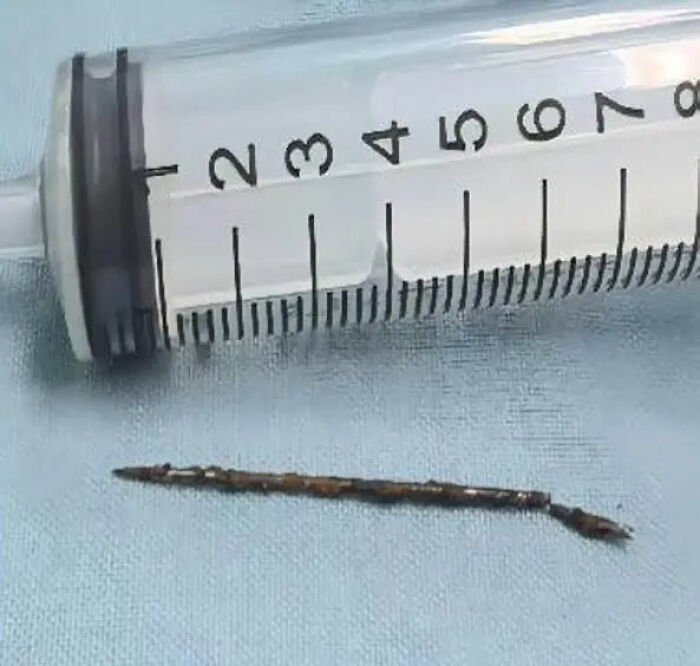
Surprised by the shadow near his heart, they ordered a contrast-enhanced CT scan and found multiple “needle-like metallic foreign bodies” scattered inside him.
These needles were lodged near his abdomen, pelvis, bladder, and his private parts, and one 1.4-inch pin had pierced the fluid-filled sac surrounding his heart, known as the pericardium.
He was immediately taken to surgery, where an intact metallic sewing needle was removed from his pericardium. Extensive corrosion on the needle suggested that it had been inside his body for some time.
After surgery, the man’s cardiac function rapidly deteriorated due to the stress of the surgery, on top of the internal damage done by the needle.
Fortunately, he recovered well and was discharged after nine days. His heart condition was found to be stable at a nine-month follow-up appointment.
While the sewing needle in his heart was removed, several others were still inside him.
Doctors chose to observe if any of them led to health complications before resorting to surgery. However, what left them perplexed was how the pins got inside the patient’s body.
Moreover, there were no obvious entry wounds or scars on the man’s body that would suggest how they got inside.
The man, who had a childhood history of intellectual disability, could not explain it, and neither could his father, who was his legal caregiver.
But one detail in the man’s medical history hinted at a possible answer.
The doctors found out that two years earlier, the patient had two foreign objects removed from his abdomen at a different hospital.
This led them to suspect that he was self-embedding, a rare form of self-inflicted injury in which people deliberately insert foreign objects into their bodies, such as shards of glass, paper clips, stapler pins, or wires.
Cases of self-embedding, while little-heard-of, have been documented by psychiatrists for decades.
One of the earliest and best-known instances was when serial assassin Albert Fish was reportedly found to have nearly 30 needles embedded in his groin, with more near his abdomen.
More cases were reported in the 1980s, but the practice took on a more concerning shape in the late 2000s and early 2010s, when teenagers were found engaging in it.
At a 2008 medical conference in Chicago, a team of radiologists from Nationwide Children’s Hospital presented X-ray evidence of the same.
They said that 11 out of 505 patients they treated in more than a decade had inserted objects such as crayons and paper clips under their skin.
“Self-injurers experience greater physiological arousal in response to stress, show poor ability to tolerate distress, and have greater deficits in social problem-solving skills,” explained Harvard psychology professor Matthew Nock to Time in 2008.
Once inserted, the foreign object not only poses a risk of infection at the site, but also in a deeper muscle or even a bone. Alternatively, hitting an artery, vein, nerve, or tendon can cause permanent damage, and the object can also travel elsewhere inside the body and perforate vital organs.

By entering your email and clicking Subscribe, you're agreeing to let us send you customized marketing messages about us and our advertising partners. You are also agreeing to our Privacy Policy.
Thank you! You've successfully subscribed to newsletters!



It says he had a "childhood history of intellectual disability". People with intellectual disabilities are more likely to s*******m.
Load More Replies... It says he had a "childhood history of intellectual disability". People with intellectual disabilities are more likely to s*******m.
Load More Replies...




































 No fees, cancel anytime



















28
2