Get Premium
Dark mode theme is available exclusively for premium users. Learn more about the benefits of subscribing.
No fees, cancel anytime.

 Dark Mode Ad-Free Browsing Unlimited Content
 Ad-Free Browsing Unlimited Content Dark Mode
Join 1.2 million Panda readers who get the best art, memes, and fun stories every week!

Office parties are full of potential for awkward small talk, that one person who overdoes it at the buffet, or the mysteriously untouched food. But sometimes, the real drama happens long after the cupcakes are devoured, and the last slice of pizza is gone.
The real kicker came when today’s Original Poster (OP) tried to do a good deed by offering the leftover gluten-free snacks to a colleague who was known to have dietary restrictions. Sounds harmless, right? Wrong. In a twist that left them scratching their head, the colleague was horrified that her dietary restriction was casually shared by the OP.
More info: Reddit
Image credits: freepik / Freepik (not the actual photo)
Image credits: QueenCandyCo
Image credits: freepik / Freepik (not the actual photo)
Image credits: QueenCandyCo
Image credits: pressfoto / Freepik (not the actual photo)
Image credits: QueenCandyCo
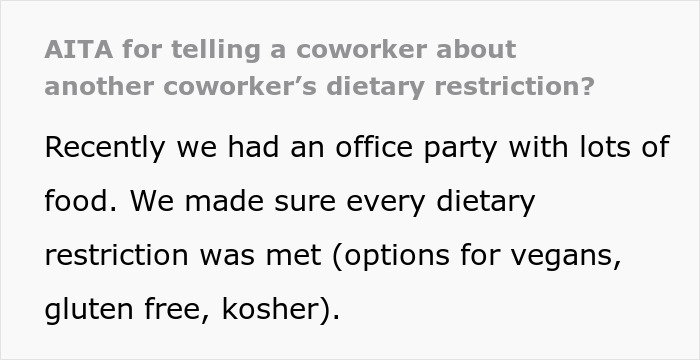
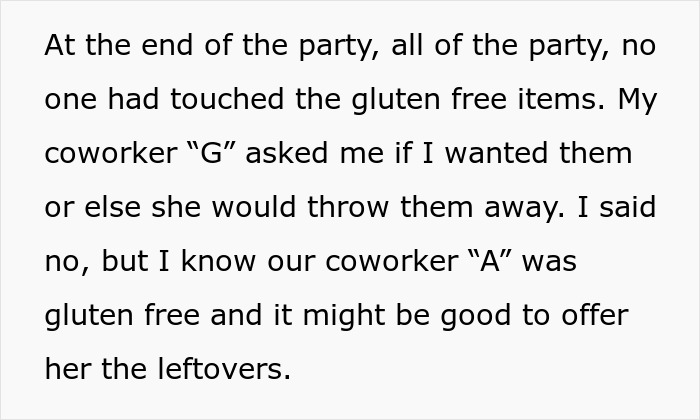
It all began with a well-meaning gesture. At a recent office gathering, the team made sure to cover every dietary base, ensuring there were options for vegans, gluten-free folks, and those who needed kosher meals. However, at the end of the party, the gluten-free treats remained untouched.
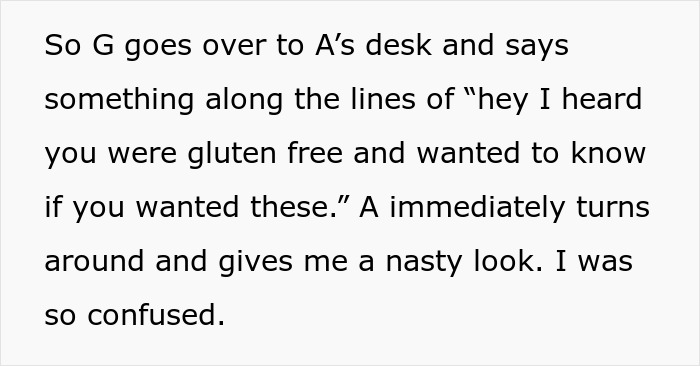
A coworker didn’t want the treats to go to waste, so they asked if anyone wanted them. The OP remembered another colleague’s dietary restrictions and pointed the coworker out to them. However, the colleague shot a nasty look at the OP in response, leaving her confused.
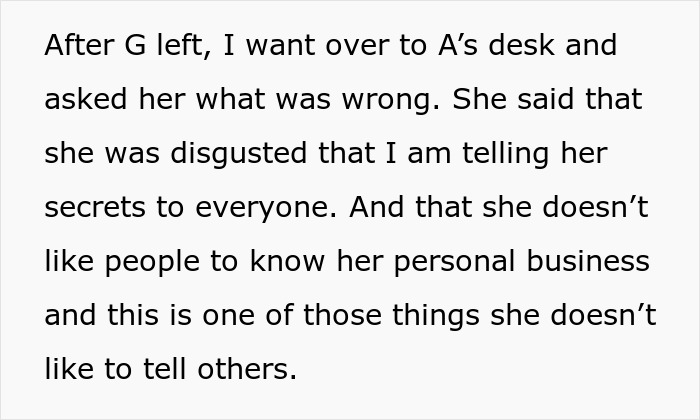
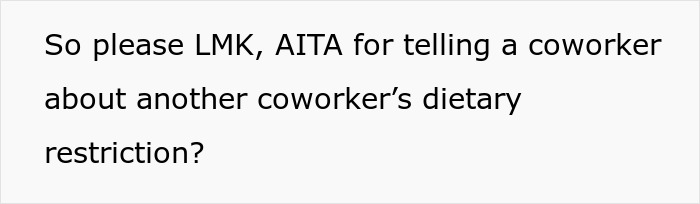
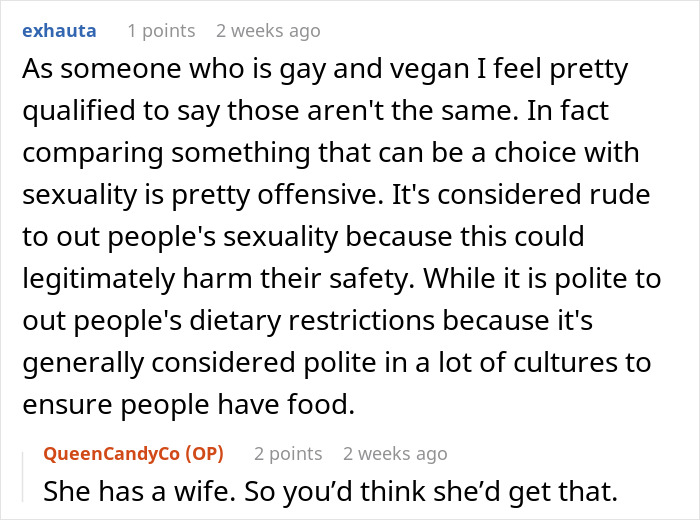
When the OP approached the colleague to ask what was wrong, she explained that she was upset that her dietary restriction was shared with others without her permission. She insisted it was personal information she never wanted to be made public. To her, it felt like a violation of privacy, comparable to outing someone’s sexuality.
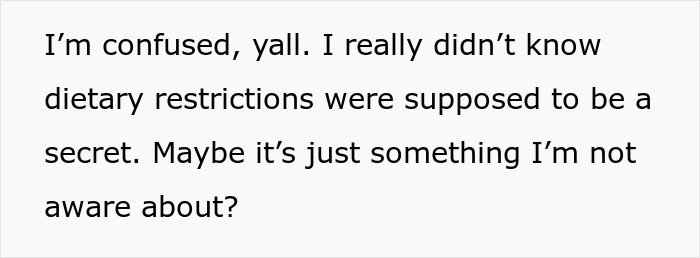
This surprised the OP because the colleague had previously mentioned her gluten-free lifestyle casually, and they assumed that it was a matter of public knowledge, not a secret. Because of this, the colleague started avoiding the OP at work, which left them confused.
Image credits: freepik / Freepik (not the actual photo)
According to Truity, people tend to keep secrets for three main reasons: to protect their ego, to avoid judgment, or simply because being private is part of their personality. This sheds light on why someone might not want even a dietary restriction shared, as they may view it as a personal detail that opens them up to scrutiny or loss of control.
As Career Contessa explains, setting boundaries early on is key to navigating the workplace effectively and protecting your energy. Without clear limits, you’re more likely to take on others’ tasks, get involved in personal drama, or blur work-life lines.
In the story, the lack of communication around boundaries, like what’s private versus shareable, shows how quickly things can spiral and is a reminder that even small oversights can trigger bigger interpersonal issues in professional environments.
Harvard Business School also affirms that conflict is inevitable in any workplace due to the diversity of personalities, experiences, and values. While disagreements are natural, many employees struggle to address them directly. However, to manage conflict effectively, it’s important to understand why it happens and choose the right strategy, whether that’s avoiding, competing, accommodating, compromising, or collaborating.
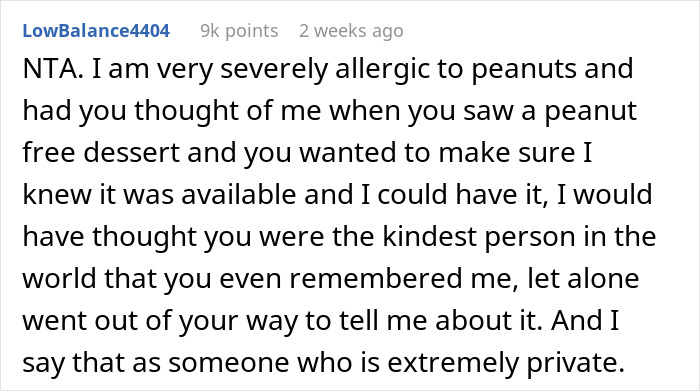
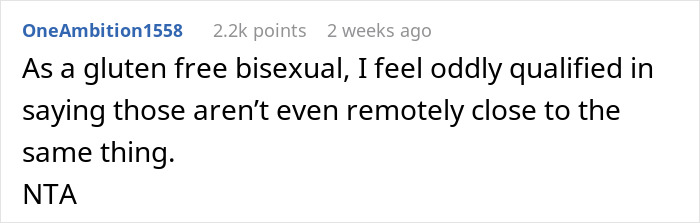
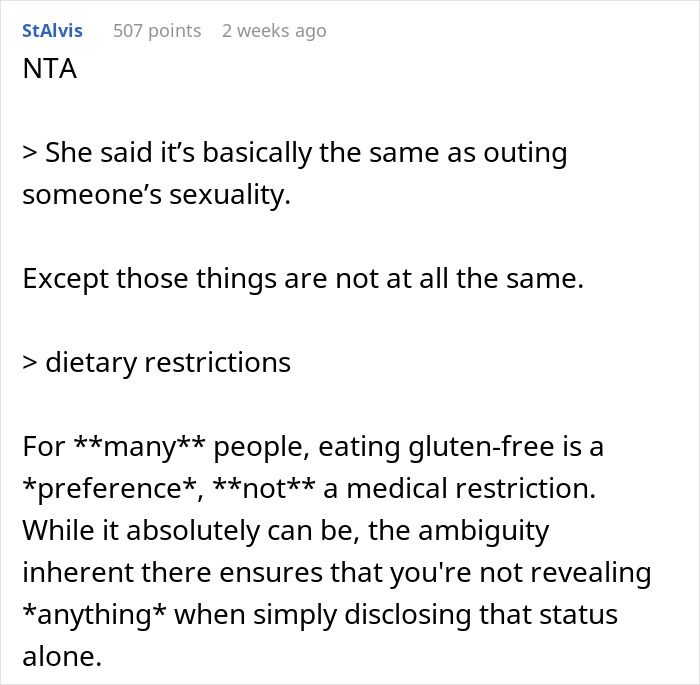
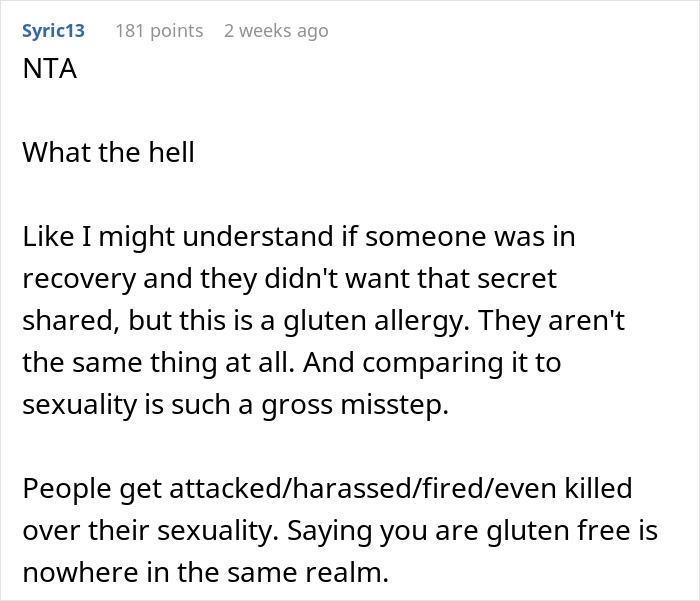
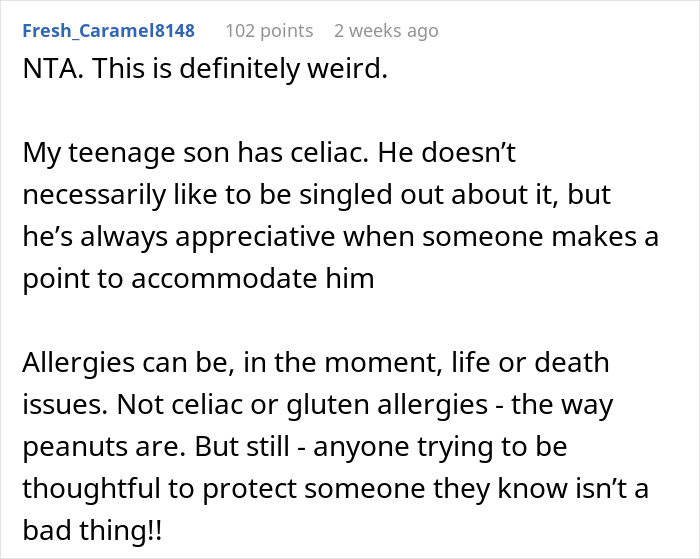
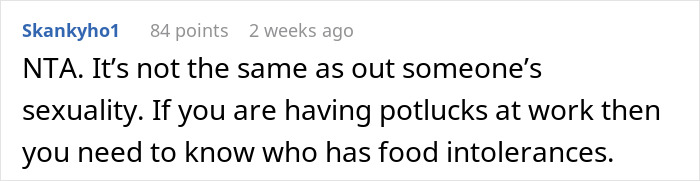
Netizens insisted that the coworker’s reaction was disproportionate and that there is no comparison between sharing someone’s dietary restrictions and outing someone’s sexuality. They affirmed that the OP’s actions were motivated by kindness, agreeing that offering the gluten-free food was a considerate gesture.
What do you think about this situation? Do you think the colleague’s reaction was justified, or was it an overreaction? Please let us know why you feel that way!

By entering your email and clicking Subscribe, you're agreeing to let us send you customized marketing messages about us and our advertising partners. You are also agreeing to our Privacy Policy.
Thank you! You've successfully subscribed to newsletters!


Perhaps someone who is LGBTQ+ could correct me if I am wrong, but one cannot CHOOSE their sexuality or gender. One CAN, however, choose their dietary preferences - no one is "born" vegan, keto, kosher, etc. While "gluten intolerance" is a physical thing that one is born with (or develops later in life without the ability to stop/control it) I feel that "A" is "gluten free" by choice instead of by intolerance/celiac/etc. Even if "A" IS gluten-free due to a physical intolerance/condition, it's still NOT THE SAME as one's sexuality or gender. If you're physically intolerant to gluten/celiac, you can be permanently injured (or die!) if you are exposed to gluten. That's something you NEED to let people know.

As a LGBTQ+ person, you are 100% right ! We don't choose, we're born who we are !
Load More Replies...
Now THIS (friend A) is an example of "too sensitive". Let the friendship go, it was only ever going to be full of drama.
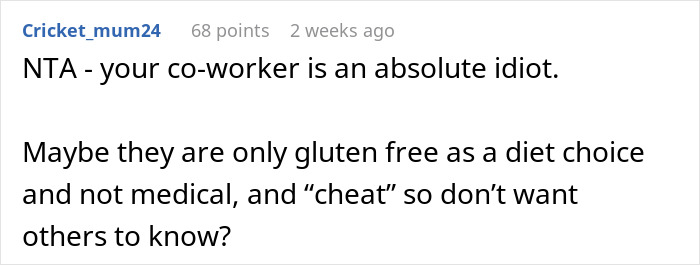
Perhaps she's not actually gluten free so having others know this about her could be an issue? Idk, it's the only thing I can come up with. NTA.
This was my thought... she talks about it when it suits her.
Load More Replies... Perhaps someone who is LGBTQ+ could correct me if I am wrong, but one cannot CHOOSE their sexuality or gender. One CAN, however, choose their dietary preferences - no one is "born" vegan, keto, kosher, etc. While "gluten intolerance" is a physical thing that one is born with (or develops later in life without the ability to stop/control it) I feel that "A" is "gluten free" by choice instead of by intolerance/celiac/etc. Even if "A" IS gluten-free due to a physical intolerance/condition, it's still NOT THE SAME as one's sexuality or gender. If you're physically intolerant to gluten/celiac, you can be permanently injured (or die!) if you are exposed to gluten. That's something you NEED to let people know.
As a LGBTQ+ person, you are 100% right ! We don't choose, we're born who we are !
Load More Replies... Now THIS (friend A) is an example of "too sensitive". Let the friendship go, it was only ever going to be full of drama.
Perhaps she's not actually gluten free so having others know this about her could be an issue? Idk, it's the only thing I can come up with. NTA.
This was my thought... she talks about it when it suits her.
Load More Replies...













 No fees, cancel anytime















29
23