Get Premium
Dark mode theme is available exclusively for premium users. Learn more about the benefits of subscribing.
No fees, cancel anytime.

 Dark Mode Ad-Free Browsing Unlimited Content
 Ad-Free Browsing Unlimited Content Dark Mode
Join 1.2 million Panda readers who get the best art, memes, and fun stories every week!
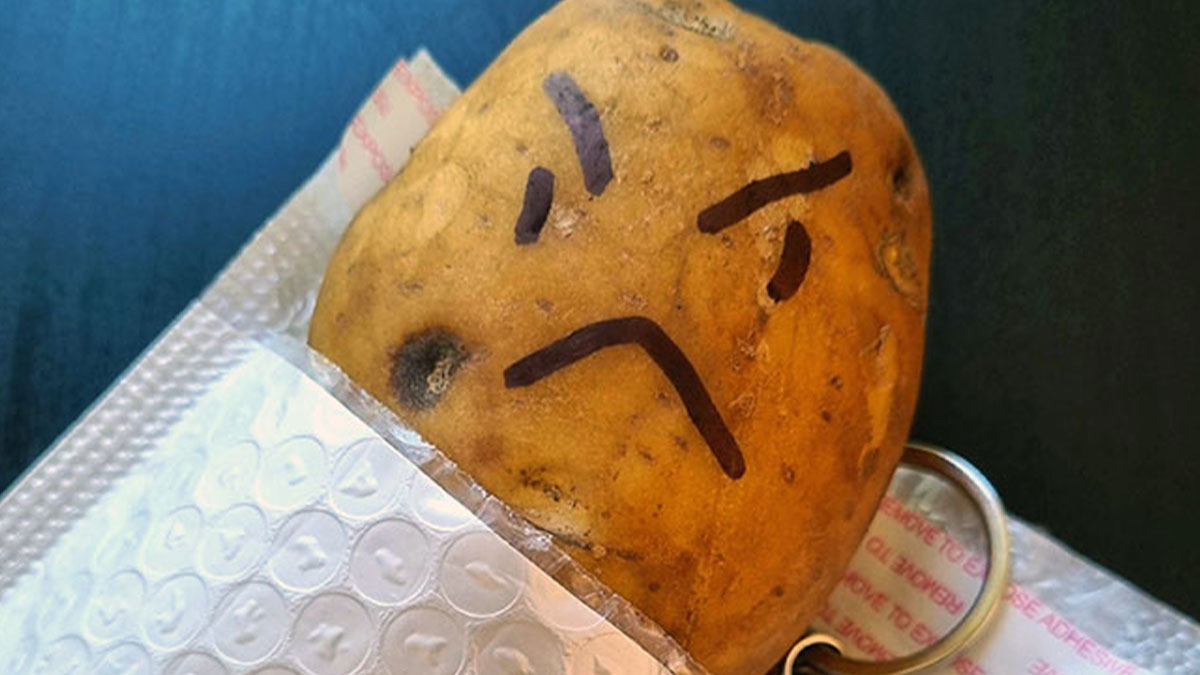
Worrying about your kids is normal for any parent. As long as those thoughts and feelings don’t grow into something overbearing, of course. Like, a desire to start secretly tracking them.
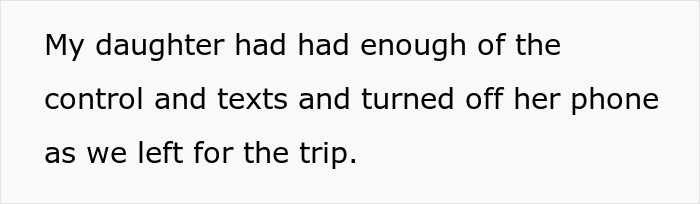
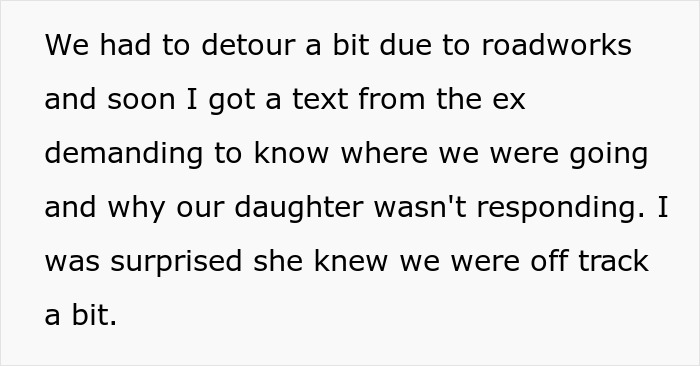
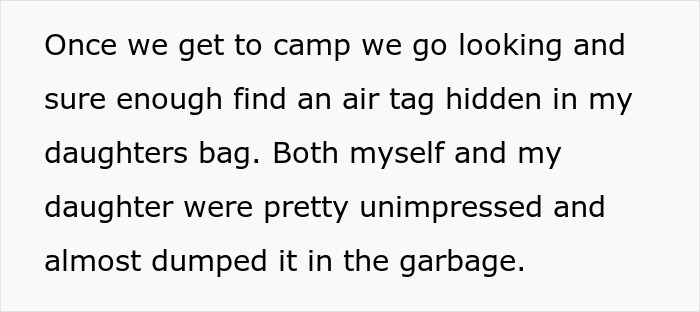
In this story, a controlling ex-wife put an AirTag in her daughter’s backpack for a trip with her father.
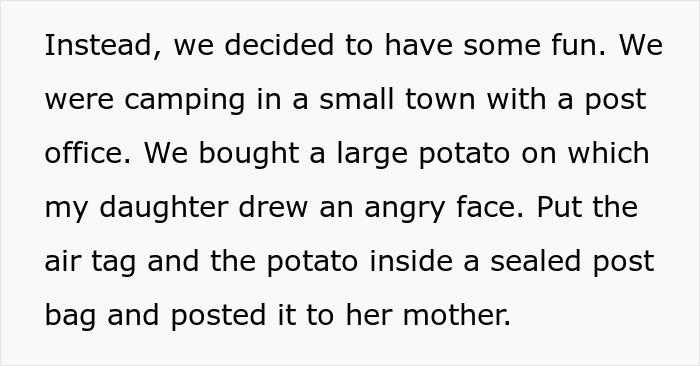
However, the two of them discovered the device and came up with a funny way to teach the lady a lesson.
To learn more about these situations, Bored Panda also got in touch with Hara Estroff Marano, the editor-at-large of Psychology Today and author of A Nation of Wimps: The High Cost of Invasive Parenting. Don’t miss our conversation!
Image credits: Mindaugas Balčiauskas / Boredpanda (not the actual photo)
Image credits: Yan Krukau / Pexels (not the actual photo)
Image credits: crowlexing
Hara Estroff Marano says that helicopter parenting is all about wanting the best for your child. The parents who do it are just going about it the wrong way. “The parents are not ill-motivated; they just happen to be 100 percent wrong about the way to produce successful adults.”
“For example, they take all the [child’s free] play out of childhood, believing it is a waste of time,” Marano points out. “In fact, free play builds happy, active children with agile brains, precisely what is needed for the dynamic economy and jobscape we inhabit.”
“In addition, in the belief that they are smoothing the path to success for their kids, they take all the lumps and bumps out of their lives. That, however, deprives children of the ordinary little challenges of life through which people normally not only learn to cope with life’s vicissitudes but gain the confidence that they can.”
Overprotective parents are so because of their own anxiety. “[It] constricts their vision and tightens their grip,” Marano explains. “Parents can’t trust that kids will grow up OK and figure out how to manage by themselves because the parents are anxious about their children.”
Image credits: Monstera Production / Pexels (not the actual photo)
“We are not and have not been living in a culture of optimism for some time, so parents’ concerns about their kids’ future are somewhat understandable,” Marano says.
“However, it is always the job of parents to filter the culture for children and prepare them for independence. You do not make children independent by removing challenges from their lives but by allowing children to approach and master them.”
Marano explains that helicopter parenting infantilizes children. “[It] deprives them of opportunities to learn how to cope with life’s challenges and kills confidence in their ability to cope.”
No wonder young people are having more mental health problems. “They have terrible self-esteem and high levels of anxiety and depression,” she adds. “They have an oversized fear of failure because they’ve never been afforded the opportunity to learn that you can mess up and still survive, even thrive.”
“It is indeed ironic that helicopter parents, who want only the best for their kids, wind up bringing out the worst in them.”
Image credits: Czapp Árpád / Pexels (not the actual photo)
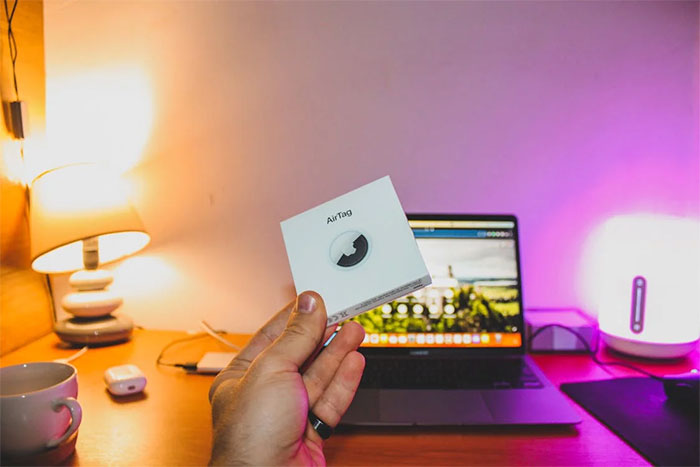
AirTags can be a convenient way to locate lost items. But some parents have been using trackers to keep tabs on their kids, just as the mother in this story did. There’s been a debate going on for the past several years: is it morally wrong to put a tracker on a child, or is it a godsend to anxious parents who worry about their kids getting kidnapped?
Parents who put AirTags on their kids defend their decision by saying that to be a parent is to worry constantly about your child’s safety. Strangers, sketchy situations, and children’s bad decisions – who knows what can happen to a kid when they’re alone? And AirTags can take some of that pressure off worried parents.
Yet experts say that it’s not the best strategy to guarantee your child’s safety. Lenore Skenazy, the president of Let Grow, told Fox26 Houston that tracking your child can definitely make them feel uncomfortable. “A kid who’s being watched all the time is not a kid who has a chance to prove to themselves, and to their parents, that they really are responsible. It changes the relationship between you and the child, even subtly.”
Interestingly, research shows that the world has never been safer for children than it is today. The biggest threat a child faces today is an accident, whether in a car, by drowning, in a fire, or due to something else. The odds of someone abducting a child are equal to getting hit by lightning, as in 2017, one out of every 293,800 minors was a victim of abduction by a stranger.
Using AirTags to keep tabs on your kid isn’t foolproof either. AirTags can get stolen, and children can lose them together with their belongings. However, the trackers don’t provide a person’s or an object’s real-time location. A parent can only see their child’s last known location if they choose to use an AirTag.






















 No fees, cancel anytime




















30
1