Get Premium
Dark mode theme is available exclusively for premium users. Learn more about the benefits of subscribing.
No fees, cancel anytime.

 Dark Mode Ad-Free Browsing Unlimited Content
 Ad-Free Browsing Unlimited Content Dark Mode
Join 1.2 million Panda readers who get the best art, memes, and fun stories every week!



Did you know that Spielberg wanted to make a James Bond movie and was rejected? Or that Canada and Denmark have a sort of joint-custody agreement over an island? Much like chicken nuggets, or grapes if you are being more healthy, people love bite-sized bits of info.
So we’ve gathered some of the coolest and most interesting facts from the IG page with the same name. Get comfortable as you scroll through, upvote your favorites and be sure to share your own thoughts in the comments section down below.
More info: Instagram
This post may include affiliate links.
The Whisky War, also known as the Liquor Wars, was a bloodless war and border dispute between the Kingdom of Denmark and Canada over Hans Island. Between 1973 and 2022, the island was under dispute between the two nations, although never amounting to direct conflict or violence.
Both countries agreed on a process in 2005 to resolve the issue, which was finally settled in 2022, resulting in the creation of a land border on the island between the two states.
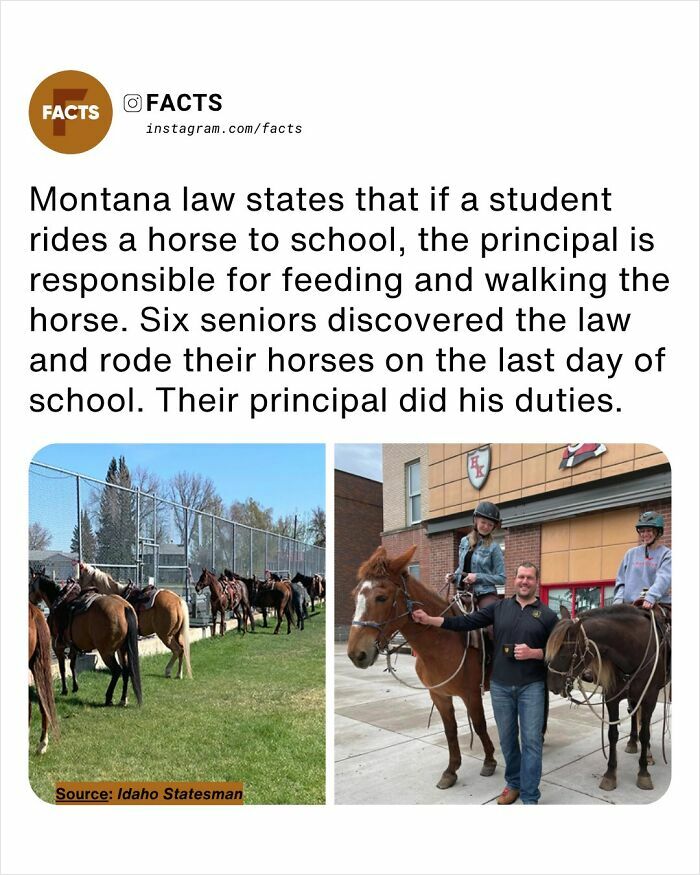
Because of a senior prank at a Montana high school, a principal had to tend to 12 horses for the day back in May 2022. It’s the law, said the Conrad Public Schools district in northern Montana. The district shared a picture on Facebook showing the 12 students on horseback outside Conrad High School. Those horses — at least for the day — were under the responsibility of school principal Raymond DeBruycker. “Montana has an old law saying if a student rides their horse to school, the school principal has to feed and tend to the horse throughout the day,” the school district said. “It looks like Mr. DeBruycker has his work cut out for him today.”
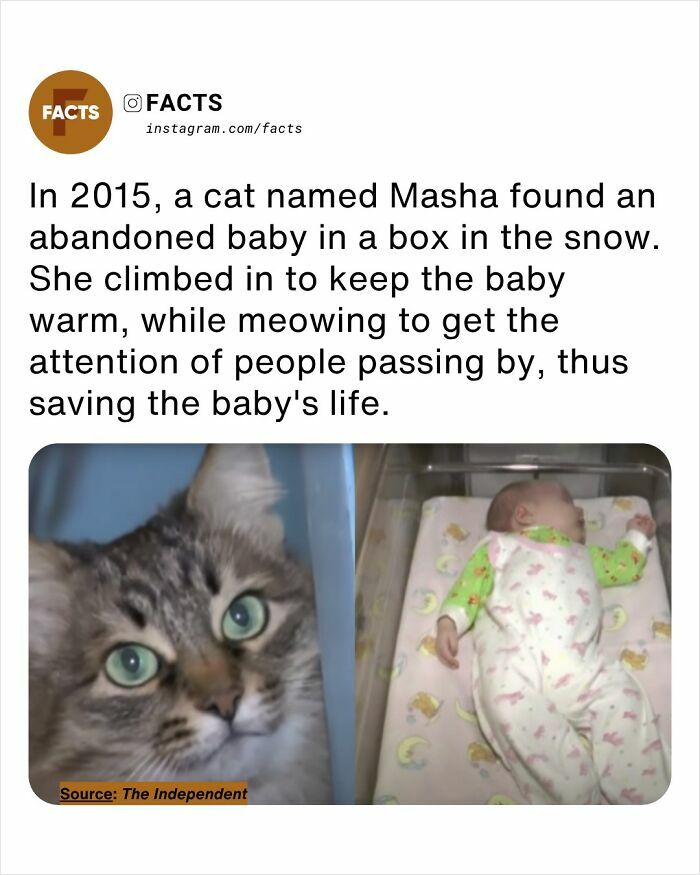
Normally, she would have come and said hello to me. You can imagine my shock when I saw her lying in a box next to a baby. She is very placid and friendly, so when I heard her meowing, I thought that perhaps she had injured herself,” said Obninsk city resident Irina Lavrova.
Masha is a communal cat who is looked after by residents. When she found the baby — who appeared to be in great shape — she immediately took him to as if he were her own.
_____
🐈“Clearly her mothering instincts had taken over and she wanted to protect the child,” Lavrova explained. “He was well-dressed with a little hat, and whoever left him here had even left a few nappies and some baby food.”
The baby was immediately rushed to a local hospital, where he was given a checkup and declared fit and healthy. Since the child was found, Masha has been hailed as a hero by residents — and she’s been reaping the benefits.

When my daughter was a baby our cat, Spider, used to go and sit with her if she heard her crying
Though Spielberg at first thought the name Indiana Jones sounded too hokey, six months later the two began to come up with the idea for the intrepid archeologist as they pitted him against nothing less than an entire army of Nazis in his quest to find something that would seem to validate the very existence of mankind in some crucial way, the Ark of the Covenant.
Strangely enough, it was Tom Selleck who was selected for the lead role at first. Unfortunately, he had to bow out thanks to his previous deal with another show titled 'Magnum P.I.' So instead the duo went for Harrison Ford, whose popularity had already been soaring at that time thanks to his involvement in Lucas hit movie 'Star Wars.' Ford brought a worldly manner to the lead role that was spot on and managed to capture the essence of Jones in a way that couldn’t possibly have been done any better by anyone other.
The frequent diner purchased the first-class, fully refundable ticket aboard Eastern China Airlines and then re-booked his ticket over and over again to have free meals.
He used the ticket to gain access to the Xi'an International Airport's VIP lounge, where high-rolling travelers dine for free, according to a report in the Chinese-language newspaper Kwong Wah Yit Poh in Malaysia.
The man flashed his ticket to the lounge staff at the Shaanxi province airport before his trip, ate a meal just like any first-class traveler, and instead of getting on the flight, he changed his flight's departure to another day.
The next day he would show up with his newly issued ticket for the revised date, eat, and then again change his ticket date. He did this over and over again, more than 300 times.
_____
Eastern China Airlines officials suddenly woke up and figured out the scam. Airline officials admitted that legal action was not possible as it was not against the rules, the New York Daily News reported.
Eastern China Airlines officials confronted him and banned him from continuing this practice. After all this, he ended up cashing in his fully refundable ticket and got back all his money.
Billy Joel never sells tickets to the front rows of his concerts.
Aside from wanting to beat the scalpers, he got tired of all the bored, rich people staring up at him — so now, he sends his road crew out to bring down the fans from the worst seats so there’ll be "people in the front row that are happy to be there, real fans."
Said Joel:
We never sell front rows; we hold those tickets at just about every concert. For years, the scalpers got the tickets and would scalp the front row for ridiculous amounts of money. Our tickets are cheap, under $100, some are in the $80s, and the highest is about $150. I’d look down and see rich people sitting there, I call ’em “gold chains.” Sitting there puffing on a cigar, “Entertain me, piano man.” They don’t stand up, make noise, sit there with their bouffant-haired girlfriend lookin’ like a big shot. I kind of got sick of that. Who the hell are these people? Where are the real fans? It turns out the real fans were always in the back of the room in the worst seats."
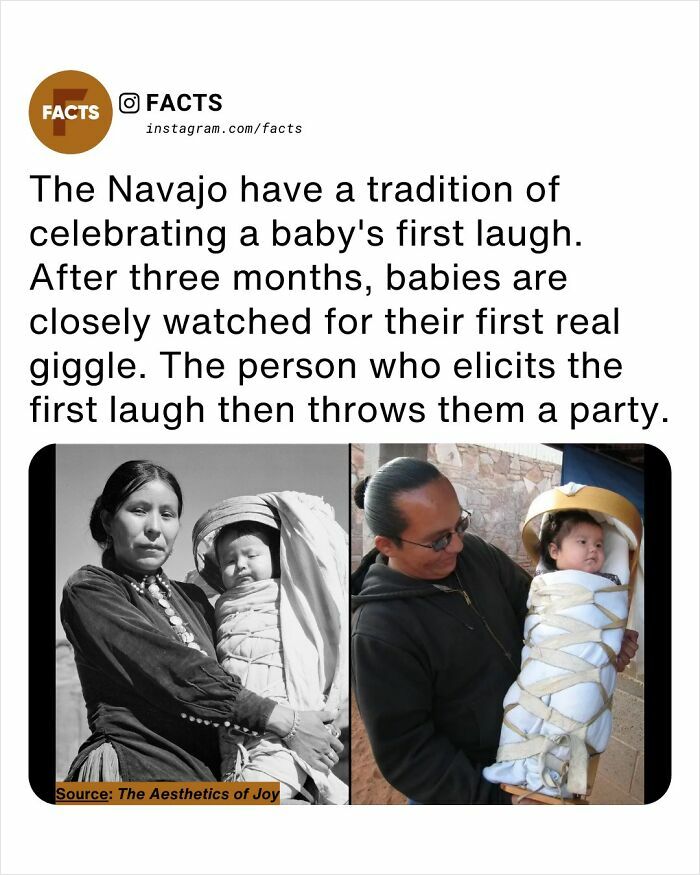
The Navajo, or Diné, believe that newborn babies first reside in the world of the Diyin Dine’e, the Holy People, before they can join their earthly families. The Diyin Dine’e are the first people, subjects of the most important myths and stories in Navajo culture. When a baby is first born, the Navajo believe the child lives among the Holy People until the first time the baby laughs. The act of laughing is a sign that the child is transitioning from the spirit world with the Diyin Dine’e and is ready to fully join his or her family in life.
_____
Because of the significance that a baby’s first laugh holds in Navajo tradition, family members watch, wait, and listen intently to hear that first utterance of a giggle. Parents, siblings, cousins, grandparents, and just about anyone close to the family will try their best to get that first laugh, from silly faces to tickles and everything in between. And finally, the first time a baby laughs, it’s time to celebrate the journey to their earthly family and welcome this new life into the community with a Navajo First Laugh Ceremony!
The kids that voiced Bluey and Bingo aren't credited on the show as their identities are kept secret to shield them from the public eye.
Unlike most animated series where voice actors become household names, Bluey takes an extraordinary approach to protect its young performers. Creator Joe Brumm revealed that "Bluey, Bingo and some of their friends are voiced by children of the production crew," but their names will never appear in the credits.
This intentional anonymity was designed from the beginning, even before anyone knew Bluey would become a global phenomenon. The children aren't professional voice actors—they're simply the kids of people working on the show who bring authentic, natural performances to their characters.
Melanie Zanetti, who voices Chilli, praised this decision: "I think that was so clever and I'm so happy that, not knowing how big the show would be, they had the foresight to do it. In the long term, I think that protecting young people is so important in this industry."
The approach ensures these children can enjoy normal childhoods away from the spotlight, even as their voices bring joy to millions of families worldwide. You won't find them at award shows, on social media, or doing interviews—and that's exactly how the creators want it.
This unique protection has allowed the show to maintain its authentic feel while keeping the magic alive for both the characters and the real children behind them.
A tourist looking to mail an envelope to a farm in the village of Búðardalur in western Iceland didn’t know the proper postal address, so instead, the visitor just sketched the location. The outside of the letter included pertinent details like the town name, descriptions like “a horse farm with an Icelandic/Danish couple and 3 kids and a lot of sheep,” and the fact that “the Danish woman works in a supermarket in Búðardalur." The envelope mapped out local highway routes and bodies of water around the farm. It also included a hefty "Takk fyrir!," Icelandic for “thank you.”
The letter departed from Reykjavik, and by the grace of very patient Icelandic postal workers, did end up at its intended destination, the Hólar farm and petting zoo. It must be quite the place to earn such dedication from its visitors.
Everybody may live and work in Svalbard indefinitely, regardless of country of citizenship. The Svalbard Treaty grants treaty nationals equal rights of abode as Norwegian nationals. Non-treaty nationals may live and work indefinitely visa-free as well. Per Sefland, then Governor of Svalbard, said, "It has been a chosen policy so far that we haven't made any difference between the treaty citizens and those from outside the treaty". "Regulations concerning rejection and expulsion from Svalbard" are enforced on a non-discriminatory basis. Grounds for exclusion include lack of means of support and violation of laws or regulations.
Japanese citizens will all have the same family name in 500 years unless married couples are permitted to use separate surnames, a new study has suggested as part of a campaign to update a civil code dating back to the late 1800s.
The study, led by Hiroshi Yoshida, a professor of economics at Tohoku University, projected that if Japan insists that couples select a single surname, every Japanese person will be known as “Sato-san” by 2531.
Yoshida conceded that his projections were based on several assumptions, but said the idea was to use numbers to explain the present system’s potential effects on Japanese society to draw attention to the issue.
“If everyone becomes Sato, we may have to be addressed by our first names or by numbers,” he said, according to the Mainichi. “I don’t think that would be a good world to live in.”
Sato already tops the list of Japanese surnames, accounting for 1.5% of the total population, according to a March 2023 survey, with Suzuki a close second

The thing is, you can choose which surname to keep... It doesn't have to be the groom's. My friend took his wife's because her father had no sons to carry on the legacy (much bigger an issue in Japan than being called Sato)
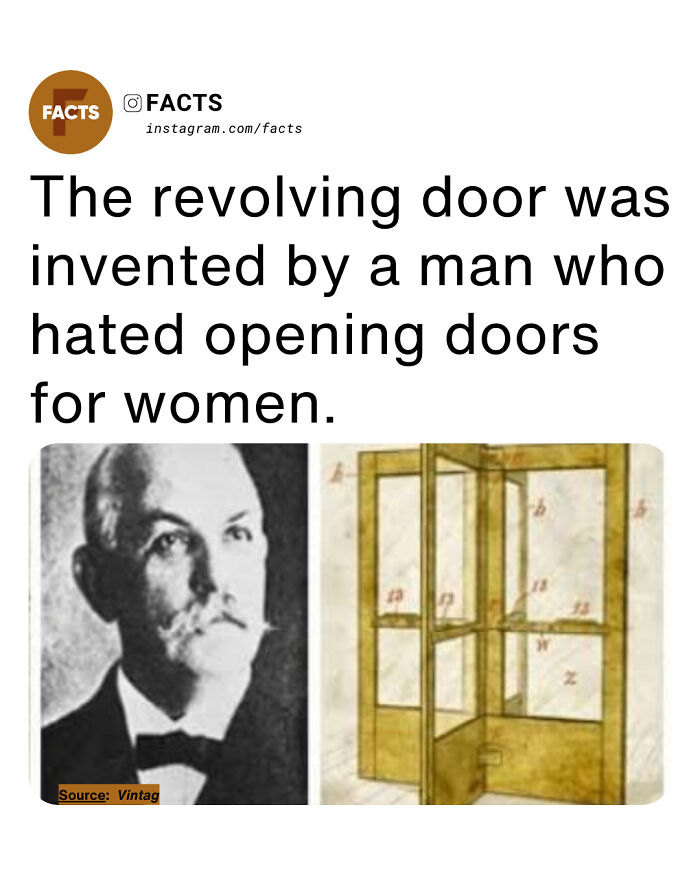
In the late 1800s, Theophilus van Kannel supposedly designed a revolving door because he hated chivalry. He didn’t like to parry with other men over who should enter or exit a door first. Even worse, he hated to open doors for women.
_____
🙅♂️ Although not much is known about Van Kannel’s life, there’s an interesting rumor concerning the inspiration behind his invention: He disliked the chivalrous act of holding open doors so ladies could pass through them. Thus, he spent most of his adult life focused on the invention, improvement, and installation of revolving doors.
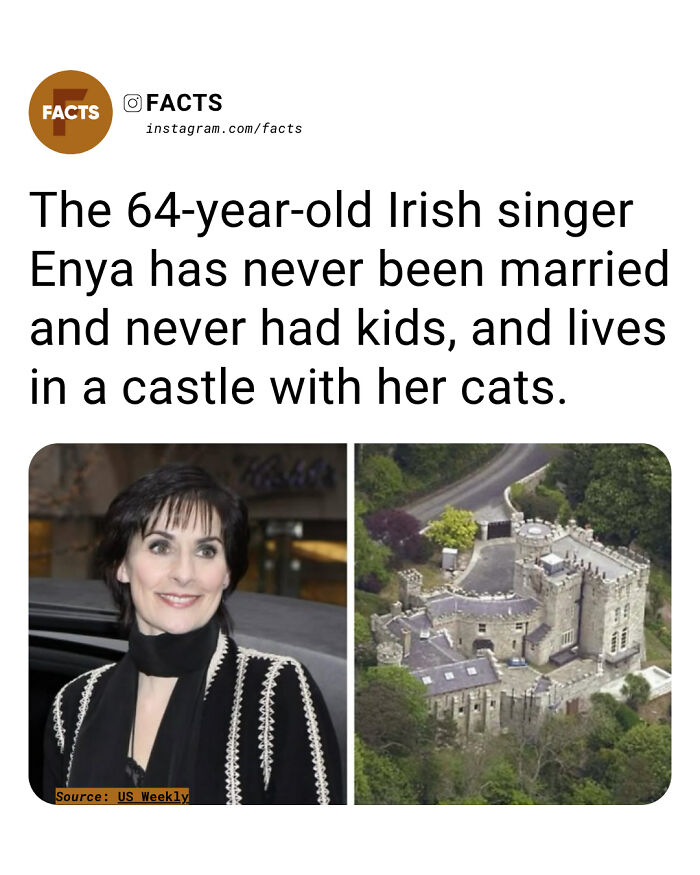
Enya, the Irish singer known for "Orinoco Flow," leads a notably private and reclusive life. She resides in Manderley Castle, a Victorian-style mansion in Killiney, County Dublin, Ireland, which she purchased in 1997 for €3.8 million. Despite her immense success, having sold over 75 million albums, Enya largely shuns public appearances, rarely tours, and avoids most interviews. She lives alone with her cats, valuing her privacy above all else. Her family members have even described her as living "like a queen" and being a recluse. Enya has stated that music is her first love and she has no plans to marry, finding long-term relationships difficult due to her devotion to her art.
The castle itself, formerly known as Victoria Castle and Ayesha Castle, has been heavily fortified by Enya due to past security breaches involving stalkers. She has installed new solid timber entrance gates, raised the surrounding stone walls to over 2.7 meters (9 ft), and added 1.2-meter (4 ft) railings. The property also features a panic room for her safety. From the castle's crenellated turret, views of the Irish Sea are visible, and the grounds encompass 14,000 m² (3.5 acres) of gardens. This secluded and heavily secured residence allows Enya to maintain her private lifestyle, dedicating herself to her music.
Apparently, a particular scene filmed for The Mandalorian Season 1's closing episodes required more Stormtrooper costumes than the crew had on hand. As such, series creator Jon Favreau and Lucasfilm's Dave Filoni reached out to a local chapter of the 501st Legion. The 501st Legion is a fan-based Star Wars organization dedicated to building and wearing screen-accurate costumes of Imperial Stormtroopers, among other villains from the franchise.
The 501st Legion was formed back in 1997 in South Carolina. The fan group now has over 13,000 active members worldwide. While the group is not officially affiliated with Lucasfilm or Disney, members frequently make in-costume appearances at promotional functions or charity events, usually at the request of Lucasfilm's Fan Events division.
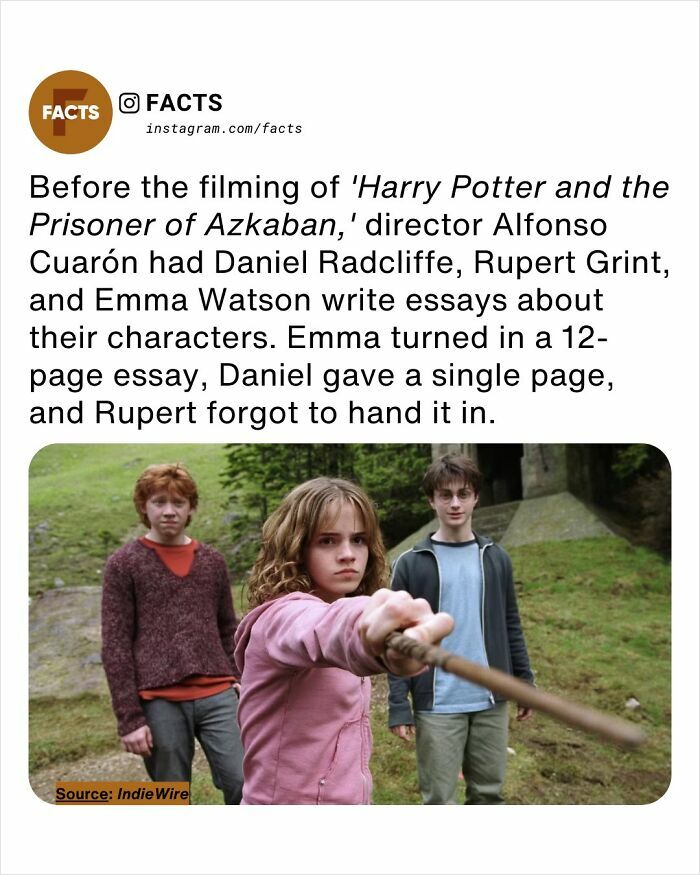
Grint had a pretty good reason to shirk the assignment. As the oldest of the three, then 15 (in 2004), he’d been preparing to take his General Certificate of Secondary Education exams, a series of standardized tests taken by British students at high school age. (Radcliffe and Watson were a year or two from the tests themselves.) Grint explained that he was too bogged down with his studies to give the assignment much thought.
“It’s quite Ron-ish not to do it,” Rupert Grint added. “I think [Cuarón] kind of appreciated that.”
_____
🍦 Smart but occasionally careless, with a fondness for snacks, Grint and his “Harry Potter” character may have more in common than he realizes.
When HuffPost asked about another Ron-ish story ― whether he’d kept the ice cream truck he bought as a teenager with a freshly minted driver’s license ― Grint responded in the affirmative.
“I’ll never get rid of it,” he said. But finding a place to park an ice cream truck has proven more trouble than not, considering its effect on pedestrians.
“They think, rightly, that you are a legitimate ice-cream salesman. And they queue up and expect ice cream, which I don’t have.”
After Top Gear ended, host Richard Hammond was reportedly so devastated that he cried all the way home from the studio and ran out of fuel because he didn't want to fill his car up while covered in tears.
The end of Top Gear in 2015, following Jeremy Clarkson's controversial departure, marked the conclusion of what Hammond himself had called his "dream job." For 15 years, he had worked alongside his best friends, creating some of television's most memorable moments while building a career around automotive passion and comedy.
Hammond's emotional connection to Top Gear ran deeper than just professional success; it represented a brotherhood with Clarkson and James May that had survived life-threatening accidents, global fame, and countless adventures across every continent.
While Top Gear's conclusion was devastating, the trio's reunion for The Grand Tour on Amazon Prime provided some consolation, though it operated under different constraints and never quite recaptured the magic of their BBC days. When The Grand Tour also concluded in 2024 with "One for the Road," fans worldwide shared Hammond's emotional response, with many posting about being "in tears" over the final episode.
Seahorses dance with their partners every morning to strengthen the bond between them.
Bonded seahorse pairs perform an elegant greeting dance each morning, mirroring each other's movements as their bodies change color and they intertwine tails while pirouetting and promenading together. This daily ritual lasts several minutes before they separate for the rest of the day.
The morning dance serves multiple purposes: it confirms both partners are still alive, reinforces their pair bond, and synchronizes their reproductive cycles—crucial when the male is the one who becomes pregnant and carries the eggs.
Project Seahorse was the first to discover this behavior in White's seahorses from southeastern Australia. Researchers describe it as an underwater ballet where the couples maintain perfect posture, hold their heads high, and conduct themselves with great dignity like ballroom dancers.
"Watching seahorses connect is like witnessing a love story unfold in the wild. Their devotion to one another, their synchronized dance, and the way they stick with each other through every stage of life is truly moving," said Prof. Amanda Vincent, Co-founder of Project Seahorse.
The ritual continues even through pregnancy, ensuring perfect synchronization between partners for the next mating. Most seahorse species studied in the wild form monogamous pair bonds during breeding season and stay loyal to a single partner—making them true ocean power couples.

My parents went out to dance every week. Almost made their 50th anniversary.
Michael Fagan, a 33-year-old London-born unemployed man, had somehow managed to stay undetected through all the palace security, becoming the best-known Buckingham Palace intruder. When he first broke into the Palace, he claims to have wandered through the palace, trying chairs “like Goldilocks and the Three Bears”, claiming he even tried out the throne, and exploring various rooms before walking out a door to the back gardens.
_____
👑 Claiming he had no prior plan, Fagan says he found his way to the private apartments by “following the pictures."
In the first anteroom, he saw an ashtray and suddenly came up with a new action plan. He broke the astray and “said that he intended to slash his wrists in the presence of Her Majesty.”
With a piece of the broken ashtray in his hand, Fagan entered Her Majesty’s bedroom and opened the curtains of her bed. Decades later, he revealed that it was a double bed but a single room, definitely – she was sleeping in there on her own.
Direct democracy is one of the special features of the Swiss political system. It allows the electorate to express their opinion on decisions taken by the Swiss Parliament and to propose amendments to the Federal Constitution. It is underpinned by two instruments: initiatives and referendums.
In Switzerland, the people play a large part in the decision-making process at all political levels. All Swiss citizens aged 18 and over have the right to vote in elections and on specific issues. The Swiss electorate is called on approximately four times a year to vote on an average of fifteen such issues. In recent decades, voter turnout has been a little over 40% on average.
Citizens are also able to propose votes on specific issues themselves. This can be done via an initiative, an optional referendum, or a mandatory referendum. These three instruments form the core of direct democracy.
The popular initiative allows citizens to propose an amendment or addition to the Constitution. It acts to drive or relaunch political debate on a specific issue. For such an initiative to come about, the signatures of 100,000 voters who support the proposal must be collected within 18 months. The authorities sometimes respond to an initiative with a direct counter-proposal in the hope that a majority of the people and the cantons support that instead.
Federal acts and other enactments of the Federal Assembly are subject to optional referendums. These allow citizens to demand that approved bills be put to a nationwide vote. In order to bring about a national referendum, 50,000 valid signatures must be collected within 100 days of publication of the new legislation.
All constitutional amendments approved by Parliament are subject to a mandatory referendum, i.e., they must be put to a nationwide popular vote. The electorate is also required to approve Swiss membership of specific international organizations.
In the early 2000s, before the rise of smartphones, one mobile phone reigned supreme — the Nokia 3310. Launched in 2000, it quickly became a cultural phenomenon, celebrated for its durability, long battery life, and no-nonsense design. It was the kind of phone that could survive being dropped, stepped on, or even launched across a room — and still function like new. For millions of users, it was their first mobile phone, and it left a lasting impression that modern smartphones haven’t quite replicated.
The 3310 wasn’t flashy, but it was highly reliable. With its simple monochrome screen, tactile keypad, and a battery that could last up to a week on a single charge, it offered everything users needed at the time: calling, texting, and a few fun extras. Among its most memorable features was the game Snake II, which became a global pastime and helped define early mobile gaming. Its customizable covers also gave users a chance to personalize their phones long before apps and wallpapers became the norm.
Today, the Nokia 3310 is remembered fondly and even revived in a 2017 modern version with updated features and color screens. But for tech enthusiasts and nostalgic users alike, the original 3310 stands as a symbol of simpler times — when phones were tough, batteries didn’t need daily charging, and the biggest concern was beating your high score in Snake.
The UK government has unveiled a significant ban on boiling lobsters alive, a key component of a broader animal welfare initiative for England. This move comes on the heels of scientific consensus that decapod crustaceans—lobsters, crabs, and crayfish—are sentient, capable of feeling considerable pain.
Experts point out that these creatures can suffer for several minutes when plunged into boiling water while still aware. The new rules will mandate more humane methods. These include electrical stunning or chilling the animals in ice or cold air to render them insensible before cooking.
This ban is at the heart of a Labour government's sweeping measures against animal cruelty, touted as the most significant reform in a generation. The plan extends far beyond shellfish, encompassing the prohibition of caged farming for hens, the end of puppy farming, and a ban on trail hunting. Furthermore, it calls for tougher welfare regulations for fish raised on farms and a consultation regarding the use of electric shock collars on dogs. By following the lead of nations such as Switzerland and Norway, the UK seeks to bolster its standing as a global frontrunner in animal protection, ensuring that contemporary legal standards reflect the latest scientific insights into sentience.
Ruth and Elliot Handler, the iconic couple that founded Mattel and created two of the most successful toys in history: Barbie and Hot Wheels.
In 1945, Ruth and Elliot Handler started Mattel in a Los Angeles garage, originally making picture frames and doll furniture. But Ruth had bigger ambitions—she was a visionary who would transform the entire toy industry.
On a 1956 family trip to Switzerland, Ruth spotted an adult-figured doll called Bild Lilli in a shop window. She realized young girls didn't just want baby dolls to nurture—they wanted dolls that showed them the women they could become. In 1959, she introduced Barbie, named after their daughter Barbara, at the New York Toy Fair. Every major retailer rejected it. Ruth went directly to children through television advertising, a radical move at the time. In its first year, 300,000 Barbies sold. Today, over 1 billion Barbies have been sold worldwide.
While Ruth conquered the doll market, Elliot focused on boys. In 1968, he launched Hot Wheels—die-cast cars with low-friction wheels that were faster and cooler than anything on the market. The timing was perfect: American car culture was exploding, and kids wanted miniature versions of muscle cars and custom hot rods. Hot Wheels became an instant phenomenon, and to date, over 6 billion cars have been sold—making it the best-selling toy line in history.
The couple also named Ken after their son Kenneth, making both their children the namesakes of cultural icons.
In 1975, the Handlers were forced to resign from Mattel after an SEC investigation revealed they had falsified financial documents, inflating earnings to boost stock prices. Ruth was convicted of fraud, receiving a suspended sentence with a fine and 500 hours of community service.
Ruth passed away in 2002, Elliot in 2011, but their creations live on as billion-dollar franchises that continue shaping childhoods around the world.
Do chimpanzees fart? Yes.
“Worst when eating figs. So loud and frequent, we locate them in the forest occasionally by following the farts; Even worse when eating Cynometra seeds! Fiber!” wrote University of Kent evolutionary anthropology Ph.D candidate Adriana Lowe.
Around 75% of the world’s adults can’t drink a lot of milk. And yet most could as a child. What’s going on here?
As you can guess from the numbers, being lactose intolerant is normal for an adult. People who can drink milk as adults have a DNA mutation. In fact, being able to drink milk as an adult is now referred to as a condition called lactase persistence. What most adults have trouble with is the sugar in milk, called lactose. When we’re children, almost all of us make an enzyme called lactase.
Lactase is an enzyme that breaks down lactose into sugars our body can use. And children make lactase because they have a working lactase gene. But then, over time, most of them lose that ability. Some lose it as early as 3, some at 20, some even older, and some never at all. If they have the gene when they’re young, where does it go when they get older?
_____
It doesn’t go anywhere; it just gets shut off. Remember, for a gene to work, it must be read by the cell and translated into a protein, like the lactase enzyme. A gene is sort of like a recipe in a cookbook. If no one reads a spaghetti recipe and follows the directions, then no spaghetti gets made -- you just have a piece of paper. Same thing with our genes. If the cell doesn’t read the lactase “recipe” and make the enzyme, then you can’t do anything with lactose. So when we’re kids, cells in our intestines can read the lactase gene and make lactase. When someone becomes lactose intolerant, their body isn’t using the gene anymore. Adults who can digest lactose don’t shut off the lactase gene. They can still make lactase and digest milk.
During the eruption of Mount Vesuvius in 79 AD, a young man's brain was melted and then rapidly cooled by a superheated ash cloud, turning the brain tissue into natural glass, preserving its microscopic neuron structure.
This extraordinary discovery was made in the ancient Roman city of Herculaneum, where archaeologists in the 1960s found the remains of a 20-year-old man who passed away in his bed at the College of the Augustales. But it wasn't until 2020 that scientists confirmed the dark, shiny fragments inside his skull were actually his vitrified brain—the first and only documented case of natural brain glass ever found.
Researchers determined that vitrification required an extremely specific sequence: a superheated ash cloud exceeding 510°C (950°F) engulfed the victim, instantly heating his brain tissue, followed by rapid cooling at rates of about 1000 degrees per second as the ash cloud dissipated within minutes.
"When we realized that there was really a glassy brain, the scientific question was: How is it possible?" said Guido Giordano, a volcanologist at Roma Tre University who led the 2025 study published in Scientific Reports.
Under scanning electron microscopy, the glass fragments revealed an incredibly well-preserved network of neurons and axons, along with proteins specific to human brain tissue. The thick skull bones likely protected the brain from complete destruction, allowing parts to survive the heating process and undergo vitrification during the rapid cooling phase.
This remarkable preservation offers scientists an unprecedented glimpse into ancient Roman brain tissue, frozen in glass for nearly 2,000 years by one of history's most devastating volcanic eruptions.
In the early 1960s, Doritos were born from an unlikely act of resourcefulness at Disneyland’s Casa de Fritos restaurant. At the time, the eatery’s ingredients were supplied by Alex Foods. During a routine delivery, a salesman noticed stale tortillas being tossed into the trash and suggested the kitchen staff fry and season them instead of wasting them. These repurposed chips became an immediate hit with park guests, who eagerly purchased the seasoned snack from the restaurant’s unique "Frito Kid" vending machine.
The snack's commercial potential was officially recognized when Frito-Lay Vice President Archibald Clark West observed its popularity during a surprise visit. Recognizing a major opportunity, West struck a deal with Alex Foods to produce the chips under a new brand name: Doritos, which translates to "little pieces of gold" in Spanish. Following a national rollout in 1966, the brand exploded into a global phenomenon. Today, Doritos remains the world's top-ranked tortilla chip brand, with approximately 100 million bags consumed daily.
John Vaillant is an American-Canadian writer and journalist who wrote 'The Tiger', which is a true story about Vladimir Markov, a poacher who met a grisly end in the winter of 1997 after he shot and wounded a tiger, and then stole part of the tiger's prey.
The injured tiger hunted Markov down in a way that appeared to be chillingly premeditated. The tiger staked out Markov's cabin, systematically destroyed anything that had Markov's scent on it, and then waited by the front door for Markov to come home.
"This wasn't an impulsive response," Vaillant says. "The tiger was able to hold this idea for some time. The animal waited for 12 to 48 hours before attacking. When Markov finally appeared, the tiger attacked him, dragged him into the bush, and ate him. The eating may have been secondary," Vaillant explains. "I think he ended him because he had a bone to pick.
What's so fascinating to me about that region is that human beings and tigers are hunting for the same prey in the same territory — and they don't have conflicts." But if you make the mistake of attacking a tiger, you will regret it, he says.
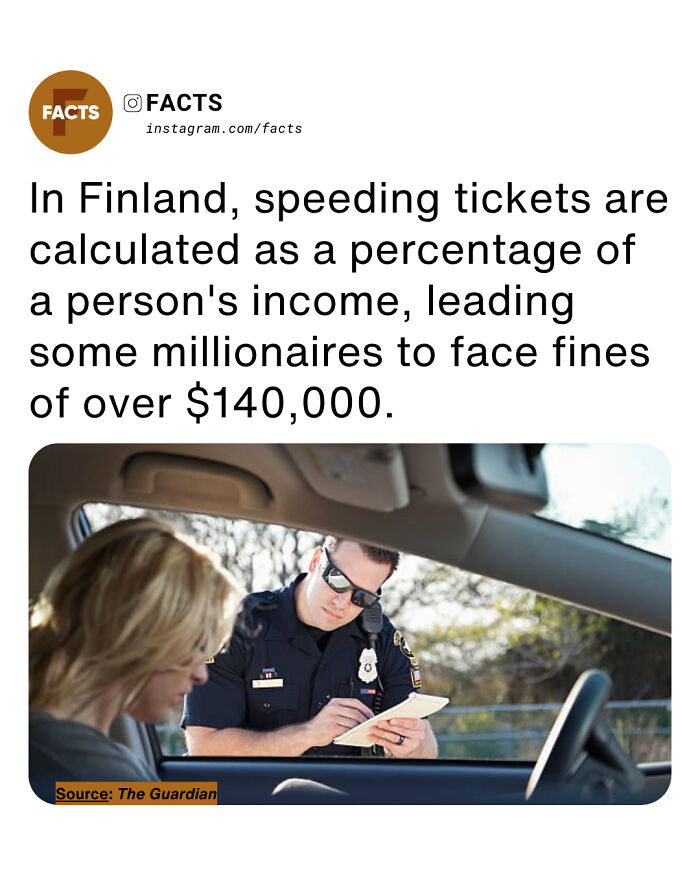
Recently, a multimillionaire businessman has been hit with one of the world’s highest speeding fines – €121,000 ($132,000) – for driving 30km/h (18.6mph) over the limit in Finland, where tickets are calculated as a percentage of the offender’s income.
“I really regret the matter,” Anders Wiklöf, 76, told Nya Åland, a newspaper for the Åland Islands, an autonomous Finnish region in the Baltic Sea. “I had just started slowing down, but I guess that didn’t happen fast enough. It’s how it goes.”
Wiklöf, the chairman and founder of a €350m-a-year holding company, said the speed limit changed “suddenly” from 70km/h to 50 when he was flashed at 82km/h.
As is common in the Nordic region, fines for traffic infringements in Finland are based on the severity of the offense and the offender’s income, which police can check instantly by connecting via their smartphones to a central taxpayer database.
Under the Finnish system, a “day fine” is calculated based on the offender’s daily disposable income, generally considered to be half their daily net income. The more a driver is over the limit, the greater the number of days' fines they receive.
The fact that Wiklöf had been fined twice previously for speeding was an aggravating factor. He also had his driving license suspended for 10 days.
In the 1630s, Gregorio Allegri composed "Miserere mei, Deus," a sublime nine-part choral setting of Psalm 51 for the Pope's Sistine Chapel. Performed exclusively during Holy Week Tenebrae, the Vatican guarded its score for nearly 140 years to preserve its unique impact, forbidding transcription under threat of excommunication. Secret, unwritten vocal ornamentations (abbellimenti) used by the papal choir, not in the simplified official copies, were crucial to the work's ethereal beauty, ensuring any external performance lacked the true Sistine Chapel magic. The composition became legendary due to its carefully maintained exclusivity and unique performance traditions.
This meticulously protected secrecy was famously shattered in 1770 by 14-year-old Wolfgang Amadeus Mozart. Visiting Rome with his father, he heard the "Miserere" at a Holy Wednesday service. Possessing an extraordinary musical memory, Mozart transcribed the entire complex piece from memory after that single hearing. Accounts suggest he attended a second performance for minor corrections. News of this incredible feat reached Pope Clement XIV.
Instead of punishing the young composer, the Pope, astounded by Mozart's genius, summoned him, showered him with praise, and awarded him the Golden Spur. Music historian Dr. Charles Burney published Mozart's transcription in London in 1771. This act effectively ended the Vatican's exclusive hold, making Allegri's "Miserere" accessible to the wider world and marking young Mozart as perhaps one of history's first, and most celebrated, "music pirates."
More than just a box-office hit in China, the animated Hollywood comedy 'Kung Fu Panda' has led Chinese artists to find fault with their own film industry and call for fewer government controls on culture.
The movie, which tells the story of a fat panda who dreams of martial arts glory, was faithful to Chinese culture and laced with good humor, but China itself may have been incapable of producing such a film, a Chinese filmmaker and opera director lamented.
“The film’s protagonist is China’s national treasure and all the elements are Chinese, but why didn’t we make such a film?” Wu Jiang, president of the China National Peking Opera Company, was cited.
_____
🇨🇳 Lu Chuan, a young film director, applauded “Kung Fu Panda” as a fresh and rich take on Chinese culture, mixing references to martial arts films with classic legends.
“I cannot help wondering when China will be able to produce a movie of this caliber,” he wrote in the China Daily.
Your whole life was a lie.
All these years, we thought we couldn't end a UNO card game with Action cards. But the matter has finally been put to rest.
Now, we have the verdict from the horse's mouth.
The Wife Carrying World Championships have been held annually in Sonkajärvi, Finland, since 1992 - would you partake?
It is a contest in which male competitors race while each carrying a female teammate. The objective is for the male to carry the female through a special obstacle course in the fastest time.
Several types of carrying methods may be used: either a classic piggyback, a fireman’s carry (over the shoulder), or Estonian-style (wife upside-down on his back with her legs over the neck and shoulders).
Public holidays in Japan were established by the Public Holiday Law of 1948 (as amended). A provision of the law specifies that when a national holiday falls on a Sunday, the next working day shall become a public holiday, known as furikae kyūjitsu (振替休日, "compensatory public holiday", literally "substitute holiday").
Additionally, any day that falls between two other national holidays shall also become a holiday, known as kokumin no kyūjitsu (国民の休日, literally "citizens' holiday"). May 4, sandwiched between Constitution Memorial Day on May 3 and Children's Day on May 5, was an annual example of such a holiday until it was replaced by Greenery Day in 2007.
Before Japan adopted the Gregorian calendar in 1873, the dates of holidays were based on the traditional Chinese lunisolar calendar. Thus, New Year's Day, for example, was celebrated at the beginning of spring, as it is in modern China, Korea, and Vietnam. Japan has 16 national, government-recognized holidays.
In 1956, it was not uncommon for children in France to be exposed to small sips of wine during family meals as part of their cultural upbringing.
Wine was traditionally regarded as an integral part of French culture, and parents often believed that introducing children to wine in moderation would teach them responsible drinking habits and an appreciation for their country’s wine heritage.
These early exposures were typically diluted with water and given in limited quantities, focusing on the sensory experience rather than intoxication.
_____
In 1956, the government took up the issue of alcohol in school canteens. For the first time, a significant measure is adopted. Now, no child under 14 is allowed to drink wine at the table. A real revolution is underway in the fight against drunkenness in schools. Nothing surprising for vine and wine historian Stéphane Le Bras, who recalls, “At that time, it was a common practice to see children consuming wine. Parents usually give their children flasks of wine mixed with water when they go to school.
Moreover, in the 1930s, a national propaganda committee in favor of wine was created, and one of their first demands was to encourage this practice by accustoming children to the taste of wine. Behind this ban, there is the desire for the former Minister of Health, Marisol Touraine, to protect children. For her, “particular attention is paid at this time to children, adolescents, young people as they enter life and start to drive”.
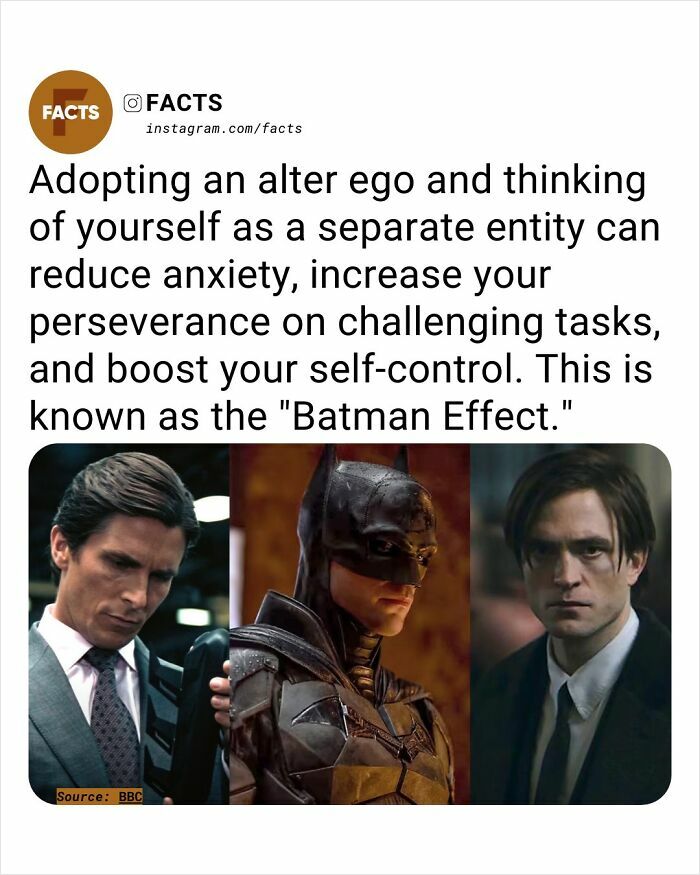
Thinking of yourself as a separate entity can reduce anxiety. It’s not you who has to perform. It’s "Batman." This seems to not only reduce anxiety but also build confidence and determination. It allows us to “self-distance” or “psychologically distance.” We step back from the situation and see it with less emotion and less passion.
It reins in that worry and stress and helps us to show additional restraint and discipline. Adopting an alter ego is a powerful way to step away from our immersion in a stressful or challenging moment, and it allows us to respond the way that our alter ego might, rather than the way we are about to.
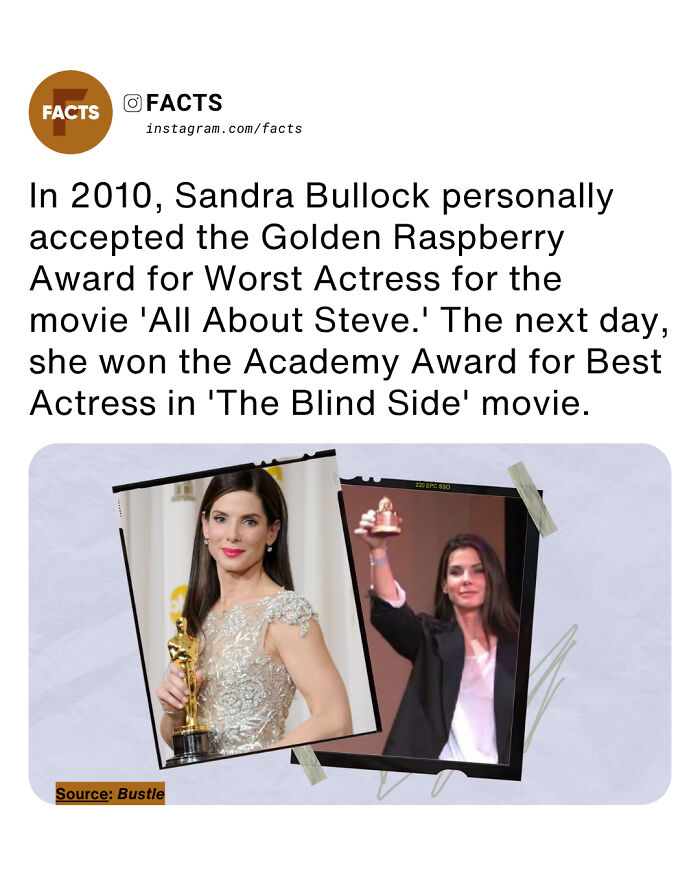
Bullock took home the "Golden Raspberry" for her performance in 'All About Steve.' The actress even showed up to the awards ceremony to pick up her prize for worst actress. "I think this is an extraordinary award," she joked. As Bullock came onto the stage to accept her honor and make her speech, she lugged a wagon full of 'All About Steve' DVDs for audience members to take.
Sandra Bullock not only received an Oscar nod for her performance in 'The Blind Side,' but in the race between Carey Mulligan, Helen Mirren, Meryl Streep, Gabourey Sidibe, and herself, it was Bullock who took home the statuette. In the drama, she played Leigh Anne Tuohy, who took in Michael Oher (played by Quinton Aaron) and helped him pursue football professionally.
Experts have found that these little creatures can learn - even though they don't have a brain. They discovered that jellyfish are capable of changing their behaviour based on previous experiences - something that's never been seen before in other similar species. Scientists believe their findings could change our understanding of the brain and could reveal more about how our own brains work.
Jellyfish have been around for more than 500 million years, long before the first dinosaurs roamed on Earth.
They've often been thought of as very simple organisms - jellyfish are made up of around 98% water and have no bones, no brain, and no heart.
However, a new study by scientists from the University of Copenhagen has found that they can learn at a much more complex level than ever imagined.
They looked at Caribbean box jellyfish, which are only around a centimetre long and are known to be able to navigate their way through tricky obstacles, including murky waters and a maze of underwater mangrove roots.
Scientists discovered that they're able to do this by using their complex system of 24 eyes, which allows them to recognise obstacles.
They can then learn from past experiences in a process called associative learning.
Anders Garm, a marine biologist from the University of Copenhagen, explained that jellyfish can be trained to "predict a future problem and try to avoid it."
It's the first time that such simple creatures have been shown to have such abilities - until now, it's only been seen in more complex animals.
Experts say the study shows that even simple animals are capable of learning and that it could help us understand more about how our own brains work.
In an interview with Wired, Linus Torvalds said that around 2000, Steve Jobs offered him a place at Apple to work on its Unix-based kernel. "Unix for the biggest user base: that was the pitch," Torvalds says. However, he was no fan of Mac OS’s Mach kernel, and Jobs insisted that he drop working on Linux, something Torvalds refused to do. Instead, he continued his work with the open-source platform and now helps manage it on behalf of the Linux Foundation.
Torvald's business ventures haven't netted him the kind of wealth or fame that Jobs received, but he says he's glad he concentrated on the technical aspects of Linux. "I’m very happy with the feeling that I’ve done the right thing." Linux has likely been better off for it: everything from the Android smartphone system to Red Hat's enterprise OS has been built on the platform.
This is because all three ingredients act on the stomach and help you to deal with the after-effects of a hangover.
Bananas are easy to digest and are also known to calm stomach upset and hydrate the body. Alcohol dehydrates the body, which is why you feel dizzy and have headaches. Bananas are also rich in electrolytes and minerals such as magnesium and potassium, which are severely depleted due to heavy drinking.
If honey is added to banana milkshakes, it helps build up the depleted blood sugar levels, providing some energy. And adding milk to it soothes and rehydrates the digestive system post-heavy drinking.
North Dakotans are used to pharmacists like Schlecht and to having pharmacies in small towns like Forman. In North Dakota, there are no Walgreens or Walmart pharmacies. Instead, North Dakotans get their medications from the 171 independent and locally-owned pharmacies throughout the state. This is no accident: It’s the result of a forward-thinking policy choice, the Pharmacy Ownership Law, that, since 1963, has given North Dakotans pharmacy care that outperforms care in other states on every key measure, from cost to access.
In North Dakota, prescription drug prices are more affordable than in two-thirds of all states. Pharmacies are more plentiful, with more per capita than in neighboring South Dakota, Minnesota, or nationally, and they’re more broadly distributed; North Dakota’s rural areas are 51 percent more likely to contain a pharmacy than similarly-populated areas of South Dakota. And in general, independent pharmacies provide higher quality care, studies and surveys of customer satisfaction find.
North Dakota reaps economic benefits, too, from this local ownership. Without the Pharmacy Ownership Law, a 2014 report from ILSR estimated, about 70 of North Dakota’s independent pharmacies would close. Chain pharmacies headquartered around the country and out-of-state mail order companies would fill the gap, and ILSR estimates that direct economic losses to the state’s economy would be at least $17 million, and as high as $29 million, without accounting for indirect impacts such as lost tax revenue.
Instead of focusing on corporate profits, North Dakota’s policy prioritizes health care, and the state’s residents are the ones who benefit.
Samoyeds' friendly and affable disposition makes them poor guard dogs; an aggressive Samoyed is rare. The breed is characterized by an alert and happy expression, which has earned the nicknames "Sammie smile" and "smiley dog." With their tendency to bark, however, they can be diligent watchdogs, barking whenever something approaches their territory. Samoyeds are excellent companions, especially for small children or even other dogs, and they remain playful into old age.
According to the Samoyed Club of America, when Samoyeds become bored, they may become destructive or start to dig. With their sled dog heritage, a Samoyed is not averse to pulling things, and an untrained Samoyed has no problem pulling its owner on a leash rather than walking alongside.
A rare Chinese bowl bought for about $3 from a yard sale in the U.S. sold for $2.2 million at an auction in New York in 2007.
The bowl, found in New York state, "was bought for a few dollars from a tag sale near the consignor's home in the summer of 2007," said Cecilia Leung of Sotheby's. "At the time, the purchaser had no idea that they had happened upon a 1,000-year-old treasure."
The previous owner displayed the bowl in their living room for several years before they became curious about its origins and had it assessed, Leung said. Sotheby's pre-sale estimates valued the bowl, which measures just five inches in diameter, at between $200,000 $300,000.
The 'Ding' bowl is an example of Northern Song Dynasty pottery and described by Sotheby's as "remarkable and exceptionally beautiful."
The only other known bowl of the same size, form, and almost identical decoration has been in the collection of the British Museum in London for over 60 years, according to Sotheby's.
The bowl was purchased by London dealer Giuseppe Eskenazi for $2,225,000, after a prolonged battle between four bidders.
Feeling that the character presented an offensive Mexican stereotype, Cartoon Network shelved Speedy's films when it gained exclusive rights to broadcast them in 1999 (as a subsidiary of Time Warner, Cartoon Network is a corporate sibling to Warner Bros.). In an interview with Fox News on March 28, 2002, Cartoon Network spokeswoman Laurie Goldberg commented, "It hasn't been on the air for years because of its ethnic stereotypes."
Despite such controversy over potentially offensive characterizations, Speedy Gonzales remained a popular character in Latin America. Many Hispanic people remembered him fondly as a quick-witted, heroic Mexican character who always got the best of his opponents, at a time when such depictions of Latin Americans were rare in popular entertainment.
The Hispanic-American rights organization League of United Latin American Citizens called Speedy a cultural icon, and thousands of users registered their support of the character on the hispaniconline.com message boards. Fan campaigns to put Speedy back on the air resulted in the return of the animated shorts to Cartoon Network in 2002.
In a March 2021 essay, Los Angeles Times columnist Gustavo Arellano wrote, “I love Speedy so much, I keep a large painting of him in my home office. His kind smile and brown skin take me back to my childhood — and remind me of where we as Mexicans exist today.”
The world’s best-known household lubricant got its secret name in 1953 from its inventor, Norm Larsen, which stands for “Water Displacer—40th attempt.”
An article in The Wall Street Journal reported that the formula is in a bank vault and has only been taken out twice—when changing banks and on the product’s 50th birthday, when CEO Garry Ridge rode on a horse into Times Square while wearing a suit of armor and carrying the formula. He said the company mixes a concentrate in three locations, then distributes it to aerosol manufacturing partners worldwide.
The company reveals what’s not in the secret formula on its FAQ page: WD-40 Multi-Use Product does not contain silicone, kerosene, water, graphite, or chlorofluorocarbons (CFCs). As for what might be in that secret formula, in 2009, Wired.com sent a can to a lab and published a report.
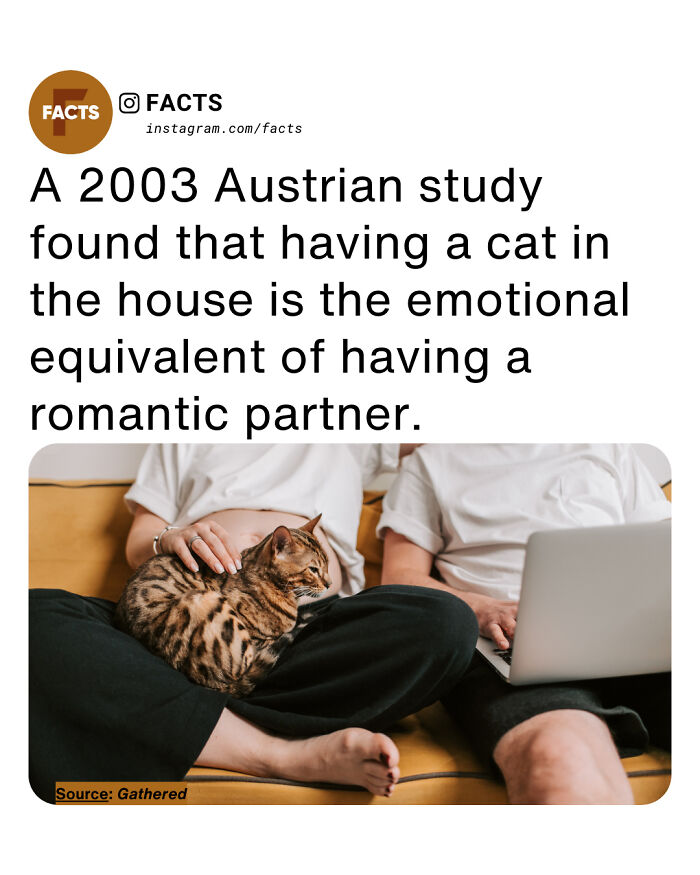
As well as initiating contact, much of the time, studies have shown that cats will remember the kindness shown to them and return the favor later.
But cats really do have the upper hand in these relationships. After thousands of years of domestication, cats have learned how to make a half-purr/half-howl noise that sounds remarkably like a human baby’s cry. And since our brains are programmed to respond to our children’s distress, it is almost impossible to ignore what a cat wants when it demands it like that.
In 2010, a man stranded in the bush in northern Saskatchewan, Canada, was rescued after chopping down four power poles — knocking out electricity to surrounding communities.
The incident left several hundred people in Wollaston Lake and Hatchet Lake Denesuline Nation without power for more than 30 hours, but it paved the way for a man to be saved by a SaskPower crew.
"He was found under his boat in a very distressed state, so essentially he was stranded for several days, and just desperate for people to know where he was," SaskPower spokesman James Parker said.
The man reported he had been on a boat on the lake when he hit bad weather. He ended up stranded in the bush, with no way to communicate with the outside world, Parker said.
But he had an axe, and he knew SaskPower would have to check the downed line, so he went to work.
"Essentially, it was mission accomplished because we got the call, we chartered a helicopter … and on Friday, around noon, we discovered him," Parker said.
A student who graduated with his bachelor's and master's degrees in only three semesters is being sued by the Essen, Germany-based School of Economics and Management for lost income. It would normally take a student 11 semesters and 60 exams to complete the two degrees, but the student, Marcel Pohl, finished in just 20 months - roughly a quarter of the time that would be expected to finish both degrees.
Pohl was able to do this with the help of two friends, who would share notes from courses he could not attend due to conflicts in his class schedule. During this time, he also completed an apprenticeship in a bank.
The school, which is claiming "income loss," was suing Pohl for $3,772—only a fraction of the tuition and fees he would have paid had he completed the degrees in the customary amount of time.
Nebraska's "safe-haven" law allows parents to abandon unwanted children at hospitals with no questions asked, was unique in a significant way: It went beyond babies and potentially permits the abandonment of anyone under 19.
While lawmakers may not have intended it, the month-old law raised the possibility that frustrated parents could drop off misbehaving teens or even severely disabled older children with impunity.
"Whether the kid is disabled or unruly or just being a hormonal teenager, the state is saying: 'Hey, we have a really easy option for you,' " said Adam Pertman, executive director of a New York adoption institute and a frequent critic of safe-haven laws back in 2008.

I might get all the hate in the world for saying this but its sad that the world doesn't have better systems in place for parents with severely disabled children.... Its heartbreaking to see some parents so broken and exhausted over taking care of their child with no mental or physical help :'(
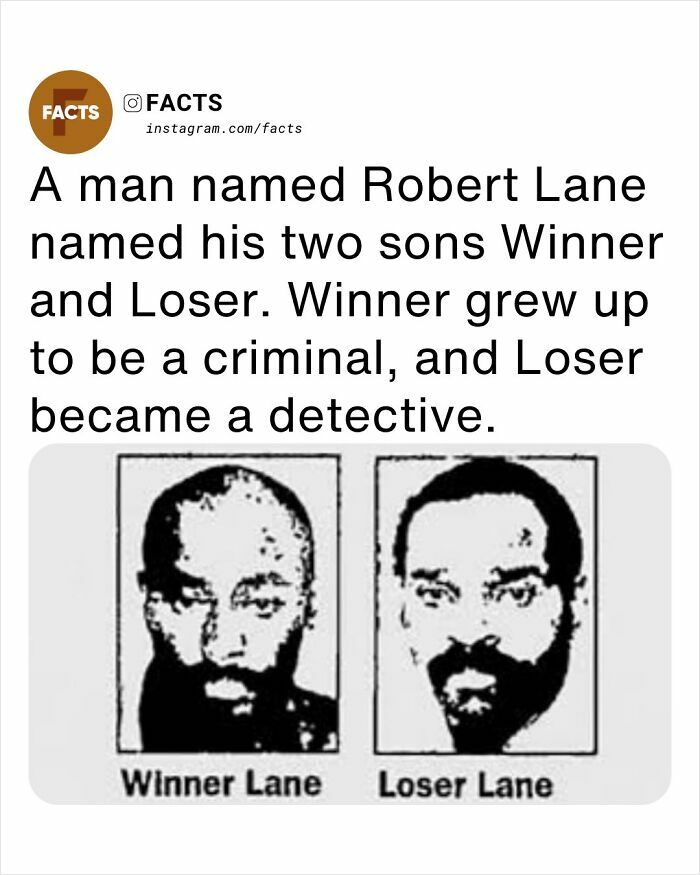
Robert Lane was already the father of five children with common first names, but apparently, he was plagued by the thought that the choice of name could influence a child’s future. What life might a person with a truly winning name lead... And so in 1958, he decided to name his sixth offspring Winner.
At the time, the family was living in a subsidized housing project in New York’s Harlem district. When Winner was three years old, another sibling announced itself. The father asked his eldest daughter what name to give the baby, and she replied that they already had a “winner,” so why not also have a “loser”? And that is what happened.
Both grew up on the grounds of the Wagner Projects. Their names never attracted much attention or ridicule among the neighborhood children. Loser later said: “As a child, you don’t know it’s a bad name. And later in school, everyone knows you, but it has become normal.”
With his distinctive name, Winner Lane should have achieved a lot. But exactly the opposite turned out to be true. The exact reasons for this can no longer be determined today. In any case, he went off the rails quite early, because his criminal career began at the age of 19 when he was arrested for the first time in September 1977.
Five years later, he was convicted for the first time after breaking into a house on Long Island. Over time, this was followed by more than 30 other crimes and offenses: fare evasion, domestic violence, trespassing, resisting arrest, and auto theft.
Around the time his brother immersed himself in the crime scene, Loser Lane received a scholarship to a prep school in Connecticut. After college, he joined the New York Police Department in January 1984.
New research has found that second-born children – particularly boys – are more likely to engage in criminal behavior than their older counterparts, according to MIT economist Joseph Doyle.
In an interview with National Public Radio, Doyle said that second-born children are “much more likely to end up in prison, much more likely to get suspended in school, [or] enter juvenile delinquency.” He added that there’s a 25 to 40 percent increase in the chances of any of these outcomes happening when comparing a second-born sibling to a first-born.
Doyle’s research centers around boys because boys are more likely than girls to get into trouble during their teenage years, NPR said. Doyle examined data from thousands of brothers from Florida and Denmark, but came to similar conclusions when it came to crime and delinquency among second-born children.
The explanation? According to Simple Most, parents tend to spend more time with their firstborn child, giving them undivided attention and engaging in activities such as bedtime stories, arts and crafts, and playing instruments. Older siblings often perform better on tests and have higher IQ scores.
Additionally, first-born children look to their parents as their first role models in life, while second-born children also have role models who are “slightly irrational 2-year-olds,” Doyle said. This pushes the notion that first-born children may behave more maturely than their younger siblings.
The report notes that every family is different, and the research covers a broader spectrum.
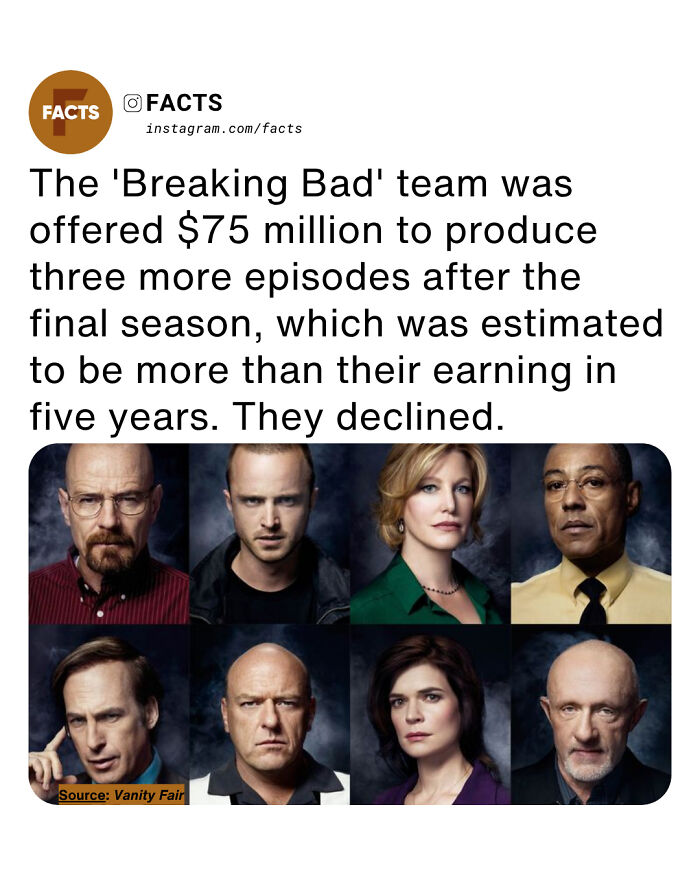
Jeffrey Katzenberg, co-founder of DreamWorks and the former chairman of Walt Disney Studios, had a radical idea for the final season of 'Breaking Bad.'
“I met with them maybe four or five months before the final season aired,” Katzenberg said. “I made a proposal to them that I would buy from them three additional episodes of ‘Breaking Bad’ for $25 million an episode. At the time, they were producing these shows for $3.5 million an episode, so to literally buy three new episodes for that amount of money meant they would have made more profit from the purchase of those three episodes than they’d made from five years.”
The “Breaking Bad” team turned down Katzenberg’s offer, mainly because the final episodes did not lend themselves to additional installments. (Look at where Bryan Cranston’s Walter White ended up in the series finale.) Looking back, Katzenberg maintains that releasing “Breaking Bad” episodes this way would’ve been a huge financial win.
As a result, they may fear activities related to happiness because they believe they can ward off something bad from happening. This is often the case when someone has experienced a past physical or emotional traumatic event.
An introvert may be more likely to experience cherophobia. An introvert is a person who typically prefers to do activities alone or with one to two people at a time. They’re often seen as reflective and reserved. They may feel intimidated or uncomfortable in group settings, loud places, and places with a lot of people.
Perfectionists are another personality type that may be associated with cherophobia. Those who are perfectionists may feel happiness is a trait only of lazy or unproductive people. As a result, they may avoid activities that could bring happiness to them because these activities are seen as unproductive.
The iconic PlayStation 2 is certainly one of Sony’s greatest accomplishments in the video gaming industry, with more than 3,800 games developed for it.
It does seem remarkable to think that Sony released it 25 years ago, and the Japanese technology company had clearly invented something that was ahead of its time.
What is interesting to note also is that, in fact, the PlayStation 2 currently has one of the longest lifespans of any console to date.
Incredibly, Sony only stopped making them in early 2013, just a month before the PlayStation 4 was to be announced.
So what made this video console so special? Well, for a start, its processing power was second to none when it was launched in 2000.
The PlayStation 2 had 32 MB of RAM, which led to the graphics of the games looking phenomenal for the early ’90s.
Another of the key selling points for the console was the addition of the DVD player, which at the time was the latest way of viewing everyone’s favorite films and TV series.
It was also cheaper to buy a PlayStation 2 with the DVD player, which cost roughly £200, rather than a DVD player by itself, which ended up being double the price.
To demonstrate how much of a success the PlayStation 2 turned out to be, over 13 years, roughly 155 million consoles were sold around the world.
Following the success of the Fantastic Four in 1961 and the subsequent revival of American comic books featuring superheroes, Marvel Comics created new superhero characters. Stan Lee developed the initial concept for Iron Man. He wanted to design a character who should be unpalatable to his generally anti-war readers, but to make them like the character anyway. Iron Man was created in the years after the United States developed a permanent arms industry, and this was incorporated into the character's backstory.
The character was introduced as an active player in the Vietnam War. Lee described the national mood toward Vietnam during Iron Man's creation as "a time when most of us genuinely felt that the conflict in that tortured land really was a simple matter of good versus evil".
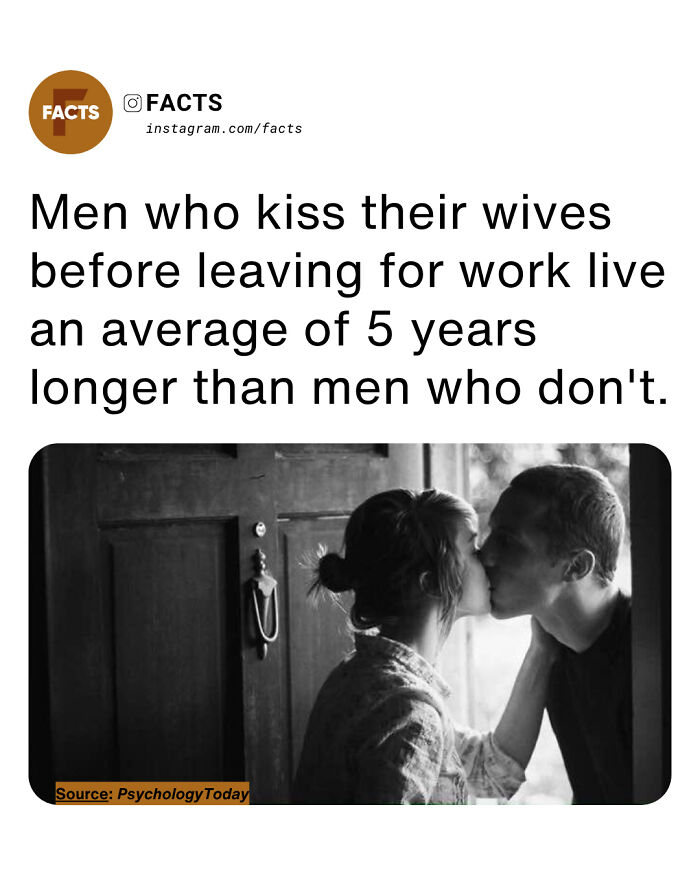
A psychological study done in Germany during the 1980s found that the men who kissed their wives before going to work in the morning lived an average of five years longer than husbands who didn’t kiss.
Dr. Arthur Szabo, professor of psychology at the University of Kiel, collected data for two years from several dozen physicians, psychologists, and leading German insurance companies that cooperated to provide actuarial data. Szabo published his findings in a West German magazine called Selecta.
_____
The kissing husbands earned 20 to 35 percent more money and used less sick time than their peers who left with no goodbye kiss. In this same study, a sampling of Germany’s top 110 industrial managers shows that the 87 percent who left home after kissing their wives saw a pay increase and held their management positions. This same research outfit reported that not kissing one’s wife before leaving in the morning significantly increases the possibility of a car accident.
The psychologists who analyzed the data do not believe that kissing alone accounts for such a significant outcome between the two groups; rather, it is the positive attitude that is strongly associated with a healthy lifestyle. It’s quite clear from the study that the strong bond formed through regular kissing promotes not only emotional well-being but also physical health.
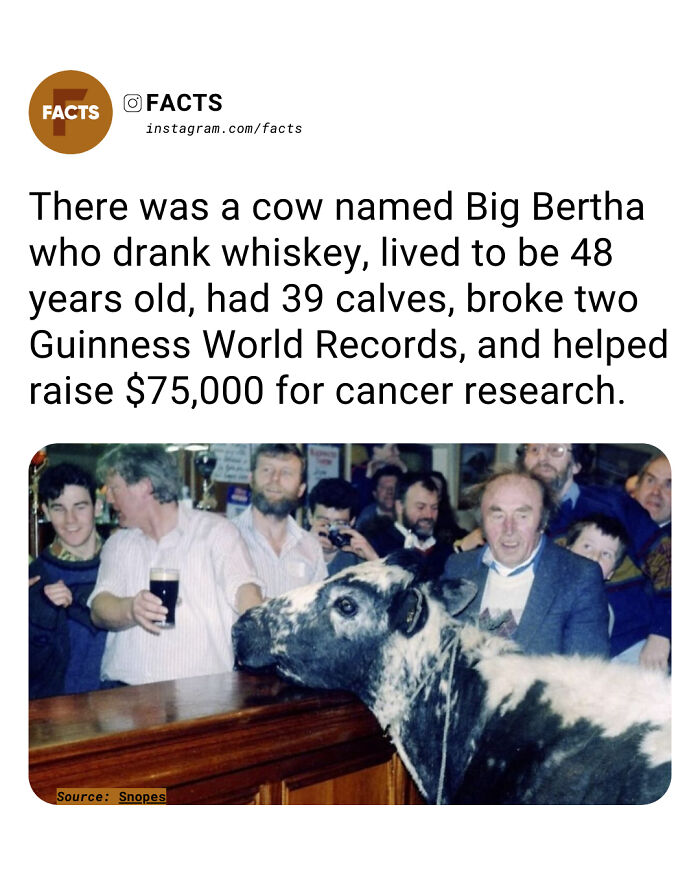
Big Bertha (17 March 1945 – 31 December 1993) was a cow who held two Guinness World Records: she was the oldest cow recorded, dying just three months short of her 49th birthday, and she also held the record for lifetime breeding, having produced 39 calves. During her lifetime, she helped raise $75,000 for cancer research and other charities.
Due to her record-breaking status, Big Bertha became a local celebrity. Her appearances at cattle fairs helped raise $75,000 for cancer research and other charities, and she would lead the St Patrick's Day parade in Sneem to aid with fundraising. Before her appearances at the noisy parades, O'Leary would feed Big Bertha whiskey to steady her nerves. After her passing on New Year's Eve 1993, a wake was held for her in a pub, the Blackwater Tavern at Raycoslough, Blackwater, in County Kerry. On Big Bertha's day of passing, O'Leary still had several of her offspring in his herd, the oldest of whom was then 35.
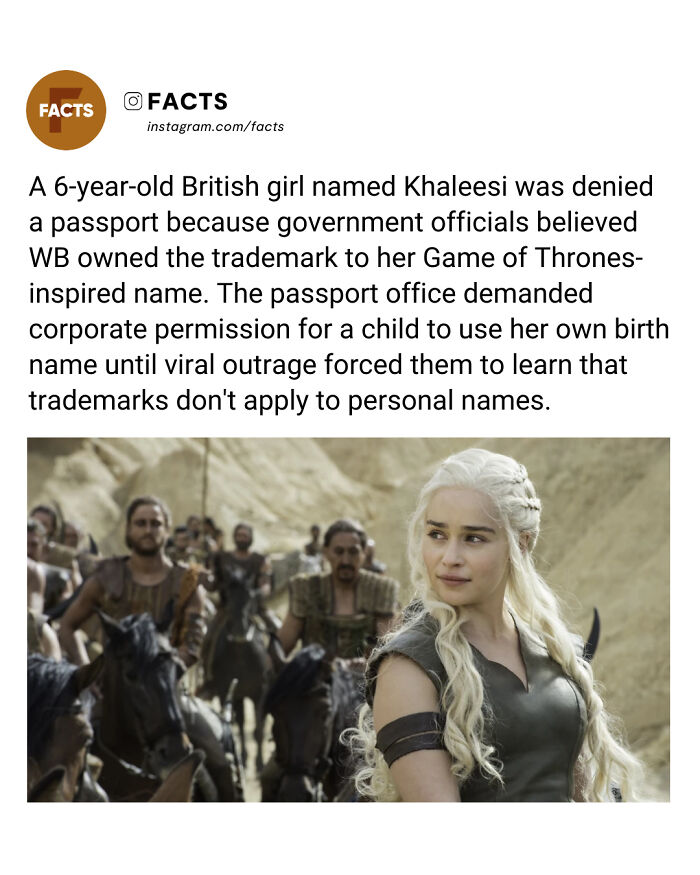
A 6-year-old British girl named Khaleesi was denied a passport because UK officials wrongly believed Warner Brothers owned the trademark to her Game of Thrones-inspired name. The Passport Office demanded corporate permission for a child to use her own birth name until viral outrage forced them to learn that trademarks don't apply to personal names.
Lucy Holloway from Swindon was "absolutely devastated" when the Passport Office rejected her daughter's application for their dream family trip to Disneyland. Officials sent a letter claiming "her name is trademarked by Warner Brothers" and demanding "a letter from Warner Brothers to confirm my daughter is able to use that name" before they could issue the passport.
The mother consulted solicitors who quickly established that while Warner Brothers does hold trademarks related to Game of Thrones, these cover goods and services—not personal names. "I was astonished," Lucy told the BBC. "If she could get a birth certificate, why wasn't this flagged then? I never thought a name could be trademarked."
The Passport Office had incorrectly applied internal guidance meant only for adults changing their names, not children born with trademarked character names. After Lucy shared her story on social media, the agency quickly reversed course and apologized for the "misunderstanding." A Home Office spokesperson confirmed: "We can verify that the application is being processed and apologize to the family for the delay."
Lucy suspects the situation was only resolved due to media attention: "If I hadn't posted about this on social media, nothing would have been done. I'd still be stuck, not knowing what to do next."
Khaleesi—named after Daenerys Targaryen's title in the HBO series—joins thousands of children worldwide given Game of Thrones-inspired names during the show's popularity peak. Her passport was eventually approved, though the family's vacation costs increased due to the delay.

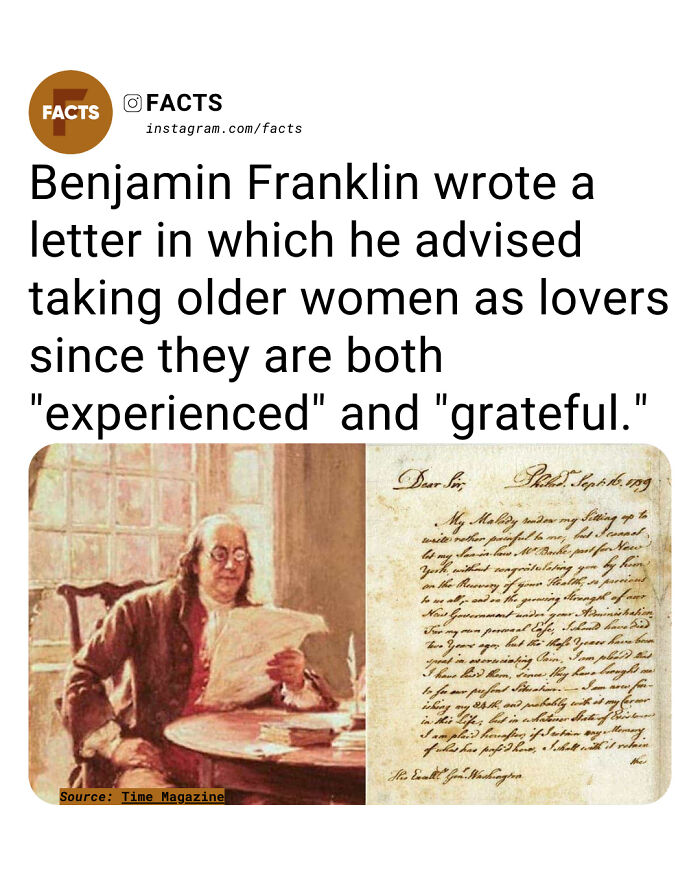
When Benjamin Franklin wasn’t pushing up his bifocals to go fly a kite in a rain storm, he was doling out love advice. In 1745, our nation’s beloved first Postmaster General wrote a letter to a younger friend advising the man “on the choice of a mistress.” In the eye-opening letter —which was not mailed but apparently simply shared for laughs in Ye Olde Locker Room — Franklin suggests the young man marry an older woman because they are both “experienced” and “grateful.”
Franklin went on to defend his thesis statement with cold, hard facts, undoubtedly collected through years of field research. Among the many reasons Franklin enumerated as to why the more mature woman is preferable to the more recent additions to the human race: They are more experienced.
While mature women may be slightly less attractive than some younger models, Franklin believed that they justified their continued existence by being kinder: “There is hardly such a thing to be found as an old Woman who is not a good Woman,” he wrote. Apparently, there is such a thing as an old man who is not a good man, though. To that point, Franklin also noted that with an older woman, there was none of that pesky guilt for “debauching a Virgin.”
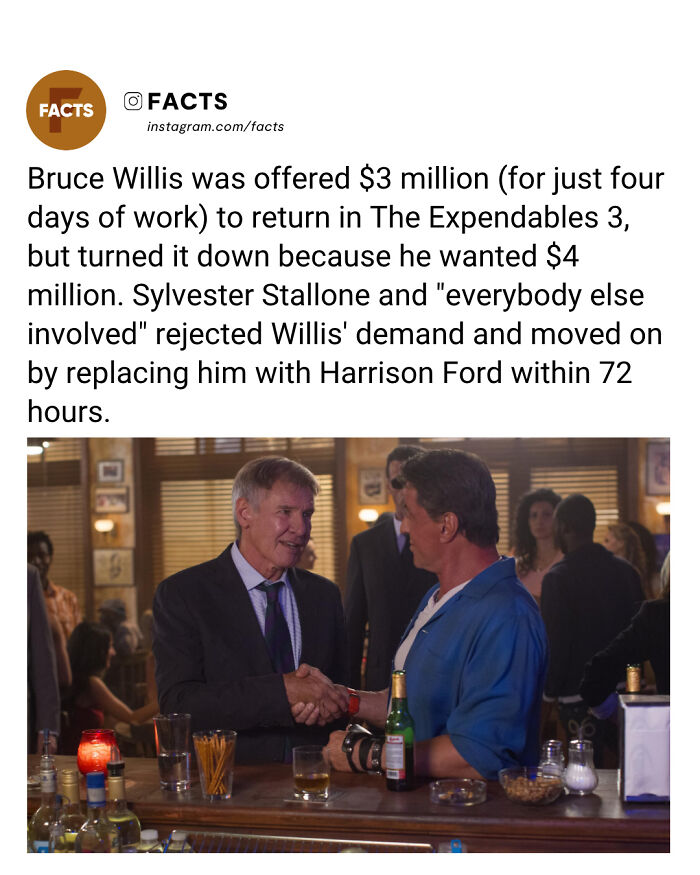
Bruce Willis was offered $3 million (for four days of work) to return in The Expendables 3 (2014), but turned it down because he wanted $4 million instead. Sylvester Stallone and "everybody else involved" rejected Willis' demand and moved on by replacing him with Harrison Ford within 72 hours.
Willis had played CIA agent Mr. Church in the first two Expendables films, which together earned $575 million at the global box office. For the third installment, producers offered him $3 million for just four days of shooting in Bulgaria—a hefty $750,000 per day. But Willis demanded $4 million, essentially asking for $1 million per day.
"He said he'd walk unless he got $4 million. A million dollars a day," a source told The Hollywood Reporter. "Stallone and everybody else involved said no."
On August 6, 2013, Stallone took to Twitter with an announcement that shocked Hollywood: "WILLIS OUT...HARRISON FORD IN!!!! GREAT NEWS!!!!! Been waiting years for this!!!!" Minutes later, he twisted the knife with another tweet: "GREEDY AND LAZY ..... A SURE FORMULA FOR CAREER FAILURE."
A Stallone spokesman confirmed the tweets were directed at Willis, who had apparently been only the third choice for the role originally—after Arnold Schwarzenegger and Kurt Russell both passed.
Ford, at 71, was eager to join the franchise and signed on immediately. "I think [Willis] was pretty surprised he was replaced in 72 hours by Harrison Ford—a better actor, a much nicer person and a more interesting direction for the film," the insider noted.
According to the latest report, full-time workers nationwide need to earn more than $23 hourly to afford a modest one-bedroom rental.
The report from the National Low Income Housing Coalition estimated the hourly wages necessary for full-time workers to afford either a one- or two-bedroom rental without paying more than 30 percent of their monthly income.
Full-time employees need $23.67 per hour to afford a fair market, one-bedroom rental home without exceeding the 30 percent threshold. For a modest two-bedroom rental, workers must earn $28.58 an hour.
The report also found that no state where minimum wage workers who put in 40 hours weekly can afford a modest two-bedroom rental. A worker earning minimum wage must work an average of 104 hours per week to earn enough to pay for it.
For a one-bedroom rental, an employee making minimum wage would need to notch 86 hours a week. Fifty percent of workers do not earn enough during a 40-hour work week to afford a one-bedroom.
“Stable, affordable homes are a prerequisite for basic well-being, and no person should face the danger of losing their home,” NLIHC President and CEO Diane Yentel said in a statement.
“Yet too many low-income renters are facing worsening housing instability as housing costs rise and pandemic-era safety net programs expire,” she added.
Rents have soared in recent years amid a broader housing shortage that was exacerbated by the pandemic and growing inflation. Yet rents are stabilizing, and some markets are showing prices decline.
Still, wages failed to keep up with median rental price growth even before the pandemic-era boom. Nationwide rents grew by 17.9 percent between 2001 and 2021, while wages increased by just 3.2 percent, according to the report.
All minimum wage earners should be able to afford a studio apartment in a neighborhood where they don't need to carry a sidearm.
When doctors told Tracy Spraggins in 2013 that her lupus would take her life her if she didn't receive a kidney transplant, she was placed on a seven-year-long transplant waiting list. Her husband, PJ, knew seven years might be too long to wait and offered to donate his, but was told he needed to lose weight and normalize his blood pressure. He was so determined to save his wife's life that he began a yearlong diet and exercise routine.
PJ, who weighed 265 pounds at the start of 2013, began biking and eating less. He had constant check-ins with doctors at several different hospitals to measure his progress and blood pressure.
Finally, in December 2014, he was told by doctors at Vanderbilt Hospital that he was healthy enough to have the operation. The couple had the four-hour surgery together on February 24, 2014. The surgery went superbly.
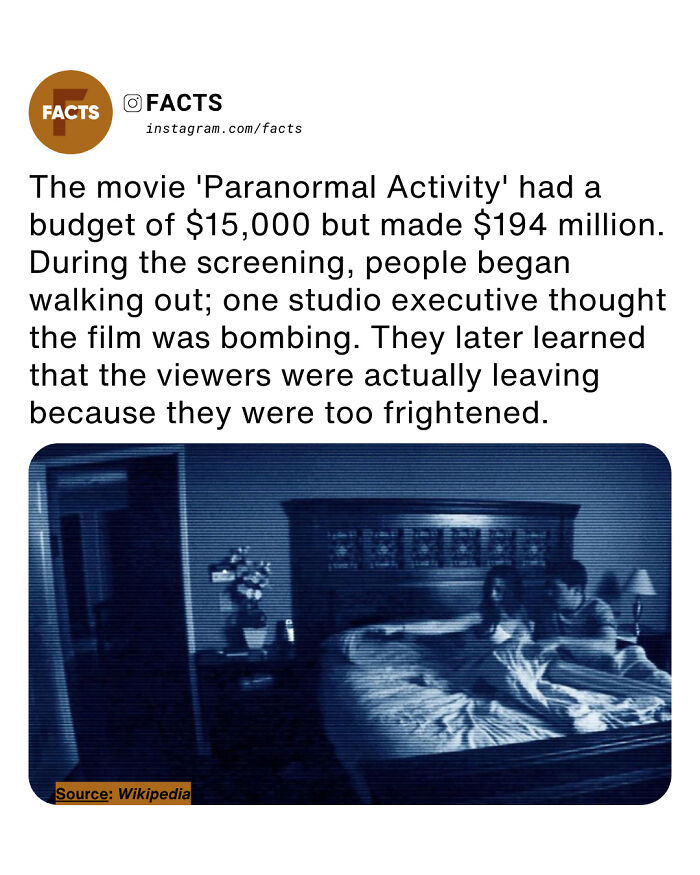
Attempting to focus on believability rather than action and gore, producer, writer, director, photographer, and editor Oren Peli chose to shoot the picture with a home video camera. In deciding on a more raw and stationary format (the camera was almost always sitting on a tripod or something else) and eliminating the need for a camera crew, a "higher degree of plausibility" was created for the audience as they were "more invested in the story and the characters". Peli says that the dialogue was "natural" because there was no real script. Instead, the actors were given outlines of the story and situations to improvise, a technique known as "retroscripting" also used in the making of The Blair Witch Project.
In casting the movie, Peli auditioned "a few hundred people" before finally meeting Katie Featherston and Micah Sloat, the stars of the movie. He originally auditioned them individually and later called them back to audition together. Peli was impressed with the chemistry between the actors, saying, "If you saw the [audition] footage, you would've thought they had known each other for years."
During a guest appearance on The Jay Leno Show on November 3, 2009, Sloat and Featherston explained they each saw the casting call on LACasting. Featherston noted they were originally paid $500 for their work.
he human desire for companionship may feel boundless, but research suggests that our social capital is finite—we can handle only so many relationships at one time. Social scientists have used several ingenious approaches to gauge the size of people’s social networks; these have returned estimates ranging from about 250 to about 5,500 people. Looking more specifically at friendship, a study that used the exchange of Christmas cards as a proxy for closeness put the average person’s friend group at about 121 people.
However vast our networks may be, our inner circle tends to be much smaller. The average American trusts only 10 to 20 people. Moreover, that number may be shrinking: From 1985 to 2004, the average number of confidants that people reported having decreased from three to two. This is both sad and consequential because people who have strong social relationships tend to live longer than those who don’t.
So what should you do if your social life is lacking? Here, too, the research is instructive. To begin with, don’t dismiss the humble acquaintance. Even interacting with people with whom one has weak social ties has a meaningful influence on well-being. Beyond that, building deeper friendships may be largely a matter of putting in the time. A recent study out of the University of Kansas found that it takes about 50 hours of socializing to go from acquaintance to casual friend, an additional 40 hours to become a “real” friend, and a total of 200 hours to become a close friend.
If that sounds like too much effort, reviving dormant social ties can be especially rewarding. Reconnected friends can quickly recapture much of the trust they previously built while offering each other a dash of novelty drawn from whatever they’ve been up to in the meantime. And if all else fails, you could start randomly confiding in people you don’t know that well in hopes of letting the tail wag the relational dog. Self-disclosure makes us more likable, and as a bonus, we are more inclined to like those to whom we have bared our souls.
A group of embittered singles worked together to buy up the tickets to a 7:30 pm screening of ‘Beijing Love Story,’ a sappy big-budget romance, at the Shanghai Xintiandi cinema, according to the Shanghai Morning Post newspaper.
In a seating chart posted online, every other seat in the cinema was marked occupied.
"Want to see a movie on Valentine's Day?" the prank's organizer, an internet user going by the name UP, wrote online. "Sorry, you'll have to sit separately. Absence makes the heart grow fonder. Give us singles a chance."
UP described himself as a "computer nerd" in an anonymous interview with the newspaper, adding that he suffered a breakup in 2013.
He said the prank was difficult to execute. He lacked the money to snap up enough seats, and both the cinema's online booking system and its behind-the-counter staff rejected his requests for exclusively odd-numbered reservations. So he turned to a group-buying website, and quickly gained an enthusiastic following.
A cinema employee told the Xi'an Daily newspaper that it had decided to sell the even-numbered seats at a steep discount.
The stunt drew mixed reviews on the internet. Some users praised it as brilliant; others called it sadistic and ill-planned. "The dream of many singles has finally come true," wrote one user. "Too stupid. Won't people just switch seats?" wrote another.



























 No fees, cancel anytime