Get Premium
Dark mode theme is available exclusively for premium users. Learn more about the benefits of subscribing.
No fees, cancel anytime.

 Dark Mode Ad-Free Browsing Unlimited Content
 Ad-Free Browsing Unlimited Content Dark Mode
Join 1.2 million Panda readers who get the best art, memes, and fun stories every week!
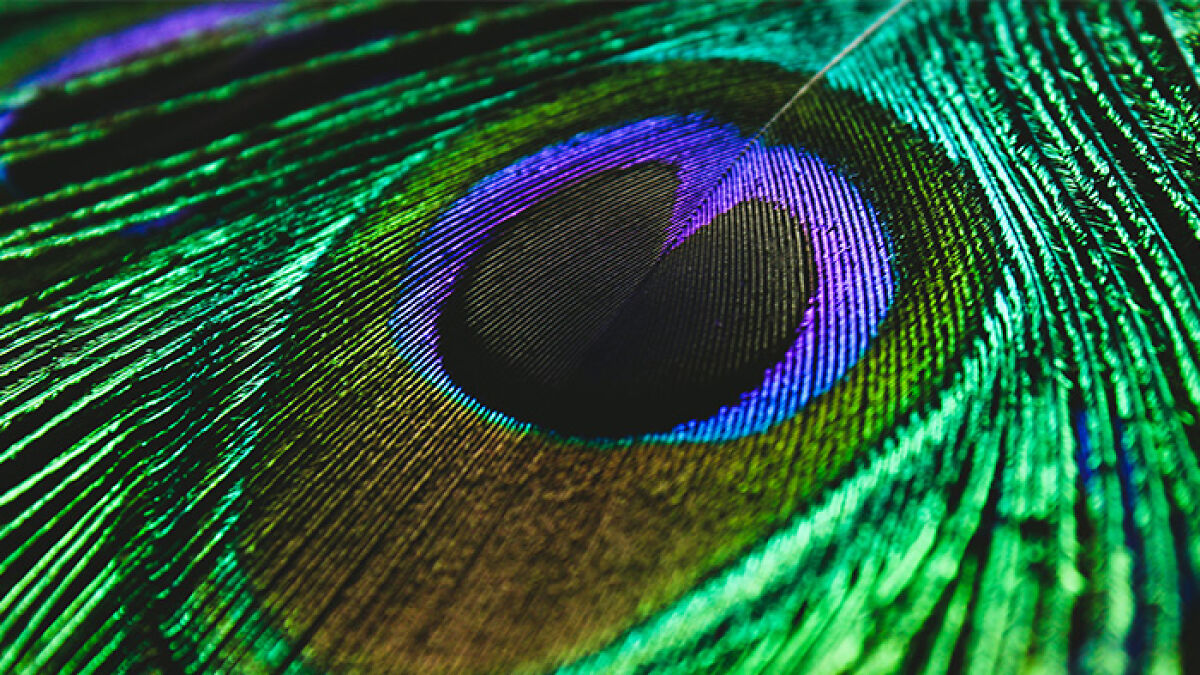
No matter how fluorescent the paint, how bright the screen, or how intense the neon light, you still won’t see what a handful of people have seen.
The color is called “olo,” and it isn’t hiding somewhere in nature waiting to be discovered.
Instead, it was created inside the human eye using a laser system that manipulates the tiny cells responsible for color vision.
What makes the experiment even stranger is that researchers didn’t just prove people could perceive something beyond the normal range of human color vision.
The idea behind olo began with Ren Ng, a computer science professor at UC Berkeley, who became fascinated by a limitation buried inside the human eye.
Most people have three types of cone cells that help us see color: L cones, which respond most strongly to longer wavelengths; M cones, which respond to medium wavelengths; and S cones, which respond to shorter wavelengths.
The problem is that these cones do not operate like three perfectly separated channels, as their sensitivities overlap.
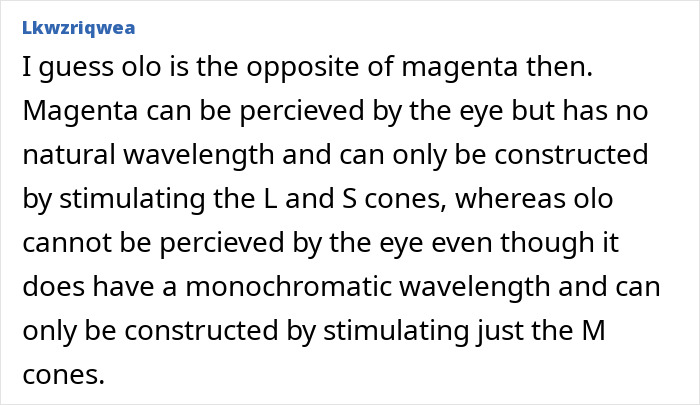
In particular, the wavelengths that stimulate M cones also stimulate L cones, meaning there is no ordinary light source that can activate only the M cones.
As Ng later explained to UC Berkeley, “There’s no wavelength in the world that can stimulate only the M cone.”
That limitation led Ng to wonder what the brain might experience if scientists could activate only the M cones.
Ng eventually approached Austin Roorda, a UC Berkeley vision scientist whose lab had developed technology that could map individual cone cells and target them with microscopic doses of laser light.
Reportedly, Ng first contacted Roorda about the idea in 2016, and when he received no response, he tried again.
By 2018, he had turned the idea into a detailed research proposal titled “The Grass Is Greenest in Oz Vision.”
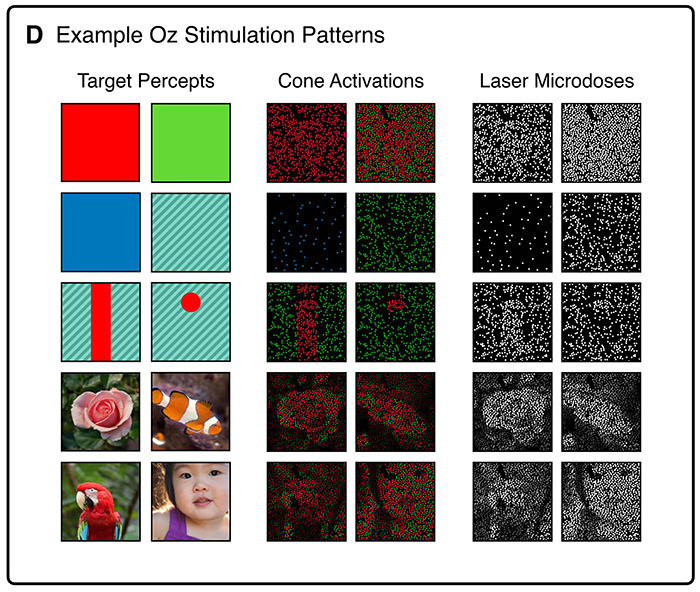
The two scientists eventually teamed up and produced Oz, an optical system that could track the eye and direct laser pulses at selected photoreceptors.
Then came the experiment: the researchers activated thousands of M cones while leaving the neighboring cone types alone, producing what they called olo.
The researchers first create a detailed map of an individual’s retina, identifying the arrangement of their S, M, and L cones.
Oz then uses that map to direct tiny laser pulses toward selected cells while accounting for the eye’s constant microscopic movements.
The system can control up to about 1,000 photoreceptors at once.
The resulting visual display is tiny, roughly the size of a fingernail held at arm’s length, but the sensation is anything but ordinary.
Five people experienced olo during the original study, including Ng and Roorda, and that number has since grown to seven.
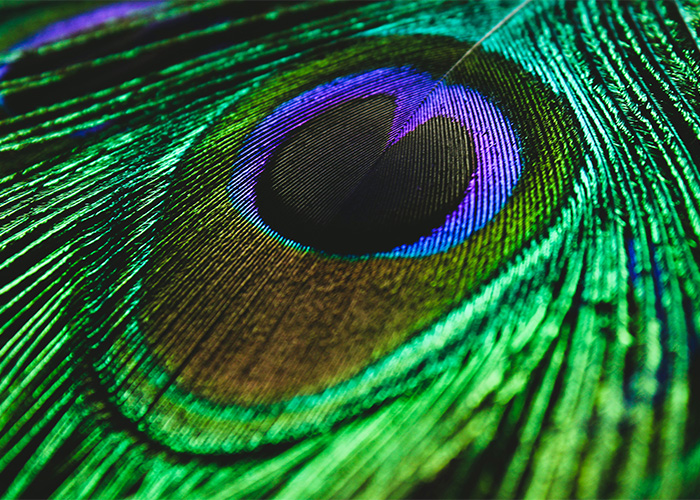
And their descriptions are strikingly similar: blue-green, peacock green, and intensely saturated.
Roorda compared olo with the most saturated natural green he could find and said the ordinary color “paled in comparison.”
In another Berkeley account, he described the experience as a “wow” moment.
The researchers also demonstrated a particularly bizarre point: olo was not simply an unusually bright version of ordinary green.
They deliberately introduced a tiny amount of error into the laser targeting.
When the beam was “jittered” away from its intended targets, the participants stopped seeing olo and immediately saw the normal green produced by the laser.
Hannah Doyle, the Berkeley doctoral student who designed and ran the human experiments, said she has seen olo herself even though she was not one of the original subjects.
She described it as strikingly blue-green and said the normal laser color could almost look yellow by comparison.
However, one cannot simply photograph the experience because olo is produced by manipulating the signals reaching the retina, rather than by creating a new wavelength of visible light.
According to the researchers, “olo” gets its name from the 0-1-0 cone activation pattern: L cones off, M cones on, and S cones off.
According to The New Yorker’s extensive feature, “What Would It Mean to See a New Color?,” the researchers are now using Oz to investigate what happens when the visual system receives signals it normally cannot produce.
One of their biggest areas of interest is color blindness.
Many forms of visual impairment involve the loss or dysfunction of cone cells.
Rather than waiting for patients to lose those cells and then trying to determine how that changes their vision, researchers can use Oz to simulate cone loss in people with otherwise healthy eyes.
As Hannah explained, the system can activate only a certain percentage of cone cells to mimic the conditions caused by degenerative eye diseases.
That could help researchers understand how different levels of cone loss affect real-world vision, and how much restoration might be needed for a treatment to meaningfully improve someone’s quality of life.
A person can lose a substantial number of cone cells and still perform surprisingly well on a standard vision test.
Oz gives researchers a way to manipulate those cells individually and investigate what different degrees of loss actually do to a person’s visual experience.
Roorda has pointed to the potential implications for emerging treatments such as gene and stem-cell therapies.
If researchers can determine how much cone function a person needs to maintain useful vision, they may be better able to estimate what level of restoration could make a meaningful difference.
But the researchers aren’t stopping there.
Roorda and Ng are also using Oz to simulate trichromatic vision in a person with dichromatic color vision and tetrachromatic vision in someone with ordinary trichromatic vision.
And that raises an even stranger possibility: perhaps the human brain has more flexibility in interpreting color than scientists once assumed.
Natural light has never provided the brain with the exact M-only signal generated by Oz.
Yet when the researchers delivered that artificial signal, the participants’ brains turned it into a coherent visual experience.
Roorda has described this as evidence that the brain can develop new perceptions from unfamiliar sensory signals.
“It’s really about the capacity of the human brain to develop new perceptions,” he said in Berkeley’s follow-up discussion.
The New Yorker reports that Roorda believes further experiments are needed before making strong conclusions about neuroplasticity.
He has also suggested that with enough exposure, even the familiar word “teal” might eventually stop feeling adequate for describing olo.
Oz could also help scientists understand how damaged retinas affect perception, investigate potential approaches for color-vision deficiencies, and test whether the brain can adapt when its normal sensory boundaries are deliberately pushed.
Berkeley researchers have also discussed using the system to explore whether humans could potentially experience something closer to tetrachromatic vision.
The work has already earned major recognition.
In March 2026, lead researchers Roorda and Ng were named to National Geographic’s prestigious 33 list, which honors 33 extraordinary people worldwide advancing bold, meaningful, and boundary-pushing solutions.
The pair were recognized for their groundbreaking work in vision science and the discovery of olo.
For now, though, olo remains a visual experience that only a handful of people have ever seen.

By entering your email and clicking Subscribe, you're agreeing to let us send you customized marketing messages about us and our advertising partners. You are also agreeing to our Privacy Policy.
Thank you! You've successfully subscribed to newsletters!


If it takes having a laser shot into my eye to see it, I think i'll just have to live my life Olo-less.

The name is really OLook, but people keep passing out before they can say the whole thing.
Load More Replies...
There's a great YouTube art channel called A Brush With Bekah who has an episode where she shows you a technique for being able to see OLO. She also made another video on how to see the opposite color, LOL. Definitely worth checking out her channel.

I have, thank you for posting this. I have seen a very saturated teal. Impressive.
Load More Replies...
Hats off to the first commenter who coined “olorblind”. I’ll spend the rest of my life trying to find up with a comment that good.
If it takes having a laser shot into my eye to see it, I think i'll just have to live my life Olo-less.
The name is really OLook, but people keep passing out before they can say the whole thing.
Load More Replies... There's a great YouTube art channel called A Brush With Bekah who has an episode where she shows you a technique for being able to see OLO. She also made another video on how to see the opposite color, LOL. Definitely worth checking out her channel.
I have, thank you for posting this. I have seen a very saturated teal. Impressive.
Load More Replies... Hats off to the first commenter who coined “olorblind”. I’ll spend the rest of my life trying to find up with a comment that good.



































 No fees, cancel anytime





























35
9