Get Premium
Dark mode theme is available exclusively for premium users. Learn more about the benefits of subscribing.
No fees, cancel anytime.

 Dark Mode Ad-Free Browsing Unlimited Content
 Ad-Free Browsing Unlimited Content Dark Mode
Join 1.2 million Panda readers who get the best art, memes, and fun stories every week!
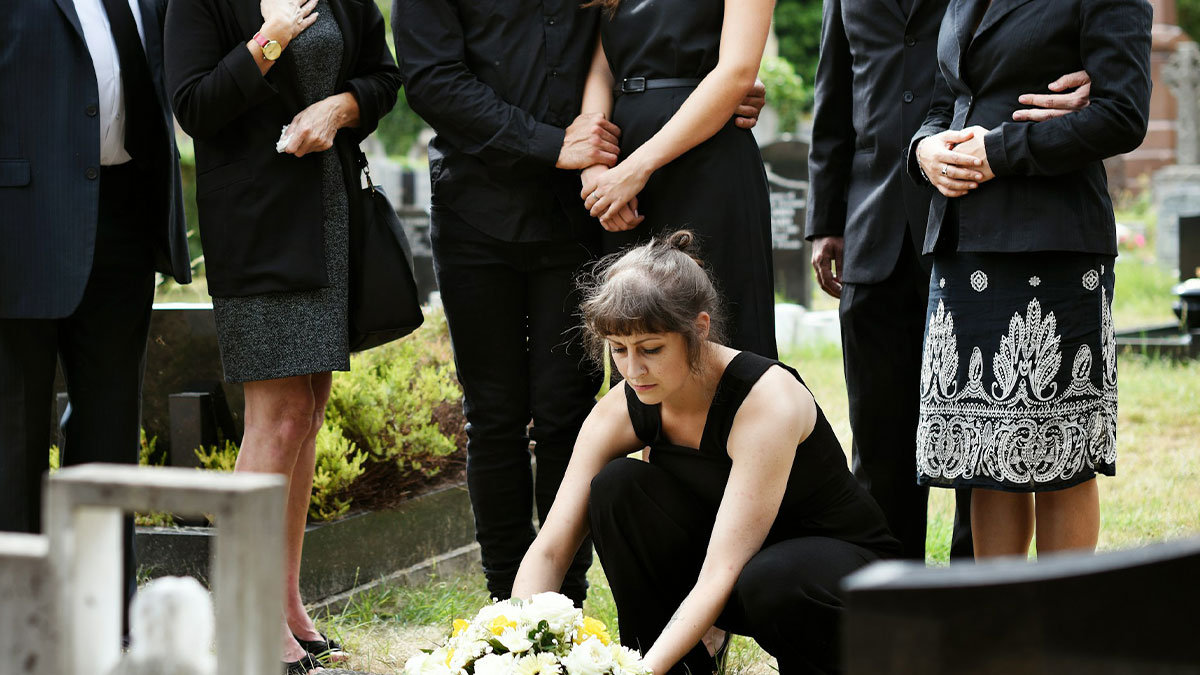
Working in the corporate world can sometimes feel like you’re haggling at a fish market, especially when it comes to bargaining for your own leave days. But while vacation time is one thing, bereavement leave should not be up for negotiation.
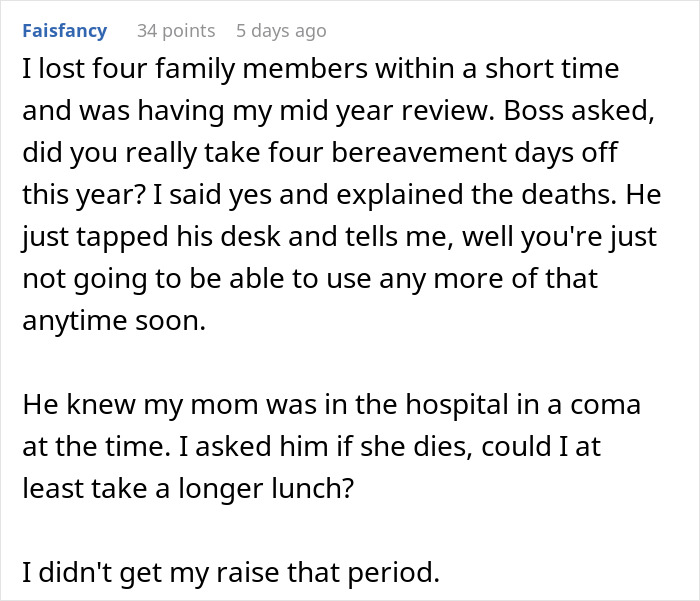
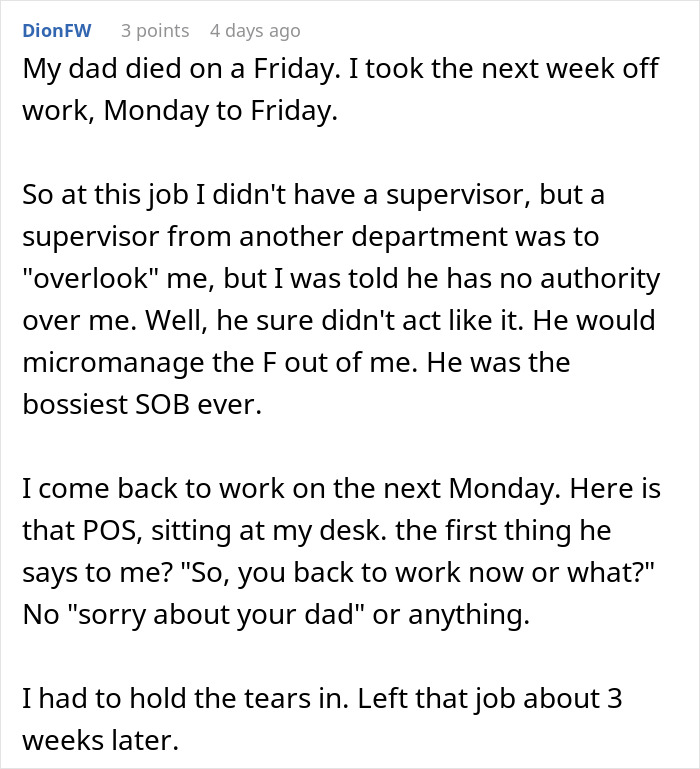
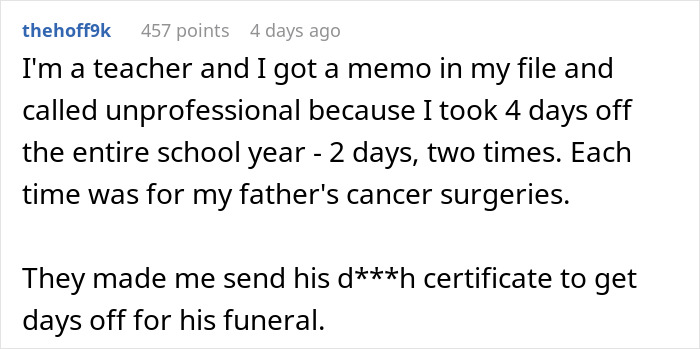
Sadly, the internet is packed with horror stories about toxic bosses denying these requests.
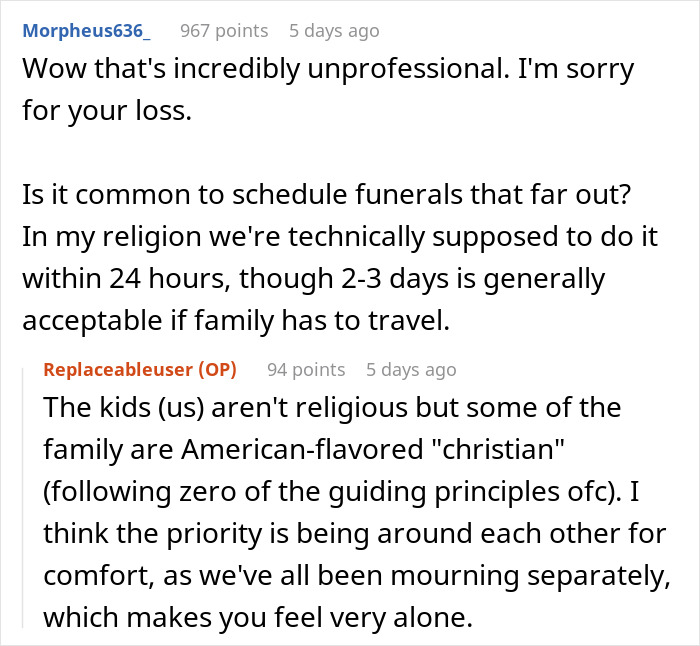
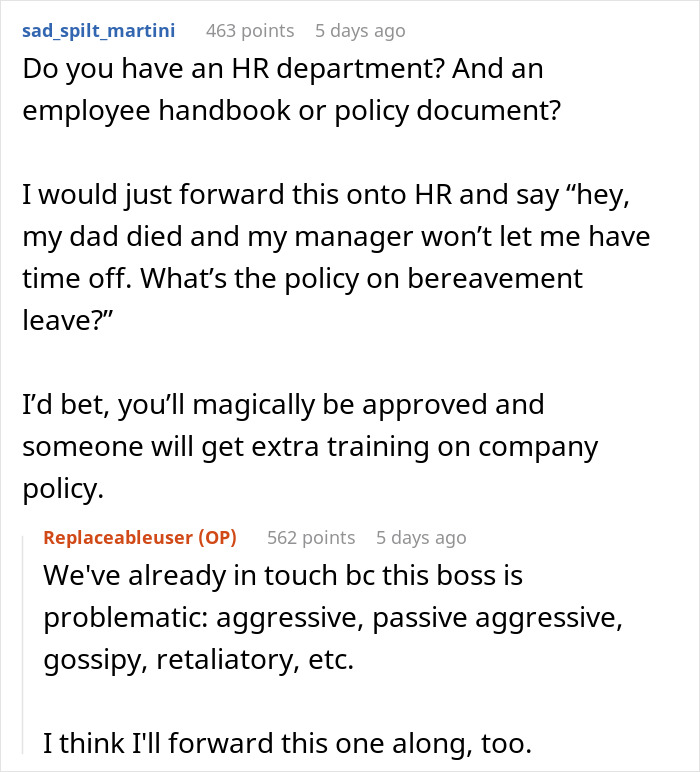
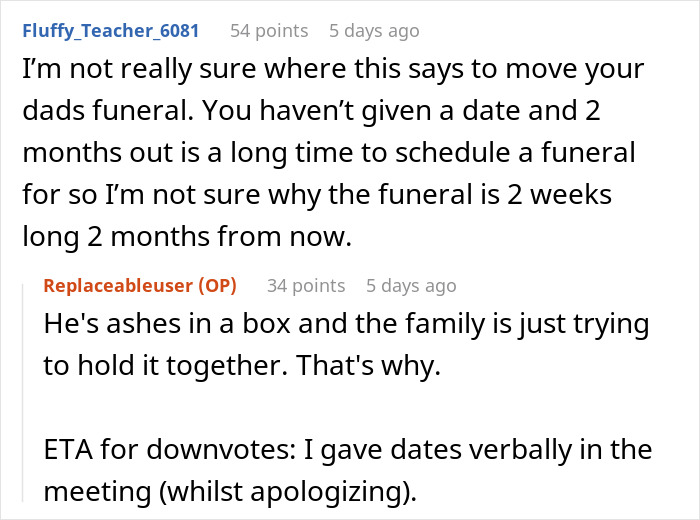
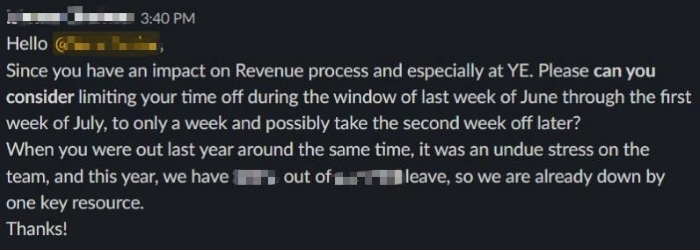
In one such instance shared recently, a man asked for two weeks off to handle his dad’s funeral and the other formalities that come with it. But his boss told him to cut it short as two other coworkers were already on leave.
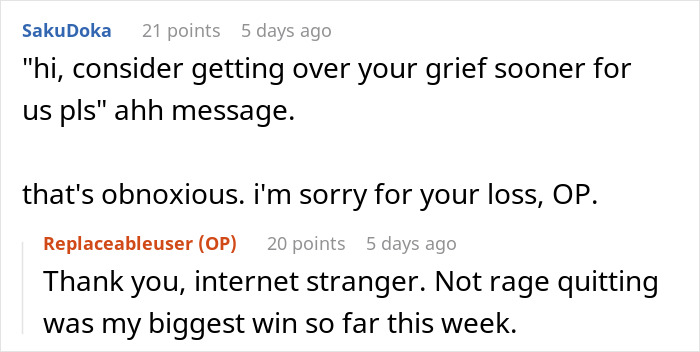
The man admitted it took every ounce of his strength not to “rage quit” right then and there.
Image credits: Replaceableuser
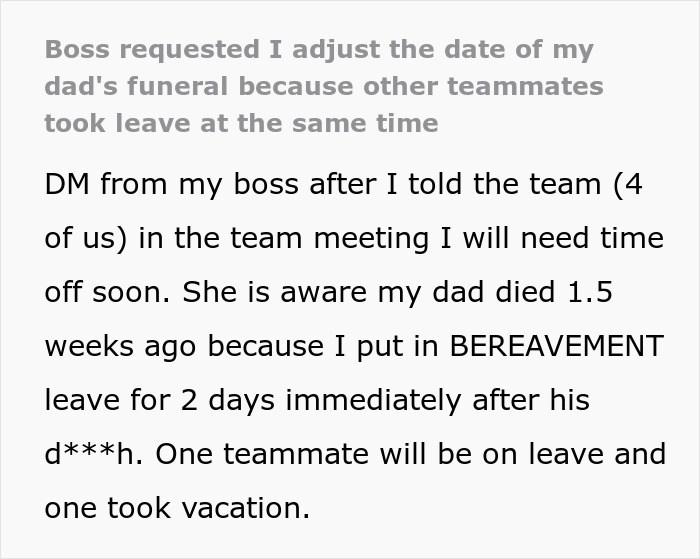
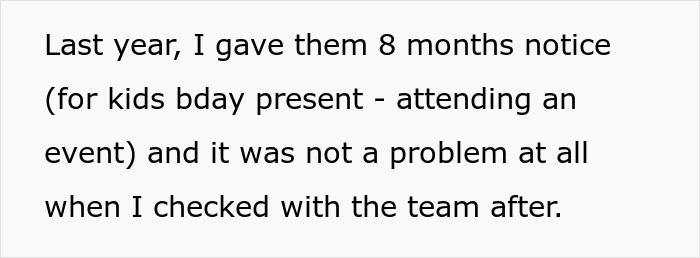
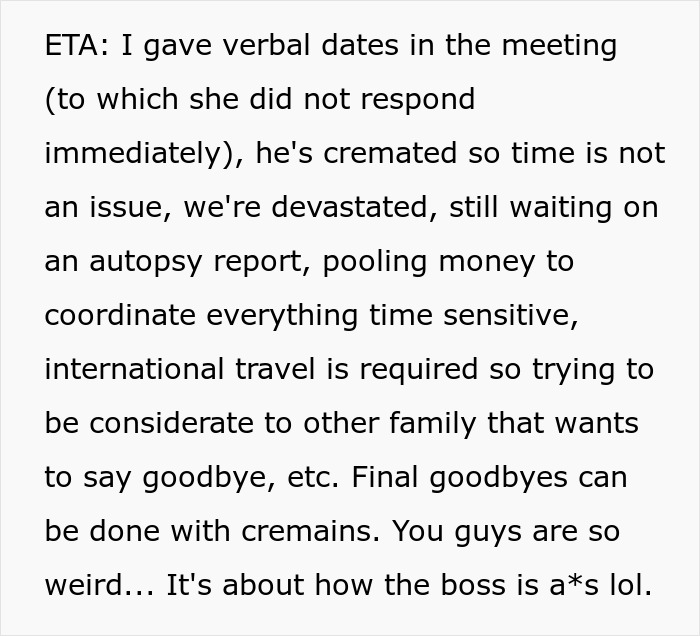
Image credits: Curated Lifestyle / unsplash (not the actual photo)
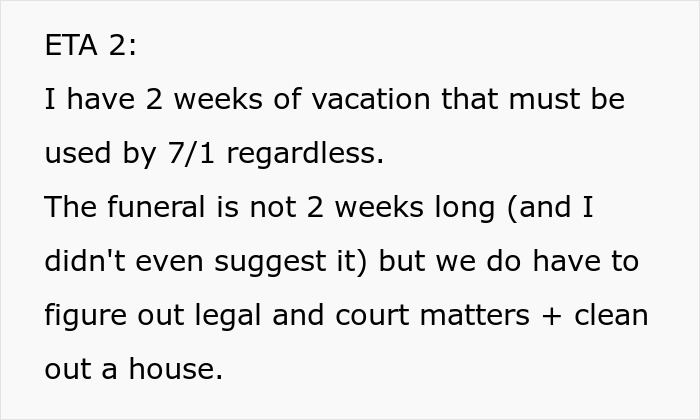
Image credits: Replaceableuser
A toxic manager might believe they are safeguarding company time by denying their employee’s leave requests. Instead, they are actually fostering a harmful workplace culture that drives high-performing employees away.
These denials usually stem from a total lack of empathy or a paranoid distrust, with bosses assuming employees are just trying to play the system for free time off.
Recent research shows 51% of employees who lose someone close leave their job within a year. It’s not just about the number of leave days though. It’s also about whether the organization responded with empathy and care.
Grief can cause debilitating feelings of distress as well as impaired cognitive and physical functioning.
And when companies deny leave during such a difficult time, it is a recipe for disaster. It forces people to bottle up their pain while trying to grind through extreme stress.
Studies show that grieving employees who are forced back too soon usually struggle to focus. It then leads to a massive drop in productivity and an increase in silly mistakes.
Beyond the work itself, this move absolutely nukes loyalty and morale. Plus, the physical toll of combined grief and work stress often leads to actual illness, meaning the employee ends up taking sick leave later anyway.
“The employer-employee relationship is just that: a relationship. And in any relationship, when we feel valued and cared for, we’re more likely to return the sentiment. Treating employees with compassion isn’t only the right thing to do; it’s also strategically beneficial,” says grief expert, author and podcaster Jessica Fein.
The Grief Recovery Institute estimates “hidden grief” costs US companies more than $75 billion each year.
Image credits: Getty Images / unsplash (not the actual photo)
Even though grief is something we all go through, studies show that standard company support usually misses the mark. Most office policies are designed for efficiency and hitting business goals rather than actually helping a person.
They treat grief like a box to be checked off based on rigid rules and hierarchy, which doesn’t at all match what a grieving employee actually needs to heal.
Companies have a formal policy, a set number of days off, and the expectation that once that time is up, you’ll come back and everything will just slide back to normal.
But grief doesn’t care about HR timelines or excel sheets. In fact, studies show that blocking the emotional pain could stifle the grieving process. It can then lead to prolonged or complicated negative outcomes such as depression, relationship issues, self-identity problems, and immunocompromised systems.
Research shows that being flexible with bereavement leave is just as vital as the amount of time employees actually get. Flexibility in when employees are able to utilize leave time can help them to settle a loved one’s personal affairs.
It takes the average person 15 to 18 months to finalize all the necessary administrative tasks that follow a loss. From settling an estate and closing financial accounts to transferring property titles and navigating insurance, there are a dozen complex hurdles that simply cannot be cleared in that first week of leave. These tasks are emotionally and physically draining as well.
Experts also believe that people need at least 20 days to process a close loss, but the average in many US companies is just three to five days.
In the US, there is no federal law requiring companies to provide bereavement leave, meaning the decision is largely left to individual employers. While seven states have enacted their own mandatory protections, the vast majority of workers in the remaining 43 states rely entirely on their company’s voluntary policies. According to industry surveys, about 91% of US employers do offer some form of bereavement leave, but these policies are often inconsistent and rarely provide the duration experts recommend.
In the UK, the situation is fairly similar. Currently, there is only a specific legal right for parents who lose a child (two weeks of protected leave). For any other loss — like a spouse or parent — there is no law forcing companies to provide paid time off; it’s mostly left up to the employer’s discretion.
However, the Employment Rights Act 2025 is paving the way for a major shift in 2027, when the UK plans to introduce a new statutory right to bereavement leave for a wider range of relationships.
Legal protection matters, but they can’t create compassionate workplaces.
Real change happens when managers know how to handle tough conversations with empathy, HR builds fair systems, and teams have plans in place so that taking time off doesn’t feel like a burden.
Because, at the end of the day, a company’s most important asset is its people.










By entering your email and clicking Subscribe, you're agreeing to let us send you customized marketing messages about us and our advertising partners. You are also agreeing to our Privacy Policy.
Thank you! You've successfully subscribed to newsletters!


Yet little old New Zealand, population around 5.5million, gives every working person 3 days (minimum) paid bereavement leave written into their employment contract.

In The Netherlands it depends on the relation to deceased. But mostly it's the day of de.ath and the day of ceremony. Unless you need to make all the arrangements i.e. really close familymember, then it's at least a week. My experience is that employer asks if you are really sure you want to return to work after two weeks (parent died)
Load More Replies...
I have NEVER experienced such insensitivity with any of my bosses, even though I live in the USA, but I also live in a blue, commie, pinko libtard state (according to the MAGATS). For the past 36 years, I’ve also worked for a county AND my classification is a union one, so we get bereavement leave in addition to all of the other benefits that people who work in non-union jobs don’t get. I know that unions are in jeopardy in the USA but maybe with the way things have been going, perhaps the working class will rise again.

When my Mum died I turned in to work for one day before the funeral. The building manager told me to go home. I explained i was saving a day of bereavement leave for the funeral, and besides I worked in a different department so technically my own manager wasn't on site. He hauled a big old rule book off the shelf (those were the days!) And leafed through to show me I was entitled to at least 2 further days as the person organising the funeral and then said "besides, I may not manage you, but I manage this building and I'm not letting you work here till after your Mum's funeral. I will email your manager about the extra days." Then he put his hand gently on my shoulder and escorted me out of the building. Brilliant manager - and that despite the fact he hated me and everything I stood for. He and I had a fractious relationship but I really admired him.
Yet little old New Zealand, population around 5.5million, gives every working person 3 days (minimum) paid bereavement leave written into their employment contract.
In The Netherlands it depends on the relation to deceased. But mostly it's the day of de.ath and the day of ceremony. Unless you need to make all the arrangements i.e. really close familymember, then it's at least a week. My experience is that employer asks if you are really sure you want to return to work after two weeks (parent died)
Load More Replies... I have NEVER experienced such insensitivity with any of my bosses, even though I live in the USA, but I also live in a blue, commie, pinko libtard state (according to the MAGATS). For the past 36 years, I’ve also worked for a county AND my classification is a union one, so we get bereavement leave in addition to all of the other benefits that people who work in non-union jobs don’t get. I know that unions are in jeopardy in the USA but maybe with the way things have been going, perhaps the working class will rise again.
When my Mum died I turned in to work for one day before the funeral. The building manager told me to go home. I explained i was saving a day of bereavement leave for the funeral, and besides I worked in a different department so technically my own manager wasn't on site. He hauled a big old rule book off the shelf (those were the days!) And leafed through to show me I was entitled to at least 2 further days as the person organising the funeral and then said "besides, I may not manage you, but I manage this building and I'm not letting you work here till after your Mum's funeral. I will email your manager about the extra days." Then he put his hand gently on my shoulder and escorted me out of the building. Brilliant manager - and that despite the fact he hated me and everything I stood for. He and I had a fractious relationship but I really admired him.































 No fees, cancel anytime






38
16