Get Premium
Dark mode theme is available exclusively for premium users. Learn more about the benefits of subscribing.
No fees, cancel anytime.

 Dark Mode Ad-Free Browsing Unlimited Content
 Ad-Free Browsing Unlimited Content Dark Mode
Join 1.2 million Panda readers who get the best art, memes, and fun stories every week!

Remember the times you had to present on some topic or a book in front of your class? You know, those ten to twenty minutes of unease, fear and worry that something will go wrong or that someone will trample your vulnerable public presentation with a question you can’t answer because you’re too worried you’ll forget how words work?
Well, that feeling is somewhat universal, but it becomes a bigger problem for those who have inherent issues with anxiety. One such lad recently took to Twitter to propose that people with anxiety shouldn’t have to present in front of classes, pointing out that there are alternatives to how this can be managed, subsequently launching a debate online.
Image credits: wimklerkx.nl
A Twitter user by the name of Jordan (@bluexmasgcv) recently ranted that those who suffer from anxiety shouldn’t be required to present in front of the class.
Jordan continued that he himself was lucky enough to have a teacher who was understanding enough to let him present privately, thus reducing the amount of stress and fear involved in the process, but schools should seriously consider providing some alternative ways for anxious kids to submit their projects without getting their points deducted for being uncontrollably anxious during the whole thing.
Image credits: bluexmasgcv
For those unaware of what it feels like to have an anxiety disorder, consider this: imagine feeling an unrelenting sense of dread and fear all the time because of being convinced that whatever you do has a high chance of failing and you will be punished for it or it will cause harm to you, spiraling down an endless hole of anxious intrusive thoughts that leave you drained pretty much all the time.
This is just the gist of what’s going through an anxious person’s mind. The experience may vary, but the feeling is uneasy and often unending in many cases.
This prompted quite a discussion amongst commenters. On the one hand, people were agreeing that forcing someone with an anxiety disorder is counterproductive. It may not in fact leave them with a sense of accomplishment and boost their confidence but rather break them down even more because they will not feel understood or empathized with.
Image credits: dazzdazzle
Image credits: the_tide_loose
Image credits: ThatHomosexual
Image credits: Minettegia
Image credits: itsnicetosmile
Others pointed out that there is also the problem with teachers simply not caring about the well-being of their students and responding with negative reinforcement like giving a bad grade or even yelling at the students for not presenting. This subsequently leads to even greater anxiety.
There were people who, however, disagreed with this. For one, public speaking is an invaluable skill that does actually reinforce in positive ways—the aforementioned self-esteem boost and empowering people to express themselves in proper ways are just a few examples.
Also, getting rid of the requirement for people to present just because someone has anxiety isn’t tackling the issue at hand—the presentation is a thing that the person perceives as the source of fear, but in reality it’s their own perception that is causing them anxiety, so dealing with this toxic view of things would be the effective way of dealing with the problem.
Image credits: 333nikita
Image credits: writejsk
Image credits: nctot21ftw
Some even touched upon how things like speech impediments might make the issue even more problematic as, for the most part, people stress because of the speech impediment and they can’t get rid of it to relieve their anxiety when speaking in public to make their speech better, consequently putting them into a vicious loop that some teachers might not understand and still dock points for, further reinforcing the problem.
The issue is obviously nowhere near one-sided as there are many nuances and factors involved and more than one solution to the problem. However, regardless, it is important to consider that ignoring mental disorders is never an option as it is estimated that nearly 40 million people in the United States—18%—experience an anxiety disorder in any given year, and the wrong means of dealing with it may likely cause a rise in this percentage.
Image credits: darbybrennan22
Image credits: clownfour1d
Image credits: kiku_is_my_son
Image credits: KilMySnflwerMnd
Image credits: halo_larry28
Image credits: imaginehunter12
Image credits: star_dusk1117
Image credits: wangjiluvbot
Image credits: maddiialexius
Image credits: exlit_
The tweet drew quite a bit of attention, getting over 159,000 likes in just a day. The tweet was retweeted over 28,000 times with 3,500 quoted tweets.
What are your thoughts on this? Did you enjoy speaking in front of the class, or was it also overly stress inducing? Let us know in the comment section below.
65Kviews
Share on Facebook
My shrink told me that the only way to overcome anxiety is to do the thing that makes you anxious... after enough repetitions it stops causing the extreme anxiety (granted taking "baby steps"). You will need this skill in your future. The real problem seems to be some of the teachers. There should a requirement to grade you from the level of your own starting ability and your own personal growth.

Good luck on overcoming your anxiety (or at least getting it to a manageable level)! I have a sister with crippling anxiety and her Dr is also doing exposure therapy and it's really making a difference. I feel terrible for the kids with anxiety, but looking at it from the teacher's perspective, they might feel like if they let one kid out of presenting, the whole class will claim to have anxiety just to get out of doing it. I'm not saying that's right or wrong, but it is a factor. You're also right about it being a necessary skill... If you're applying for a job you can't request that the employer let you skip the interview because it gives you anxiety. I know the kids can't just "suck it up" or "get over it" because that's not how anxiety works... It's more than being nervous or a little scared. I think the kids with anxiety need to get into treatment. Exposure therapy doesn't work for everyone, but there are other therapies that can help get your anxiety to a manageable level.
Load More Replies...
I'm a teacher and I have dealt with my own anxiety issues, so I can totally understand when a student is suffering it. To overcome this condition is not a matter of will, as it's a mental disease. You don't tell people with a coldthat if they stay positive it eventually will disappear. It's the same thing about anxiety. So, what do I do when I encounter a student dealing with this problem? We deal with the fear. The first time they read a text we're alone in the room, even if that means no break between classes. If they feel con fident enough to do a presentation in class, I'll be by their side boosting their confidence. Speaking in public is an important skill, but some people take a little more time to achieve it and that's ok.

You sound exactly the kind of person pupils need in the classes - can we have you cloned? Honestly, forcing people to do things doesn't eradicate fear. It can cause people to be overwhelmed and worsen the anxiety. Dealing with something like this is a stepped process and can only be achieved with proper support and those who know who to help professionally. Parents and teachers should work together to find therapists for children with genuine and severe anxiety.
Load More Replies...
This is so entitled I'm struggling to stay polite. The idea that students can opt out of a part of the class because they don't like it is insulting. Some people get massive test anxiety, should they not be required to take exams? I personally couldn't stand sitting still for more than 5 minutes (ADHD), but my teachers didn't let me get up and wander around all the damn time because it was disruptive to the rest of the class. Trigonometry gave me fits, and I had to do 10 or so hours of practice problems every week just to keep up, which SUCKED by the way. But I got an A. Doing things that make us uncomfortable is how we learn to tolerate discomfort. It's called LEARNING, and is the whole point of school. I mean, why go if you're only going to do the things that you're already good at over and over?
Never had to do this in school, no presenting of anything. We did have to read aloud but that's somewhat easier for most people as they're not having to come up with their own words. Of course it's different for those who have a stutter or dyslexia but then those pupils should be getting additional support. Anxiety is also not the same thing at all as being 'uncomfortable' doing something. I don't enjoy public speaking but I became proficient at it as part of my job - when you know your subject well it can help. I wasn't anxious though. School is about learning but they have to accept that those with additional problems should have additional support or a different approach. We can and should make accommodations.
Load More Replies...
At 18 I had crippling anxiety. Half of our exams were oral, and I would get up to 4 grades lower than on written exams. It was so bad, I've become suicidal and had to drop. At 26 I moved to the UK to study a new course that wasn't available in my own country. Thankfully, the teachers were much more accommodating and would allow me and another student to stay until the end and perform only in front of the minimum amount of students required in the room. (You are not allowed to do presentations, etc. without any witnesses.) I'm proud to say, that with a bit of encouragement, I am now able to hold a presentation without getting panic attacks and without blacking out. It's still not perfect and maybe it never will be. But in my field, public engagement is essential, and sadly, heated debates are the norm, so it was vital for me to figure out ways in which I can handle my anxiety.

Schooling in the UK does seem to be generally very accommodating overall. There is a pretty good understanding of individual needs. Also finding therapists for children with problems is accepted for more readily - possibly because there isn't usually a cost involved. Therapists on the NHS.
Load More Replies...
Learning to present in front of people is a good life skill, but just throwing someone in front of a crowd of judgemental peers, probably not the way to go. Wouldn't it be a good idea for the first time to be just a presentation in front of the teacher, then 2 or 3 of the less risky peers. Ones less likely to gossip or make fun of, then work your way up to everyone.
There are loads of jobs where people work away in the background and will never need these so-called life skills of presenting. Interview panels are not the same thing before someone suggests they are. A presentation to a school room of your peers is far more scary a prospect than an interview panel of at most a handful of people - with whom if you mess up you'll probably never see them again unlike your class mates who will probably take the p**s out of you if you stuff up. There are many careers where people won't be expected to present anything, ever. That said these children need professional help with their anxiety.
Load More Replies...
In my opinion most people will not have to face a situation where they have to make public speeches. Confident natural speakers will seek out these situations , people who do not wish to will go through life without any problems!!!! We all have different abilities and navigate our way through life making the most of our natural talents or how we wish to be. We should embrace this not see it as a problem. Xx
I don't know what the idea behind these presentations is in the US but in Germany the purpose isn't just to practice public speaking. It is often also to present and defend a point of view or argument. This is more effective when it's done with peers and often results in lively discussions between students if moderated properly by the teacher.
Load More Replies... Best part of an applied training course I ever had was a 2-day practice module on how to write a resume, give an interview, and speak in front of a large group. Even by college, not everyone has learned how to do that on their own. Getting the tools to succeed makes it a lot easier!

A job interview is NOT the same thing as presenting to over 25 people.
Load More Replies... It's good to get outside of your comfort zone, and many of us have to face it. But the thing is, you have to be ready for that and to be honest your teacher is probably not the right person to guide you through it. I believe there are great teachers around but I have rarely encountered one that understood shy kid like I was. Not going to say I'm "introvert" because I'm not, I was just shy and would always blush and monitor myself... aaaaand blush some more. When I got over that, there's no limit but these kind of teachers made things worse.

Anyone that thinks "just doing it" will help you get over anxiety needs to shut it. I have debilitating anxiety, to the point of getting sick and or passing out when forced to do things like present in front of a group, especially a group of my peers. I barely passed classes in school where I was forced to present on a topic, and in my mid 30's now I'm still asked to do these things but can respectfully decline. Some people are just not capable of "getting over it" because that is not how all anxieties work. The logic that it is a necessary life skill that you'll have to do at some point is right up there with the "you wont always have a calculator in your pocket" when forced to do any math by hand.

I once had a panic attack in the middle of class and was still crying and shaking during my presentation. I'm f*****g traumatized from some times I've had to do presentations, and in almost every single case I'm out of commission for the entire day, unable to focus on any work because my brain is still fogged up and in panic mode.
Then you need psychological help. I'm serious, and I don't mean that as an insult. You should look into EMDR; it's a very powerful technique for learning to deal with trauma. Many therapists are trained in it. I had PTSD as the result of witnessing the violent death of a loved one, and the triggers from it would immediately drag me back into reliving the moment of the original trauma. Because of this, I avoided those triggers, and had terrible anxiety when in proximity of them. But after about 20 EMDR sessions, I am now capable of facing those same triggers, and I feel in control of my situation and my composure. So if it can do that for me, I don't see why it couldn't do the same for someone whose anxiety is provoked by the thought of speaking in front of 20 of their friends...
Load More Replies...
Unless the student is majoring in Business or the Performing Arts, or the course title is “Public Speaking 101” then the student should not be required to give a public performance. This is all about receiving the proper training beforehand, knowing what to do and what not to do, proper technique, etc., and not blindsiding the student after they have enrolled. Would a teacher get away with handing the student a firearm or throwing them into a swimming pool? In a shop class, does the instructor just cut the kids loose with table saws, power tools and paint sprayers? No, the mandatory training all comes first. So unless a student has first received the proper training to prepare and perform a presentation, then it is just pure sadism to force it upon them. Public speaking is one of the most nerve-wracking things a person can do, especially unprepared, which is why there are so many books on the subject with titles such as “I’d Rather Die Than Give a Speech” and the reason why Toastmasters International exists. Sadly, it is also one of the reasons why nowadays there is such a thing as Active Shooter training, because a human’s autonomic nervous system can’t just spontaneously “grow a pair” in a moment of extreme anxiety. Furthermore, it isn’t just about shyness or anxiety. Without coaching and practice, even the most extroverted person can end up giving a presentation that just plain sucks.
@RobertYoudontneedit: I don’t need a lecture from you. My son is a former Marine who served in Desert Storm, 1st Amphibian Assault Battalion, MEF-II. My brother-in-law is former Deputy Director of Staff of the United States Air Force, European Theater. Read again to refresh your memory that my remarks were about not throwing kids out there without proper training and coaching beforehand, like you had with Basic Training and drills. You don’t sound to me like a service member who has experienced professional combat yet because the ones I know that made it out don’t talk like that. Combat veterans are the first to tell us that nothing can prepare you for “the real thing.” There is no shame in confronting a teacher to let them know that you are not yet ready to execute on their assignment if they overlooked the prerequisite education and training that the student is paying them for. And many students don’t manage to survive high school for a lot of reasons. Thank you for your service.
Load More Replies... I hated giving presentations in school, it only got worse in college, by then it absolutely terrified me, to the point where I almost had a panic attack at the very idea of having to give a presentation at the end of the semester. Luckily I haven't had to give presentations in my adult life. Interviews, and discussions in a small group are much more manageable for me. Same thing goes for when we had to read parts of books out loud. I can read perfectly to myself, but as soon as it was my turn to read aloud, I started stumbling over my words. It's all well and good for people to say you shouldn't let anxiety control you, but it's easier said than done for some.

I do have anxiety, and I had anxiety back in high school, and I hated hated hated doing presentations. No, they shouldn't be necessary for every class like they usually are - BUT. I had a teacher that made us do 5-minute presentations on some random topic on a weekly basis and WE WERE GRADED on our ability to make eye contact and appear confident. I hated it. I ranted about it to my friends. I shrank away from this anxiety-inducing, fearful task and I got a lot of bad marks. But then something *literally life-changing* happened. I began to fake it - pretending to be confident, making eye contact, etc because my grades were all-important to me and the teacher wouldn't budge. And... at some point it stopped being fake. Twenty years later, I reconnected with that teacher on Facebook and gave her a heart-felt thank you, because if anyone had just told me "fake it til you make it" at that age, I wouldn't have believed it worked. But it does, and it helped my confidence SO MUCH.
Good for you, but it doesn't work for everyone. Also, your teacher sounds awful.
Load More Replies...
I'm someone w bad anxiety in school I couldn't talk in front of class for s**t but as soon as I got in my 20s I could talk in front of hundreds of people bc I grew up and gained more experience got a better handle on my anxiety. I dropped classes and purposely took a 0 on assignments in school bc there was no way I was panicking and presenting. My daughter got a letter from her therapist and psychiatrist not to let her present unless she felt she could. We video taped them instead for her teachers and emailed her presentations in from home. Never force someone w a mental health issue or disability to do something they aren't ready for. Teachers aren't therapists

USA/NJ If there was an IEP or 504 plan for these emotional or learning disabilities, it could be written with the instructions for alternative assessments or having the teacher refrain from having the student read out loud. I have come across these provisions in an educational plan several times.If anxiety, speech problems, ADHD, OTC, dyslexia, etc. have an impact on the students educations - there are legal documents and plans to assist the student and additionally all evaluative, assessment services are funded by the state.

I'm on the fence with this one. I understand having anxiety in class. I could get up and do a presentation with anxiety, but when it came to testing I was literally incapacitated, but received no assistance. Sometimes dealing with anxiety is just a part of learning. I understand reasonable accommodations, but if you give it to one group you need to give it to others. Maybe the education system needs to adjust their expectations for students and grade differently; weigh basic homework and papers more than the presentations and tests themselves, which could help alleviate some of the anxiety they cause to begin with.
Yeah, sometimes anxiety is a part of learning, but some other times it can be really severe and forcing someone to give a presentation can make the anxiety even worse.
Load More Replies...
Anxiety is so crippling. My 1st grade teacher tells a story where I voluntarily sat myself down during a mock spelling bee even though I knew the material. I am 38 years old now and deal with my anxiety every day (some better than others) I am grateful, however, to all the teachers, coaches and my parents who pushed me to do public speaking and other task that terrified me. From scholarship applications, job interviews, important phone calls and social situations involving my children, I use these skills every day. I am so glad I didn't have the choice to just sit it out because I would have.

In 6th grade the teacher caught me giggling with my seat mate. When she called me out and I had to read a paragraph out loud, one of the boys announced loudly "oh look she's turning bright red" (I'm a natural blond). A couple of years later similar scenario except music class and the band teacher made me SING by myself. However, jump ahead 25 years and joining the local Mensa group. New person had to be leader. The outgoing person told me whatever I had to say, no one else in the room knew what it was; they wanted to know what it was; just relax and say it. Now I can speak comfortably to a "crowd" of two or two hundred, but nothing in between. Plus I have Asbergers. Just as an aside, in kindergarten a boy named Douglas was chosen to hold the flag for the daily Pledge of Allegiance. He was so excited and nervous he wet his pants. DO NOT FORCE PUBLIC HUMILIATION.

i've always hated presenting in front of class and i understand public speaking is important but there's certain situations in which students are super uncomfortable to talk in front of a large group of people and not everybody is going to work in a job where they have to talk a lot. especially people with anxiety. even though i have great teachers they always make us present. i really wish that more schools would allow you not to


I have anxiety too. When I was in 7th grade I got so nervous about a presentation that I almost fainted. I was super nervous!!

Would it help if one could record their presentation in the comfort of their home and be allowed to play the video in class? It could work as a compromise?
Um... If a student has bad anxiety issues with something, shouldn't the school provide training / therapy to overcome that anxiety? It's no use forcing them to do it, but just excusing them from it is not fair to the student either.


I feel like this is a choice people should be able to make. Some people(like myself) have anxiety but want to overcome the fear of public speaking, and there are people without anxiety that still don't enjoy it. It is not okay to force/threaten people to do something they don't want to do, and it has happened to me where I was blackmailed into presenting. Although it's a good skill to have, it is entirely possible to avoid public speaking in your life, and it should not be required. Some people just can't and teachers need to respect that.
How about people who have severe text anxiety? Should they be exempt from tests? Or students who play sports in the evenings? Do they get a pass on homework?
Load More Replies...
I work with dogs, not people so take this with a large helping of salt...I have anxiety as well, but not centered around public speaking because IMO I have a captive audience I get to lecture at, and I enjoy it! Many dogs are anxious for a variety of reasons, but the two worst things you can do are just "flood" a dog, OR coddle it. I realize this seems contradictory, but dogs are like little kids and need to see how WE handle the world and take their cues accordingly. I'm not sure if people are the same, but it sounds like what this thread is talking about. The people getting anxious about presenting shouldn't be coddled and allowed to reinforce their anxiety, but they ALSO shouldn't be forced to present (flooding). This is a place where teachers need to think outside the box and work with students. Some solutions could be a pre-recorded presentation, the student presenting to an empty classroom for just the teacher, the student facing away from the class/ behind a partition 1/2
2/2 Student presents from a different room via Skype/Zoom, or even have the student do a short "cliffnotes" presentation so they aren't overwhelmed. The late, great Mitch Hedberg always performed with his eyes closed and sunglasses on because he got bad stage fright and almost nobody knew about it. My anxiety is more of an obsessive thing (that black and white dead cat in the street is DEFINITELY my grey and white indoor only cat, and I can't stop freaking out until I get home and physically touch him) but it's real, and it sucks. I've been able to work around it, but I still have to take meds. Baby steps are the key to working past it for dogs AND people.
Load More Replies...
I agree with all of them. On the one hand presenting to class is, for most subjects, totally unnecessary and requires a skillset that isn't even on the curriculum. Anxious pupils will be made MORE anxious and their performance will dip as a result. However, the ability to be able to speak to a group without feeling terrified AND the ability to write something that is suitable to be spoken are both arts worth learning. It builds confidence and it also gives you a skill you might use in almost any profession. But this should be taught at an early age and as a skill on it's own. They should be taught how to rather than thrown into it..

I have anxiety and would love it if people thought about stuff like this instead of the torture that is isolating the person yelling or other negative thing that can make it worse. Also i see lots of hate comments and let me tell you I don’t care becouse I had a teacher and counselor that helped me feel strong again and even though I still have moments when I feel down I’m not sulking to you level.

I can't over come anixety and don't know what to do seeing a therapist doesn't seem to help anymore or meds

sounds like you need a new therapist, maybe, one who has more experience dealing with anxiety. sometimes it's just so bad that nothing helps, but there are always new medications coming out, and new therapy methods. i'm sorry yours is so bad, i can't imagine what it must be like. :(
Load More Replies... Opting out does not make the problem go away. I had and have severe anxiety, but I would never blame my teachers for making me go up and present. It was horrible for me, but growing older I know it was a necessity. NOW, the way a teacher approaches a student with anxiety and helps them overcome it is more important. Rather than having a curriculum where "do this or you fail," have one where there is an assignment (like an oral presentation) and help students improve on it. If someone has anxiety? Give them some more effort to help them fight that anxiety. Don't throw them into it, but let them gradually be exposed to it (exposure therapy really does work). School should be for genuine teaching, not following some strict curriculum that is built on the idea that students need to pass everything in a short amount of time so their test scores in certain areas are high so the school gets more money (this is the U.S. predicament, I do not know how it works elsewhere). Focus on the students

Speaking as a former professor here: anyone who yells at a student in class should not be teaching. Period. That being said, the fear of speaking in front of others, which is not the same thing as anxiety disorder, is something that can be overcome. But the only way to do this is to do the thing you fear.....and to do it over and over again. To show yourself that it is a survivable situation, and that there is really nothing about it to be afraid of.

The comments on this really demonstrate the gap between how mental and physical health are treated. If a child with a physical condition was forced to endure some kind of exercise that caused them pain, most of the commenters here (not all, to their deserved shame) would be up in arms at the mistreatment. But because we're talking about a mental health issue, people feel justified in passing judgement on the victim. Imagine the reaction to a teacher telling a child with cerebral palsy that they just have to "walk it off"!
exactly, thank you. we don't tell people with glasses to just "push through it" so why should people with anxiety?
Load More Replies...
One: there are various types of anxiety, as well as degrees. I believe public presentation isn't an essential skill for all of us especially in the digital age, that aside if the anxiety is "very severe" and if the parents and student want to overcome it, it should be handled by a professional, such as a therapist, or else you could risk it being mishandled and made worse, which goes against the main goal.
Again some may need to work up to it gradually, especially if it's severe. Some anxiety is severe enough to be a mental illness, and the person may need years of work and/or medication.
Load More Replies...

What the hell have we done to the younger generation to produce this mess? Clearly the current methods of teaching and parenting aren't working. No previous generations had this problem, you sucked it up and got on with it. There wasn't one person in my school who would cry or have a panic attack if asked to read or present in front of a group, but now it seems to be everywhere. We have to stop babying children and allow them to actually practice feeling fear without wrapping them in cotton wool or this is only going to get worse. Overprotectiveness is literally killing our children, the mental illness and obesity epidemics are just a symptom of our failure to understand that you can't grow up normal if you only ever feel 'positive' emotions. The grand experiment has failed at a tragic human cost.
just because you've never experienced someone with anxiety doesn't mean it's not a problem, or that it wasn't a problem when you were in school. babying children doesn't cause anxiety; genetics do, and repeated trauma does. you don't sound like you have children, or anxiety, so try stepping back and not speaking for people.
Load More Replies... I WAS that anxious kid that HATED public speaking. It was humiliating, and horrific. However.... when I moved out of home at 18 & had to put a roof over my head, the only job I could get was as a server / waitstaff. In order to live, I had to overcome that whole "public speaking" fear pretty fast. REPETITION IS KEY. Yes, it's awful. Yes, it's scary. A lot of things in life are. But with practice, preparation, and repetition, it CAN be overcome. I have since done presentations in front of groups of hundreds, and am totally chill about it now - because I still practice, prepare, and repeat my presentation before i do it. :D ie there ARE solutions that help.
I'm glad for you but some people don't have a problem with dealing with individuals and so serving wouldn't raise anxiety. One on one is fine. It's not the same as presenting and doing proper public speaking in a classroom setting which emulates presenting at a corporate event. Some people will seek jobs that avoid needing to do this. I think a lot of people don't realise that there are distinct differences in the issues here.
Load More Replies...
I totally agree, I despise presenting and in grade 10 (my first year at that high school) I luckily only had to do 2 presentations, 1 was in my psych class which the teacher I am very comfortable with and my presentation partner was one of my friends so I did alright with something to fidget with. The other was in my social class and my teacher let me present in front of only her after school and I got a pretty good grade and did pretty well other than fidgeting cause basically no matter who it is or how many people I still get nervous and super anxious unless they’re my best friends.

i don't have anxiety, but some of the kids in my class do. In fourth grade, I used to bring extra gum on presentation days and give it to them afterwards. This started a minor gum black market. Glad I did it, at least they know that someone cares about them and wants to encourage them, even if that someone is an outgoing indian girl with a Dora the Explorer haircut.

I think the first thing you can do is stop insisting that all the students in the room pay attention to the student presenting. That adds so much pressure. And don't take off points for ums unless it's clear it's because they don't know the subject, not just nerves. Slot of these just sound like bad teachers

Another similar thing I hate is the way that in sports the two best players get to pick which kids go on their teams, and the kids that are bad at sports are picked last. It's so humiliating being one of the kids picked last. Each week's sports lesson is another reminder of your incompetence and a public shaming, due to your inability to perform in the area considered most important in the school yard. It would be considered in humane if it were done for academic ability.

I have always struggled with anxiety and severe attacks when I had to do any public speaking. Freshman year of high school I signed up for drama. I pushed myself through every audition. I still have the same nervousness inside when I speak in front of people. I still feel like I'm going to be sick and I still feel like the blood is rushing too fast through my body. But I do it. We decide if we let these things control our lives.

" responding with negative reinforcement like giving a bad grade or even yelling at the students for not presenting. " These aren't examples of negative reinforcement, these are both positive punishment. Negative reinforcement would be taking away something unpleasant like your desk shocks you constantly until after your presentation then it stops. You are reinforcing the behavior (giving a presentation) by taking away something bad (getting shocked.) " In negative reinforcement, a response or behavior is strengthened by stopping, removing, or avoiding a negative outcome or aversive stimulus." https://www.verywellmind.com/what-is-negative-reinforcement-2795410

Watch the film, The King's Speech. You may not ever "get over it" but are there techniques you can use to manage your anxiety or stutter and get through?

I am a teacher and I was quite anxious about returning to public school in the middle of a massive, uncontrolled pandemic I even had a medical note recommending I teach virtually. No such luck. The students were anxious. They cannot really socially distance. We have been in school for 3 weeks now. Tensions are very high. People have gotten sick. There have been arguments, even fist fights. Yet we all have had to just suck it up and show up. That is real life, sometimes we have to do what we do not want to do. It may nor be right. It may not be fair. But it is reality.
I think it's important to note that most teachers teach hundreds of students throughout their career, and they are teachers, not psychiatrists. It's unreasonable to expect them to be able to tell the difference between students who are shy and have normal levels of anxiety about normal things, and students who have a disorder or illness. Some students do need a bit of a push to overcome their fears and gain confidence. Other students have debilitating illness and a small push can cause serious harm to them, but teachers shouldn't be expected to know which is which. Doctors should. If your anxiety is a problem, you should discuss it with your doctor, and your doctor should make recommendations to your teacher about how to keep you safe and healthy. We ask far too much of our teachers.
The sad reality is that not all families can afford mental health services, especially in the developing countries... or in the US.
Load More Replies...
Such a typical egocentric teenager post. If you don’t agree with me you’re wrong! I hope he has the same opinion about abortion: no uterus, no opinion! No one likes to present anxious or not, but at some point in life you’ll likely have to present or talk to a large group of people so might as well give it a try before you just make your anxiety worse. The thing with anxiety, which I do have is you can’t overcome it if you don’t take risks.

Truly, teachers should understand. not everyone is a confident piece of machinery who functions normally. we have all sorts of different parts, and it effects us all in different ways. Some teachers were probably in the same position as we were, but decided to just do it anyways.
Children today have been poisoned by social media. Obviously you need to learn proper elocution. I was the quiet weird kid, always looked at my material instead of the class, and got terrible grades on orals for years. But I DID it, which is how I learned resilience and to grow the fvck up. As my english teacher put it : "failure to prepare on your part does not constitute an emergency on my part"
you did not have anxiety, then. as many other comments have said, clinical, diagnosed anxiety is not something you just push through or get over, and growing up rarely helps either.
Load More Replies... Err no... this is a strawberry personality problem. Yes, people can get anxiety. Yes, it takes a lot to overcome it. Yes, you should be able to choose whether or not you present. No you will not be judged on an equal footing. That's just the way the world works, you don't get the things you don't go for. Sheltering children just produces more weaklings. It's all baby steps and specific adaptation to imposed demand. If you are so impacted that it's causing mental health problems, then you need a shrink's letter saying that you've got special needs. Otherwise, you either present, or you don't get the grades. Oh... yes, I'm part of the Boomer-hated millennial generation, so no, it's not a generational war problem, it's a problem of entitlement and weak characters.
you started out strong there, and then tanked. are you a psychiatrist or psychologist? no? then your opinion means nothing here. having clinical anxiety is not a result of "sheltering" nor does it make the individual entitled or weak. you're just an a*****e.
Load More Replies...
Sometimes, you're just gonna have to do things you don't like or that take you out of your comfort zone.

The problem here is partly about teachers: it's also part of their role to teach students to feel more confident, even if it's not an easy task. I'm a high school teacher, and have dealt with anxiety all my life. Every year, I work with my students on how to do an oral presentation, from the practical point of view (technology etc) but also emotional: how to deal with your stress with practical tips. During the presentations, I always try to maintain a comfortable atmosphere, and at the end I ask the students who are listening to give minimum 2 positive comments on the presentation, so the student presenting knows that they will also be judged positively.

I get it. I have a decent amount of social anxiety, but once you are outside of school, no one will make allowances for you to present how you want to. If you need to do a job interview and presentation to 10 people at a new company, you either do it or don't. In almost every job you need public speaking skills. It's hard, but it's doing a disservice to students not to require it. Be thankful that you got to break down in school rather than on your dream job interview. I'm a still life photographer and I spend more time selling myself and speaking about my work and potential jobs that I spend behind the camera.
sorry, but i had three different jobs and never had to speak to more than one person at a time in any of them, nor did i have to do an interview with more than one person. i'm sure higher positions and other types of jobs probably have more people involved, but not "almost every" job. and if it were me, and i had severe clinical anxiety, i wouldn't even apply to a job where public speaking was a possibility at any point. i don't think you understand the level of avoidance that comes with anxiety. i would rather walk my disabled a*s half a mile in full sun in july to see if a place of business is open than pick up the phone and call to check. that's what anxiety is.
Load More Replies... 
This is ridiculous. Keep bending over to anxiety, create a society of pussies.

a job interview is not the same thing as speaking for five or ten minutes to a room full of people, most of whom are either indifferent or dislike you somewhat.
Load More Replies... 

"Kids today" ------ Have you read about thsoe WW2 teens? The rate of suicide? The depression, alcoholism, etc.? Yeah, they "dealt" just fine ----- No, they didn't. PLEASE GET MORE HELP FOR YOUR PTSD YOU ADMITTED TO IN ANOTHER PART OF THESE COMMENTS. You're sending up red flags we learn in PTSD therapy for "when to get the he** away from people b/c we're gonna blow".
Load More Replies... not all problems can be overcome. do you consider a wheelchair or crutch a free pass? what about glasses or hearing aids? these are the tools for physical disabilities, and often one of the best tools for anxiety is to avoid the situations that trigger your anxiety, where possible.
Load More Replies...


i've never had to present anything outside of school, and a flat tire is a "difficult situation". your brain shutting down from perceived threats, however mundane they might be, is not.
Load More Replies... your anxiety sounds more like the "oh i hope i don't mess this up" variety, which is not real anxiety. you're just an a*****e.
Load More Replies... My shrink told me that the only way to overcome anxiety is to do the thing that makes you anxious... after enough repetitions it stops causing the extreme anxiety (granted taking "baby steps"). You will need this skill in your future. The real problem seems to be some of the teachers. There should a requirement to grade you from the level of your own starting ability and your own personal growth.
Good luck on overcoming your anxiety (or at least getting it to a manageable level)! I have a sister with crippling anxiety and her Dr is also doing exposure therapy and it's really making a difference. I feel terrible for the kids with anxiety, but looking at it from the teacher's perspective, they might feel like if they let one kid out of presenting, the whole class will claim to have anxiety just to get out of doing it. I'm not saying that's right or wrong, but it is a factor. You're also right about it being a necessary skill... If you're applying for a job you can't request that the employer let you skip the interview because it gives you anxiety. I know the kids can't just "suck it up" or "get over it" because that's not how anxiety works... It's more than being nervous or a little scared. I think the kids with anxiety need to get into treatment. Exposure therapy doesn't work for everyone, but there are other therapies that can help get your anxiety to a manageable level.
Load More Replies... I'm a teacher and I have dealt with my own anxiety issues, so I can totally understand when a student is suffering it. To overcome this condition is not a matter of will, as it's a mental disease. You don't tell people with a coldthat if they stay positive it eventually will disappear. It's the same thing about anxiety. So, what do I do when I encounter a student dealing with this problem? We deal with the fear. The first time they read a text we're alone in the room, even if that means no break between classes. If they feel con fident enough to do a presentation in class, I'll be by their side boosting their confidence. Speaking in public is an important skill, but some people take a little more time to achieve it and that's ok.
You sound exactly the kind of person pupils need in the classes - can we have you cloned? Honestly, forcing people to do things doesn't eradicate fear. It can cause people to be overwhelmed and worsen the anxiety. Dealing with something like this is a stepped process and can only be achieved with proper support and those who know who to help professionally. Parents and teachers should work together to find therapists for children with genuine and severe anxiety.
Load More Replies... This is so entitled I'm struggling to stay polite. The idea that students can opt out of a part of the class because they don't like it is insulting. Some people get massive test anxiety, should they not be required to take exams? I personally couldn't stand sitting still for more than 5 minutes (ADHD), but my teachers didn't let me get up and wander around all the damn time because it was disruptive to the rest of the class. Trigonometry gave me fits, and I had to do 10 or so hours of practice problems every week just to keep up, which SUCKED by the way. But I got an A. Doing things that make us uncomfortable is how we learn to tolerate discomfort. It's called LEARNING, and is the whole point of school. I mean, why go if you're only going to do the things that you're already good at over and over?
Never had to do this in school, no presenting of anything. We did have to read aloud but that's somewhat easier for most people as they're not having to come up with their own words. Of course it's different for those who have a stutter or dyslexia but then those pupils should be getting additional support. Anxiety is also not the same thing at all as being 'uncomfortable' doing something. I don't enjoy public speaking but I became proficient at it as part of my job - when you know your subject well it can help. I wasn't anxious though. School is about learning but they have to accept that those with additional problems should have additional support or a different approach. We can and should make accommodations.
Load More Replies... At 18 I had crippling anxiety. Half of our exams were oral, and I would get up to 4 grades lower than on written exams. It was so bad, I've become suicidal and had to drop. At 26 I moved to the UK to study a new course that wasn't available in my own country. Thankfully, the teachers were much more accommodating and would allow me and another student to stay until the end and perform only in front of the minimum amount of students required in the room. (You are not allowed to do presentations, etc. without any witnesses.) I'm proud to say, that with a bit of encouragement, I am now able to hold a presentation without getting panic attacks and without blacking out. It's still not perfect and maybe it never will be. But in my field, public engagement is essential, and sadly, heated debates are the norm, so it was vital for me to figure out ways in which I can handle my anxiety.
Schooling in the UK does seem to be generally very accommodating overall. There is a pretty good understanding of individual needs. Also finding therapists for children with problems is accepted for more readily - possibly because there isn't usually a cost involved. Therapists on the NHS.
Load More Replies... Learning to present in front of people is a good life skill, but just throwing someone in front of a crowd of judgemental peers, probably not the way to go. Wouldn't it be a good idea for the first time to be just a presentation in front of the teacher, then 2 or 3 of the less risky peers. Ones less likely to gossip or make fun of, then work your way up to everyone.
There are loads of jobs where people work away in the background and will never need these so-called life skills of presenting. Interview panels are not the same thing before someone suggests they are. A presentation to a school room of your peers is far more scary a prospect than an interview panel of at most a handful of people - with whom if you mess up you'll probably never see them again unlike your class mates who will probably take the p**s out of you if you stuff up. There are many careers where people won't be expected to present anything, ever. That said these children need professional help with their anxiety.
Load More Replies... In my opinion most people will not have to face a situation where they have to make public speeches. Confident natural speakers will seek out these situations , people who do not wish to will go through life without any problems!!!! We all have different abilities and navigate our way through life making the most of our natural talents or how we wish to be. We should embrace this not see it as a problem. Xx
I don't know what the idea behind these presentations is in the US but in Germany the purpose isn't just to practice public speaking. It is often also to present and defend a point of view or argument. This is more effective when it's done with peers and often results in lively discussions between students if moderated properly by the teacher.
Load More Replies... Best part of an applied training course I ever had was a 2-day practice module on how to write a resume, give an interview, and speak in front of a large group. Even by college, not everyone has learned how to do that on their own. Getting the tools to succeed makes it a lot easier!
A job interview is NOT the same thing as presenting to over 25 people.
Load More Replies... It's good to get outside of your comfort zone, and many of us have to face it. But the thing is, you have to be ready for that and to be honest your teacher is probably not the right person to guide you through it. I believe there are great teachers around but I have rarely encountered one that understood shy kid like I was. Not going to say I'm "introvert" because I'm not, I was just shy and would always blush and monitor myself... aaaaand blush some more. When I got over that, there's no limit but these kind of teachers made things worse.
Anyone that thinks "just doing it" will help you get over anxiety needs to shut it. I have debilitating anxiety, to the point of getting sick and or passing out when forced to do things like present in front of a group, especially a group of my peers. I barely passed classes in school where I was forced to present on a topic, and in my mid 30's now I'm still asked to do these things but can respectfully decline. Some people are just not capable of "getting over it" because that is not how all anxieties work. The logic that it is a necessary life skill that you'll have to do at some point is right up there with the "you wont always have a calculator in your pocket" when forced to do any math by hand.
I once had a panic attack in the middle of class and was still crying and shaking during my presentation. I'm f*****g traumatized from some times I've had to do presentations, and in almost every single case I'm out of commission for the entire day, unable to focus on any work because my brain is still fogged up and in panic mode.
Then you need psychological help. I'm serious, and I don't mean that as an insult. You should look into EMDR; it's a very powerful technique for learning to deal with trauma. Many therapists are trained in it. I had PTSD as the result of witnessing the violent death of a loved one, and the triggers from it would immediately drag me back into reliving the moment of the original trauma. Because of this, I avoided those triggers, and had terrible anxiety when in proximity of them. But after about 20 EMDR sessions, I am now capable of facing those same triggers, and I feel in control of my situation and my composure. So if it can do that for me, I don't see why it couldn't do the same for someone whose anxiety is provoked by the thought of speaking in front of 20 of their friends...
Load More Replies... Unless the student is majoring in Business or the Performing Arts, or the course title is “Public Speaking 101” then the student should not be required to give a public performance. This is all about receiving the proper training beforehand, knowing what to do and what not to do, proper technique, etc., and not blindsiding the student after they have enrolled. Would a teacher get away with handing the student a firearm or throwing them into a swimming pool? In a shop class, does the instructor just cut the kids loose with table saws, power tools and paint sprayers? No, the mandatory training all comes first. So unless a student has first received the proper training to prepare and perform a presentation, then it is just pure sadism to force it upon them. Public speaking is one of the most nerve-wracking things a person can do, especially unprepared, which is why there are so many books on the subject with titles such as “I’d Rather Die Than Give a Speech” and the reason why Toastmasters International exists. Sadly, it is also one of the reasons why nowadays there is such a thing as Active Shooter training, because a human’s autonomic nervous system can’t just spontaneously “grow a pair” in a moment of extreme anxiety. Furthermore, it isn’t just about shyness or anxiety. Without coaching and practice, even the most extroverted person can end up giving a presentation that just plain sucks.
@RobertYoudontneedit: I don’t need a lecture from you. My son is a former Marine who served in Desert Storm, 1st Amphibian Assault Battalion, MEF-II. My brother-in-law is former Deputy Director of Staff of the United States Air Force, European Theater. Read again to refresh your memory that my remarks were about not throwing kids out there without proper training and coaching beforehand, like you had with Basic Training and drills. You don’t sound to me like a service member who has experienced professional combat yet because the ones I know that made it out don’t talk like that. Combat veterans are the first to tell us that nothing can prepare you for “the real thing.” There is no shame in confronting a teacher to let them know that you are not yet ready to execute on their assignment if they overlooked the prerequisite education and training that the student is paying them for. And many students don’t manage to survive high school for a lot of reasons. Thank you for your service.
Load More Replies... I hated giving presentations in school, it only got worse in college, by then it absolutely terrified me, to the point where I almost had a panic attack at the very idea of having to give a presentation at the end of the semester. Luckily I haven't had to give presentations in my adult life. Interviews, and discussions in a small group are much more manageable for me. Same thing goes for when we had to read parts of books out loud. I can read perfectly to myself, but as soon as it was my turn to read aloud, I started stumbling over my words. It's all well and good for people to say you shouldn't let anxiety control you, but it's easier said than done for some.
I do have anxiety, and I had anxiety back in high school, and I hated hated hated doing presentations. No, they shouldn't be necessary for every class like they usually are - BUT. I had a teacher that made us do 5-minute presentations on some random topic on a weekly basis and WE WERE GRADED on our ability to make eye contact and appear confident. I hated it. I ranted about it to my friends. I shrank away from this anxiety-inducing, fearful task and I got a lot of bad marks. But then something *literally life-changing* happened. I began to fake it - pretending to be confident, making eye contact, etc because my grades were all-important to me and the teacher wouldn't budge. And... at some point it stopped being fake. Twenty years later, I reconnected with that teacher on Facebook and gave her a heart-felt thank you, because if anyone had just told me "fake it til you make it" at that age, I wouldn't have believed it worked. But it does, and it helped my confidence SO MUCH.
Good for you, but it doesn't work for everyone. Also, your teacher sounds awful.
Load More Replies... I'm someone w bad anxiety in school I couldn't talk in front of class for s**t but as soon as I got in my 20s I could talk in front of hundreds of people bc I grew up and gained more experience got a better handle on my anxiety. I dropped classes and purposely took a 0 on assignments in school bc there was no way I was panicking and presenting. My daughter got a letter from her therapist and psychiatrist not to let her present unless she felt she could. We video taped them instead for her teachers and emailed her presentations in from home. Never force someone w a mental health issue or disability to do something they aren't ready for. Teachers aren't therapists
USA/NJ If there was an IEP or 504 plan for these emotional or learning disabilities, it could be written with the instructions for alternative assessments or having the teacher refrain from having the student read out loud. I have come across these provisions in an educational plan several times.If anxiety, speech problems, ADHD, OTC, dyslexia, etc. have an impact on the students educations - there are legal documents and plans to assist the student and additionally all evaluative, assessment services are funded by the state.
I'm on the fence with this one. I understand having anxiety in class. I could get up and do a presentation with anxiety, but when it came to testing I was literally incapacitated, but received no assistance. Sometimes dealing with anxiety is just a part of learning. I understand reasonable accommodations, but if you give it to one group you need to give it to others. Maybe the education system needs to adjust their expectations for students and grade differently; weigh basic homework and papers more than the presentations and tests themselves, which could help alleviate some of the anxiety they cause to begin with.
Yeah, sometimes anxiety is a part of learning, but some other times it can be really severe and forcing someone to give a presentation can make the anxiety even worse.
Load More Replies... Anxiety is so crippling. My 1st grade teacher tells a story where I voluntarily sat myself down during a mock spelling bee even though I knew the material. I am 38 years old now and deal with my anxiety every day (some better than others) I am grateful, however, to all the teachers, coaches and my parents who pushed me to do public speaking and other task that terrified me. From scholarship applications, job interviews, important phone calls and social situations involving my children, I use these skills every day. I am so glad I didn't have the choice to just sit it out because I would have.
In 6th grade the teacher caught me giggling with my seat mate. When she called me out and I had to read a paragraph out loud, one of the boys announced loudly "oh look she's turning bright red" (I'm a natural blond). A couple of years later similar scenario except music class and the band teacher made me SING by myself. However, jump ahead 25 years and joining the local Mensa group. New person had to be leader. The outgoing person told me whatever I had to say, no one else in the room knew what it was; they wanted to know what it was; just relax and say it. Now I can speak comfortably to a "crowd" of two or two hundred, but nothing in between. Plus I have Asbergers. Just as an aside, in kindergarten a boy named Douglas was chosen to hold the flag for the daily Pledge of Allegiance. He was so excited and nervous he wet his pants. DO NOT FORCE PUBLIC HUMILIATION.
i've always hated presenting in front of class and i understand public speaking is important but there's certain situations in which students are super uncomfortable to talk in front of a large group of people and not everybody is going to work in a job where they have to talk a lot. especially people with anxiety. even though i have great teachers they always make us present. i really wish that more schools would allow you not to
I have anxiety too. When I was in 7th grade I got so nervous about a presentation that I almost fainted. I was super nervous!!
Would it help if one could record their presentation in the comfort of their home and be allowed to play the video in class? It could work as a compromise?
Um... If a student has bad anxiety issues with something, shouldn't the school provide training / therapy to overcome that anxiety? It's no use forcing them to do it, but just excusing them from it is not fair to the student either.
I feel like this is a choice people should be able to make. Some people(like myself) have anxiety but want to overcome the fear of public speaking, and there are people without anxiety that still don't enjoy it. It is not okay to force/threaten people to do something they don't want to do, and it has happened to me where I was blackmailed into presenting. Although it's a good skill to have, it is entirely possible to avoid public speaking in your life, and it should not be required. Some people just can't and teachers need to respect that.
How about people who have severe text anxiety? Should they be exempt from tests? Or students who play sports in the evenings? Do they get a pass on homework?
Load More Replies... I work with dogs, not people so take this with a large helping of salt...I have anxiety as well, but not centered around public speaking because IMO I have a captive audience I get to lecture at, and I enjoy it! Many dogs are anxious for a variety of reasons, but the two worst things you can do are just "flood" a dog, OR coddle it. I realize this seems contradictory, but dogs are like little kids and need to see how WE handle the world and take their cues accordingly. I'm not sure if people are the same, but it sounds like what this thread is talking about. The people getting anxious about presenting shouldn't be coddled and allowed to reinforce their anxiety, but they ALSO shouldn't be forced to present (flooding). This is a place where teachers need to think outside the box and work with students. Some solutions could be a pre-recorded presentation, the student presenting to an empty classroom for just the teacher, the student facing away from the class/ behind a partition 1/2
2/2 Student presents from a different room via Skype/Zoom, or even have the student do a short "cliffnotes" presentation so they aren't overwhelmed. The late, great Mitch Hedberg always performed with his eyes closed and sunglasses on because he got bad stage fright and almost nobody knew about it. My anxiety is more of an obsessive thing (that black and white dead cat in the street is DEFINITELY my grey and white indoor only cat, and I can't stop freaking out until I get home and physically touch him) but it's real, and it sucks. I've been able to work around it, but I still have to take meds. Baby steps are the key to working past it for dogs AND people.
Load More Replies... I agree with all of them. On the one hand presenting to class is, for most subjects, totally unnecessary and requires a skillset that isn't even on the curriculum. Anxious pupils will be made MORE anxious and their performance will dip as a result. However, the ability to be able to speak to a group without feeling terrified AND the ability to write something that is suitable to be spoken are both arts worth learning. It builds confidence and it also gives you a skill you might use in almost any profession. But this should be taught at an early age and as a skill on it's own. They should be taught how to rather than thrown into it..
I have anxiety and would love it if people thought about stuff like this instead of the torture that is isolating the person yelling or other negative thing that can make it worse. Also i see lots of hate comments and let me tell you I don’t care becouse I had a teacher and counselor that helped me feel strong again and even though I still have moments when I feel down I’m not sulking to you level.
I can't over come anixety and don't know what to do seeing a therapist doesn't seem to help anymore or meds
sounds like you need a new therapist, maybe, one who has more experience dealing with anxiety. sometimes it's just so bad that nothing helps, but there are always new medications coming out, and new therapy methods. i'm sorry yours is so bad, i can't imagine what it must be like. :(
Load More Replies... Opting out does not make the problem go away. I had and have severe anxiety, but I would never blame my teachers for making me go up and present. It was horrible for me, but growing older I know it was a necessity. NOW, the way a teacher approaches a student with anxiety and helps them overcome it is more important. Rather than having a curriculum where "do this or you fail," have one where there is an assignment (like an oral presentation) and help students improve on it. If someone has anxiety? Give them some more effort to help them fight that anxiety. Don't throw them into it, but let them gradually be exposed to it (exposure therapy really does work). School should be for genuine teaching, not following some strict curriculum that is built on the idea that students need to pass everything in a short amount of time so their test scores in certain areas are high so the school gets more money (this is the U.S. predicament, I do not know how it works elsewhere). Focus on the students
Speaking as a former professor here: anyone who yells at a student in class should not be teaching. Period. That being said, the fear of speaking in front of others, which is not the same thing as anxiety disorder, is something that can be overcome. But the only way to do this is to do the thing you fear.....and to do it over and over again. To show yourself that it is a survivable situation, and that there is really nothing about it to be afraid of.
The comments on this really demonstrate the gap between how mental and physical health are treated. If a child with a physical condition was forced to endure some kind of exercise that caused them pain, most of the commenters here (not all, to their deserved shame) would be up in arms at the mistreatment. But because we're talking about a mental health issue, people feel justified in passing judgement on the victim. Imagine the reaction to a teacher telling a child with cerebral palsy that they just have to "walk it off"!
exactly, thank you. we don't tell people with glasses to just "push through it" so why should people with anxiety?
Load More Replies... One: there are various types of anxiety, as well as degrees. I believe public presentation isn't an essential skill for all of us especially in the digital age, that aside if the anxiety is "very severe" and if the parents and student want to overcome it, it should be handled by a professional, such as a therapist, or else you could risk it being mishandled and made worse, which goes against the main goal.
Again some may need to work up to it gradually, especially if it's severe. Some anxiety is severe enough to be a mental illness, and the person may need years of work and/or medication.
Load More Replies... What the hell have we done to the younger generation to produce this mess? Clearly the current methods of teaching and parenting aren't working. No previous generations had this problem, you sucked it up and got on with it. There wasn't one person in my school who would cry or have a panic attack if asked to read or present in front of a group, but now it seems to be everywhere. We have to stop babying children and allow them to actually practice feeling fear without wrapping them in cotton wool or this is only going to get worse. Overprotectiveness is literally killing our children, the mental illness and obesity epidemics are just a symptom of our failure to understand that you can't grow up normal if you only ever feel 'positive' emotions. The grand experiment has failed at a tragic human cost.
just because you've never experienced someone with anxiety doesn't mean it's not a problem, or that it wasn't a problem when you were in school. babying children doesn't cause anxiety; genetics do, and repeated trauma does. you don't sound like you have children, or anxiety, so try stepping back and not speaking for people.
Load More Replies... I WAS that anxious kid that HATED public speaking. It was humiliating, and horrific. However.... when I moved out of home at 18 & had to put a roof over my head, the only job I could get was as a server / waitstaff. In order to live, I had to overcome that whole "public speaking" fear pretty fast. REPETITION IS KEY. Yes, it's awful. Yes, it's scary. A lot of things in life are. But with practice, preparation, and repetition, it CAN be overcome. I have since done presentations in front of groups of hundreds, and am totally chill about it now - because I still practice, prepare, and repeat my presentation before i do it. :D ie there ARE solutions that help.
I'm glad for you but some people don't have a problem with dealing with individuals and so serving wouldn't raise anxiety. One on one is fine. It's not the same as presenting and doing proper public speaking in a classroom setting which emulates presenting at a corporate event. Some people will seek jobs that avoid needing to do this. I think a lot of people don't realise that there are distinct differences in the issues here.
Load More Replies... I totally agree, I despise presenting and in grade 10 (my first year at that high school) I luckily only had to do 2 presentations, 1 was in my psych class which the teacher I am very comfortable with and my presentation partner was one of my friends so I did alright with something to fidget with. The other was in my social class and my teacher let me present in front of only her after school and I got a pretty good grade and did pretty well other than fidgeting cause basically no matter who it is or how many people I still get nervous and super anxious unless they’re my best friends.
i don't have anxiety, but some of the kids in my class do. In fourth grade, I used to bring extra gum on presentation days and give it to them afterwards. This started a minor gum black market. Glad I did it, at least they know that someone cares about them and wants to encourage them, even if that someone is an outgoing indian girl with a Dora the Explorer haircut.
I think the first thing you can do is stop insisting that all the students in the room pay attention to the student presenting. That adds so much pressure. And don't take off points for ums unless it's clear it's because they don't know the subject, not just nerves. Slot of these just sound like bad teachers
Another similar thing I hate is the way that in sports the two best players get to pick which kids go on their teams, and the kids that are bad at sports are picked last. It's so humiliating being one of the kids picked last. Each week's sports lesson is another reminder of your incompetence and a public shaming, due to your inability to perform in the area considered most important in the school yard. It would be considered in humane if it were done for academic ability.
I have always struggled with anxiety and severe attacks when I had to do any public speaking. Freshman year of high school I signed up for drama. I pushed myself through every audition. I still have the same nervousness inside when I speak in front of people. I still feel like I'm going to be sick and I still feel like the blood is rushing too fast through my body. But I do it. We decide if we let these things control our lives.
" responding with negative reinforcement like giving a bad grade or even yelling at the students for not presenting. " These aren't examples of negative reinforcement, these are both positive punishment. Negative reinforcement would be taking away something unpleasant like your desk shocks you constantly until after your presentation then it stops. You are reinforcing the behavior (giving a presentation) by taking away something bad (getting shocked.) " In negative reinforcement, a response or behavior is strengthened by stopping, removing, or avoiding a negative outcome or aversive stimulus." https://www.verywellmind.com/what-is-negative-reinforcement-2795410
Watch the film, The King's Speech. You may not ever "get over it" but are there techniques you can use to manage your anxiety or stutter and get through?
I am a teacher and I was quite anxious about returning to public school in the middle of a massive, uncontrolled pandemic I even had a medical note recommending I teach virtually. No such luck. The students were anxious. They cannot really socially distance. We have been in school for 3 weeks now. Tensions are very high. People have gotten sick. There have been arguments, even fist fights. Yet we all have had to just suck it up and show up. That is real life, sometimes we have to do what we do not want to do. It may nor be right. It may not be fair. But it is reality.
I think it's important to note that most teachers teach hundreds of students throughout their career, and they are teachers, not psychiatrists. It's unreasonable to expect them to be able to tell the difference between students who are shy and have normal levels of anxiety about normal things, and students who have a disorder or illness. Some students do need a bit of a push to overcome their fears and gain confidence. Other students have debilitating illness and a small push can cause serious harm to them, but teachers shouldn't be expected to know which is which. Doctors should. If your anxiety is a problem, you should discuss it with your doctor, and your doctor should make recommendations to your teacher about how to keep you safe and healthy. We ask far too much of our teachers.
The sad reality is that not all families can afford mental health services, especially in the developing countries... or in the US.
Load More Replies... Such a typical egocentric teenager post. If you don’t agree with me you’re wrong! I hope he has the same opinion about abortion: no uterus, no opinion! No one likes to present anxious or not, but at some point in life you’ll likely have to present or talk to a large group of people so might as well give it a try before you just make your anxiety worse. The thing with anxiety, which I do have is you can’t overcome it if you don’t take risks.
Truly, teachers should understand. not everyone is a confident piece of machinery who functions normally. we have all sorts of different parts, and it effects us all in different ways. Some teachers were probably in the same position as we were, but decided to just do it anyways.
Children today have been poisoned by social media. Obviously you need to learn proper elocution. I was the quiet weird kid, always looked at my material instead of the class, and got terrible grades on orals for years. But I DID it, which is how I learned resilience and to grow the fvck up. As my english teacher put it : "failure to prepare on your part does not constitute an emergency on my part"
you did not have anxiety, then. as many other comments have said, clinical, diagnosed anxiety is not something you just push through or get over, and growing up rarely helps either.
Load More Replies... Err no... this is a strawberry personality problem. Yes, people can get anxiety. Yes, it takes a lot to overcome it. Yes, you should be able to choose whether or not you present. No you will not be judged on an equal footing. That's just the way the world works, you don't get the things you don't go for. Sheltering children just produces more weaklings. It's all baby steps and specific adaptation to imposed demand. If you are so impacted that it's causing mental health problems, then you need a shrink's letter saying that you've got special needs. Otherwise, you either present, or you don't get the grades. Oh... yes, I'm part of the Boomer-hated millennial generation, so no, it's not a generational war problem, it's a problem of entitlement and weak characters.
you started out strong there, and then tanked. are you a psychiatrist or psychologist? no? then your opinion means nothing here. having clinical anxiety is not a result of "sheltering" nor does it make the individual entitled or weak. you're just an a*****e.
Load More Replies... Sometimes, you're just gonna have to do things you don't like or that take you out of your comfort zone.
The problem here is partly about teachers: it's also part of their role to teach students to feel more confident, even if it's not an easy task. I'm a high school teacher, and have dealt with anxiety all my life. Every year, I work with my students on how to do an oral presentation, from the practical point of view (technology etc) but also emotional: how to deal with your stress with practical tips. During the presentations, I always try to maintain a comfortable atmosphere, and at the end I ask the students who are listening to give minimum 2 positive comments on the presentation, so the student presenting knows that they will also be judged positively.
I get it. I have a decent amount of social anxiety, but once you are outside of school, no one will make allowances for you to present how you want to. If you need to do a job interview and presentation to 10 people at a new company, you either do it or don't. In almost every job you need public speaking skills. It's hard, but it's doing a disservice to students not to require it. Be thankful that you got to break down in school rather than on your dream job interview. I'm a still life photographer and I spend more time selling myself and speaking about my work and potential jobs that I spend behind the camera.
sorry, but i had three different jobs and never had to speak to more than one person at a time in any of them, nor did i have to do an interview with more than one person. i'm sure higher positions and other types of jobs probably have more people involved, but not "almost every" job. and if it were me, and i had severe clinical anxiety, i wouldn't even apply to a job where public speaking was a possibility at any point. i don't think you understand the level of avoidance that comes with anxiety. i would rather walk my disabled a*s half a mile in full sun in july to see if a place of business is open than pick up the phone and call to check. that's what anxiety is.
Load More Replies... This is ridiculous. Keep bending over to anxiety, create a society of pussies.
a job interview is not the same thing as speaking for five or ten minutes to a room full of people, most of whom are either indifferent or dislike you somewhat.
Load More Replies... "Kids today" ------ Have you read about thsoe WW2 teens? The rate of suicide? The depression, alcoholism, etc.? Yeah, they "dealt" just fine ----- No, they didn't. PLEASE GET MORE HELP FOR YOUR PTSD YOU ADMITTED TO IN ANOTHER PART OF THESE COMMENTS. You're sending up red flags we learn in PTSD therapy for "when to get the he** away from people b/c we're gonna blow".
Load More Replies... not all problems can be overcome. do you consider a wheelchair or crutch a free pass? what about glasses or hearing aids? these are the tools for physical disabilities, and often one of the best tools for anxiety is to avoid the situations that trigger your anxiety, where possible.
Load More Replies... i've never had to present anything outside of school, and a flat tire is a "difficult situation". your brain shutting down from perceived threats, however mundane they might be, is not.
Load More Replies... your anxiety sounds more like the "oh i hope i don't mess this up" variety, which is not real anxiety. you're just an a*****e.
Load More Replies...





















 No fees, cancel anytime



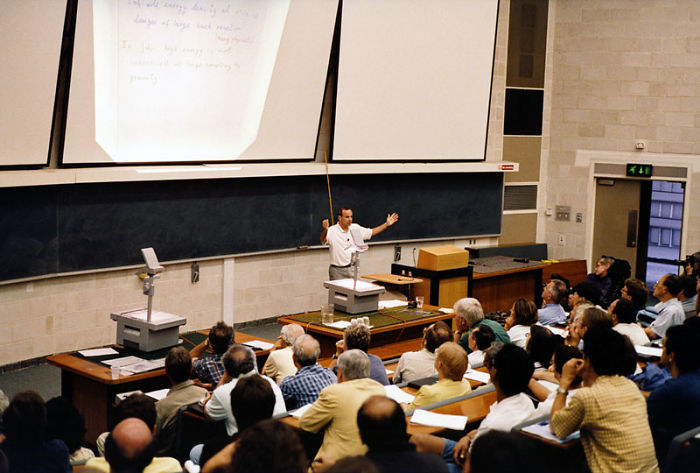
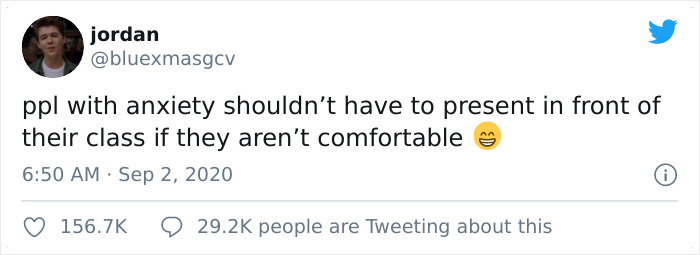
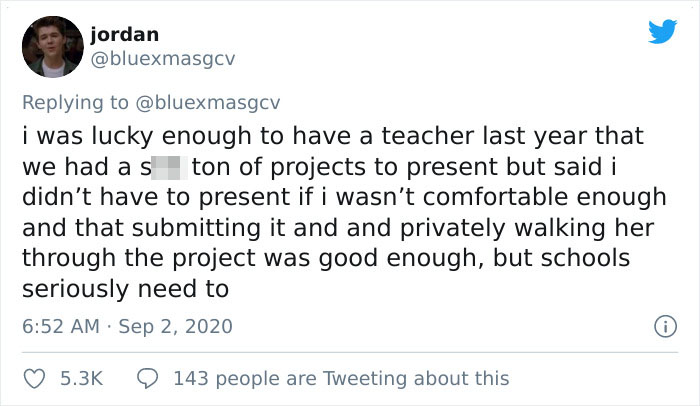
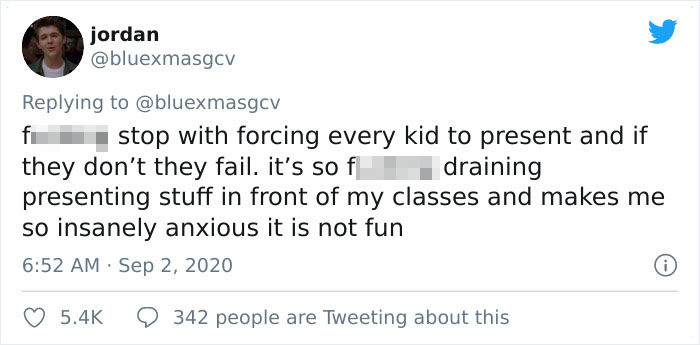
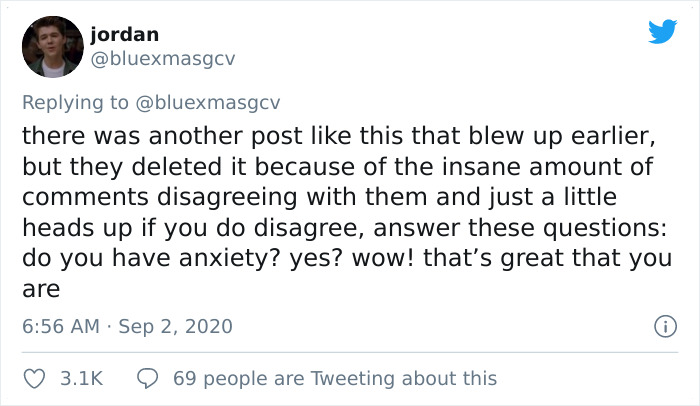
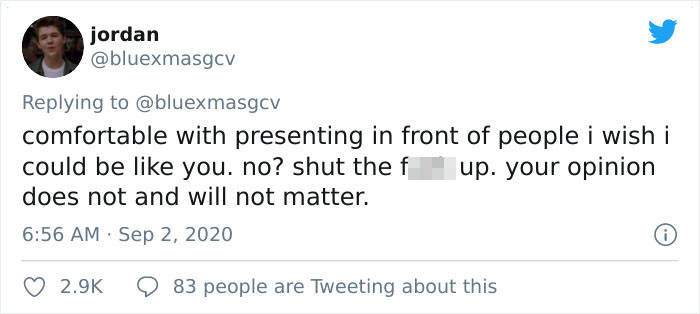
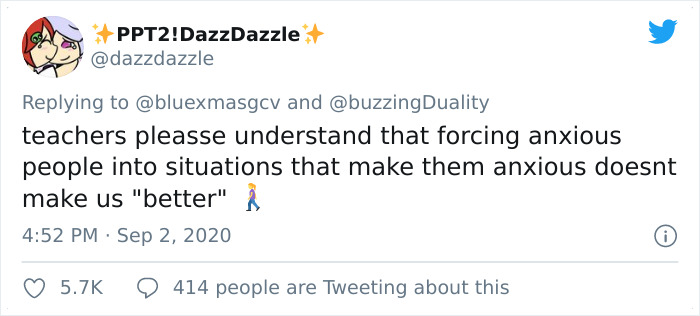
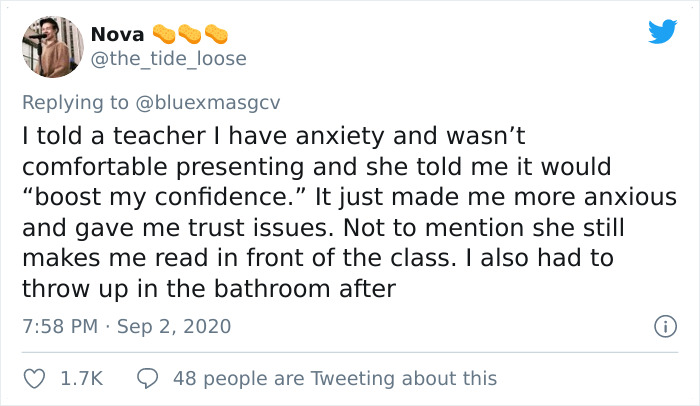
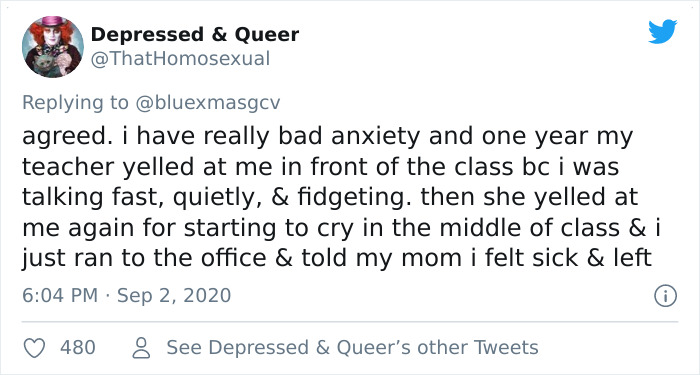
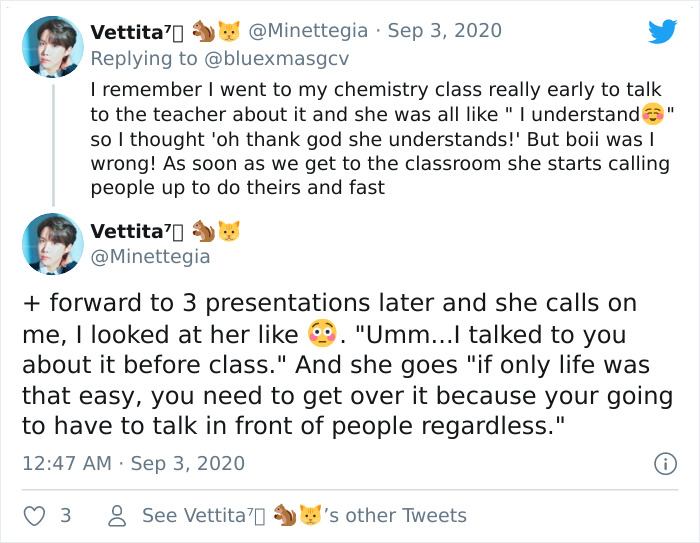
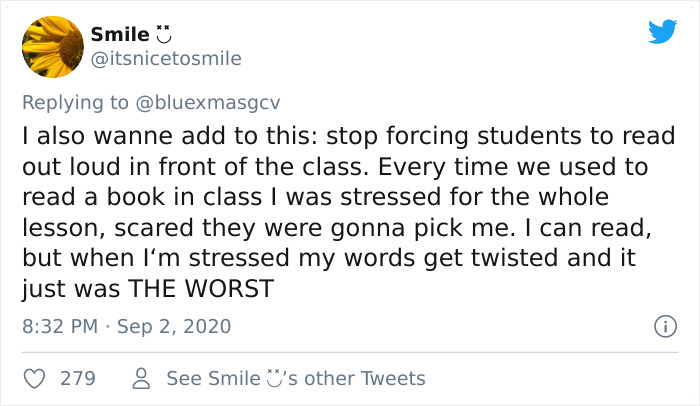
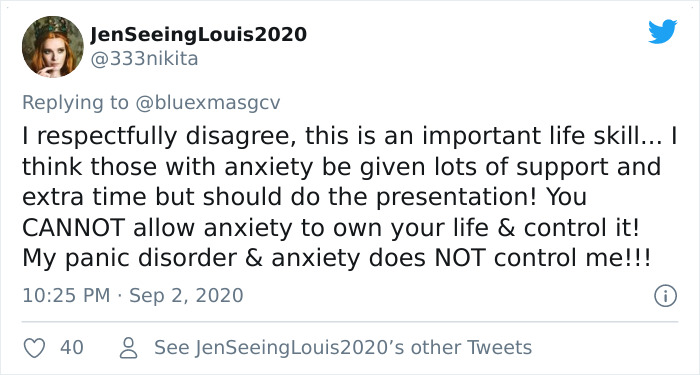
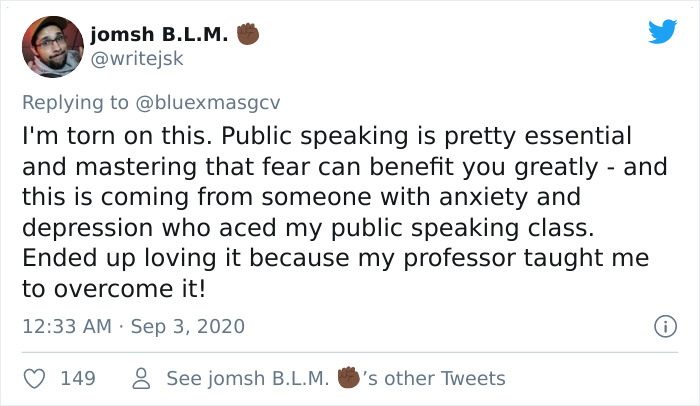
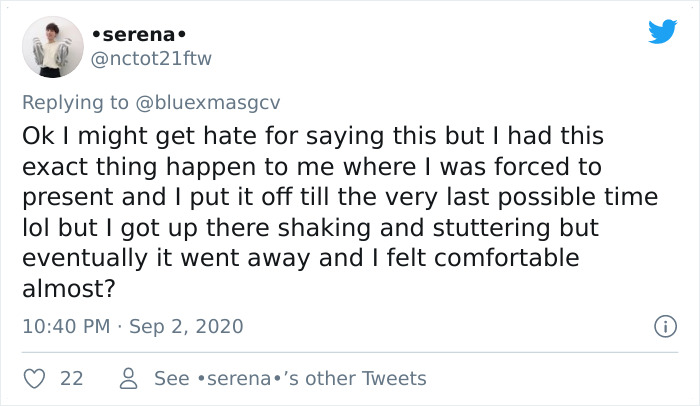
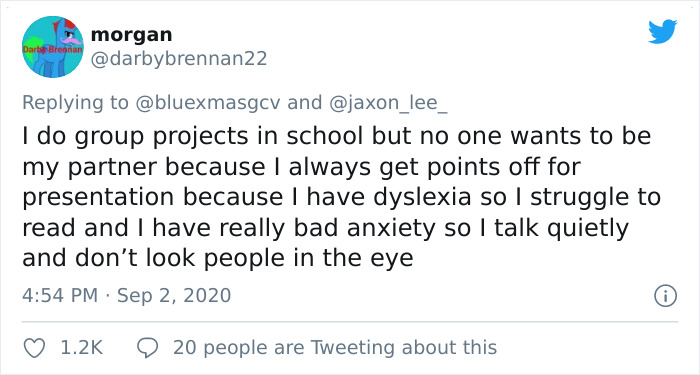
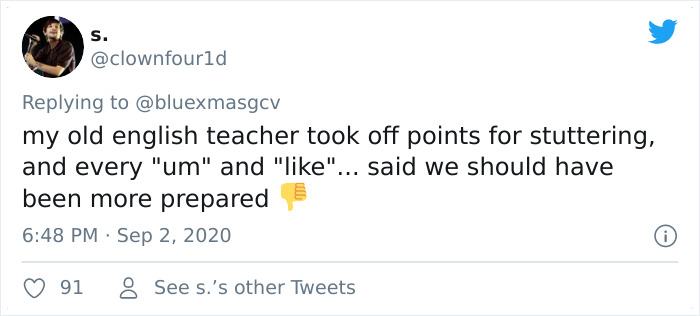
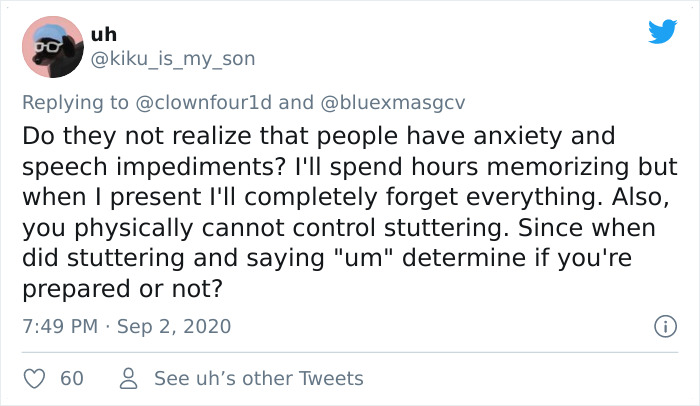
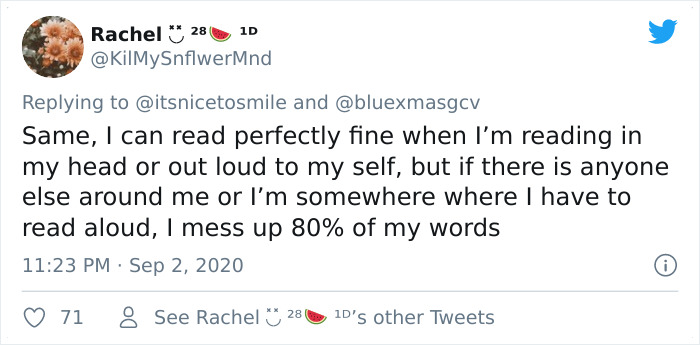
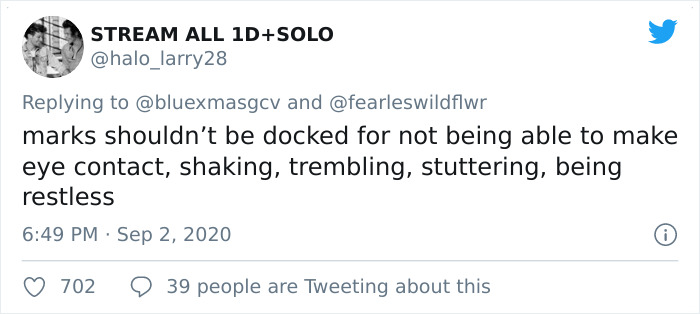
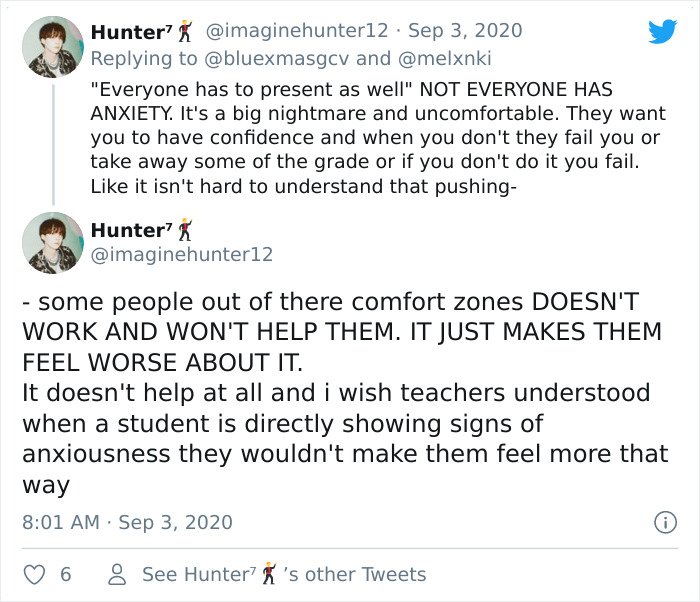
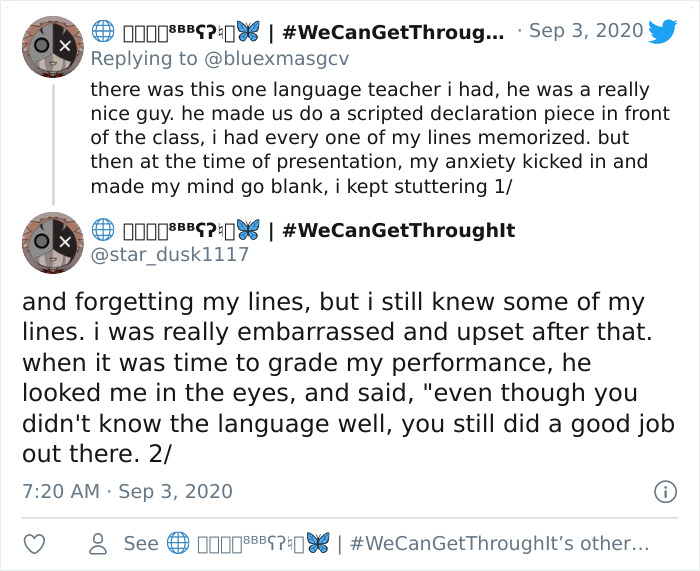
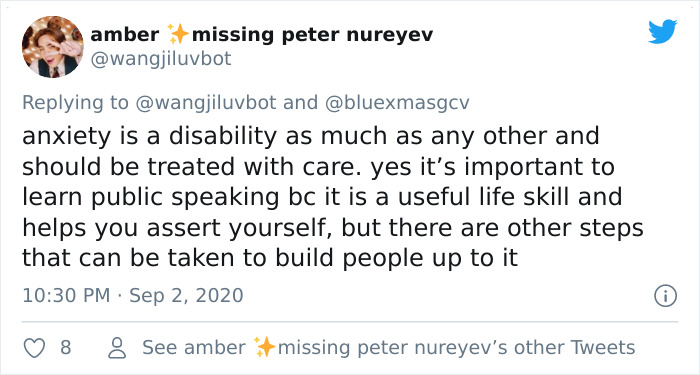
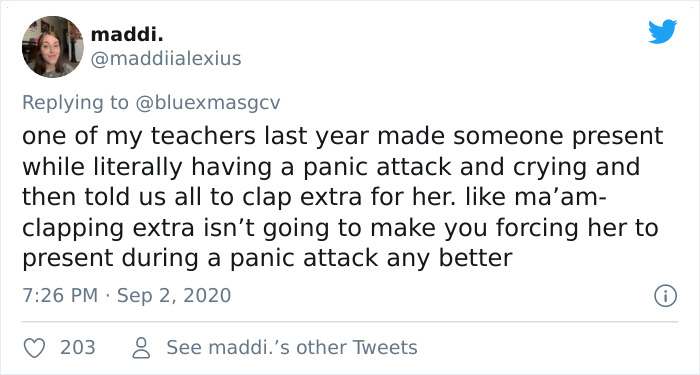
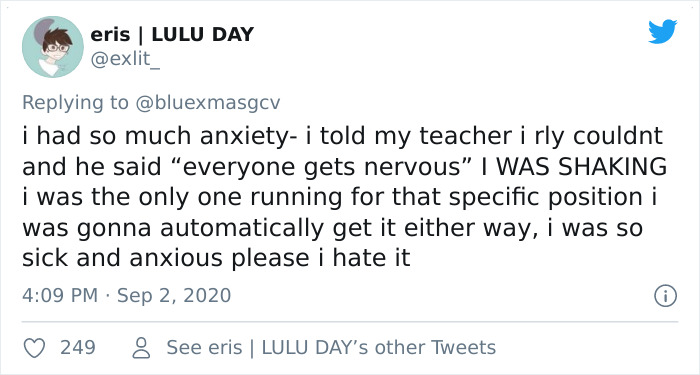




























136
191