Get Premium
Dark mode theme is available exclusively for premium users. Learn more about the benefits of subscribing.
No fees, cancel anytime.

 Dark Mode Ad-Free Browsing Unlimited Content
 Ad-Free Browsing Unlimited Content Dark Mode
Join 1.2 million Panda readers who get the best art, memes, and fun stories every week!

If your job has been sucking the soul out of you for a decade, it’s probably time to move on.
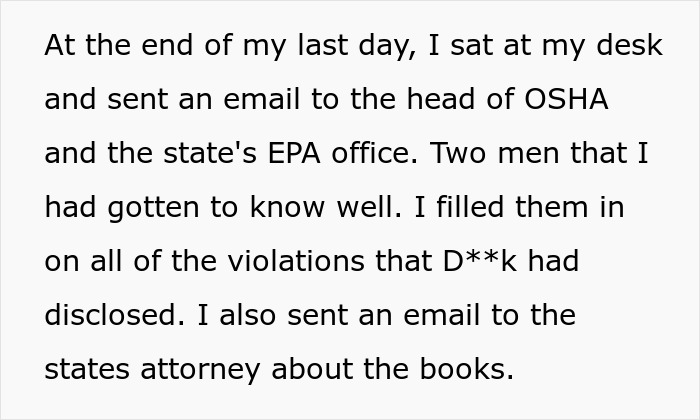
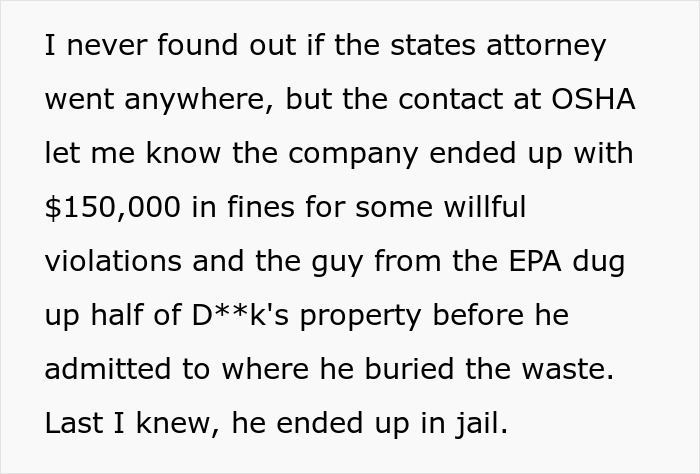
And maybe, just maybe, take the whole place down on your way out—just like this Redditor did. After years of enduring, in his own words, “the absolute worst” boss, he finally scored a new position with better pay and real benefits. But before leaving, he made sure to get revenge for all the abuse—one final move that landed his ex-boss with a six-figure fine and a jail sentence.
Read the full story below.
Image credits: Getty Images (not the actual photo)
Image credits: Getty Images (not the actual photo)
Image credits: onehalfofham
Image credits: Getty Images (not the actual photo)
Sending your boss to jail or pulling off a grand act of revenge probably isn’t on your to-do list if you’re thinking about leaving a miserable job. But making an exit that sends a message? That might be tempting.
Enter “revenge quitting”—abruptly and dramatically quitting on the spot to prove a point. And according to a new survey by Software Finder, it’s becoming more common. The study, which polled over 1,000 full-time employees, found that 28% expect to see revenge quitting happen in their workplace in 2025.
Meanwhile, 17% admitted they’ve already done it in the past, and 4% say they’re planning to quit this way in 2025—having wanted to leave their current job for over a year, on average.
But while some are eager to make a bold departure, others feel stuck. 27% of employees say they can’t leave their jobs due to economic or external factors, with workers in government (33%), retail (31%), and marketing/advertising (31%) feeling the most trapped.
Image credits: Getty Images (not the actual photo)
The short answer? They’re unhappy. The long answer? There’s a growing list of reasons pushing employees to their breaking point.
Gallup reports that U.S. employee engagement has hit a 10-year low, and as Bryan Robinson, Ph.D., author of Chained to the Desk in a Hybrid World, explains, revenge quitting is becoming a way for workers to push back against big business. Employees now have more job options, and when faced with toxic workplaces, unfair policies, or burnout, they’re choosing to walk away.
Robinson spoke with John Scott, head of learning design and strategy at MasterClass at Work, who outlined four signs that an employee might be on the verge of revenge quitting:
The Software Finder survey backs this up, revealing that the biggest workplace frustrations include low salaries or lack of raises, which was the top complaint at 48%. Feeling undervalued came in second at 34%, followed closely by limited career growth opportunities at 33%.
However, companies do have ways to turn things around. Many employees said they’d be more likely to stay if they were offered incentives like a four-day workweek, which 33% said would make a difference. The same percentage said performance-based bonuses would keep them from leaving, while 28% pointed to more paid time off as a key motivator.
At the end of the day, if businesses want to avoid high turnover and keep employees engaged, the solution is simple—invest in their happiness or pay the price.

By entering your email and clicking Subscribe, you're agreeing to let us send you customized marketing messages about us and our advertising partners. You are also agreeing to our Privacy Policy.
Thank you! You've successfully subscribed to newsletters!

What is the lesson here? Pay me and treat me decently enough and I'll overlook toxic waste dumping, cooking the books and inhumane labor practices? What a working class hero /s

That does seem to be the lesson. Even so, he ignored the sexual assaults.
Load More Replies...
Wow! My husband has owned his own business for over 8 years…no laws broken whatsoever. No “cooked books” either. We’re not rich but we eat and have a roof over our heads. So do his employees. That’s what matters to us :)
What is the lesson here? Pay me and treat me decently enough and I'll overlook toxic waste dumping, cooking the books and inhumane labor practices? What a working class hero /s
That does seem to be the lesson. Even so, he ignored the sexual assaults.
Load More Replies... Wow! My husband has owned his own business for over 8 years…no laws broken whatsoever. No “cooked books” either. We’re not rich but we eat and have a roof over our heads. So do his employees. That’s what matters to us :)




































 No fees, cancel anytime




















43
28