Get Premium
Dark mode theme is available exclusively for premium users. Learn more about the benefits of subscribing.
No fees, cancel anytime.

 Dark Mode Ad-Free Browsing Unlimited Content
 Ad-Free Browsing Unlimited Content Dark Mode
Join 1.2 million Panda readers who get the best art, memes, and fun stories every week!

Living together comes with the unenviable task of needing to figure out who does what. After all, the laundry, dishes and general cleaning have, at least, doubled, so it’s not exactly fair to dump it all on one person.
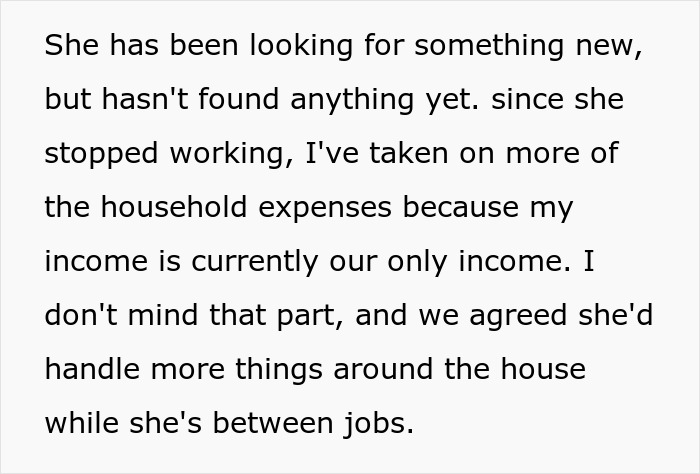
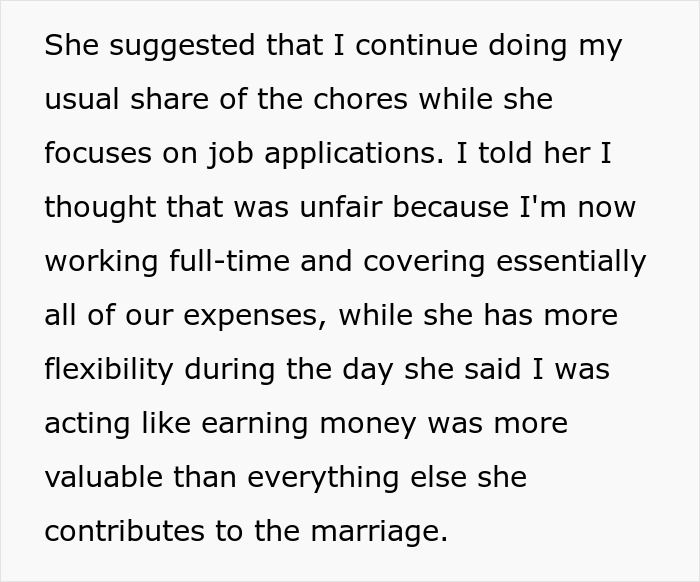
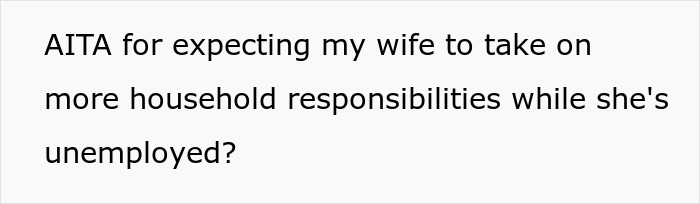
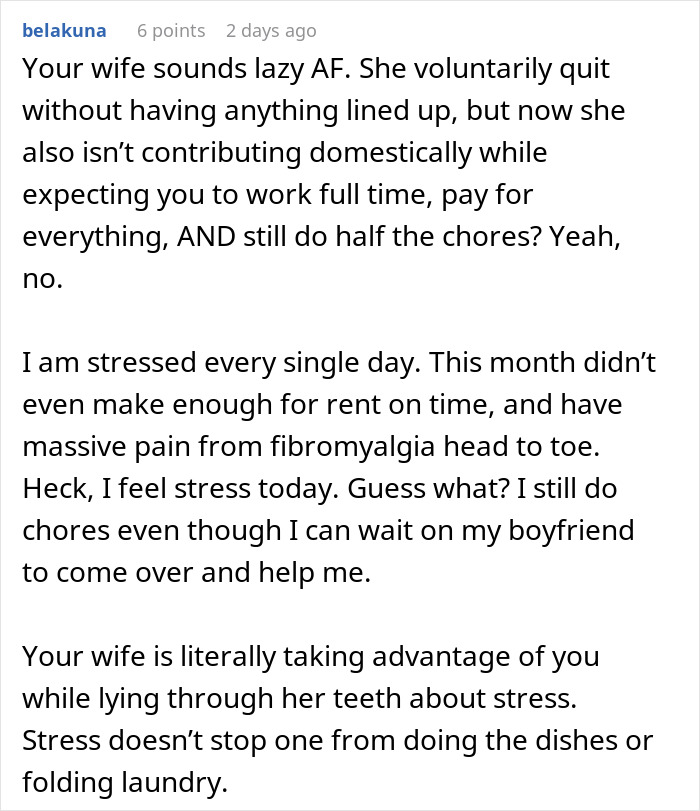
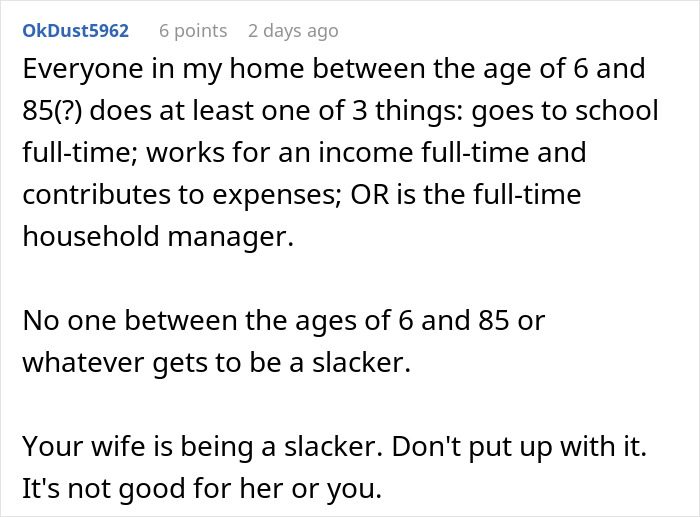
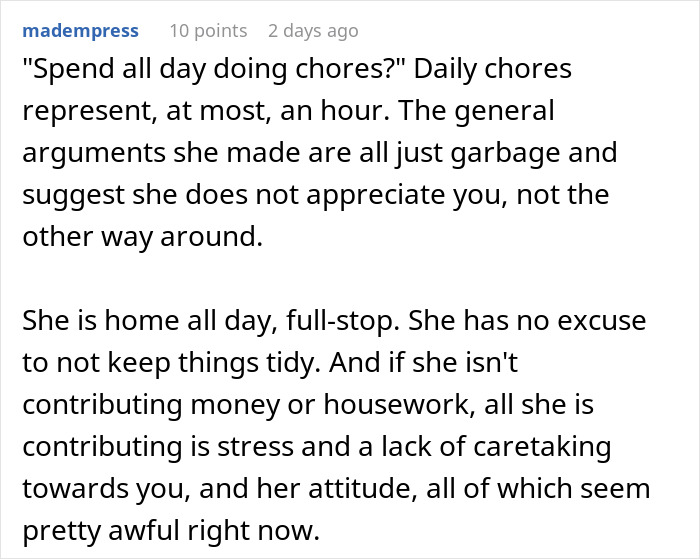
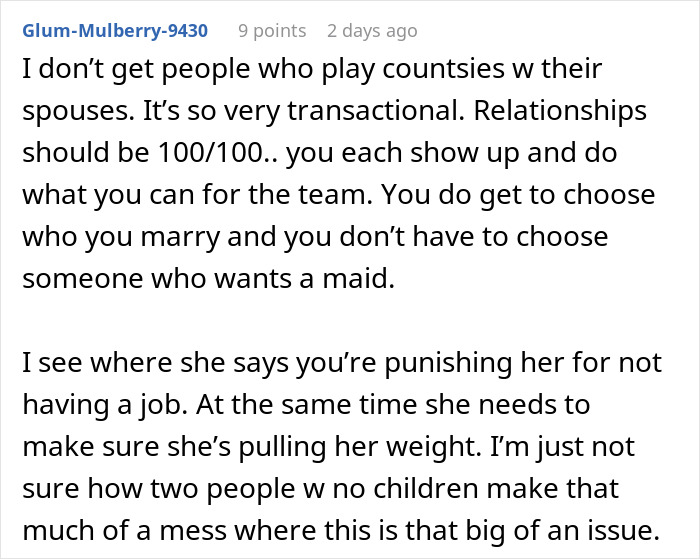
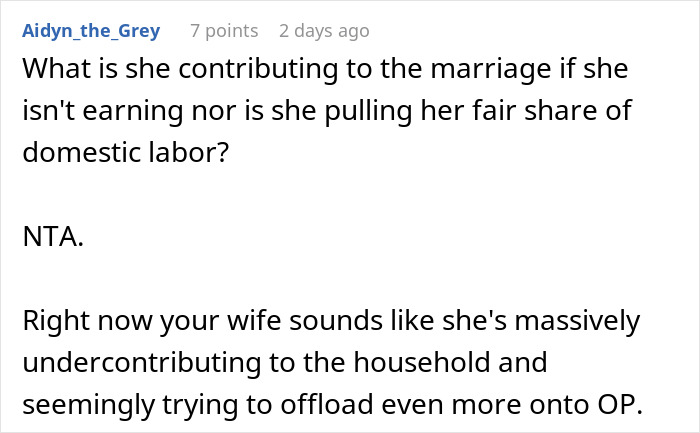
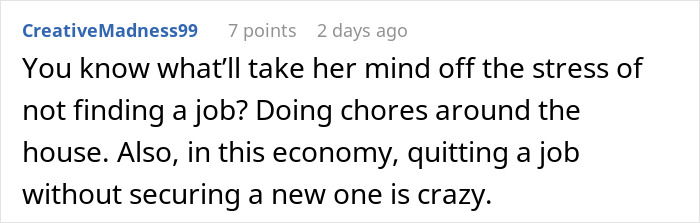
A man turned to the internet for advice after realizing that his unemployed wife had decided to fully check out of doing any chores at home. So the internet decided to weigh in with their thoughts, advice and a few also shared similar stories. As it turns out, there wasn’t necessarily just one clear victim and villain here.
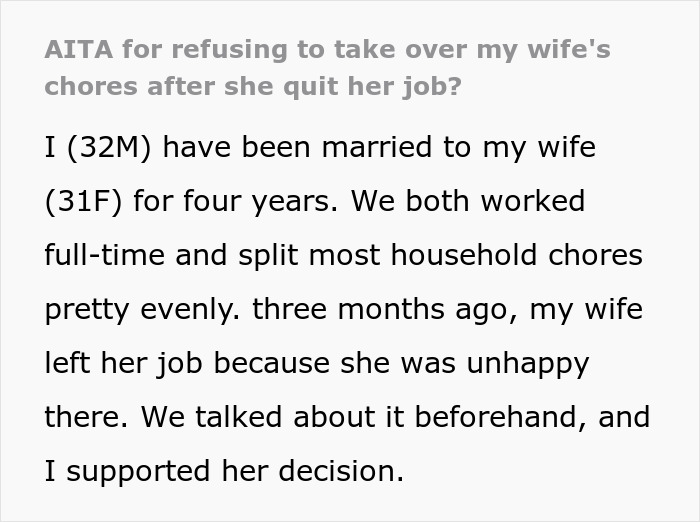

Plenty of couples run their households on an unspoken rule that fair means equal, and plenty of them discover that the rule only holds while life stays the same. Pew Research has found that more than half of married adults call sharing chores very important to a successful marriage, and an earlier Pew report on modern marriage ranked it third among nine possible ingredients, ahead of adequate income. That helps explain why a sink full of dishes can turn into a conversation about respect so quickly. The dishes are seldom the whole story.
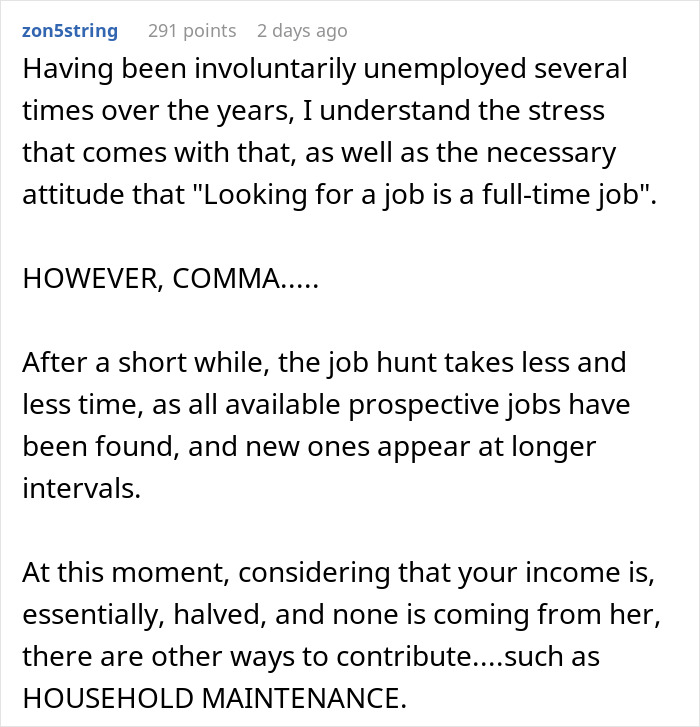
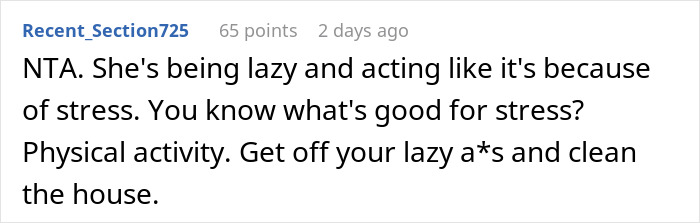
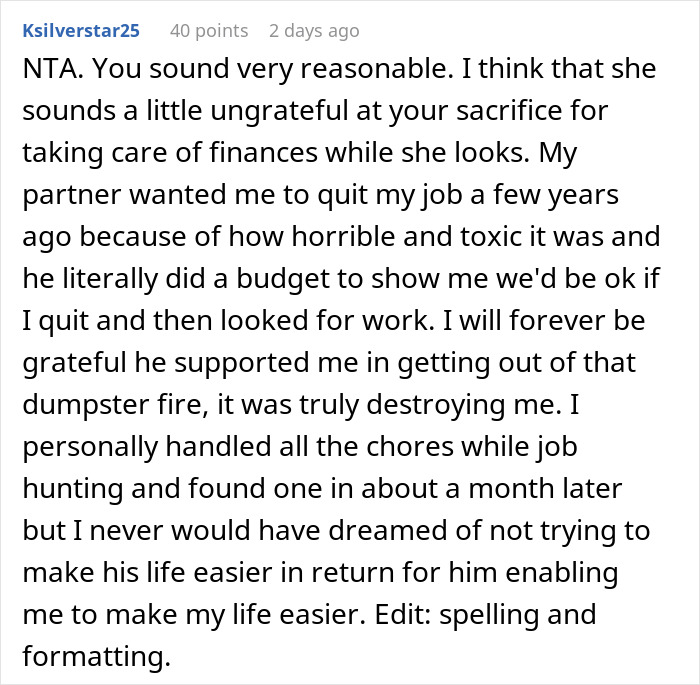
The husband’s position has plenty of everyday logic behind it. Chores often follow hours, and Pew notes that even when both partners work full time, differences in hours worked can shape how housework gets divided. When one partner’s paid hours drop to zero and the other carries the entire income, many people would expect the split to shift as well. The broader numbers point the same way. Bureau of Labor Statistics data show that adults who are not employed spent about 2.6 hours a day on household activities in 2024, compared with about 1.6 hours for people working full time, though that group also includes people outside the labor force. A study of time use during recessions by Aguiar, Hurst, and Karabarbounis found that roughly 30 to 40 percent of the extra hours people gain from not working go toward work in the home, while job searching takes up a smaller fraction. By that yardstick, taking on more housework during a gap between jobs is a common pattern, and it is the very arrangement the couple agreed to at the start.
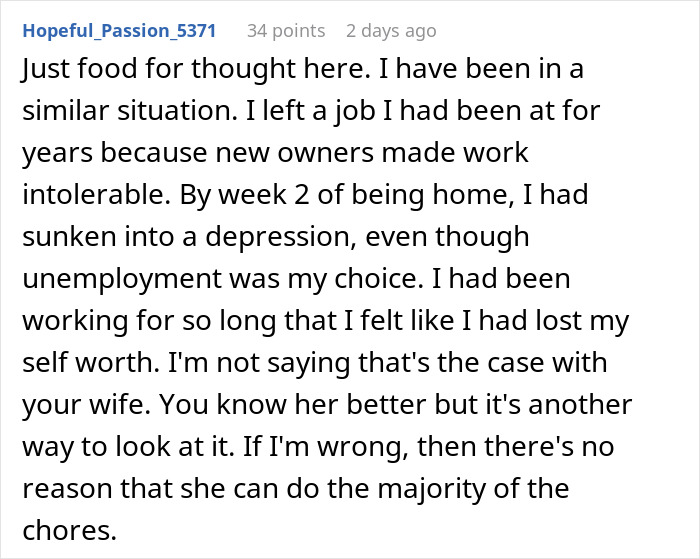
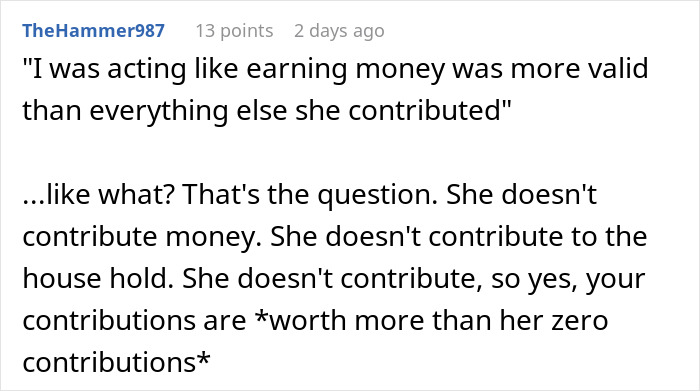
The wife’s side deserves equal attention. Leaving a job is a major change even when it is planned, and the same time use research found that more than 20 percent of those freed hours go to extra sleep, which some readers will see as recovery and others as a sign of strain. The Family Institute, which studies how couples handle stress, says the links between unemployment, psychological distress and relationship distress are well established, and it also points to declines in self esteem. Many job seekers describe the search as slow and uncertain, with little feedback, so a day of applications can feel heavier than the hours suggest. Her remark that earning money should not outrank everything else she contributes raises a question many couples wrestle with. Unpaid work at home, from planning meals to remembering appointments, is easy to overlook, and it can sting when it gets measured only against a paycheck. A single income can also bring its own pressure, since the person covering every bill may feel a weight that rarely gets discussed.

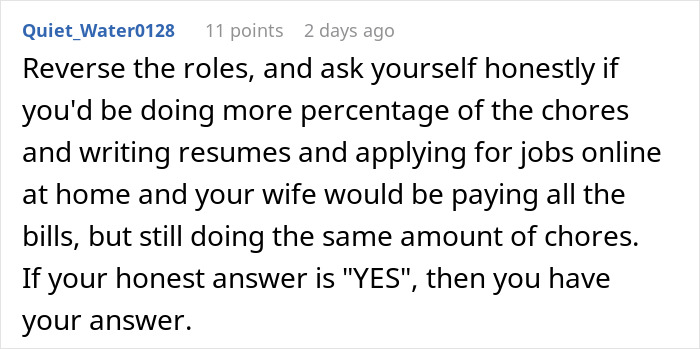
Where the story gets tricky is the gap between the two proposals. One spouse asked for a new split, and the other offered the old split with a new justification, so each may feel unheard. The word fair is carrying a lot of weight. For him it seems to mean balancing the total workload, paid and unpaid together. For her it seems to mean protecting her energy for a task that is stressful and has no clear end date. Both definitions are reasonable, which is exactly why they collide. Some couples in this spot find it helps to agree on a specific set of tasks, pick a date to check in, and settle what job search time looks like in practice, such as set hours or a weekly number of applications. That kind of plan may work best when both people see it as a shared project and not a performance review.
It also helps to remember that much of the research here looks at involuntary job loss, while this couple made the decision together. That difference could cut either way. A planned break may leave less room for surprise, yet it can also leave both partners with different pictures of how long it will last. The same Family Institute page admits there is little guidance for how couples should navigate unemployment in a healthy way, so no one is working from a perfect script. Readers will land in different places depending on what they believe a marriage owes each person during a lean stretch. The more useful question may be what the two of them would call fair if they sat down with a calendar and a cup of tea.







By entering your email and clicking Subscribe, you're agreeing to let us send you customized marketing messages about us and our advertising partners. You are also agreeing to our Privacy Policy.
Thank you! You've successfully subscribed to newsletters!


Hubby works full time. If he has to take over all household chores as well, then burn-out will lurk around the corner and then you have 2 people who are out of a job. So, she should get medical help asap and perhaps ask family to help out for a few weeks until medication kicks in.


This is absolutely depression. Yes, she quit her job, but it's a shock and she is hurting. I've been there and know.
Hubby works full time. If he has to take over all household chores as well, then burn-out will lurk around the corner and then you have 2 people who are out of a job. So, she should get medical help asap and perhaps ask family to help out for a few weeks until medication kicks in.
This is absolutely depression. Yes, she quit her job, but it's a shock and she is hurting. I've been there and know.




































 No fees, cancel anytime






27
10