Get Premium
Dark mode theme is available exclusively for premium users. Learn more about the benefits of subscribing.
No fees, cancel anytime.

 Dark Mode Ad-Free Browsing Unlimited Content
 Ad-Free Browsing Unlimited Content Dark Mode
Join 1.2 million Panda readers who get the best art, memes, and fun stories every week!
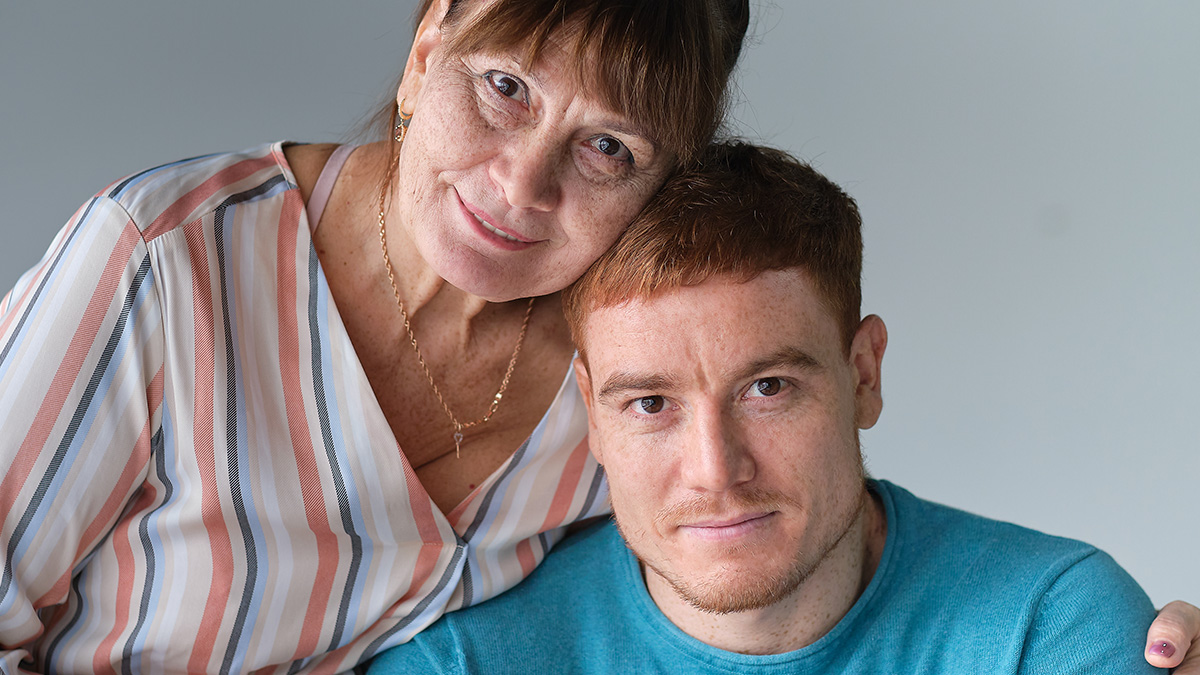
Everyone has a different comfort level when it comes to physical affection, which mainly stems from the way we were brought up. If our parents were comfortable with showing physical affection, chances are we’re too, and vice versa. But when people raised with different levels of physical affection come together, it can sometimes lead to misunderstandings or discomfort.
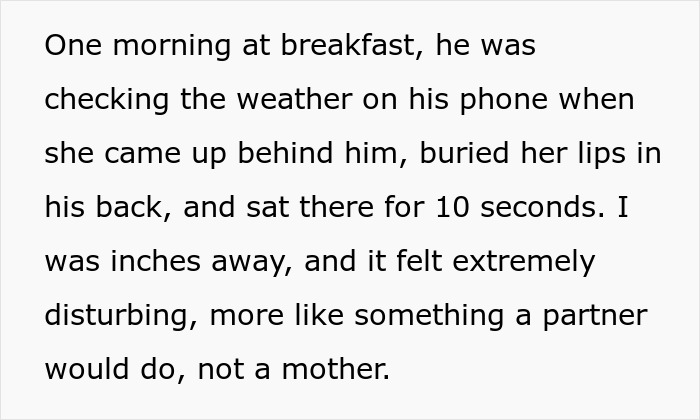
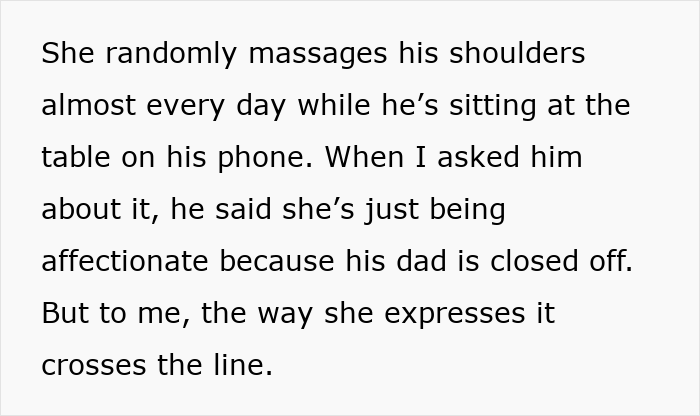
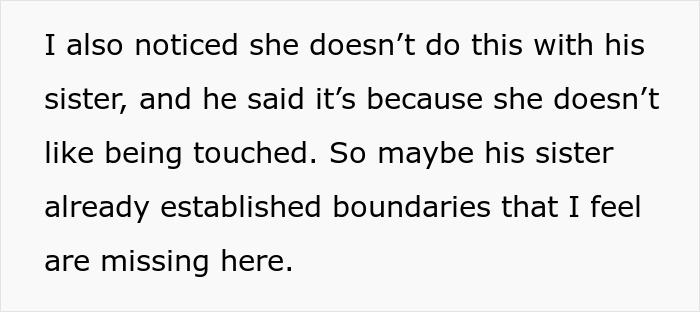
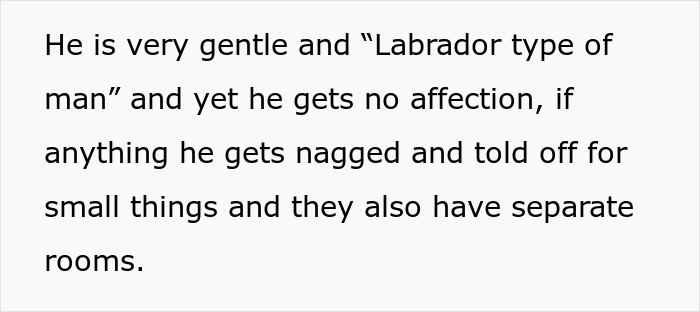
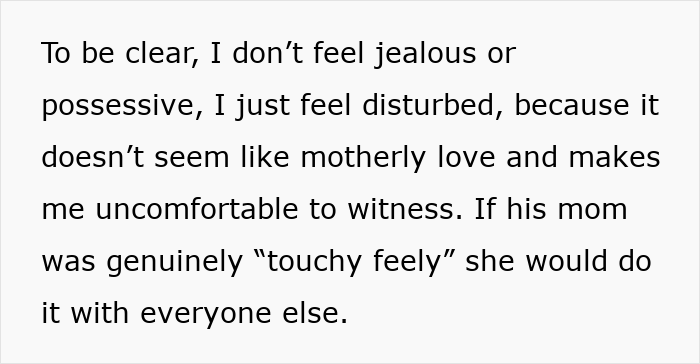
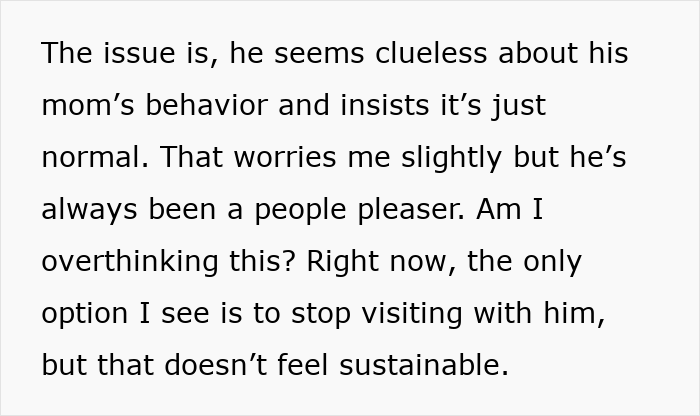
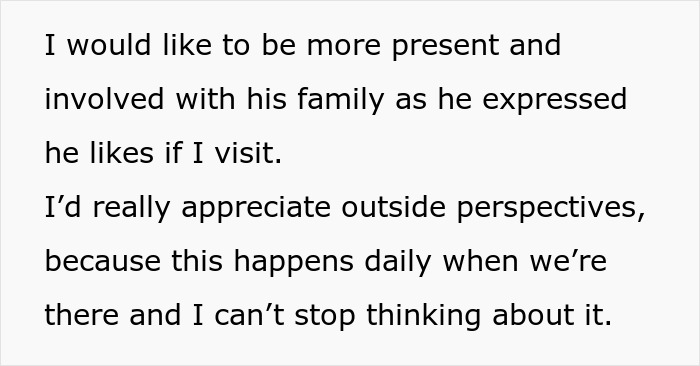
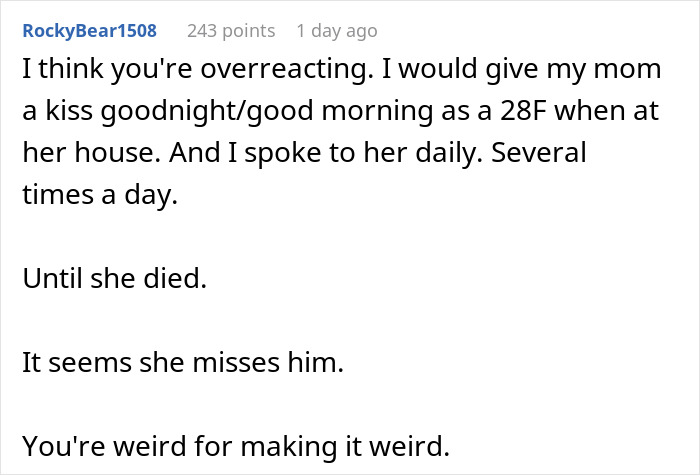
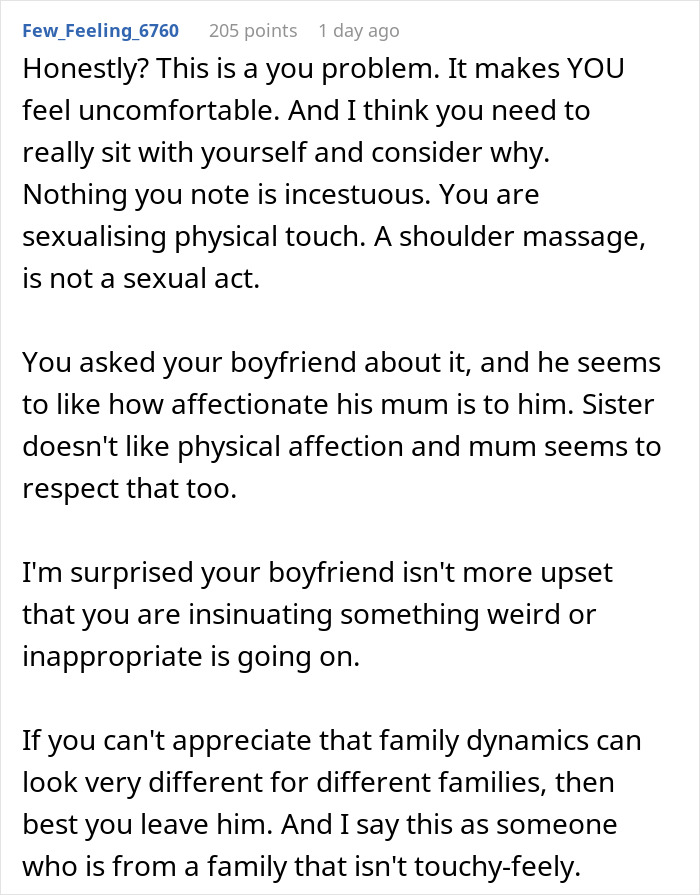
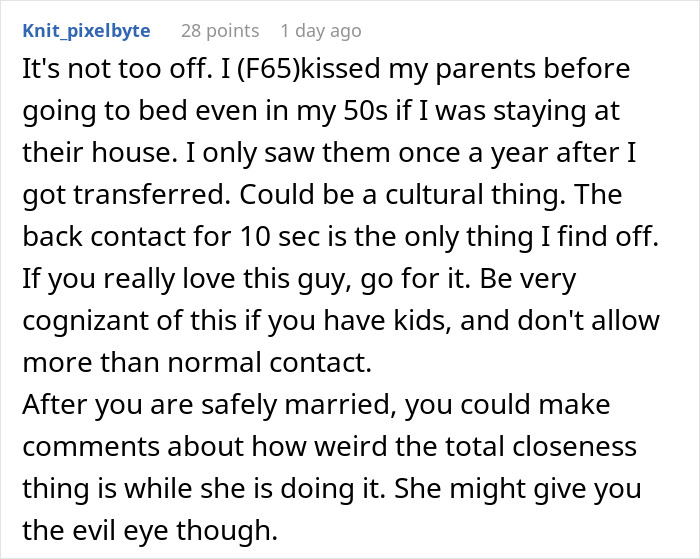
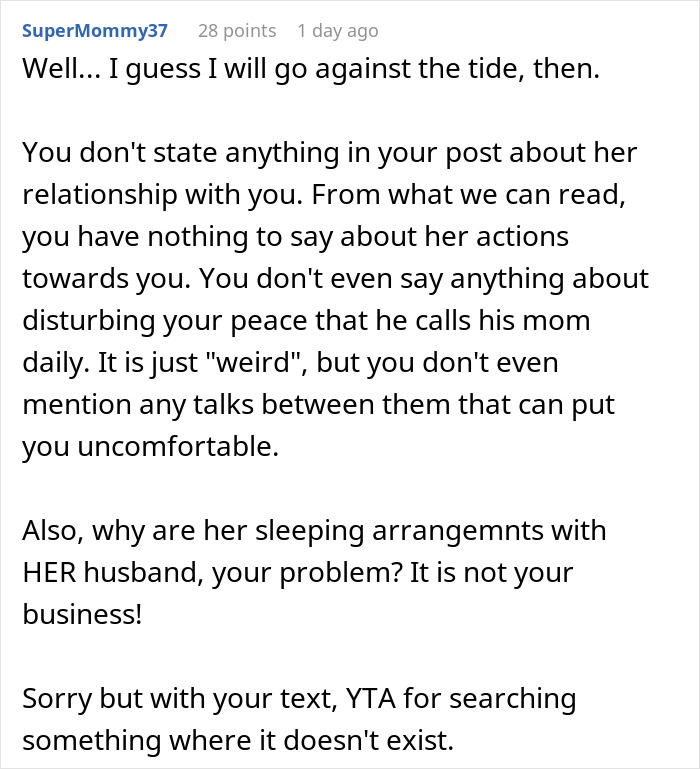
It’s exactly what happened to this woman when she visited her boyfriend’s parents. She, who wasn’t that much of a touchy person, found it strange that her partner’s mom was kissing him and giving him shoulder rubs every day. Worried that she might be overthinking things, she shared the story online, hoping netizens would weigh in with their unbiased opinions.
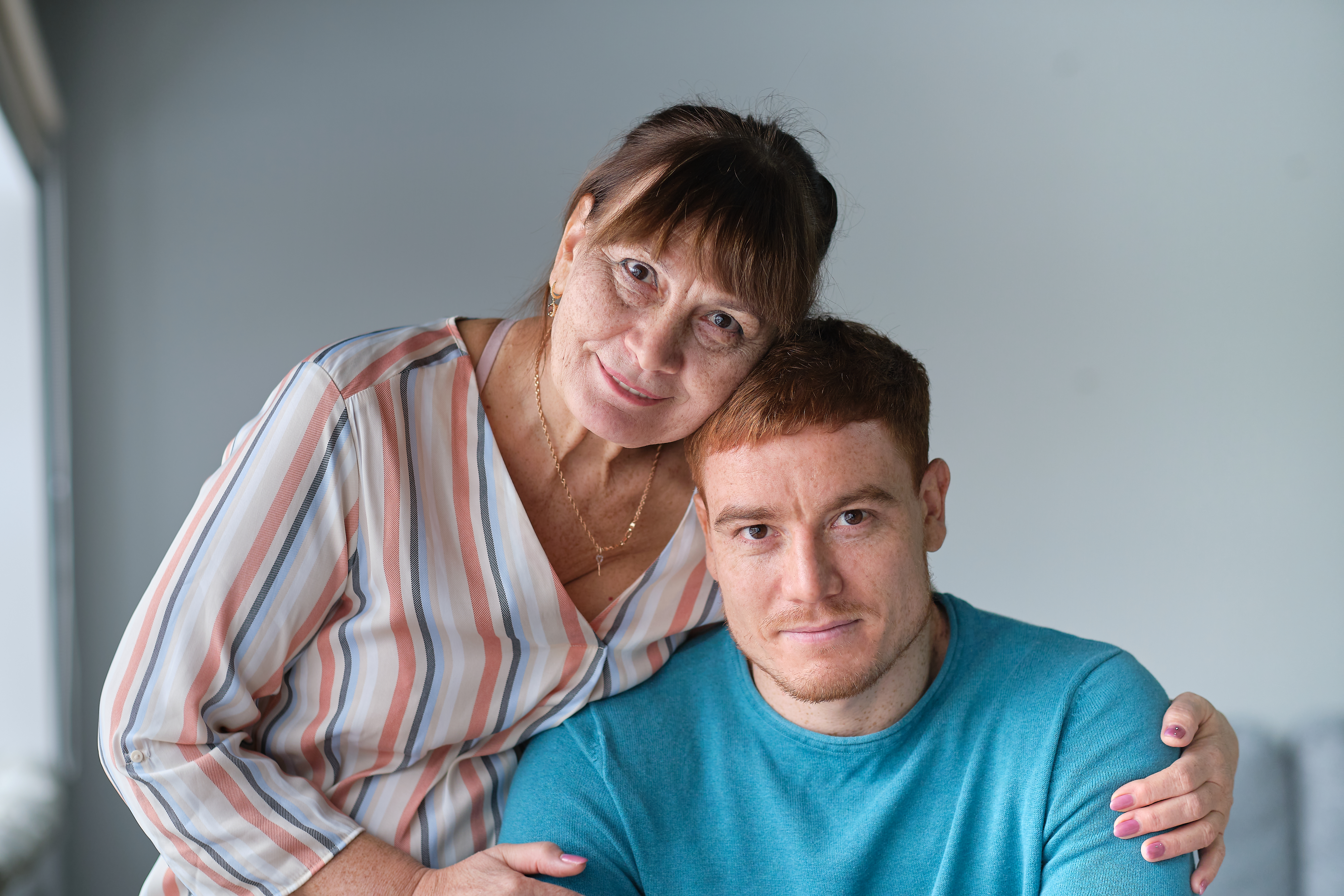
Image credits: ekoneva695 (not the actual photo)
Image credits: Camandona (not the actual photo)
Image credits: Wonderful-Drive-8000
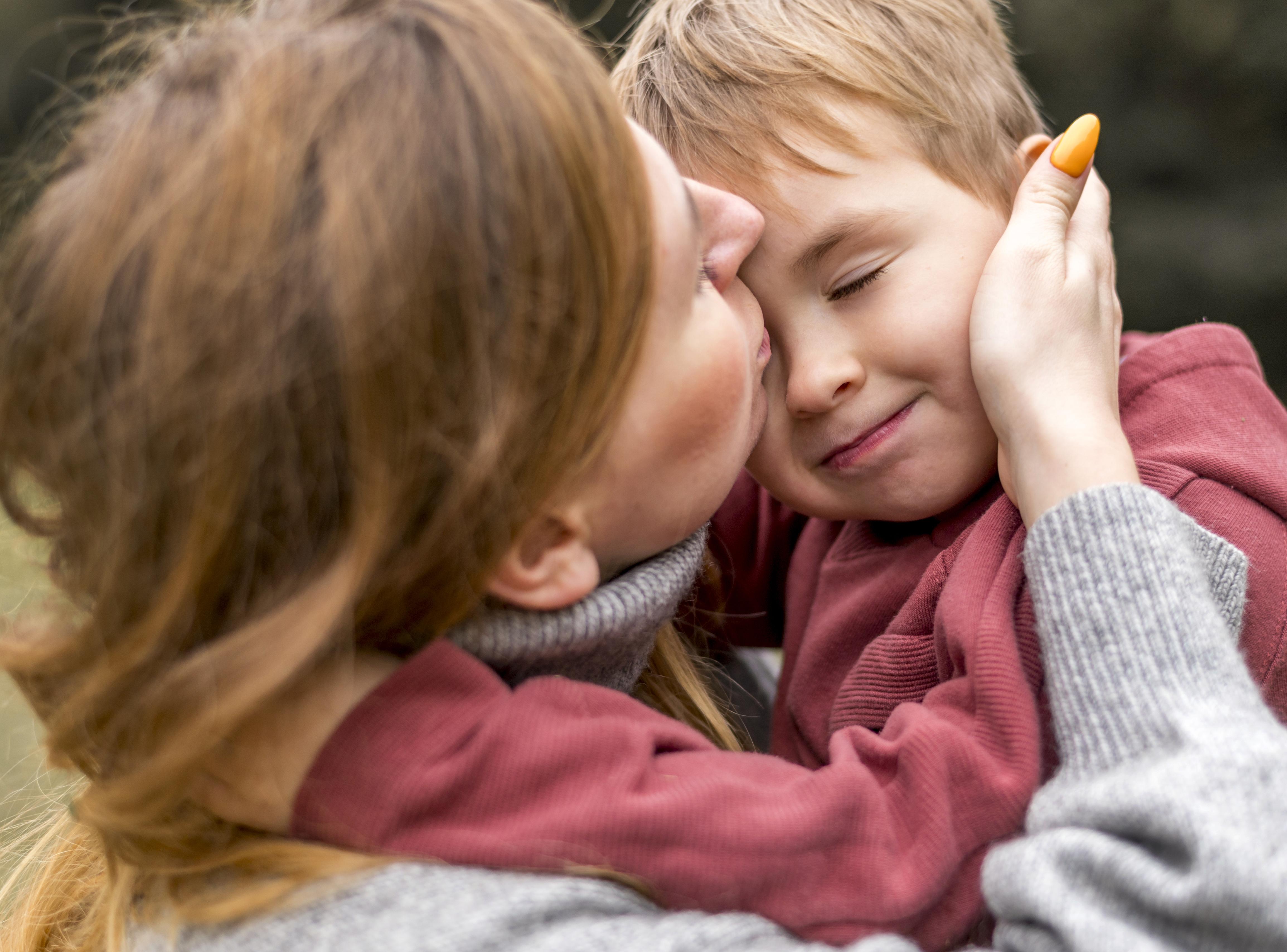
Image credits: freepik (not the actual photo)
Physical affection between parents and their kids is very important, as it’s an essential component in children’s emotional and social development. Many studies prove that physical affection results in kids’ higher self-esteem, improved academic performance, better parent-child communication, and fewer psychological and behavioral problems. It also reduces stress, improves their mood, and enhances brain development.
As children get older, the level of physical affection may lessen, but it’s still important not to awkwardly shy away from showing it. A big squeeze provides emotional support and time for bonding, improves mood, and reduces stress. If a teen is not up for more extravagant physical affection, they can still be emotionally supported by high fives, back rubs, silly games, etc.
If parents don’t give up, many teens remain affectionate in their adolescence and see frequent hugs and kisses as acceptable behavior, while those people whose parents struggled with physical touch might deem such gestures strange.
“For a child growing up in a home where affection isn’t really shown, displays of affection might make them feel awkward or out of place,” explains Dr. Dakari Quimby, Ph.D., a clinical psychologist. “Without seeing affection to take after, it could make doing it as an adult feel like trying something unfamiliar, which could cause feelings of discomfort rather than connection.”
Parents who show less affection to their children often do it because they experienced growing up with unaffectionate caregivers themselves. Suppression of physical affection is usually carried from one generation to the next, so it can be difficult to break out of the vicious cycle.
Lack of physical affection shown to children can result in negative outcomes, such as having lower self-esteem and feeling more alienated, hostile, aggressive, and antisocial. The kids may also have trouble showing affection themselves, have difficulty trusting others, and feel hesitant about being vulnerable with others.
Image credits: freepik (not the actual photo)
So, as you might have already gathered, affection between a parent and child that starts at birth is very normal and greatly encouraged. The only time it becomes a problem is when it causes discomfort to anyone involved. If it does, then it might be time to set boundaries, which should be respected.
As children grow up, they become their own independent persons, so it’s not uncommon for them to try to set boundaries with parents that reflect that.
“When adult children ask for changes like this, it’s actually a sign of healthy development. They’re learning to set boundaries and define themselves as individuals. This process is crucial for becoming a well-adjusted adult,” Dr. Nicole McGuffin, PsyD, LPC, BCN, explained.
“For the [parent], this change can feel like a loss. It’s normal to feel hurt or even a bit abandoned. The key is to recognize that adjusting [their] behavior doesn’t mean losing [their] connection with her son. Instead, it’s about evolving that connection to fit [this] new stage of life.”
But if neither parent nor their adult child has any issue with showing platonic physical affection to each other, it’s nothing to worry about. In case others find it uncomfortable, it’s often simply a reflection of their personality, different experiences, the way they were brought up, and comfort levels of physical affection.

By entering your email and clicking Subscribe, you're agreeing to let us send you customized marketing messages about us and our advertising partners. You are also agreeing to our Privacy Policy.
Thank you! You've successfully subscribed to newsletters!
13Kviews
Share on Facebook
All families have different levels of contact and affection, however the biggest red flag for me is the response from her partner that the mother is like that because his father is "closed off". That's not just being affectionate, that's her projecting the perceived lack of affection and contact from a partner onto her adult child, and it's not healthy.

My thought, too. The word "perceived" seems pretty spot on - if the father is closed off to his wife, it suggests that she doesn't love him or even like him. Without knowing the history, it's hard to know if the husband was unaffectionate and the wife got frustrated or if the wife started acting cold and hostile and the husband withdrew.
Load More Replies...
I don't think it sounds dodgy, I think she just misses him. I still kiss (cheek) and hug my parents, squeeze their shoulders if they seem a bit down. Probably more than I used to, passage of time.
So my family has a couple habits that seem to throw outsiders off. If you stand by someone talking to them, chances are they will be rubbing your back. not like a massage or anything, but like how you rub a babies back to stop them fussing. We all do it. Its a comforting gesture. We all also twirl our hair, or the hair of others near us. I slipped up and was with the step family at a funeral and did the back thing to one of the step family cousins, freaked him right the hell out, had to explain and back away slowly. What's normal for one family is not for another. When my family is talking there's usually 4 -6 of us in a circle chatting, one will be oscillating rocking a baby, everyone else will start moving in sympathy and next thing you know we're all oscillating, usually with a kid hanging on a leg while everyone is rubbing/scratching the back of the person next to them.

Ignore Ace, Helena. You’ve not described a single thing even *bordering* on sexual (never I d outright sexual!), and so it’s absolutely normal FOR YOUR FAMILY, and you don’t need internet strangers telling you your family is gross or whatever after reading a couple sentences. You people can rub my back when I come visit, and I’ll twirl your hair!
Load More Replies... All families have different levels of contact and affection, however the biggest red flag for me is the response from her partner that the mother is like that because his father is "closed off". That's not just being affectionate, that's her projecting the perceived lack of affection and contact from a partner onto her adult child, and it's not healthy.
My thought, too. The word "perceived" seems pretty spot on - if the father is closed off to his wife, it suggests that she doesn't love him or even like him. Without knowing the history, it's hard to know if the husband was unaffectionate and the wife got frustrated or if the wife started acting cold and hostile and the husband withdrew.
Load More Replies... I don't think it sounds dodgy, I think she just misses him. I still kiss (cheek) and hug my parents, squeeze their shoulders if they seem a bit down. Probably more than I used to, passage of time.
So my family has a couple habits that seem to throw outsiders off. If you stand by someone talking to them, chances are they will be rubbing your back. not like a massage or anything, but like how you rub a babies back to stop them fussing. We all do it. Its a comforting gesture. We all also twirl our hair, or the hair of others near us. I slipped up and was with the step family at a funeral and did the back thing to one of the step family cousins, freaked him right the hell out, had to explain and back away slowly. What's normal for one family is not for another. When my family is talking there's usually 4 -6 of us in a circle chatting, one will be oscillating rocking a baby, everyone else will start moving in sympathy and next thing you know we're all oscillating, usually with a kid hanging on a leg while everyone is rubbing/scratching the back of the person next to them.
Ignore Ace, Helena. You’ve not described a single thing even *bordering* on sexual (never I d outright sexual!), and so it’s absolutely normal FOR YOUR FAMILY, and you don’t need internet strangers telling you your family is gross or whatever after reading a couple sentences. You people can rub my back when I come visit, and I’ll twirl your hair!
Load More Replies...





























 No fees, cancel anytime





















37
30