Get Premium
Dark mode theme is available exclusively for premium users. Learn more about the benefits of subscribing.
No fees, cancel anytime.

 Dark Mode Ad-Free Browsing Unlimited Content
 Ad-Free Browsing Unlimited Content Dark Mode
Join 1.2 million Panda readers who get the best art, memes, and fun stories every week!
Leonard Koscianski’s paintings feel like suburban dreams that have wandered just a little too far into the uncanny. At first, his scenes may seem familiar: glowing windows, moonlit streets, leafy yards, swimmers, runners, birds, fish, and animals moving through carefully built spaces. But the longer you look, the stranger they become. Shadows stretch dramatically, creatures appear oversized or unexpected, and ordinary neighborhoods begin to feel charged with mystery, tension, and imagination.
Born in Cleveland, Ohio, Koscianski studied under R. Buckminster Fuller and American painter Wayne Thiebaud, receiving his Bachelor’s degree from the Cleveland Institute of Art and his Master’s degree from the University of California, Davis. Over the course of his career, his psychologically charged work has been exhibited internationally and included in public and private collections, such as the Metropolitan Museum of Art in New York, the Philadelphia Museum, and the Art Institute of Chicago. He has also received major recognition, including a National Endowment for the Arts Individual Artist Fellowship and a Rockefeller Foundation Bellagio Fellowship.
Scroll down to explore some of his striking artworks, and be sure to check out his website and Instagram to see more of his work.
More info: leonardkoscianski.com | Instagram
This post may include affiliate links.
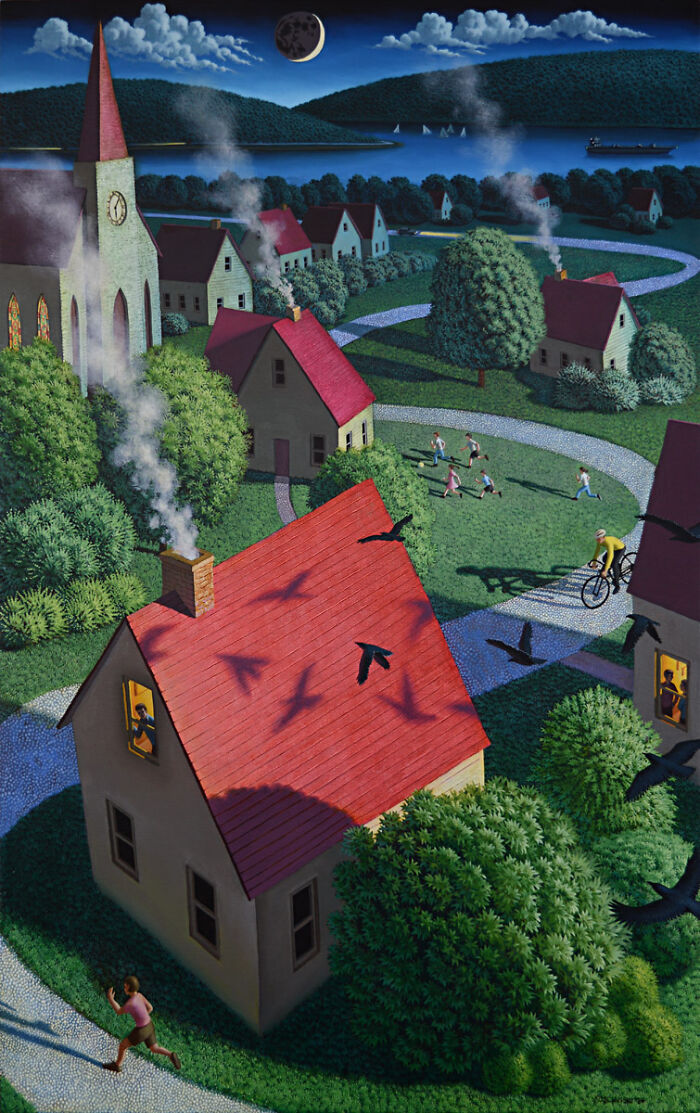
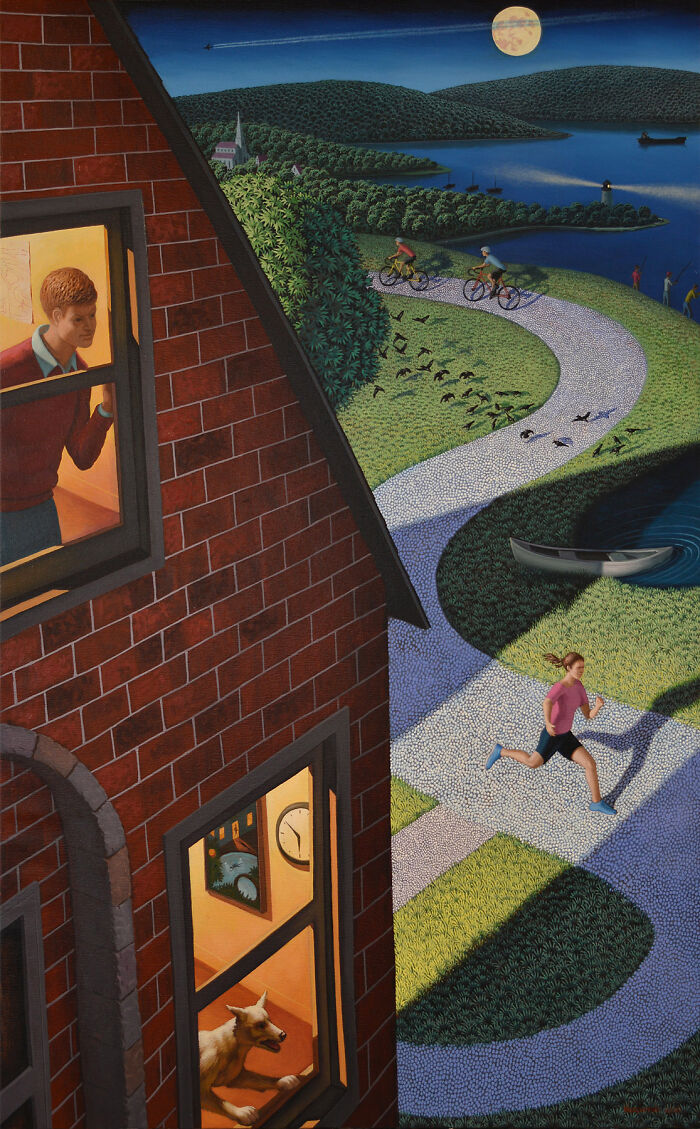
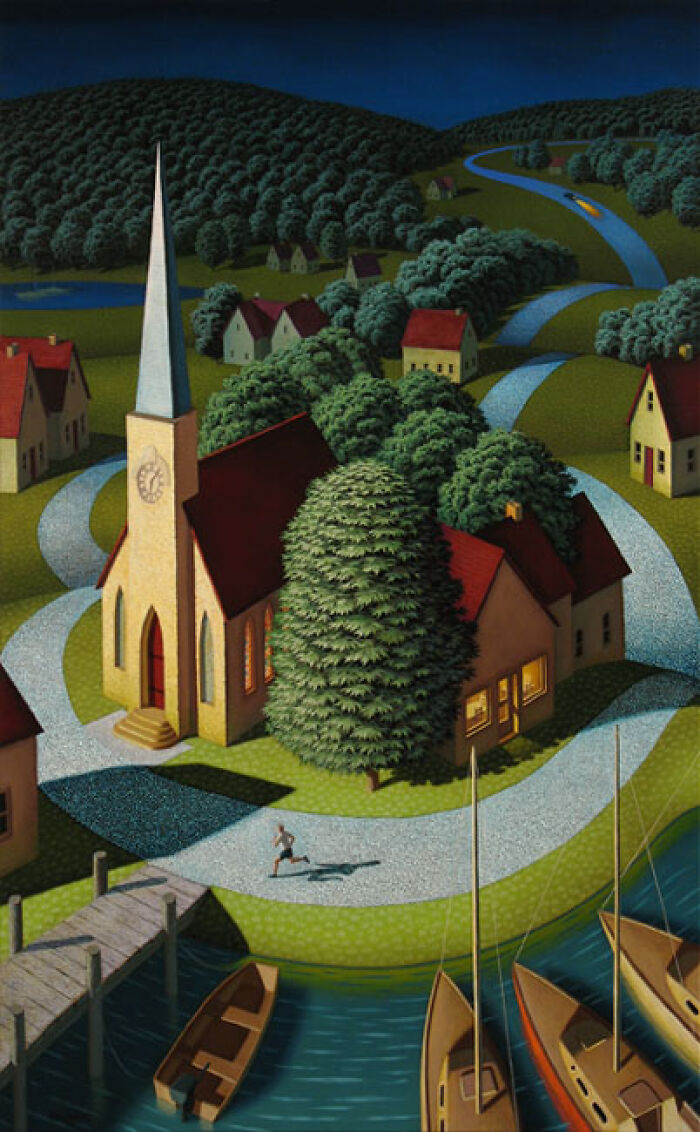
Description: “Birds of a Feather is a medium size painting, oil on canvas, 42″ x 26″, painted in 2024. As its title suggests, it depicts several “flocks”. There is a flock of black birds casting their shadows on the red roof, a group of children kicking a ball in the middle ground, a group of sailboats racing, in the distance. There is also a village of houses, trees, and shrubs (a kind of flock) scattered throughout the scene. Plus, there is a group of adults doing adult things like riding a bike, running, talking, looking out a window.
The painting is surrealist in style in that it combines the appearance of things with my intuitive recreation of them. Many of the elements, like the houses, are more symbolic than “real”. The colors are primary – red, blue, green, and yellow. The red rectangle of the foreground house dominates the scene. Its smooth shingles dotted with the shadows of a flock of birds flying overhead. Smoke comes out of the chimneys, echoing the angled lines of the roofs. There is a woman runner in the lower left, and a man looking out a window. Is he looking at her? Has he been waiting for her to pass? Over on the right is a couple in a window. They seem to suggest the outcome if the couple on the left were to meet. There is a sense of the passage of time. It is daylight in the foreground, with its crisp shadows, and twilight in the background – the car in the distance has his lights on as the moon floats above the horizon.”
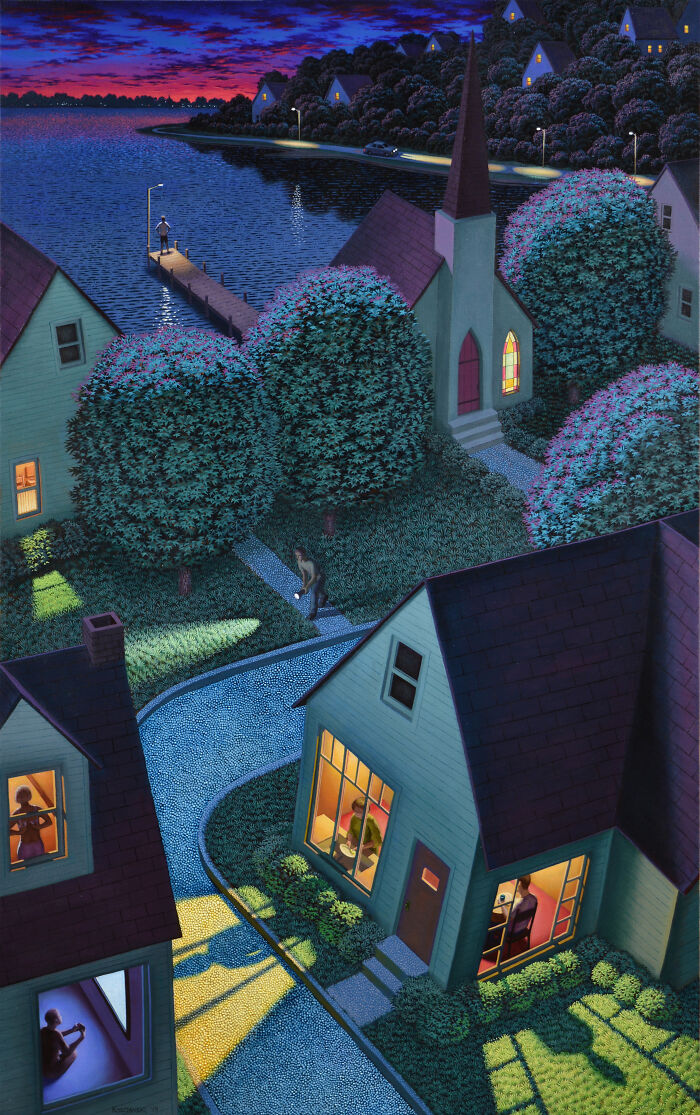
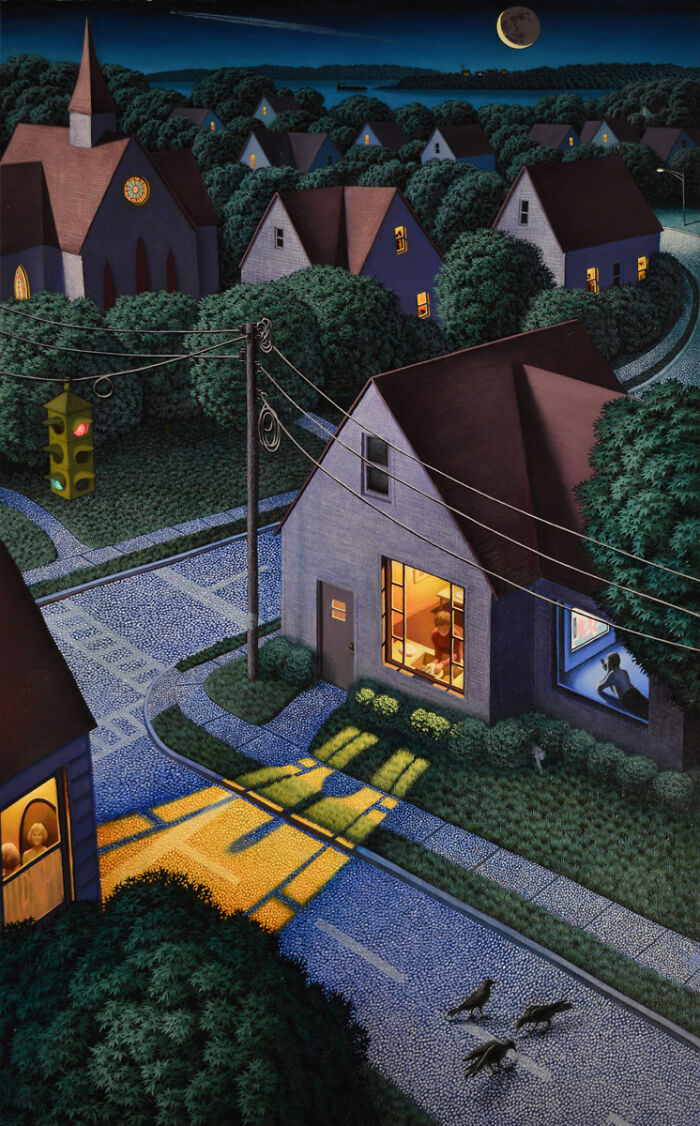
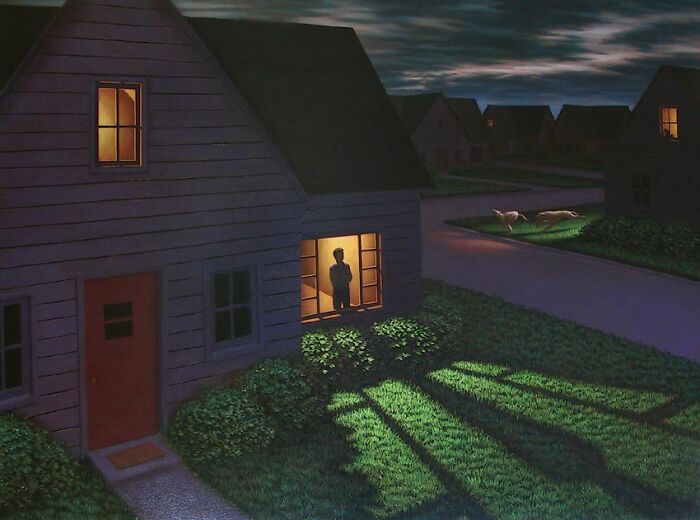
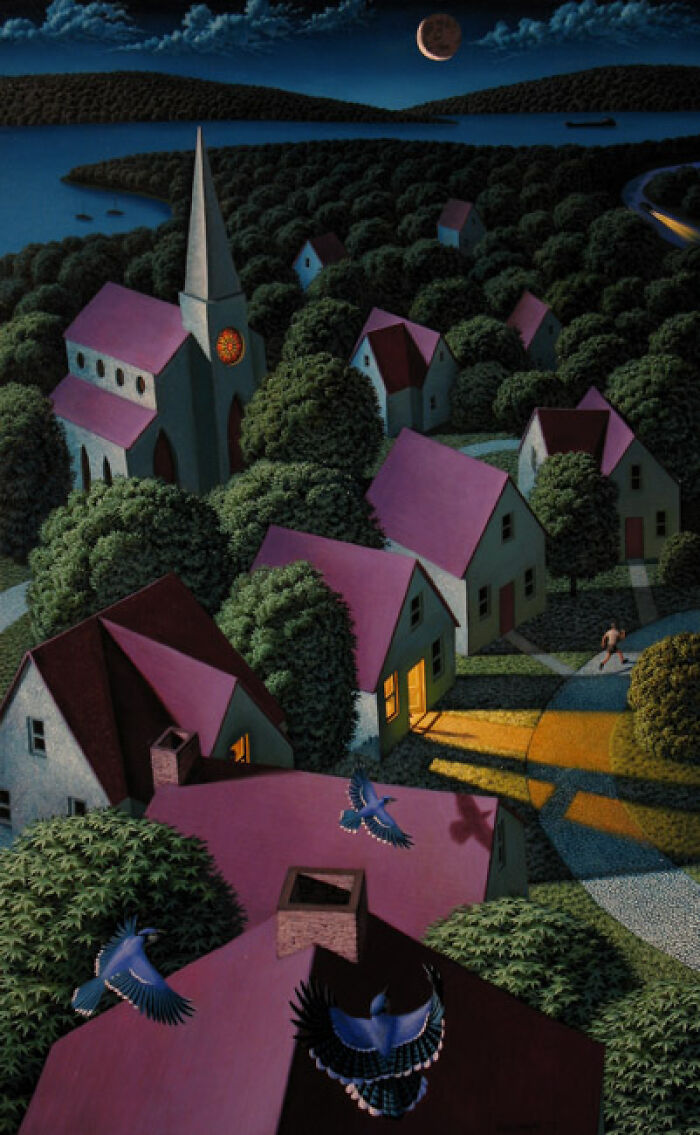
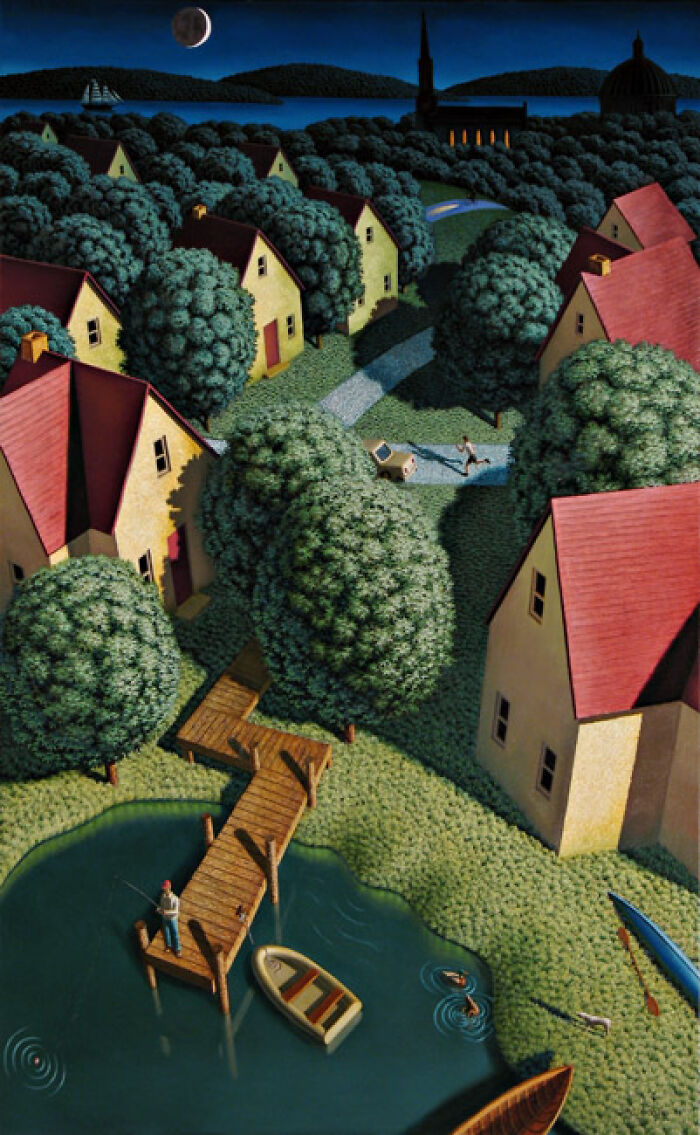
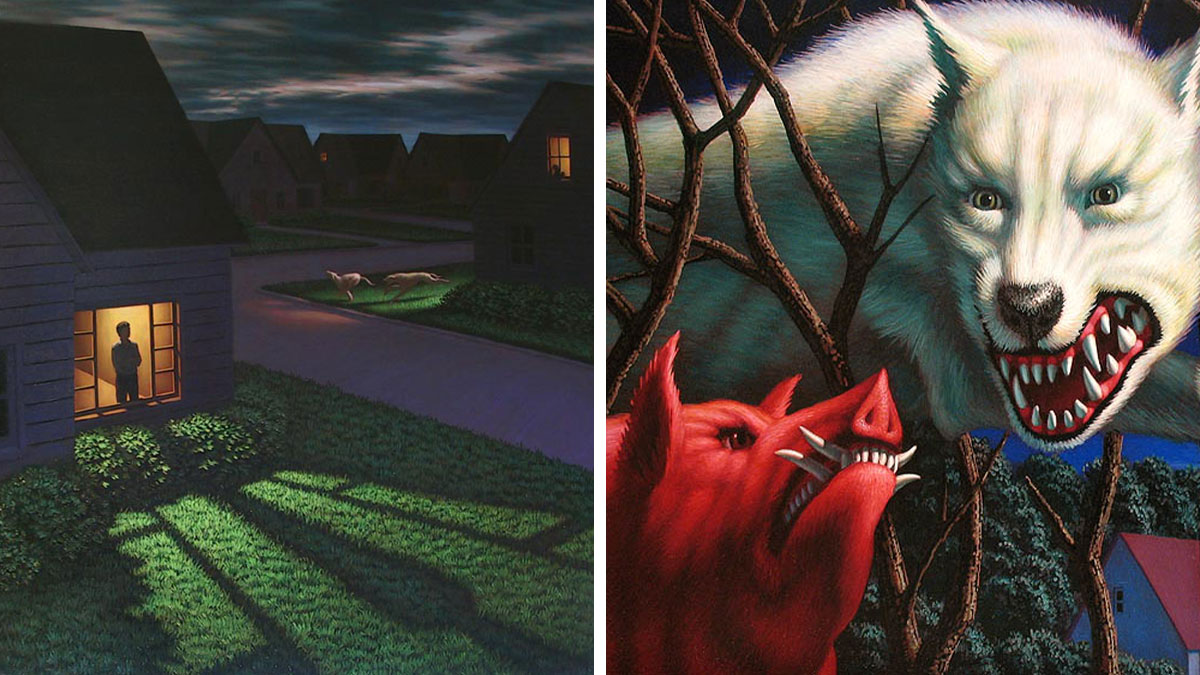
Description: “On the Corner is a medium size painting, in oils on canvas. It is a night scene with different color light coming from different sources – interior lighting, a TV screen, a traffic light, the moon, a stain glass window. This manmade lighting creates our night time world. It is Surrealist Art combined with American Scene painting, and American Primitive art. The lighting combined with the severe simplification of the houses and trees creates a dream world of memory rather than observation.
Different levels of image and reality are represented. A woman looking at herself in a mirror, a child watching TV, a woman seen through a window are examples of this. These reflections of reality, and transmissions of reality are real and not real at the same time. Just as this painting itself is real and not real at the same time.
Technically speaking the pebbly road and shingles were created by underpainting the textures with raised white paint. When the white was dry, thin oil paint was glazed over this creating a luminous color. The surreal space is a distortion. The viewer is looking down at the immediate foreground, then gradually moves to a straight out view in the distance.”
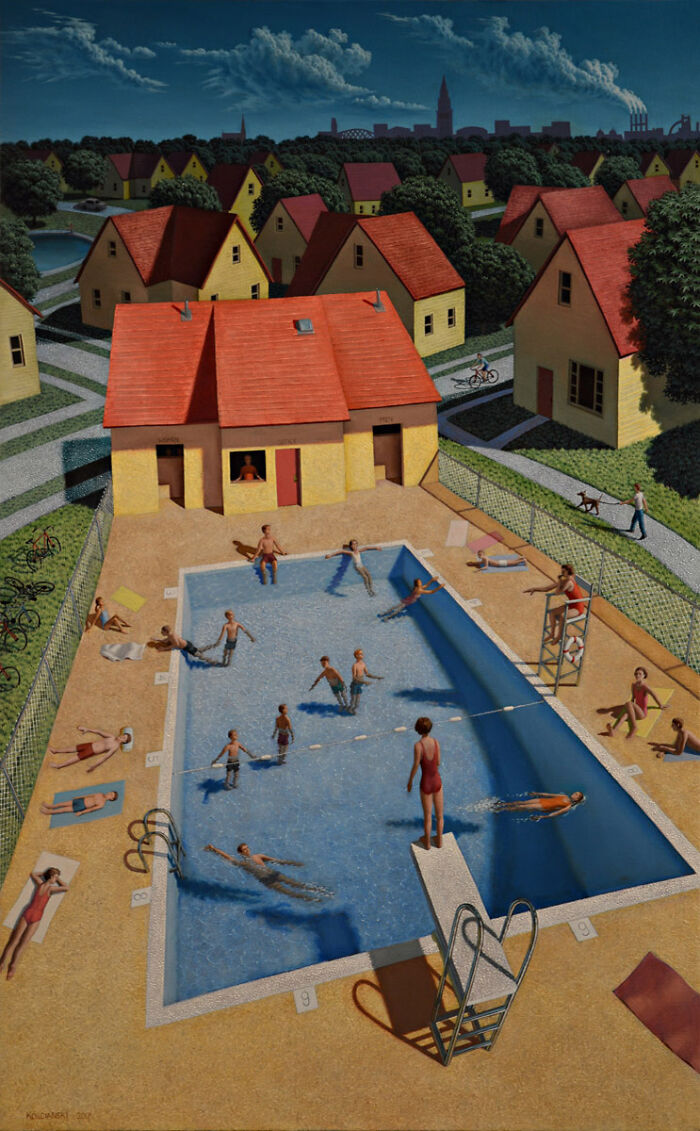
Description: “Summer in the City is a medium size painting, in oils on canvas. Its based on childhood memories of summers spent at the municipal pool in Parma, Ohio, a suburb of Cleveland. Everyday in the summer the pool was packed with kids from the nearby neighborhoods. Except for the lifeguards, and the managers, there were no adults. Its not that they weren’t allowed, they just never came in the afternoons. In the background – the Cleveland skyline as it existed in 1963.
Stylistically it is an eclectic mix of American Realism, Surrealist Art, and American Primitive painting. This mixing of styles makes it Postmodern Art. The diver is realistic, but the houses are severely simplified, ala the surrealist paintings of Giorgio de Chirico. Paintings based on childhood memories are a favorite of American Primitive painters. The texture of the water and concrete were both created by underpainting with thick, pure white paint to create the textures. The colors were glazed over the top of the dry white paint, giving them luminosity. The space of the painting is a Surrealist distortion of classical perspective. The viewer is looking straight down at the diving board ladder, but straight out at the city skyline.”
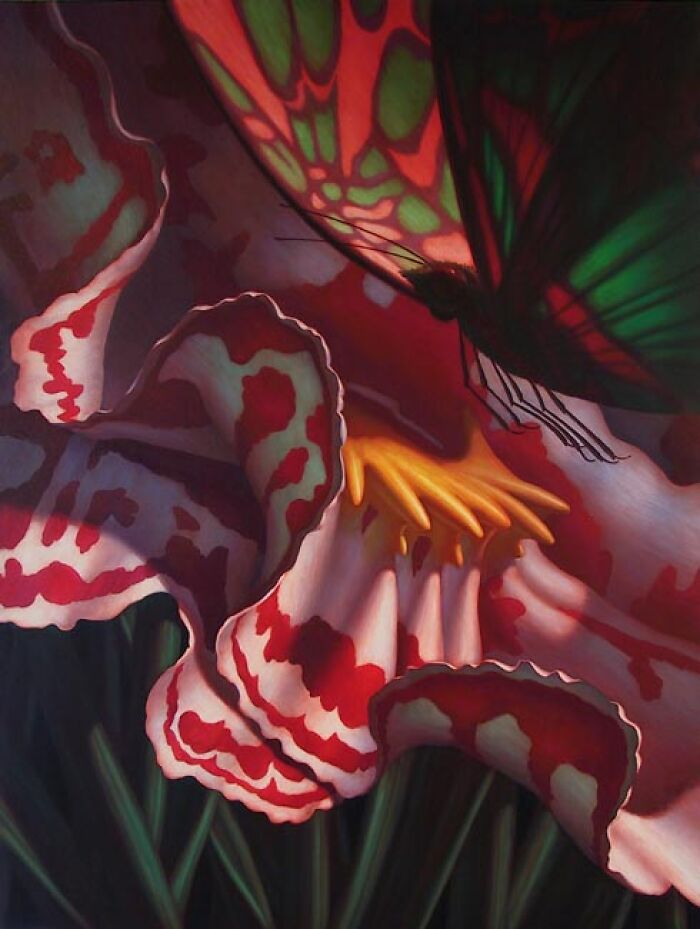
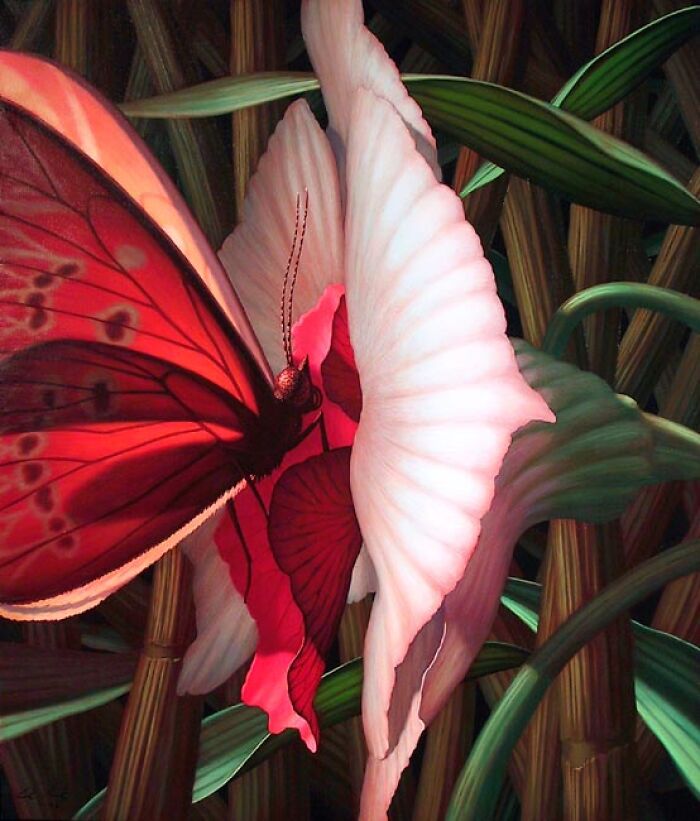
Description: “Orchid and Butterfly is a medium size painting in oils on canvas. It is a combination of imagination and observation. The scene itself is imaginary; the orchid is based on a live orchid in the artist’s collection, the pattern on the butterfly’s wings is imagined. The visual richness of the painting is created by color patterns that combine reflected and transmitted light. The painting has a dark night time feel with light pouring in from above. This is a surreal, dreamlike image. It is strongly influenced by mid Twentieth Century American and European artists like Georgia O’Keeffe, Rene Magritte, and Salvador Dali.”
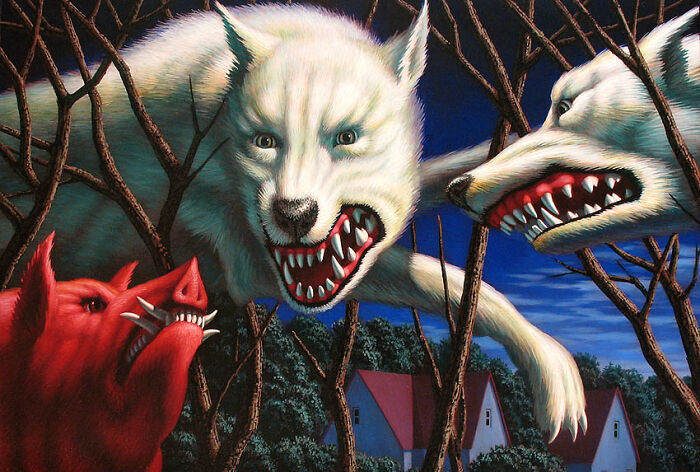
Description: “Modern Living is a small painting in oils on canvas. It features three animals in aggressive conflict. Two dogs are confronting a red boar. It is a surreal painting, the colors are symbolic, the animals idealized. The title suggests that it is not about animals, but about people, and their interactions. The tone of the interaction is fierce and aggressive. It is a painting, not an illustration, so we are asked to contemplate this fierce energy as a thing of beauty. Living in an increasingly feminized world, masculine expressions are increasingly rare and valuable, we are asked by this painting to value them. Many of our greatest achievements as humans began with expressions of frustration and anger.”

"Living in an increasingly feminized world, masculine expressions are increasingly rare and valuable" - W H A T
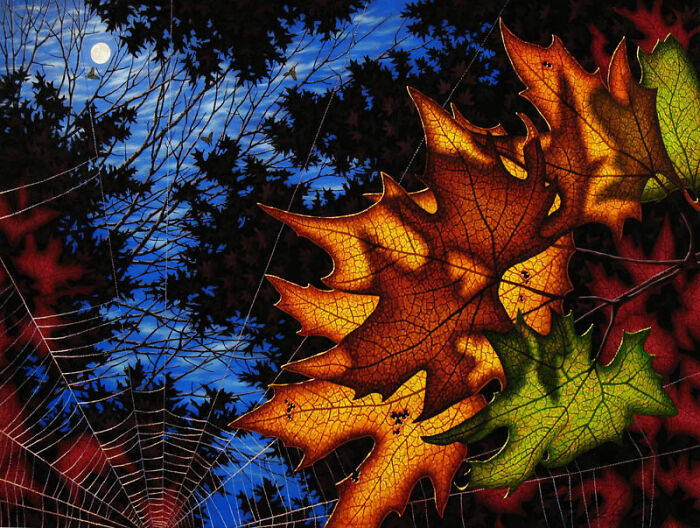
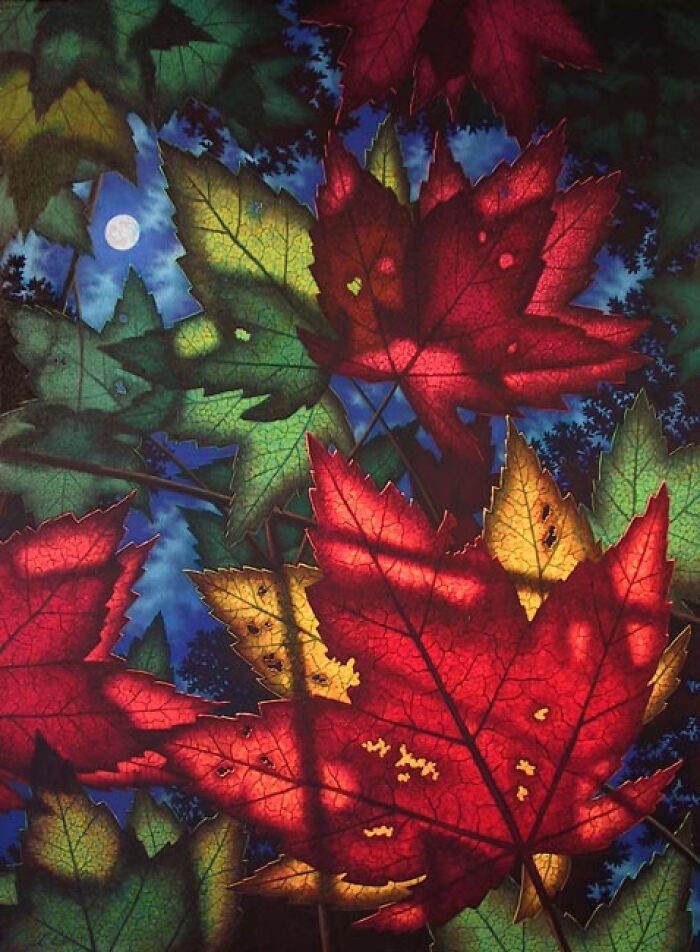
Description: “Leaf Shadows is a medium size painting in oils on canvas. It is surreal and dreamlike. It is one of a series of paintings depicting a view up through autumn leaves on a moon lit night. It combines several incongruous elements in a plausible space to create a dramatic image. It is Postmodern Art in that it borrows different styles and recombines them to create the image. The light shining through the leaves creates a sense of the transparency of autumn leaves. The spider web glistens with tiny drops of dew. The moon lit night sky is the back ground for this look up through tree branches.
The texture of the leaves is created by small, raised spots of paint. This gives the leaves a physical as well as visual texture. The painting was first painted in a cooler palette, and then thin layers of glazes were applied to give the colors more luminosity to compliment the illusion of transparency and glowing color. The holes in the leaves add a realistic touch to a Surrealist painting that also pays homage to American Primitive art.”
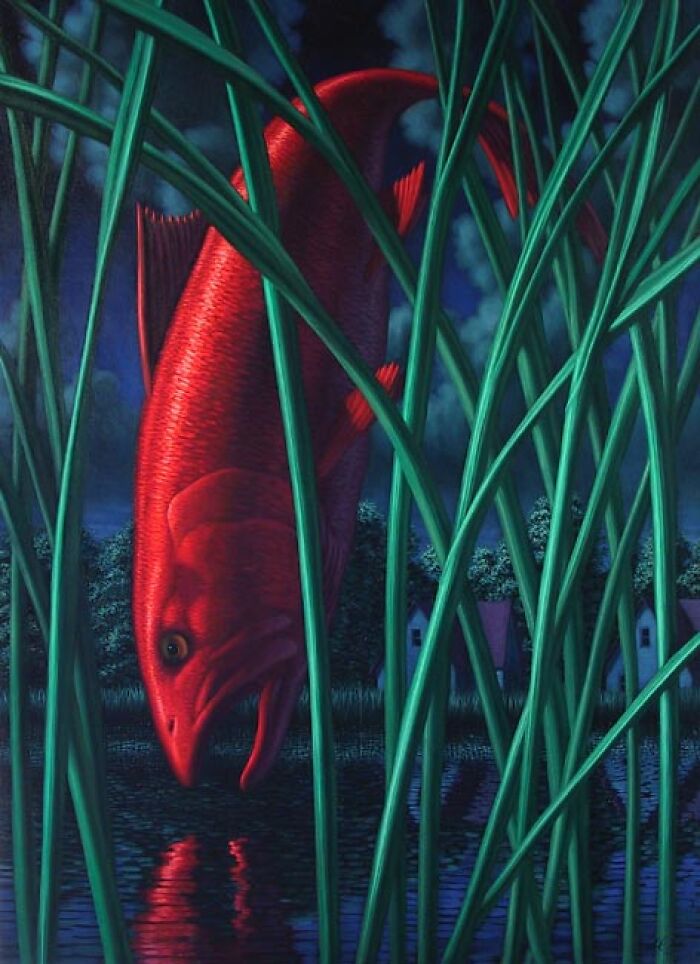
Description: “Red Fish is a large painting in oils on canvas. Very dreamlike and surreal it depicts a large red fish plunging back into blue water. It is the moment before the fish enters the water, it is suspended above it’s own reflection. This dramatic night scene has a tranquil suburban background. This dream may be happening in the backyard of our own minds. The fish appears to be contemplating its own image. In symbolic terms, the fish may represent the self, and the pool of water, the subconscious mind. Elements, sometimes scary, emerge from the subconscious, into the clear air of the conscious realm, then plunge back into the subconscious and disappear for a time. The red color may stand for heat or passion lurking in the cool depths. The point is that on a symbolic level, this may be happening to us now, in our own lives.”
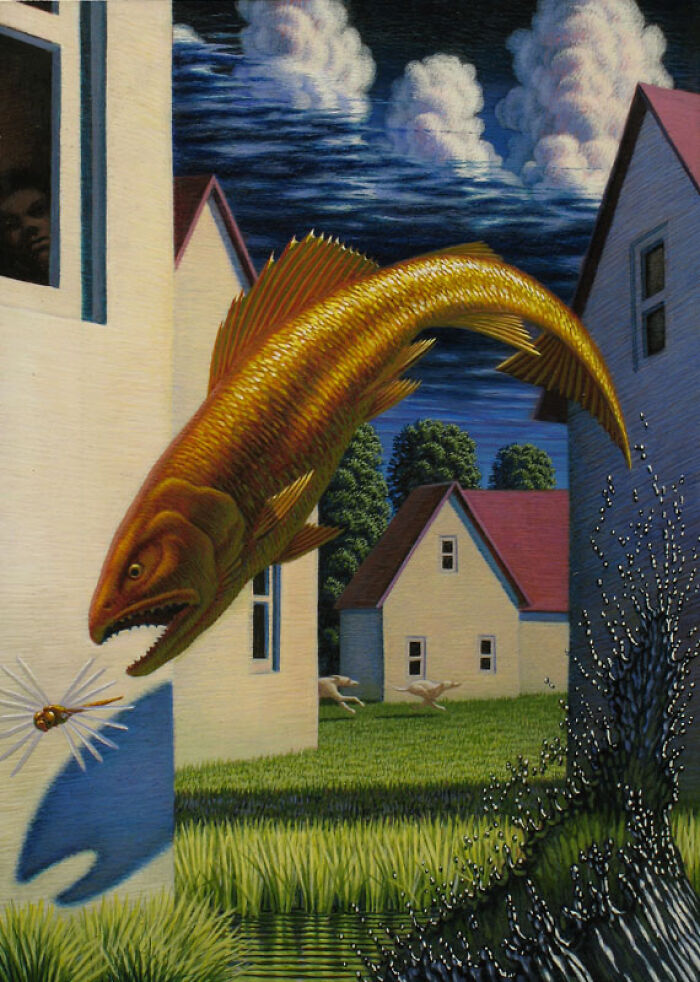
Description: “From the Window is a very small painting in egg tempera on panel. This painting is based on a much larger oil on canvas. It depicts a golden fish leaping out of the water to catch a dragon fly. This painting was done from the imagination. It wasn’t “intend” to have a literal meaning, it is not an illustration. However, the golden fish has received attention for its symbolic associations. In Jungian literature, a golden fish can stand for the soul. Gold is the color of the eternal, and a pool is often seen as representing the subconscious. This is a surreal painting. It is a surreal reflection on suburban, waterfront living. The title of the work (“window”) refers to the figure looking out of the window, as well as to the picture plane itself. Though not deliberately intended, the person in the window bears a striking resemblance to the artists brother. The splash is influenced by Harold Edgerton’s famous historic photograph of the splash of a drop of milk.”
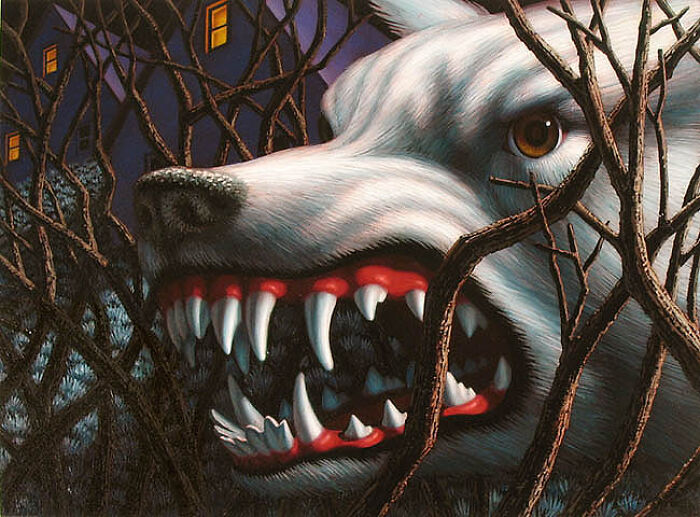
Description: “This is a small painting, in oils on wood panel. It is Postmodern in style. It combines styles in an eclectic blend to create a contemporary art piece. Romantic Art ala George Stubbs is combined with Surrealism and American Primitive art. The white, dreamlike canine (is it a wolf or a dog?) is rendered in precise detail. But the details are not those of a “realistic” image. The canine is painted from the imagination. It is not based on any real world model. The background houses are severely simplified ala Italian surrealist, Giorgio de Chirico. The viny branches are symbolic as well. The colors are used to heighten the expressive character of the subject. The red gums of the dog are exaggerated, over simplified. Most of the other colors are exaggerations and/or oversimplifications. This is a dream world, a nightmarish world, of a dystopian suburbia.”
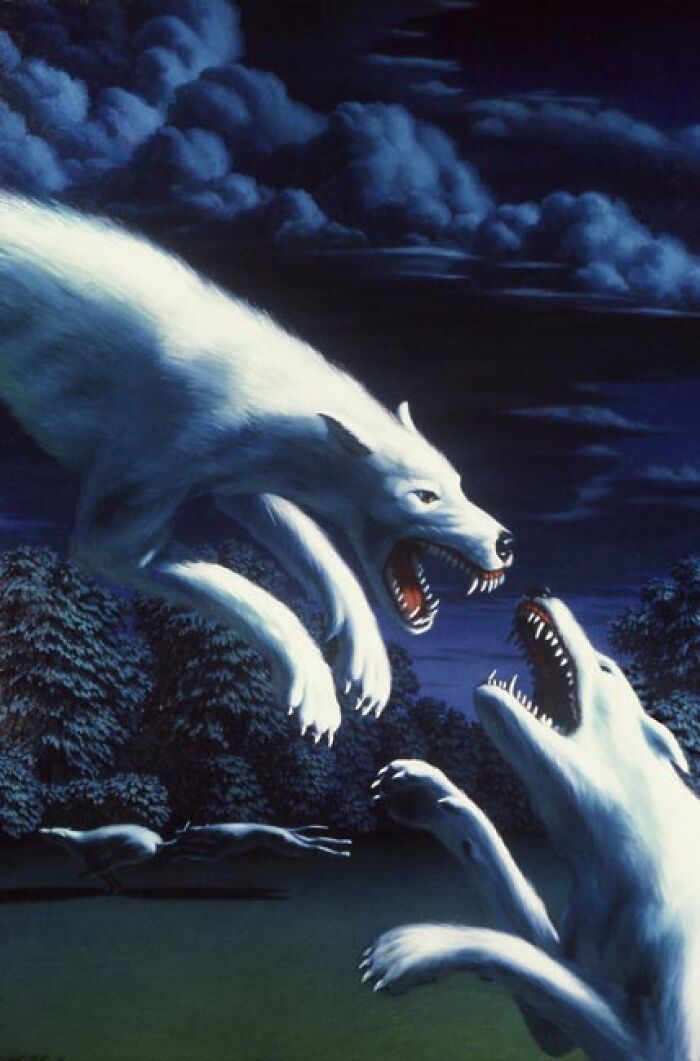
Description: “This painting was created using oil paint on canvas. It is Surreal in style, with a dreamlike character. The blue tonality gives the image a night time appearance. The lighting suggests moonlight. This painting was acquired by curator William Lieberman for the permanent collection of the Metropolitan Museum of Art. It is a classic example of 1980’s Postmodern Art.”
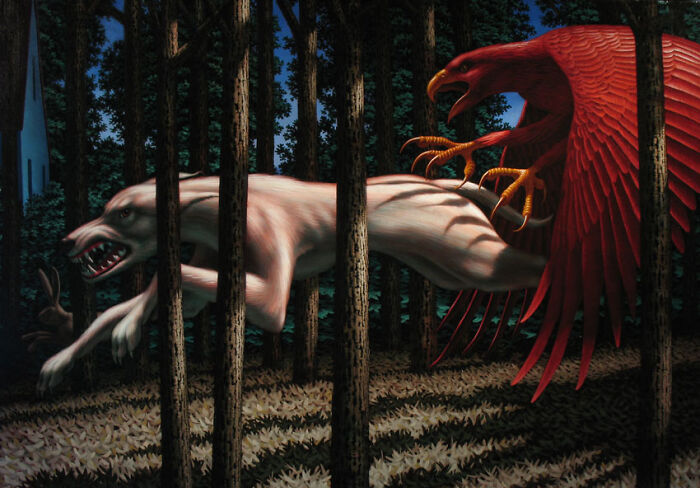
Description: “Claws is a large painting in oils on canvas. It is a wholly imaginary and surreal image of animal conflict. Being surreal, it can be read as a symbol of human conflict. The scene takes place behind a suburban home, which places it in a human context. Brush strokes are used to create texture, especially in the foreground leaves. The colors are symbolic with warm, even hot colors in the animal dominated foreground, and tranquil blues and greens in the distance. Even though the theme is fierce, there is a rhythmic elegance to the composition as a whole. This rhythmic quality harks back to the Mannerist paintings of 16th Century Italy. This borrowing of styles from the past makes this painting Postmodern in style.”
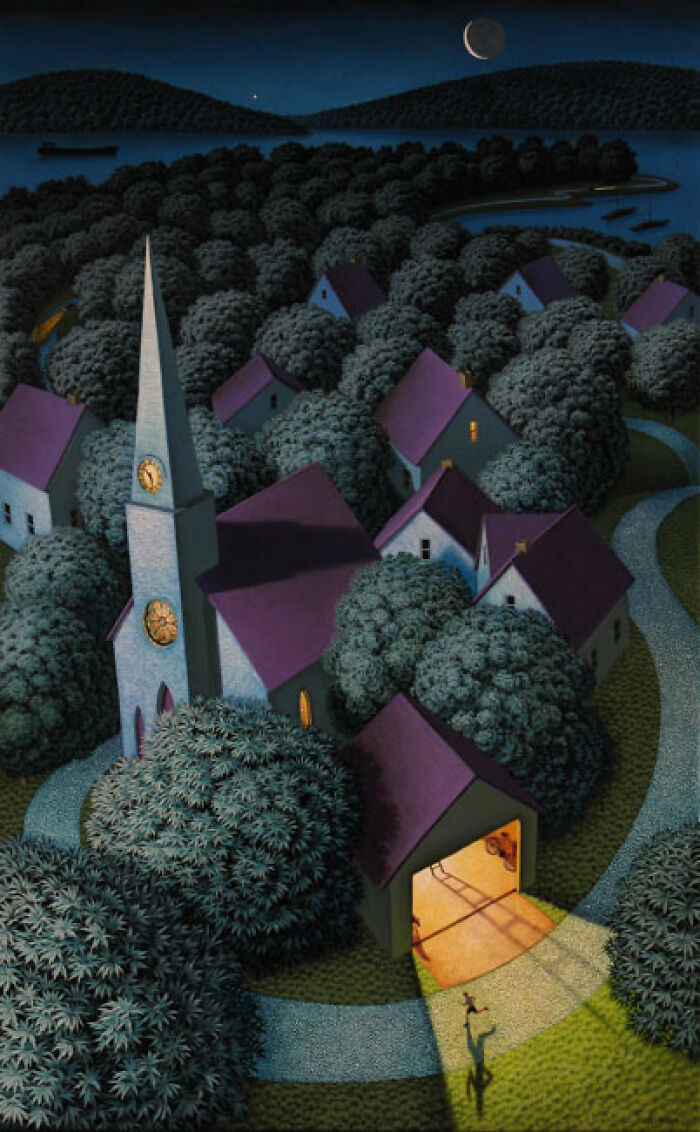
Description: “The Fisherman is a medium size painting in oils on canvas. It is an imaginary reconstruction of my favorite fishing spot, near my house, on Spa Creek, in Annapolis. The best time for fishing here is early in the morning, when the night is turning into day. In the painting, it is morning in the foreground, and still night in the blue background. It is Postmodern in that it appropriates different styles and recombines them into an eclectic whole.
The surreal space is curved. The viewer is looking straight down at the foreground, with the fisherman, and straight out at the distance, with silhouettes of prominent Annapolis churches. The road connects the foreground to the background. The fisherman is realistic, but the severely simplified houses are not. They are surreal houses, dream houses that are symbolic rather than real. Some aspects of the highly detailed water, grass, and trees are real, some are not. This painting was done from the imagination. It is influenced by Grant Wood, though the ultra simple houses are more like Italian Surrealist Giorgio de Chirico, and the fisherman is akin to the style of American realist Martin Johnson Heade. The primary color scheme is dominated by red, yellow, green and blue. The fisherman is red, white, and blue.”
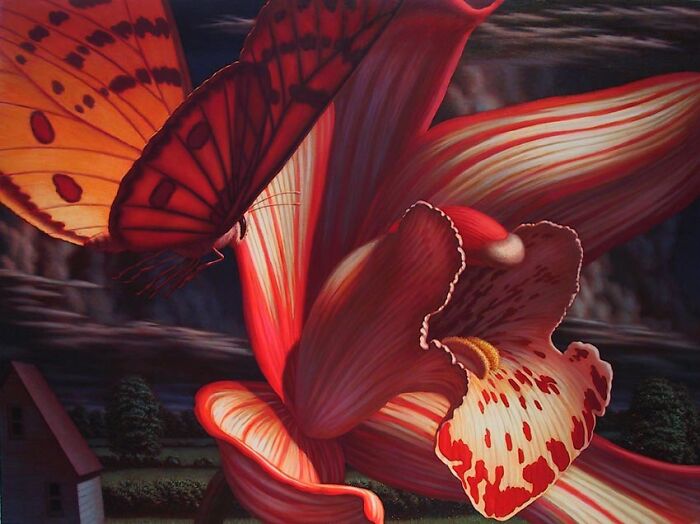
Description: “Cymbidium and Butterfly is done from the imagination. It is a large painting in oils on canvas. The dramatic Postmodern style combines elements of Surrealism and Expressionism. Though the orchid and butterfly seem based on observation, they are imaginary. With the orchid, the long thin brushstrokes create a sense of detail. The transparency of the butterfly wings are the result of subtle color relationships. The ominous feathery clouds create a stormy mood.
Technically speaking, the painting was first painted in a much cooler palette, then thin warm colors were glazed over this to create a luminosity and atmosphere, that would not be possible with straight “ala prima” painting. This appropriation of styles and techniques from the past is characteristic of Postmodernism. The white brush strokes, in the orchid, use relatively thick paint compared to the rest of the painting.”
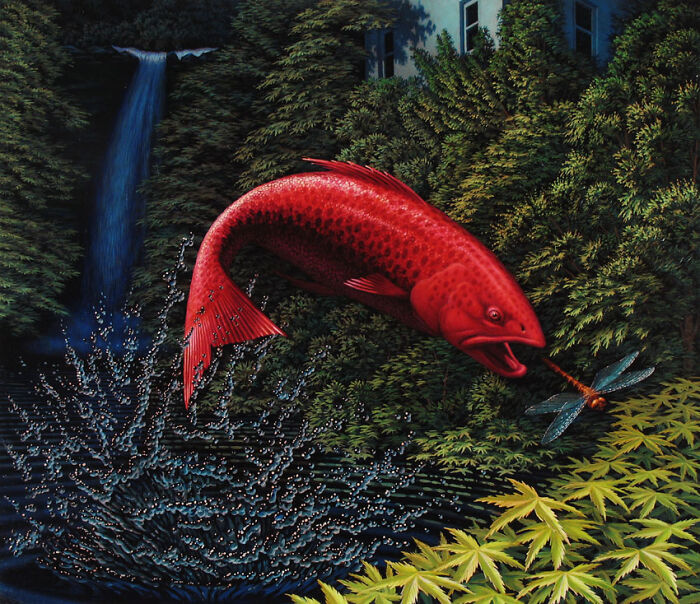
Description: “Like a Fish Out of Water is a small panel painting, in oils on a wooden panel. It is an imaginary reconstruction, inspired by a hike in the Shenandoah Mountains. I did see trout swimming in a pool, but they weren’t red. There was a waterfall, but it wasn’t blue. The marijuana leaves in the foreground suggest a dream state. Though based on an actual experience, it is painted from imagination. However, I did do some research when painting the dragon fly wings. The house is difficult to place in a rational space, but is important because it suggests the presence of civilization. This is Surrealist Art, but it is combined with other styles in a Postmodern Art manner. Portraits of leaping fish were popular in the Nineteenth Century, Winslow Homer comes to mind. Though this painting is not at all realistic, it does allude to the realist tradition in American Art, as well as the colorful romantic visions of the Hudson River School.”
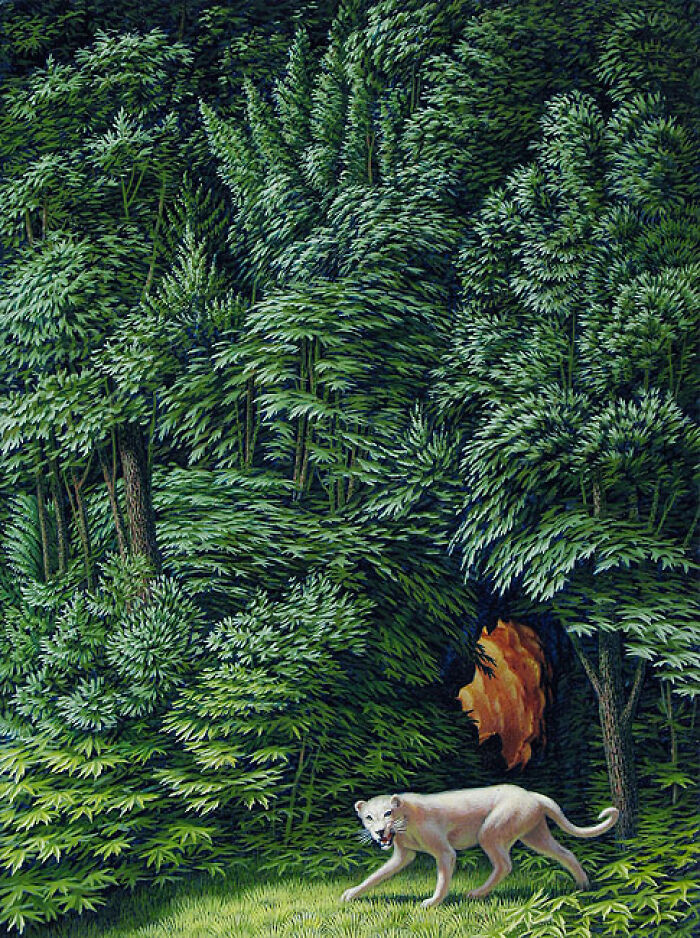
Description: “Forest Green is a small painting, in egg tempera, on a gessoed, wood panel. It is very precise in detail, but is not realistic. The egg tempera medium uses thin brushes, so it is conducive to detailed painting. At some points, it was painted using a magnifying glass. This scene is composed primarily of a lush green landscape of trees, with a white panther stalking across the foreground, and an illuminated cave under the trees. The landscape background is based on a 16th painting by Lucas Cranach.
The style is Postmodern in that it appropriates styles from the past and recombines them to create a contemporary image. It is dreamlike – more expressive, and surreal than realistic. There is a flow to the leaves and branches that creates a sense of movement and energy. It’s as if the leaves and branches are being stirred by the wind, it also expresses the animal energy, and motion of the white panther. The painting is green overall, however, there are many shades of green, ranging from a pale yellow, to a dark almost blue.”



These are really wonderful! I love the vivid colors and clean lines.
These are really wonderful! I love the vivid colors and clean lines.






























 No fees, cancel anytime