Get Premium
Dark mode theme is available exclusively for premium users. Learn more about the benefits of subscribing.
No fees, cancel anytime.

 Dark Mode Ad-Free Browsing Unlimited Content
 Ad-Free Browsing Unlimited Content Dark Mode
Join 1.2 million Panda readers who get the best art, memes, and fun stories every week!
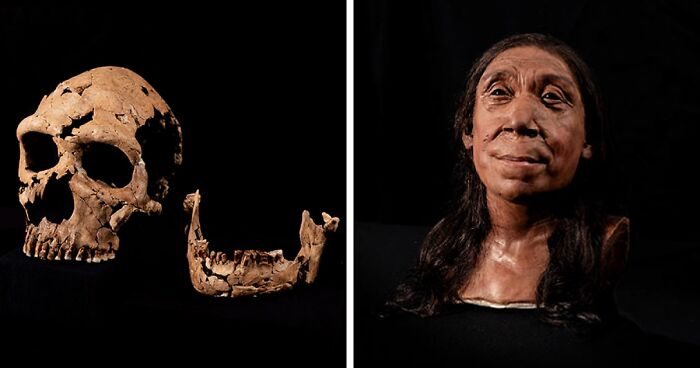
Scientists have reconstructed the skull of a 40-something Neanderthal woman buried in a cave 75,000 years ago.
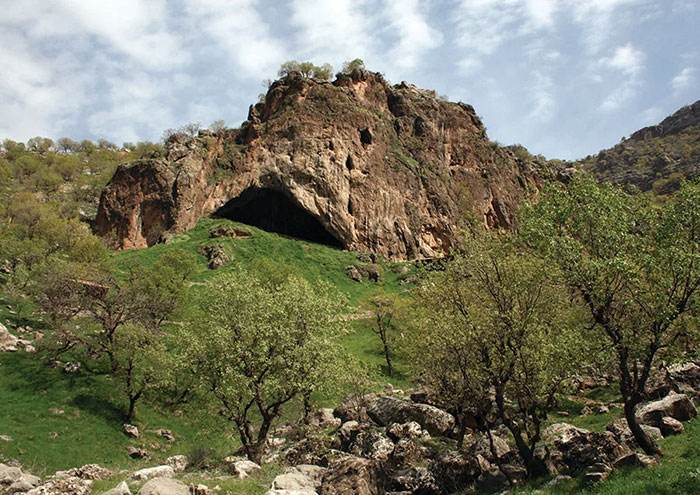
The woman, found in 2018, was given the name Shanidar Z after the cave in Iraqi Kurdistan where she was laid to rest.
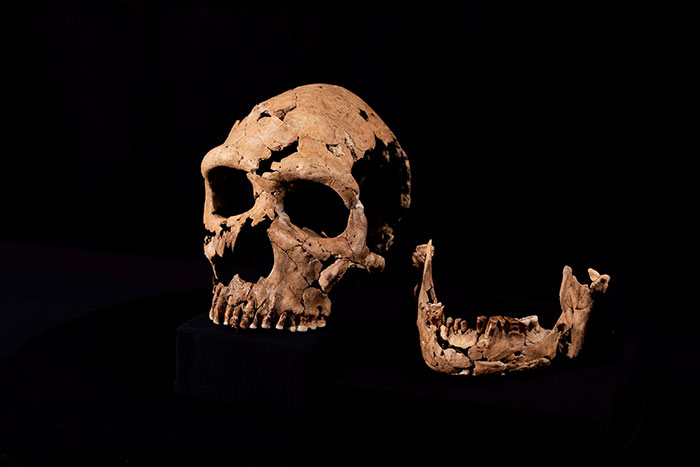
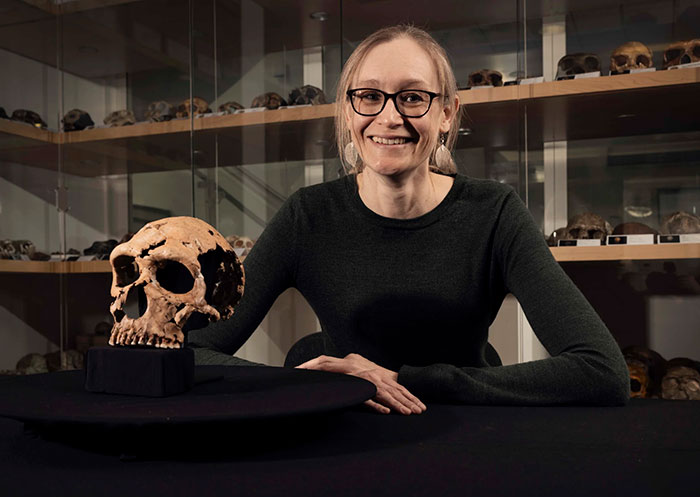
To learn more about Neanderthal anatomy, scientists spent nine months piecing together Shanidar Z’s skull from 200 bone fragments.
“There is some artistic license there, but at the heart of it is the real skull and real data on what we know about (these) people,” said Dr. Emma Pomeroy, a paleoanthropologist and associate professor with the University of Cambridge’s department of archaeology who unearthed the skeleton.
The skull had been crushed, possibly by rockfall soon after death, so reconstructing it felt like piecing together a “high stakes 3D jigsaw puzzle,” Pomeroy described.
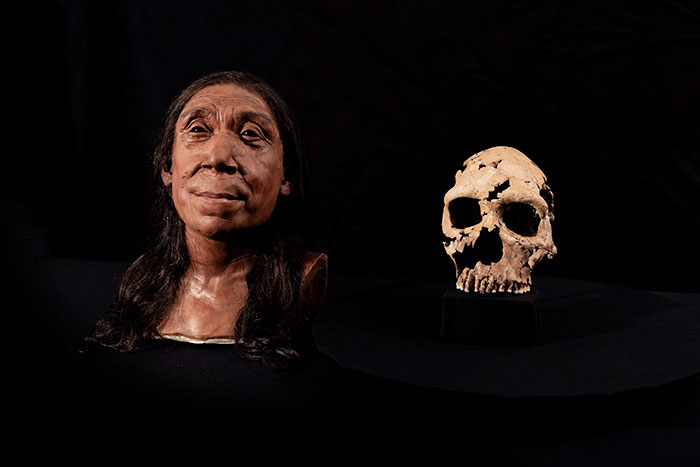
Image credits: University of Cambridge/Jamie Simonds
Neanderthals inhabited Europe, the Middle East, and Central Asia Mountains for approximately 300,000 years, overlapping with our own species, Homo sapiens, for about 30,000 years. Evidence confirms that, during this period, Neanderthals and modern humans encountered each other and interbred.
The recreation of Shanidar Z’s skull is shown in the new Netflix documentary Secrets of the Neanderthals, which was produced by the BBC.
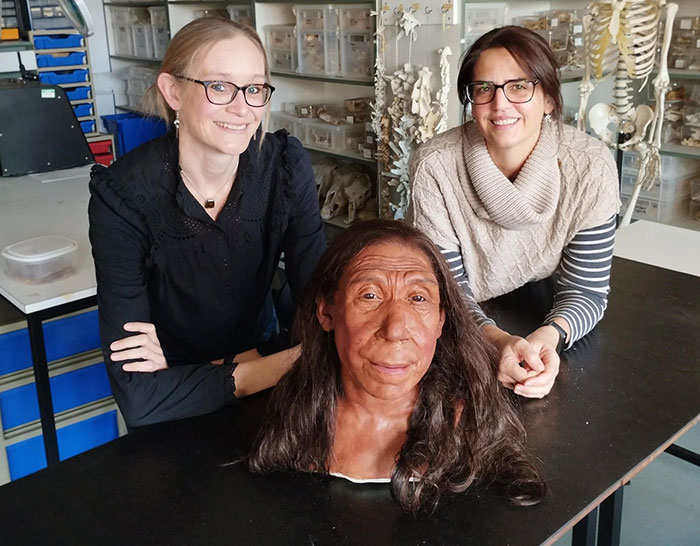
“She’s actually got quite a large face for her size,” Dr. Pomeroy, who appears in the film, explained.
“She’s got quite big brow ridges, which typically we wouldn’t see, but I think dressed in modern clothes, you probably wouldn’t look twice.”
In addition to more prominent brow ridges, another difference between the anatomy of Neanderthals and Homo sapiens is that the former had no chins, the paleoanthropologist added.
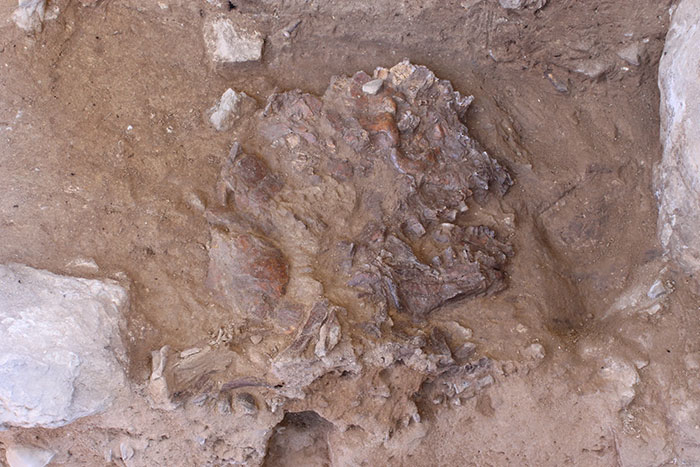
At the time of the excavation, Pomeroy was unable to immediately determine the sex of Shanidar Z, given that the lower part of the body, including pelvic bones, wasn’t preserved.
Image credits: University of Cambridge/Graeme Barker
Image credits: University of Cambridge/Graeme Barker
Researchers were able to conclude that Shanidar Z was a woman after using a technique involving the sequencing of proteins inside the tooth enamel.
Furthermore, after analyzing the wear and tear on her teeth and bones, they estimated that Shanidar Z was in her mid-40s when she was buried.
“It’s a reasonable estimate, but we can’t be 100% sure, actually, that they weren’t older,” Pomeroy said.
“What we can say is this is someone who had lived a relatively long life. For that society, they probably would have been quite important in terms of their knowledge, their life experience.”
Image credits: University of Cambridge/Jamie Simonds
As for the specimen’s height, researchers from the universities of Cambridge and Liverpool believe she measured around 5 feet (1.5 meters). They arrived at this number by comparing the length and diameter of Shanidar Z’s arm bones with data on modern humans.
Shanidar Z is the first Neanderthal found in the cave— located in the foothills of Iraq— in over 50 years.
Image credits: University of Cambridge
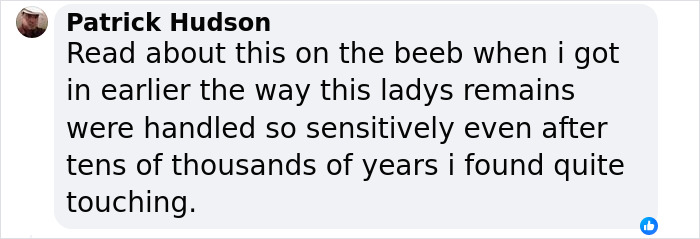
Scientists have proven that it was common for the Neanderthals of Shanidar Cave to lay their dead to rest at the site, contradicting long-held beliefs that members of this species were brutish and insensitive.
Discoveries of decorative shells and the use of red ochre pigment at Neanderthal sites also suggest that they used objects for art. This would mean that Neanderthals had symbolic abilities once thought to be uniquely human.
Image credits: University of Cambridge/Emma Pomeroy
After excavating the skull, researchers used a glue-like consolidant to harden the fossilized bones. Then, they removed them in small blocks of cave sediment and sent them to the University of Cambridge for analysis.
After that, the dedicated team of archaeologists took micro-CT scans of each block, and the lead conservator, Dr. Lucía López-Polín, pieced over 200 bits of the skull together by eye to return it to its original shape.
The rebuilt skull was scanned and 3D-printed before Shanidar Z’s face was recreated by world-leading paleoartists Adrie and Alfons Kennis.
As Pomeroy explained, the reconstruction of the Neanderthal skull helps “bridge that gap between anatomy and 75,000 years of time.”


More cool space, archeological, and general science articles, less aita. This is actually interesting, reading about a Redditors divorce isn't


she looks like the type of woman who invites everyone into her home and feeds them. idk why, she just has a kind homely look.

I've always been fascinated with human evolution. And especially how H.sapiens and Neanderthal interacted with each other. According to numerous studies, modern humans of European descent have up to 4% Neanderthal DNA, while humans living in Europe & the Middle East 40,000 years ago had as much as 9%. There's been a lot of debate over the years as to whether Neanderthals should be considered a separate species from modern humans (Homo Neanderthalensis), or a sister species to modern humans (Homo Sapiens Neanderthalenis).
More cool space, archeological, and general science articles, less aita. This is actually interesting, reading about a Redditors divorce isn't
she looks like the type of woman who invites everyone into her home and feeds them. idk why, she just has a kind homely look.
I've always been fascinated with human evolution. And especially how H.sapiens and Neanderthal interacted with each other. According to numerous studies, modern humans of European descent have up to 4% Neanderthal DNA, while humans living in Europe & the Middle East 40,000 years ago had as much as 9%. There's been a lot of debate over the years as to whether Neanderthals should be considered a separate species from modern humans (Homo Neanderthalensis), or a sister species to modern humans (Homo Sapiens Neanderthalenis).





















 No fees, cancel anytime










64
16