Get Premium
Dark mode theme is available exclusively for premium users. Learn more about the benefits of subscribing.
No fees, cancel anytime.

 Dark Mode Ad-Free Browsing Unlimited Content
 Ad-Free Browsing Unlimited Content Dark Mode
Join 1.2 million Panda readers who get the best art, memes, and fun stories every week!

Recruiting is all about finding and hiring the right people. However, the criteria that describe the term “right” might be different depending on who you ask. Even within the same company.
A recent post from r/RecruitingHell highlights this dilemma.
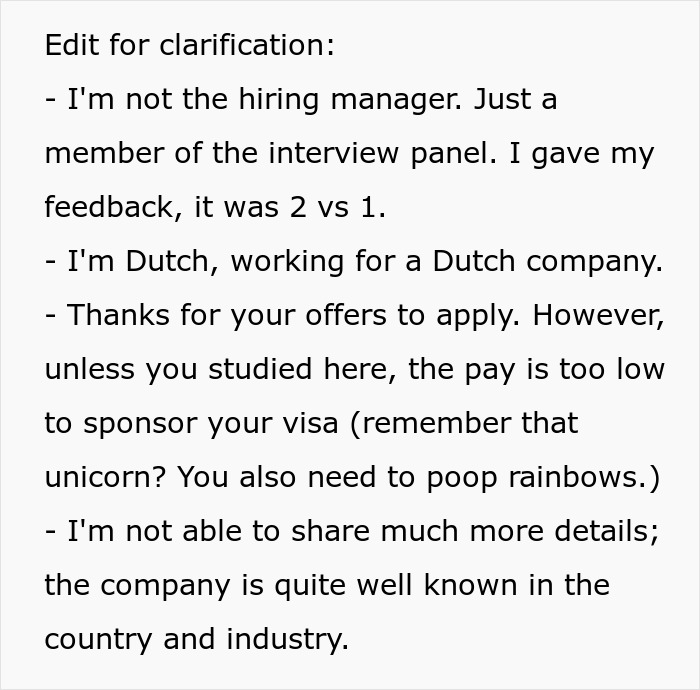
Created by a person who goes by the nickname DutchTinCan online, it describes a situation their company ended up in when it finally received approval to fill a critical role.
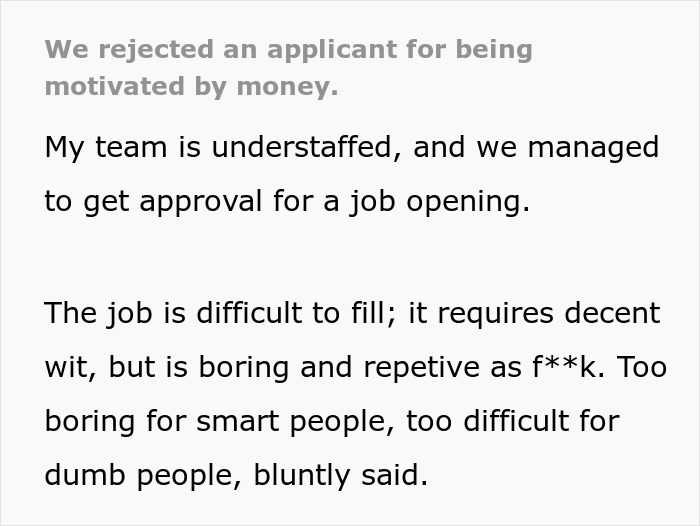
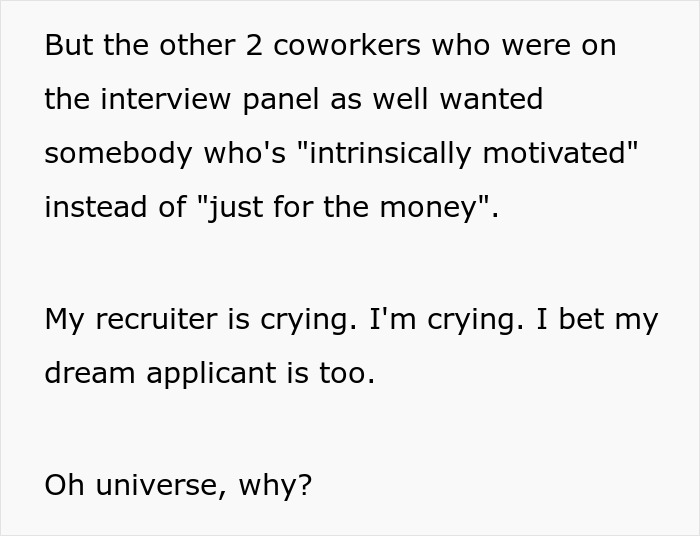
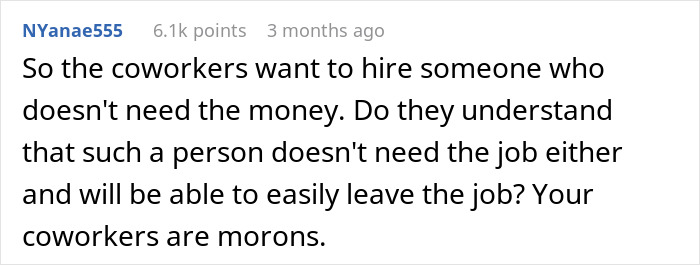
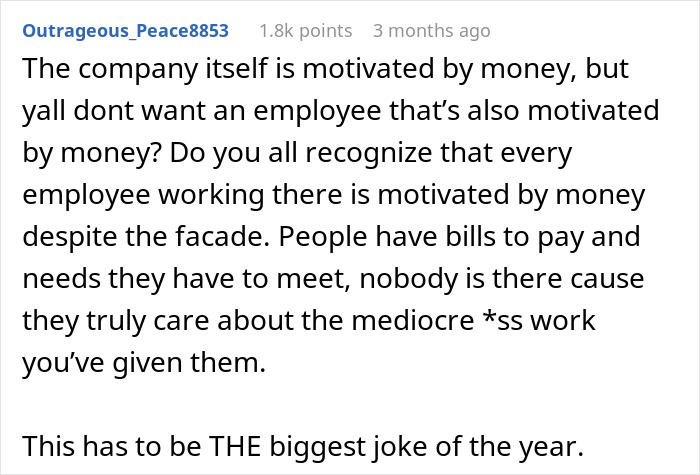
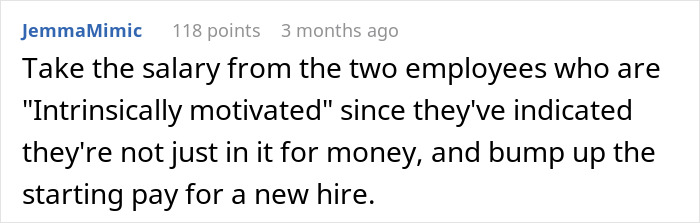
The position was a tough sell—boring and repetitive, yet demanding enough to require a sharp, capable individual. After a lengthy search, they found one person who seemed like the perfect candidate—until the hiring panel started raising concerns about his motivation.
Image credits: Tima Miroshnichenko/Pexels (not the actual photo)
Image credits: Tim Gouw/Pexels (not the actual photo)
Image credits: DutchTinCan
Image credits: Sora Shimazaki/Pexels (not the actual photo)
In a huge meta-analysis comprised of 120 years of research and findings from 92 quantitative studies, Tim Judge and his colleagues showed that the link between salary and job satisfaction is pretty weak.
The reported correlation indicates that there is less than a 2% overlap between pay and job satisfaction levels. Furthermore, the correlation between pay and pay satisfaction was only marginally higher (4.8% overlap), indicating that people’s satisfaction with their salary is mostly independent of their actual salary.
Interestingly, employees earning salaries in the top half of their data range reported similar levels of job satisfaction to those in the bottom half of their data range.
However, a study by Yoon Jik Cho and James Perry offers more nuance on the topic. The researchers analyzed real-world data from a representative sample of over 200,000 U.S. public sector employees. While the results showed that people’s engagement levels were three times more strongly related to intrinsic than extrinsic motives, the data also revealed that both motives tend to cancel each other out.
In other words, when employees have little interest in external rewards, their intrinsic motivation has a substantial positive effect on their engagement levels, and when employees are focused on external rewards, the effects of intrinsic motives on engagement are significantly diminished.
But don’t these numbers just mean that people who don’t like their jobs have nothing to think about other than the money? Or does focusing on money prevent you from enjoying your job?
Tomas Chamorro-Premuzic, the Chief Innovation Officer at ManpowerGroup and a professor of business psychology at University College London and at Columbia University, believes that ultimately, one size does not fit all.
“Our relationship to money is highly idiosyncratic,” he writes. “Indeed, in the era of personalization, when most things can now be customized to fit our needs — from social media feeds to potential dates, to online shopping displays and playlists — it is somewhat surprising that compensation systems are still based on the premise that what works for some people will also work for everyone else.”
“Other than its functional exchange value, pay is a psychological symbol, and the meaning of money is largely subjective. For example, there are marked individual differences in people’s tendency to think or worry about money, and different people value money for different reasons (e.g., as a means to power, freedom, security, or love),” Chamorro-Premuzic explains. “If companies want to motivate their workforce, they need to understand what their employees really value — and the answer is bound differ for each individual.”

By entering your email and clicking Subscribe, you're agreeing to let us send you customized marketing messages about us and our advertising partners. You are also agreeing to our Privacy Policy.
Thank you! You've successfully subscribed to newsletters!

LOL at the comment who is complaining about "corporate America". OP literally stated they're Dutch and working for a Dutch company.


I teach English at a technical university and one of the things we talk about with my students is job interviews (in English, obviously). When we get to the question "Why do you want to work here?" they all instinctively want to answer "to have money for bills", and I have to explain the song and dance you have to do about how you want to be a part of the company because it's so great bla bla. They always find it funny.
LOL at the comment who is complaining about "corporate America". OP literally stated they're Dutch and working for a Dutch company.
I teach English at a technical university and one of the things we talk about with my students is job interviews (in English, obviously). When we get to the question "Why do you want to work here?" they all instinctively want to answer "to have money for bills", and I have to explain the song and dance you have to do about how you want to be a part of the company because it's so great bla bla. They always find it funny.







































 No fees, cancel anytime























33
21