ADVERTISEMENT

In a world that moves forwards quickly and relentlessly, we’re so lucky to still have the ruins of ancient history to remind us of our past. But even though it’s inspiring to visit something that was built thousands of years ago, it’s not always easy to understand what it would the historical sites actually looked like.

Take the Parthenon in Athens, for example. Today it’s mostly a collection of very old pillars without a roof, because of an explosion that happened in the 17th Century, and all of its treasures, including a huge statue of the goddess Athena, are long gone.

Luckily a team of digital artists has gone through the trouble of digitally recreating what, according to the experts, the inside of the Parthenon would have looked like in all its original glory, and it’s an incredible place to see. They’ve done the reconstruction for six other famous historical places, from Angkor Wat in Cambodia to some Roman Baths in England, and the result is as close as you can get without jumping into a time machine.

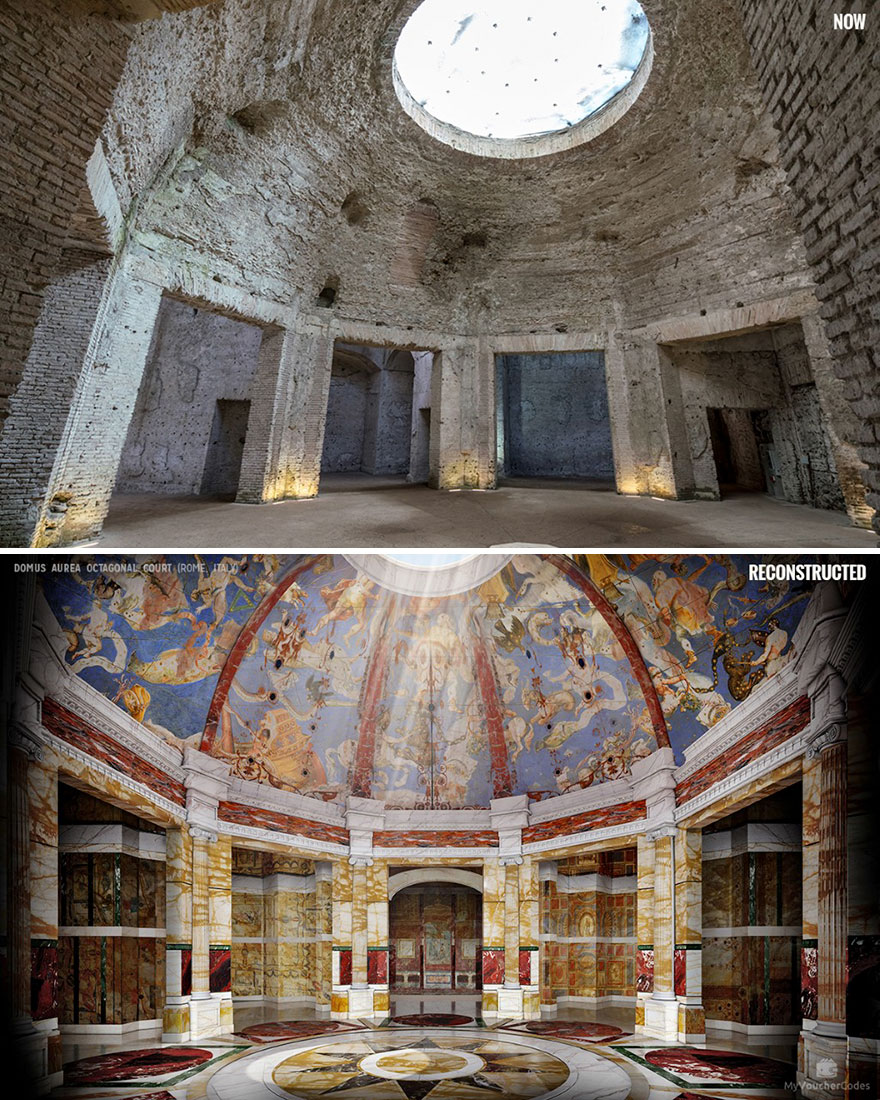
One of the hardest things to imagine when looking at ancient ruins is seeing the kind of jewel-encrusted finery that was surely there in a room as grand as the Domus Aurea Octagonal Court in Rome. The famous building dates back to around 65 AD and was basically a party hall for Emperor Nero, so probably saw some crazy stuff and wouldn’t have looked out of place on MTV’s Cribs.

However, visiting it today you get to see a lot of bare walls and a dome. But with the help of some digital wizardry, you can really see a room fit for an Emperor and his posse, from the mosaic in the dome to walls covered in gems and flowers.

Scroll down to see all seven of these amazing ancient ruins brought back to life.

More info: myvouchercodes.co.uk

#1

Domus Aurea Octagonal Court (Rome, Italy)

Domus Aurea Octagonal Court (Rome, Italy)

Constructed between 65 and 68 AD by one of Rome's most notorious emperors, the eponymous Golden House of Nero was a lavish palace complex that played host to the Emperor’s wild parties and banquets. The large, octagonal room had a concrete dome, most likely covered in glass mosaic. Roman historian Suetonius tells us of a 'circular banquet hall, which revolved incessantly, day and night, like the heavens.' He describes gem-encrusted walls, ivory and mother-of-pearl decorations and ceilings that showered guests with flowers and perfumes. Sounds like the height of luxury.

my voucher codes Report

semyramys
Community Member
7 years ago Created by potrace 1.15, written by Peter Selinger 2001-2017

This is absolutely gorgeous!

Douglas Campbell
Community Member
7 years ago Created by potrace 1.15, written by Peter Selinger 2001-2017

Doesn't look authentic, although who knows what the original looked like. Apparently a lot of Roman and Grecian ruins & artifacts were originally painted and inlaid in garish colors.

Donna Schneider
Community Member
7 years ago Created by potrace 1.15, written by Peter Selinger 2001-2017

Like the reconstruction but would have loved to have seen it during its hey day!!

malov alovi
Community Member
4 years ago Created by potrace 1.15, written by Peter Selinger 2001-2017

HI My name is Jonathan Demme, am from France i will brief you more oncei hear from you as soon as possible i will like to discuss with you,but not here in boredpanda email me to (dj76354641@gmail.com) With Regards Jonathan Demme

Promo code
Community Member
5 years ago Created by potrace 1.15, written by Peter Selinger 2001-2017

https://uk.answers.yahoo.com/question/index?qid=20200605053242AA7G8MW

RELATED:
    #2

    Parthenon (Athens, Greece)

    Parthenon (Athens, Greece)

    Sitting atop the hill at the Acropolis, the Parthenon was built in the mid-5th century BCE to house a monumental golden statue of Athena. We all know the outside of this iconic temple, but what went on inside? The gigantic statue was over 12 m high and made of carved ivory and gold – 1,140 kilos of gold, to be exact. A basin of water sat in front of Athena to provide humidity, which preserved the ivory. This obvious display of wealth and power sent a very clear message to the rest of the world. And for those lucky enough to see the Parthenon from the inside in its heyday, the statue must have been nothing less than awe-inspiring.

    my voucher codes Report

    Zanthe
    Community Member
    7 years ago Created by potrace 1.15, written by Peter Selinger 2001-2017

    This is so beautiful. Talk about a place worth visiting.

    Dave Silvey
    Community Member
    7 years ago Created by potrace 1.15, written by Peter Selinger 2001-2017

    Nashville has the only full-sized replica of the parthenon complete with athena covered in (flake) gold. also a nice art museum down below. if ever here, check it out

    ADVERTISEMENT
    #3

    Basilica Of Maxentius (Rome, Italy)

    Basilica Of Maxentius (Rome, Italy)

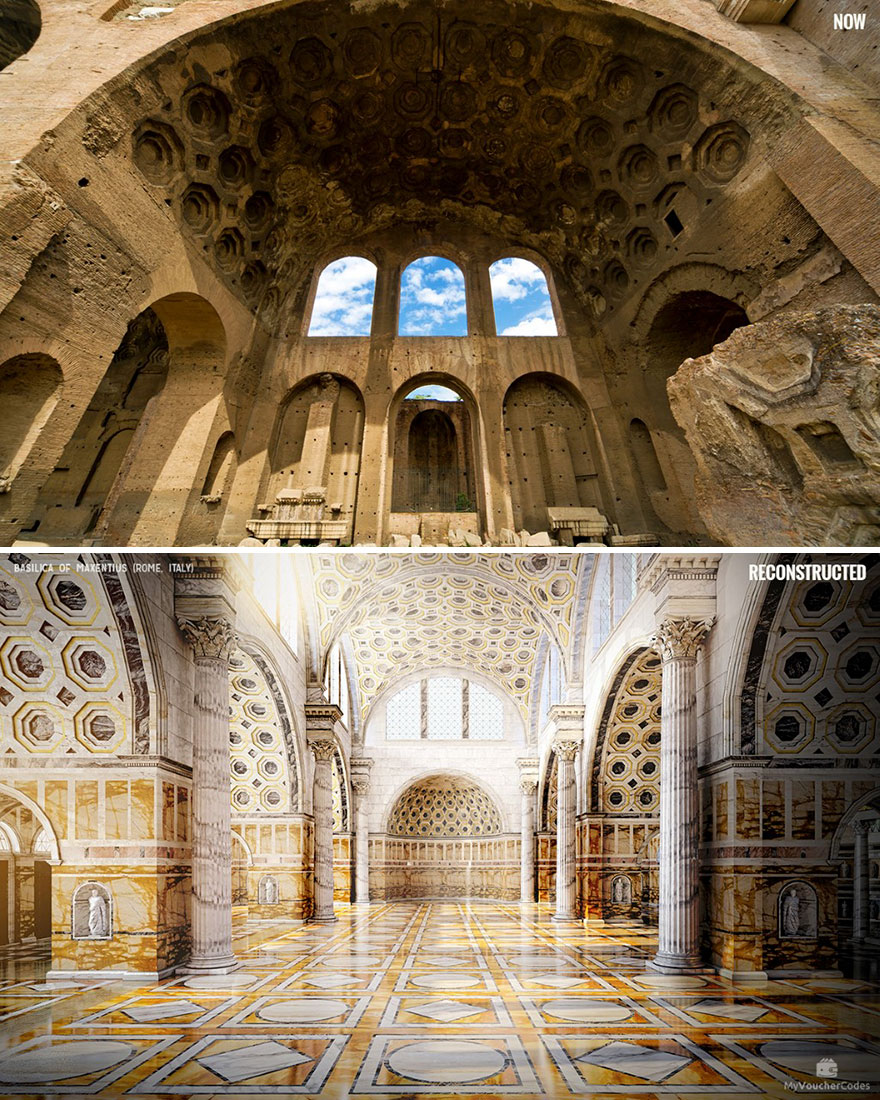
    This majestic building in the Forum Romanum was the greatest of all the Roman basilicas. Covering 6,500 square meters, it acted as a meeting house, commercial area and administrative building. It was designed in a grand fashion fit for its prime location and importance to the Roman government and public. The spectacular Corinthian columns, multi-colored marble floors and gilded bronze tile walls made this one of the most impressive buildings of Ancient Rome. The ornate details might have disappeared with time, but with this reconstruction you can get a sense of the basilica’s former opulence.

    my voucher codes Report

    Agnes Jekyll
    Community Member
    7 years ago Created by potrace 1.15, written by Peter Selinger 2001-2017

    Does anyone know what happened to the marble floor? Did people remove it and use it for other projects?

    Speedy panda
    Community Member
    7 years ago Created by potrace 1.15, written by Peter Selinger 2001-2017

    Yes you can find many marble columns from old Roman buildings in churches and newer building all around Rome

    Load More Replies...
    Donna Schneider
    Community Member
    7 years ago Created by potrace 1.15, written by Peter Selinger 2001-2017

    Were there looters for all the works of art?

    Fester Sixonesixonethree
    Community Member
    7 years ago Created by potrace 1.15, written by Peter Selinger 2001-2017

    There is no apse in the upper picture. Why add one in the lower?

    #4

    Lower Terrace, Masada (Masada, Israel)

    Lower Terrace, Masada (Masada, Israel)

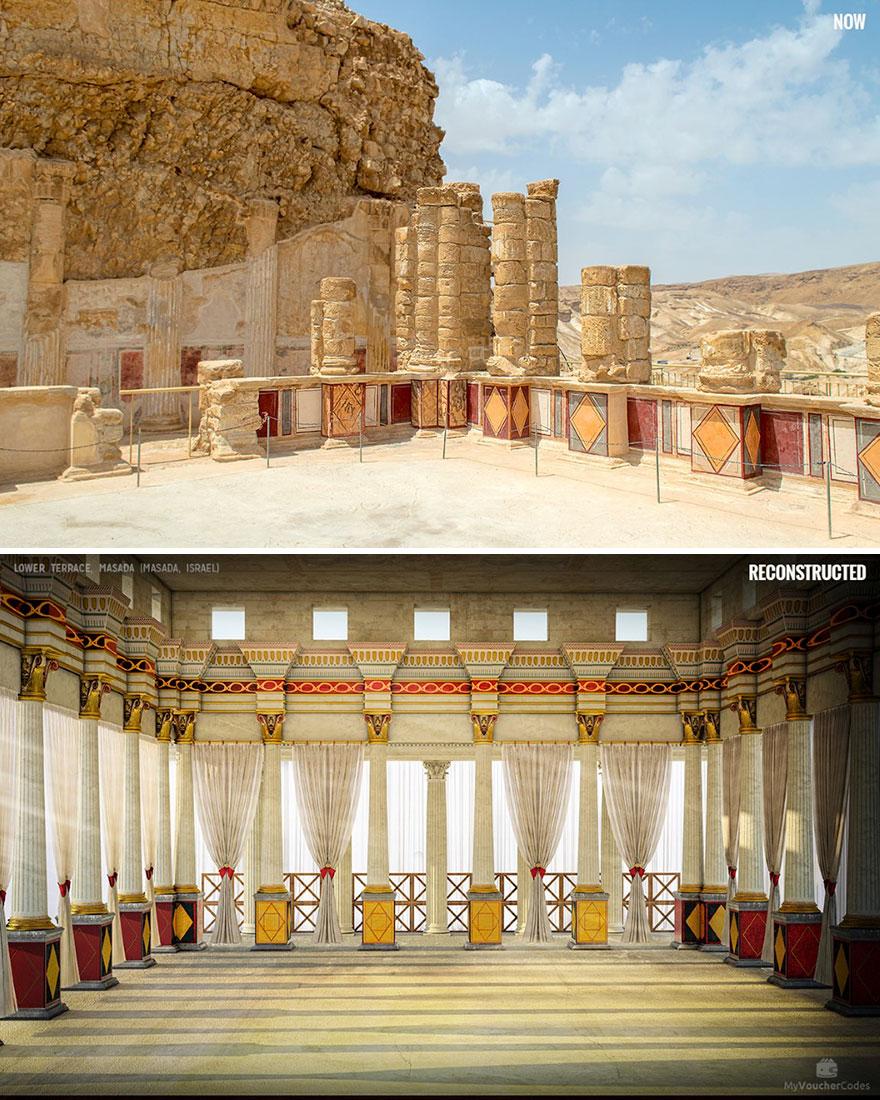
    According to Josephus Flavius, governor of Galilee, Herod the Great built the fortress of Masada between 37 and 31 BCE. It stands atop an isolated rock cliff overlooking the Dead Sea and is a place of undeniable majestic beauty. King Herod’s elegant, intimate residential palace consisted of three luxuriously built terraces. Here, we’ve reimagined the lower terrace, which was designed especially for entertainment and relaxation. It was surrounded by porticos, with walls covered in beautiful frescos of multi-colored geometric patterns. In case that doesn’t sound luxurious enough, there was also a small private bathhouse.

    my voucher codes Report

    Mike Thomas
    Community Member
    4 years ago Created by potrace 1.15, written by Peter Selinger 2001-2017

    Its very interested.. also visit my site all beauty discount code

    Nadine
    Community Member
    7 years ago Created by potrace 1.15, written by Peter Selinger 2001-2017

    If you are really interested in the actual history of the region https://www.euppublishing.com/doi/abs/10.3366/hlps.2016.0140?journalCode=hlps

    Nabilah Razak
    Community Member
    7 years ago

    This comment is hidden. Click here to view.

    I don't find Israel on my map

    Fester Sixonesixonethree
    Community Member
    7 years ago

    This comment is hidden. Click here to view.

    Really? These are two completely different structures! None of the elements in the upper are visible in the lower!

    kat newt shulder
    Community Member
    7 years ago Created by potrace 1.15, written by Peter Selinger 2001-2017

    it's probably because it has been weathered so much, the upper layer has just crumbled.

    Load More Replies...
    Joe Gray
    Community Member
    7 years ago

    This comment is hidden. Click here to view.

    Masada, Palestine. Can't call it Israel's

    Stannous Flouride
    Community Member
    7 years ago Created by potrace 1.15, written by Peter Selinger 2001-2017

    Herod (who built Masada) ruled the Roman province of Judea in the 1st century CE. 'Palestine' as a word first appeared in the 5th century BCE but likely derives from the word 'peleshet' which means 'migrant' and refers to a nomadic people, not a place. In the 2nd century CE, the Romans crushed the revolt of Shimon Bar Kokhba (132 CE), during which Jerusalem and Judea were regained and the area of Judea was renamed Palaestina in an attempt to minimize Jewish identification with the land of Israel. Just another example of Europeans stirring up s**t in the Mideast to benefit their own economic interests.

    Load More Replies...
    ADVERTISEMENT
    #5

    Roman Baths (Bath, England)

    Roman Baths (Bath, England)

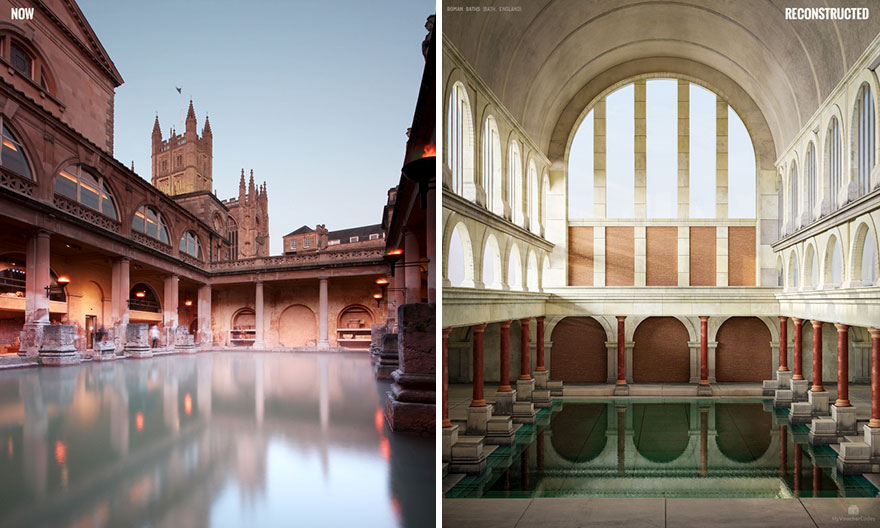
    This bathhouse complex is a perfect example of the luxurious – and often ostentatious – Roman lifestyle. Constructed around 70 AD, the baths were an integral part of ancient Roman daily life. Offering citizens the chance to mingle, gossip and relax, the bathing culture showed the whole world just how superior (and clean) the Romans were. The steaming, geothermally heated water from the 'Sacred Spring' fills the Great Bath. While it’s in the open-air these days, the bath was originally covered by a 45m-high barrel-vaulted roof. This reconstruction lets you dip your toes in to get a little taste of the luxury.

    my voucher codes Report

    Kathryn Jackson
    Community Member
    7 years ago Created by potrace 1.15, written by Peter Selinger 2001-2017

    The water at the old baths isn't safe. They won't even let you stick your hand in. However there is a modern spa in town that uses the water from the spring.

    Joannie Goulet
    Community Member
    7 years ago Created by potrace 1.15, written by Peter Selinger 2001-2017

    Yes I remember being told not to touch the water when we visited. Something to do with the hot water and sunlight that made bacteria proliferate. Back in roman times the roof kept the sunlight out but now it's gone.

    Load More Replies...
    Leigh Zamparelli
    Community Member
    7 years ago Created by potrace 1.15, written by Peter Selinger 2001-2017

    They sometimes have open days (went 2 years ago) but it's very rare they do have open days for the public to bathe x

    Agnes Jekyll
    Community Member
    7 years ago Created by potrace 1.15, written by Peter Selinger 2001-2017

    Do people still bathe in it today?

    Joannie Goulet
    Community Member
    7 years ago Created by potrace 1.15, written by Peter Selinger 2001-2017

    No you're not even allowed to touch the water. It's unsanitary.

    Load More Replies...
    ADVERTISEMENT
    See Also on Bored Panda
    #6

    Great Kiva, Aztec Ruins National Monument (New Mexico, Usa)

    Great Kiva, Aztec Ruins National Monument (New Mexico, Usa)

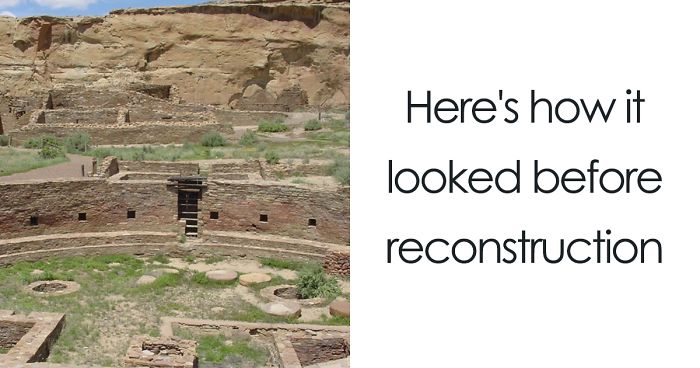
    These ruins were first discovered in 1859 and provide invaluable insight into the daily lives of the Pueblo people. Sprawled over 27 acres, the ruins boast over 450 rooms and include a fully restored kiva. Built partly underground, the ‘great kivas’ were huge, round structures where people gathered to socialize, discuss important issues of the day or tuck into a communal feast. Visitors can find the restored kiva by walking the original trails that lead through the ruins. And if you can’t make it to New Mexico, this reconstruction should give you an idea of how this great civilization lived.

    my voucher codes Report

    ADVERTISEMENT
    See Also on Bored Panda
    #7

    Angkor Wat (Siem Reap, Cambodia)

    Angkor Wat (Siem Reap, Cambodia)

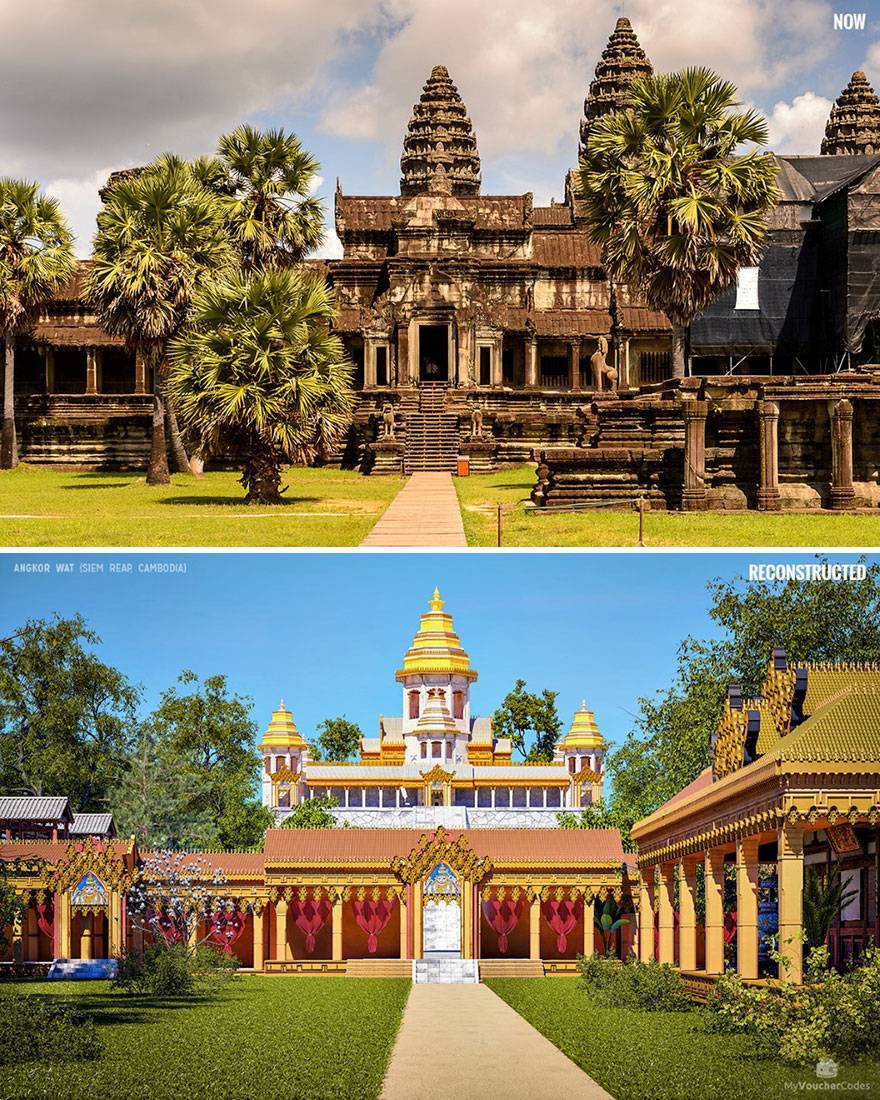
    Estimated to have taken around 30 years to construct, this complex was originally a Hindu temple dedicated to the god Vishnu. It transitioned to a Buddhist temple towards the end of the 12th century and is believed to be the world’s largest religious building. From afar, Angkor Wat appears to be one enormous mass of stone. Once inside, however, visitors will find a series of elevated towers, porches and, courtyards on different levels, linked by a series of stairways. We’ve recreated one of Angkor Wat’s lush courtyards, and we think it looks like the perfect place for some mindful walking.


    my voucher codes Report

    criminalgirl
    Community Member
    7 years ago Created by potrace 1.15, written by Peter Selinger 2001-2017

    It doesn't look anything like the old building above it though.

    Douglas Campbell
    Community Member
    7 years ago Created by potrace 1.15, written by Peter Selinger 2001-2017

    Nope. The second pic looks Thai, not Cambodian, and is missing many architectural details.


    Lauren Nicklow
    Community Member
    7 years ago Created by potrace 1.15, written by Peter Selinger 2001-2017

    The pictures don't even really look like they are of the same build unless the rebuild is of an earlier incomplete version that was rebuilt later on. The structure of the buildings, the flora, and the towers in the back are vastly different which throws off the illusion that it is of the same place when it doesn't look like it is at all. If you look at the tiny details like the steps or the rise of the roof in the original image it is nowhere near how the reconstructioned one looks. Details like that don't wear away completely.

    Morgan
    Community Member
    7 years ago Created by potrace 1.15, written by Peter Selinger 2001-2017

    The style is not the same. The towers are way more pretty in the original.

    Emma
    Community Member
    7 years ago Created by potrace 1.15, written by Peter Selinger 2001-2017

    Maybe it's just a matter of the pictures portraying the buildings from different distances but... where did all the towers go? There are at least 2 towers missing in the reconstructed images.

    Chhun Haven
    Community Member
    7 years ago Created by potrace 1.15, written by Peter Selinger 2001-2017

    Everything look great but why Angkor Wat look so wrong. I hope the artist do more research on Cambodia structure. Anyway appreciated

    Wanderlust
    Community Member
    7 years ago Created by potrace 1.15, written by Peter Selinger 2001-2017

    Doofus, they imagined what it looked like if digitized. Sheesh.. of course it's not real. Read first before assume everything

    Load More Replies...
    View more comments
    ADVERTISEMENT
    See Also on Bored Panda