Get Premium
Dark mode theme is available exclusively for premium users. Learn more about the benefits of subscribing.
No fees, cancel anytime.

 Dark Mode Ad-Free Browsing Unlimited Content
 Ad-Free Browsing Unlimited Content Dark Mode
Join 1.2 million Panda readers who get the best art, memes, and fun stories every week!
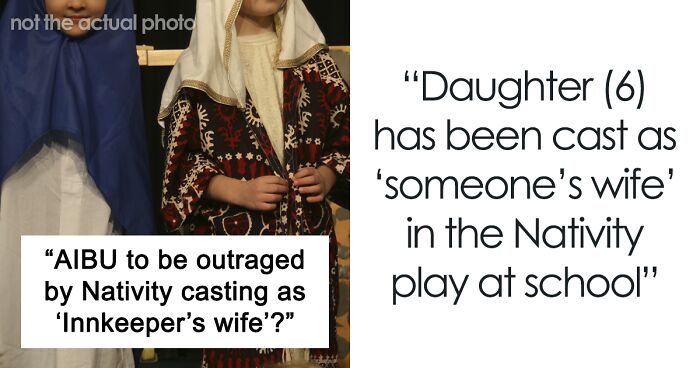
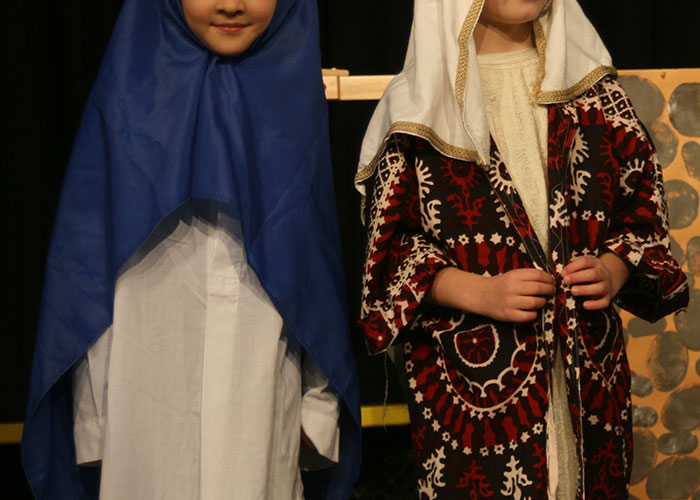
Casting children in school plays can be tricky. Not all roles are equal: some may have more lines, while others might have better-looking costumes. There’s always bound to be one or two unhappy kids and parents. Unfortunately, someone’s got to play the Tree, right?
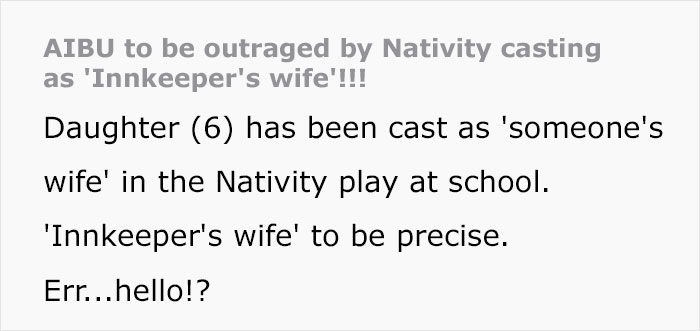
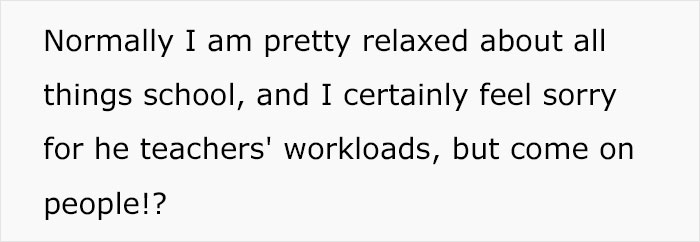
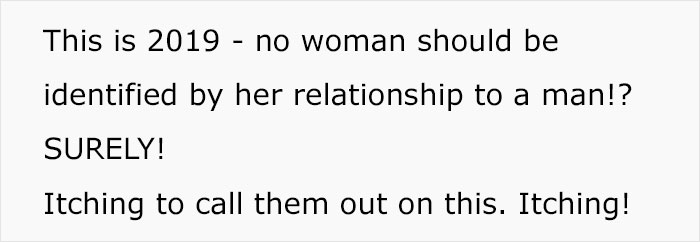
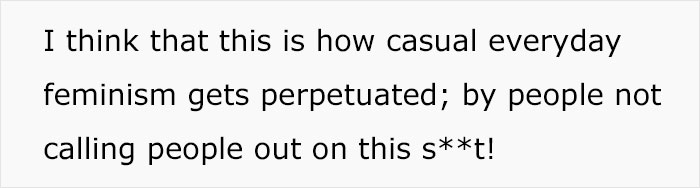
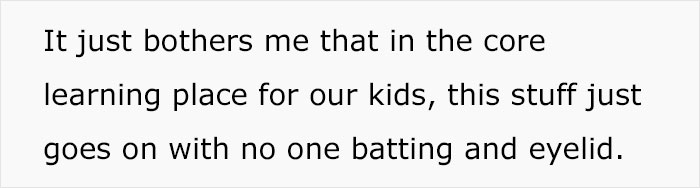
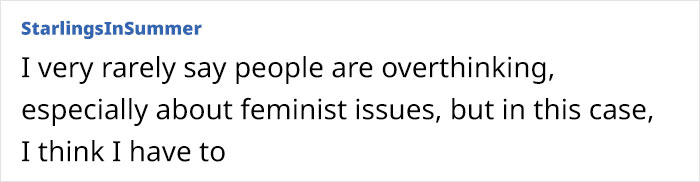
Interestingly, this mother’s problem wasn’t that her daughter needed more lines. She was unhappy with the role’s title. How can a character have no name and be simply the “Inn Keeper’s Wife”? That’s not cool in this day and age, the mother thought. She asked other moms on the Mumsnet forum whether her outrage was appropriate. Read on to find what other mothers thought and let us know your opinions in the comments.
Image credits: Peter C (not the actual photo)
Image credits: PIPERHELLO
Image credits: Owen Lucas (not the actual photo)
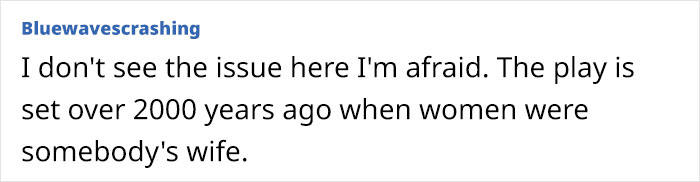
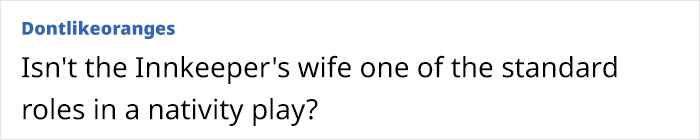
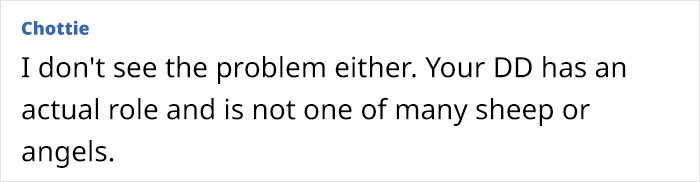
The issue the mother is raising might seem trivial at first. It’s just a silly role in a school play – it’s unlikely either the daughter or her classmates will remember it after a few years. As some commenters said, the mother should be happy the daughter at least gets to play a person. Many kids might only get the role of a shrub or a sheep in those school plays.
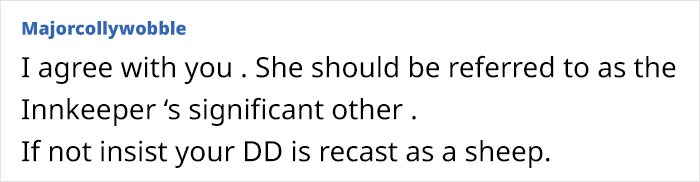
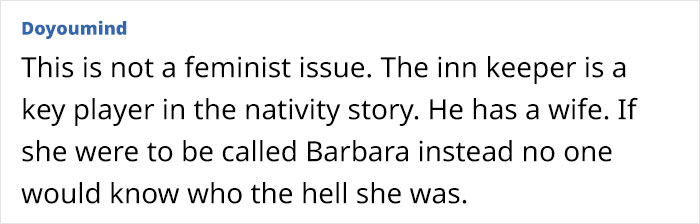
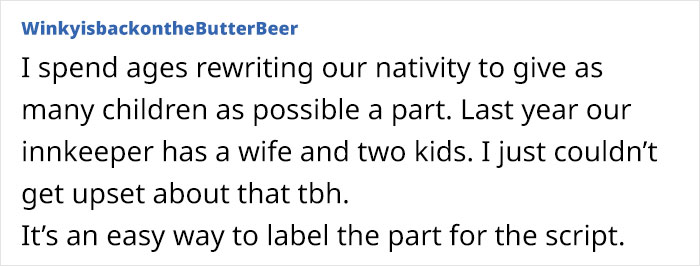
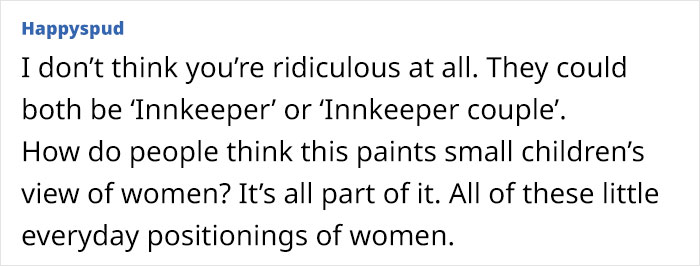
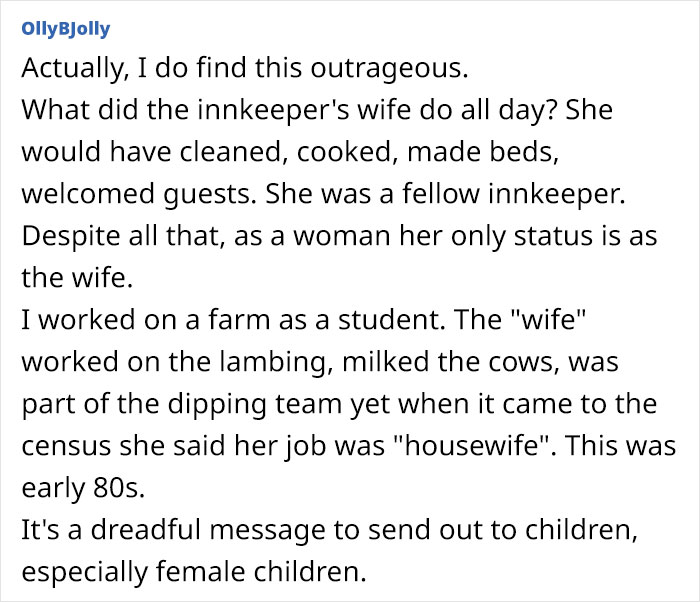
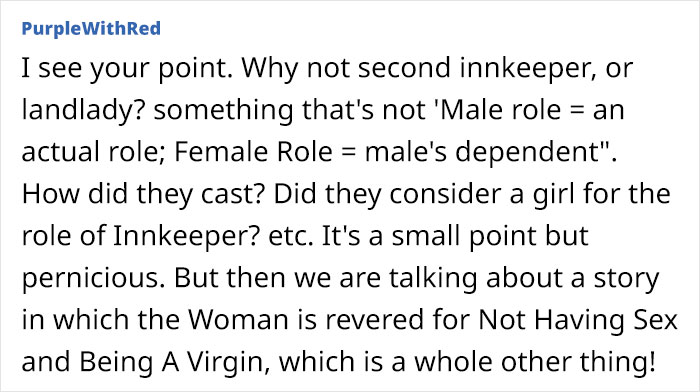
However, there’s a deeper issue here if we’re willing to look into it. The mother’s surprise comes from the fact that the school, even if inadvertently, teaches children gender stereotypes. The commenters touched upon this as well. Why couldn’t both persons in the couple be ‘The Innkeepers’? Why is the word ‘Wife’ the identifier? There’s no ‘Inn Keeper’s Husband’ in the script.
There are also always two sides to an argument. It’s unlikely the school play’s director and author of the script meant it this way. A Nativity play could hardly be propaganda by traditionalists to maintain the patriarchy. Even if it is, it’s an attempt that will have a fairly low impact. But that doesn’t mean it can’t influence the way children understand and internalize gender stereotypes.
Image credits: mliu92 (not the actual photo)
Rebecca Bigler published a study in 1995 about stereotyping children in the classroom. She found that dividing schoolchildren into groups will lead them to develop stereotypes about those groups. Boys will start to think certain jobs are only “meant for men,” and girls will start to associate pink as a color only for girls.
Bigler conducted an experiment with elementary school students and teachers. In the first group, the teachers labeled the kids and organized the classroom using gender. In the other one, the teachers had to ignore the students’ gender. They used individual names and didn’t say things like, “You’re such a smart girl” or “I need the boys to settle down.”
What was the result? “The use of gender dichotomies in the classroom increased children’s gender stereotyping,” Bigler wrote in the conclusion. The kids stereotyped occupations and character traits more in the group where teachers labeled them according to their gender.
Image credits: Jamie Smed (not the actual photo)
Professor of Developmental Psychology at the University of Kentucky Christia S. Brown, Ph.D., writes that the way we talk about gender to our kids can make a big difference. She says that although many people assume that what matters is to treat children equally, it’s not always true.
It would be true if children only paid attention to what we say to them overtly. But sometimes we teach things even when we’re not aware of it. Brown says that it’s the parents that make the differences between genders meaningful.
“When we repeatedly say, ‘Look at those girls playing!’ or ‘Who is that boy with the blue hat?,’ children assume that being a boy or girl must be a really important feature about that person,” Brown writes for Psychology Today.
“In fact, it must be the single most important feature of that person. Otherwise, why would we point it out all the time?” We can try to apply this to the OP’s concerns about the Nativity play as well.
If we refer to men according to their occupation (innkeeper in this case) and to women in relation to men, that’s bound to register in children’s brains. “With gender, children notice the difference and adults make it meaningful,” Brown writes.
“Children see the category. We made sure of that with our pink or blue shirts. Also, the experts in the world, their parents, always label the category. We put a figurative flashing neon arrow on gender and say ‘Pay Attention! Important Information Here!’ And guess what, they pay attention.”
72Kviews
Share on Facebook
If a lawyer who has worked at the International Court in The Hague, is an absolute star for human rights and has represented a host of high-profile clients - from former Ukrainian Prime Minister Yulia Tymoshenko to WikiLeaks founder Julian Assange - and used her human-rights expertise to advocate for the cases of imprisoned journalists and Yazidi women abused under ISIS - is referred to as 'George Clooney's wife' - I don't hold out too much hope for your daughter representing a wife from 2000 years ago.

Small parts often come with this type of role name - their relationship to a more central character, and often a physical characteristic or position in the scene - from recent Spiderman films we have May's neighbor and Old man on Bus, the character titles are not a reflection of the actors' worth as humans, just the most succinct description of their part in the production. Thank goodness this lady's daughter didn't get cast as sheep or cow, it really would have kicked off.
If a lawyer who has worked at the International Court in The Hague, is an absolute star for human rights and has represented a host of high-profile clients - from former Ukrainian Prime Minister Yulia Tymoshenko to WikiLeaks founder Julian Assange - and used her human-rights expertise to advocate for the cases of imprisoned journalists and Yazidi women abused under ISIS - is referred to as 'George Clooney's wife' - I don't hold out too much hope for your daughter representing a wife from 2000 years ago.
Small parts often come with this type of role name - their relationship to a more central character, and often a physical characteristic or position in the scene - from recent Spiderman films we have May's neighbor and Old man on Bus, the character titles are not a reflection of the actors' worth as humans, just the most succinct description of their part in the production. Thank goodness this lady's daughter didn't get cast as sheep or cow, it really would have kicked off.
















 No fees, cancel anytime










26
51