Get Premium
Dark mode theme is available exclusively for premium users. Learn more about the benefits of subscribing.
No fees, cancel anytime.

 Dark Mode Ad-Free Browsing Unlimited Content
 Ad-Free Browsing Unlimited Content Dark Mode
Join 1.2 million Panda readers who get the best art, memes, and fun stories every week!

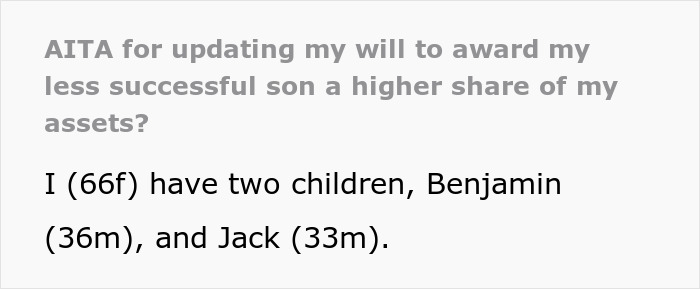
Playing favorites in your family hardly ever ends well. Research shows that parents are likely to silently and unconsciously prefer one of their kids over the others. But it becomes a huge issue when they vocalize it. Or, in this case, when they put their money where their mouths are.
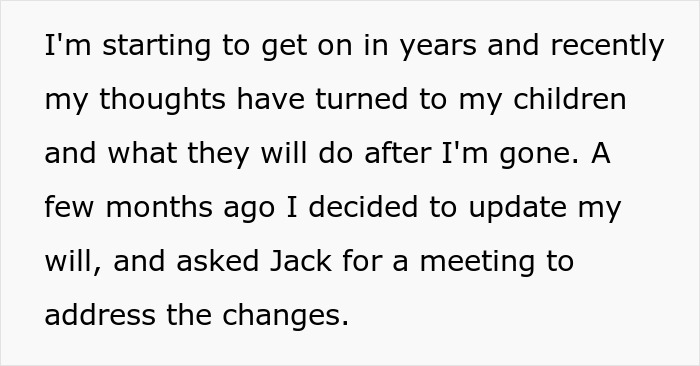
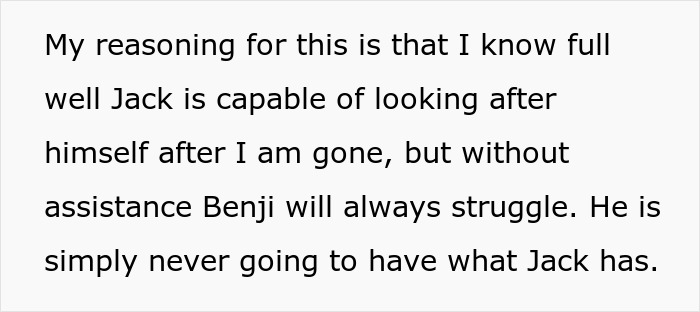
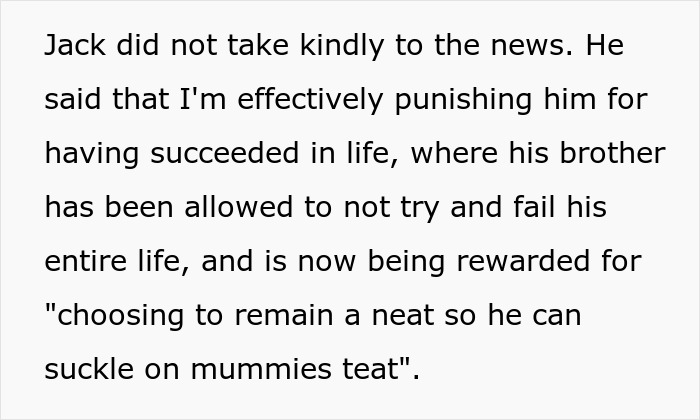
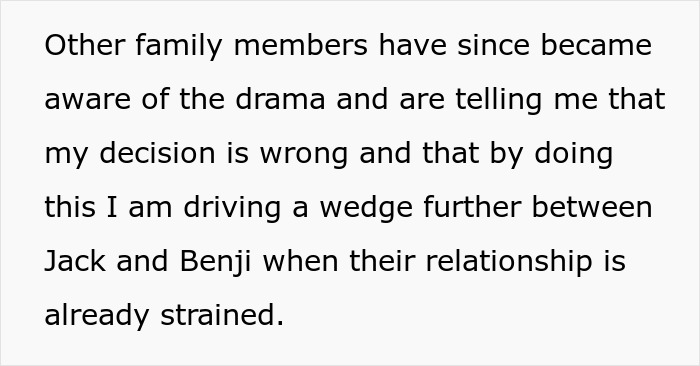
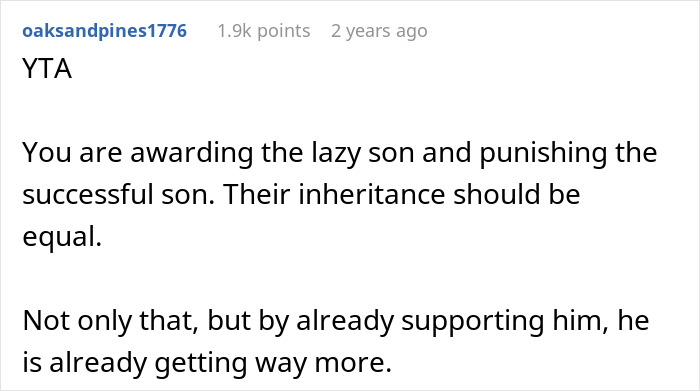
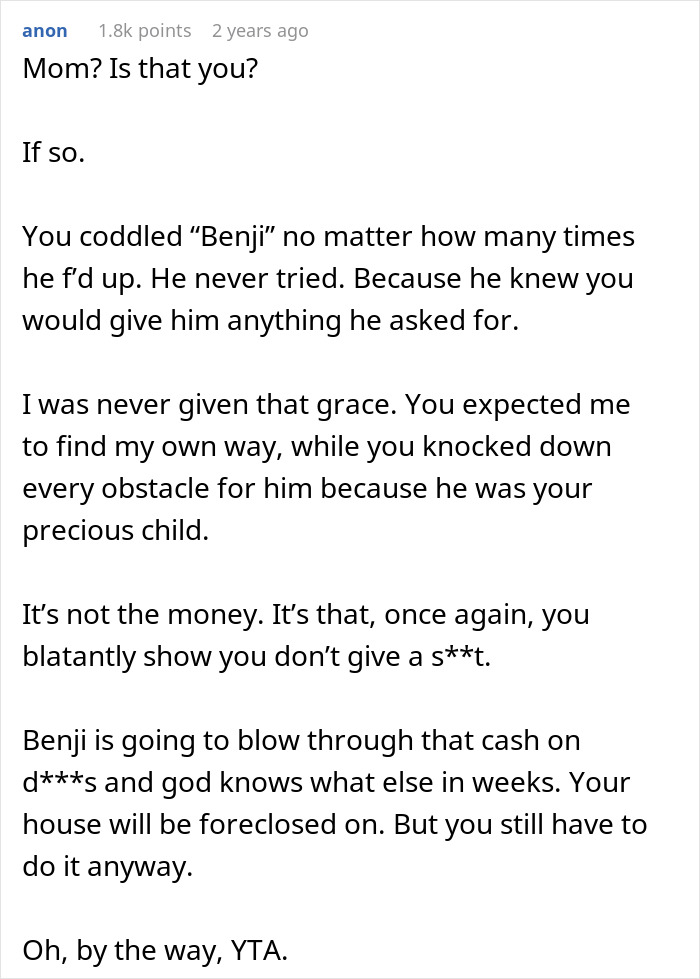
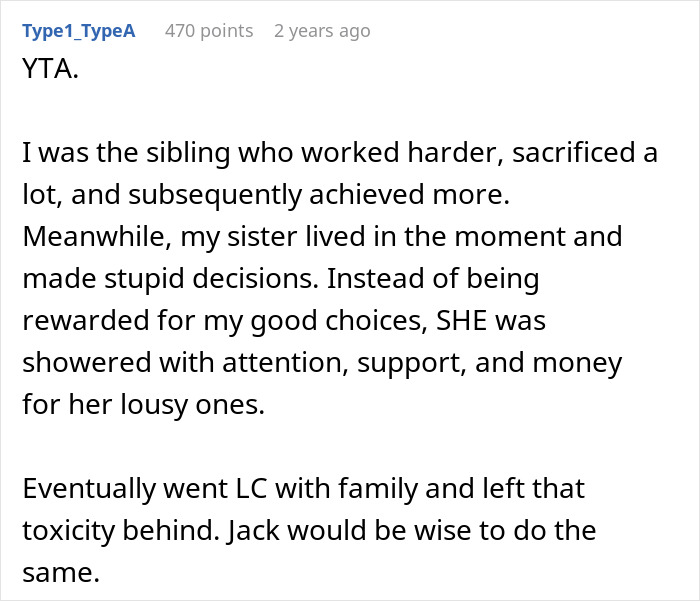
The internet rushed in to comment on a senior woman’s decision to update her will to favor her “less successful” son rather than split her inheritance equally among her adult children. Her choice sparked major drama and resulted in an even bigger rift in her family. Keep scrolling to read the full story and all the criticism coming the mom’s way.








Like it or not, the reality is that some parents tend to prefer some of their children over others. And this behavior has lasting repercussions that can follow children into adulthood. In layman’s terms, it hurts to realize that your parents might love and support your siblings more than you, even if they aren’t aware of it.
Temperament, responsibility, and how easy or difficult you are to deal with might all impact this behavior.
A meta-analysis of studies published by the American Psychological Association found that parents look more favorably upon their agreeable and conscientious children. These kids are easier to manage. What’s more, both moms and dads prefer their daughters to sons. And older siblings tend to get more autonomy than their younger siblings.
Parents display favoritism in a wide variety of ways. For example, how much money they spend on them, how much they try to control them, how they interact with them, etc. Children whose parents favor them less have poorer mental health and more strained family relationships. You can also end up feeling socially isolated and dealing with serious self-esteem issues.
Financial favoritism can lead to a lot of jealousy and resentment, the BBC stresses. Moreover, it can even lead to legal disputes after a parent passes away. And yet, these finance-related arguments are often not even about the money itself.
“Financial support from parents often carries a powerful emotional meaning and some siblings tend to interpret differences in support as signs of favouritism, unequal love or a lack of recognition,” says Dr. Fenia Christodoulidi, from counselling service Relate.
Naturally, there will be situations where, for practical reasons, parents need to support and treat their children differently. For example, one of your children might be earning significantly less money, they might have (more) trouble buying property, or they are dealing with illness.
The key here is to be open and transparent. Communicate the reasons for this differential treatment as clearly as you can. Otherwise, you’re simply leaving room for resentment and misunderstanding to grow. Dr. Christodoulidi suggests having “open conversations about expectations and the reasons behind decisions.”
Meanwhile, solicitor and mediator Claire Webb, from Family Solutions Now, told the BBC about the types of situations she regularly handles. “One sibling might argue the other was given more money earlier on in life, say, to buy a house, and that the parents said this would be reflected in the will. Then the will says, ‘everything should be shared equally’. So you have all of that historic feeling of unfairness being dredged up,” she said.
According to Webb, legal disputes often find friendly ways to solve the situation. “Most of the time there is a deep-down family bond – and if you can crack what started the problem they often find a way through.”
So, parents need to proactively be as clear as possible about what they want while they’re still alive and well.
To avoid conflict, she says parents need to be clear with their children about what they want while they are still alive. Meanwhile, the siblings themselves should look for the core reasons behind their disagreements, instead of focusing just on the inheritance itself.
What’s more, you should try to give your relatives the benefit of the doubt. Do not make assumptions about your siblings’ financial situation or the reasons behind your parents’ decisions. Try to actively listen to their perspective, and look for some common ground.
Once you’ve finished reading the story and all the internet users’ perspectives, we want to hear from you in the comments. Do you think the mom was wrong to favor her “less successful” son in her will, or do you think she was right to give him a bit more support? What do you think the woman can do to heal the rift in her family? Have you ever seen or personally experienced favoritism, financial or otherwise, in your family or at someone else’s home? Join the conversation and share your thoughts.








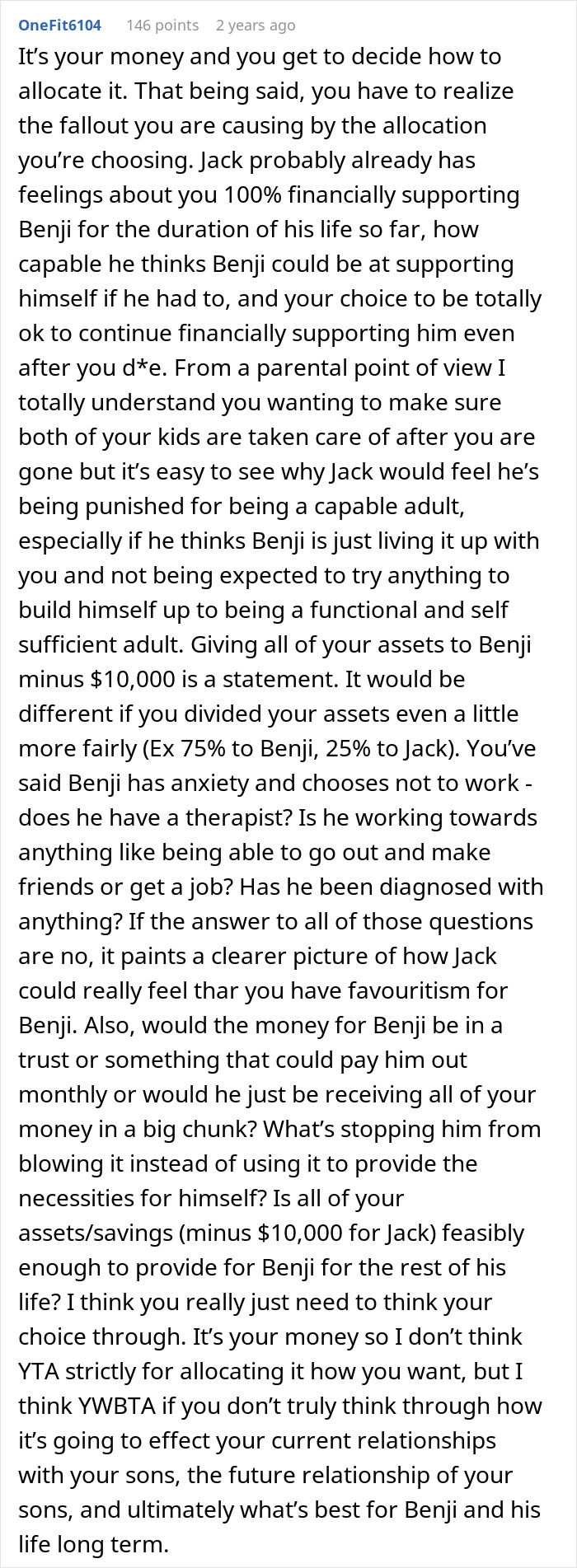



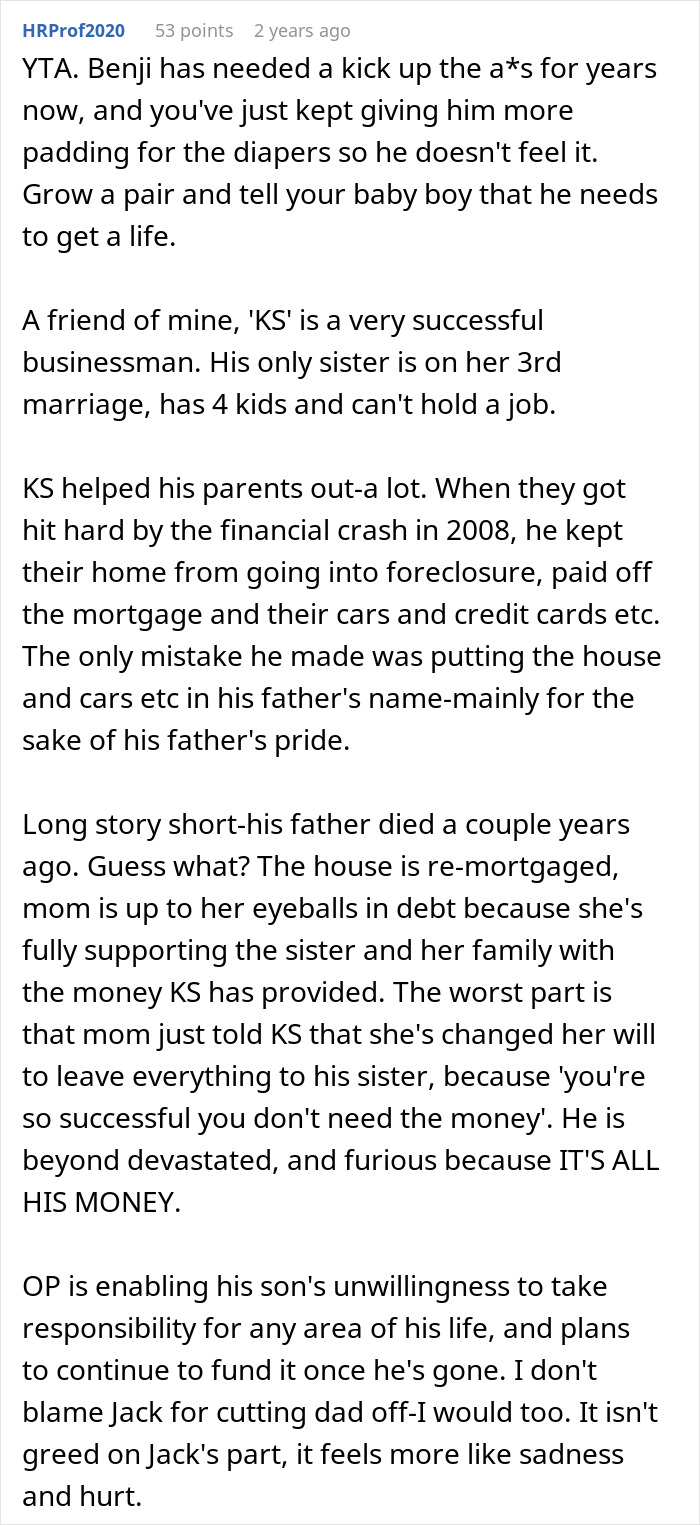

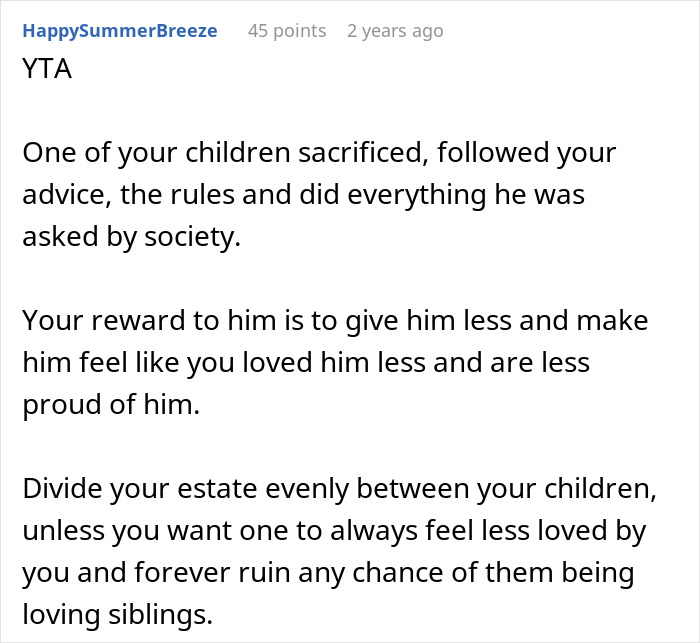

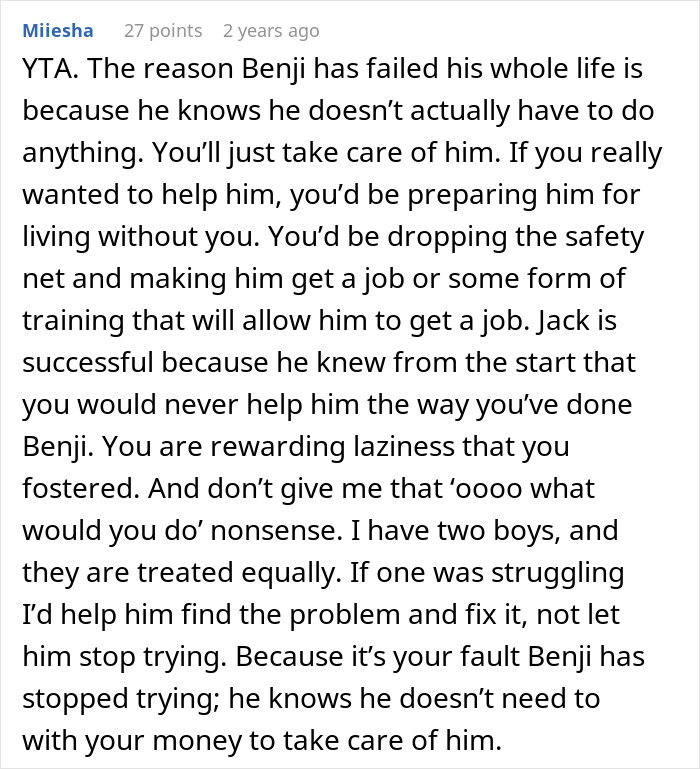





By entering your email and clicking Subscribe, you're agreeing to let us send you customized marketing messages about us and our advertising partners. You are also agreeing to our Privacy Policy.
Thank you! You've successfully subscribed to newsletters!


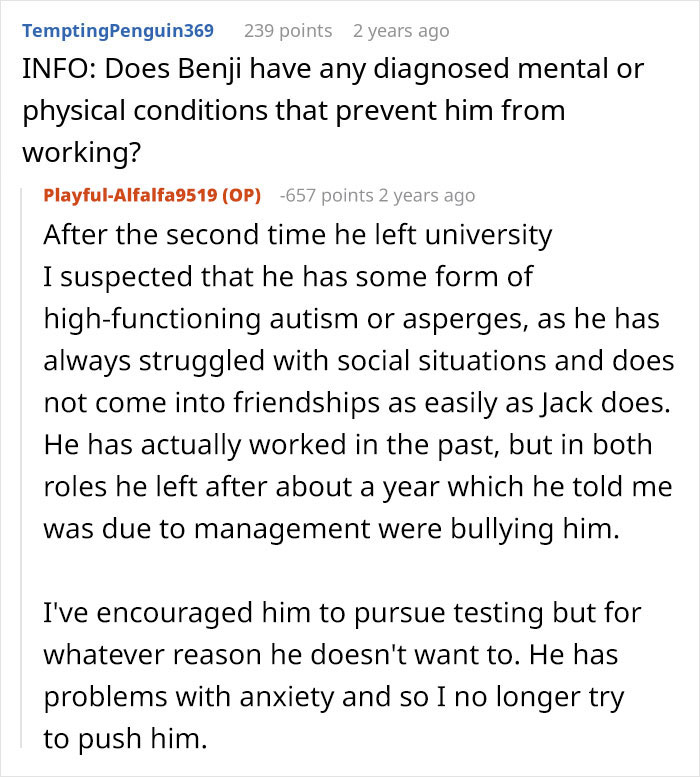
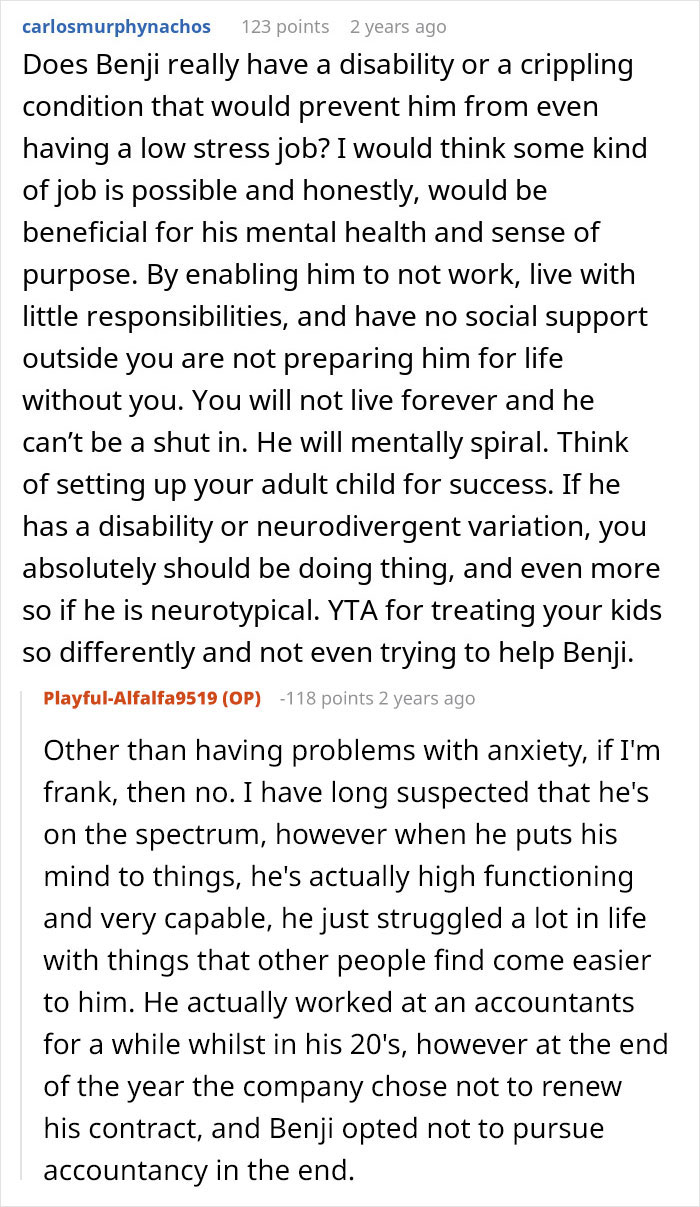
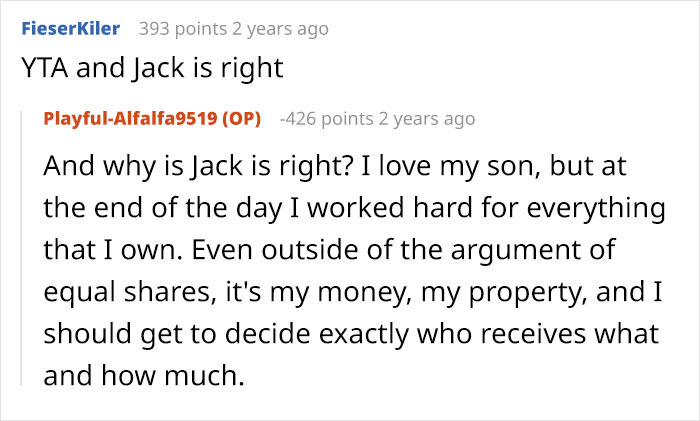
Benji needs to try to help himself. It's okay to have anxiety, but there are ways that people with anxiety disorders can get help (medications, therapy, counseling, all of the above, etc.) Benji can also try to get a job that is remote/at-home work so he won't have to be "bullied" by management (though one wonders if he was "bullied by management" at both jobs, if the problem was actually Benji...) If he has autism or Asperger's, see my first point - there are many ways that one can learn to deal with/work with that. When OP díes, the money she leaves to Benji won't last forever - then what? Benji still won't have learned to deal with reality/real life and will have no lifeline. Jack was absolutely right to feel incredibly hurt by what OP did. It's obviously OP's money in the end and she can do what she likes with it, but she certainly shouldn't be surprised that her "successful" son is hurt and offended by this.

My daughter has fought with social anxiety since she was a teenager (consequences of severe bullying at Secondary (aka: High) school), but, with emotional support, a school move and had a strong motivation to succeed (she's now a Senior Accountant). Fortunately, for the last 3 years, she only needs to go to the offices one day a week, and the rest is remote.
Load More Replies...
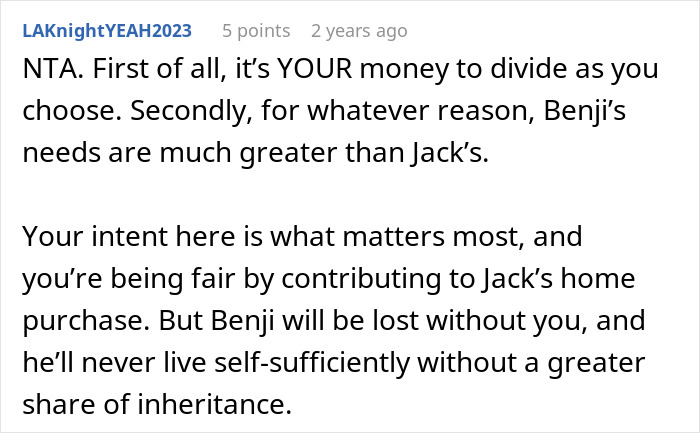
One person said that she should split it equally but put Benji's in a trust, to be doled out monthly, so he doesn't waste his portion and I agree with that. Assigned a trustee to Benji's portion until he can show that he is able to handle it on his own because you just KNOW that if he's given it all at once, it will be gone and his brother won't help him, nor should he.

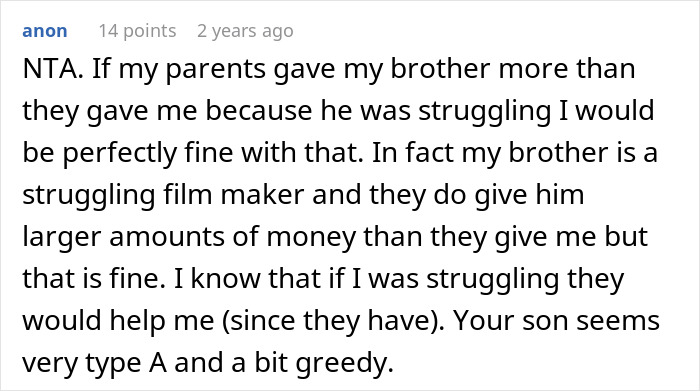
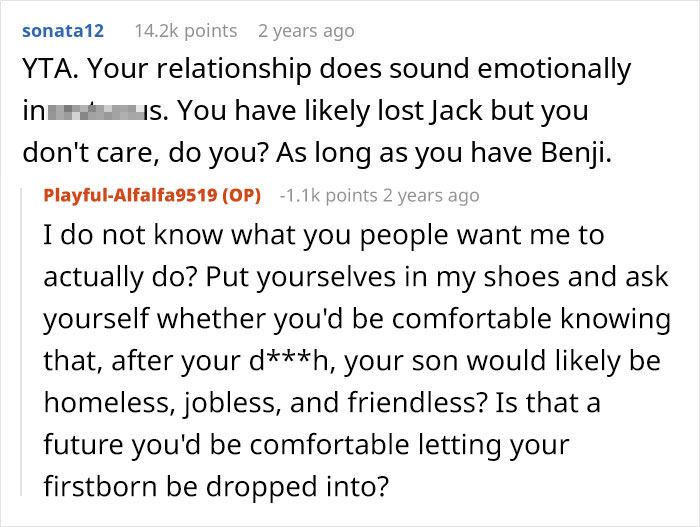
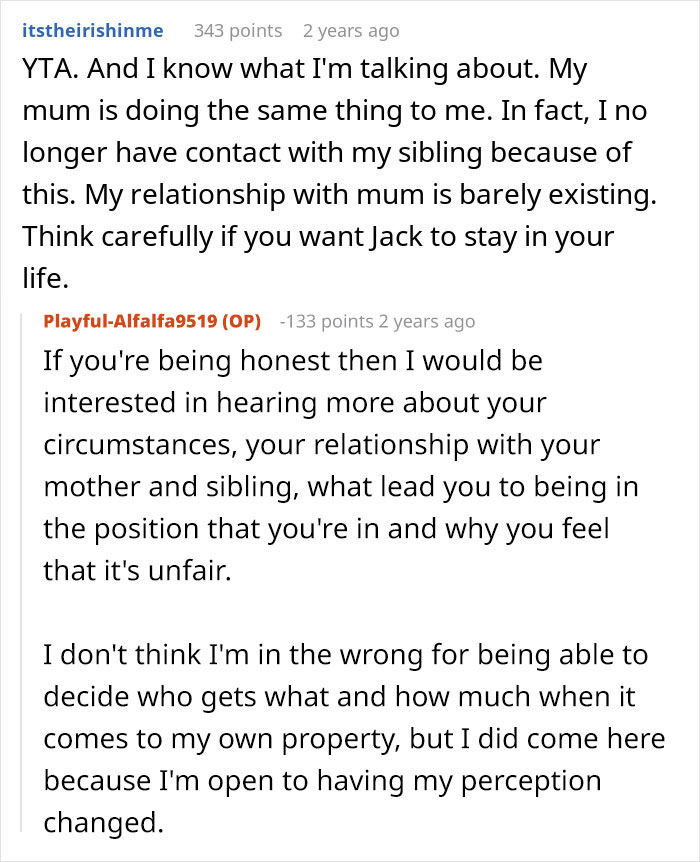
Ah, NTA total AHs today. Makes a nice change. Everything the OP reported that Jack said about her seems 100% on the money, yet she totally refuses to understand it, but wants everyone to just pat her on the back and approve of her decision to totally drive a wedge between her children. How is Benji going to cope when she's gone, he's blown all the money and his brother wants nothing to do with him?
Benji needs to try to help himself. It's okay to have anxiety, but there are ways that people with anxiety disorders can get help (medications, therapy, counseling, all of the above, etc.) Benji can also try to get a job that is remote/at-home work so he won't have to be "bullied" by management (though one wonders if he was "bullied by management" at both jobs, if the problem was actually Benji...) If he has autism or Asperger's, see my first point - there are many ways that one can learn to deal with/work with that. When OP díes, the money she leaves to Benji won't last forever - then what? Benji still won't have learned to deal with reality/real life and will have no lifeline. Jack was absolutely right to feel incredibly hurt by what OP did. It's obviously OP's money in the end and she can do what she likes with it, but she certainly shouldn't be surprised that her "successful" son is hurt and offended by this.
My daughter has fought with social anxiety since she was a teenager (consequences of severe bullying at Secondary (aka: High) school), but, with emotional support, a school move and had a strong motivation to succeed (she's now a Senior Accountant). Fortunately, for the last 3 years, she only needs to go to the offices one day a week, and the rest is remote.
Load More Replies... One person said that she should split it equally but put Benji's in a trust, to be doled out monthly, so he doesn't waste his portion and I agree with that. Assigned a trustee to Benji's portion until he can show that he is able to handle it on his own because you just KNOW that if he's given it all at once, it will be gone and his brother won't help him, nor should he.
Ah, NTA total AHs today. Makes a nice change. Everything the OP reported that Jack said about her seems 100% on the money, yet she totally refuses to understand it, but wants everyone to just pat her on the back and approve of her decision to totally drive a wedge between her children. How is Benji going to cope when she's gone, he's blown all the money and his brother wants nothing to do with him?




































 No fees, cancel anytime



















31
48