Get Premium
Dark mode theme is available exclusively for premium users. Learn more about the benefits of subscribing.
No fees, cancel anytime.

 Dark Mode Ad-Free Browsing Unlimited Content
 Ad-Free Browsing Unlimited Content Dark Mode
Join 1.2 million Panda readers who get the best art, memes, and fun stories every week!

Pandas, we’ve all heard those classic mother-in-law stories where they somehow become the supervillain in their child’s relationship. You know the type—the ones who criticize everything, cross boundaries, and have a talent for making their daughters-in-law question every little decision. But thankfully, not every MIL is out to cause chaos. Sometimes, they’re actually the ones standing beside you when things get messy.
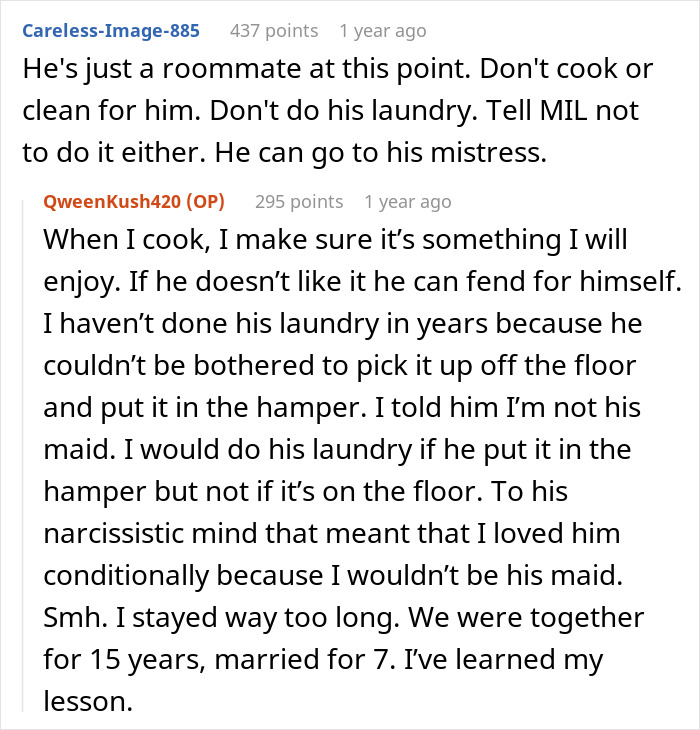
That’s exactly what happened in today’s story. A woman was going through a divorce after discovering her husband had been cheating when her in-laws moved into her home. Despite the awkward situation, she welcomed them with open arms because they had always treated her with kindness. Her mother-in-law, however, was not nearly as forgiving toward her cheating son—and eventually came up with a wonderfully petty way to make him fend for himself. Keep reading to see what happened, Pandas!









“Ugh, I hate my mother-in-law.” “I can’t stand my daughter-in-law.” How often have we heard people complain about their in-laws? Probably more often than we’d like to admit. These relationships can be complicated, especially when different personalities, expectations, and family traditions collide. But complicated doesn’t always mean hostile, and not every mother-in-law and daughter-in-law relationship is destined to become a family battleground. In fact, research suggests that around 60% of mothers-in-law and daughters-in-law share a good relationship, while only about 15% describe their relationship as deeply troubled.
Getting along with your partner’s parents can be important because these people can become a regular and meaningful part of your life. Whether it’s family dinners, holidays, birthdays, childcare, or simply spending time together, these relationships can influence the atmosphere of the entire family. Constant tension can also put the partner in an uncomfortable position, especially when they feel as though they have to choose between the person they married and the parent who raised them.
So, how do you actually make these relationships work? There isn’t a magic formula, and let’s be honest, some personalities are simply harder to deal with than others. But there are plenty of useful ideas worth considering. One interesting perspective comes from Dr. Deanna Brann, a relationship expert and psychotherapist. Her book, Reluctantly Related: Secrets to Getting Along with Your Mother-in-Law or Daughter-in-Law, offers a practical and empathetic look at why these relationships can become so complicated. Rather than simply labeling one person as the problem, Brann explores the expectations, misunderstandings, and changing family dynamics that can create tension between mothers-in-law and daughters-in-law.
One of the book’s central ideas is that many in-law conflicts aren’t necessarily about two people simply disliking each other. Instead, they can stem from territory, roles, expectations, and the uncomfortable process of adjusting to a new family dynamic. Think about it. A mother may have spent decades being the person her son calls when he needs advice, celebrates an achievement, or needs help with something. Then he gets married, moves in with his partner, and suddenly someone else becomes his closest confidant and shares many of those decisions with him. Even when everyone loves each other, that transition can take some getting used to.
Research has found that mothers are more likely than fathers to describe themselves as overprotective, which can sometimes make stepping back even more difficult when their child enters a serious relationship. For example, a mother who once felt perfectly comfortable dropping by her son’s home or telling him how to handle something might not immediately realize that her involvement now needs to look a little different. What she sees as caring can feel intrusive to his partner.
Another important lesson is avoiding “triangulation,” where the husband or son gets stuck in the middle of disagreements between his mother and his partner. We’ve probably all seen some version of this: Mom complains to her son about his wife, the wife complains to her husband about his mother, and suddenly the poor guy is carrying messages between two people who should really be talking to each other. He may love both women and want everyone to get along, but constantly being expected to take sides can be exhausting and unfair.
Instead of turning him into the family referee, Brann encourages more direct communication. If the mother-in-law is upset about something, she should ideally be able to discuss it respectfully with her daughter-in-law, and vice versa. Of course, not every disagreement needs a dramatic family meeting. Sometimes a simple, calm conversation can clear up a misunderstanding before it grows into something much bigger.
Brann also discusses different behavioral patterns that can appear in these relationships, including the “controlling mother” and the “defensive daughter.” A controlling mother may have difficulty accepting that her son is now an adult with his own household, routines, and decisions. Her intentions might genuinely come from love or concern, but constantly offering opinions, questioning decisions, or insisting that things be done her way can leave her daughter-in-law feeling as though she is being judged or pushed aside.
On the other hand, a defensive daughter-in-law may interpret almost every comment from her mother-in-law as criticism or interference. When there is already some tension between two people, even an innocent comment can land badly. A suggestion such as “Have you thought about trying this?” can suddenly sound like “You’re doing everything wrong.” Recognizing these patterns isn’t about deciding who is the villain. It’s about noticing when a familiar cycle keeps repeating and asking whether both people could respond differently. Sometimes, simply realizing that you’re falling into the same pattern can make it easier to stop before another argument begins.
Expectations around unsolicited advice can create plenty of friction too. And let’s be honest, almost everyone has received advice they didn’t ask for. Imagine a mother-in-law telling her daughter-in-law, “You should really try putting the baby down for naps earlier. That’s what worked for us.” She might genuinely be trying to help. Perhaps she’s remembering what worked when she raised her own children and thinks she’s passing along something useful. But the daughter-in-law might hear something completely different: “You don’t know what you’re doing.” And suddenly, a harmless suggestion has become another source of tension.
Brann’s approach encourages both sides to reconsider these moments. Mothers-in-law can learn when to offer advice and when it might be better to simply listen, while daughters-in-law can sometimes recognize that an unwanted suggestion isn’t automatically a personal attack. That doesn’t mean anyone should tolerate constant criticism or boundary-crossing. Rather, it’s about giving each other enough room to communicate without immediately assuming the worst.
When it comes to building a stronger relationship, communication is still one of the biggest pieces of the puzzle. But effective communication doesn’t necessarily mean sitting down for a three-hour heart-to-heart and unpacking every disagreement you’ve ever had. Sometimes, it’s much simpler than that. Ask questions. Share experiences. Say thank you. Talk about things you genuinely have in common. If something bothers you, bring it up before resentment has had time to build.
Ultimately, a healthy mother-in-law and daughter-in-law relationship needs both boundaries and empathy. The new couple should be able to make decisions about their own household without feeling pressured, while the extended family should still feel respected and valued. And setting boundaries doesn’t necessarily mean shutting someone out. In many cases, clear boundaries actually make relationships easier because everyone knows what is expected and where the limits are.
And that’s what makes today’s story so refreshing. Instead of another tale about an impossible mother-in-law making her daughter-in-law’s life miserable, we get to see a very different kind of family dynamic—one where a mother-in-law actually chooses to stand by her daughter-in-law and even finds her own way to show support. What do you think, Pandas? Have you ever had an unexpectedly wonderful relationship with a family member? Let us know in the comments.












By entering your email and clicking Subscribe, you're agreeing to let us send you customized marketing messages about us and our advertising partners. You are also agreeing to our Privacy Policy.
Thank you! You've successfully subscribed to newsletters!


I cared for my MIL through her final illness and I wouldn’t have had it any other way. She treated me better when I was just her son’s friend than my ex-MIL did when I was married to my ex.

I cared for my MIL through her final illness and I wouldn’t have had it any other way. She treated me better when I was just her son’s friend than my ex-MIL did when I was married to my ex.







































 No fees, cancel anytime
















38
10