Get Premium
Dark mode theme is available exclusively for premium users. Learn more about the benefits of subscribing.
No fees, cancel anytime.

 Dark Mode Ad-Free Browsing Unlimited Content
 Ad-Free Browsing Unlimited Content Dark Mode
Join 1.2 million Panda readers who get the best art, memes, and fun stories every week!

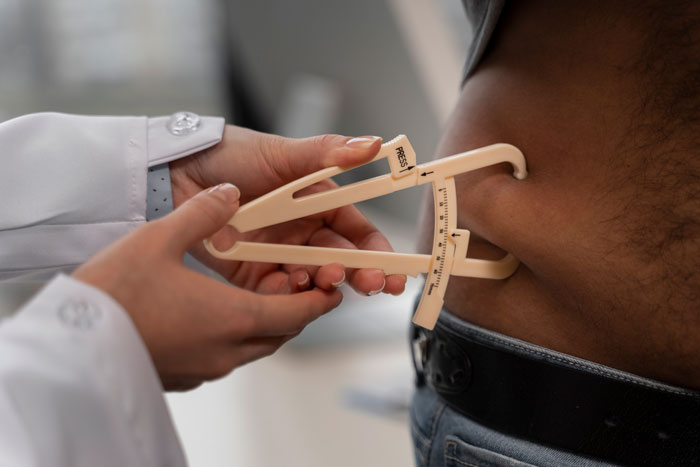
Millions of Americans may be considered obese under a new health classification system developed in Europe.
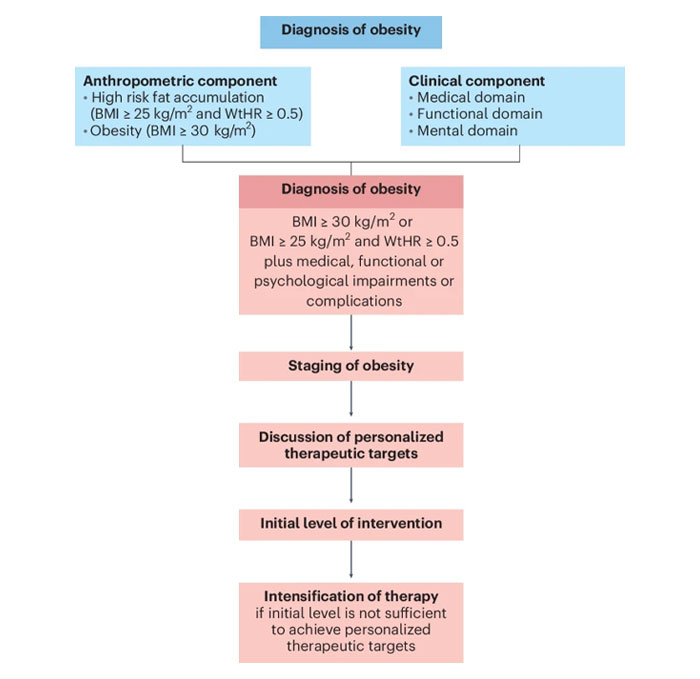
The framework, created by the European Association for the Study of Obesity (EASO), adds people with obesity-related conditions like diabetes or high blood pressure to the “obese” category, even if they were previously classified as only “overweight.”
Researchers stated that the update could help identify health risks earlier and improve access to treatment.
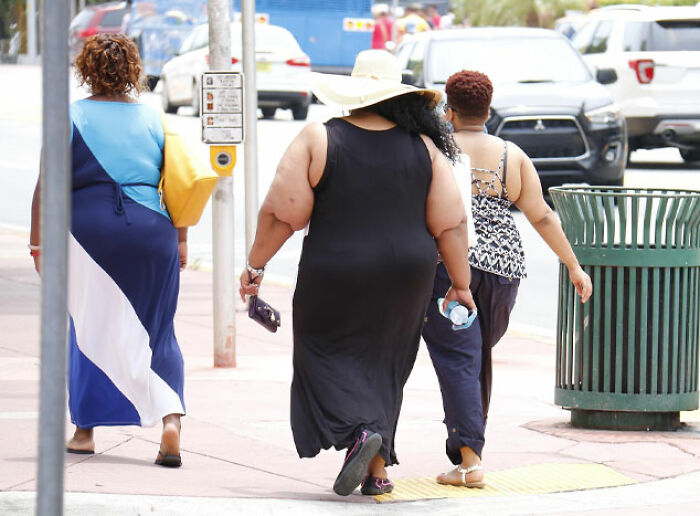
Image credits: Pixabay/Taniadimas
According to a new study published in the Annals of Internal Medicine, nearly one in five American adults who were classified as “overweight” would be considered “obese” under the new EASO framework.
That change pushes the United States’ national obesity rate from 42.4% to a staggering 54.2%.
The findings are based on data from more than 44,000 adults that was collected as part of the National Health and Nutrition Examination Survey (NHANES) between 1999 and 2018, which includes data on BMI and underlying health conditions, according to the Daily Mail.
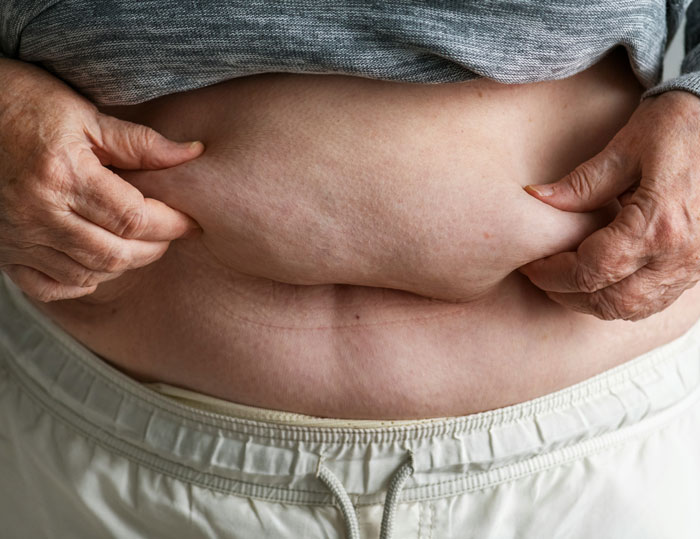
Image credits: Unsplash+
The adults in the study were 43.4 years old on average, and about half were women.
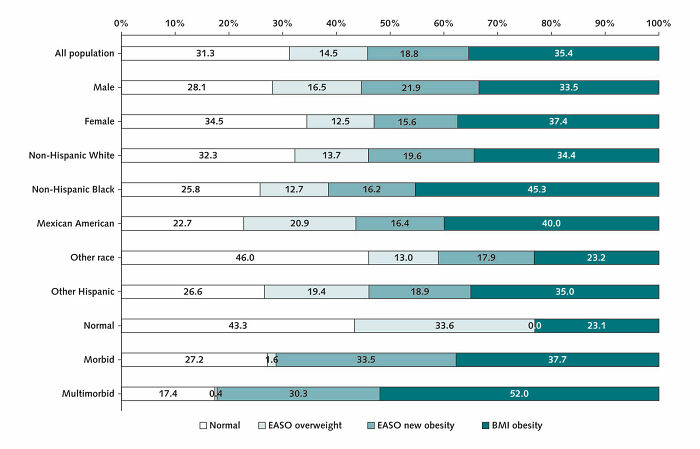
Using BMI alone, the researchers noted that 35.4% of the participants would be considered obese, while 33.3% would be considered overweight. A total of 31.3% were considered to be at a healthy weight.
Researchers found that those newly reclassified into the obese category using the EASO framework were more likely to be older, with an average age of 51.3 years compared to 36.5 for others in the overweight group.
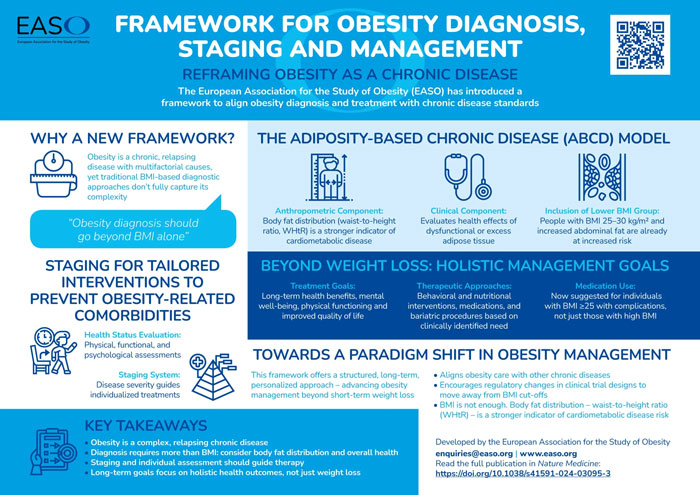
Image credits: European Association for the Study of Obesity (EASO)
Men were also more likely to fall into the EASO’s redefined group, as were individuals already struggling with chronic health conditions like diabetes.
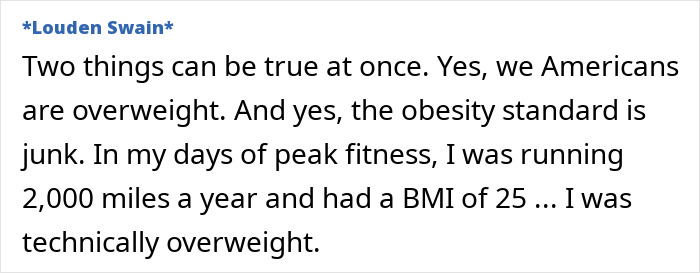
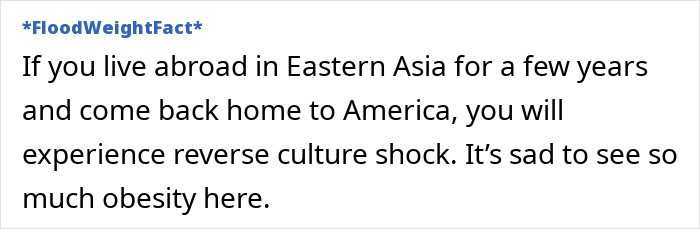
Some Netizens noted that the United States indeed appears to be experiencing an obesity crisis.
“It shocks me how obese and unhealthy Americans are compared to Europeans (and anywhere else, really..). No self-respect or self-control,” one commenter wrote.
Image credits: Freepik
“I would be considered pretty average build in some parts of Europe. Lucky for me, I live in North Carolina, so I look like an athlete in comparison. It’s not all bad news,” one joked.
“Obesity is the new smoking in terms of cardiovascular disease and cancer,” another commenter stated.
Image credits: European Association for the Study of Obesity (EASO)
Doctors and researchers stated that broadening the definition of obesity could bring major benefits.
For one, it may help patients qualify for early intervention programs and medications like Ozempic, which are typically given to patients meeting a certain BMI threshold today.
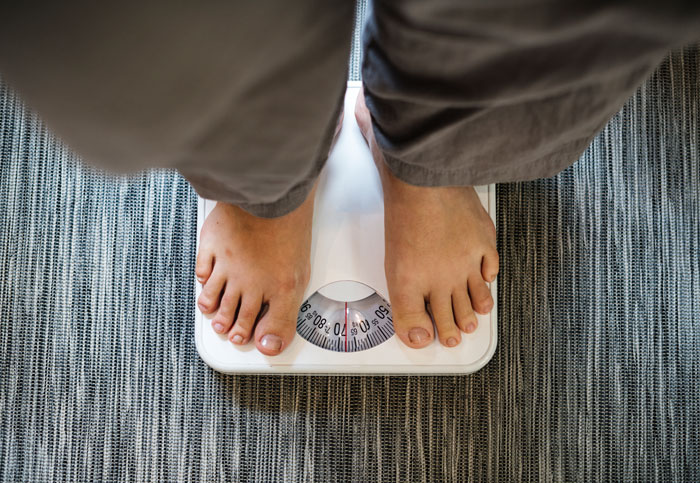
Under the current model, people with a Body Mass Index (BMI) of 30 or higher are categorized as obese.
Image credits: Freepik
The EASO system keeps that standard, but it adds a second step. If someone has a BMI between 25 and 29.9 and also suffers from a related condition, they would be considered obese as well.
“The new EASO framework may provide a more sensitive tool to diagnose obesity than the traditional BMI definition,” the study’s authors wrote.
Among the American adults who were newly reclassified as obese, 57.5% had at least one condition, such as high blood pressure, diabetes, or arthritis.
Image credits: Unsplash+/Toa Heftiba
Interestingly enough, high blood pressure affected 79% of the newly defined group, making it the most common health condition.
Following was arthritis, which affected 33.2%, and diabetes, which affected 15.6%.
Image credits: Freepik
Parts of the EASO’s updated health guidelines have been adopted in countries like Ireland and the Netherlands.
Countries like the United States and major health bodies, such as the World Health Organization (WHO), have yet to adopt the EASO’s standard.
BMI, at least for now, remains the standard in American medicine.
Image credits: European Association for the Study of Obesity (EASO)
Still, the findings could influence future guidelines. When researchers looked at mortality risk, they found that the newly reclassified group had a 50% higher risk of dy*ng prematurely compared to individuals with a healthy weight.
That’s a major red flag, and it’s a good reason why healthcare providers should consider taking a closer look at how obesity is defined and treated. The new approach could also encourage people to take weight-related conditions more seriously, even if they don’t look significantly overweight.

By entering your email and clicking Subscribe, you're agreeing to let us send you customized marketing messages about us and our advertising partners. You are also agreeing to our Privacy Policy.
Thank you! You've successfully subscribed to newsletters!



even if you add here really muscular people, truth is heart can only pump so much blood at once, if your vascular system has overgrown, heart has a limited space to grow into... so if you think BMI is s**t, think about this for a while, and then think about pressure on bones even from neck down, the heavier you are, the more pressure on them bones and joints and there is a limit there too , even with training and with age it starts degradation, compression etc depends of man or woman of the speed... so yeah, take care of your body and don't ignore doctors ;)

Every few years they change the guidelines, though. It’s true a lot of people are obese, but they need to quit moving the goalposts. Also, U.S. culture has created a lifestyle where it’s not easy to eat right and exercise. We live the way things are set up…we gain weight….they turn around and tell us, “You’re fat! How dare you get fat?” Well, maybe if there was less junk food available, healthy food was cheaper and easier to get, and we didn’t have to waste so much of our lives at work so we’d have more time for exercise….I feel like U.S. culture is setting us up to fail.
even if you add here really muscular people, truth is heart can only pump so much blood at once, if your vascular system has overgrown, heart has a limited space to grow into... so if you think BMI is s**t, think about this for a while, and then think about pressure on bones even from neck down, the heavier you are, the more pressure on them bones and joints and there is a limit there too , even with training and with age it starts degradation, compression etc depends of man or woman of the speed... so yeah, take care of your body and don't ignore doctors ;)
Every few years they change the guidelines, though. It’s true a lot of people are obese, but they need to quit moving the goalposts. Also, U.S. culture has created a lifestyle where it’s not easy to eat right and exercise. We live the way things are set up…we gain weight….they turn around and tell us, “You’re fat! How dare you get fat?” Well, maybe if there was less junk food available, healthy food was cheaper and easier to get, and we didn’t have to waste so much of our lives at work so we’d have more time for exercise….I feel like U.S. culture is setting us up to fail.







































 No fees, cancel anytime















33
4