Get Premium
Dark mode theme is available exclusively for premium users. Learn more about the benefits of subscribing.
No fees, cancel anytime.

 Dark Mode Ad-Free Browsing Unlimited Content
 Ad-Free Browsing Unlimited Content Dark Mode
Join 1.2 million Panda readers who get the best art, memes, and fun stories every week!

Every year, the Capture the Atlas Milky Way Photographer of the Year contest brings together some of the most striking night sky images from photographers all over the world. Curated by photographer Dan Zafra, the project highlights a carefully selected collection of around 25 photos taken in some of the darkest and most remote places on Earth – locations where the Milky Way is still visible in incredible detail, free from the glow of light pollution.
What makes this contest special isn’t just the final images, but everything behind them. Each photo usually involves planning, travel, and a lot of patience, waiting for clear skies, perfect timing, and the right conditions to align. These aren’t just snapshots of the night sky, but moments earned through dedication and a real passion for astrophotography. The result is a collection that feels both artistic and deeply human, showing how different places on Earth (and beyond) connect through a shared view of the cosmos.
Scroll down and explore the winning images for yourself. Each one is a window into a different corner of the night sky, captured in a way most of us rarely get to see.
More info: Instagram | Facebook | youtube.com | capturetheatlas.com
This post may include affiliate links.
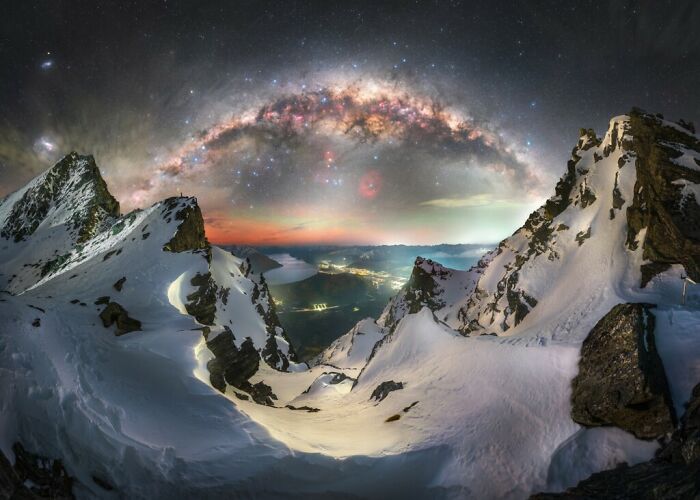
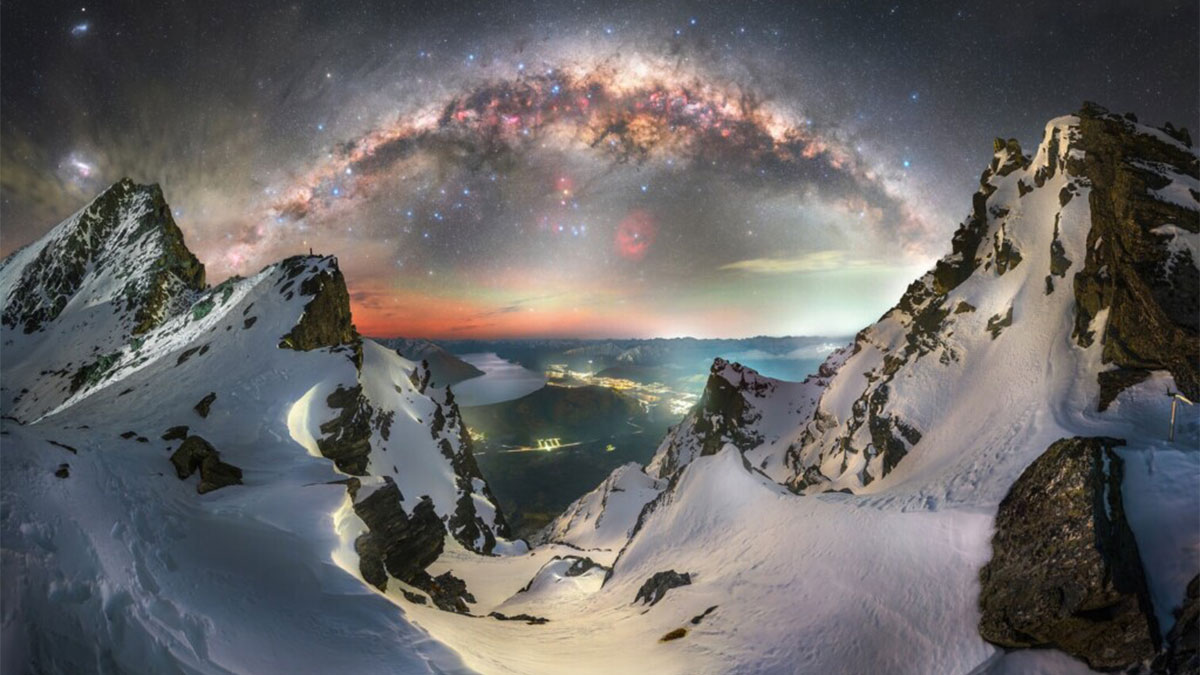
Location: Remarkables, Queenstown, New Zealand
The winter Milky Way arch sets above the rugged Remarkables Range in the Southern Alps, while the lights of Queenstown, New Zealand, glow far below. It is a rare alignment of galaxy, alpine terrain, and human presence, all captured in a single moment.
That distant glow tells a larger story. Most people beneath those lights will never see this sky. Light pollution continues to erase the universe from view, even in places that still feel remote. There is something surreal about watching the quiet, ancient light of the Milky Way above a place filled with motion, noise, and activity.
Creating this image meant climbing steep snow and ice, then enduring hours of wind and freezing cold through the night before sleeping in the snow until sunrise. Clouds and conditions shifted constantly, and the final result remained uncertain until the image came together many days later.
For one brief moment, everything aligned: mountain, light, and the fading presence of the Milky Way above.
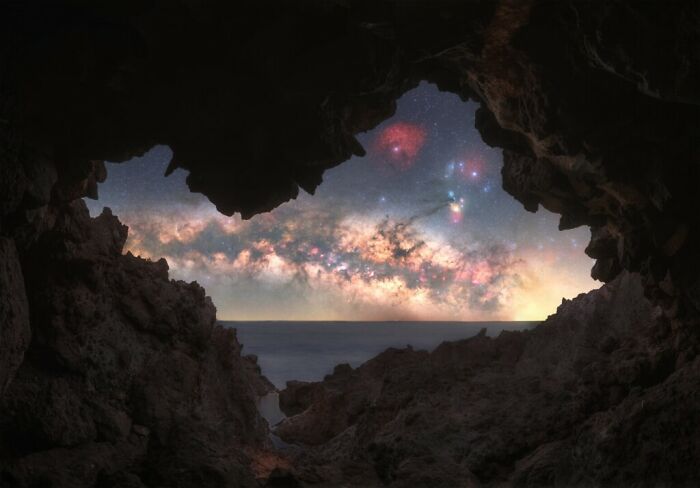
Location:Tenerife, Canary Islands, Spain
I’m always drawn to locations that feel unique and relatively undiscovered, and this cave was a perfect example. Although it was only a few minutes from the parking area, it took me nearly four hours of scouting to finally locate it.
The conditions made the process even more demanding. Intense heat combined with powerful winds made movement difficult, at times pushing me against sharp rocks. After nearly giving up and heading back, I finally came across the cave, a moment that made the entire search worthwhile.
Capturing the image proved just as challenging. Composing and shooting the panoramic foreground required careful positioning, while properly illuminating the upper section of the cave was particularly difficult. To manage this, I used focus stacking across different planes, including the upper edge, the horizon, and the lower foreground, all in near-total darkness, where the brief blue hour offered little assistance.
With the Milky Way sitting low on the horizon, bringing out its color and detail required additional effort in both capture and processing. In the end, the result reflects not only the scene itself, but also the persistence and experience behind it, making it especially meaningful.
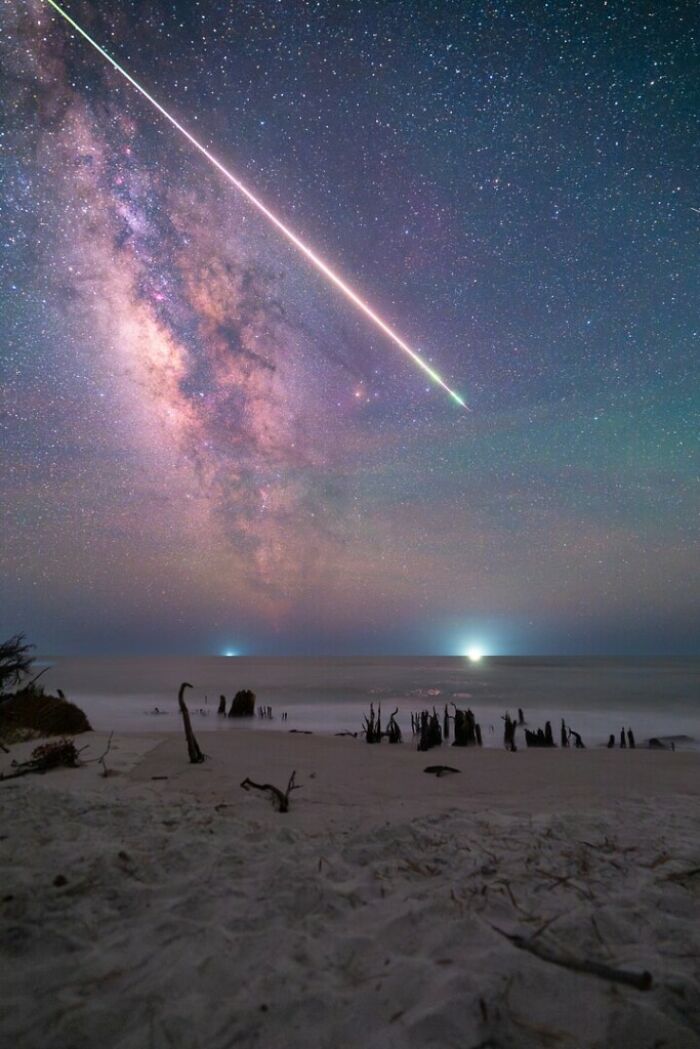
Location: Cape San Blas, Florida, USA
This single-exposure image became a reminder to always expect the unexpected in astrophotography. I had not even planned to visit this beach, as the forecast called for clouds and rain throughout the night.
The capture was part of a larger day-to-night time-lapse that I began shooting at golden hour, working through biting insects and the intense tropical humidity of Florida. After setting up the sequence, I left the camera running and returned to my vehicle.
Several hours later, shortly after midnight, I noticed the ground around me suddenly illuminated by a green glow, prompting me to look up. What followed was the largest meteor I have ever witnessed. It moved slowly across the Milky Way for nearly five seconds, and the glowing trail left behind by the fireball remained visible for almost fifteen minutes.
It was one of the most memorable moments I have experienced in astrophotography, completely unplanned and impossible to anticipate.
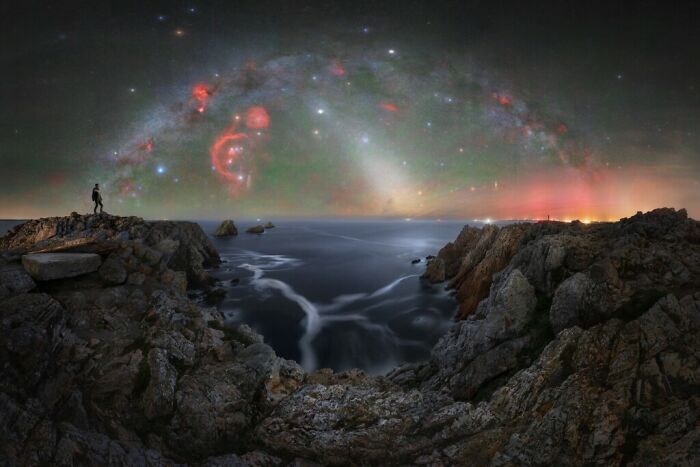
Location: Pen Hir – Bretagne, France
A two-week camper trip along the coasts of Normandy and Brittany became a continuous struggle against wind and cloud cover, until a single clear night transformed the entire experience.
I was positioned on the Pen Hir peninsula, scouting for a wide panoramic composition of the Milky Way. As darkness fell, I began capturing a 200° panorama using focus stacking. While reviewing one of the final frames, I noticed an unexpected red glow in the sky, aurora. At first, it was hard to believe.
After completing the planned sequence and confirming the phenomenon, I shifted my attention fully to the sky. As the night unfolded, zodiacal light also became visible, adding yet another rare element to the scene.
Within a single composition, the sky revealed an exceptional combination of phenomena: airglow, the winter arc of the Milky Way, Orion with Barnard’s Loop, the Pleiades, the Rosette and California nebulae, Andromeda, Jupiter, zodiacal light, and aurora borealis.
This image captures what astrophotography often represents at its core: careful preparation meeting complete unpredictability.
The final result is a blend of 12 focus-stacked exposures for the foreground and 7 tracked exposures for the sky, captured using a Minitrack LX2, an astro-modified camera, and an H-alpha filter.
Sometimes, the most memorable images emerge when conditions seem to fail, only to align in ways you could never have planned.

It looks like the guy on the left is exhaling the universe into existence
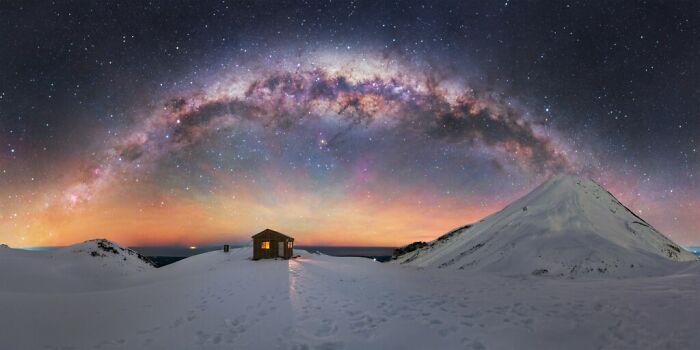
Location: Syme Hut, Mt Taranaki, New Zealand
Reaching this location required a demanding ascent to Fanthams Peak on Mount Taranaki, involving over five hours of hiking through deep snow and ice in extreme conditions. With windchill dropping to around -15°C and a heavy 20kg pack, progress was slow and physically taxing, with each step forward often followed by sliding back in the soft snow. The journey culminated at what is known as the coldest hut in New Zealand’s North Island, making this one of the most challenging hikes I have ever undertaken.
This image is the result of a large-scale panorama composed of 78 individual frames, captured over the course of approximately one hour and fifteen minutes in those harsh conditions. Despite the difficulty of both the ascent and the shoot, the opportunity to document this scene made the effort entirely worthwhile.
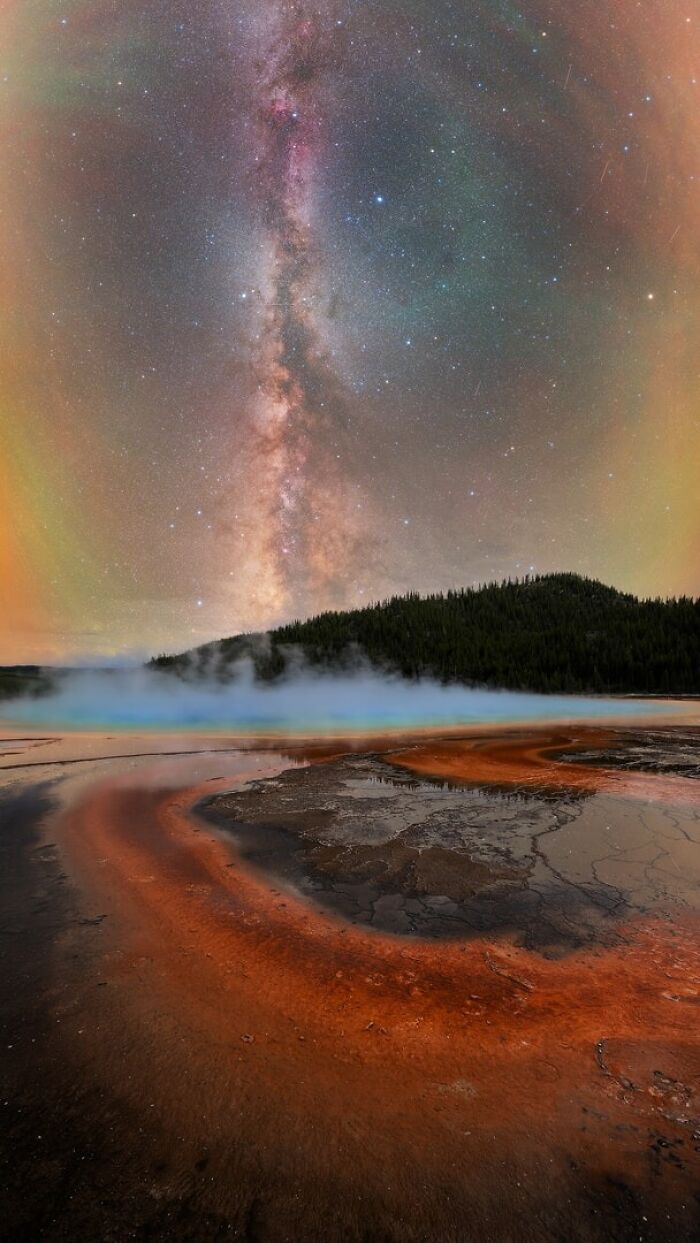
Location: Grand Prismatic Spring, Yellowstone National Park, USA Framed by the vibrant colors and drifting steam of Grand Prismatic Spring, the Milky Way rises above one of the most unique geothermal landscapes on Earth. It is a rare moment where the raw energy of the planet meets the quiet vastness of the night sky. The constantly shifting steam transformed the scene from one moment to the next, briefly revealing the stars before concealing them again. By carefully timing the intervals between changes in the wind, the Milky Way became visible, accompanied by a pronounced display of airglow that added depth and atmosphere to the sky.
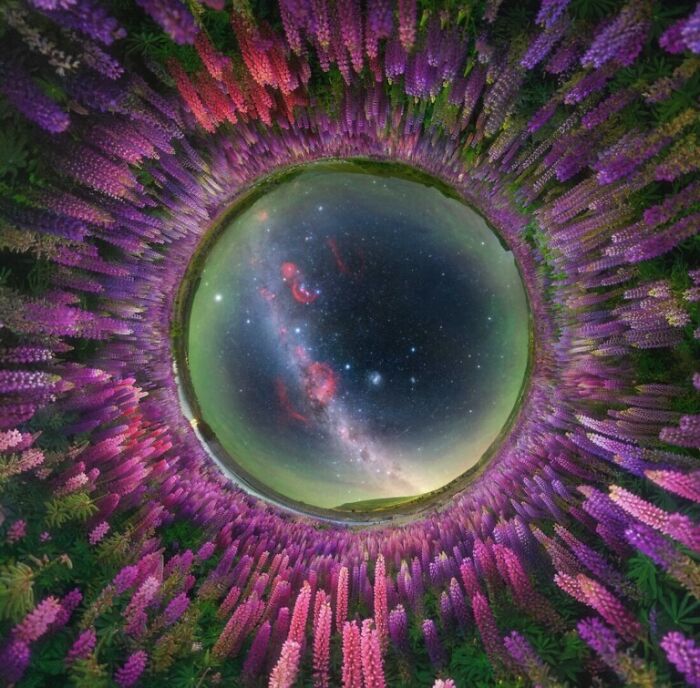
Location: Twizel, New Zealand
This image captures the Milky Way rising above a blooming field of lupines in New Zealand during November, when spring wildflowers transform the landscape beneath the night sky.
Using a fisheye perspective, the flowers encircle the scene, forming a natural frame that draws the viewer into the celestial sphere above.
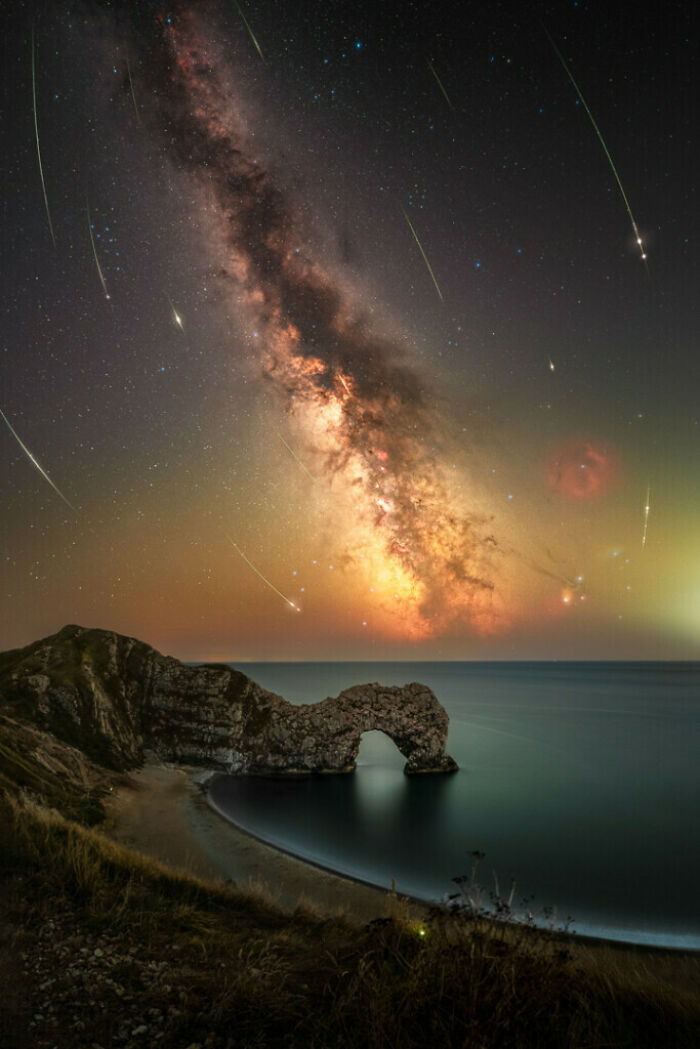
Location: Durdle Door, Jurassic Coast, Dorset, England
“Ancient fireworks” from Comet Swift-Tuttle hurtled through the atmosphere to document this ultra-wide angle composite image above the natural limestone arch of Durdle Door. In the foreground, a singular glow worm was documented amongst reeds along the sea cliff edge.
As the subject of Astrophotography grows by demand, beauty hotspots and World Heritage Sites including Durdle Door, are getting busy. With good reason that is why as Astrophotographers, we need to set an example in protecting beauty hotspots and local ecology. Through practice of utilising red head torches and adhering to access-restricted areas of UNESCO World Heritage sites.
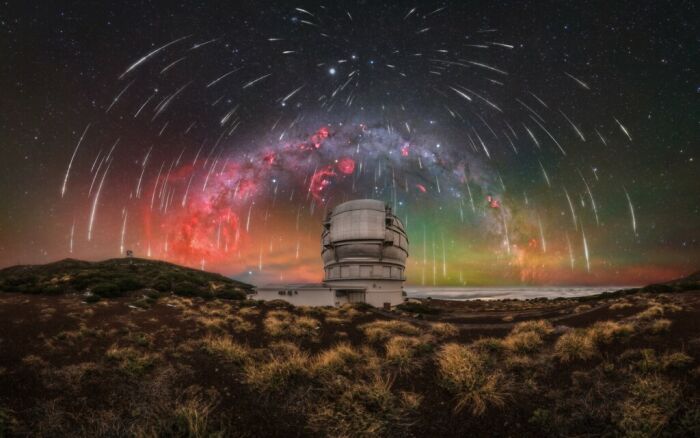
Location: Roque de los Muchachos GTC Telescope, La Palma This winter Milky Way panorama captures a sky filled with Geminid meteors above the Gran Telescopio Canarias, the largest optical telescope in the world.
My first trip to La Palma was an intense and unpredictable experience, from storms and summit snowfall to strong winds, rain, and brief windows of clear skies. For the first three nights, we were confined to the southern part of the island, as the road to the Roque de los Muchachos Observatory remained closed, forcing us to search for clear conditions elsewhere.
Reaching the summit seemed increasingly unlikely, until the fourth day, when the road finally reopened. We immediately made our way up, filled with anticipation. After scouting compositions and preparing for the night, clouds once again moved in, putting everything at risk. Rather than giving up, we waited, constantly checking the sky for any sign of improvement.
Around midnight, the first stars began to appear, and we quickly headed to the Gran Telescopio Canarias. Above us, the sky opened into a field of stars, while a layer of clouds remained below, creating a striking contrast with the illuminated structure of the telescope. Although the dome could not be opened due to humidity, the experience of witnessing such dark skies for the first time was remarkable, with the Milky Way appearing almost three-dimensional.
This was also my first successful capture of the Gum Nebula, adding a unique element to the composition. The final image is the result of an extensive post-processing workflow, combining meteor data registered using Auriga RegiStar from six cameras over five nights on La Palma.
All RGB frames were captured using the Capture the Night Astro filter by Capture the Atlas. The final resolution reaches approximately 400 megapixels. This image reflects not only the complexity of the process, but also the experience behind it. Each time I revisit it, it brings me back to that unforgettable time on La Palma.
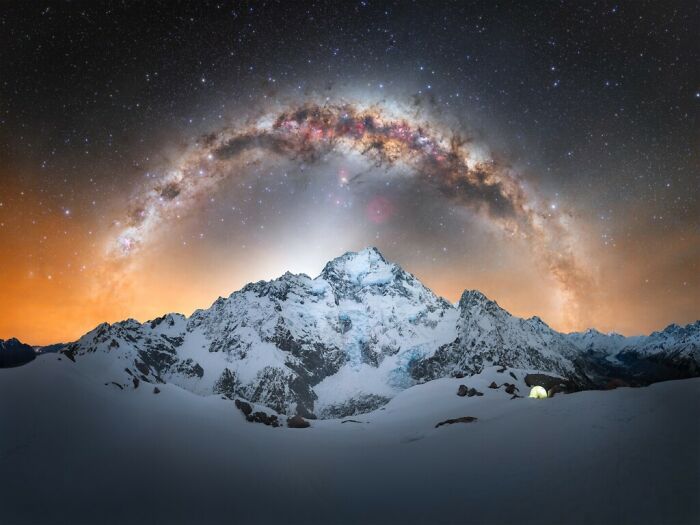
Location: Aoraki/Mt Cook National Park, New Zealand
My goal with astrophotography has always been to combine my passion for mountains, adventure, and the landscapes of New Zealand. Capturing the Milky Way arch above Aoraki / Mount Cook, the central peak of the national park, became one of the most demanding challenges I had set for myself.
Reaching this location required drawing on my experience as a mountaineer, navigating steep rocky terrain and snow-covered slopes under winter conditions. The route presented constant challenges, including large washouts along the mountainside, unstable snow affected by solar radiation, and the demands of winter camping at altitude. The effort required both physical endurance and careful decision-making throughout the journey.
Despite these difficulties, the environment offered extraordinary conditions. As night fell, the Milky Way and zodiacal light appeared with exceptional clarity, enhanced by the cold, stable air at elevation. Being positioned so close to Aoraki added a sense of scale and intensity to the moment, especially as the western arc of the Milky Way moved into alignment above the mountain.
With only a brief window to capture the scene, there was little margin for error. This image represents that single opportunity, where preparation, experience, and timing came together to document a moment that felt both challenging and deeply rewarding.
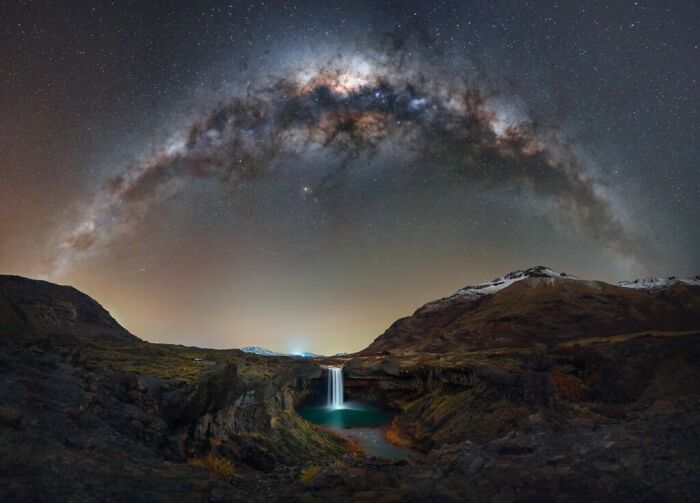
Location: Salto del Agrio, Caviahue, provincia de Neuquén, Argentina
This image was captured during a night at Salto del Agrio, in the province of Neuquén, Argentina. It’s a place that invites reflection on the immense sequence of events, both on Earth and in the sky, that shaped this landscape. The 45-meter waterfall plunges into a canyon carved by ancient lava flows from the Copahue volcano. Surrounded by basalt, the scene is enriched by the vivid colors left behind by minerals, particularly iron and sulfur carried by the Agrio River.
Images like this are carefully planned and patiently awaited, yet they always carry an element of uncertainty. Weather is often the greatest challenge. My first attempt to reach this location was stopped by heavy snowfall, and on this occasion, the cold and strong winds once again put the outcome in doubt.
Despite the harsh conditions, I waited for the precise moment when the Milky Way aligned above the waterfall, forming an arch suspended over this ancient terrain. Working with the tripod close to the ground and repeating exposures, I was finally able to capture the scene I had envisioned for so long.
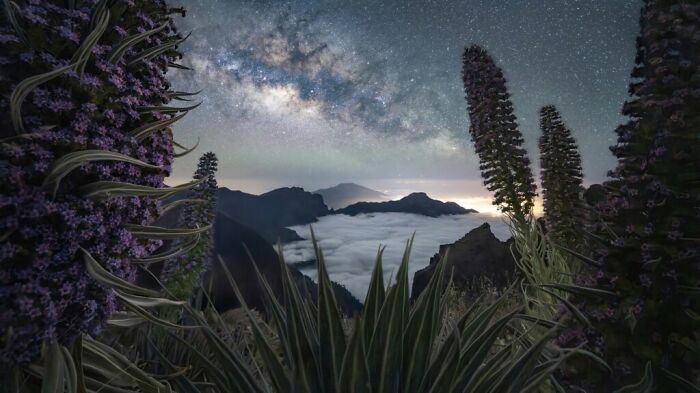
Location: La Palma, Canary Islands
This panorama was captured at the highest point of the volcanic island of La Palma, a location defined by its unique terrain and exceptional night sky conditions. The lack of ambient light made the process more demanding, requiring extensive focus stacking to achieve sharpness across the entire scene, but it also provided ideal conditions for astrophotography.
I chose to create a panoramic composition to include the blooming pink Tajinaste flowers, an endemic species of the island, using them to frame the full arc of the Milky Way’s core. The summit itself forms a vast crater, offering expansive views across the island, often rising above a layer of clouds.
Although it was already early summer and nearing the end of the blooming season, I was fortunate to find a few flowers still in good condition and positioned perfectly for the composition I had envisioned.
This image represents both careful planning and timing, and I’m especially pleased with the result and honored to have it selected for the Milky Way Photographer of the Year collection.
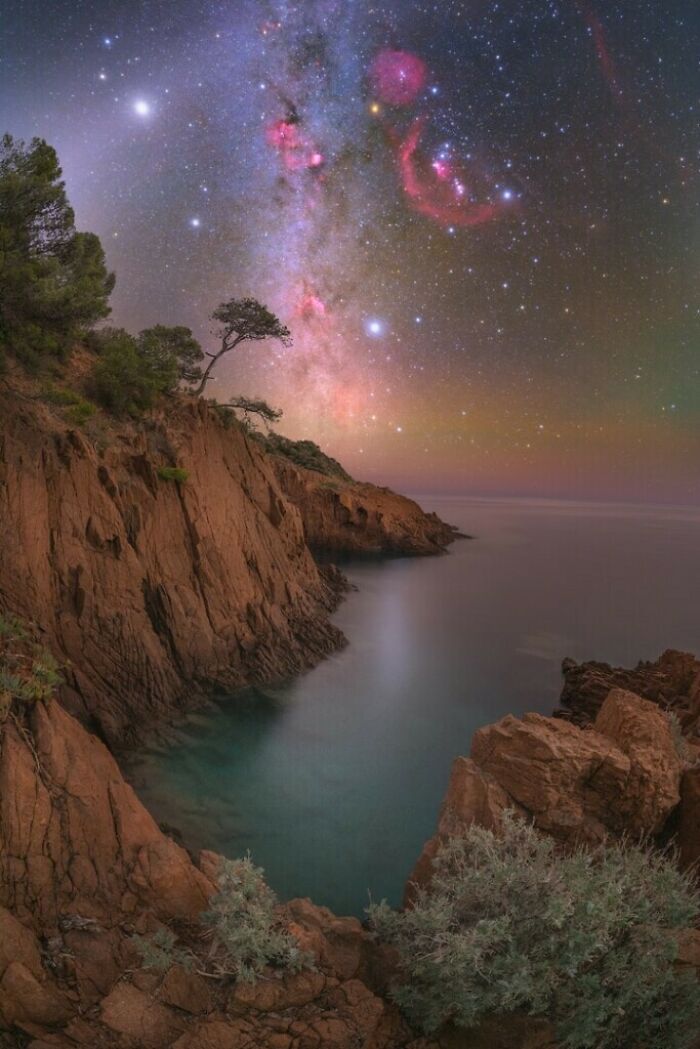
Location: Saint Raphaël, French Riviera
The night sky takes on a distinctly different character during this time of year, especially with the arrival of the winter constellations. The tones feel cooler, the air sharper, and Orion rises prominently above the horizon, becoming the centerpiece of the scene. It’s a season that brings a quiet, almost meditative atmosphere to nightscape photography.
This image was captured along the sea cliffs near my home in the south of France, a place where the coastline, the stars, and the surrounding silence come together in perfect balance. Having access to such diverse landscapes, from mountains to the sea, all within reach of dark skies, makes moments like this not only possible, but deeply rewarding.
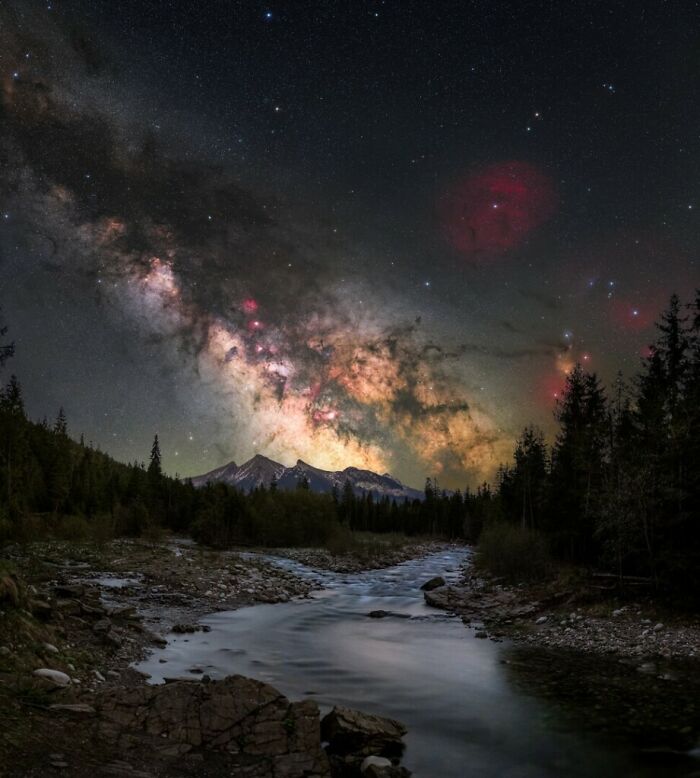
Location: Jurgów, Poland
Taking advantage of the April new moon, I set out to capture my first Milky Way image of 2025. With promising conditions forecast across southern Poland, I returned to the Tatra Mountains, a region I often revisit with my camera, this time exploring the Białka Gorge in Jurgów, a location I had not photographed before.
From this vantage point, the Milky Way rises above the Tatras, which in early spring still carry the lingering traces of winter. What drew me most to this scene was the contrast between the dark, rugged landscape and the richness of the sky. The galactic core emerges just above the mountain horizon, accompanied by the subtle colors of the dust and nebulae within the Rho Ophiuchi region.
In the foreground, the river creates a natural leading line, guiding the eye from the earth toward the mountains and into the night sky, visually connecting the terrestrial and the cosmic.
Beyond the final image, astrophotography is equally about the experience in the field, often shared with others who are drawn to the same conditions and moments, united by a common appreciation for the night sky.
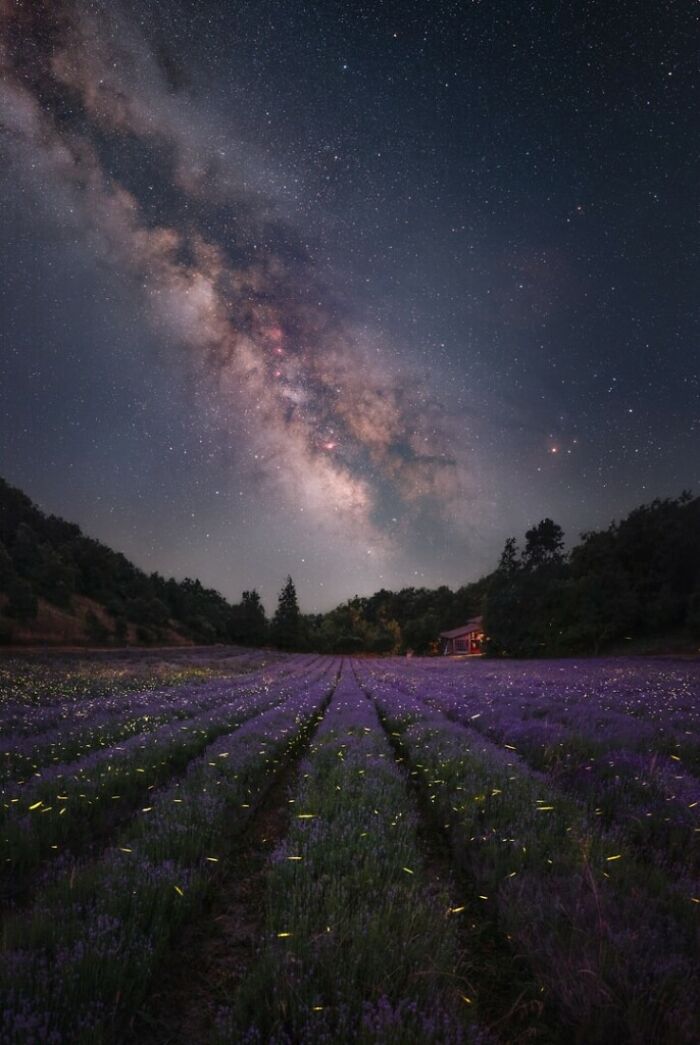
Location: Appennino Bolognese, Italy
Among rows of blooming lavender, the air filled with fragrance, fireflies appeared like small lanterns beneath a sky dominated by the summer Milky Way, a perfect meeting between the wonders of Earth and the night sky above.
Astrophotography and night photography are defined by moments, brief instances when everything aligns and each element falls into place. The process often involves working against changing weather, technical challenges, and the constant search for the right timing, followed by careful post-processing.
Yet when all these elements come together, the effort is always rewarded by the emotion of the final result.
Location: Mexico, Baja California Sur, La Giganta
This photograph was captured in the heart of the Sierra La Giganta, in Baja California Sur, following a two-day expedition from the small village of San Juan Londo. The final approach required an ascent of more than 800 meters by mule along a long-forgotten section of the historic Camino Real, once used by vaqueros and their donkeys to transport goods between remote settlements. This path has remained largely untouched for nearly 80 years.
The image forms part of an ongoing project focused on documenting and promoting the exceptional dark skies of Baja California Sur for astrotourism. These conditions meet the standards of true Dark Sky Sanctuaries, offering some of the purest night skies in the region. On the right side of the frame, the faint glow belongs to the distant city of Loreto, the first capital of the Californias, located approximately 30 kilometers to the south.
We were accompanied by Señor Juan, our guide, whose father first brought him to this hidden location over 65 years ago. Together, we aim to preserve the memory of these historic routes, ancient paths that have been gradually reclaimed by nature over time.
This photograph reflects not only the pursuit of pristine dark skies, but also a deeper process of exploration and rediscovery. It brings together the search for untouched landscapes with the recovery of a cultural and historical legacy, helping to position Baja California Sur as a world-class destination for night sky photography while honoring the stories embedded in its terrain.
Milky Way photography goes beyond capturing the stars. It becomes a way to explore remote environments, challenge physical limits, and reconnect with both nature and history. If this image encourages others to look beyond established paths in search of truly dark skies, then it has fulfilled its purpose.
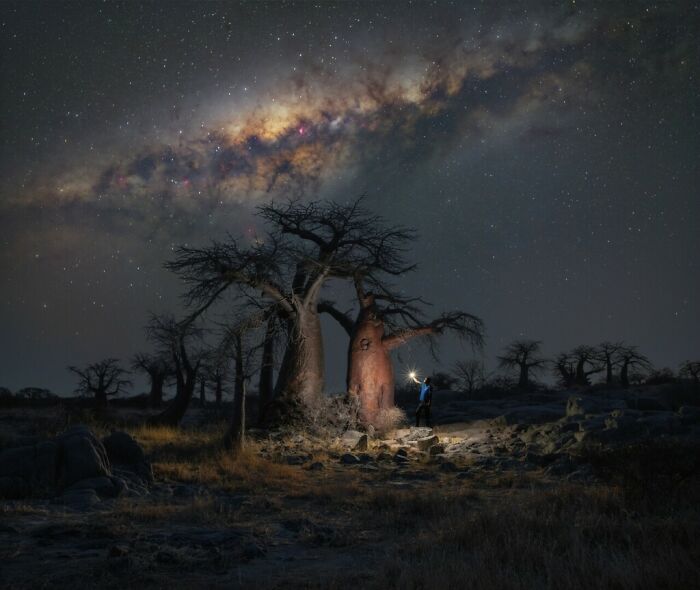
Location: Botswana
I spent ten days traveling through Botswana, living out of my car and moving through remote desert landscapes in complete isolation, focused entirely on photographing the night sky. This location became the highlight of the trip: a small, ancient island rising from the middle of a vast salt pan.
Reaching it, however, was far from straightforward. After struggling to find the route and nearly giving up, I only managed to get there by chance, spotting two Jeeps heading in the opposite direction and deciding to turn around and follow them. After three intense hours navigating the terrain, I finally found myself driving across the open salt pan, leaving a trail of white dust behind.
The island itself was covered with baobab trees, scattered in small groups or standing alone, each one offering a striking subject under the night sky. Many were naturally positioned beneath the Milky Way core early in the night, while others lent themselves to different compositions, including star trails.
This particular group stood out to me the most. Alone in the darkness, I took my time shaping the scene, using a torch to carefully light-paint the foreground. The final image is a blend of one exposure for the landscape, eleven for the light painting, and a stack of four tracked exposures for the sky, combined to balance detail and atmosphere.
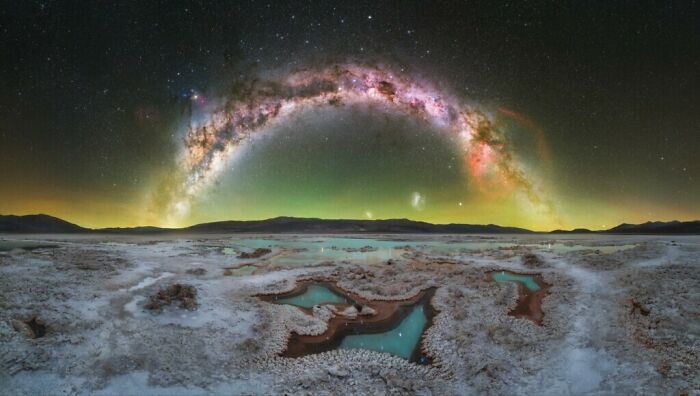
Location: Catamarca, Argentina
Reaching this location required traveling deep into the Argentine Puna, a remote region accessible only by 4×4 vehicles along rough dirt tracks, far from any source of light pollution. The nearest settlement was Antofalla, a small village of around 60 inhabitants, where electricity is generated locally and turned off at night. Beyond that, the closest towns are several hours away, surrounded by vast and isolated landscapes. Situated between 3,500 and 4,000 meters above sea level, the altitude and remoteness make this an exceptional environment for night sky photography.
What made this place particularly compelling was its rarity. I had never seen photographs of this salt flat before, and its untouched character and minimalist landscape immediately stood out.
Photographing the Milky Way in the southern hemisphere brought both challenges and excitement, as its appearance differs significantly from what I was used to in the north. In this moment, the galactic center sits to the left side of the arch, while the Gum Nebula appears on the right, creating a natural visual balance across the sky.
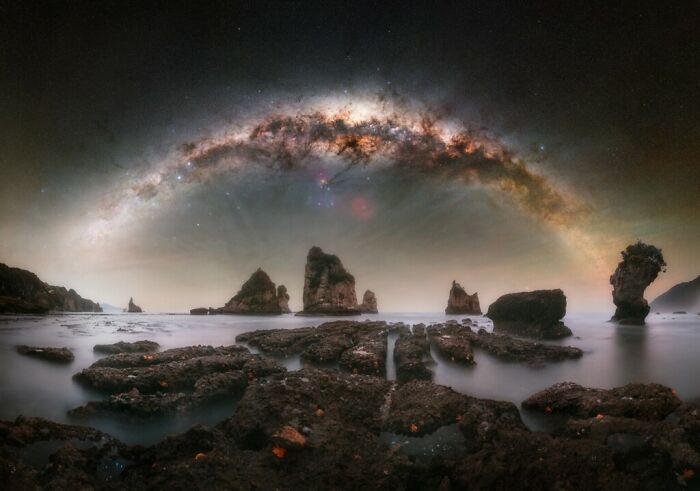
Location: West Coast, New Zealand
Capturing a setting Milky Way core from this beach had been on my list for a long time, with the starfish-covered reef offering a distinctive and compelling foreground.
It’s a notoriously difficult scene to photograph, as access to the reef is only possible during the lowest tides, while the sky must also cooperate with favorable moon and cloud conditions. During my short visit, everything unexpectedly aligned.
At first, the conditions seemed uncertain due to strong winds, but I decided to attempt the shot with some company for safety. After assessing the reef, I carefully made my way onto it while others kept watch to ensure I remained safe. The terrain is hazardous, with gaps between the rocks posing a real risk, and the rapidly rising tide added constant pressure throughout the shoot.
Despite these challenges, I was able to capture the necessary frames, returning to shore just in time. Due to the changing tide, the upper rows of the sky panorama were photographed from the beach, while the lowest row was captured from the reef to maintain proper alignment and perspective in the final composition.
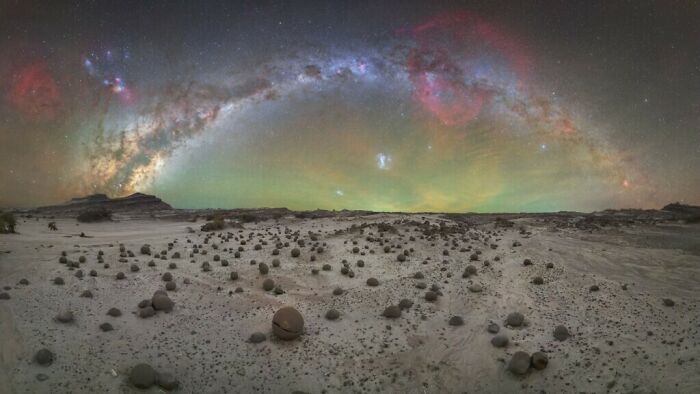
Location: Parque Provincial Ischigualasto, Valle de la Luna, San Juan, Argentina
This photograph captures the first full Milky Way arch ever taken at this location, a site of exceptional scientific and cultural significance. Recognized as a UNESCO World Heritage Site, its geological importance lies in being the only place on Earth where the complete sequence of the Triassic Period can be observed, preserving key fossils from the earliest dinosaurs and earning its place among the most valuable geological heritage sites in the world.
Located in Valle Fértil, this landscape was shaped more than 200 million years ago by powerful river systems. Today, it continues to attract geologists and paleontologists from around the globe, further highlighting both its importance and its fragility.
While photographing in the area known as Cancha de Bochas, I felt an unprecedented sense of responsibility. Guided by local experts, accessing the site required extreme care. Every movement had to be deliberate to avoid damaging this irreplaceable environment, turning the experience into a challenge that went far beyond the technical aspects of photography.
In the end, this was not just about capturing an image, but about connecting with the deep past of our planet. Places like this remind us that beyond appreciating them, we also share the responsibility of preserving them.
This photo is a reminder that magic often hides in the most unexpected places. All it takes is a little patience, planning, and passion.
Location: Wairarapa Coast, New Zealand
When I first discovered this location, I immediately envisioned creating something special beneath the night sky. However, upon arriving after dark, I found that a seal had settled exactly where I had planned to set up my tripod. It showed little interest in moving, and judging by how worn and polished the rock was, it was clearly one of its preferred resting spots.
Eventually, the seal shifted slightly to the side, remaining within the scene for the duration of the shoot. It can still be seen in the final image for those who look closely, adding an unexpected and memorable element to the composition.
Given the complexity of the scene, I knew the final image would require a significant amount of work. Over the following weeks, starting in November, I returned whenever possible to collect the necessary data for this panorama, carefully building the image piece by piece under the night sky.
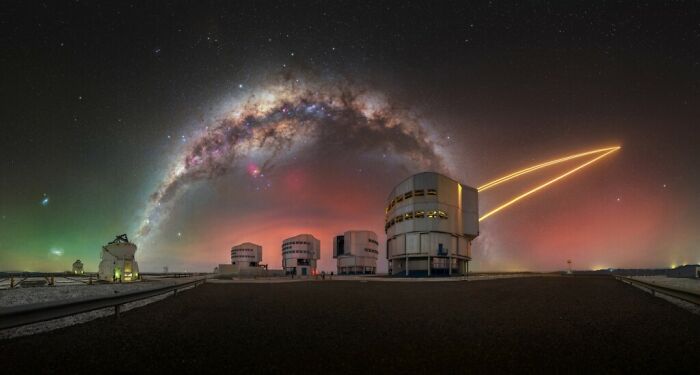
Location:Very Large Telescope, Paranal, Chile
This scene was captured at the Very Large Telescope (VLT) on Cerro Paranal, in Chile’s Atacama Desert, under exceptionally pure observing conditions where the boundary between Earth and sky feels almost seamless.
The Milky Way stretches across the sky, with its dense central bulge rising prominently overhead. To the left, the Magellanic Clouds, two neighboring satellite galaxies, are visible to the naked eye from the Southern Hemisphere. Subtle airglow adds another layer to the scene, a natural emission produced by chemical reactions in the upper atmosphere at altitudes of 80 to 100 kilometers. In this image, it reveals a range of colors, with green tones on the left and warmer reddish hues toward the right.
In the foreground stands the VLT, operated by the European Southern Observatory. Situated at 2,635 meters above sea level, the site benefits from extremely dry conditions, stable atmospheric layers, and minimal light pollution, resulting in more than 300 clear nights each year.
The observatory consists of four primary telescopes, each equipped with 8.2-meter mirrors. One of them, UT4 (Yepun), projects four sodium laser beams into the sky, creating artificial guide stars at an altitude of approximately 90 kilometers. These reference points enable adaptive optics systems to correct for atmospheric distortion in real time, significantly enhancing the clarity and precision of astronomical observations.
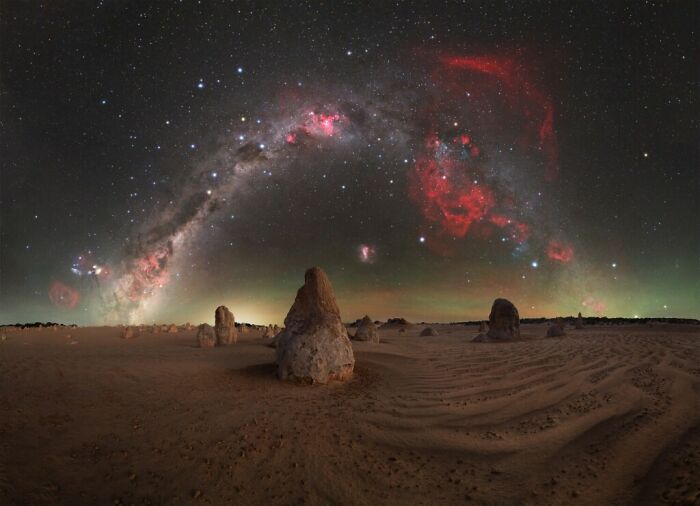
Location:Pinnacles Desert, Nambung, Western Australia
There’s something uniquely powerful about a calm, windless night in the Pinnacles Desert, a place that never fails to remind me how fortunate we are to have such pristine dark skies so close to home, just a short drive away. As the sun sets beyond the Indian Ocean, a profound stillness settles over Nambung, transforming the landscape into an almost otherworldly scene and drawing me back here time and time again.
In this composition, the main limestone pillar aligns almost perfectly with the South Celestial Pole, anchoring the image beneath the rotating sky. To the right, the faint but unmistakable red glow of the Gum Nebula, a vast supernova remnant, adds depth and scale to the scene.
Western Australia offers some of the finest night skies in the world, yet it’s easy to take them for granted. Nights like this serve as a reminder of just how special these quiet, remote corners of the Wheatbelt truly are.
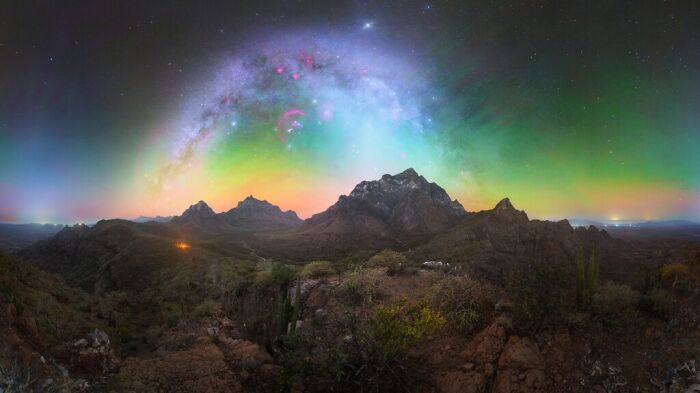
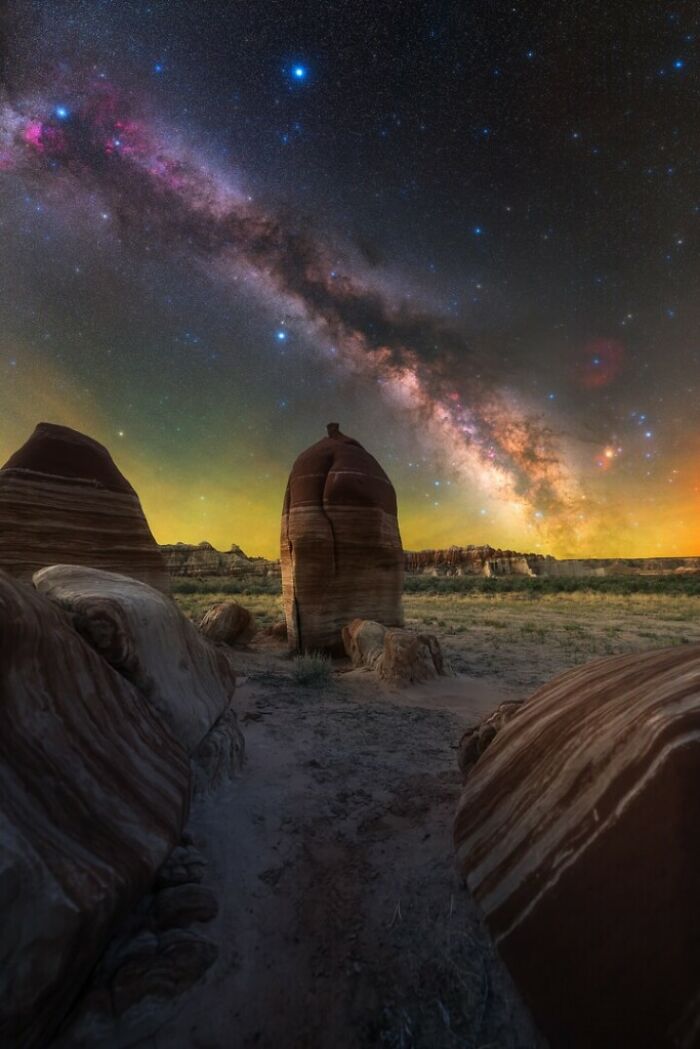
Location: Hopi Reservation, Northern Arizona, USA
I am drawn to Milky Way photography because of its ability to spark curiosity. It offers a perspective that feels entirely different from other forms of photography, often revealing a world that many people have never experienced.
With my images, my goal is to inspire that same sense of curiosity, encouraging others to imagine what it feels like to stand beneath a sky like this and witness it with their own eyes. That sense of wonder is what first drew me to the Milky Way, and it continues to shape the way I approach each image.
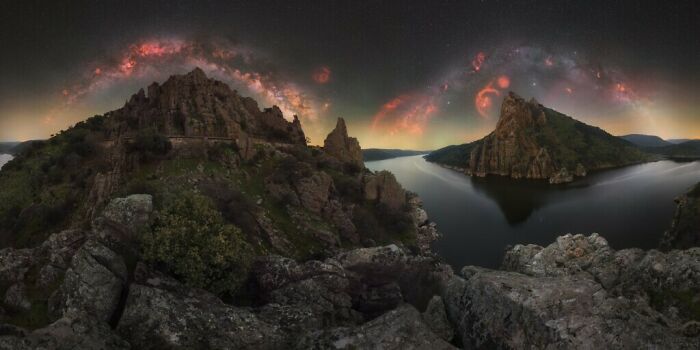
Location: Monfragüe National Park, Spain
I am always drawn to traveling to remarkable natural landscapes to capture their essence through night photography. This image, which represented a significant challenge for me, was taken in Monfragüe National Park during one of the few nights of the year when both the winter and summer Milky Way can be seen in the same sky.
The scene does not appear this way to the naked eye. It is a composite that captures the transition of the Milky Way over several hours, combining the winter Milky Way visible after dusk with the summer Milky Way rising before dawn.
The following morning, I was able to return to this location with my family, who had accompanied me in the search for this long-envisioned image. Those shared moments, along with the effort behind the capture, make this photograph especially meaningful to me.

"Holy cats"? I have never heard that kind of saying before. I like it.
Load More Replies...

Wow is the only thing I could articulate looking at these. I can't imagine how anyone could choose a winner.
"Holy cats"? I have never heard that kind of saying before. I like it.
Load More Replies... Wow is the only thing I could articulate looking at these. I can't imagine how anyone could choose a winner.


































 No fees, cancel anytime