Get Premium
Dark mode theme is available exclusively for premium users. Learn more about the benefits of subscribing.
No fees, cancel anytime.

 Dark Mode Ad-Free Browsing Unlimited Content
 Ad-Free Browsing Unlimited Content Dark Mode
Join 1.2 million Panda readers who get the best art, memes, and fun stories every week!
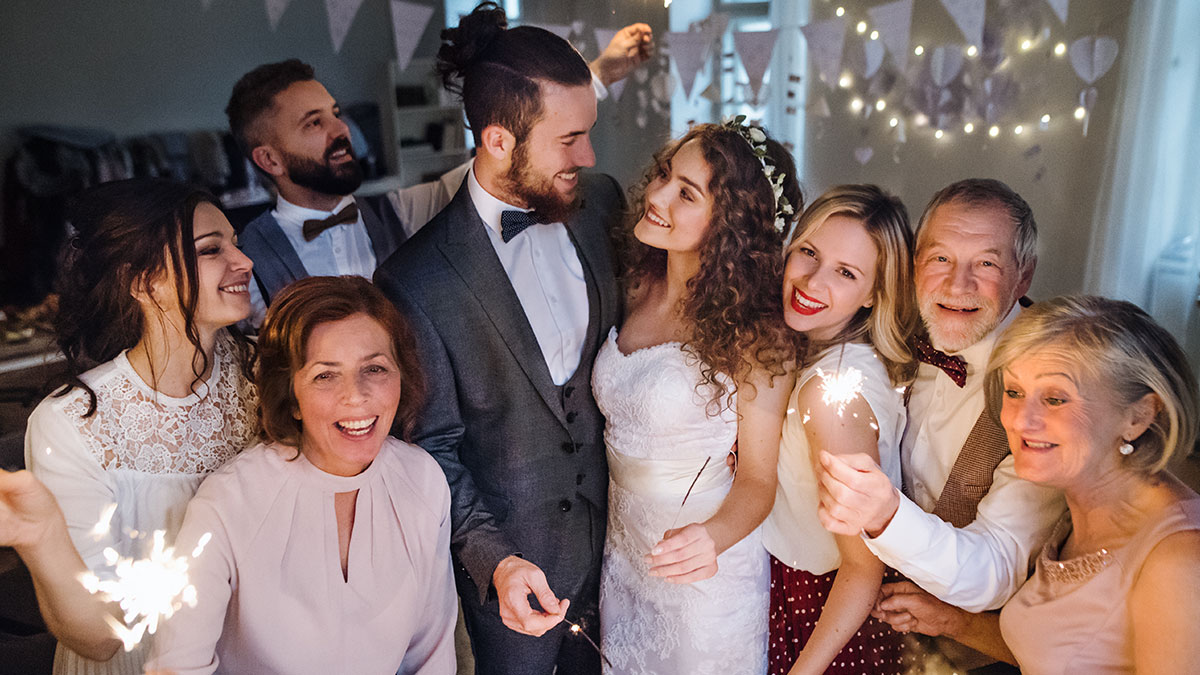
Despite often becoming quite a headache, wedding planning can be an exciting experience. That’s why many happy couples spend countless hours making sure their special day is everything they ever dreamed of.
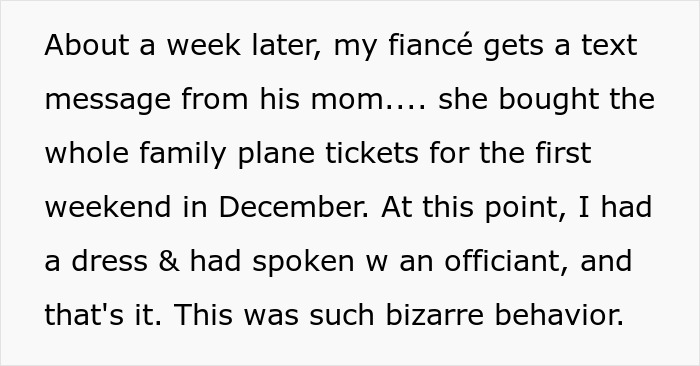
But some people have that taken away from them, like this redditor did when her mother-in-law decided to take certain matters into her own hands. She set the date for the wedding and bought plane tickets for the entire family, all without consulting the soon-to-be-wed once. Scroll down to find the full story in the bride’s own words below.
Image credits: halfpoint / envatoelements (not the actual photo)
Image credits: kues1 / freepik (not the actual photo)
Image credits: Impossible_Hour_4374
Image credits: Rawf8.com / freepik (not the actual photo)
After the big question has been popped and the squeals of excitement let out, it’s time to roll up your sleeves and start planning – whether it’s an elopement getaway or a big celebration in your home town, there’s usually a lot to do before the big day.
According to The Knot, the soon-to-be wed usually take on the largest share of the wedding planning tasks themselves. The source’s data shows that they cover roughly 81% of the responsibilities, while 11% are taken care of by their parents, 7% by a wedding planner, and 2% by the couple’s loved ones.
When trying to make sure that their special day is exactly what they hoped for, the newlyweds usually focus on five main aspects of the big day: the guests (and ensuring that they’re well taken care of and having a good time), the costs and the budget, personalization, the overall look and the vibe, and, last but definitely not least, the food and drinks.
But before tackling these important tasks, one might want to focus on the cornerstones – the when and the where – first. According to one of The Knot’s surveys, the average engagement length for couples in the U.S. is 15 months; but that in no way means that everyone should wait this long. As for the where, you can have your wedding almost anywhere you like, and many people seemingly do – as of 2023, close to one-in-five weddings were a destination wedding.
Image credits: YuriArcursPeopleimages / envatoelements (not the actual photo)
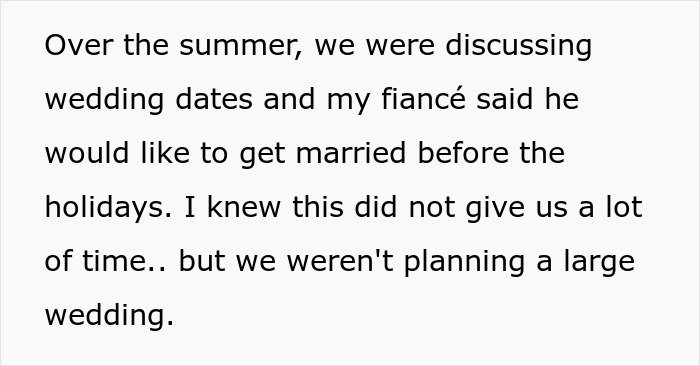
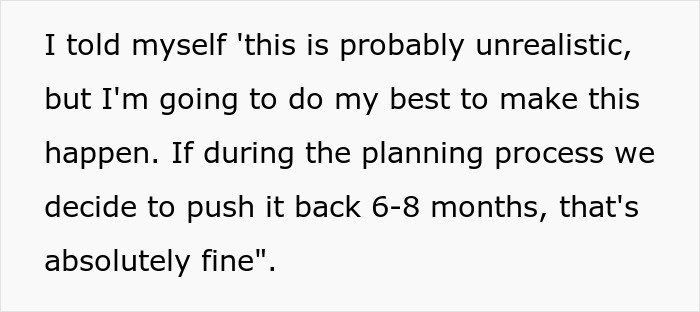
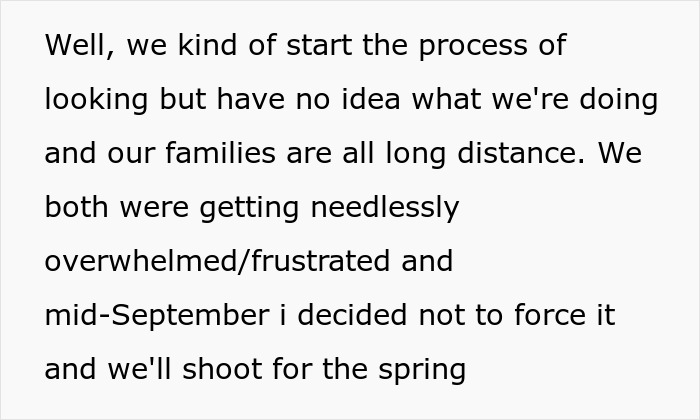
The OP shared that she and her partner didn’t have the when—seemingly not the where, either—set in stone yet, when they started planning their wedding. Be that as it may, the mother-in-law setting the date and choosing the location without consulting the couple came as quite a shock; especially since she didn’t contribute to the big day financially (other than booking the plane tickets), which, for some, means that the person doesn’t get to dictate much regarding the wedding.
Needless to say, financial contributions can quite significantly alleviate the financial burden of a wedding celebration. Nowadays, the venue alone can cost close to $13,000. That, according to Statista, is the average cost of the biggest wedding expense couples in the U.S. make when it comes to their big day, followed by engagement rings (costing $5,500 dollars on average), live bands ($4,300 dollars), wedding photographers ($2,900 dollars), florists, alcohol (both $2,800 dollars), and other costs.
Traditionally, wedding costs are at least partially covered by the couple’s parents. The British Vogue notes that the expenses that would usually befall the bride’s family entailed invitations and announcements, wedding dress and accessories, floral arrangements and corsages, ceremony arrangements, the reception party and vendors, necessary transportation, and the wedding photographer or videographer. The groom’s family was traditionally expected to pay for the officiant fee and marriage license, rehearsal dinner costs, music (DJ or band) and drinks, and honeymoon expenses.
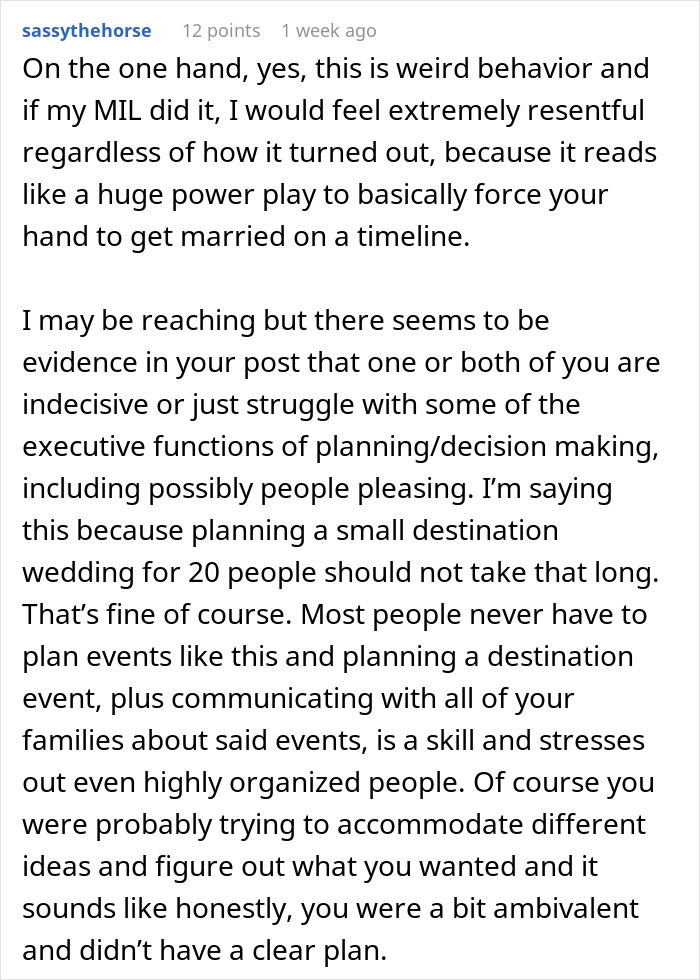
Nowadays, it’s likely not as widely expected for parents to pay for their children’s union. (Though, according to The Knot’s Real Weddings Study from 2023, newlyweds paid for around 48% of their wedding costs, leaving the remainder of the bill (52%) to their parents.) But some parents might still want to be involved, which, in the OP’s case, meant having her mother-in-law set the date for the big day. The redditor admitted having mixed feelings about it, even though the couple went with it and seemingly enjoyed their wedding day. Netizens in the comments seemed to share mixed opinions about the situation, too.

By entering your email and clicking Subscribe, you're agreeing to let us send you customized marketing messages about us and our advertising partners. You are also agreeing to our Privacy Policy.
Thank you! You've successfully subscribed to newsletters!
65Kviews
Share on Facebook
MIL overstepped, but it does seem like maybe her son had more to do with all this than is evident. Lots of red flags. Maybe just me, but I also found it odd to say MIL contributed nothing to the wedding. Maybe not like it, but she bought all those plane tickets to get the family there, right? Indirect contribution.

everyone taking about the MIL being an AH, when it's 100% on the husband (and OP) to just do everything for the date cause MIL decided to buy plane tickets when she felt like it. Grow a spine.


MIL overstepped, but it does seem like maybe her son had more to do with all this than is evident. Lots of red flags. Maybe just me, but I also found it odd to say MIL contributed nothing to the wedding. Maybe not like it, but she bought all those plane tickets to get the family there, right? Indirect contribution.
everyone taking about the MIL being an AH, when it's 100% on the husband (and OP) to just do everything for the date cause MIL decided to buy plane tickets when she felt like it. Grow a spine.




































 No fees, cancel anytime










































21
9