Get Premium
Dark mode theme is available exclusively for premium users. Learn more about the benefits of subscribing.
No fees, cancel anytime.

 Dark Mode Ad-Free Browsing Unlimited Content
 Ad-Free Browsing Unlimited Content Dark Mode
Join 1.2 million Panda readers who get the best art, memes, and fun stories every week!

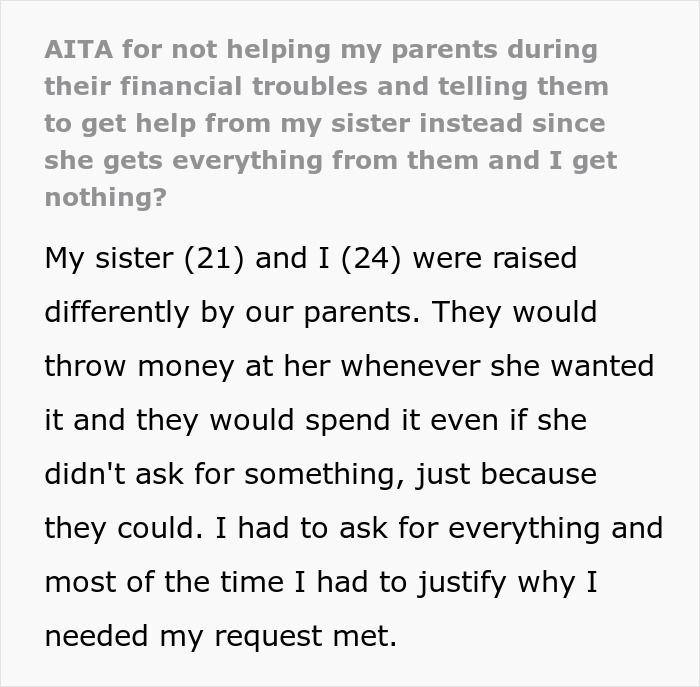
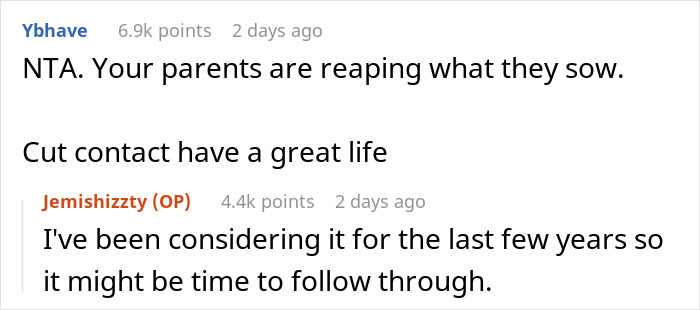
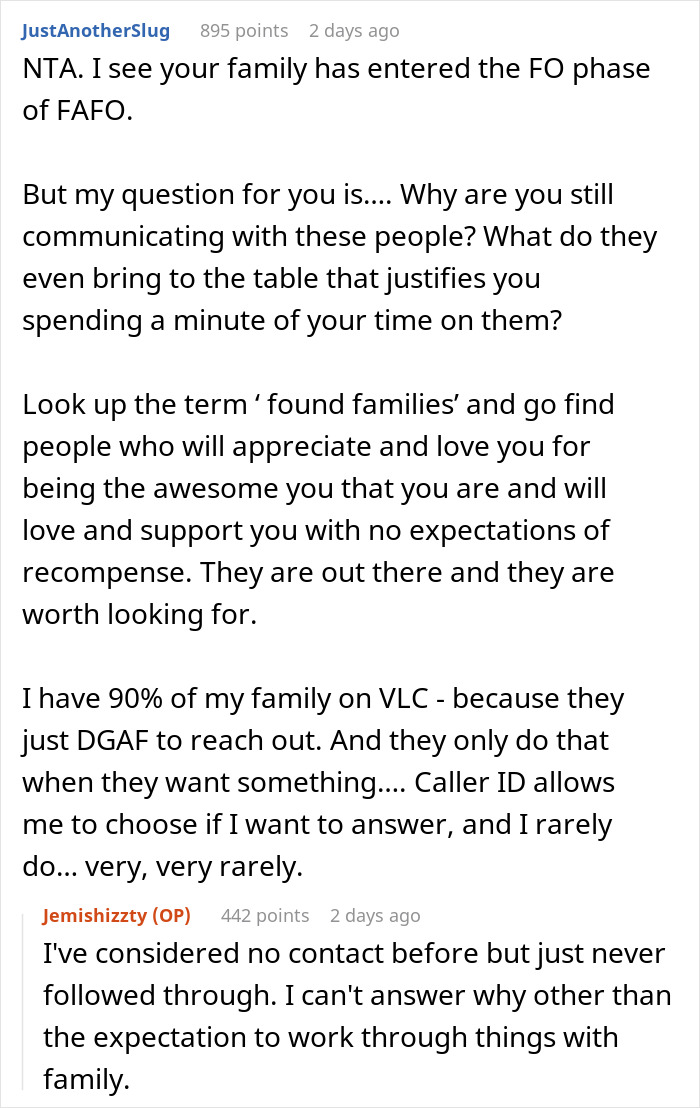
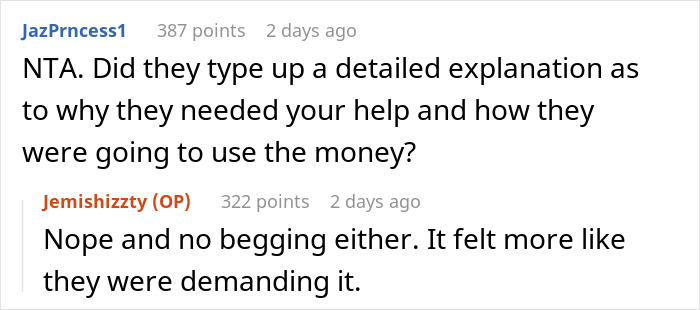
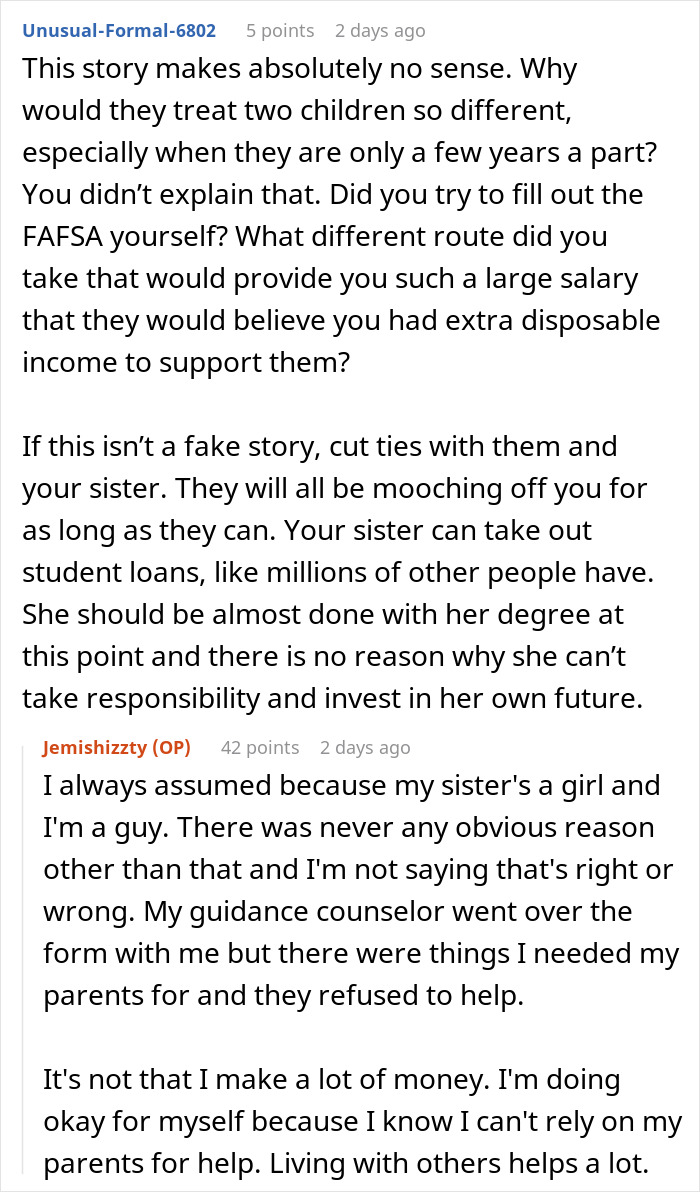
You reap what you sow, and Reddit user Jemishizzty wanted to teach his parents a lesson.
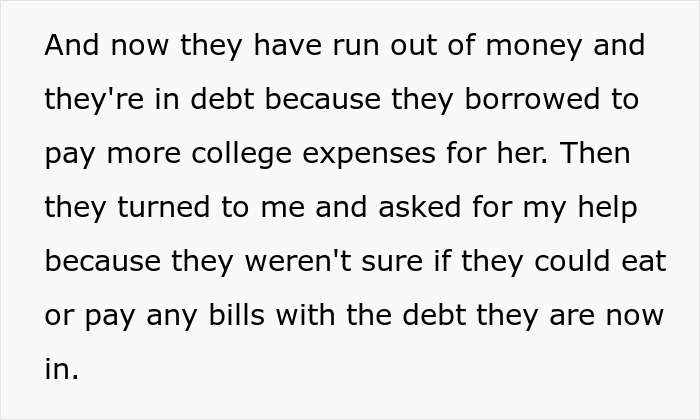
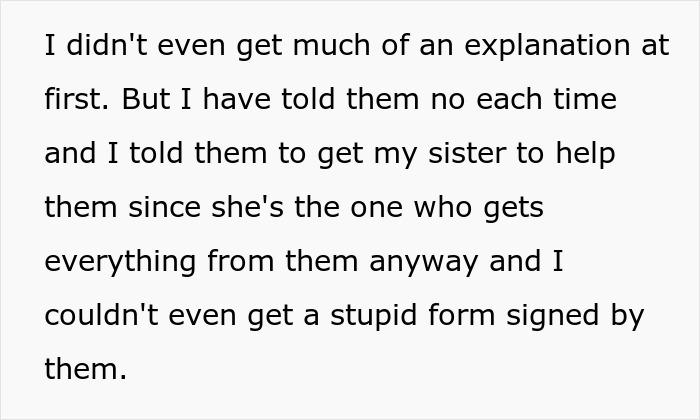
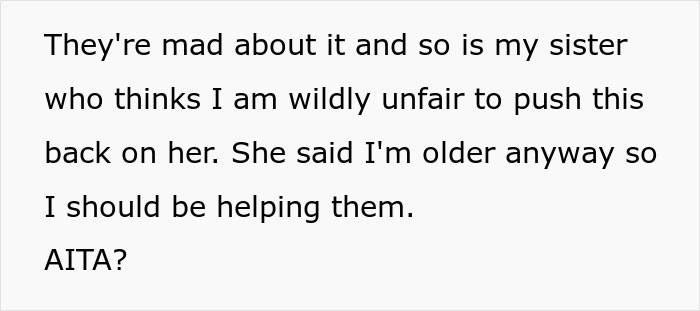
For years, the man had witnessed his younger sister being spoiled at his expense, so when the tables turned and their old folks became the ones who needed financial assistance, he refused to step up and told them that it should be her who returns the “investment.”
However, deep inside, the Redditor doubted his decision, so he shared his story online, asking people to share their thoughts on it. Here’s what he wrote.
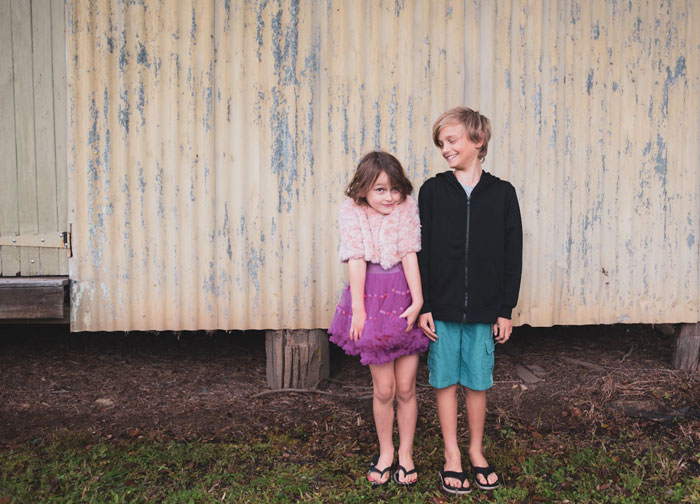
Image credits: Daniel Jurin / Pexels (not the actual photo)
Image credits: cottonbro studio / Pexels (not the actual photo)
Image credits: Fallon Michael / Unsplash (not the actual photo)
Image credits: Kindel Media / Pexels (not the actual photo)
Image credits: Jemishizzty
Image credits: Oss Leos / Pexels (not the actual photo)
Research suggests that parental favoritism occurs in around 65% of families, and has been identified and studied across many different cultures.
“It is the experience that people have that a parent prefers another child to them,” says Laurie Kramer, a professor of applied psychology at Northeastern University in the US.
“This could be by devoting more time, attention, praise, or affection. Possibly asserting less control, so that they may enjoy fewer restrictions, be subject to less discipline or even punishment.”
As was the case in the Redditor’s story, siblings may disagree over whether their family is even affected by it. That’s because feeling less or more favored can be very subjective.
But the problem is that, indeed, as this story shows, it can damage kids’ wellbeing across their lifespan, from childhood into middle age, and beyond.
It is considered such an important factor in a range of emotional problems that psychologists have a name and acronym for it: “parental differential treatment”, or PDT.
Image credits: Pixabay / Pexels (not the actual photo)
Such perceived parental favouritism has been associated with low self-esteem in children, as well as childhood anxiety, depression, and behavioral problems, including an increased likelihood to take risks.
There may also be a subsequent effect on emotional wellbeing that causes other, more indirect problems. Researchers in China have, for instance, shown that parental favouritism is a predictor of mobile phone addiction in adolescents. In a tiny Canadian study of eight homeless teenagers, seven said they felt that their parents had favored a sibling over them, while they had always been the “problem child”, and that this had contributed to the breakdown of family ties.
So while it’s easy to comment on conflicts such as the one we just read from the outside, the people involved in it might see the situation in a different light than we do.
Image credits: Arina Krasnikova / Pexels (not the actual photo)
Recently, researchers conducted a meta-analysis of 30 peer-reviewed journal articles and dissertations/theses, along with 14 databases, encompassing a total of 19,469 participants. They examined how birth order, gender, temperament, and personality traits (extraversion, agreeableness, openness, conscientiousness, and neuroticism) were linked to parental favoritism.
They found that parents show favoritism in numerous ways, including how they interact with their children, how much money they spend on them, and how much control they exert over them.
The researchers initially thought that mothers would tend to favor daughters and fathers would favor sons; however, the study discovered that both mothers and fathers were more likely to favor daughters.
Of the personality traits evaluated, conscientious children—meaning they were responsible and organized—also appeared to receive more favorable treatment. This implies that parents may find these children easier to manage and may respond more positively.
The researchers also looked at whether parent-child relationships were influenced by other factors, such as the child’s age or the parent’s gender, and although they might play a role, the effect was minimal.

By entering your email and clicking Subscribe, you're agreeing to let us send you customized marketing messages about us and our advertising partners. You are also agreeing to our Privacy Policy.
Thank you! You've successfully subscribed to newsletters!



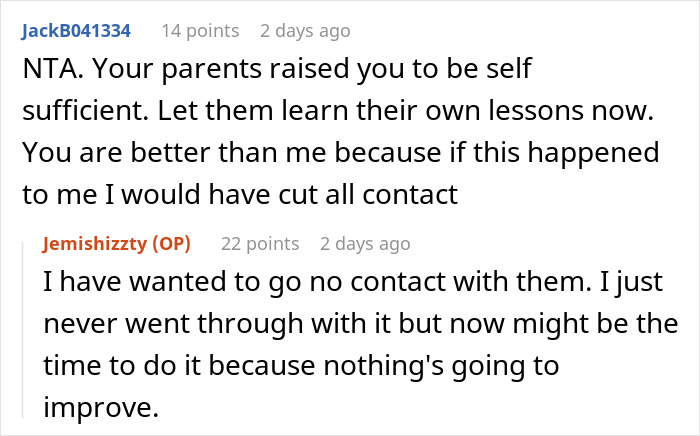
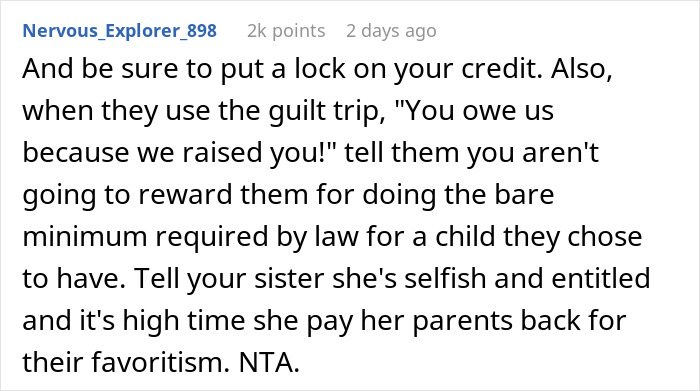
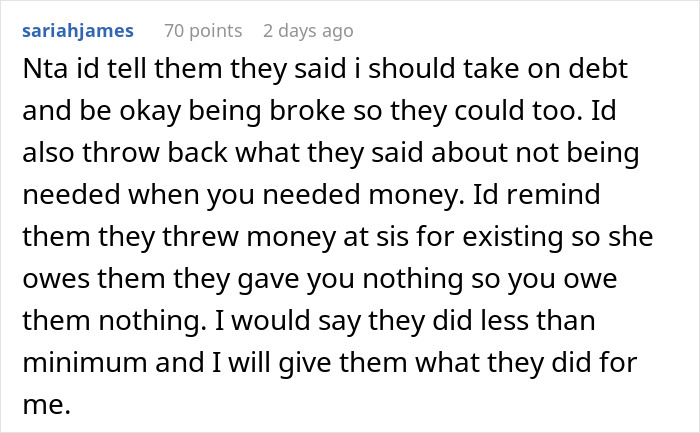
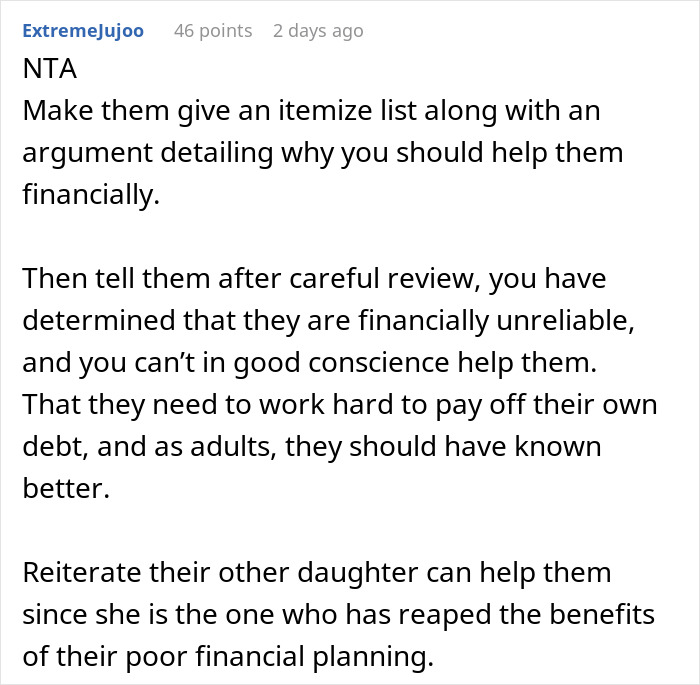
I thought that too, but they didn't help the OP when he needed it, so... 🤷
Load More Replies...
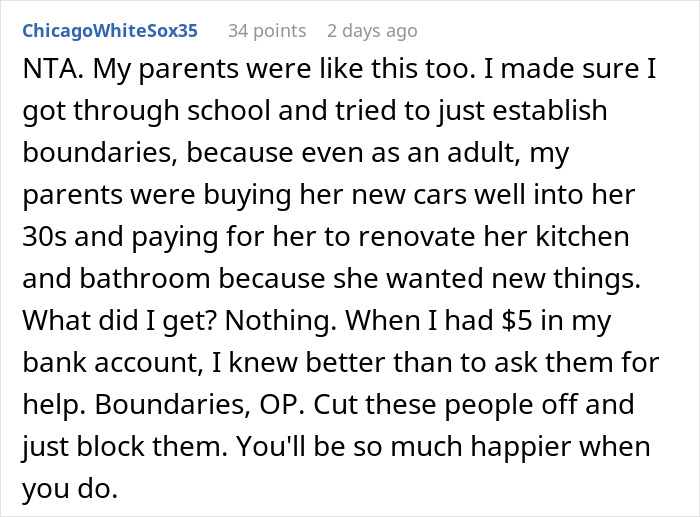
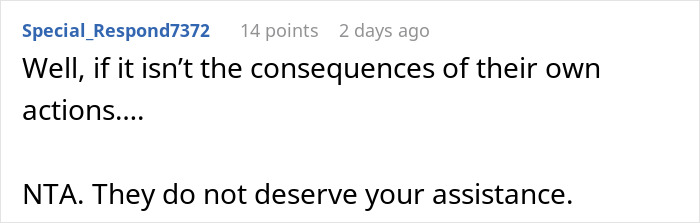
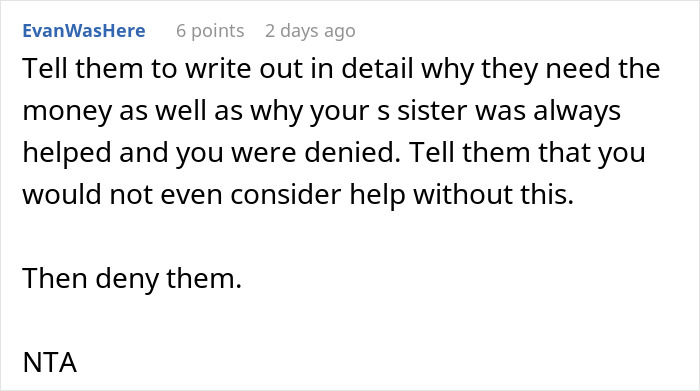
Grynost, you absolute dumb-skull, why don't you go help OP's parents then without asking anyone else, YER GIT!!! It's now OP's turn to neglect her ever had parents to begin with. His plonker excuse of birth-givers and their enabled golden girl ought to be made to write a detailed explanation as to why OP should help them, and any use of "family" will see the document being torn, burned, or thrown out immediately. Best thing OP can do is raze bridges until not even the foundations are left. People, SMH!!!

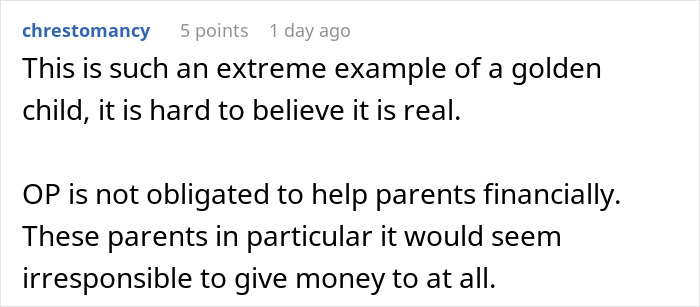
That YTA there is hilarous. "Family helps family" yet the parents didn't help the son.
I thought that too, but they didn't help the OP when he needed it, so... 🤷
Load More Replies... Grynost, you absolute dumb-skull, why don't you go help OP's parents then without asking anyone else, YER GIT!!! It's now OP's turn to neglect her ever had parents to begin with. His plonker excuse of birth-givers and their enabled golden girl ought to be made to write a detailed explanation as to why OP should help them, and any use of "family" will see the document being torn, burned, or thrown out immediately. Best thing OP can do is raze bridges until not even the foundations are left. People, SMH!!!
That YTA there is hilarous. "Family helps family" yet the parents didn't help the son.






















 No fees, cancel anytime





















39
17