Get Premium
Dark mode theme is available exclusively for premium users. Learn more about the benefits of subscribing.
No fees, cancel anytime.

 Dark Mode Ad-Free Browsing Unlimited Content
 Ad-Free Browsing Unlimited Content Dark Mode
Join 1.2 million Panda readers who get the best art, memes, and fun stories every week!
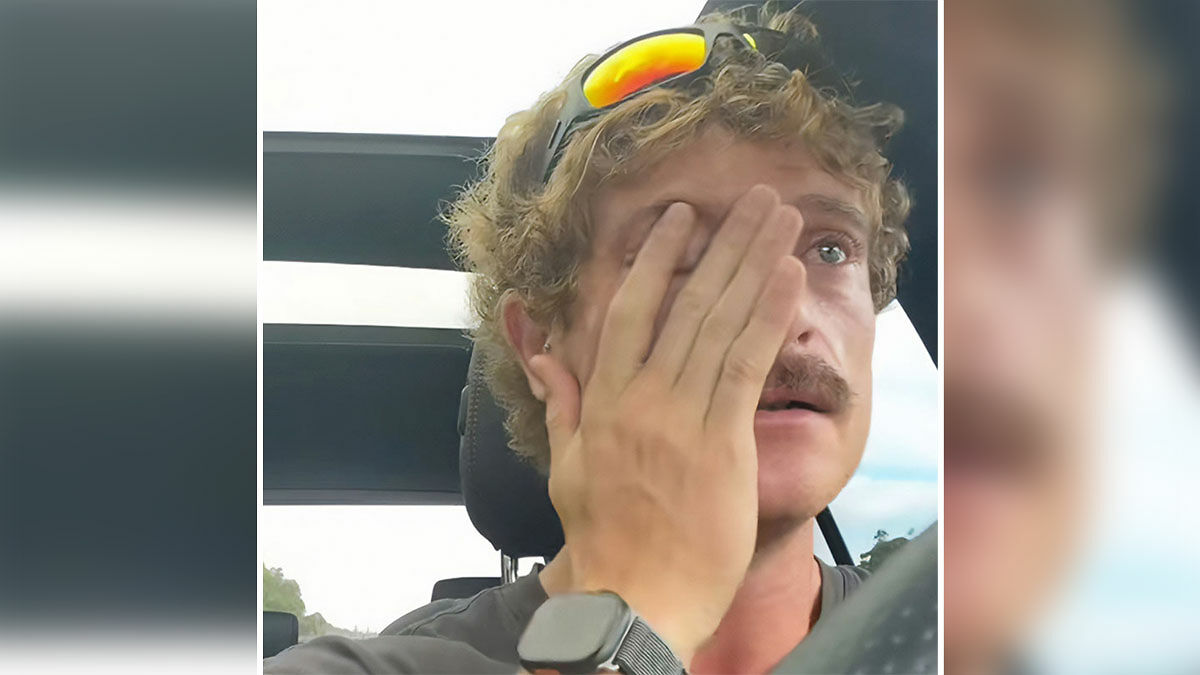
The sight of a grown man crying should not be unusual, but it still is.
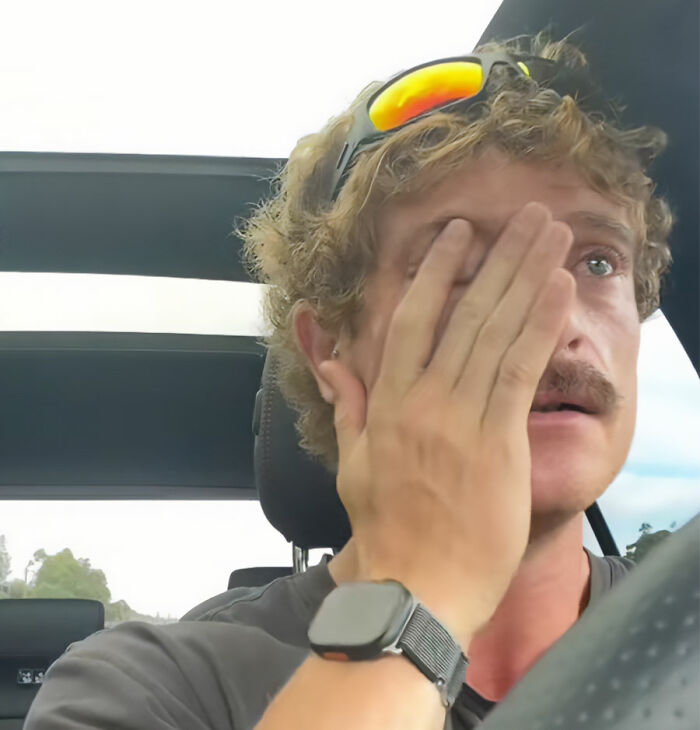
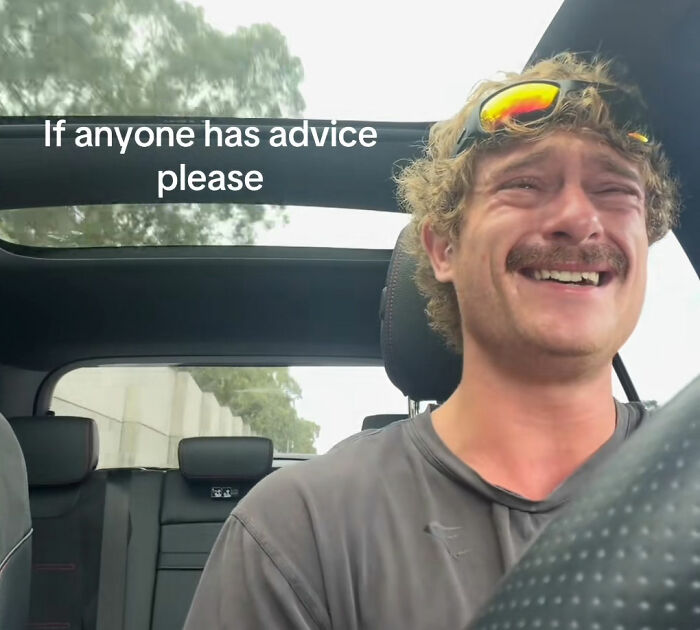
That’s exactly why the video of an Australian man crying into his phone recently went viral.
As he broke down about how lonely he feels, the video struck a chord online, sparking discussions about loneliness, masculinity, and the struggles of being an adult.
Image credits: luh_2805
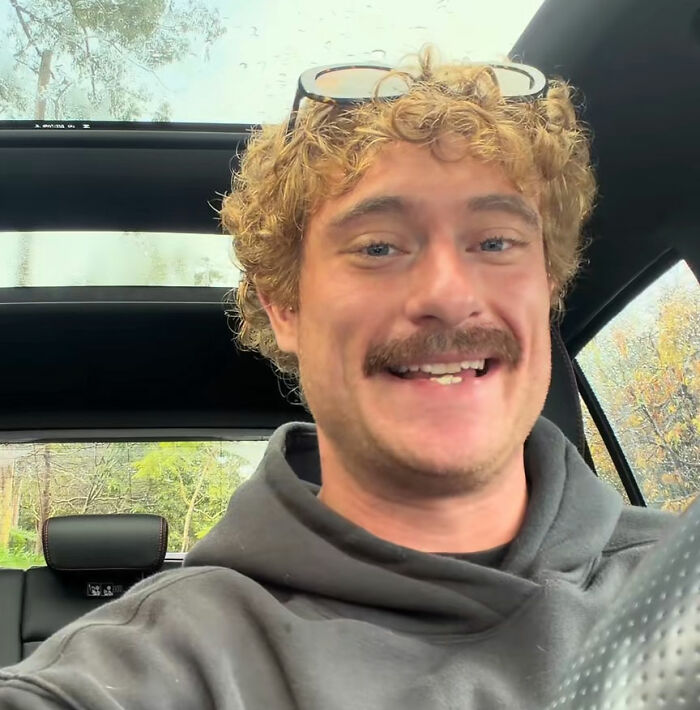
A man who goes by Luh or luh_2805 on TikTok shared a video in which he made raw confessions about how difficult life has been after moving to a new city.
With tears streaming down his face, the man said, “I really need someone to talk to. I moved to Sydney like four years ago, and I still haven’t made any friends.”
Luh explained that he moved to the new city after the end of a relationship that lasted about three to four years.
“I haven’t opened my heart since,” he said before going on to explain how he had a situationship with someone who recently called it quits.
“I really opened my heart to this person, and she didn’t reciprocate. She didn’t open up… She got scared of her feelings and avoided it,” the man tearfully said. “She’s like ‘nah, it’s too much for me’ and then just left me.”
Image credits: luh_2805
Baring all his emotions, he broke down and said, “I’m so f***ing lonely. I spent every day pretending that I’m not. I spend every day trying to make other people laugh and just put a smile on everyone else’s face. And I’m just so f***ing lonely.”
He went on to say that he tries to stay fit and active, eat healthily, and puts effort into “keeping [himself] looking good.” But “it’s just not enough. It’s just such a mask for how I’m feeling inside. I just want to be loved…” he said.
Image credits: nicoletaionescu/Adobe Stock (not an actual photo)
Luh continued to talk about the hardships he went through in his childhood. “I was f***ing tormented in my childhood. I was ab*sed… by the people that f***ing should have cared for me,” he said.
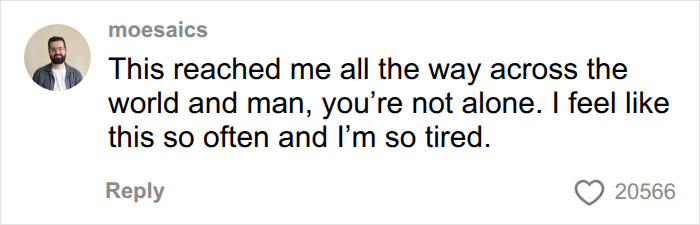
The response to Luh’s video was immediate, and the general consensus was: “Being an adult is so f***ing hard man.”
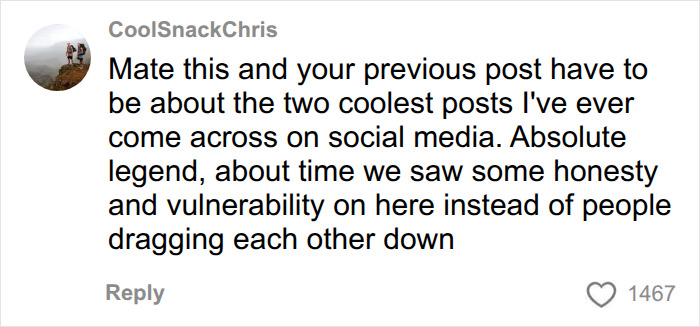
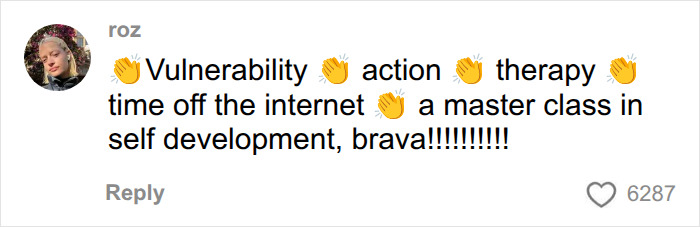
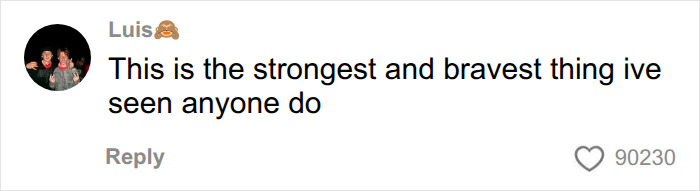
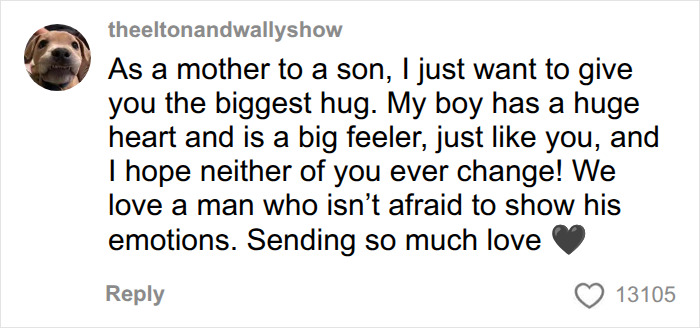
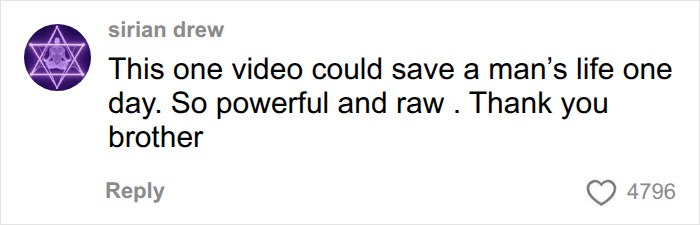
“This is the strongest and bravest thing I’ve seen anyone do,” one said. Another wrote, “You’re a braver man than me. This video has shown incredible strength. Vulnerability will get you everywhere and everything.”
Image credits: emrullah ağır/Pexels (not an actual photo)
Hundreds of viewers echoed the same sentiment, which was not just empathy but also a sense of relatability to their own experiences.
But why does a man simply expressing sadness still feel rare enough to be labeled “brave?”
According to experts, the answer may lie in the social conditioning of men and women and the “display rules” that we are taught.
“Men and women feel emotions similarly but are socialized to show them differently,” Dr. Qing Huang, an Assistant Professor of Interpersonal Communication at Loyola Marymount University’s Communication Studies department, told Bored Panda.
Image credits: LIGHTFIELD STUDIOS/Adobe Stock (not an actual photo)
“Traditional masculinity norms treat emotional control and self-reliance as central to manhood, and because manhood tends to be experienced as a status that must be continually earned and can be easily lost, a man crying publicly still reads as a norm violation (hence ‘brave’).”
The expert said this “suppression” comes at a cost.
“A meta-analysis of nearly 20,000 participants found that conformity to masculine norms, particularly self-reliance and emotional control, is consistently associated with poorer mental health and lower willingness to seek help,” Huang added.
@luh_2805Yes I’m in therapy aswell♬ original sound – Luh
Psychologist and LMU professor Máire B. Ford pointed out that men and women report similar levels of loneliness, but “gender norms shape the way they experience, express, and cope” with it.
Social conditioning could even lead men to associate the simple act of asking for help with weakness, hence making it more difficult to express vulnerability.
“Studies have identified masculine norms such as self-reliance, emotional restriction, and the belief that needing support reflects weakness,” she told Bored Panda.
“As a result of these norms, it is more difficult for some males to rely on others and disclose emotions and vulnerabilities,” she continued. “Additionally, men tend to have a smaller social support network. This can lead to loneliness.”
Image credits: SOMKID/Adobe Stock (not an actual photo)
Single men in individualistic cultures are at the highest risk of being burdened by loneliness because men do “less of what actually reduces loneliness,” Huang explained.
The Interpersonal Communication and Relationships expert pointed to a global study of over 46,000 people that showed that young men in individualistic cultures like the U.S. were the loneliest group.
Moreover, “Being single is associated with greater loneliness, particularly among men, and loneliness is concentrated among adults under 50 generally (22% vs. 9% for those 50 and older).
“This is not because men feel more loneliness than women overall. Across the population, men and women report similar levels, and men are just as likely to have at least one close friend,” she said. “What differs is behavior—men do less of what actually reduces loneliness.”
A nationally representative Pew survey revealed that men were far less likely than women to say they’d turn to a friend for emotional support (38% vs. 54%), to another family member (26% vs. 44%), or to a mental health professional (16% vs. 22%), and men communicate with their close friends less often.
“Men’s networks are not necessarily smaller; they are underused,” Huang said.
Image credits: Prostock-studio/Adobe Stock (not an actual photo)
While masculinity is one element, Huang said another influencing factor is how male friendships “tend to be organized around shared activities rather than open disclosure, and emotional restraint keeps them less intimate and supportive.”
“Shared activities are genuinely valuable. Time in leisure together strongly predicts closeness—but combined with the self-reliance norm and the greater stigma men face in admitting loneliness, it can leave men with friends they cannot turn to in a crisis,” she said.
Huang said this could be one of the reasons why being single hits men harder than women, because for most men, their primary, and sometimes only, confidante is their romantic partner.
“So being unpartnered removes their main outlet for emotional support,” she said.
Image credits: Eslam Mohammed Abdelmaksoud/Pexels (not an actual photo)
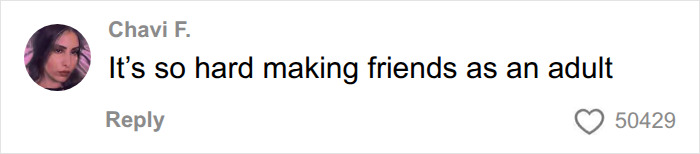
On the subject of making friends as an adult, experts agreed that the process is, unfortunately, difficult.
“You’re not imagining that it’s hard: in a recent national study, 51% of Americans said it is difficult to make new friends, and 62% felt it was easier at some other time in their life,” Huang said.
Experts noted how the process of making friends can change with age and become more complicated.
“Research suggests that as we age, the conditions of our lives change in ways that make it more difficult to make new friends. As children, we were in school with our friends for hours each day. This provided the rich conditions for friendships to develop,” Ford said.
“As adults, most of us are interacting with others at work in a task-oriented way, but not necessarily in a way that allows us to get to know each other well so that a friendship can form,” she continued. “Outside of work, we might not have enough time to devote to developing friendships.”
Image credits: Andrea Piacquadio/Pexels (not an actual photo)
Ford noted that as we age, we are also likely to become increasingly averse to rejection and, consequently, take fewer risks.
Another critical component in how friendships develop is time. And to answer just how important time is, Huang provided the numbers, based on research conducted by The Social Biome: How Everyday Communication Connects and Shapes Us author and professor Jeffrey A. Hall.
“Prof. Hall’s well-known study found it takes roughly 50 hours together to move from acquaintance to casual friend, about 90 hours to become ‘friends,’ and more than 200 hours to develop a close friendship,” Huang said.
Image credits: wavebreak3/Adobe Stock (not an actual photo)
“Those hours spent in shared leisure and everyday talk matter far more than hours spent merely working side by side,” she added.
The problem of time is exacerbated for adults in a new city because they have lost their usual settings that “generate repeated and unplanned contact.” It also doesn’t help that they need to invest their available time into their possible new job and keeping in touch with family or friends back home.
Image credits: Ron Lach/Pexels (not an actual photo)
Another fundamental aspect of building a close friendship is being open and having deep conversations. But as we grow older, our tendency to open up to new people diminishes.
“One practical suggestion for facilitating meaningful connections is to dig a bit deeper in what we talk about, such that we are engaging in more intimate self-disclosure,” Amit Kumar, a University of Delaware professor and expert on Happiness and Social Psychology, told Bored Panda.
“In our studies, we’ve found that people anticipate that discussions about deeper or more meaningful topics, such as what they are grateful for or a recent time they cried, will be significantly more awkward and less enjoyable than they actually are,” he explained. “Part of what’s going on here is that we assume that other people will be somewhat indifferent towards us, and that can lead us to think that a deeper conversation will be really uncomfortable.”
Image credits: Lomb/Adobe Stock (not an actual photo)
When people are “overly worried” about having deep conversations, it becomes a barrier to engaging more deeply with others in their daily lives.
“Miscalibrated expectations can result in people not exposing themselves to the situations that create the opportunity to learn how they would have felt if they did the thing they didn’t do,” Kumar went on to say.
“If you think something is going to be awkward, you might not do it, and then you’d never have the chance to find out that your expectations could have been wrong.”
Kumar said it is possible for people to “learn,” as shown by his own research. “In one of our experiments, we had people engage in both relatively shallow and comparatively deeper conversations,” he said.
Image credits: luh_2805
“Participants expected they might prefer a more shallow conversation to a deeper one prior to when these conversations actually happened, but after the interactions had occurred for real, they reported that they significantly preferred the deeper conversation,” he said.
“In everyday life, other people can care more about us and what we have to share than we sometimes think they will, and they tend to reciprocate. Opening up is likely to leave people happier than they might expect.”
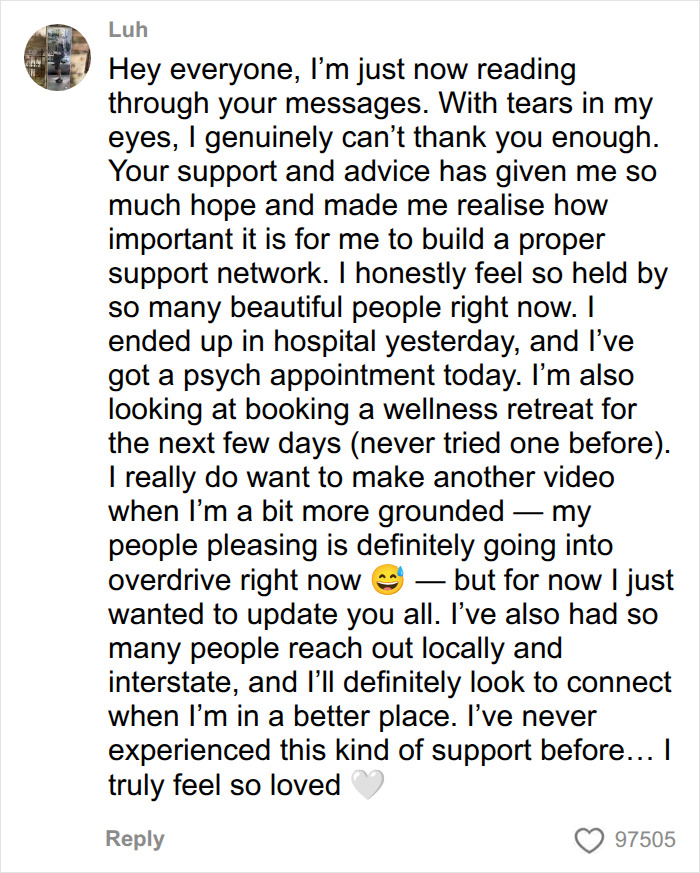
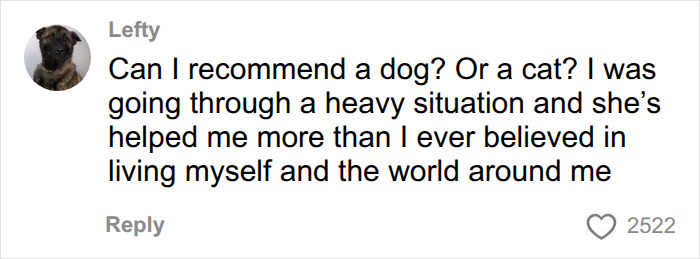
A couple of months after Luh posted the video, he shared a “bit of an update” on his TikTok, saying: “I’m doing way better.” He said the reaction to his video has been “unbelievable.”
Image credits: Dragana Gordic/Adobe Stock (not an actual photo)
“I’ve never experienced anything like this in my life,” he told his viewers. The man said he took a couple of months to make some actual “change” in his life, instead of just talking about it.”
Some of the factors that helped him were journaling every day, going for regular therapy sessions, and even joining a football team. “I’ve just played my fourth game on Saturday, which has been awesome, like 20 mates overnight,” he said.
“I’ve met someone as well. And yea, I think I’m just in a much better spot… I truly feel like organically this is the right time for me to post,” he continued before thanking everyone for all their support and advice in the comments section of his previous video.
@luh_2805♬ original sound – Luh
When asked for practical solutions to help adults make friends, both Ford and Huang offered helpful suggestions.
Ford’s suggestions were as follows:
Image credits: bernardbodo/Adobe Stock (not an actual photo)
Huang added to the list, with:

By entering your email and clicking Subscribe, you're agreeing to let us send you customized marketing messages about us and our advertising partners. You are also agreeing to our Privacy Policy.
Thank you! You've successfully subscribed to newsletters!


One thing his experience may elude to, but isn’t discussed is what happens when the lonely single (mostly cishet) man does find a female partner. Rather than learning how to express emotion, he instead relies on her for 100% of his emotional support & as his sole receipt for any emotional expression. This is emotional outsourcing & creates emotional dependency, while her mental & emotional labor multiplies. It’s likely what causes a woman in a situationship to be emotionally guarded & unwilling to open up, as he puts it. She enjoys the company & physical aspect, but doesn’t want to be burdened as his only emotional outlet. Justified because she’s been conditioned to express & manage emotions without a singular recipient being burdened. We gay men have our own issues with shame & delayed interpersonal development, which is compounded by modeling women in how we express emotion. It why we get called soft or sissy.

Couple things. First, we have no glimpse into how he behaves in relationships, aside from the last one where the woman felt too overwhelmed to continue it. Second. I am happy to see he went to therapy to talk out his emotions and receive guidance in how to handle them in a healthy way, instead of dumping them on someone else to manage for him. Funny how, when you stop expecting others to accept your emotionally stunted and reclusive self, stop dwelling on past disappointments and heartache, and start working on improving yourself and dealing with your issues in a healthy manner, along with getting out in the world and joining groups who share interests with you, your life takes a huge turn for the better. No one else is going to come along and fix you, that’s something you have to do all by yourself as an adult. I am glad this man finally had that epiphany and instead of wallowing, took control of his life and improved it. And guess what? A person who has their life together and on a positive path, who finally feels happy in their own skin, becomes attractive to other people who also have their own lives together and on a positive trajectory. That’s why he’s finally in another budding relationship. As long as he doesn’t fall back on old bad habits, it might work out and prove to be lasting—-of course, chance are it might not, but as long as he stays in this place of personal strength and satisfaction with the direction he’s heading, he will weather that storm if it happens. Then go on to meet someone else. I hope he stays pointed in this direction.

I’ve lived in a bad place, surrounded by men who are alcoholics, addicts, and former prisoners, many of them secksual prisoners, for the last twelve years. I take a meat tenderizer and a box cutter with me when I go to the bathroom. I withdrew from all my friends when I came here because I had two of them over once and they freaked the eff out and never invited ‘em again because I was so ashamed. The way I deal with the loneliness is to keep telling myself I’m not lonely, because I’d cry 24/7 if I thought of a girl living the way I do and I’d start screaming and never stop. The only way to deal with it is to push it out of my head and read, study, and watch movies because if I thought about my situation too hard, I’d just OD. He’s young and seems like a nice fellow, but the loneliness of crowds is a thing. I hope after he feels better he makes a whooole lotta friends because this isn’t living; it’s dying in slow motion.
One thing his experience may elude to, but isn’t discussed is what happens when the lonely single (mostly cishet) man does find a female partner. Rather than learning how to express emotion, he instead relies on her for 100% of his emotional support & as his sole receipt for any emotional expression. This is emotional outsourcing & creates emotional dependency, while her mental & emotional labor multiplies. It’s likely what causes a woman in a situationship to be emotionally guarded & unwilling to open up, as he puts it. She enjoys the company & physical aspect, but doesn’t want to be burdened as his only emotional outlet. Justified because she’s been conditioned to express & manage emotions without a singular recipient being burdened. We gay men have our own issues with shame & delayed interpersonal development, which is compounded by modeling women in how we express emotion. It why we get called soft or sissy.
Couple things. First, we have no glimpse into how he behaves in relationships, aside from the last one where the woman felt too overwhelmed to continue it. Second. I am happy to see he went to therapy to talk out his emotions and receive guidance in how to handle them in a healthy way, instead of dumping them on someone else to manage for him. Funny how, when you stop expecting others to accept your emotionally stunted and reclusive self, stop dwelling on past disappointments and heartache, and start working on improving yourself and dealing with your issues in a healthy manner, along with getting out in the world and joining groups who share interests with you, your life takes a huge turn for the better. No one else is going to come along and fix you, that’s something you have to do all by yourself as an adult. I am glad this man finally had that epiphany and instead of wallowing, took control of his life and improved it. And guess what? A person who has their life together and on a positive path, who finally feels happy in their own skin, becomes attractive to other people who also have their own lives together and on a positive trajectory. That’s why he’s finally in another budding relationship. As long as he doesn’t fall back on old bad habits, it might work out and prove to be lasting—-of course, chance are it might not, but as long as he stays in this place of personal strength and satisfaction with the direction he’s heading, he will weather that storm if it happens. Then go on to meet someone else. I hope he stays pointed in this direction.
I’ve lived in a bad place, surrounded by men who are alcoholics, addicts, and former prisoners, many of them secksual prisoners, for the last twelve years. I take a meat tenderizer and a box cutter with me when I go to the bathroom. I withdrew from all my friends when I came here because I had two of them over once and they freaked the eff out and never invited ‘em again because I was so ashamed. The way I deal with the loneliness is to keep telling myself I’m not lonely, because I’d cry 24/7 if I thought of a girl living the way I do and I’d start screaming and never stop. The only way to deal with it is to push it out of my head and read, study, and watch movies because if I thought about my situation too hard, I’d just OD. He’s young and seems like a nice fellow, but the loneliness of crowds is a thing. I hope after he feels better he makes a whooole lotta friends because this isn’t living; it’s dying in slow motion.














 No fees, cancel anytime

















27
3