Get Premium
Dark mode theme is available exclusively for premium users. Learn more about the benefits of subscribing.
No fees, cancel anytime.

 Dark Mode Ad-Free Browsing Unlimited Content
 Ad-Free Browsing Unlimited Content Dark Mode
Join 1.2 million Panda readers who get the best art, memes, and fun stories every week!
Have you ever come across an idea that seems perfectly logical at first, but the more you think about it, the less sense it makes? Welcome to the wonderfully confusing world of paradoxes. These aren't always just clever riddles or wordplay—some of them challenge the very way we understand logic, time, reality, and even ourselves. A paradox can leave you stuck between two ideas that both seem true, even though they appear impossible to reconcile.
And that's exactly what today's collection is all about. We dove into a thread where people answered the question, “What is a logical paradox that completely breaks your brain the more you think about it?” From classic thought experiments to mind-bending ideas that somehow become even more confusing the longer you think about them, these answers might leave you questioning everything you thought you understood. Keep scrolling, Pandas, and try not to hurt your brain too much along the way.
This post may include affiliate links.
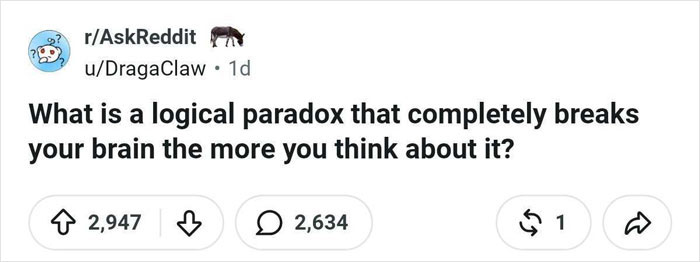
 Either the universe has always existed, or at some point it started existing: neither makes sense.

What we know as our universe is actually the inside of a black hole. It's a theory that's been proposed for a while now, but when you start examining the peculiar properties of our universe, it starts to make a lot of sense.
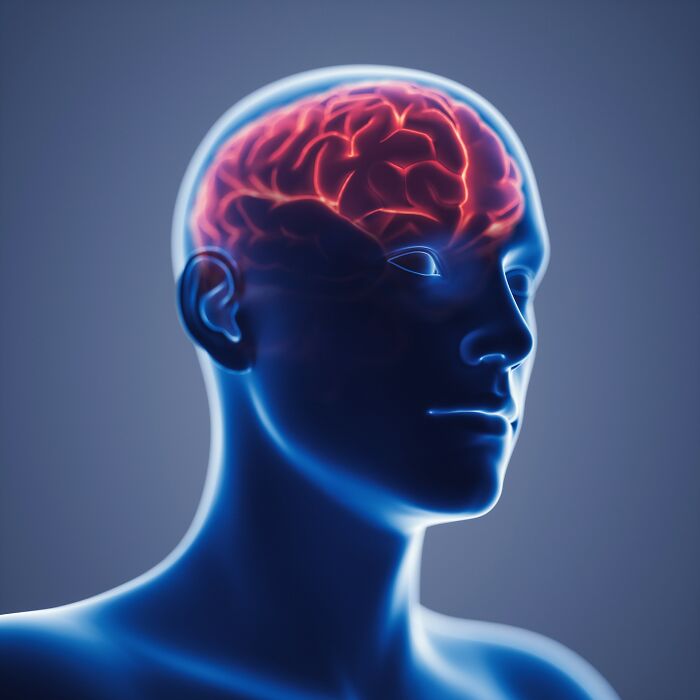 Not so much a paradox, but the concept of emergence gets me. It's the idea that new properties emerge from large quantities of a certain material.
For instance, a brain cell has no consciousness. Nor do two brain cells. Yet when enough of them come together, the property of consciousness emerges.
There are examples of emergence throughout the universe.
You mean like how a hot dog does not taste like a proper hot dog until it merges with the yellow mustard?
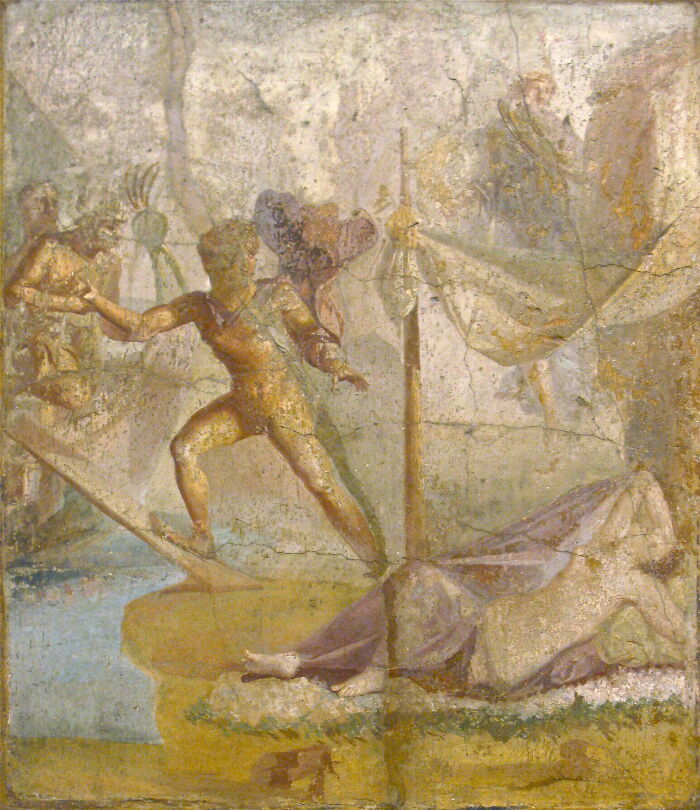 The Ship of Theseus. If you replace every single wooden plank on a ship over time, is it still the same ship?
“Less Is More.” You’ve probably heard this phrase before, and at first, it sounds completely wrong. Surely having more of something should be better than having less, right? Well, that’s exactly what makes it a paradox. The phrase is often used in design, art, writing, and even everyday life to show that simplicity can sometimes create a bigger impact than excess. A clean, simple design can be more striking than one crowded with unnecessary details, just as a few carefully chosen words can sometimes say more than a long explanation. In other words, removing something can occasionally make what remains even more powerful.
 You get to choose whether to believe in free will or not.
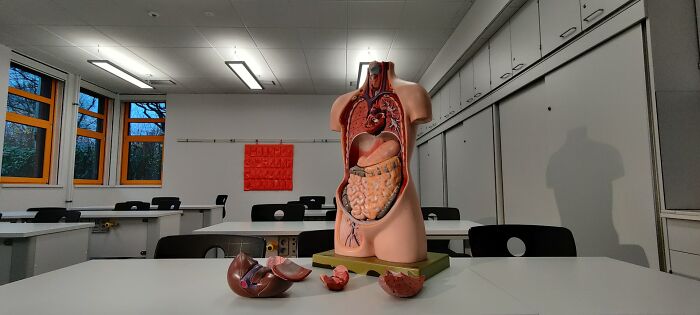 We're build of entirely inanimate parts. They stacked together in exactly the right way and somehow are aware of themselves.
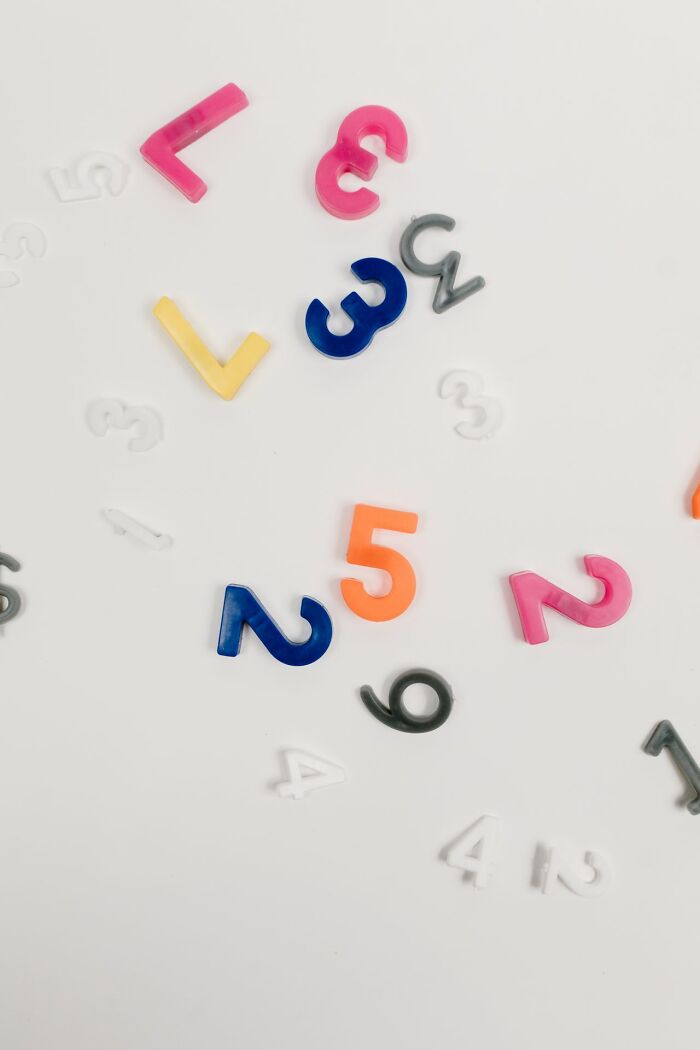 You could list out an infinite count of numbers (1,2,3...). You could also list an infinite number of decimal increments (1.1, 1.2, 1.3, 1.4...). Therefore there are multiple 'sets' of infinities, some of which are bigger and smaller than each other, while also being being infinite.

Welcome to George Cantor's transfinite numbers and "Infinity of infinities".
Another familiar paradox is, “You Have To Spend Money To Make Money.” On the surface, it sounds like terrible financial advice. If making money means increasing your wealth, and spending money means giving some of it away, how can doing one help you achieve the other? The answer lies in the difference between simply saving and investing. Money sitting untouched under a mattress isn't likely to grow, while money spent strategically can help create something that generates more income later.
Think about opening a bakery. If you refuse to spend any money, you'll keep your savings, but you won't have an oven, ingredients, equipment, or a place to sell your bread. Spending money on those things may reduce your bank balance in the short term, but it gives you the opportunity to create a business and potentially earn more in the future. So, in this case, the “spending” isn't necessarily about wasting money; it's about using resources to create an opportunity for growth.
 Shoreline paradox. The idea that technically a shoreline's perimeter is infinite if you measure infinitely close.
 Not exactly the assignment, but my own individual self boggles me.
I mean, I can accept that evolutionary processes can explain how intelligence and consciousness can arise, and can accept that a sense of self is a natural outgrowth of consciousness in an animal. So I don't feel there is any necessity to bring spirituality or some creator to explain why people exist and why they have selves that they see life through.
What boggles me is why *I* am one of them. Where did the me come from that is experiencing life through *this* body? Why do I get this unique perspective of the universe? What is the me that make me me?
I perceive myself as a ghost inhabiting a (slightly defective) meatsack.
 I call it "The Paradox of the Everyday Anomaly"
Think about a rare event that you heard about. A literal one-in-a-million occurrence!
Now think about today's world, we have news from around the world, 24 hours a day.
There are eight billion people on the planet. *8,000 people, each and every day, have a one-in-a-million day.*
Over the last 50 years, we have gone from a daily world where we would almost never hear about rare things, to a world where our daily travels bombard us with rare things.
It impacts our perception of our world, it creates cognitive biases in our thinking, changes the way we make decisions.
People overall tend to underestimate percentages in large groups. For example queerphobes often argue like "Why should we cater to trans people so much when they only make like 0,8% of the population?" 0,8% seems incredibly small, but it means 160 people in a small town of 20,000 inhabitants, or 800 people on a large concert for 100,000 people. Even if something is only 0,1% chance, that's still 1000 people in a million.
There’s even an entire book built around ideas that make you stop, think, and then think again. Douglas Hofstadter’s Pulitzer Prize-winning Gödel, Escher, Bach: An Eternal Golden Braid is one of the most famous books exploring paradoxes, logic, patterns, self-reference, and human consciousness. First published in 1979, the book brings together the work of mathematician Kurt Gödel, artist M.C. Escher, and composer Johann Sebastian Bach—three people from completely different fields who, surprisingly, share some fascinating ideas about repetition, recursion, and seemingly endless loops. So, let's take a closer look at some of those mind-bending ideas.
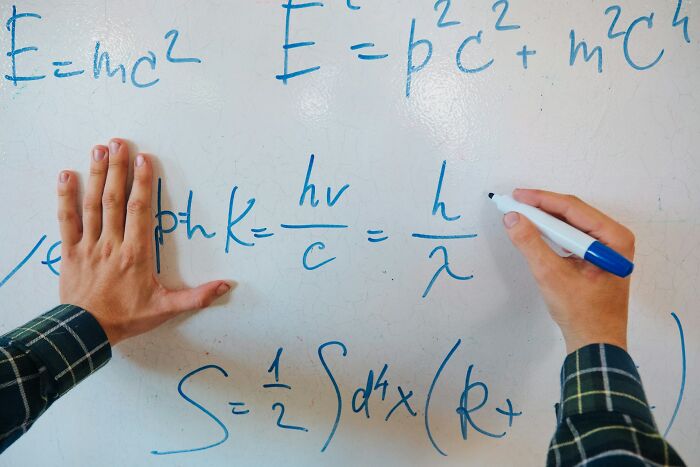 Almost anything to do with quantum mechanics. It's probably the only area i've come across where the mathematical equations are easier to understand than the attempts at an accurate layman's explanation. .
 I can’t comprehend what “nothing” is. My brain can’t do it because the closest to nothing I can think of is emptiness, but that’s not the same. Death is what “nothing” is and it’s incredibly strange to me that one day I will not have anymore thoughts, but I also won’t know. My mind, which will hopefully have been doing something at every moment for near a century, will suddenly cease to do anything at all. I will no longer be able to enjoy any of the things I love. I also won’t know it has happened, but I will finally be experiencing nothing.
It’s insane to me that one day the last star will burn out in the universe and there will be no life remaining. “Nothing” is the inevitable conclusion, but our minds can’t experience it while alive.
I hate the idea that no matter what we do in this universe, it is eventually all going to crumble. With that in mind, I start to wonder if our universe is cyclical. If over some unimaginable amount of time after everything has died, all of the matter collides back together to Big Bang back out again in a universe reborn. Then I like to wonder what version we’re on ourselves and how far back in time life may actually go. It’s possible we’re version number 263920294758402073759 of this universe, but we can’t know because the death and rebirth is so catastrophic that all evidence of prior life is erased.
I like to imagine there is a species out there who has learned how to travel between universes to survive and has existed longer than we can fathom. I also like to imagine that if we were to ask them which universe’s laws of physics have they experienced as the worst, that the answer would be ours because everything is always in a state of decay, and that’s just not how it is in other universes. A universe where magic is real would be cool.
Kurt Gödel's Incompleteness Theorems changed the way mathematicians thought about the limits of mathematics. Before Gödel published his groundbreaking work in 1931, many mathematicians hoped that mathematics could be built into a complete logical system in which every true mathematical statement could, in principle, be proven. Gödel showed that this dream had a fundamental limitation. In any sufficiently powerful and consistent formal system, there will be statements that are true but cannot be proven using only the rules of that system.
The idea is famously connected to self-reference and resembles the classic Liar Paradox: “This statement is false.” Gödel developed a far more sophisticated mathematical version by encoding statements about provability into numbers. The result was astonishing: a logical system can be consistent, yet still be incomplete. In other words, the system can contain truths it cannot prove. It's a humbling reminder that even mathematics has limits to what it can establish from within its own set of rules.
 "Every rule has an exception ... except this one.".
 The Grelling Nelson paradox.
An autological word is a word that describes itself, so 'short' as it's a short word or 'pentasyllabic' as it has multiple syllables.
A heterological word does not describe itself, so 'long' or 'monosyllabic'.
Is "heterological" heterological? Because if it doesn't describe itself, then it does describe itself and is autological. If it does describe itself, then it's heterological which means it doesn't describe itself, which means it does describe itself.
 If you're going to falsely get in trouble for something you haven't done, you might as well do it.
While Gödel explored strange loops through mathematics, Dutch artist M.C. Escher explored them through images. Escher was fascinated by geometry, symmetry, perspective, and the ways our eyes can be tricked into accepting something that is locally logical but globally impossible. His artwork is filled with buildings, staircases, and objects that seem perfectly believable when you look at one small section—but become impossible when you try to understand the whole picture.
In his famous 1960 lithograph Ascending and Descending, people appear to walk endlessly around a staircase. Each step makes sense, yet the staircase forms an impossible loop in which someone can keep walking uphill forever without ever getting any higher. Another famous work, Drawing Hands, shows two hands drawing each other into existence, creating a visual loop with no obvious beginning or end. Escher's work reminds us that something can make perfect sense in small pieces yet become completely impossible when viewed as a whole.
 Right now is the youngest I will ever be for the rest of my life.
 For there to be free will, there need to be uncaused occurrences in the universe. Things happening, such as a “choice”, that are not *caused* by anything, are extraordinarily difficult or impossible to comprehend. Technically, that’s not a logical paradox, but it seems in the spirit of the assignment.
 If you’re traveling at light speed then start decelerating, objects in front of you will start getting farther away.
Johann Sebastian Bach explored similar patterns through music. Centuries before Gödel and Escher, Bach was creating intricate musical structures that used repetition, transformation, and patterns that seem to circle back on themselves. He was particularly famous for his use of canons and fugues, where a musical idea is repeated, imitated, and transformed by different voices or instruments.
One of the most fascinating examples is the Canon per Tonos, often translated as the “Endlessly Rising Canon,” from The Musical Offering. As the music progresses, the melody moves upward through different keys. Yet the structure is designed so that, after completing the sequence, it can return to the beginning and repeat the process. The effect creates a remarkable musical loop: the music seems to keep climbing while also eventually arriving back where it started. Much like Escher's impossible staircase, Bach's music can give us the strange feeling of moving continuously while somehow remaining within the same repeating structure.
 The best possible outcome to living in a capitalist system is getting so rich that you no longer have to participate in it.
No other institution or social construct works this way. It's inherently counterintuitive. "You got so good at fidging the widget, the widget now fidges itself and you can frick off and do other things."
 Bigger roads make traffic worse.
Yep. We've known this for decades and we keep doing it nevertheless because of market forces.
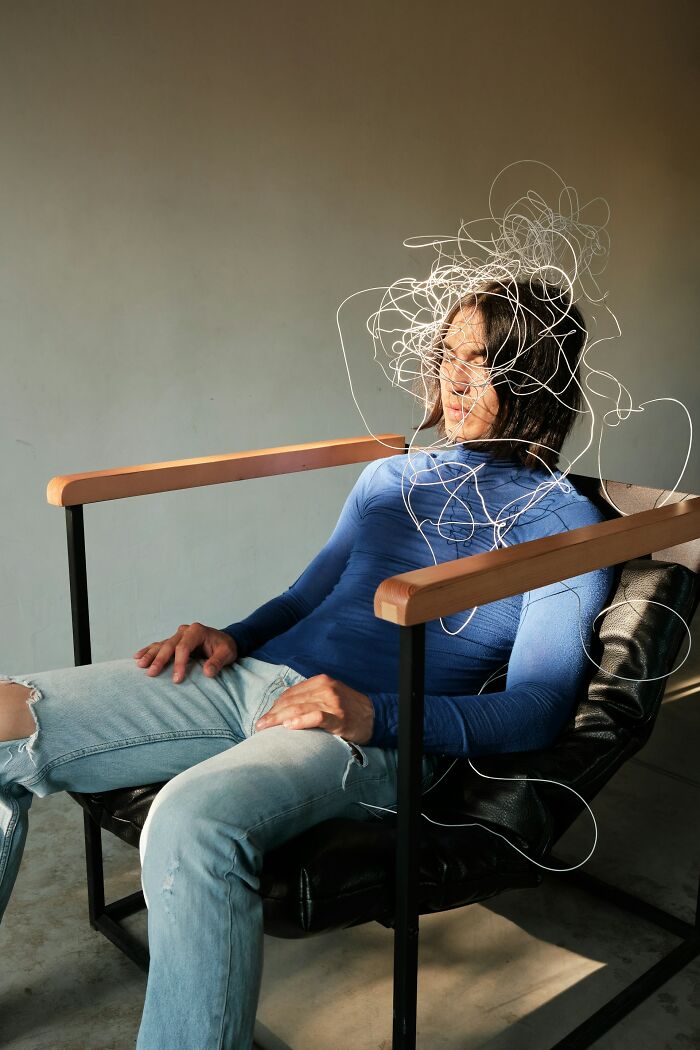 Most paradoxical mind puzzles are only confusing because the premise breaks reality. The question forces you to consider constraints that go against the way the world actually works. Either you don’t have enough information or the information has yet to be discovered. There is an answer if the question is valid.
 When I was a kid, in Sunday School, I asked the teacher where God came from. She answered God has always been and was never born or created. He just exists and always has.
My brain could never work through that. The logical person in me reasoned it made more sense that God simply didn’t exist. But then the same concept manifested itself in the more scientific question: what existed before the Big Bang?
I’m not a religious person at all, but that doesn’t mean I can’t think about such things.
Let's end with another classic: “The Only Constant Is Change.” This one sounds contradictory almost immediately. A constant is something fixed and unchanging, while change is the exact opposite—it means things are shifting, evolving, and becoming different. So how can change itself be constant?
The deeper meaning is actually surprisingly simple. Almost everything around us changes over time: our relationships, careers, technology, bodies, cities, cultures, and even the natural world. Because we can consistently expect change, it becomes one of the few predictable patterns in life. Think about how people listen to music. Vinyl records gave way to cassette tapes, CDs, MP3s, digital downloads, and now streaming platforms. No single format lasted forever, but one thing remained consistent: eventually, something new came along. It may sound contradictory, but perhaps that's the point—sometimes the only thing we can rely on is that things won't stay the same forever.
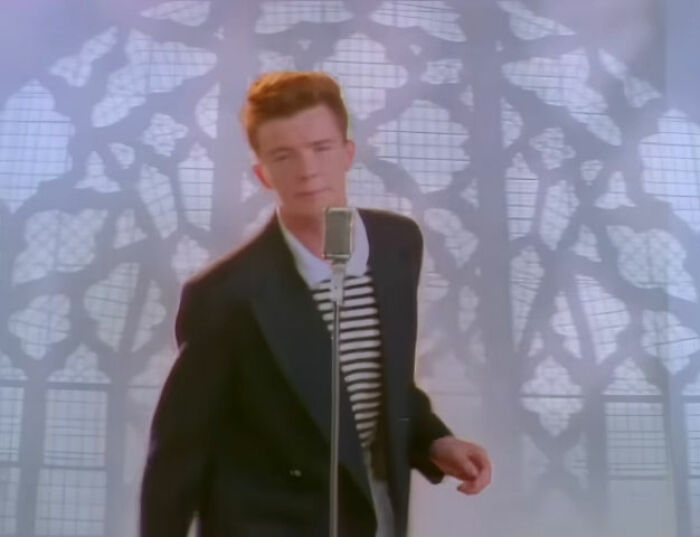 Rick Astley will never give you his DVD copy of “Up”, but he’ll never let you down, but if you want to borrow “Up” from him, he won’t thus letting you down.
 The bootstrap paradox. I learned about it from Legend of Zelda.
Adult Link learns the "Song of Storms" from a man in the windmill. The man claims to have learned it from Young Link, and when you travel back in time you must teach him the song that he taught you in the future.
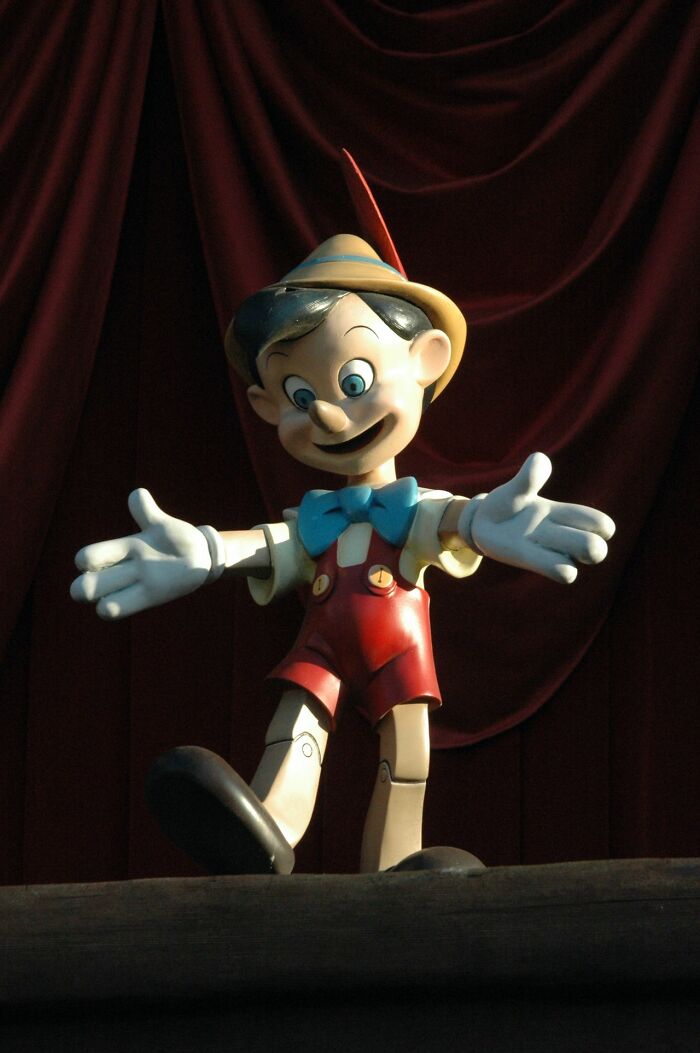 Pinocchio says his nose is growing. What happens?

At the moment he utters it, it's a lie, triggering the nose to grow. It thus becomes true, but alas, too late. Also, find a hobby, Pinocchio
 This statement is false.
And that's exactly what makes paradoxes so fascinating. They remind us that the world isn't always as straightforward as we would like it to be. Sometimes two ideas can seem equally reasonable while pointing in completely different directions. Other times, the more carefully we follow a line of logic, the more surprising the destination becomes. Paradoxes encourage us to question assumptions, look at familiar ideas from a different angle, and accept that not every strange question has a simple answer.
Coming back to today's posts, these mind-bending ideas prove just how much fun it can be to let your brain wander down a particularly confusing rabbit hole. Some of these paradoxes might make perfect sense at first before suddenly leaving you completely lost, while others may become even stranger the longer you think about them. So, Pandas, which one made your brain hurt the most? And do you know a paradox that has kept you thinking about it for far longer than you'd like to admit?
 Newcomb's Paradox.
A predictor with a near-perfect track record presents two boxes. Box A has one thousand dollars. Box B has either one million dollars or nothing. You can take both boxes, or only Box B. The catch is that yesterday, the predictor foresaw your choice. If it predicted you would take only Box B, it put the million inside. If it predicted you would take both, it left Box B empty.
Causal logic says take both because the money is already sitting there and your physical choice now cannot change yesterday. Evidential logic says take only Box B because people who take only Box B walk away with a million almost every time. Both arguments feel airtight.
 Not exactly a "logical paradox" but in a similar camp: the Monty Hall problem always screws with my head.
Yes, I understand how it works, but the last time I tried to explain it to someone, I accidentally convinced myself I was wrong and had to stop and write it all out because it sounded crazy.
Normal_Average_9812:
The one that works for me is to scale it up. There are 100 doors with 99 goats and 1 car. You choose a door. Monty Hall opens 98 doors showing 98 goats. Do you switch your choice?
Of course. You would have to pick at a 1 in 100 odds initially, he just got it wrong 98 times in a row. every wrong answer makes it more and more likely the other door has the car. You can think of making 1 good choice as not making 99 bad choices and he just made 98 bad choices for you.

One of the problems with explaining this is that people get it into their head that for this to be true something must have changed through this chain of events, i.e. that the likelihood of the initially chosen door hiding the prize is no longer what it was when they started. If you separate the two situations in becomes clear(er). Given a choice of 3 doors, clearly your choice has a 1 in 3 chance of success. Given a single choice of 2 doors, equally clearly, you have a 1 in 2 chance. Moving on, the initially chosen door _still_ has its original 1 in 3 chance, nothing has changed. The other door has a 1 in 2 chance, regardless of whether you started with 3, or with 100.
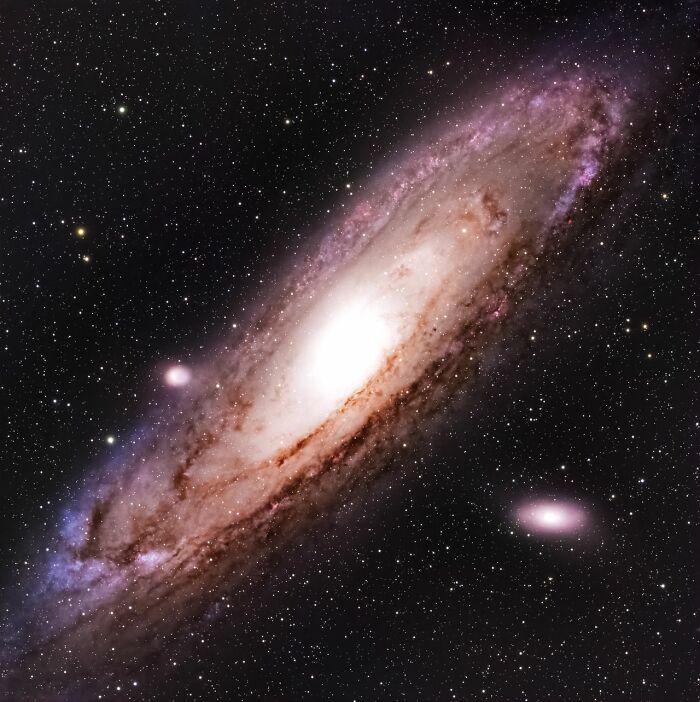 An infinite universe.
 The paradox of the unexpected hanging. You are to be executed on one day of the following week (starting Monday, ending Sunday). You are also not going to know beforehand the day on which you will be executed.
Clearly, therefore, you cannot be hanged on Sunday - because you would know that was the last day on which you could be hanged, so that's out.
But then by the same logic, you cannot be hanged on Saturday because you already know that Sunday is out, and therefore you would know beforehand.
And so on and so forth, resulting in there being no day upon which you can be hanged!
Imagine your surprise, therefore, when on Wednesday it is announced that you will be hanged on that day...
Here's a slightly different version of this paradox:
You have 10 boxes, numbered 1 to 10. Assume that it is not possible to determine what is in each box without opening it.
Is it possible to put a carrot in one of the boxes so that if someone opens the boxes in order 1 to 10, they cannot know before opening each box that the carrot is in the box?
 God so many
The fact that the brain is always perceiving itself in the past. Light travels and it takes time (small and imperceptable) to us, but it still takes time. So our brain is reaction to stimuli after its happened. Our kids just blend it so we can react properly.
The biggest mind bend is that other animals have different time perceptions than humans. So depending on the species they hear and see us moving slower or faster because their brain processes it differently.
Far *far* slower than the speed of light is the speed that your eyes perceive the light, transmit this to the brain, and the brain does something with this stimulus. Oh, and what you think you see is mostly a simulation. Your eyes flit around focussing on the important details, but your brain fills in the rest of your vision with information that may be seconds out of date.
 I heard somewhere many years ago that someone was sitting a philosophy exam in a school/college. The question posed to the class was "Is this a question?" This individual stood up within moments of the test starting and left whilst the remainder of the class were still furiously scribbling their essays.
This individual simply answered "If this is an answer." I'm told he got a B for the paper.
 Why is there something, rather than nothing.
 Russell’s paradox. “Does the set of all sets which does not contain its self, contain its self?”.
Set theory only really started to become a thing after I'd finished school, I recall being completely baffled trying to get my head round it later. It's not just the learning of the various rules to apply to it, but the fundamental question posed in some of these so-called paradoxes. "Why?" (In other words, if I don't understand something I cannot understand why it should be).
 The clone paradox.
Let's say you're going into a facility where you're going to be cloned. The clone is going to be a perfect copy of you right up until the point the cloning switch is thrown, and the clone will have all your memories, personality, etc.
Going into the procedure, you can be 100% sure that when you walk out of the lab in an hour (or whatever) that you're the original, that you aren't the clone, because you know going in that you're the original. If you were to bet a million dollars on it, you'd be correct every time.
However, the clone will wake up also remembering that they are the original, and also being 100% certain that they are not the clone. Yet, when they walk out of the lab, they're going to be wrong every time.
So, the paradox is that you can seemingly have 100% odds of something being correct, and yet being correct only 50% of the time.
The real question is: why would I want a clone of myself? Is there any lab where I can go and walk out as a girl an hour later instead?
 It seems impossible (to me) for the current state of the Universe to be the result of an infinite chain of causality. It seems equally impossible (to me) that the Universe had a beginning.
"Brute Fact" and "Unmoved Mover" are equally incomprehensible.
 A baseball being thrown looks to be going different speeds to different people.
But a light being shone looks to be going the exact same speed to everyone no matter where they are.
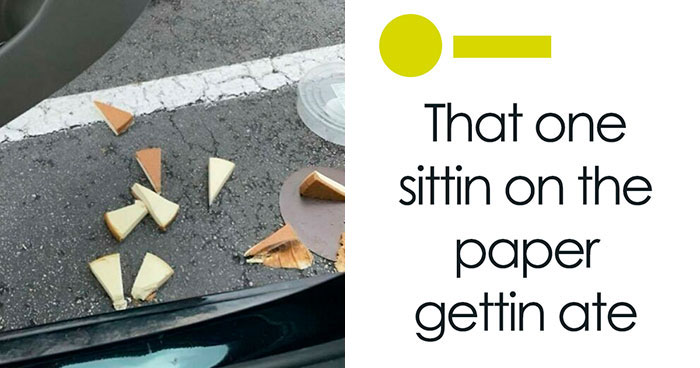
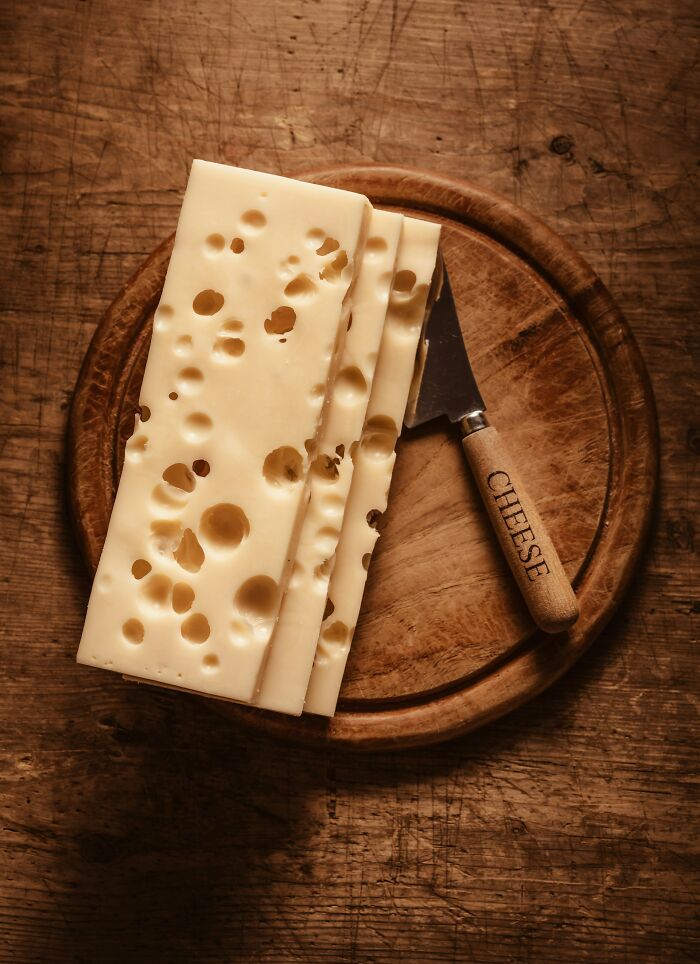 More cheese, more holes. More holes, less cheese => more cheese = less cheese.
 I mentioned this in another thread, and don't know if it counts here:
There's a hilariously sad thing that Boomers do now:
Boomer: 'When I was your age, kids would play outside! Why aren't you playing outside?'
Also Boomer: Walks over to the houses of nearby neighbors and complains about kids making noise while playing outside.
Also Boomer: I'm reporting parents to the Police for allowing their kids to play in the front yard while under supervision! (yes, this happened)
Someone, please, make it make sense.

this whole post is like ADHD mind at like 2 in morning when youre trying to sleep
That's the most accurate comment on this whole site.
Load More Replies...
this whole post is like ADHD mind at like 2 in morning when youre trying to sleep
That's the most accurate comment on this whole site.
Load More Replies... 






















 No fees, cancel anytime