Get Premium
Dark mode theme is available exclusively for premium users. Learn more about the benefits of subscribing.
No fees, cancel anytime.

 Dark Mode Ad-Free Browsing Unlimited Content
 Ad-Free Browsing Unlimited Content Dark Mode
Join 1.2 million Panda readers who get the best art, memes, and fun stories every week!
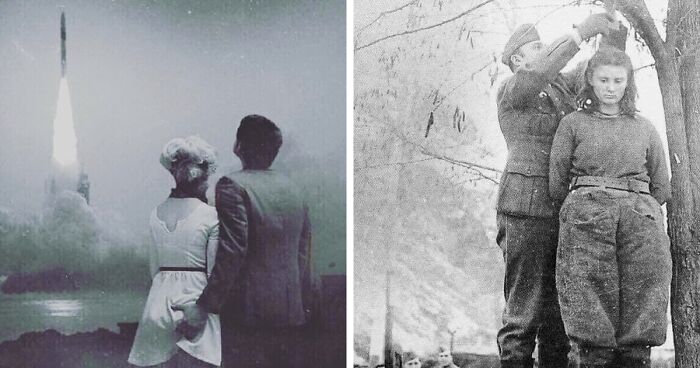
Learning about history is a continuously interesting, never-ending adventure. What makes it even more exciting is exploring the past through authentic photographs. These historical photos, coupled with the fascinating stories behind them, allow us to take an intimate glimpse into the lives of people long gone. They provide a tangible link that connects us to these unfamiliar faces and teaches us about their dreams, fears, and brave decisions that changed the course of history.
Our team here at Bored Panda absolutely adores discovering golden nuggets about the old days, and we’re thrilled to bring you plenty of vintage photos that correspond with them. Today’s post will serve as a captivating archive of some rarely seen photos filled with unstaged and genuine scenarios from the past.
So, let’s take a look at some historical moments—both big and small—that may just help us see the world in a different light. Continue scrolling, upvote your favorite rare pictures, and tell us in the comments which ones you love the most and why. Then, if you’re interested in broadening your mental horizons even further, check out our earlier piece about historical photos that might change your perspective.
This post may include affiliate links.
The best thing about stumbling across historical pictures like these is how much they spark our interest. Many of us immediately feel the urge to do a few Google searches, quickly click on hyperlinks, and dive headfirst into the world of knowledge, all to learn more about these past eras, long-gone events, and people who created something out of them.
It’s amazing how old photos can lead to hours of research about something you might not even have known existed before. By exploring historical events through old photographs, you have a chance to interpret and enhance your perception of the world in a visual way. You’re suddenly presented with new information about how individuals lived back then and how their actions molded our society.
“Photography can definitely be a powerful tool in understanding history,” Jo Romero, a writer, sketcher, and founder of the blog Love British History, previously told Bored Panda. “It gives us that link between us and people in the past—we can look into the person’s eyes in a photograph and it creates that human connection between us.”
“From a photograph too, we can see body languages and poses within a group of people or the way a scene is laid out, and this is much more than we could ascertain from reading a book,” Jo added. “Photographs help make history seem more real. They’re like a viewfinder into the past!”
And we can’t help but agree. Of course, oral traditions, artifact collection, and volumes of manuscripts and documents are essential sources of information for historical periods. But there’s something about old photographs that enhances our understanding of history. With each and every closing of the camera shutter, a moment is recorded and frozen in the past, and uncovering these gems makes them seem even more real.
“We have so much we can learn from the visual evidence that we have, whether that’s a portrait of a person or a snapshot captured of a group or scene,” the blogger pointed out that history is an extremely varied topic. Jo added that visual media helps make the past seem more accessible and that we can see old photos like we see historical artifacts. “They add interest and give us context.”
According to Jo, it’s one thing to read about your great-great-grandfather on a page, but seeing a photograph of him and looking into his eyes is completely different. She believes that “photos of people or scenes evoke a much stronger emotional reaction, and it’s great that they can be used alongside written sources for context. Not everyone wants to learn just by reading, and using different visual sources can help keep our interest and curiosity up and make the topic a lot more engaging.”
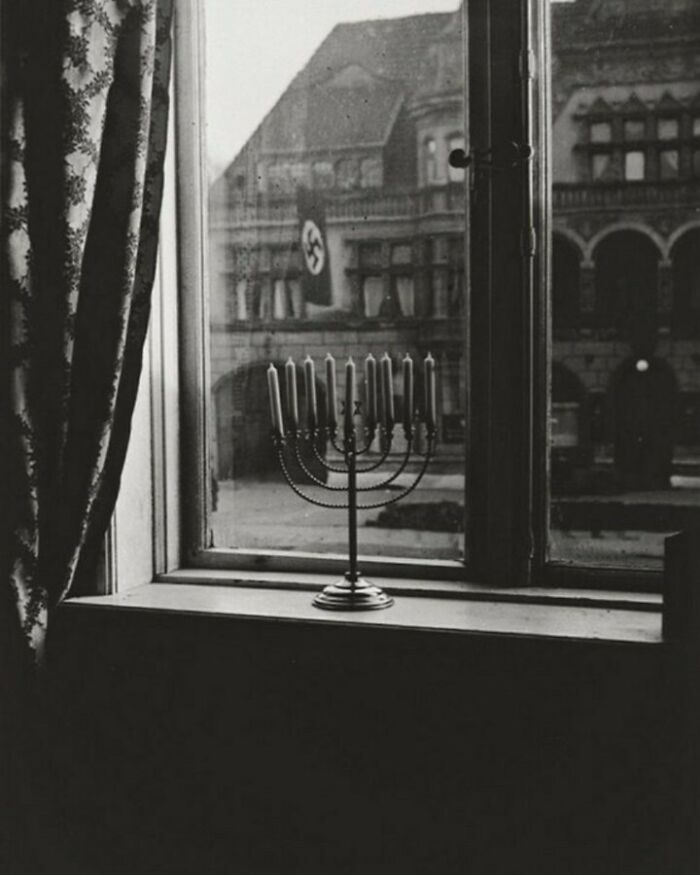
On Hanukkah 1932, just one month before Hitler came to power, Rachel Posner, wife of Rabbi Dr. Akiva Posner, took this photo of the family Hanukkah menorah from the window ledge of the family home looking out on to the building across the road decorated with Nazi flags.
On the back of the photograph, Rachel Posner wrote in German (translated here): Chanukah 5692 (1932)
"Death to Judah"
So the flag says
"Judah will live forever"
So the light answers. -.
As Anna Pegler-Gordon, an associate professor at the University of Michigan, explained in a piece called Seeing Images in History, we rarely spend time exploring pictures that illustrate history. Most of the time, we focus on the written content “because of the way that images are presented in many historical texts and also because of the way that historians are trained to view images—as illustrations of written history rather than sources of history themselves.”
But this seems to be changing, as Pegler-Gordon mentioned evidence of a “visual turn” in learning and teaching the subject in the last few years. It looks like more academics and historians now give more attention to visual images.
By using history pictures to teach, the professor noticed that students often see media as more accessible than written records. “Students themselves mention that images make the past seem more accessible, giving concrete shape to a world that sometimes seems intangible,” she added.
“The learners who arrive in our classrooms today are not only immersed in technology, but also in visual ways of learning. They appreciate the immediacy of the image, which often conveys information more quickly than a primary document written in an unfamiliar, or even a foreign, language.” Another benefit is that this immediacy leads to a shared experience of viewing a picture together that can contribute to a lively group discussion.
Moreover, students are often advanced readers of graphic media, and with proper guidance and support from their teachers, they can truly enjoy the process of looking at and analyzing historical visual representations.
“However, visual images are also inaccessible for the same reasons that they are accessible. The apparent legibility of the image hides its historical construction, the ways in which the image was made, distributed, and read at the time it was produced and since.” Pegler-Gordon added that to become better at reading images, we must become informed about the history and the theory of images.
Once we arm ourselves with knowledge, historical photos can be a great tool to expand our mental horizons even further. “We establish a connection with not only the subject but also the photographer, so we see exactly what they saw through their lens that day as if we’re seeing it now and are part of the scene in a way,” blogger Jo Romero added. She concluded by saying that discovering the past through historical photographs simply makes it seem “much more relatable to us and we want to discover more.”
The oldest photograph takes us back to a time around 1826 or 1827. A French inventor named Joseph Nicéphore Niépce captured an image titled “View from the Window at Le Gras” at his country estate in Saint-Loup-de-Varennes, France. This photo required an exposure time of about eight hours.
It stands as a legendary moment in the history of humanity, marking the first successful attempt to permanently capture a scene from nature. This image paved the way for modern photography and also serves as a reminder of the lengths to which pioneers went to capture a moment in time.
The title of the most-seen picture of all time might surprise you—it’s not a work of art, a historical event, or even a celebrity snapshot but rather an image of a green hill and blue sky dotted with clouds.
“Bliss,” photographed by National Geographic photographer Charles O’Rear in 1996, gained its fame as the default desktop background for Microsoft’s Windows XP operating system. This iconic image has ended up on the screens of computers around the world, becoming an inadvertent yet pervasive piece of visual culture. It’s estimated that billions of people have seen the historical photo.






























 No fees, cancel anytime