Get Premium
Dark mode theme is available exclusively for premium users. Learn more about the benefits of subscribing.
No fees, cancel anytime.

 Dark Mode Ad-Free Browsing Unlimited Content
 Ad-Free Browsing Unlimited Content Dark Mode
Join 1.2 million Panda readers who get the best art, memes, and fun stories every week!

When someone uses a season as a verb, you know you are in the company of ignorance. "We are summering in Tuscany," delivered with complete composure, as if this is a normal thing that normal people say in normal conversations, while somewhere nearby, a person is quietly calculating whether they can afford to put the heating on this winter. Not winter as a verb. Winter as a cold, expensive, extremely real noun.
The middle class has developed its own language, reference points, and bizarre blind spots that are equal parts fascinating and infuriating, depending on where you are standing. The wellness advice, the property ladder opinions, the baffling confidence with which deeply out-of-touch things are said to people who cannot afford to relate to a single word of them. These are the worst of the worst.
This post may include affiliate links.

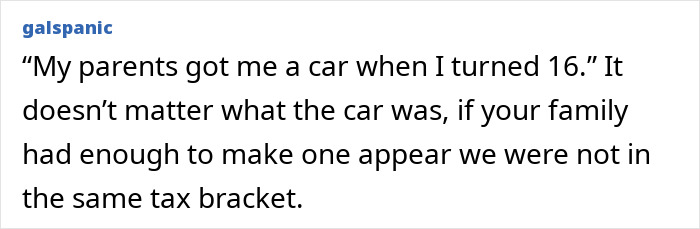
"I got a car for graduation! What did you get Rinso?" "I got kicked out"

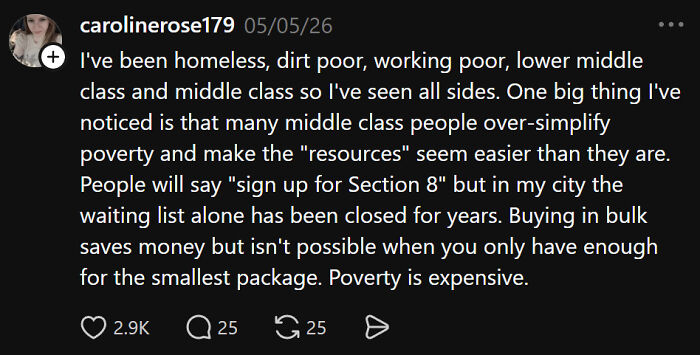
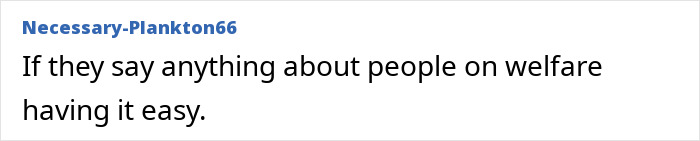
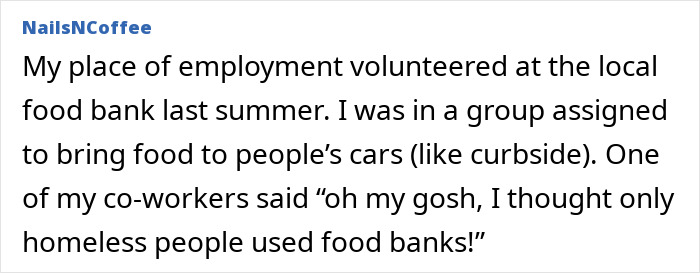
I can't count the number of people I've seen that complain about all the perks the poor get: free medical, free food, free housing. They have no understanding of what it takes to qualify for these things and what you have to do to keep them. I always ask, "If these things are so wonderful and important to you, why haven't you quit your job and applied for them then?" People finally shut up then.
The middle class did not always exist. Before the Industrial Revolution turned the economic world upside down in the late 18th and early 19th centuries, society operated on a brutally simple two-tier system: you were either born into land and title, or you were not, and that was largely the end of the conversation.
The rise of factories, trade, and professional work created something entirely new: a class of people who built their position through skill and commerce rather than inheritance. They were not aristocrats. They were not peasants. They were something the world had not quite seen before, and they have been finding their own way ever since.

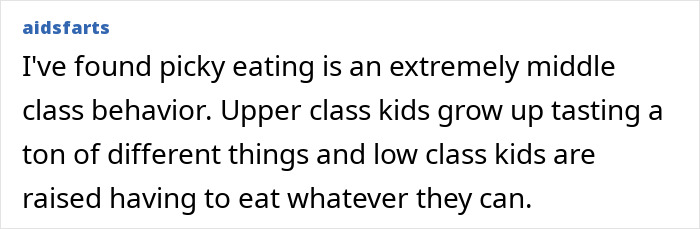
I'll eat your leftovers, your rightovers, heck even your middleovers. I'm not picky.


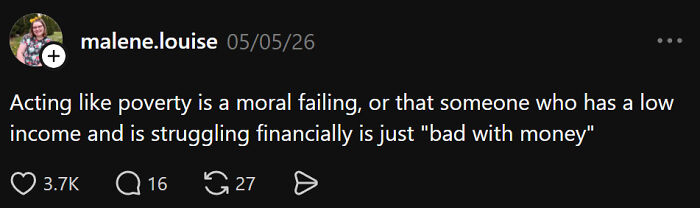
Saying someone being poor is bad with money is like saying someone falling off a cliff is bad with gravity.
The global middle class is considerably larger than most people picture when they imagine it. Somewhere between 4 and 4.5 billion people currently fall into this category worldwide, meaning that for the first time in human history, more than half the planet lives in a middle-class household.
The defining threshold is roughly $11 to $110 in spending power per day, adjusted for local costs. This is a bracket wide enough to contain both the person agonizing over an avocado at a farmers market and the person who has never set foot in a farmers market in their life, and yet here they both are.

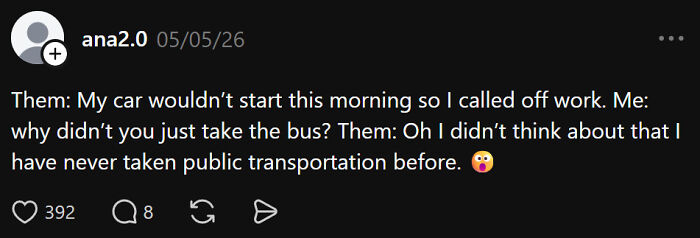
Public transportation isn't readily available in all cites. Our transportation system s***s where I live.
Getting into the middle class and staying in the middle class are two different conversations, and getting out of it entirely is a third one that nobody talks about enough. The route in typically runs through education, specialized skills, and consistent employment, all achievable with the right circumstances and a significant amount of work.
The route upward from there is a fundamentally different challenge. Building genuine upper-class wealth requires moving away from earning a wage and toward owning assets that generate income independently. The middle class works for its money. The upper class has largely arranged for its money to work for itself.
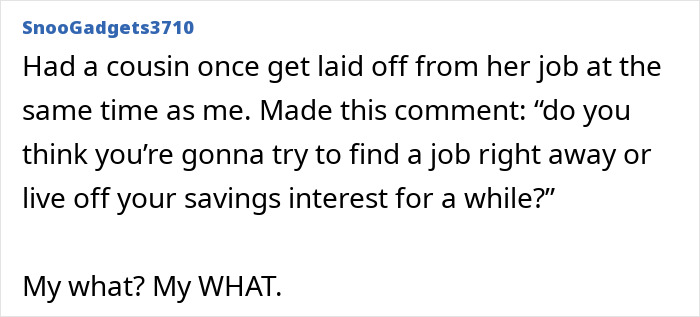
The only savings I have is what's required to keep my checking acct open at the credit union.

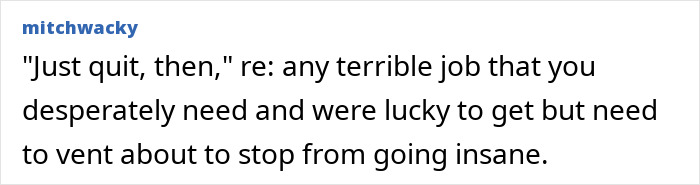
The only way one can "just quit then" (and don't tell me you haven't had days when you've wanted to go to your boss and hand over your badge and leave, all without saying a single word) is to already have another job lined up. That's when you realise that, for the most part, you're nothing special. Just yet another person looking to exchange time for money, just like everybody else. You know, the place I work, there are girls with degrees. Okay, often in dumb subjects like hairdressing or whatever, but there are only so many people needed to do those jobs, so these girls who did a couple of years at college and might be good at it, turn up at 4am to spend the next eight hours putting cherries on cupcakes, because that's the job that took them on and when you have bills you don't get to be choosy. So "just quit then", nice dream, terrible reality.
No, dear, I don't. I grew up with the mindset of figuring out my problems by myself because others were........unreliable at best.
Baby boomers were the golden generation of the middle class in a way that has not been replicated since. When boomers were in their 20s, nearly 70% of them fell into middle-income territory. This represents a level of generational economic stability that successive cohorts have simply not been able to match.
The middle class has been quietly shrinking ever since, meaning millennials and Gen Z are navigating a significantly more compressed version of the economic landscape that their parents and grandparents built their assumptions on. This does go some way toward explaining why the advice to simply "get on the property ladder" lands the way it does.
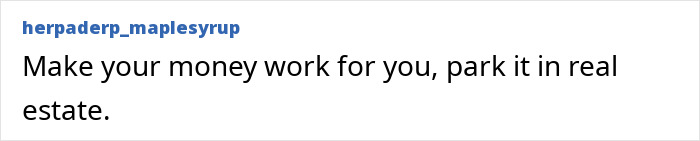
Many people devote a large chunk of every paycheck to real estate. It's called "rent".
In the United States, the middle class has an official income bracket, and it is broader than most people expect. A three-person household earning anywhere between roughly $55,800 and $167,500 annually falls within the middle-class definition used by the Pew Research Center and the U.S. Census Bureau.
That is a range wide enough to contain deeply different lived experiences. You will have the family carefully managing every monthly expense at the lower end, and the household taking two international holidays a year at the upper end. They are technically the same class. They are not, in any meaningful daily sense, living the same life.

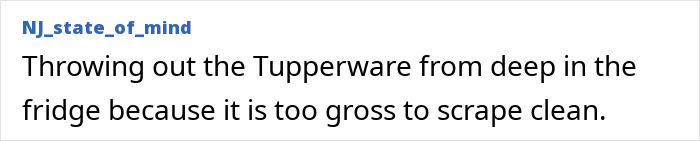
I mean..... it depends on what has been sitting in said tupperware and how long. Once I totally forgot about a container of beef stroganoff and it ended up pushed juuust far back enough in the fridge that I couldn't see it, so out of sight out of mind. There was no way I was releasing the abomination in that container into the world by opening it.
In the United Kingdom, class identity is expressed as much through shopping habits and leisure choices as it is through income, and a large-scale YouGov survey mapped this out with uncomfortable precision. Buying groceries at Waitrose or Marks and Spencer rather than a budget supermarket emerged as a significant class marker.
So did taking skiing holidays abroad, a leisure activity that carries a very specific set of financial and cultural assumptions baked directly into its existence. The British class system has always communicated itself through extremely specific consumer choices, and the supermarket you walk into says more about your perceived social position than most people are entirely comfortable admitting.

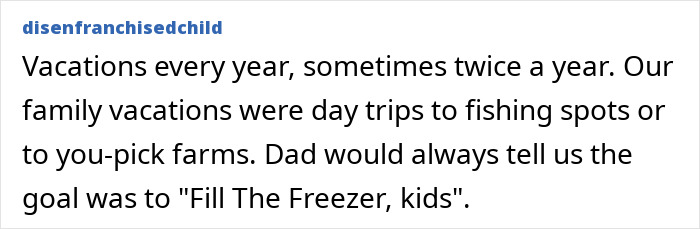
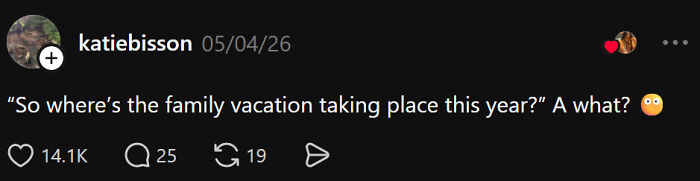
I remember in high school my friend asking where my family was going for vacation. I said nowhere? And she let out a big sigh , and was like ugh we're going to Belize..again.
Ask Americans how they define middle-class status, and the answers are grounded, practical, and very revealing. A Washington Post survey found that the top markers were not holidays or postcodes or supermarket preferences; they were a stable job, the ability to put money aside for the future, and access to health insurance.
No mention of summering anywhere. No skiing. Just security, savings, and not being one medical bill away from a financial crisis. The contrast between what the American middle class considers its defining characteristics and the oblivious confidence with which some of its members speak about financial struggle is, frankly, the whole article.
Also, poor people can usually eat the same thing day after day because that's what they do. I have a friend who can't stand to even eat leftovers because they're something she ate the day before. But I remember getting a can of Crisco, some salt, and a 5-lb bag of potatoes and having fried potatoes for every meal until the potatoes were gone. If I told someone that, they'd ask me how I could stand to eat like that. The other thing in eating is that poor people don't make "balanced" meals a priority. They can't always afford to have three or four different things to eat at the table. One item is what they'll eat and that's the meal. I still find myself doing that today. I'll eat plain hamburger with ketchup and that will be my supper. Nothing else. No veggies, no dessert. I had to keep a food diary once and the doctor wouldn't believe what I would put down for meals. He thought I was lying about what I ate every day.

Expecting someone to co-sign is d**n cheeky - the business wants to make the loan but expects someone not involved with the purchase to back the loan anyway? This comes across as "We'll make sure we get our money but we'll still hit you with extreme interest rates because you're poor". Cake-ism?
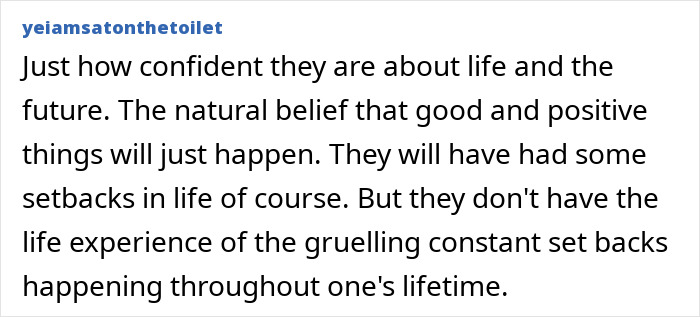
The ignorant comments on this list were almost never delivered with bad intentions, and that is the most important thing to hold onto as you read them. The middle-class blind spot is not cruelty; it is insulation. It is the very specific unawareness that comes from being comfortable enough, for long enough, that discomfort starts to feel like a choice rather than a circumstance.
The summer-as-a-verb crowd is not the villain. They are just people who have forgotten, or perhaps never fully learned, that the view looks completely different from the other side of the income bracket. The first step is noticing. This list is a good place to start.
Do you have any other middle-classisms that drive you up the wall? Share them in the comments!

I hated those "tell us where you went on your summer vacation" the teacher asked when school started.
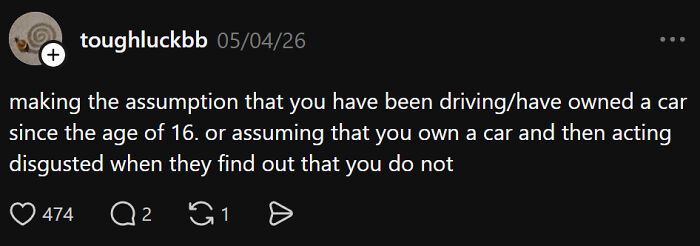
I am 50, and I have never been able to afford a car. I do live in a place with good public transportation, so before I got too disabled I could get a lot done with that (though it did get more and more difficult/exhausting over time). Now my primary transportation is only what is covered by my Medicare health insurance, which is so inconvenient and tedious to deal with that I only use it for unavoidable medical appointments. I do use Lyft, but as little as possible (mainly to take cats to the vet) as I need to save the money for other things. (No, the cats aren't optional, they keep me hanging on.)

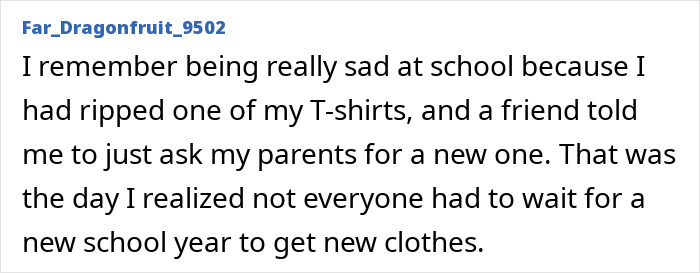
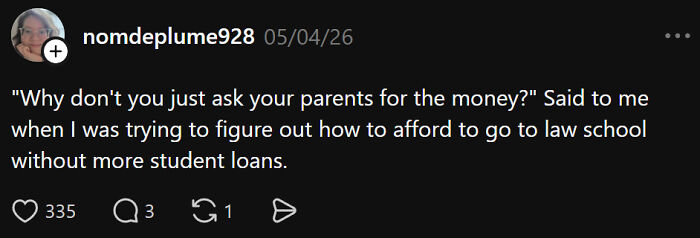
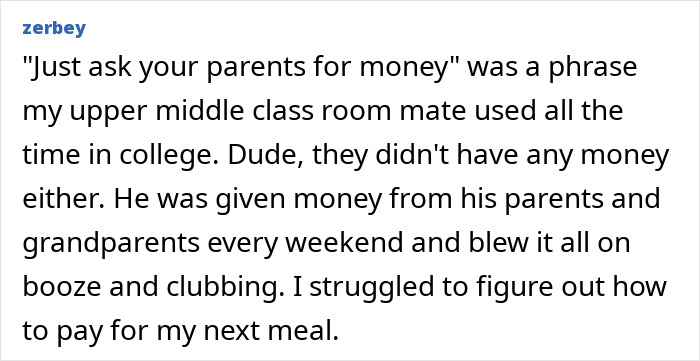
Ask my parents? One was going to run me after graduation had I not moved, the other I was grateful to get a box of groceries once in a while to survive college. I STILL can't abide the taste of ramen...
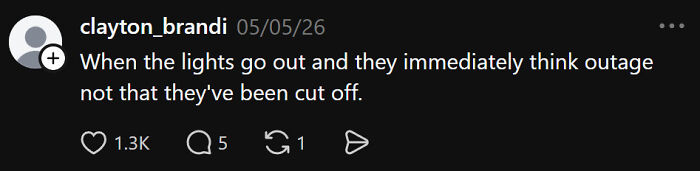
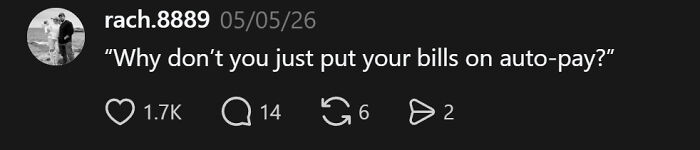
I worked in a bank and saw firsthand how hard it is to take things off auto-pay, short of closing your checking account. I swore I would never have anything on auto-pay, no matter how much it saved me.
Do I *ski*? Take a good long look at my body and ask me that again, slowly. 😂
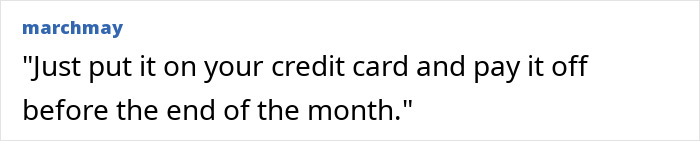
That's not always possible, especially if something unexpected comes up like a car repair.

When pharma commercials say, "Ask your doctor if Fhqwhgads is right for you." Ah yes, "my doctor," who is a person I know and can afford to talk to. We golf together.
If I got asked to lunch and said it was because I had no money, people would tell me, "Oh, it's only $5. Surely you can afford that!" People don't understand, when you say you have no money, you have NO money. Not yes, I have a couple bucks in change in the car, or yes, I can pull it out of my a*s. I mean I have NO money, as in ZERO, ZILCH, ZIP. It's the 1st, I've paid my rent, my bills, and gotten gas and groceries and for the next four weeks, I have NO money left over for ANYTHING!

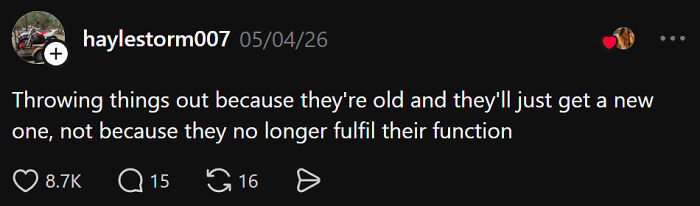
I'm reaching that point in time where my fridge is 20 years old (and I've replaced the door gasket and both thermostats), my stove is 25 years old (and the propane regulators are shot), and my washer and dryer are 15 years old (and fortunately mechanical and, thus, easily fixed). Also, my car is nearly 20 years old. I hope they don't all go at once.
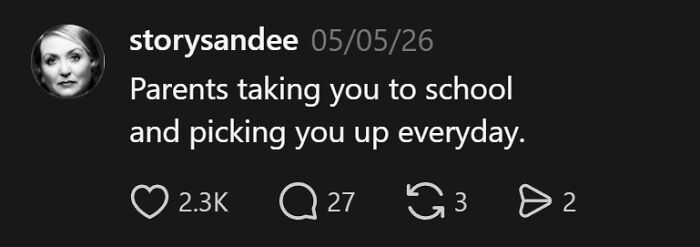
I took two city busses on my own as a kid to get to school , I remember showing up soaking wet and freezing after waiting in the rain. I always envied my friends who came with their parents in a warm car.
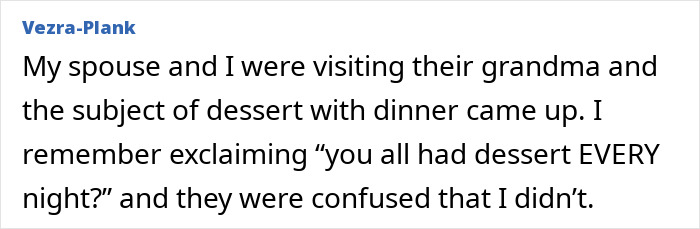
Pudding was for Christmas or the occasional Sunday, only.

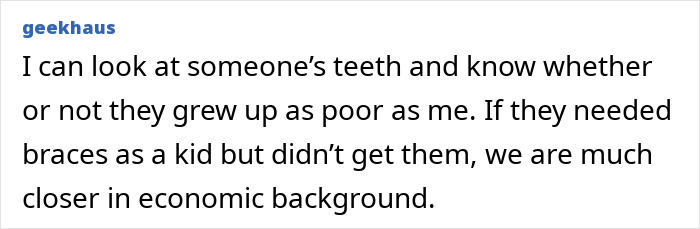
The saddest part is that adults who never had braces are viewed differently. This is especially an issue for women. In order to appear polished and professional, society expects clean, straight white teeth. It's not fair for all the kids out there who didn't have that from their parents. I don't agree with it, at all. I'm simply pointing out the way things are (a lot of the time).
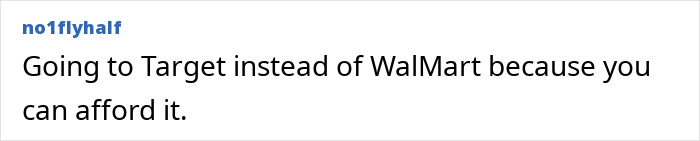
"We don't like Walmart because of how they treat their employees, so we shop at Whole Foods instead." How nice you can afford to do that.
Nothing middle class about a pool. In ground? Rich. Above ground? Poor. No pool? Middle class.

Pretty normal in European countries. And of course visiting a foreign country is easier here too.

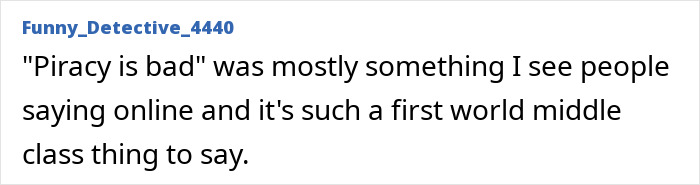
No, I'm sorry, it's not middle class. I'm doing well now, but my 20s and early 30s were a mess. I pirated nothing. I did without.
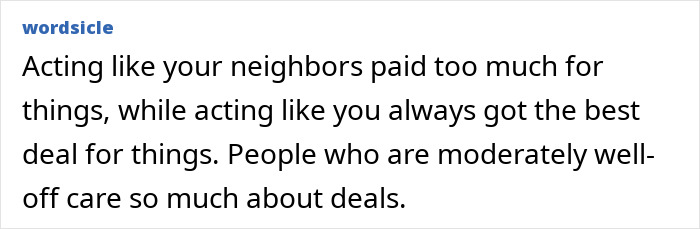
There are two sorts of middle class. Those who came from middle class backgrounds, and those who rose there. It's the second lot that are massively insecure about money and the prices of things. If you got into a home and it is tasteful Laura Ashley, then it's middle class. If you got into a home and the host points it out and, worse, starts talking about the price, then they aren't from a middle class background.

My mom was a SAHM, which is why she and my dad always thought I was such a failure. Why couldn't I get married and stay at home all day and take care of kids, why couldn't a husband support a wife and kids on one salary, why didn't I just go to college to get a good job so I could buy a house, how hard can it be to get a job - just walk in and give them your resume? If you can't do any of that, there must be something wrong with you. We did it, why can't you?




No,No, No. You aren't going to post s**t like this to deflect things from the overly rich bastards that are the biggest problem. Keep the lower classes fighting amongst themselves? Those bloated f*****s won't be happy until everyone but them has nothing. . Not that I have any strong opinions on the matter.

While a lot of these don't seem like "middle class" things, you have to bear in mind what generation you are. If you are gen X and boomer, these are "middle class" things. They were around and making money when the environment wasn't near as harsh as it is these days.
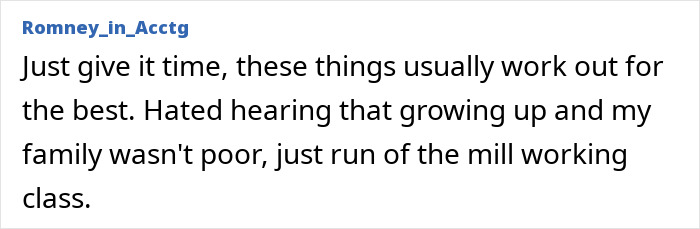
However poor the middle-class gets, there is always a group that is poorer.
Load More Replies... No, this is BS. The person who pulled together this c**p is just ticking some boxes for pay. Most middle class people are frugal, empathetic, and do what they have to do to get and and with luck get their kids a leg up. What's published in this whatever it is (article? pieced together c**p?) is so far off coarse and just plan c**p.
No,No, No. You aren't going to post s**t like this to deflect things from the overly rich bastards that are the biggest problem. Keep the lower classes fighting amongst themselves? Those bloated f*****s won't be happy until everyone but them has nothing. . Not that I have any strong opinions on the matter.
While a lot of these don't seem like "middle class" things, you have to bear in mind what generation you are. If you are gen X and boomer, these are "middle class" things. They were around and making money when the environment wasn't near as harsh as it is these days.
However poor the middle-class gets, there is always a group that is poorer.
Load More Replies... No, this is BS. The person who pulled together this c**p is just ticking some boxes for pay. Most middle class people are frugal, empathetic, and do what they have to do to get and and with luck get their kids a leg up. What's published in this whatever it is (article? pieced together c**p?) is so far off coarse and just plan c**p.













 No fees, cancel anytime