Get Premium
Dark mode theme is available exclusively for premium users. Learn more about the benefits of subscribing.
No fees, cancel anytime.

 Dark Mode Ad-Free Browsing Unlimited Content
 Ad-Free Browsing Unlimited Content Dark Mode
Join 1.2 million Panda readers who get the best art, memes, and fun stories every week!

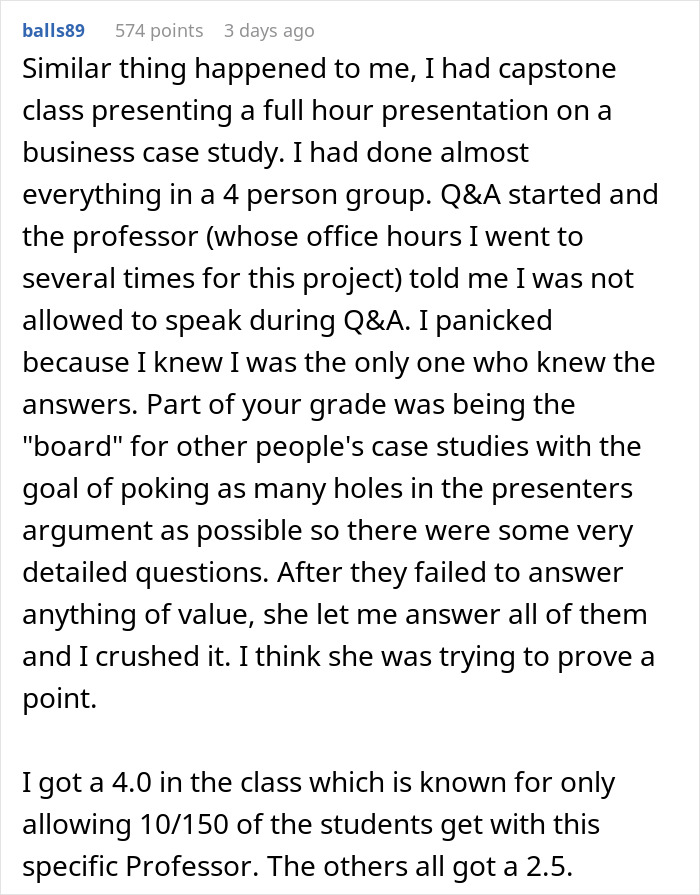
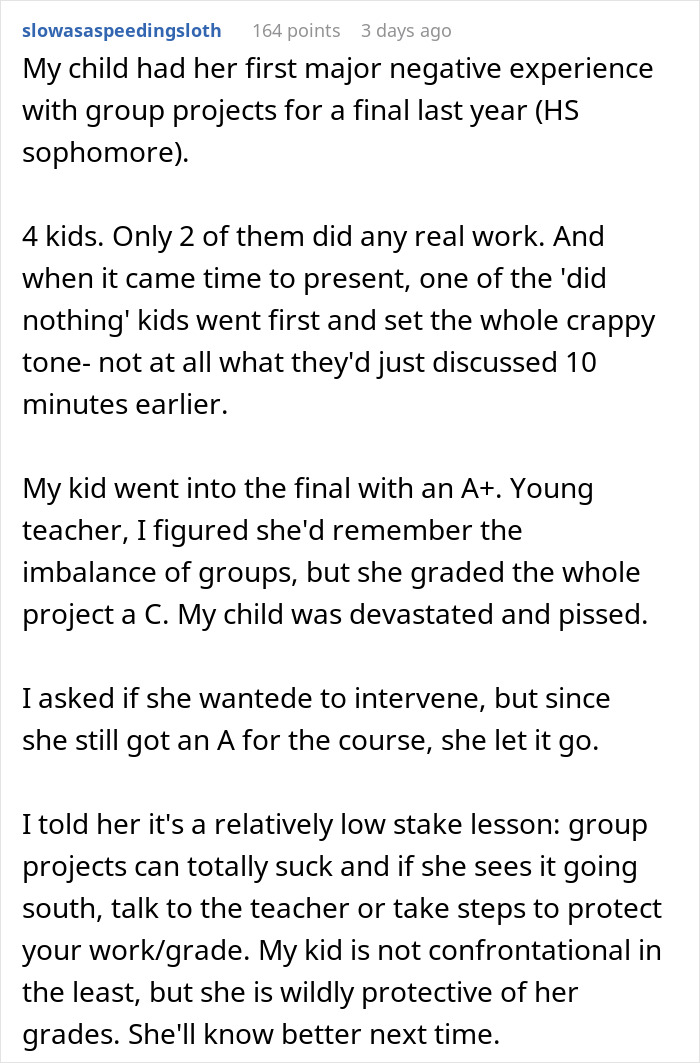
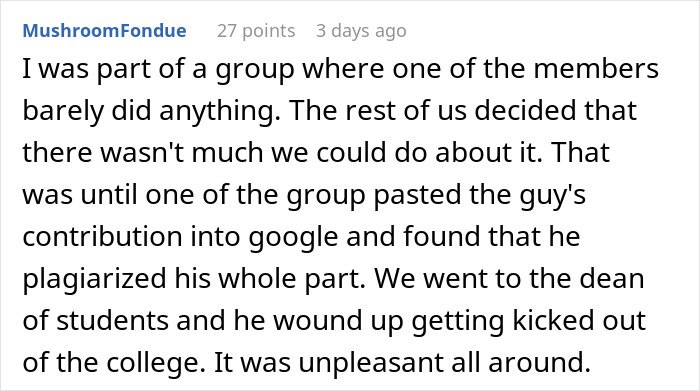
Group projects do prepare people for working in the real world, in the sense that one learns that nothing is fair, someone will always get by on someone else’s work and that you rarely get credit for taking on the hardest tasks.
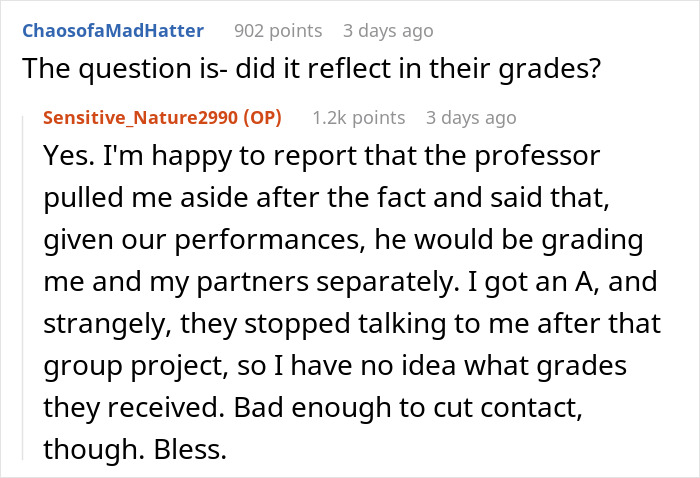
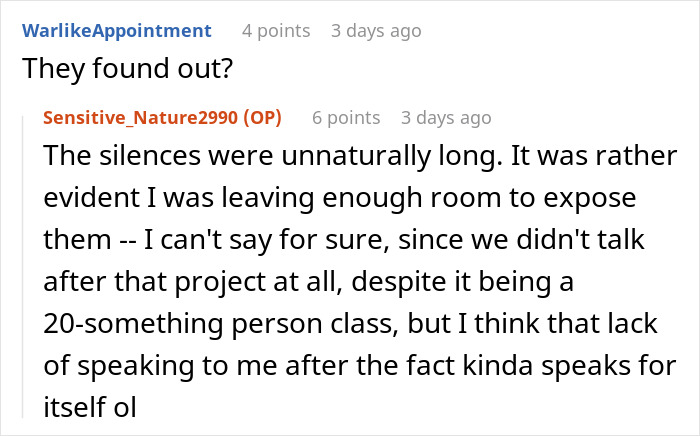
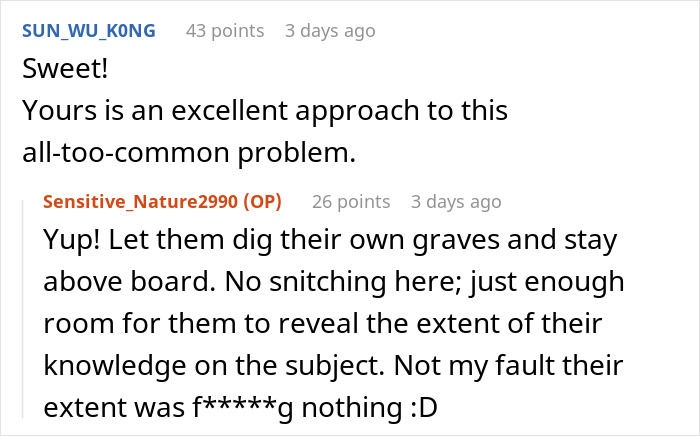
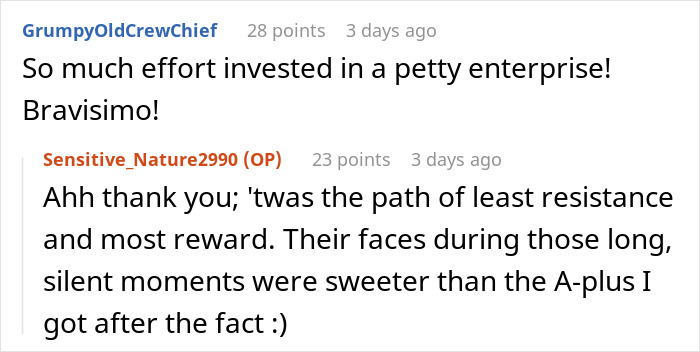
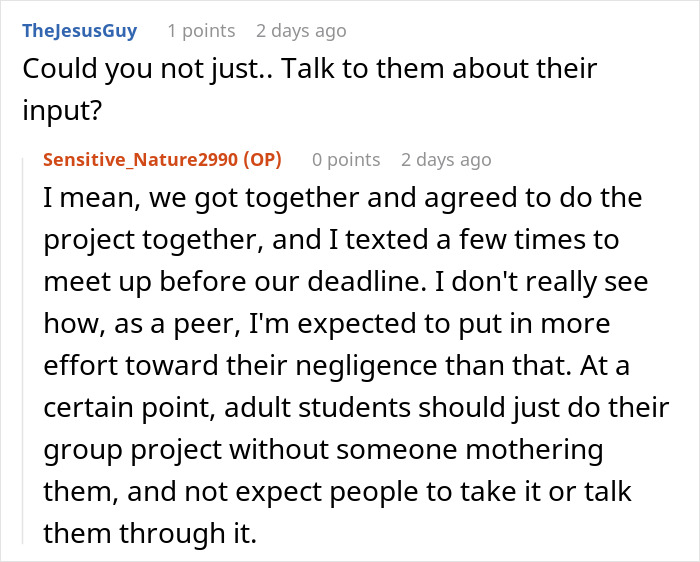
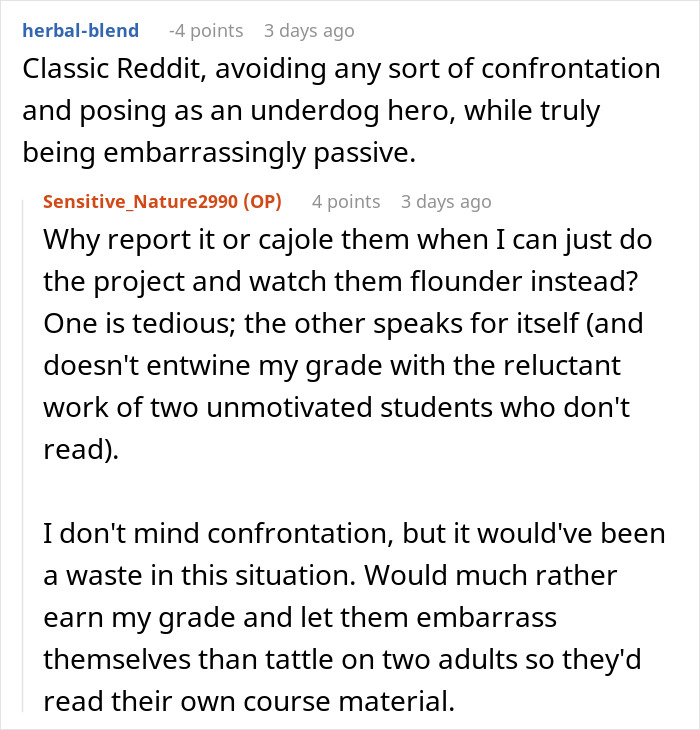
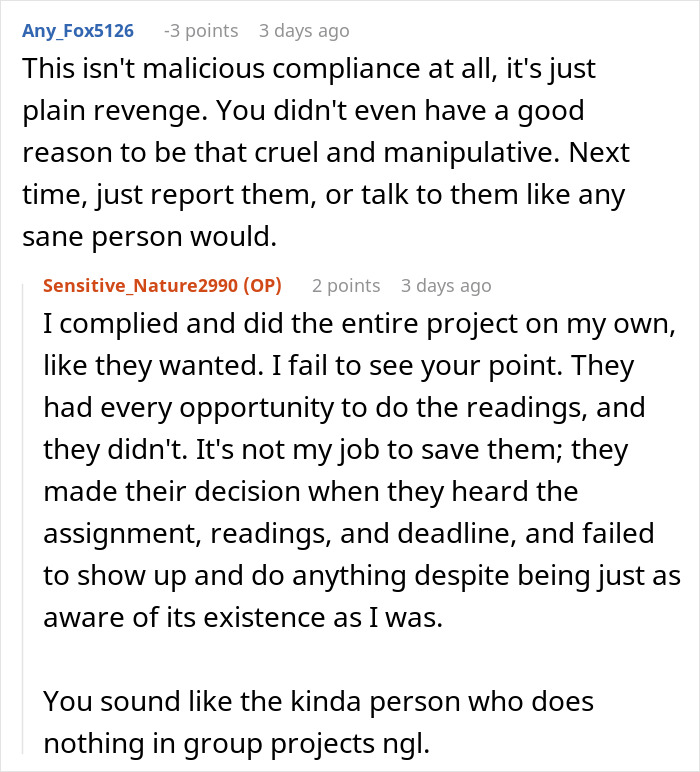
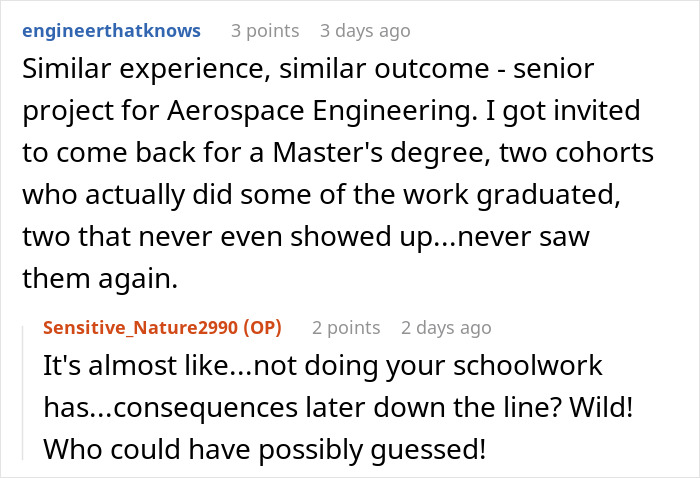
A student went online to both vent and share their rather clever bit of malicious compliance. They were struck with the usual curse of group projects, as they did all the work and the rest did nothing. So when it came time to present their project, they decided to let their team dig their own grave.
Image credits: A. C. / Unsplash (not the actual photo)
Image credits: westend61 / Envato (not the actual photo)
Image credits: Sensitive_Nature2990
Image credits: Getty Images / Unsplash (not the actual photo)
Group projects have a way of turning into psychological experiments nobody signed up for, and the story of a memorized presentation and a strategically vague worksheet is a pretty perfect illustration of why. The core issue almost always comes down to something researchers call social loafing, sometimes referred to as the free rider problem, which happens when some students in group projects put in less effort into the work than when they work alone, try to survive in the group, and then take credit for someone else’s work. It sounds almost too simple to be the culprit, but it shows up constantly, and it tends to demotivate the people actually doing the work while breeding resentment that festers long after the grade gets posted.
Part of the reason this keeps happening traces back to a phenomenon first documented over a century ago by a French engineer named Max Ringelmann, who noticed something strange happening with people pulling rope. A man pulling alone exerted significantly more force than those working in groups, and the average force per person kept dropping as group size increased.
Translate that from rope to research papers, and you get exactly what unfolded in that Scottish madness project, where two out of three people quietly assumed someone else would handle it. When people are placed in a group, they often feel less personally responsible for the outcome and assume someone else will pick up the slack, which leads to disengagement. Nobody has to consciously decide to be lazy for this to kick in, it is baked into how humans process shared responsibility.
Image credits: Vitaly Gariev / Unsplash (not the actual photo)
Diffusion of responsibility is the more precise term for what makes this so insidious, and it explains why free riding is not always a deliberate act of laziness. Free-riding behavior is not necessarily due to apathy or a deliberate attempt to do as little work as possible, and there can be numerous and complex reasons behind why a student fails to contribute equally. That does not make it any less frustrating for the person left holding the entire syllabus, but it is worth remembering that plenty of free riders are not villains twirling a mustache so much as people who never quite clicked into a sense of ownership over the outcome. Anonymity, in this context, is doing a lot of damage. When contribution cannot be easily tracked or measured, individual accountability tends to evaporate, and the group becomes a place to hide rather than a place to build something.
This is exactly why professors increasingly lean on peer evaluations and individualized grading, which is what ultimately saved the day in that story once the professor pulled the storyteller aside. Research backs this instinct up: using structured evaluation methods with early implementation and specific criteria has been shown to mitigate free-rider problems and improve students’ perceptions about groups and group projects. Grading everyone identically regardless of contribution is basically an invitation for the Ringelmann effect to thrive, since there is no cost to coasting. Separate grading, or a public Q&A that puts knowledge on display in real time, restores the individual stakes that group work tends to erase.
There is also a structural problem baked into how these assignments get assigned in the first place, since students rarely get a say in who they are paired with or how work gets divided beforehand. Without clear roles, contribution becomes a fog, and fog is where free riders thrive. One widely cited fix for teams outside the classroom is to keep the group as small as possible for the task, since if a task can be handled by five people, a manager should not automatically make it ten. Universities rarely have this luxury given class sizes and course requirements, so mismatched groups keep happening, and stories like this one keep getting written, because the underlying incentive structure has never really been solved. It has just been quietly managed by professors clever enough to grade the truth rather than the performance.












By entering your email and clicking Subscribe, you're agreeing to let us send you customized marketing messages about us and our advertising partners. You are also agreeing to our Privacy Policy.
Thank you! You've successfully subscribed to newsletters!

Had a similar situation in a pre-med class, 1990's. 4 person group projects where one person each separately led experimental design, actual experimentation, data analysis, and report writing, but everyone is supposed to collaborate for each step. Even though I had owned more than my fair share in the previous projects, for one project I missed a class for a doctor's appointment, so the team decided somehow I was slacking, that they refused to give me the data to write the report, and cut me out to write their own. I was able to find a similar data set based on the same experiment in a textbook, and wrote an excellent report, and also found conclusions that the rest of the team were unable to. I explained the situation to the confused TA, and I ended up getting an A while the rest of the team ended up getting worse grades. Sweet victory.

I cannot believe that someone attempted to correct pregnant pause with poignant pause 🤣🤣🤣
Had a similar situation in a pre-med class, 1990's. 4 person group projects where one person each separately led experimental design, actual experimentation, data analysis, and report writing, but everyone is supposed to collaborate for each step. Even though I had owned more than my fair share in the previous projects, for one project I missed a class for a doctor's appointment, so the team decided somehow I was slacking, that they refused to give me the data to write the report, and cut me out to write their own. I was able to find a similar data set based on the same experiment in a textbook, and wrote an excellent report, and also found conclusions that the rest of the team were unable to. I explained the situation to the confused TA, and I ended up getting an A while the rest of the team ended up getting worse grades. Sweet victory.
I cannot believe that someone attempted to correct pregnant pause with poignant pause 🤣🤣🤣

































 No fees, cancel anytime















34
7