Get Premium
Dark mode theme is available exclusively for premium users. Learn more about the benefits of subscribing.
No fees, cancel anytime.

 Dark Mode Ad-Free Browsing Unlimited Content
 Ad-Free Browsing Unlimited Content Dark Mode
Join 1.2 million Panda readers who get the best art, memes, and fun stories every week!

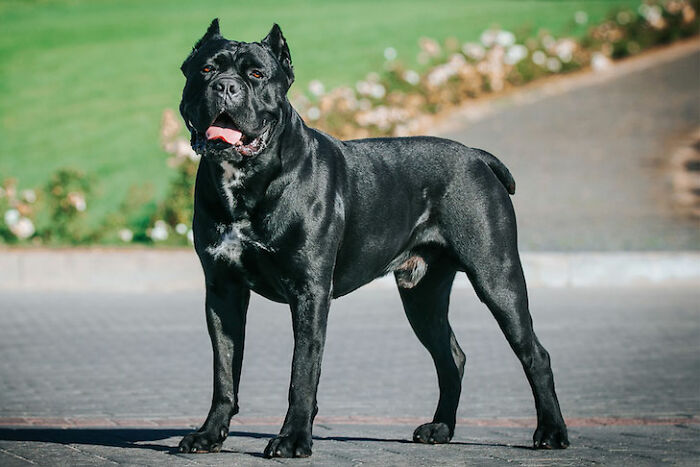
Cane Corso
The Cane Corso is an independent breed that possesses intellect and dignity. It has a long history of being bred to be a canine multitasker that is alert, energetic, and keeps a close watch on its family. It’s critical to socialize this breed properly and teach them important skills so they establish the behaviors they need to be successful as adults. The adorable, wrinkly, and clever Cane Corso puppy can grow into a 110-pound energetic adult.
Jami-Lyn Derse, DVM, the founder of Veterinary Housecall Care, urges prospective owners to take lots of time to plan and get ready before obtaining any dog, even a Cane Corso. The Cane Corso is a breed of Italian mastiff. He is a complicated, powerful dog with particular needs. He is a large breed that may weigh up to 120 pounds. He was designed to hunt big game and defend property. The Cane Corso is a large-headed, rectangular-shaped dog with a short, either black, grey, fawn, or red coat.
1). Cane Corso Appearance
The Cane Corso is a big, strong dog that has a royal appearance. He’s a popular choice for watching over his owners and property because of his size and power, of course. They are of the “big, attractive, mastiff-type” breed, according to Derse. A mature male Cane Corso can weigh up to 110 pounds, while a mature female typically weighs 88 to 99 pounds.
The Cane Corso’s short, double-layered coat comes in a variety of hues, including black, grey, fawn, red, and brindle. The texture of the coat has been described by some as that of a cow’s coat because it is coarse, thick, and occasionally tufted.
2). Cane Corso history
Two breeds that resemble mastiffs said to have originated in Italy are the Neapolitan Mastiff and the Cane Corso. Both are ancestors of the Roman war dogs. The Cane Corso worked as a farmhand, flock monitor, property and family defender, and hunting dog during the fall of the Roman Empire and may be likened to the Neo’s “howitzer” as “light artillery” (especially of the big and dangerous game such as wild boar).
Industrialization was blamed for the demise of the Cane Corso, and both World Wars I and II came perilously near to putting an end to his existence. By the 1970s, just a handful of the dogs were left living in remote southern Italian districts. Dr. Paolo Breber developed an interest in the breed when Giovanni Bonnetti, who was acquainted with it from his boyhood, brought it to his attention in 1973. The next year, Breber began a breeding scheme by purchasing many of the puppies. More individuals became interested in dogs when they were mentioned in a magazine article. The breed had received approval from the Federation Cynologique Internationale by 1996.
3). Cane Corso Personality and Temperament
The Cane Corso is a naturally independent dog with a dominating attitude. Because of these traits, he is an excellent defender of his household and family. The dog’s innate desire to take the lead might be an issue if the owner is unable to establish himself or herself as the pack leader and control this behavior. The Cane Corso will try to maintain control of the home while remaining amiable and sympathetic to all members of his family, including small children. Anybody considering purchasing one of these dogs must be prepared to do so since they will undoubtedly test any boundaries that are set.
Despite his high intellect and exceptional athletic abilities, the Cane Corso needs a lot of exercises to stay mentally and physically fit. Take him running or on strenuous outings to help him expend his energy.
When being handled or relocated, or when he balks at going outside or only walks in one direction while wearing a leash, don’t let him get away with acts like snapping or growling. When someone gets too close to his food or toys, he shouldn’t be let to behave in the same way. It is improper to mount family members. To take back control of the issue and reclaim your role as the pack leader, you must act quickly and firmly. To prevent these behaviors from ever developing, work closely with a trainer or behaviorist who is knowledgeable about the guardian breed attitude.
Note:
If you want to know more about this and want to see images so click on link
More info: petlifehealth.com
Cane Corso
The Cane Corso is an independent breed that possesses intellect and dignity. It has a long history of being bred to be a canine multitasker that is alert, energetic, and keeps a close watch on its family. It’s critical to socialize this breed properly and teach them important skills so they establish the behaviors they need to be successful as adults. The adorable, wrinkly, and clever Cane Corso puppy can grow into a 110-pound energetic adult.
Jami-Lyn Derse, DVM, the founder of Veterinary Housecall Care, urges prospective owners to take lots of time to plan and get ready before obtaining any dog, even a Cane Corso. The Cane Corso is a breed of Italian mastiff. He is a complicated, powerful dog with particular needs. He is a large breed that may weigh up to 120 pounds. He was designed to hunt big game and defend property. The Cane Corso is a large-headed, rectangular-shaped dog with a short, either black, grey, fawn, or red coat.
1). Cane Corso Appearance
The Cane Corso is a big, strong dog that has a royal appearance. He’s a popular choice for watching over his owners and property because of his size and power, of course. They are of the “big, attractive, mastiff-type” breed, according to Derse. A mature male Cane Corso can weigh up to 110 pounds, while a mature female typically weighs 88 to 99 pounds.
The Cane Corso’s short, double-layered coat comes in a variety of hues, including black, grey, fawn, red, and brindle. The texture of the coat has been described by some as that of a cow’s coat because it is coarse, thick, and occasionally tufted.
2). Cane Corso history
Two breeds that resemble mastiffs said to have originated in Italy are the Neapolitan Mastiff and the Cane Corso. Both are ancestors of the Roman war dogs. The Cane Corso worked as a farmhand, flock monitor, property and family defender, and hunting dog during the fall of the Roman Empire and may be likened to the Neo’s “howitzer” as “light artillery” (especially of the big and dangerous game such as wild boar).
Industrialization was blamed for the demise of the Cane Corso, and both World Wars I and II came perilously near to putting an end to his existence. By the 1970s, just a handful of the dogs were left living in remote southern Italian districts. Dr. Paolo Breber developed an interest in the breed when Giovanni Bonnetti, who was acquainted with it from his boyhood, brought it to his attention in 1973. The next year, Breber began a breeding scheme by purchasing many of the puppies. More individuals became interested in dogs when they were mentioned in a magazine article. The breed had received approval from the Federation Cynologique Internationale by 1996.
3). Cane Corso Personality and Temperament
The Cane Corso is a naturally independent dog with a dominating attitude. Because of these traits, he is an excellent defender of his household and family. The dog’s innate desire to take the lead might be an issue if the owner is unable to establish himself or herself as the pack leader and control this behavior. The Cane Corso will try to maintain control of the home while remaining amiable and sympathetic to all members of his family, including small children. Anybody considering purchasing one of these dogs must be prepared to do so since they will undoubtedly test any boundaries that are set.
Despite his high intellect and exceptional athletic abilities, the Cane Corso needs a lot of exercises to stay mentally and physically fit. Take him running or on strenuous outings to help him expend his energy.
When being handled or relocated, or when he balks at going outside or only walks in one direction while wearing a leash, don’t let him get away with acts like snapping or growling. When someone gets too close to his food or toys, he shouldn’t be let to behave in the same way. It is improper to mount family members. To take back control of the issue and reclaim your role as the pack leader, you must act quickly and firmly. To prevent these behaviors from ever developing, work closely with a trainer or behaviorist who is knowledgeable about the guardian breed attitude.
Note:
If you want to know more about this and want to see images so click on link
More info: petlifehealth.com
 No fees, cancel anytime



-2
0