Get Premium
Dark mode theme is available exclusively for premium users. Learn more about the benefits of subscribing.
No fees, cancel anytime.

 Dark Mode Ad-Free Browsing Unlimited Content
 Ad-Free Browsing Unlimited Content Dark Mode
Join 1.2 million Panda readers who get the best art, memes, and fun stories every week!

27submissions
Finished

Many of us genuinely care about the impact we have on the people closest to us, as well as society and the environment as a whole. Your decisions, actions, and spending habits—though just drops in the ocean—can have an impact on your surroundings. One thing to look at is your relationship with buying and consuming products.
The ‘Anticonsumption’ community is a popular online community that criticizes consumer culture while also encouraging everyone to be more environmentally conscious. Today, we’re featuring some of their members’ most popular posts to potentially inspire you to rethink how and why you spend money.
Bored Panda reached out to Matt Johnson, PhD, a marketing psychology expert specializing in topics such as consumer psychology and serendipity, for his thoughts on how consumers can convince companies to be more eco-friendly, as well as why sustainability may be good for brands. "Sustainability isn’t just good ethics—it’s good business," he told us. Read on for our full interview with Johnson.
Click here & follow us for more lists, facts, and stories.
This post may include affiliate links.
The amount of poorly utilized resources and general waste we’re surrounded by is shocking. Statista reports that a jaw-dropping 2+ billion tons of municipal solid waste is generated around the world each year. This number is likely to grow by around 70% by the year 2050.
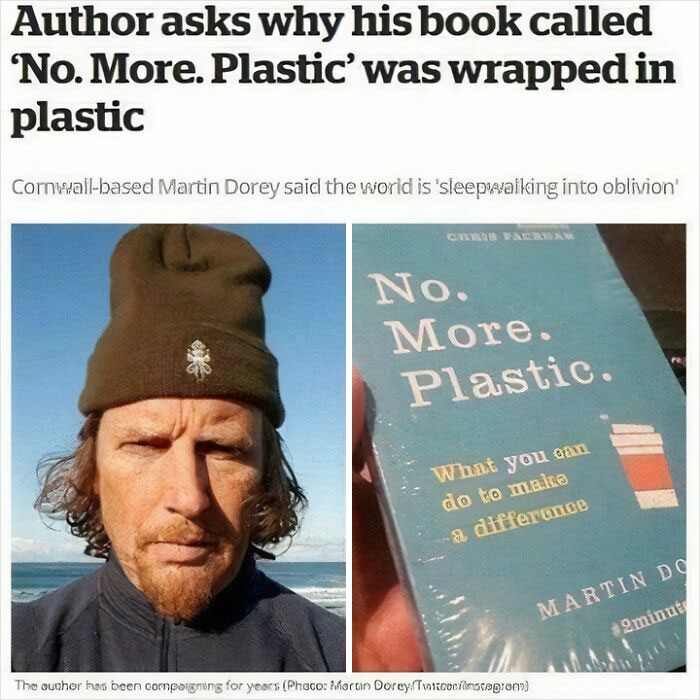
Humankind also generates over 350 million metric tons of plastic waste per year, the amount of which is set to triple by the year 2060. The core issue is that the average lifespan of a plastic product is around a decade, but some plastics can take hundreds of years to decompose.
With so many people going hungry in the world, food waste is a particularly painful topic. In 2022, the world produced around 1.05 billion tons of food waste. This comes out to around 132 kilograms of food waste per capita; 79 kilograms of this was household waste.
Around a trillion dollars worth of food is thrown away each year. Food waste takes up around 30% of agricultural land around the world and generates between 8% to 10% of global greenhouse gas emissions.
The World Food Programme states that a fifth of all food produced for human consumption around the world is wasted. That’s around a billion meals thrown out the window every single day. Food waste is more common in hot climates because food spoils faster as it’s stored, processed, and transported.
The majority of food waste happens at the household level: we’re responsible for around 60% of this waste. So, all of us can realistically reduce this waste on a very individual level.
According to Johnson, consumers have more power than they think. "Every purchase is a vote, and collectively, those votes shape corporate behavior," the marketing psychology expert told Bored Panda via email. He explained that when enough people demand sustainability—whether by choosing brands with eco-friendly practices, calling out greenwashing, or supporting regulatory changes—change happens.
"Companies take notice when, and only when, they have to. The key to applying this pressure is consistency: businesses don’t just respond to trends; they respond to sustained shifts in consumer behavior. If waste reduction and sustainability become market expectations rather than niche preferences, corporations will follow," he said.
"After all, companies don’t change out of goodwill—they change because consumer demand makes it profitable. The more visible and vocal consumers are, the faster that shift happens."
"Apartment building has a vending machine that lets you rent vacuums, air mattress, printer, and even an Xbox!"
We were curious what the upsides of more sustainable business practices might be for companies. Johnson noted that sustainability is good business, not just good ethics.
"Consumers are increasingly aligning their spending with their values, and brands that embrace sustainability can build stronger customer loyalty, enhance brand reputation, and differentiate themselves in a crowded market. Eco-conscious companies also future-proof themselves against regulatory shifts and resource scarcity, making them more resilient in the long run," he told Bored Panda.
"Moreover, sustainability can drive innovation, leading to cost savings and new revenue streams. In today’s market, being green isn’t just a selling point—it’s becoming an expectation. Brands that ignore this shift risk becoming obsolete as consumer and investor priorities evolve."
You can get a sense of the type of relationship people have with consumption by looking at their debt. For example, credit card debt reached $1.17 trillion in the United States in the third quarter of 2024, up from $770 billion in the first quarter of 2021. Low-income Americans are more likely to use various loans (for example, buy now, pay later payday, p**n shop, etc.). The average annual interest rates of payday loans, for instance, stand at 400%. This is unsustainable and traps people in a loop of taking on more debt to pay old debt.
This isn’t to say that money, the economy, or buying and selling things are inherently ‘evil’ or anything like that. Balancing the short-term needs of humankind and the long-term needs of the environment and future generations is hard, yes, but it’s theoretically possible. There’s no such thing as a constantly growing global economy. But eco-conscious, sustainable growth isn’t a bad thing. After all, people need food, a place to live, medicine, entertainment, art, and various goods and services. Civilization is far too advanced for everyone to suddenly embrace a tribal lifestyle with limited to no trade.
Job security, purposeful work, good wages, career opportunities, health insurance, and social programs can provide you with safety and stability. And you can use the money you earn for good food, quality leisure activities with the people you care about, education for your kids, etc. But the way you spend your hard-earned cash should be reflective of something deeper than just trying to ride that dopamine high that comes from shopping addiction.
According to the Addiction Center, people suffering from shopping addiction often compulsively spend lots of money and time buying things they either might not need or simply cannot afford. An example of this is buying luxury goods with money that you’d otherwise use for rent.
Shopping addicts tend to experience things very emotionally, feeling euphoria or excitement when they shop, as well as regret or guilt. These addicts may lie about their habits, feel like they’ve lost control, and have let their financial habits negatively impact their lives.
Robert Waldinger and Marc Schulz, the authors of ‘The Good Life,’ explain that prestige at work and having lots of money doesn’t make someone happier. That being said, money can still give you security, safety, and a sense of control over your life. Your relationships matter the most.
This sentiment is partly echoed by researcher Matt A. Killingsworth from the Wharton School at the University of Pennsylvania. Though he argues that the more money someone has, the happier they are, this ultimately may come down to having more freedom and control to live your life the way you want to. In short, it’s not (just) about being able to buy more stuff.
At the time of writing, the Anticonsumption online group has 954k members, just shy of 1 million. The community was started in September 2009.
If you’re interested in consumer culture and behavior, economics, the environment, etc., the team of moderators running the group has lots of resources for you to look through in the sidebar.
The mods ask all members not to criticize each other’s lifestyles and choices. Posts about the news, shopping trends, and celebrity consumer habits are fine, but you shouldn’t be making fun of regular people.
And, naturally, the subreddit is no place to promote or recommend any brands and products. That goes against the idea of the group, which is to criticize corporate influence, as well as material and media consumption.
What’s your relationship with buying new things like dear Pandas? What areas have you cut back spending on?
Have you embraced secondhand shopping, recycling, reusing, and repairing old(er) things? What are some of your small habits that help the environment and your wallet? Let us know in the comments!
You might also like: 50 ‘Weird Facts’ About The World That Might Give You A Fresh Perspective


























 No fees, cancel anytime