Get Premium
Dark mode theme is available exclusively for premium users. Learn more about the benefits of subscribing.
No fees, cancel anytime.

 Dark Mode Ad-Free Browsing Unlimited Content
 Ad-Free Browsing Unlimited Content Dark Mode
Join 1.2 million Panda readers who get the best art, memes, and fun stories every week!
The 2026 FIFA World Cup has always produced unforgettable photographs. A last-minute goal, a breathtaking save, a perfectly timed header, or an emotional celebration can become the image that defines an entire tournament.
During this year’s FIFA World Cup, however, many of those unforgettable moments ended up telling another story.
Without anyone planning it, they looked remarkably similar to famous paintings, sculptures, and masterpieces created by some of history’s greatest artists.
Those unexpected comparisons came from LJ Rader, the creator behind the hugely popular Art But Make It Sports accounts, where he pairs iconic sports photographs with famous works of art that share the same pose, movement, emotion, colours, or composition.
Throughout the tournament, fans from around the world constantly tagged him in photos from different matches, giving him an endless stream of images to explore.
"Everybody is dialled into the same event," Rader told CNN Style.
"The community is constantly sending me things, and there are photographers from everywhere. It ends up getting easier because there's so much to work with."
Even then, finding the right match wasn’t as simple as putting two similar images side by side.
Rader explained that football is actually one of the hardest sports to work with because “there are only so many positions they can be, since they can’t use their hands.”
That’s why he often studies various photographs, revisits match footage frame by frame, and sometimes even reaches out to photographers for a better angle.
"The ideal is getting a sports photo, rather than a screenshot, and pairing it with the best possible artwork," he said, adding that many potential matches never make it online because they don't meet "the editorial bar" he has set for himself.
Some moments, however, instantly reminded him of a masterpiece.
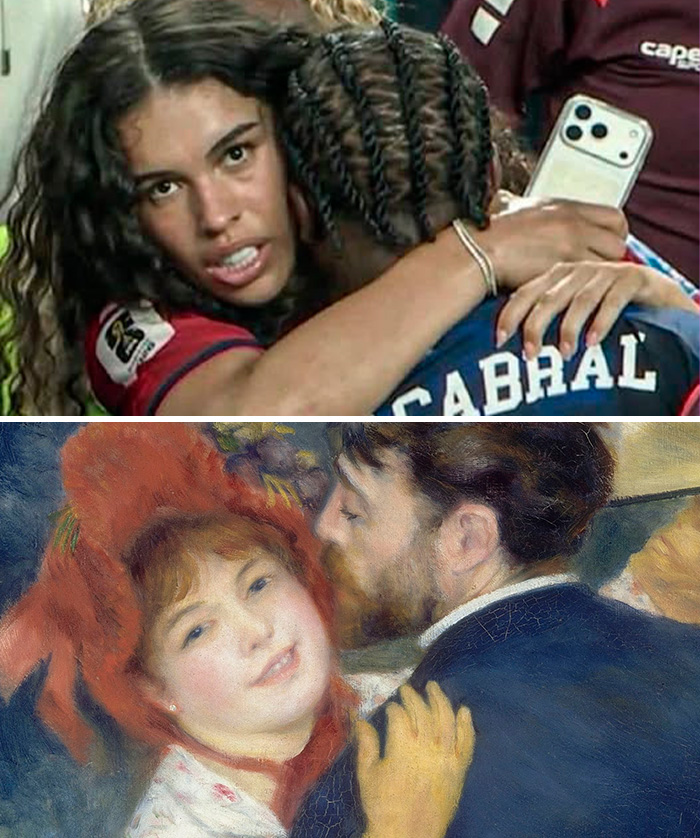
For instance, Cape Verde's defence of Sidny Lopes Cabral’s emotional hug with his girlfriend after scoring against Argentina was one of them.
"Regardless of whether or not Cape Verde was going to win that match, that was the image that would summarise that game," Rader said.
Other pairings took much longer, drawing from what he described as his “mental library” of artworks spanning Renaissance paintings, Impressionist masterpieces, abstract art, and modern sculptures.
Here are 21 World Cup moments that looked as if they had stepped straight out of an art museum.
This post may include affiliate links.
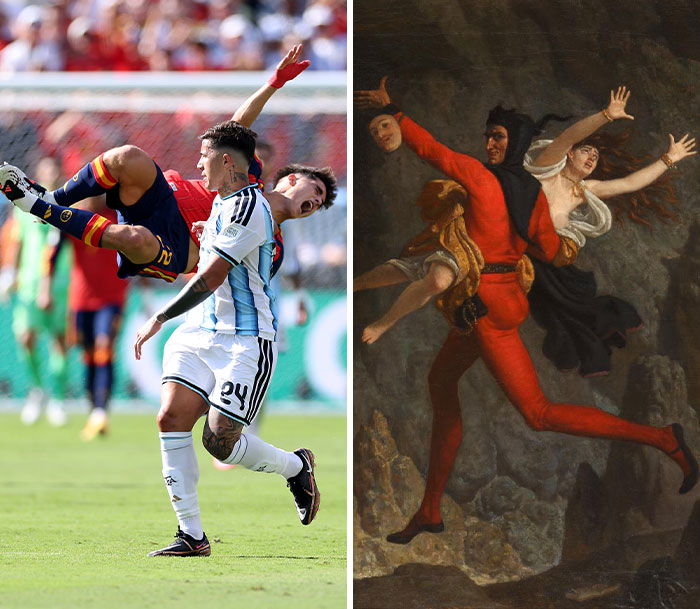
Few paintings capture theatrical movement quite like Mephisto, painted by Spanish Romantic artist Joaquín Espalter y Rull in 1872.
The oil painting depicts Mephistopheles, the infamous demon from Johann Wolfgang von Goethe's Faust, soaring through the air with his body twisted into a dramatic pose as he carries two figures through the darkness.
With its striking composition and sense of motion, the artwork became a memorable example of 19th-century Romanticism, blending fantasy, tension, and theatrical storytelling.
More than 150 years later, football unexpectedly recreated that same dramatic scene.
Photographer Dan Mullan captured Argentina's Enzo Fernández flying through the air after a late challenge on Spain's Pau Cubarsí.
The tackle earned Fernández a second yellow card and a red card, forcing Argentina to play the entirety of extra time with 10 men.
Many later viewed the dismissal as a turning point, with Spain eventually scoring the winning goal to lift the World Cup.
Fernández's airborne pose, Cubarsí's outstretched body, and the overall composition closely mirrored Espalter y Rull's Mephisto, prompting the comparison to quickly go viral online.
One person joked, "Cubarsi deserves an Oscar for this, what an overacting and great stunt he performed here."
Another simply wrote, "Centuries apart. Same composition."
A third added, "When I saw this play, I immediately thought about the potential correlation to artwork."
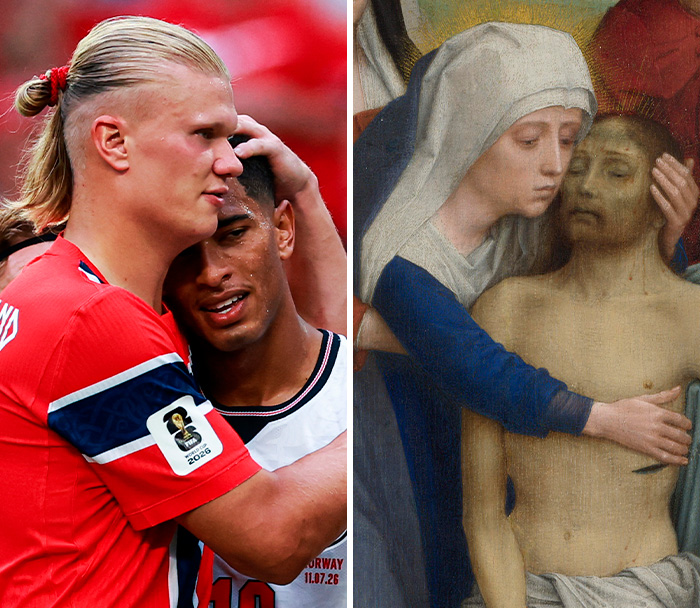
Painted between 1515 and 1523, Lamentation by the Early Netherlandish artist Gerard David captured one of Christianity’s most emotional scenes.
The painting shows the moments after Jesus Christ is taken down from the cross, with the Virgin Mary gently embracing her son’s body while Saint John supports him.
Mary Magdalene kneels nearby to anoint Christ’s feet, as other mourners gather around in grief.
The work became one of the best-known examples of the Lamentation tradition, which focused on sorrow, compassion, and human connection after the Crucifixion.
More than 500 years later, those same emotions unexpectedly appeared on a football pitch.
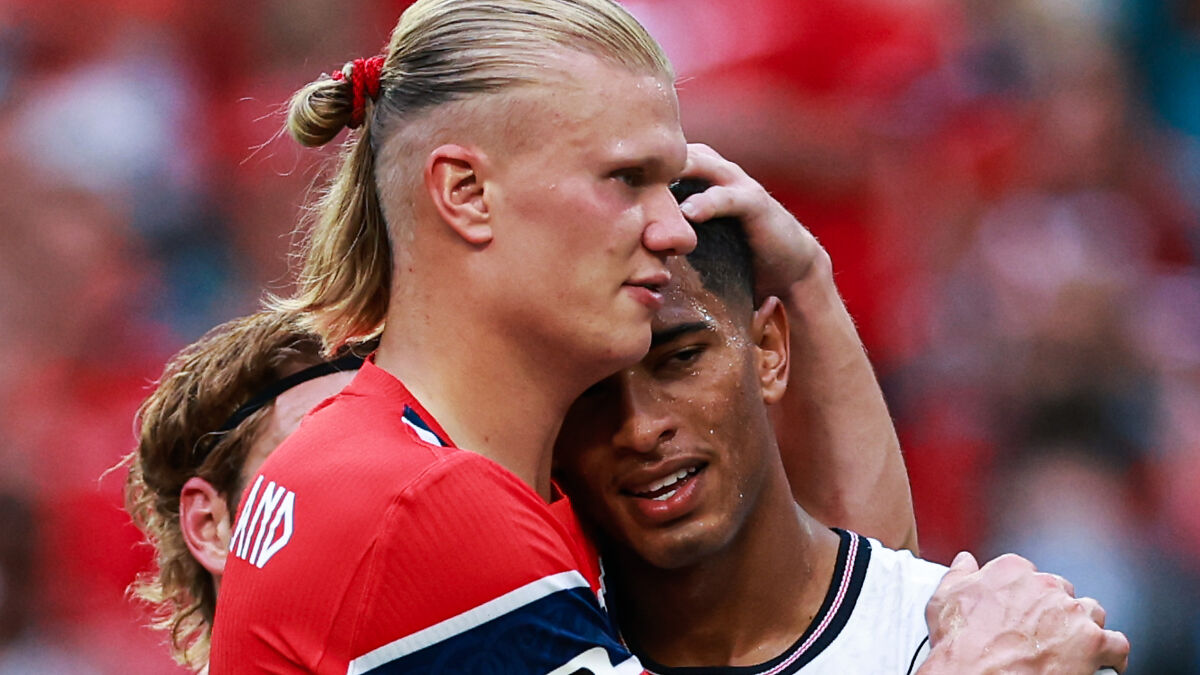
After Norway’s Erling Haaland comforted England’s Jude Bellingham during the FIFA World Cup, the photograph immediately reminded Art But Make It Sports creator LJ Rader of David’s masterpiece.
Haaland’s protective embrace, Bellingham resting his head against him, and the calm, intimate composition closely echoed the central figures in Lamentation.
Fans also couldn’t believe how closely the two images matched.
One person wrote, "Insane bromance."
Another noted, "Lamentation comes from Latin—literally 'a wailing.' The whole painting genre was named for the sound of mourning. Five hundred years later, Haaland silently recreated one on a soccer pitch in Miami."
A third simply joked, "Bro's got that divine touch on the pitch."

Bellingham and Haaland were teammates for two years. They both used to play for Borussia Dortmund.
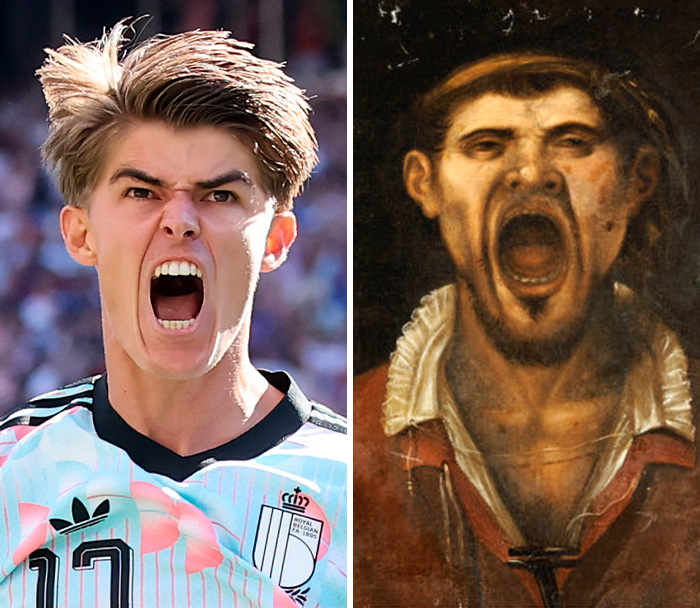
Few paintings capture raw human emotion as vividly as Agostino Carracci’s A Peasant Man, Head and Shoulders, Shouting.
Created in the late 16th century, the Baroque portrait broke away from the idealised style of the Renaissance by focusing on an ordinary working-class man instead of royalty or religious figures.
With his mouth wide open and every facial muscle tensed, the painting conveys an outpouring of emotion that has fascinated art lovers for centuries.
That centuries-old expression found a modern-day twin during the 2026 FIFA World Cup.
Photographer Alex Grimm captured Belgian forward Charles De Ketelaere roaring in celebration while wearing his national team’s jersey.
His wide-open mouth, intense stare, and dramatic facial expression were almost identical to the figure in Carracci’s painting.
The comparison surprisingly became a fan favourite, with one writing, "Finding these matches without AI is an elite talent honestly."
Another joked, "When you realise the scream in the painting was just the original 'goal!' chant."
A third summed up what many were thinking and writing, writing, "The resemblance is actually uncanny, straight out of the 16th century."
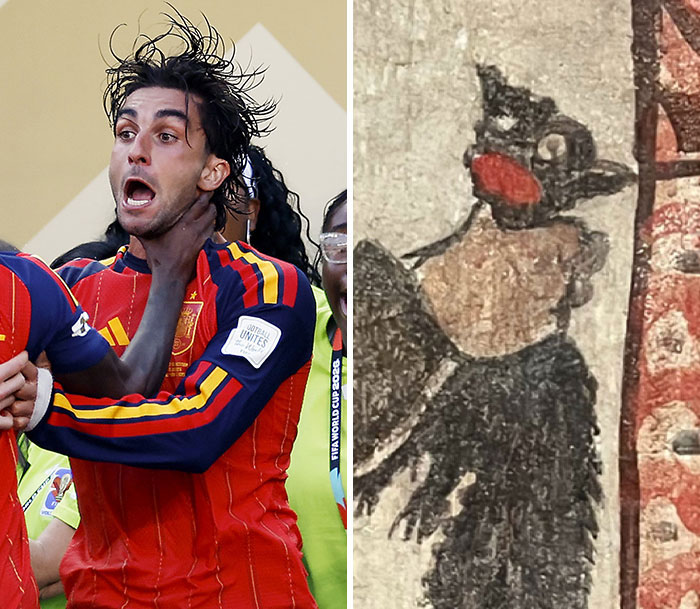
Painted in 1915, Xavier Nogués’ Mural del Celler features a black cat being held by its neck.
Nogués’ work is characterized by his satirical humor, best expressed in his drawings and famous caricatures.
He published two of the fundamental books of graphic humor in Catalonia, La Catalunya pintoresca and *50 ninots, during the first third of the 20th century.
The Spanish artist also gained recognition for painting the ceilings of the wine cellar of the Galerías Layetana, where he included the expressive black cat.
Nogués also painted the murals for the mayor's office of the Barcelona City Council.
His work celebrates scenes from everyday life, Catalan folklore, and the Mediterranean spirit.
More than a century later, another famous Spaniard gave the 1915 mural an entirely different meaning.
At the 2026 World Cup final, Ferran Torres scored the winning goal against Argentina, helping his country claim its second title after first lifting the trophy in 2010.
Immediately afterward, teammate Nico Williams made an effusive show of appreciation by placing one hand around the Valencian striker’s neck.
“And so the prophecy was fulfilled…” an Instagram user joked.
“Artist from Barcelona, Torres plays for Barcelona, and the mural is from the National Museum of Barcelona,” shared someone else.
“This might be my favourite one,” a third football fan wrote.
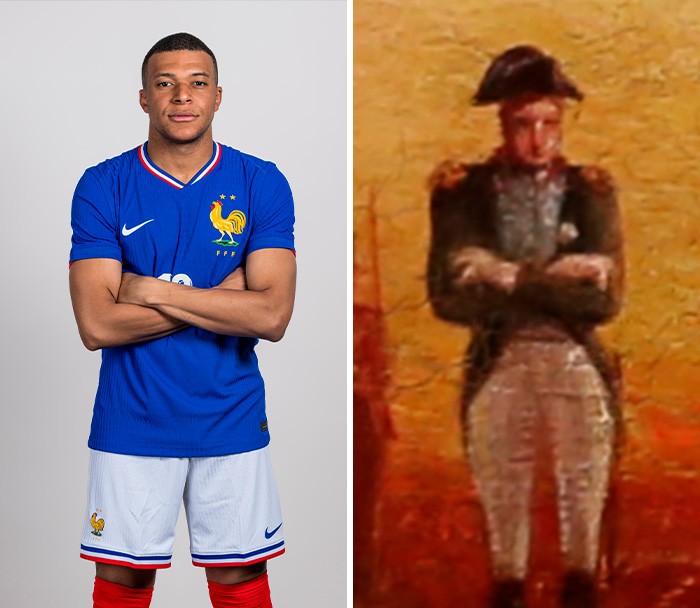
Painted in 1842, War. The Exile (of Napoleon) and the Rock Limpet by English Romantic artist J. M. W. Turner portrays French emperor Napoleon Bonaparte during his exile on the remote island of Saint Helena after his defeat at the Battle of Waterloo.
Standing alone with his arms folded beneath a glowing sunset, Bonaparte appears isolated and reflective as he looks down at a small rock limpet.
Turner described the fiery sky as a “sea of blood”, using it to symbolise the destruction and suffering caused by years of war.
More than 180 years later, that iconic stance reappeared through another famous Frenchman.
Rader paired a promotional photo of Kylian Mbappé wearing France’s national team kit with Turner’s painting after noticing the striking resemblance.
Mbappé’s folded arms, upright posture, and calm expression closely mirrored Bonaparte’s pose in the artwork.
Fans appreciated the reference, with one writing, “This one hurts but okay,” while another wrote, “Subtle.”

I don't follow any sports, but I heard he scored 20 goals over 20 games??!! (I heard it listening to NPR lol) That's pretty dang impressive! I kinda had to get tangled up in the world cup because Seattle was a host city, and my employer was a supporter (Puyallup Tribe, the first time in its history FIFA has partnered with an American Indian tribe!!)
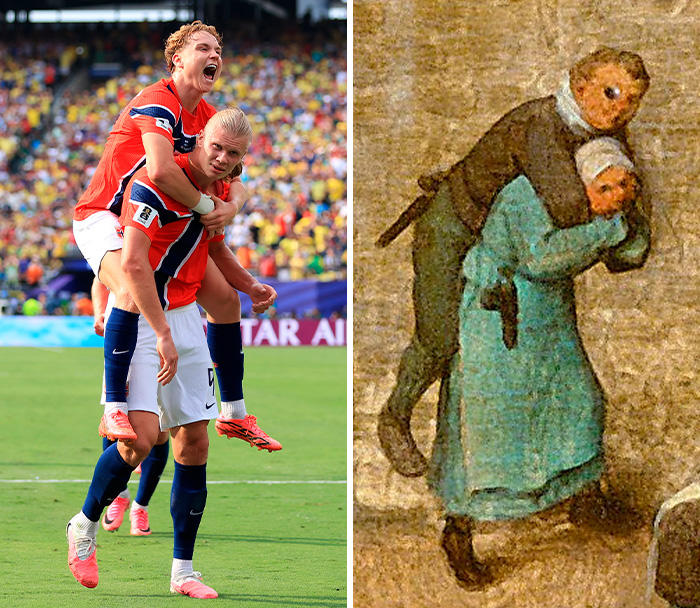
Joy, playfulness, and childhood are at the heart of Pieter Brueghel the Elder’s Children’s Games.
Painted in 1560, the Renaissance masterpiece features hundreds of children filling a town square as they take part in more than 90 different games and activities, from leapfrog and hoop rolling to piggyback rides.
More than simply documenting children’s pastimes, Brueghel used the bustling scene to suggest that adults often approach life with the same seriousness and competitiveness as children absorbed in play.
Apparently, one tiny detail from the enormous canvas found its way onto a World Cup football pitch centuries later.
Following a memorable moment for Norway, Erling Haaland was photographed carrying a teammate who was celebrating on his back.
When Rader placed the image beside a cropped section of Children’s Games, the resemblance was impossible to miss.
Even online fans admired his work, with one writing, "Your talent is making the World Cup so very delightful. So fun.”
Another reflected on the pairing by writing, "Some moments are so timeless that they happen twice—once on canvas, once on the pitch."
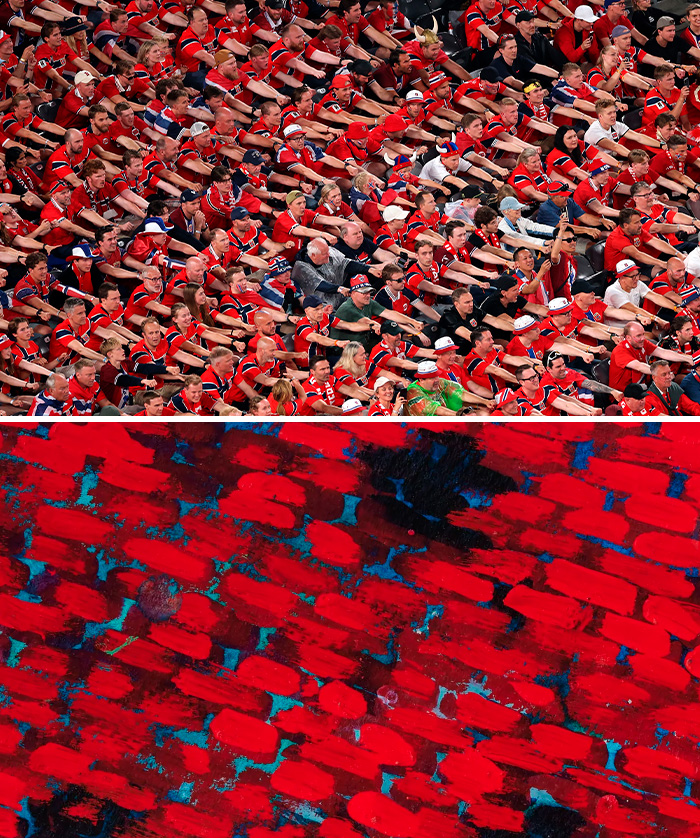
American artist Alma Thomas became one of the most celebrated abstract painters of the 20th century for her vibrant works built from small patches of colour.
Her 1968 painting Untitled is made up of hundreds of bold red and blue brushstrokes arranged in a rhythmic pattern.
Rather than depicting people or landscapes, Thomas used repeating colours and shapes to create a sense of movement and energy.
His abstract apparently resembled a sea of Norway supporters during the 2026 FIFA World Cup, bringing that same visual rhythm to life.
Captured by photographer Justin Setterfield, thousands of fans dressed in red performed a synchronised rowing celebration, extending their arms in perfect unison.
From a distance, the tightly packed crowd looked less like a football stand and more like an abstract painting.
Fans were just as impressed by the comparison, with one saying, "If I can ever do you a service in thanks for all the joy you've given me over these past few weeks, please do not hesitate to reach out.”
Another added, "I don't have time for sports nowadays, but I do have time for your content.”
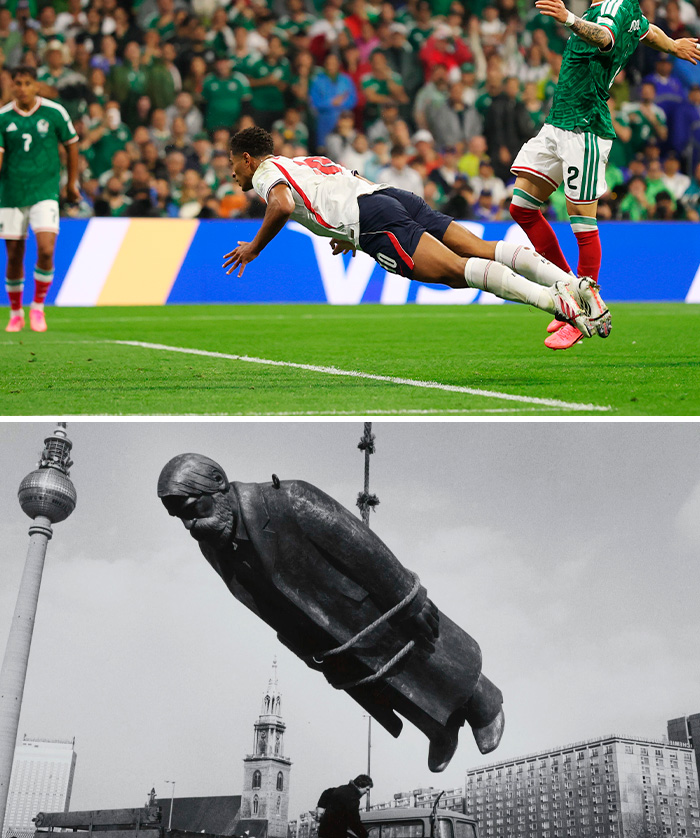
Not every match-winning moment stays on the ground. During England's 2026 FIFA World Cup Round of 16 clash against Mexico, Jude Bellingham launched himself through the air to meet the ball with a spectacular diving header.
The split-second photograph froze him almost perfectly horizontal, creating one of the tournament's most memorable images.
That pose reminded Rader of Sibylle Bergemann's iconic photograph Das Denkmal (The Monument).
Taken in 1986, the black-and-white image shows a bronze statue of Friedrich Engels suspended mid-air by a crane as workers assembled the Marx-Engels Forum in East Berlin.
It was part of Bergemann's eleven-year project documenting the monument's construction, a series that quietly challenged the rigid visual language of East Germany by capturing its symbols in unexpectedly human and sometimes ironic ways.
Placed side by side, the likeness is striking. Bellingham's body appears to float almost exactly like the suspended statue, with both figures angled downward in the same direction and seemingly defying gravity.
The comparison quickly resonated with viewers.
One fan celebrated the goal itself, writing, "What a goal this was! Jude, the dude," while another praised the account behind the pairing, commenting, "Your eye is incredible. Thank you for these posts; they make my day!"
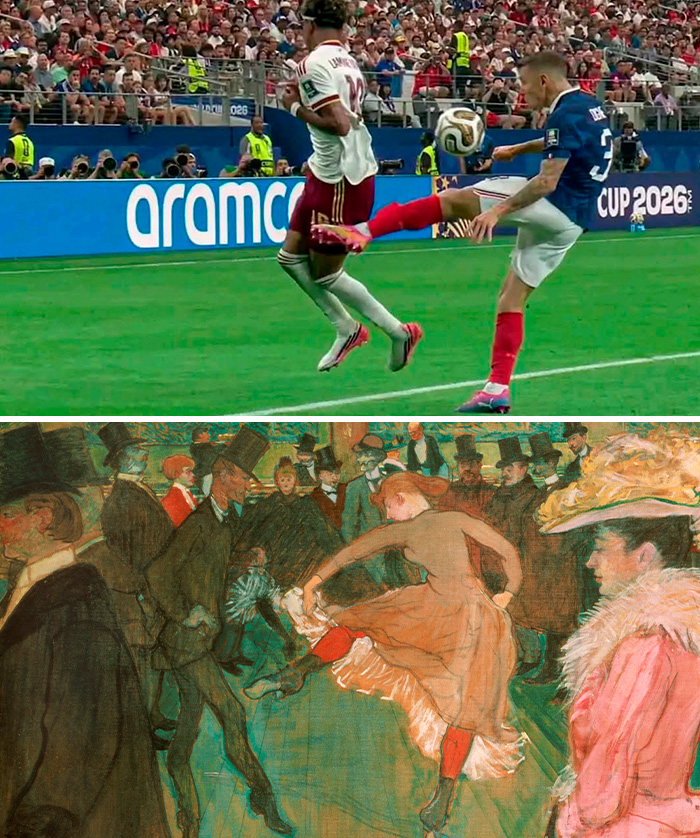
Painted in 1890, At the Moulin Roug, The Dance is one of Henri de Toulouse-Lautrec’s most famous depictions of Paris’ lively nightlife.
The oil painting captures two performers dancing the energetic can-can at the iconic Moulin Rouge cabaret, surrounded by a crowded hall filled with spectators.
The male dancer is believed to be the famous performer Valentin le Désossé, who is shown teaching a new dancer.
Today, a World Cup challenge recreated that same scene.
Rader matched the painting with a photograph of Lamine Yamal and Lucas Digne after a controversial foul during a major international match.
The players’ body positions closely resembled the dancers in Toulouse-Lautrec’s artwork, with Digne’s stretched leg and Yamal’s twisting movement creating a look like the dance scene.
The comparison quickly amused football fans online.
One person wrote, "How do these people make the connection? This is apt."
Another couldn't resist poking fun at the incident, commenting, "Even ArtButMakeItSports knows that was a dive."
Also I heard from NPR: Messi gave Yamal a bath as an infant 😹 it's really true. It's the first time a player of one team is facing off against an opponent they bathed -support NPR, y'all - 😹
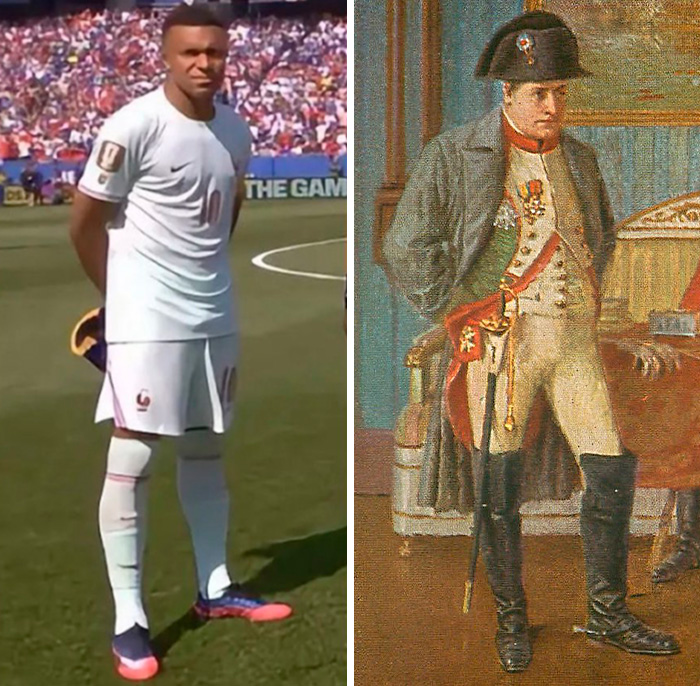
French emperor Napoleon Bonaparte has been the subject of countless paintings, but Emanuel Bachrach- Barée often portrayed him in a more restrained and reflective way rather than in the middle of battle.
In several of his early 20th-century works, the German painter depicted Napoleon standing quietly with his hands behind his back, a pose that became closely associated with the military leader.
That familiar posture surprisingly resurfaced through Kylian Mbappé during the 2026 FIFA World Cup.
A pre-match image of the French captain standing on the pitch with his hands clasped behind his back, body slightly turned, and eyes looking straight ahead resembled Bachrach-Barée's portrait of Napoleon.
The comparison became a favourite among fans.
One joked, "Only one of these two went to Russia and brought a win back to France..." referencing France's 2018 World Cup triumph.
Another simply praised LJ Rader's consistency, writing, "Bro you don't miss! Period."
This is so silly because these are all such normal people poses lol. Yes it's a Sunday and I don't have anything to do, so I guess I'm looking at this on BP 😅😹
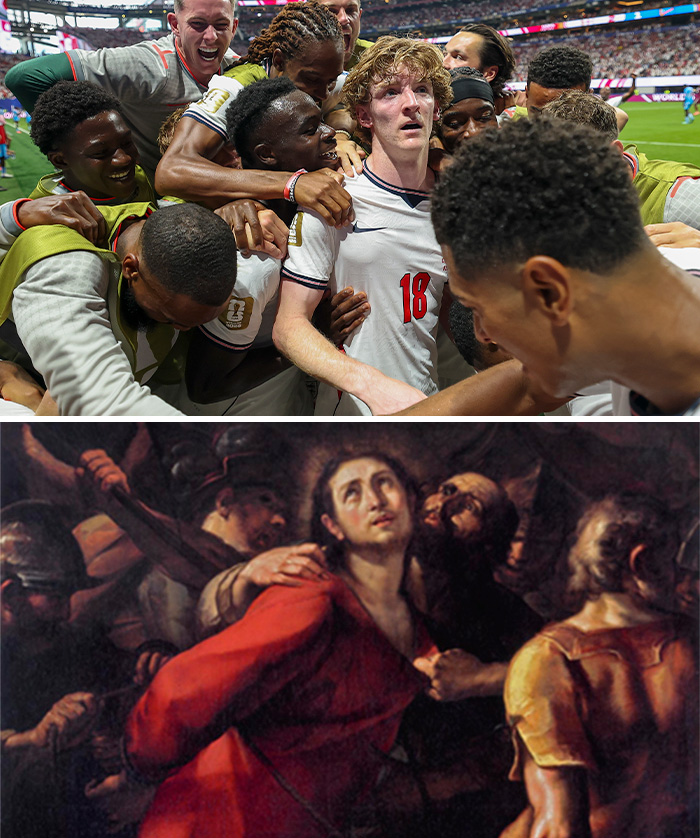
Painted in the 1610s, Giulio Cesare Procaccini’s The Capture of Christ is a powerful example of early Baroque art.
The painting portrays the biblical moment when Jesus is arrested in the Garden of Gethsemane, surrounded by soldiers who close in on him from every direction.
Procaccini used dramatic lighting, tightly packed figures, and strong contrasts between light and shadow to heighten the scene's emotional impact.
A remarkably similar arrangement appeared during an England celebration at the 2026 FIFA World Cup.
In a photograph taken by Steph Chambers, midfielder Anthony Gordon stood in the middle of a crowd of jubilant teammates, including Jude Bellingham.
Gordon’s wide-eyed expression, upward gaze, and central position closely mirrored Christ in Procaccini’s painting.
The comparison also earned plenty of praise online, with one netizen saying, "Absolute fuego, my bro. Pure flames!"
Another applauded Rader’s work, "Every day you outdo yourself."
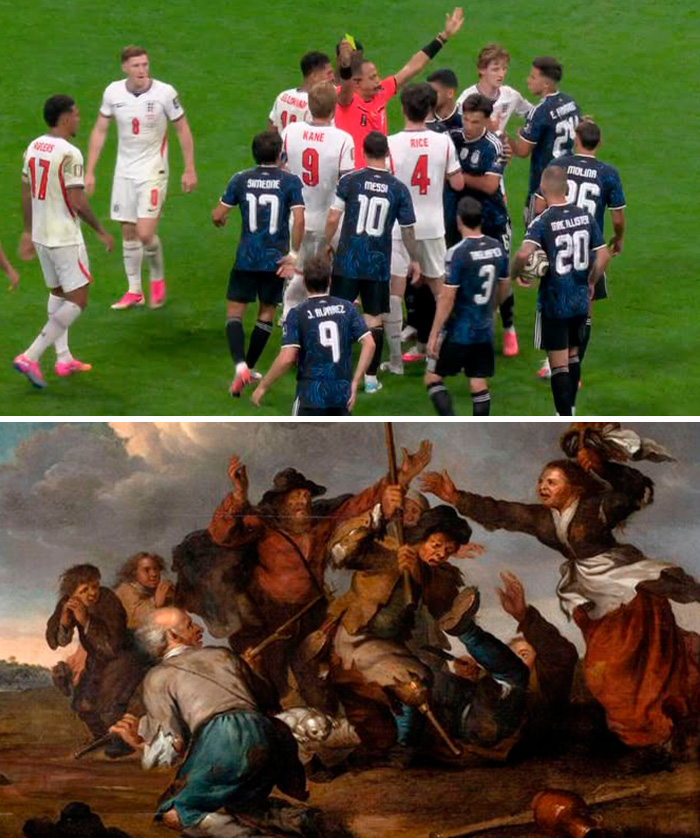
Painted in the 17th century by Dutch artist M.D. Hout, The Battle of the Peasants captured a loud and disorderly fight between villagers.
The oil-on-panel painting is filled with raised arms, flying emotions, and people shouting over one another.
Rather than glorifying violence, Hout used the crowded brawl as a satirical look at everyday disputes and the unpredictable nature of human behaviour.
That same sense of chaos echoed during the World Cup semifinal between Argentina and England.
After tensions boiled over on the pitch, players from both teams surrounded the referee as he held up a yellow card.
With stars including Lionel Messi, Harry Kane, and Declan Rice all crowding around, arms raised and players talking over one another, the scene looked surprisingly similar to Hout’s centuries-old painting.
Instead of villagers arguing in a field, it was football’s biggest names passionately protesting a decision on the world’s biggest stage.
Fans were amazed at how perfectly the two scenes lined up.
One person wrote, "It has to be a tool you use to be so quick and accurate to find the perfect painting every time!! Pretty awesome."
Another joked, "They are not fighting for the ball, they are literally recreating history. Modern art at its finest!"
A third added, "Wow, history really does repeat itself."
Argentina, we English are quite flattered that you're obsessed with us, but you need to a) learn the difference between England and the UK b) stop using football matches to promote your political message and c) either forget about the Falklands or let us know if you want a repeat of 1982 and we'll send the boys round. Also, remember that several of your national team players play for English clubs and are due back at work once the World Cup is over.
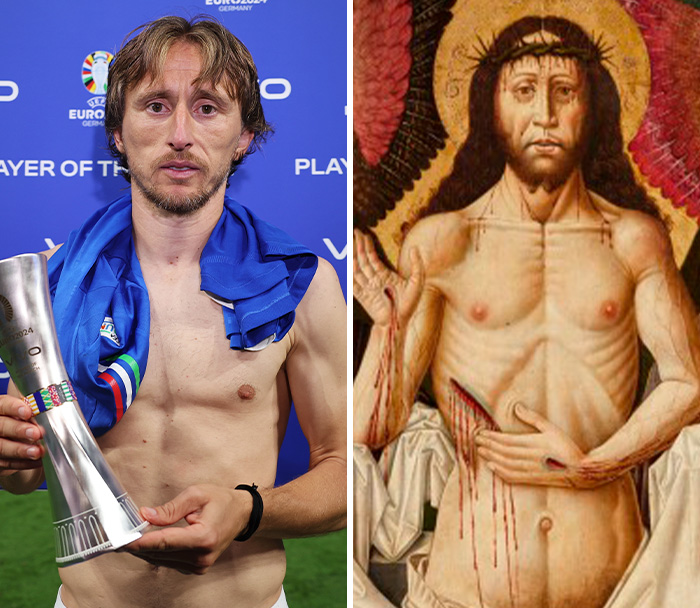
Created in 1475, Christ as the Man of Sorrows is one of the most striking surviving works attributed to the Austrian artist known as the Master of Sankt Kathrein, also called the Master of the Winzendorf D*ath of the Virgin.
The painting portrays Christ after the Crucifixion, seated on his tomb and displaying the wounds of his Passion.
Rather than focusing solely on physical suffering, the artwork emphasises quiet sorrow, exhaustion, and resilience.
Christ’s mournful expression and direct gaze make the painting one of the artist’s most emotionally powerful works.
Those same emotions were reflected in a photograph of Luka Modrić after Croatia’s match at Euro 2024.
Standing shirtless with the Player of the Match trophy in his hands, the Croatian captain appeared visibly emotional.
His weary eyes, solemn expression, and the way he held the trophy closely echoed the pose and mood of the 15th-century painting.
While one image represents religious suffering and the other the emotional toll of elite sport, the resemblance in expression made the comparison remarkably compelling.
The pairing quickly resonated with fans online.
"This account is genuinely increasing my interest in art history," one person commented.
Another joked, "Someone photoshop the trophy on Christ please, it looks like he dropped his."
A third simply wrote, "The accuracy of this one is crazy."
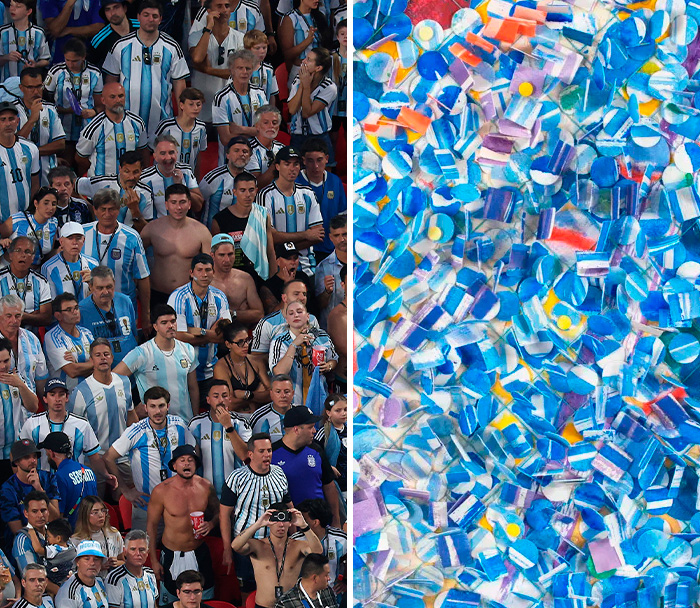
American artist Howardena Pindell is known for creating vibrant abstract collages filled with hundreds of tiny circles, dots, and paper cutouts layered into intricate patterns.
Created in 2010, this untitled work is dominated by shades of blue, white, and yellow, with overlapping shapes that draw the viewers’ eye across the canvas.
That same visual effect surprisingly appeared during the 2026 FIFA World Cup.
Rader paired Pindell’s artwork with a wide photograph of Argentina’s supporters packed tightly inside the stadium.
From a distance, the sea of blue-and-white shirts, flags, hats, and scarves blended together into a colourful mosaic that looked similar to Pindell’s collage.
Fans also loved how accurate the comparison was.
One person wrote, "The painting looks a lot like the crowds at Argentine soccer fields, where you see lots of drums that provide the music for the 90 (or 120) minutes of the match."
Another added, "Howardena Pindell's work in 2010 is honestly hypnotic, perfect pairing with the Argentina match."
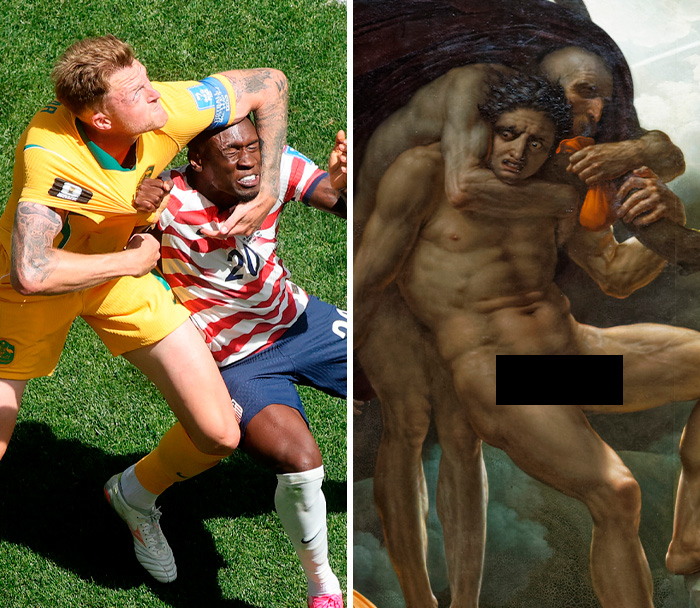
Anne-Louis Girodet’s Scene from a Deluge, first exhibited in 1806, is one of the defining works of early French Romanticism.
Now housed at the Louvre Museum in Paris, the monumental painting depicts a family desperately trying to survive a catastrophic flood.
At its centre, a man struggles to climb onto a rock while carrying his elderly father on his back and reaching for his wife and children below.
Filled with dramatic movements, strained bodies, and raw emotion, the painting captures a desperate fight for survival against the force of nature.
A photograph from the USA vs. Australia match at the 2026 FIFA World Cup surprisingly echoed that same composition.
Taken by photographer Alex Grimm, the image shows an Australian player grabbing an American opponent from behind while both players stretch and twist in opposite directions.
The awkward body position, the arm wrapped around the shoulders, and the intense expressions closely resembled the central figures in Girodet’s masterpiece.
The comparison also amused football fans, with one writing, "Bro forgot that he's playing soccer, not rugby."
In Les Femmes se battent, which means “Women Fighting,” French artist Louis Léopold Boilly captures a chaotic brawl in his 1818 work of art.
The painting sees its subjects frozen in the middle of peak tension, with tempers flaring and bystanders watching the unfolding violence.
A similar kind of chaos was seen on the field during the football match on Sunday, July 19, right after the final whistle was blown at the 2026 World Cup final.
The match ended in an ugly fight after Argentina suffered a 1-0 defeat against Spain and failed to defend their 2022 World Cup title.
Argentina midfielder Leandro Paredes shoved Eric Garcia by the throat and punched him, prompting Spanish midfielder Gavi to step in.
Paredes wrestled Gavi to the ground as the argument escalated.
Gavi’s teammates came to the 21-year-old player’s defense, and Paredes, who had already been shown the yellow card in the game, was given a red card and sent off.
Argentina’s assistant coach, Daniel Ayala, was also seen hitting Spain’s Dani Olmo in footage circulating online.
When Spain lifted the World Cup trophy during the awards ceremony, the Argentinian players refused to watch and turned their backs on the winners.
Joe Hart, the goalkeeper for England, slammed the Argentine team for their “disgusting behavior,” while former England defender Gary Neville called them a “disgrace” following the match.
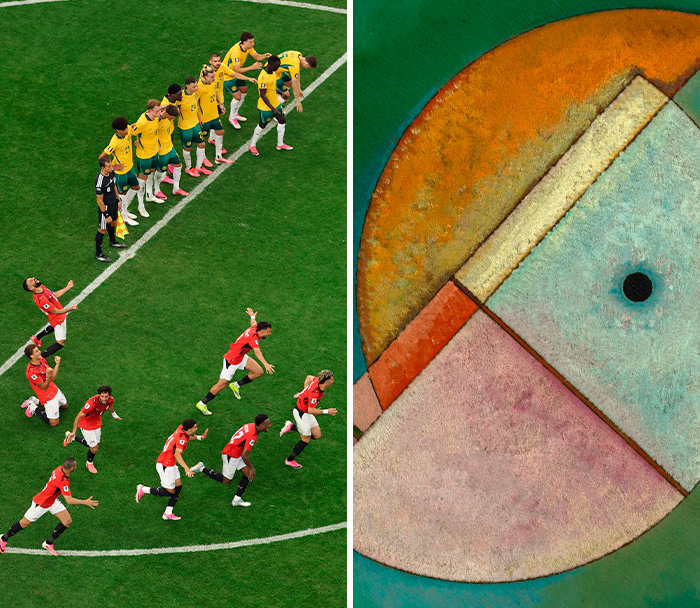
Wassily Kandinsky’s Upwards (Empor) communicates through shapes, colours, and geometry.
Painted in 1929 while the Russian artist was teaching at Germany’s Bauhaus school, the abstract work is built from circles, straight lines, and curved forms that create a powerful sense of movement and rising energy.
Today, the painting is housed in the Peggy Guggenheim Collection in Venice.
That same arrangement of lines and shapes appeared on the football pitch after Egypt knocked Australia out of the 2026 FIFA World Cup in a penalty shootout.
The image from the pitch shows Australia’s players standing shoulder-to-shoulder along the edge of the penalty area while Egypt’s players burst away in celebration.
Viewed from that angle, the white arc of the penalty box, the players’ positions, and the movement across the field mirrored the geometric forms in Kandinsky’s artwork.
The comparison apparently also caught fans’ attention, as one wrote, "Bravo. This is amongst your best.”
However, one wasn’t entirely convinced, writing, "This one is a bit of a reach."
Few paintings capture the warmth of a shared embrace quite like Pierre-Auguste Renoir’s Dance in the Country.
Completed in 1883, the Impressionist masterpiece depicts a couple dancing beneath a chestnut tree, with the woman smiling directly at the viewer while holding an elegant fan.
The painting, which features Renoir’s future wife, Aline Charigot, and his friend, Paul Lhôte, is celebrated for its joyful atmosphere and intimate portrayal of love and companionship.
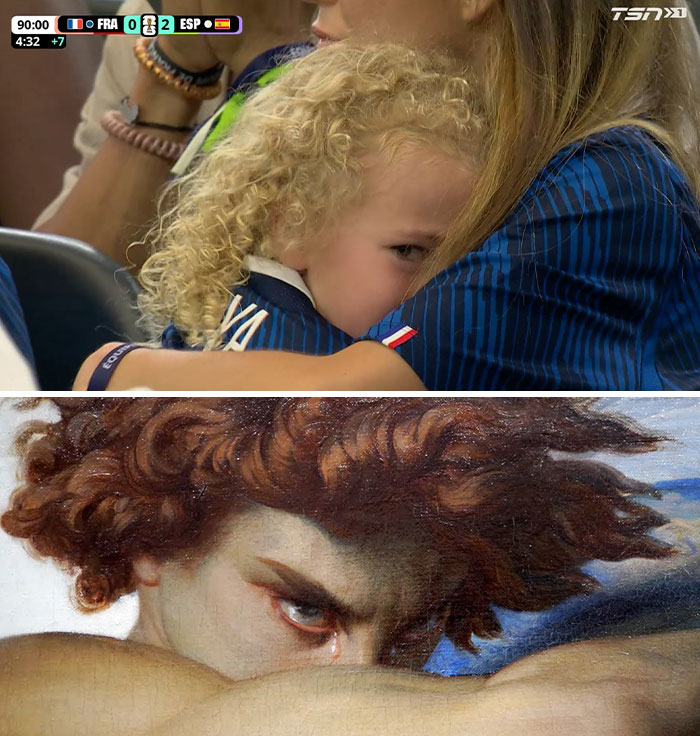
Surprisingly, Rader knew he had found the perfect art pairing the moment Sidny Lopes Cabral sprinted into the stands to hug his girlfriend, Jayley da Cruz, after scoring a dramatic extra-time equalizer for Cape Verde against Argentina.
Regardless of whether or not Cape Verde was going to win that match, that was the image that would summarise that game," said Rader in the interview.
Rader also explained that while there are countless paintings of couples embracing, Renoir’s stood out because Jayley, like the woman in the painting, is looking directly at the viewer.
He also pointed out that the smartphone in Jayley’s hand almost perfectly matched the fan held by Renoir’s subject.
The comparison also became the tournament’s most beloved pairing, with one fan writing, "That is love, needing to hug your partner, more than anything else.”
Another commented, "Bro that flipped Renoir goes hard, love the art crossover."
A third summed it up perfectly, writing, "Life imitating art at the highest level fr. The composition, the emotion, the lighting... an absolute masterpiece."
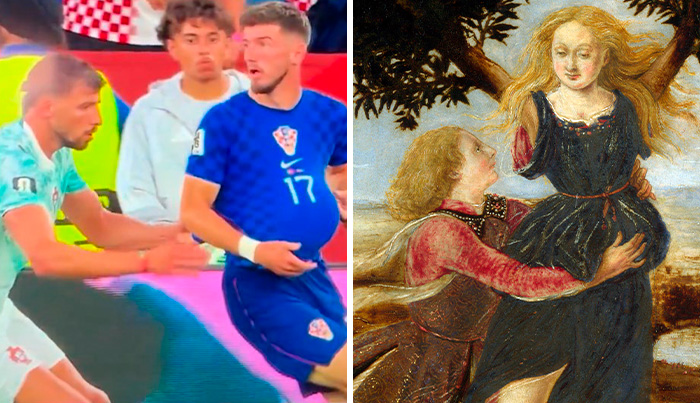
Greek mythology has inspired artists for centuries, and Piero del Pollaiuolo’s Apollo and Daphne is one of the best-known Renaissance depictions of the ancient tale.
Painted around 1470-1480, the artwork captures the dramatic moment when the nymph Daphne begins transforming into a laurel tree to escape the relentless pursuit of the god Apollo.
Based on Ovid’s Metamorphoses, the painting freezes the story at the exact instant before the transformation is complete, with Apollo reaching toward Daphne as she pulls away.
One split-second moment during the Portugal vs Croatia match brought that centuries-old composition back to life in the most unexpected way.
Captured from a perfect broadcast angle, the image created an amusing optical illusion.
Croatia’s No. 17 appeared to have a rounded, pregnant-looking belly, while a Portugal player stretched both hands toward him in a pose that closely resembled Apollo reaching for Daphne.
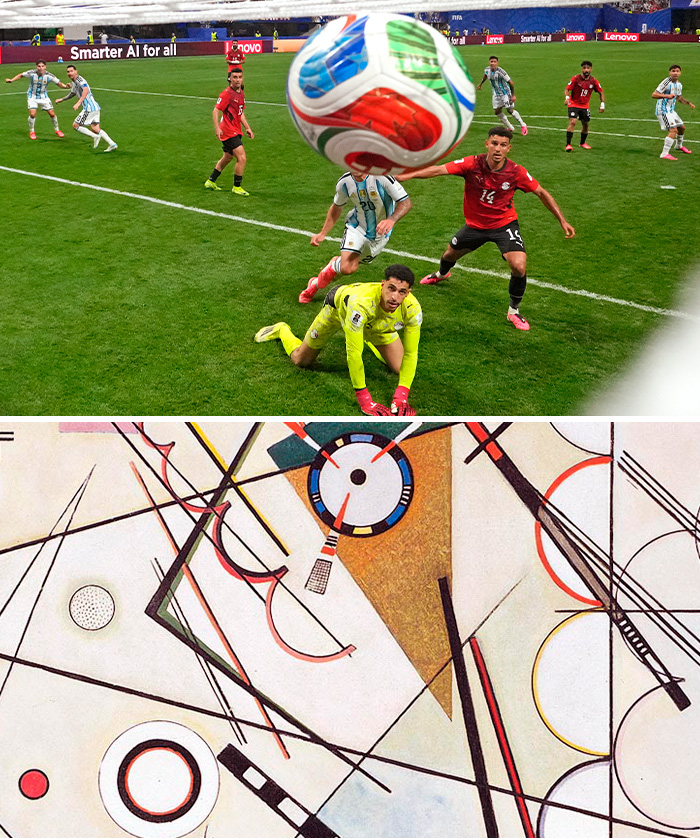
Painted in 1923, Wassily Kandinsky’s Composition VIII is considered one of the defining masterpieces of geometric abstraction.
Created during his years at the Bauhaus, the painting replaces recognisable subjects with circles, triangles, straight lines, and intersecting shapes arranged in a carefully balanced composition.
That philosophy found an echo during the Argentina vs. Egypt match at the 2026 FIFA World Cup.
In a photograph by Elsa Garrison, a ball flying toward the camera dominates the frame while the goalkeeper and surrounding players create a web of diagonal lines and triangular shapes beneath it.
Moreover, the oversized ball mirrors the bold circles that define Kandinsky’s composition, while the players’ positioning and the pitch markings resemble the paintings’ arranged geometric forms.
Even fans were impressed, with one writing, "One of your best pulls yet. Super abstract. Reminds me of the US Hockey pic!"
Another joked, "Looks like the ball finally found its true colours, turns out it's playing in a Kandinsky dream."
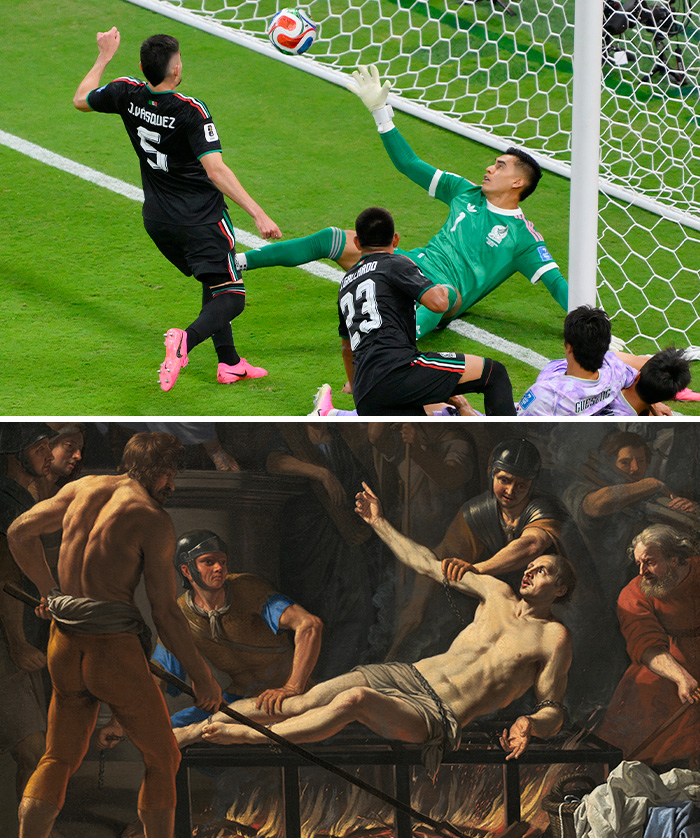
Painted around 1660, Jean-Baptiste de Champaigne’s The Martyrdom of Saint Lawrence depicts the final moment of Saint Lawrence, an early Christian deacon who was sentenced to be executed on a burning gridiron under the Roman Emperor Valerian.
The artist used strong contrasts of light and carefully arranged figures to heighten the tension of the scene.
More than 350 years later, a football moment unexpectedly recreated that same composition.
During Mexico’s World Cup clash with South Korea, goalkeeper Raúl Rangel threw himself backwards across the goal line to make a stunning last-ditch save, while defenders Johan Vásquez and Jesús Gallardo closed in around him.
The goalkeeper’s outstretched body, the positioning of the surrounding players, and the angle of his raised arm closely resembled Saint Lawrence lying across the gridiron as soldiers restrained him in Champaigne’s painting.
Fans also applauded Rader’s eye for visual parallels.
"You always outdo yourself with each new post," one user commented. Another joked, "I'm gonna print this, frame it, and hang it in my living room.”

What the Saint in the original painting is saying, per the legend, was: 'Turn me over, for I am done on this side." Instead of confessing a crime or recanting testimony\ to stop the torment.
German-American painter Hans Hofmann was one of the pioneers of Abstract Expressionism, and his 1952 work Composition, No. V showcases the energetic style he became known for.
Rather than painting recognisable subjects, Hofmann built his compositions with thick layers of colour, sweeping brushstrokes, and bold shapes.
His famous "push and pull" theory used contrasting colours and textures to create movement and depth, making viewers feel the energy within the painting instead of simply observing it.
That same sense of movement appeared during Argentina's Round of 16 clash with Egypt at the 2026 FIFA World Cup.
In an overhead photograph, Leandro Paredes launches into a perfectly timed sliding tackle on Mohamed Salah, stretching one leg toward the ball while twisting his body across the grass.
From above, the white of Argentina's kit, the deep green pitch, the red of Egypt's jersey, and the sweeping motion of the tackle closely resemble the bold colours and flowing forms in Hofmann's abstract painting.
Rather than matching individual figures, the comparison captures the painting's rhythm and kinetic energy.
Followers once again admired Rader's ability to spot a connection where few others could.
"Bro literally never misses," one fan commented. Another simply wrote, "God bless whatever is happening in your head.”
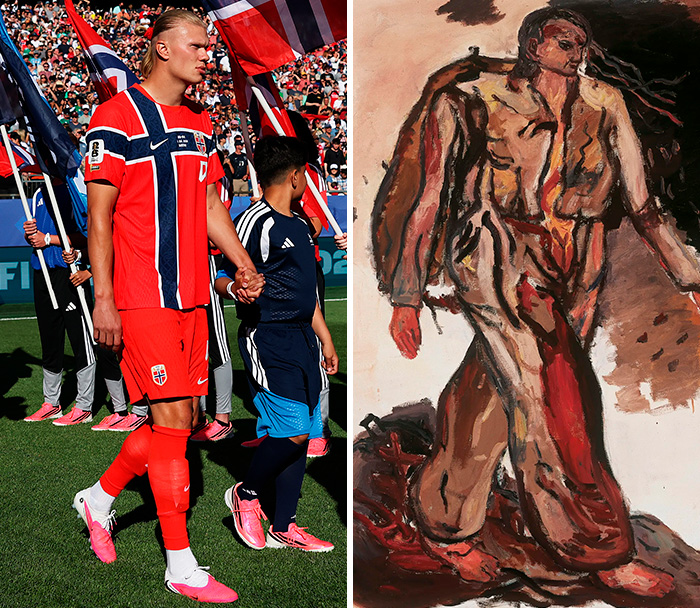
Before Norway's World Cup match got underway, Erling Haaland walked onto the pitch holding hands with a young mascot.
It was an ordinary pre-match moment, but one photograph transformed it into something that looked like it belonged inside an art gallery.
The image was paired with Georg Baselitz's B.J.M.C. (Bonjour Monsieur Courbet), and the resemblance was hard to ignore.
Painted in 1965, the work comes from Baselitz's celebrated Heroes (Die Helden) series, which portrays imposing yet wounded figures wandering through a fractured post-war landscape.
The title references Gustave Courbet's famous The Meeting (Bonjour, Monsieur Courbet), but Baselitz replaced the original scene with distorted forms that reflected uncertainty, resilience, and the changing identity of post-war Germany.
The painting also predates the artist's signature upside-down compositions that later made him internationally famous.
In the comparison, Haaland's towering frame, relaxed stride, and broad shoulders closely echo the solitary figure in Baselitz's painting. Even the red-and-white colours of Norway's kit seem to mirror the expressive streaks of paint running through the artwork.
Fans were just as impressed by the pairing. One user pointed out another detail, writing, "The cross is even on there, crazy.”
Painted in 1933, Composition (Petit univers) by Joan Miró is one of the Spanish Surrealists’ playful abstract works, filled with floating shapes, curved lines, stars, and colourful symbols that seem to exist in their own dreamlike universe.
Rather than depicting reality, Miró used bold forms and movement to create images that encouraged viewers to find their own meanings within the composition.
The abstract found a resemblance in France’s match against Sweden at the 2026 FIFA World Cup, when photographer Morgan Tencza captured Michael Olise attempting an acrobatic bicycle kick.
With his body suspended in mid-air, one leg stretched high toward the ball and the other extended behind him, Olise’s silhouette resonated with one of the abstract figures in the painting.
The pairing left many followers amazed by Rader’s eye for detail.
"Spotting a 1933 Miró in the French squad is actually insane," one person commented. Another admitted, "I wish I could comprehend how your brain works.”

I live about 30 minutes from Seattle, a host city for the FIFA world cup. I didn't attend any games but the excitement in the area was palpable. I work for the Puyallup Tribe, who sponsored the world cup. It was the first time in its history that FIFA partnered with an American Indian tribe. Just wanna share this, because it's awesome

I live about 30 minutes from Seattle, a host city for the FIFA world cup. I didn't attend any games but the excitement in the area was palpable. I work for the Puyallup Tribe, who sponsored the world cup. It was the first time in its history that FIFA partnered with an American Indian tribe. Just wanna share this, because it's awesome





























 No fees, cancel anytime