Get Premium
Dark mode theme is available exclusively for premium users. Learn more about the benefits of subscribing.
No fees, cancel anytime.

 Dark Mode Ad-Free Browsing Unlimited Content
 Ad-Free Browsing Unlimited Content Dark Mode
Join 1.2 million Panda readers who get the best art, memes, and fun stories every week!

We all know not to judge a book by its cover. You can’t possibly know what’s going on inside someone’s mind or body without them telling you, so we certainly shouldn’t make assumptions about someone’s health just by glancing at them. But unfortunately, that doesn’t stop people from doing it!
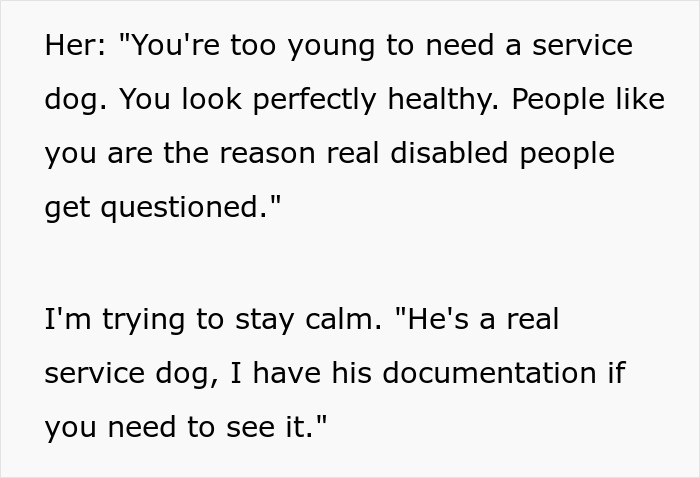
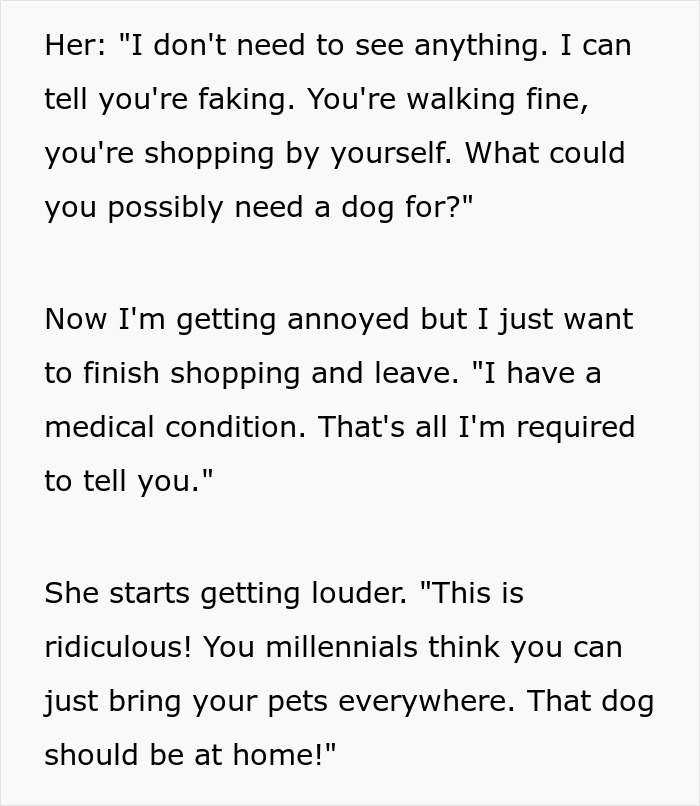
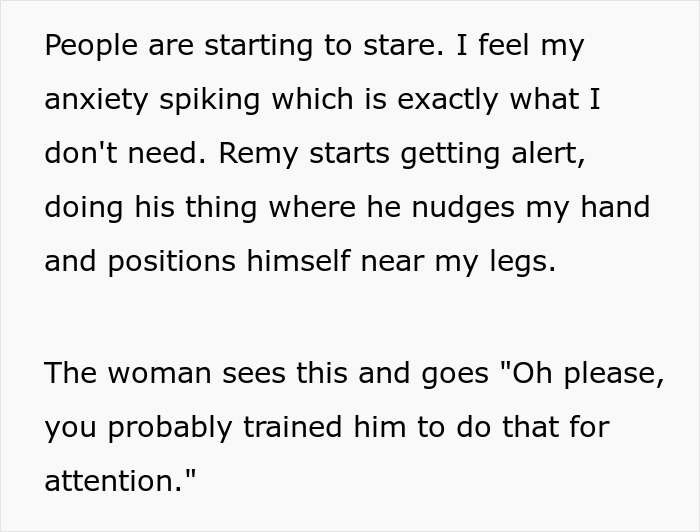
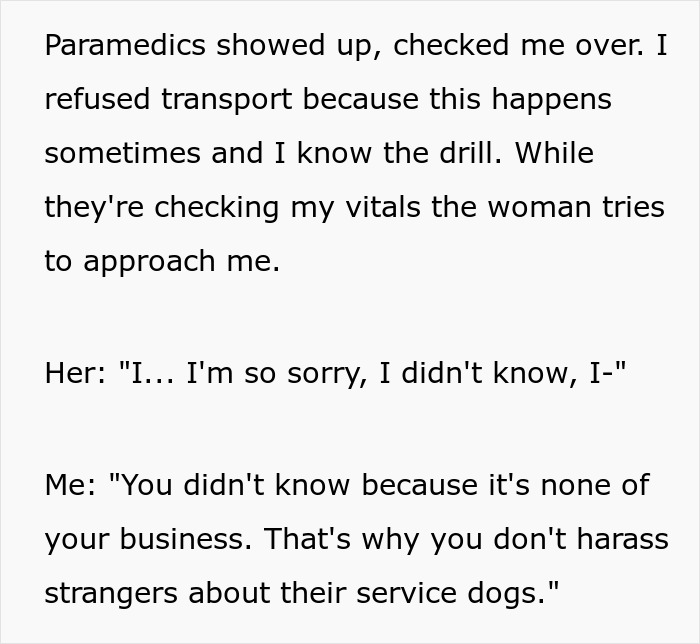
One Redditor recently shared a story online detailing how they encountered a woman at the grocery store who insisted that they couldn’t possibly need a service dog. Below, you’ll find the full story of how that woman learned a valuable lesson that day, as well as some of the replies readers shared.
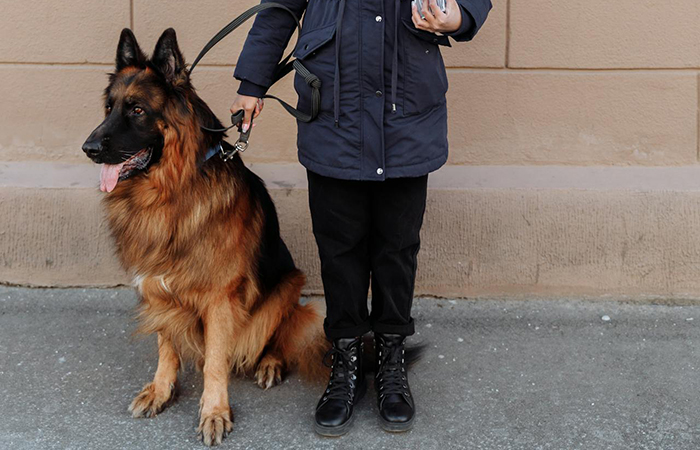
Image credits: guyswhoshoot / envato (not the actual photo)
Image credits: ilonadesperada / envato (not the actual photo)
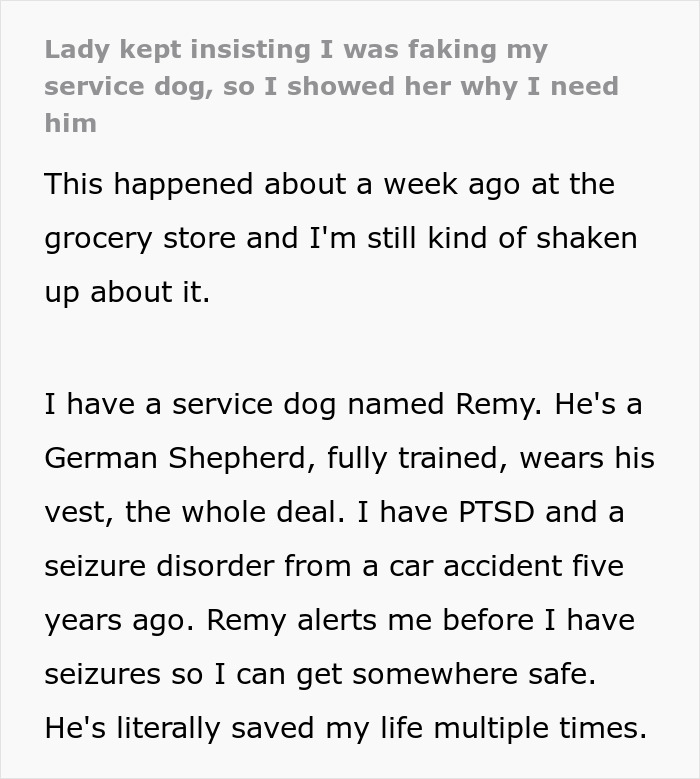
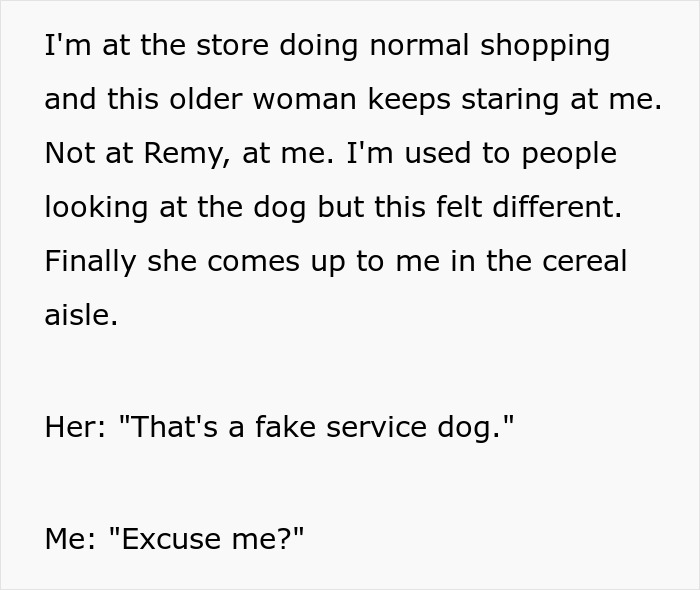
Image credits: CompetitionAsleep468
There are currently over 61 million people in the United States living with disabilities. And contrary to what some people might assume, a significant number of those disabilities are invisible. Just because a person isn’t in a wheelchair or blind does not mean that they can’t benefit from the help of a service dog.
In fact, it’s estimated that there are about 500,000 service dogs working in the U.S. at the moment. These include guide dogs, hearing dogs and general service dogs, which can help with a variety of conditions.
As far as what conditions service dogs can help support, Service Dog Certifications notes that mental conditions such as depression, anxiety, bipolar disorders, schizophrenia, ADHD, PTSD, OCD, dissociative and personality disorders, autism and neurocognitive disorders can all qualify someone for a service dog.
And, of course, physical conditions such as MS, sensory disabilities, dementia, cancer, cerebral palsy, Parkinson’s Disease, arthritis, diabetes, chronic pain, stroke, paralysis, vertigo and more can qualify someone for a service dog.
Now, when someone has a service dog, they are allowed to take them into almost all public places. Whether they’re eating in a restaurant, grocery shopping or walking through the mall, their service animal should be allowed to stay by their side.
Image credits: Thirdman / pexels (not the actual photo)
In some situations, however, a business or government institution may deny entry to a service dog if they will “fundamentally alter the nature of the goods, services, programs, or activities provided to the public,” the ADA explains. For example, if an environment must be kept sterile, it may jeopardize someone’s health to allow an animal into the room.
But if you’re in a public space, and the service animal is well behaved, there is rarely a reason to deny them entry into any area. Some people could definitely use a refresher on service dog etiquette, though. Michigan State University notes on their site that typically, we should just ignore service dogs and let them do their jobs.
Don’t try to pet them, and don’t try to get their attention. At the same time, leave their handler alone as well. Don’t ask the owner about their disability or ask for proof that their dog is in fact a service animal.
And if you own a pet that is not a service animal, don’t ever try to pass them off as one. It can hurt the credibility of actual service animals when people see pets disguised as service dogs behaving poorly.
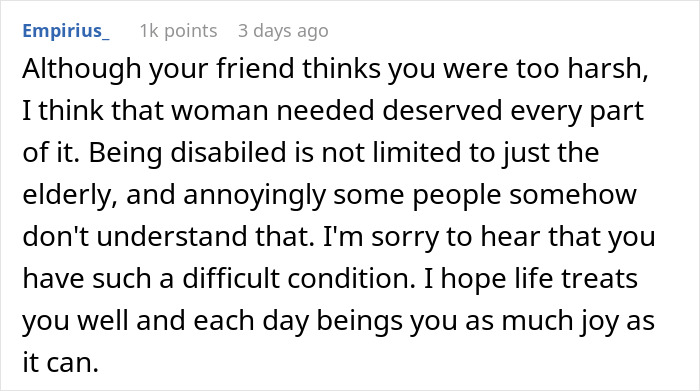
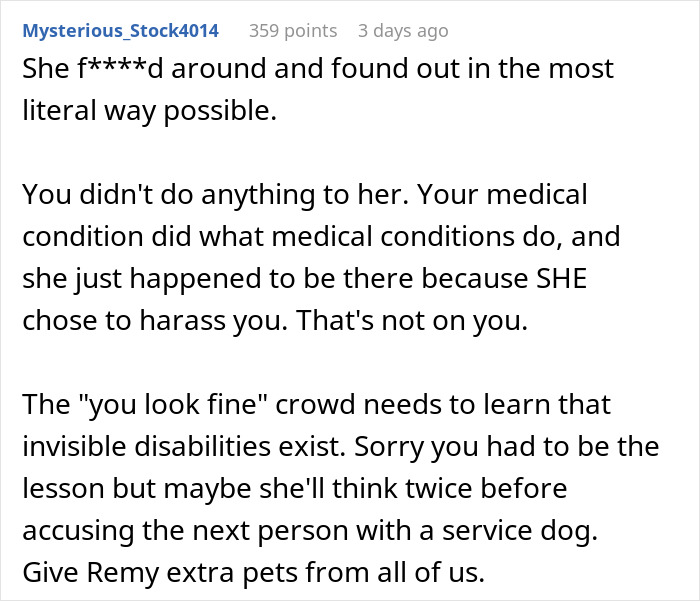
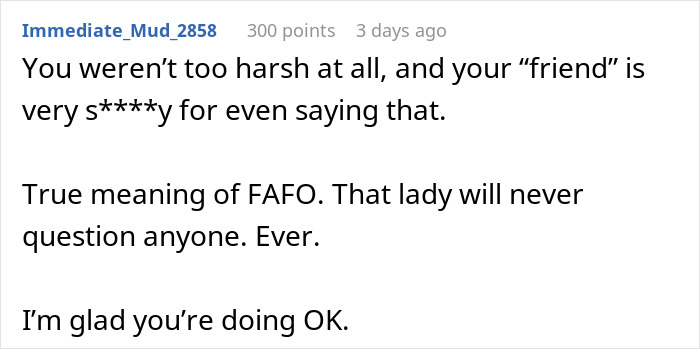
We would love to hear your thoughts on this situation in the comments below, pandas. Do you think the woman in this story learned her lesson after witnessing a seizure right in front of her? Feel free to weigh in. Then, you can find another Bored Panda article discussing similar drama right here.

By entering your email and clicking Subscribe, you're agreeing to let us send you customized marketing messages about us and our advertising partners. You are also agreeing to our Privacy Policy.
Thank you! You've successfully subscribed to newsletters!

Disabilities aren't always visible. My little sister has Chronic Fatigue Syndrome brought on by having Covid. She is 13 years old and outwardly looks perfectly healthy, but some days she struggles with walking and mobility. I was visiting for spring break after not seeing them for a long time, and we went to the grocery store and she came with because she didn't want to be away from me. She used one of the mobility scooters to help her, and she told me how anxious it made her, that she felt like everyone was judging her because she was young and using the mobility scooter. I told her it was none of their business that she was using it, that she did need it if it was helping her, and to ignore them. It hurts me that there will be people like this judging her her whole life. She says kids at school yell at her to walk faster or mock the way she walks- she's actually on half days at school due to her weakness. I really hope something like this never happens to her.

I'd have added "and it's your fault I had the seizure". What a [female dog].

Nope, all dogs are good. She was being an utter d****e. Call it like it is.
Load More Replies...
Too many people take their "emotional support" animals places they don't belong (sometimes wearing fake vests), which makes it tougher to ID the real ones, but you can usually tell by the dog's training and behavior in public. As for this nosy lady, she got the Karen equivalent of a 'Scared Straight' education, so maybe she'll keep her mouth shut next time.

Or just quietly go to the managers if she has a concern. (And she should base that on the dog's behavior, not on the apparent health of the dog's companion. As you say, you can often tell by the dog's behavior.)
Load More Replies... Disabilities aren't always visible. My little sister has Chronic Fatigue Syndrome brought on by having Covid. She is 13 years old and outwardly looks perfectly healthy, but some days she struggles with walking and mobility. I was visiting for spring break after not seeing them for a long time, and we went to the grocery store and she came with because she didn't want to be away from me. She used one of the mobility scooters to help her, and she told me how anxious it made her, that she felt like everyone was judging her because she was young and using the mobility scooter. I told her it was none of their business that she was using it, that she did need it if it was helping her, and to ignore them. It hurts me that there will be people like this judging her her whole life. She says kids at school yell at her to walk faster or mock the way she walks- she's actually on half days at school due to her weakness. I really hope something like this never happens to her.
I'd have added "and it's your fault I had the seizure". What a [female dog].
Nope, all dogs are good. She was being an utter d****e. Call it like it is.
Load More Replies... Too many people take their "emotional support" animals places they don't belong (sometimes wearing fake vests), which makes it tougher to ID the real ones, but you can usually tell by the dog's training and behavior in public. As for this nosy lady, she got the Karen equivalent of a 'Scared Straight' education, so maybe she'll keep her mouth shut next time.
Or just quietly go to the managers if she has a concern. (And she should base that on the dog's behavior, not on the apparent health of the dog's companion. As you say, you can often tell by the dog's behavior.)
Load More Replies...





























 No fees, cancel anytime

























43
34