Get Premium
Dark mode theme is available exclusively for premium users. Learn more about the benefits of subscribing.
No fees, cancel anytime.

 Dark Mode Ad-Free Browsing Unlimited Content
 Ad-Free Browsing Unlimited Content Dark Mode
Join 1.2 million Panda readers who get the best art, memes, and fun stories every week!

Sometimes new management gets the impression that they really should just get to work and shake things up. While the best might have good reasons, more often than not, all this does is bother existing employees and make a mess.
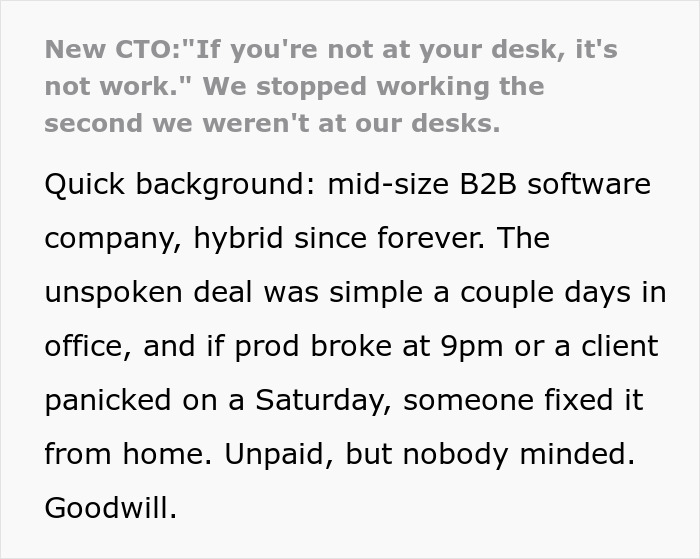
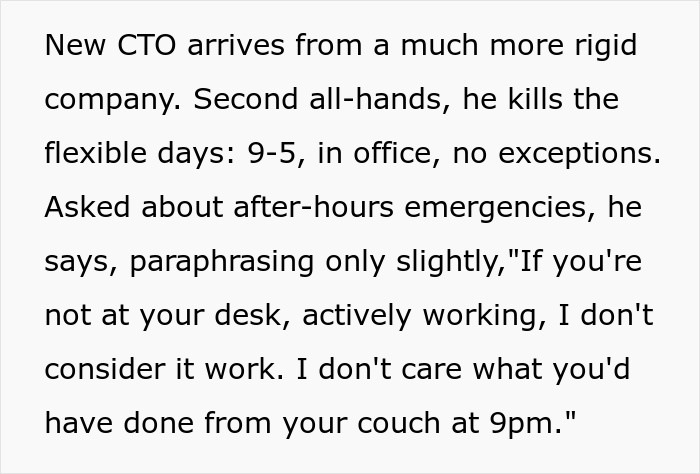
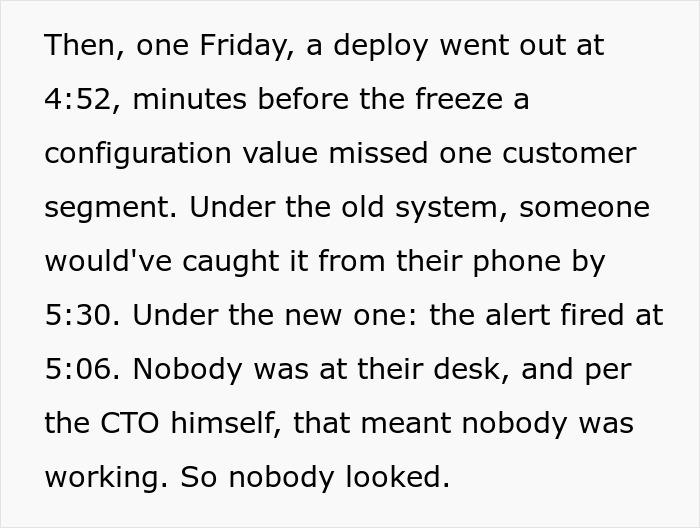
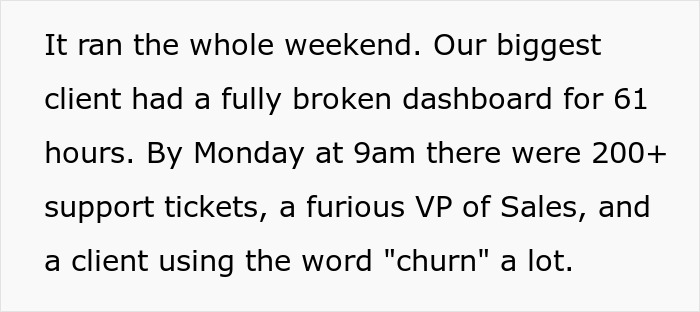
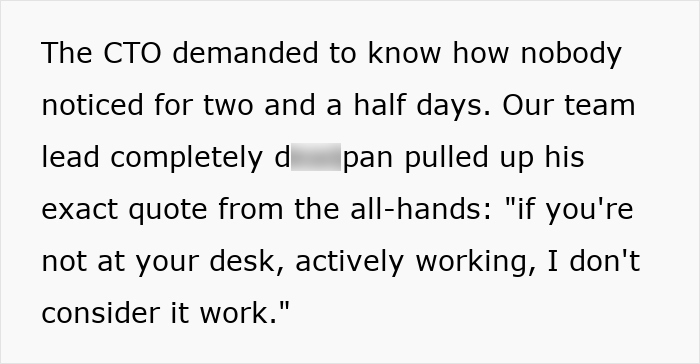
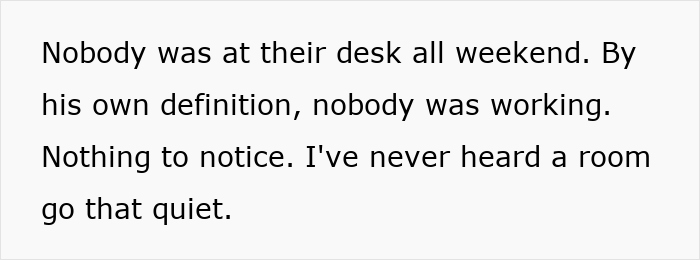
A netizen shared a glorious bit of malicious compliance after a new CTO came in and decided that work from home has to end and that “it’s only work if it’s done from a desk,” without actually thinking about how this might affect stuff that happens outside of a 9-5. The second some software broke after hours, chaos ensued.
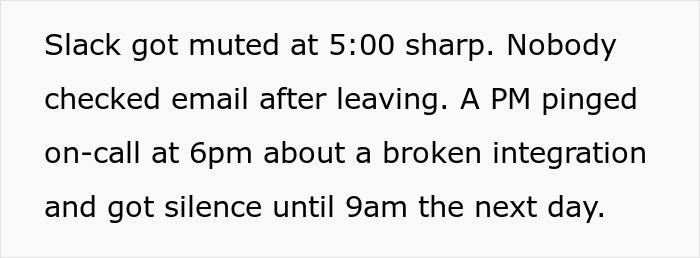

Malicious compliance works precisely because it breaks nothing. It follows the stated rule so exactly that the rule collapses under its own weight, which is why the tactic has a long industrial history well before it became a genre of internet story. Unions have used the same logic for over a century under the name work-to-rule, sometimes called an Italian strike, where employees do no more than the minimum their contract requires and strictly observe time-consuming rules that are normally ignored. Antwerp dockers did it with safety checks. Bus drivers have done it by simply obeying traffic law. Researchers writing in The Conversation have argued that “quiet quitting” is largely the same old method in modern clothing, noting that strict rule-following demonstrates to an employer that the organization cannot function without staff routinely going beyond what their jobs actually require.
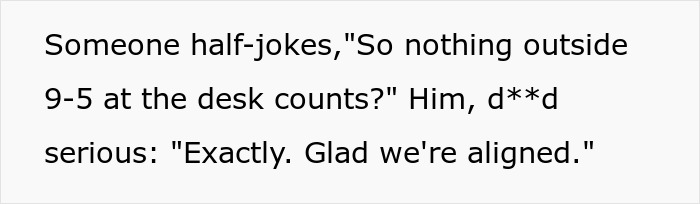
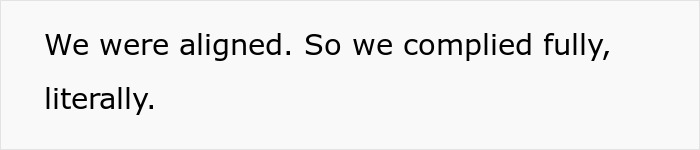
What makes a case like this one land so hard is that the definition came from the top and was said out loud, in front of everyone, in response to a direct question. That turned a throwaway line into policy, and policy is a thing people can be held to. The team did not sabotage anything. They accepted a definition of work and applied it consistently, including on a Friday evening when applying it was expensive.
The reason this is so costly is that most organisations run on labour that no job description mentions. Researchers call it organisational citizenship behaviour, defined as individual behaviour that is discretionary, not directly or explicitly recognised by the formal reward system, and that in aggregate promotes the effective functioning of the organisation. Glancing at an alert from the sofa is a textbook example. It is invisible on every dashboard a manager looks at, it costs the company nothing, and it is quietly load-bearing. When it disappears, nobody can point at the gap until something falls through it.
The withdrawal itself is predictable. Workplace psychology describes the unwritten deal between staff and employer as the psychological contract, and the research on what happens when it is broken is fairly consistent. One review in Frontiers in Psychology summarizes that when people believe promised obligations have not been honored, they commonly reduce both their formal duties and their discretionary contributions in order to restore balance in the exchange. Flexibility was one side of that bargain. Remove it and the goodwill attached to it tends to leave with it, whether or not anyone plans a protest.
So why do capable managers walk into this? Partly because presence is legible and judgement is not. A desk with a person at it can be counted, while a problem that never became an incident produces no evidence at all. Partly because new leaders arrive with a template that worked somewhere else and apply it before learning which local habits are quietly holding things up. The wider evidence is not kind to the instinct. Researchers at the University of Pittsburgh examined S&P 500 firms that imposed return to office mandates and reported that the mandates hurt employee satisfaction without improving firm performance. Writing in MIT Sloan Management Review, Brian Elliott makes the sharper point that falling back on management through monitoring is the weakest form of management available, and that mandates tend to damage engagement and push out high performers.
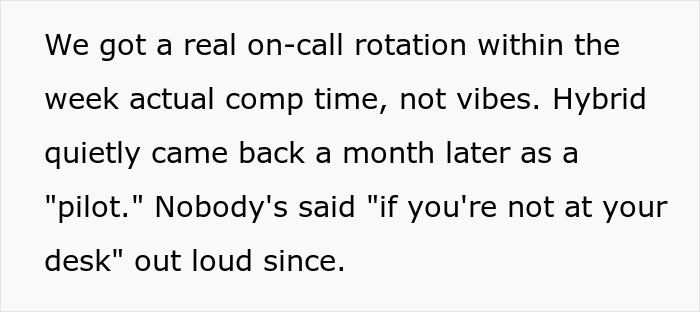
The resolution here is the genuinely interesting part, because it is the correct one. Unpaid goodwill is not a system. It is an accident that has not failed yet. Google’s own site reliability engineering handbook is blunt about this, stating that out of hours support needs adequate compensation, whether as time off in lieu or cash, capped as a proportion of salary. A rota with real compensation makes coverage explicit, distributes it fairly, and puts the cost on the balance sheet where it belongs. The uncomfortable takeaway for anyone managing people is that the favors are the audit. If a policy would collapse the moment everyone followed it exactly, the policy was never really running the place.










By entering your email and clicking Subscribe, you're agreeing to let us send you customized marketing messages about us and our advertising partners. You are also agreeing to our Privacy Policy.
Thank you! You've successfully subscribed to newsletters!

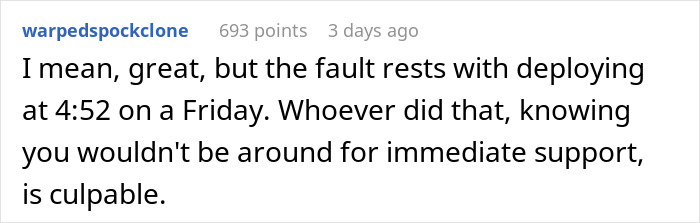
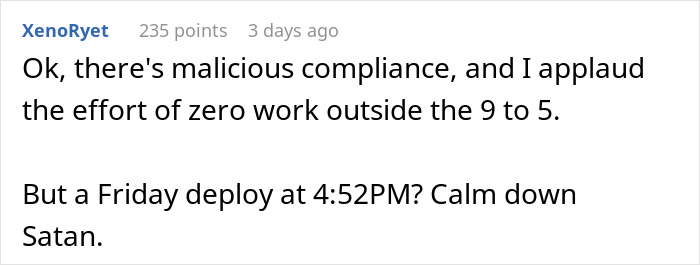
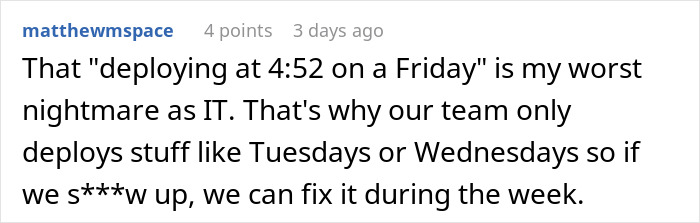
All these people shocked at a 4:52 pm Friday launch surprise me; isn't it typical to launch changes after business hours, when traffic will drop to the lowest point possible? When I worked as a QA tester for a finance company, a team of people worked after hours (paid overtime). At close of business, they'd take all the websites down, I'd confirm that the appropriate "website out of service" screens were up, they'd deploy the updates, then take the websites up, and I'd confirm that they were all working again. (Yes, there was a lot of paid goofing off in the middle for me.) One time there were problems with the launch, and we were there ALL NIGHT while they tried to fix it, and eventually rolled it back to pre-deployment.
THAT SAID, it *was* insane to schedule a roll-out 8 minutes before the point where every employee would clock out. Either the launch was scheduled by a manager who was oblivious to the fact that employees were strictly complying with the CEO's words, or it was scheduled by someone who knew exactly what was going on, and wanted to prove a point.
Load More Replies...
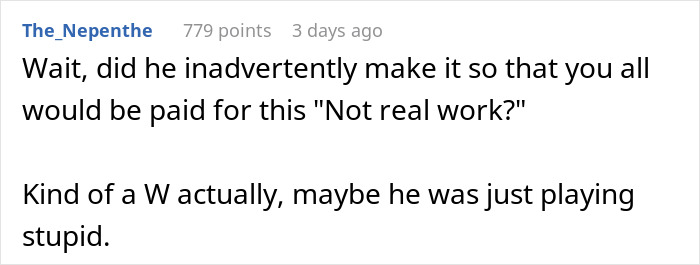
Just a slight this on this could tell a very different story. New CTO come into place; spots that everyone's working loads of unpaid overtime; realises that wage theft is a bad thing, but wouldn't be able to justify the paid overtime; forces a scenario where the lack of the unpaid support causes the company problems; thereby manages to justify a properly-controlled flexible working system where employees are fairly paid for the hours they put it.
All these people shocked at a 4:52 pm Friday launch surprise me; isn't it typical to launch changes after business hours, when traffic will drop to the lowest point possible? When I worked as a QA tester for a finance company, a team of people worked after hours (paid overtime). At close of business, they'd take all the websites down, I'd confirm that the appropriate "website out of service" screens were up, they'd deploy the updates, then take the websites up, and I'd confirm that they were all working again. (Yes, there was a lot of paid goofing off in the middle for me.) One time there were problems with the launch, and we were there ALL NIGHT while they tried to fix it, and eventually rolled it back to pre-deployment.
THAT SAID, it *was* insane to schedule a roll-out 8 minutes before the point where every employee would clock out. Either the launch was scheduled by a manager who was oblivious to the fact that employees were strictly complying with the CEO's words, or it was scheduled by someone who knew exactly what was going on, and wanted to prove a point.
Load More Replies... Just a slight this on this could tell a very different story. New CTO come into place; spots that everyone's working loads of unpaid overtime; realises that wage theft is a bad thing, but wouldn't be able to justify the paid overtime; forces a scenario where the lack of the unpaid support causes the company problems; thereby manages to justify a properly-controlled flexible working system where employees are fairly paid for the hours they put it.







































 No fees, cancel anytime









32
3